Introduction
Dementia is a national and international public health priority. Worldwide, 4.7 million people have dementia, this is projected to triple by 2050. A key goal internationally is to increase early diagnosis and promote optimal management (World Health Organization (WHO; 2016). In the UK, numbers will rise to 1 million by 2025, and at present only 44% are diagnosed (Alzheimer's Society, 2014). Early diagnosis can end uncertainty and promote planning for the future and accessing support (Manthorpe et al., Reference Manthorpe2011; Bunn et al., Reference Bunn2012; Prorok et al., Reference Prorok, Horgan and Seitz2013).
It can take a year before people with memory problems address this with their families, and another 1–2 years before approaching a healthcare professional (Chrisp et al., Reference Chrisp, Thomas, Goddard and Owens2011; Perry-Young et al., Reference Perry-Young, Owen, Kelly and Owens2016). Barriers to diagnosis include stigma, lack of awareness of dementia symptoms, minimization of symptoms, and not knowing help is available or where to seek help (Boise et al., Reference Boise, Morgan, Kaye and Camicioli1999; Vernooj Dassen et al., Reference Vernooij-Dassen2005; Chrisp et al., Reference Chrisp, Thomas, Goddard and Owens2011; Manthorpe et al., Reference Manthorpe2011; Bunn et al., Reference Bunn2012). Furthermore, once referred, patients experience anxiety and uncertainty about their assessment (Manthorpe et al., Reference Manthorpe2011). The National Institute for Health Research (NIHR) (Manthorpe et al., Reference Manthorpe2011) recommends services that provide information about pathways of care, and that patients and carers are involved in producing this information. Others have advocated pre-assessment counseling to explain what the assessment involves (Guss et al., Reference Guss2014).
Information that raises awareness, reduces stigma, outlines the benefits of assessment and diagnosis, and clarifies the assessment process may be beneficial in two ways: It might encourage those with memory problems to seek help. It could also improve the assessment process by informing and empowering patients awaiting assessment.
Videos can effectively communicate information about dementia for older patients (Volandes et al., Reference Volandes2009). Videos of people with dementia can promote innovative, reflective thinking in carers (Hansebo and Kihlgran, Reference Hansebo and Kihlgran2001), and alter perspectives in members of the public (Heward et al., 2015).
This evidence base, combined with international priorities, formed the basis of the development of a patient-centered video as part of a quality improvement project for memory clinics in Oxford Health NHS Foundation Trust (OHNFT).
Our aims were the following.
-
1. To collect feedback from people with dementia, carers, and staff to establish what information should be in a video about the memory clinic.
-
2. To create a patient information video for OHNFT website, using interviews with staff, patients, and carers.
-
3. To collect feedback on the video from staff, patients, and carers and to refine the video based on this.
-
4. To collect further feedback on the final version of the video.
Method
To determine the video content, we approached five patients and seven carers who attended OHNFT memory clinics and were assessed by psychiatrists as able to give informed consent using Mental Capacity Act (2005) criteria. Of this group, five declined and seven participated. All patients and carers gave written informed consent to filming and publication of the video. As this was a quality improvement project, participants were not selected randomly but chosen by memory clinic staff to give a good cross section of people attending the clinic. However, as patients and carers were free to decline, the final cohort was self-selecting as mostly white British older adults.
We identified seven clinicians with experience of working in memory clinics, to obtain their views on themes the video should cover. All helped produce the video, two were filmed. The OHNFT Communications team, as experts in promoting health information, advised on the ideal video format and length of 3–4 minutes.
Discussions with these patients, carers, and staff enabled the identification of “key themes” for the video, for example, the aims of the appointment and support available if diagnosed (See Box 1). This enabled a list of questions to be designed for videoed interviews.
Box 1: Key themes to be included in video, derived from patient, carer, and staff feedback
1. Normalize the experience
E.g. it will be an outpatient appointment (patients and carers described feeling anxious about going to a psychiatric hospital and relieved that the outpatient unit was separate), the aim of the appointment is to provide support, patients with dementia and their carers are not defined by the dementia.
2. Explain practicalities
E.g. parking, what happens on the day, how a diagnosis is made.
3. Demonstrate that support is available
E.g. Dementia advisor and other organisations (Alzheimer's Society, Age U.K.) cited by carers as extremely helpful and that they had not expected this, clinicians are approachable and competent.
4. Promote early stage recognition of dementia to access support
E.g. carers described worries they had “jumped the gun” by pushing their relative to seek help and were reassured to know this was not the case.
Filming took place in an OHNFT memory clinic setting over 3.5 hours. NB and CA interviewed participants using pre-selected questions. Participants were not aware of what they would be asked. This semi-structured approach allowed conversation to develop spontaneously, to elaborate on key themes. Each interview lasted approximately 30 minutes. The material was edited by the Communications team to produce a 4 minute video (YouTube link: https://youtu.be/gRxM7LuCaYY).
Once a “first draft” of the video was created, patients, carers, and staff involved in the creation of the video were able to review and comment on it and all gave informal, verbal feedback. In addition, between March and May 2016, we opportunistically approached ten new patients prior to attending their initial memory clinic assessment, asking them to rate their confidence and understanding of memory clinic immediately before and after watching the video. Nine agreed to participate and one declined. All patients were assessed by memory clinic clinicians as having capacity to consent to give feedback. They provided feedback using a Likert scale from 0–5 and free text comments (see Appendix 1, published as supplementary material online, attached to the electronic version of this paper at http://journals.cambridge.org/ipg). We refined the video content according to this feedback. Finally, we obtained further feedback on the final video from new patients; 11 were approached, two declined. Local governance procedures were followed but formal ethics approval was not sought as this was a quality improvement project informed by patient and staff feedback.
Results
A 4-minute video consisting of unscripted interviews with three patients, four carers, a consultant psychiatrist, and a dementia support worker was created (https://youtu.be/gRxM7LuCaYY). These emphasized the importance of early diagnosis: “It was a relief.. We knew where we stood” (carer), and it was clear that patients were treated with dignity, helping to address stigma: “We were treated as decent, normal human beings” (patient).
Understanding of the assessment process (new memory clinic patients)
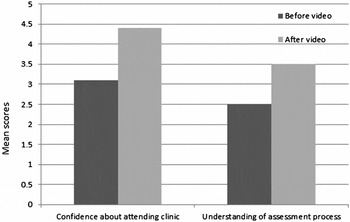
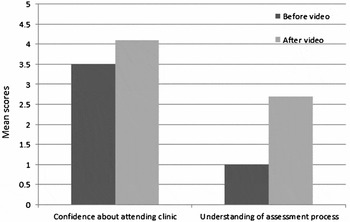
Mean ratings for confidence and understanding increased after watching the first version of the video (see Figure 1). For the final version of the video, there was a further increase in mean scores for confidence and understanding (Figure 2). The improvement in understanding was greater than for the draft version (Figure 1).
Graph showing an increase in mean patient ratings of confidence (N = 9) and understanding (N = 7) after watching the draft version of the video.

Graph showing an increase in mean patient ratings on confidence (N = 9) and understanding (N = 9) after watching the final version of the video.

Qualitative feedback (staff, patients, and carers making the video and new memory clinic patients)
Sound quality was criticized, so subtitles were added. Patients were anxious about memory tests, so information and reassurance about these were added. The inclusion of Alzheimer's Society representative was discussed, however on balance, keeping a short length was prioritized.
Comments from new memory clinic patients (see appendix 2, published as supplementary material online, http://journals.cambridge.org/ipg) about the final video reflected increased confidence: “More interested in coming to the clinic now” and increased understanding: “Understand better the things that are going to happen, it seems a personal service.” Only one of eighteen patients commented negatively: “Video did not particularly add information, or information was not needed.” Five commented positively on relating to patients in the video.
Discussion
We created a patient information video about memory clinics. The content was driven by patient, carer, and staff feedback. The video consisted of patient and carer experiences of the clinic, and information from staff. Links on the webpage clarified how to seek help and further information.
For patients awaiting a memory clinic appointment, feedback showed the video increased confidence and improved understanding about the appointment. Although one comment stated that the video did not add information, this patient already felt well informed prior to watching the video. The majority of comments were positive. This project demonstrates that working with patients and carers can spontaneously yield information that is empowering and reassuring, in line with recent NIHR recommendations (Manthorpe et al., Reference Manthorpe2011). The video was disseminated through OHNFT website and YouTube channel, links were added to all memory clinic correspondence, and promoted to GPs. While older adults show relatively low rates of internet use, this is changing, with the number of users tripling in the last two years (Office of National Statistics, 2016). The widespread use of smartphones by older people and their carers allows video clips to be easily accessed.
One of the strengths of this video was that it gave patients and carers a voice, and feedback about relating positively to patients in the video suggests it may be a tool to reduce stigma and minimization of symptoms and thus improve rates of diagnosis of dementia in line with international priorities (WHO, 2012). The patients and carers reported that they enjoyed being filmed. Two couples met before filming to discuss it and subsequently continued to meet. One couple joined more community activities due to the boost in confidence from making the video. Two carers and a patient attended a meeting of the OHNFT Directors Board meeting to share their experiences of making the video.
We present a description of producing a video about our service, to promote similar initiatives in other services. By its nature, this is a small and exploratory study and conclusions are limited by the small sample size. The possibility that other factors caused the improved scores and positive comments cannot be ruled out. The contact with the healthcare professional showing the video may be enough to reduce anxiety. This seems unlikely however, given that many comments referenced helpful aspects of the video. It was also beyond the scope of this project to get feedback from people who had not been referred but were worried about their memory. Locally, further work will involve continued feedback collection and modification of the video so it remains relevant. Other work could involve more rigorous evaluation of the video's effectiveness, for example, a larger new patient survey with a control group.
Conflict of interest
None.
Description of authors’ roles
Dr Nina Baruch co-designed the video and the study, interviewed patients, carers and staff, collected data and wrote the first draft of the manuscript; Dr Charlotte Allan co-designed the video and the study, interviewed patients, carers and staff, and revised the manuscript; Maureen Cundell co-designed the video, collected data and revised the manuscript; Dr Samuel Clark collected data and revised the manuscript; Dr Brian Murray co-designed the video and the study and revised the manuscript. All authors approved the final manuscript.
Acknowledgments
Oxford Health NHS Foundation Communications team, Dr Rupert McShane Consultant Psychiatrist, Jane Probets Dementia Advisor, and all patients and carers involved in making the video.
Supplementary material
To view supplementary material for this paper, please visit https://doi.org/10.1017/S104161021600209X