1. Introduction
There are several typological distinctions in first-person non-singular pronouns, such as the well-known inclusive-exclusive distinction, in which the pronoun may either include or exclude the hearer (Cysouw Reference Cysouw, Simon and Wiese2002, Helmbrecht Reference Helmbrecht and Duszak2002). This paper discusses a rather different facet of first-person plural pronoun alternations, on the basis of data collected from a contemporary dialect of Yiddish, spoken mainly in Jerusalem by ultra-orthodox Jews. This dialect distinguishes between a specific “we” referring to a particular and clearly defined group, and a generic “we,” which refers to an unspecified group.
2. Sociolinguistic Background
Israeli Haredi Yiddish (IHY) is a minority language spoken by several Jewish ultra-orthodox (Hebrew Haredi) communities in Israel (Isaacs Reference Isaacs1999aReference Isaacsb). All adult speakers of IHY are bilingual, speaking Israeli Hebrew on a daily basis, and also using what they refer to as loshn-koydesh (LK)—literally, Holy Tongue—in specific domains such as prayer and study.Footnote 1 These two varieties of Hebrew (both LK and Israeli Hebrew) serve as the main medium of written language in the com-munity.Footnote 2 As a result, Hebrew is the functionally dominant language in the speech community, since it is used for reading and writing, as well as a spoken language.
The intensive use of Hebrew has a marked effect on spoken IHY. This is evident in the phonological system of IHY, which is practically identical to that of Israeli Hebrew, as well as in the lexicon of IHY, which contains numerous Hebrew borrowings. In addition to the Hebrew influence, IHY is characterized by vast variation in phonology, mor-phology, lexicon, and syntax. It also manifests a great deal of linguistic simplification, such as the loss of case markers and the rise of peri-phrastic constructions.
IHY includes two main dialects, “Hasidic Yiddish” and “Jerusalemite Yiddish,” deriving from geographically distinct European forerunners. Hasidic Yiddish, arguably the most prevalent IHY dialect in Israel, developed mainly from Central Yiddish dialects, and is spoken in Hasidic sects such as Belz, Vizhnitz, Tzanz, and Satmar.Footnote 3 Most of the speakers of Hasidic Yiddish originate from East-European Jews who settled in Israel in the period between the two World Wars and after World War II.
Jerusalemite Yiddish (also called Litvish ‘Lithuanian’ Yiddish) is derived from North Eastern Yiddish, and its speakers include descendants of the Perushim, an ascetic group that left Lithuania at the beginning of the 19th century to settle in the holy cities of Safed and Jerusalem. The speakers of Jerusalemite Yiddish, the “Jerusalemites” (yershláymers, tshálmers), are a distinctive group within the Haredi community. Many belong to small, secluded groups considered kanóim ‘zealots’ because of their religious and ideological radicalism. The extreme ideological and religious stance of the Jerusalemites, combined with the fact that they maintain their own independent system of schools, enabled them to maintain Yiddish as a spoken language in daily use, in spite of the ever-growing pressure of the majority language—Israeli Hebrew.
A third dialect, derived from South Eastern Yiddish, is also found in Haredi neighborhoods. It has few speakers in comparison to the other two dialects, and many of its speakers who belong to one or another Hasidic sect are gradually switching to the prevalent Hasidic dialect, derived from Central Yiddish. Others, associated with the Jerusalemite groups, have adopted many features of Jerusalemite use into their dialect.
IHY dialects in Israel have become markers of communal affiliation, maintaining several salient dialectal features that denote group member-ship.Footnote 4 Speakers of the different dialects live side-by-side in crowded urban neighborhoods, and the intensive contact between them has several interesting outcomes, as is discussed below.
3. The Corpus
The corpus consists of spoken sermons (Hebrew drashót) in IHY delivered mostly in Jerusalem by men and women from different Haredi groups during the years 1991–2005.Footnote 5 The corpus consists of approxi-mately 250 hours of recorded drashót, delivered by over 100 men and women. The sermon-givers (Hebrew darshaním) are considered the most fluent and skilled speakers in the community, and many fill prominent positions in the Haredi educational system. All were born in Israel in the 1950's and 1960's.
4. The Pronoun “We” in Israeli Haredi Yiddish
4.1. Historical Background: The Pronoun “We” in Yiddish
In North Eastern Yiddish, the first-person plural pronoun is mir: mir zogn ‘we say’, mir geyen ‘we go’, with mir the nominative form and undz the form used in all oblique contexts, for example, er zet undz ‘he sees us’. er git undz a bukh ‘he gives us a book’. Other Yiddish dialects contain a variety of combinations of pronouns and verb conjugation. These include forms such as indz zugme(r) ‘we say’, where the historical oblique pro-noun undz (pronounced indz in Central and South Eastern Yiddish) is used as the nominative and precedes the verb, and the verb takes the suffix me(r) rather than -(e)n. Another option is use of the mixed form indz zugn (Herzog Reference Herzog1965:147–149; see Prilutski 1921:14–33 for additional forms).
4.2. Current Variation
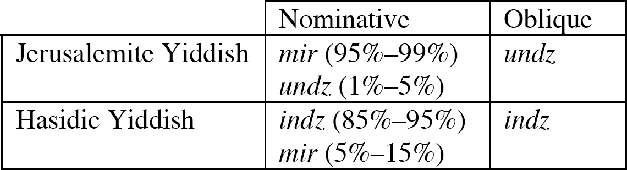
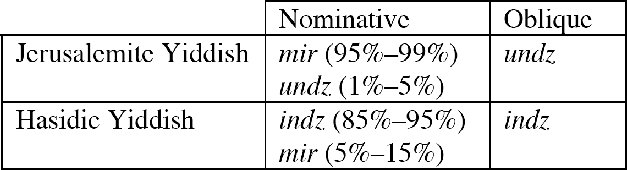
Analysis of the corpus revealed a variation in first-person plural pro-nouns in both dialects, as is seen in table 1.
The distribution of first-person plural pronouns.
In Eastern Europe Yiddish, the usage of first-person plural pronouns differed according to geographical dialectal boundaries, whereas in Israel, as a result of dialect contact, both mir and undz/indz serve in both dialects. However, while Hasidic Yiddish freely alternates between mir gayen, indz gayen, and sometimes indz gaymer ‘we go’ as semantically equivalent variants, this is not the case in Jerusalemite Yiddish.
Speakers of Jerusalemite Yiddish use the widespread variant mir as in mir geyen ‘we go’ as an unmarked pronoun that denotes a generic “we,” equivalent to the Yiddish impersonal pronoun me(n) as in me geyt ‘one goes’ (compare French on, Swedish man). The pronouns mir and me(n) generally appear in the same contexts, often in alternation with one another. The form mir is typically clitic and unstressed. The nominative pronoun undz is rarely used (in only around 1%–5% of all occurrences of nominative first-person plural pronouns in the corpus), and serves to refer to a specific group of people. It may appear as an independent pronoun in cases such as appositional constructions, and is typically stressed. Of the two pronouns, undz is distributionally marked: undz can be replaced by mir, but not the other way around.
5. Examples
Examples 1–3 are taken from a sermon delivered by a leader of one of the Jerusalemite groups. The speaker is a man in his fifties, and the sermon was recorded in 1997.
(1)


(2)
In 1, the pronoun mir denotes a general “we,” which can be replaced by the impersonal me(n). Vos mir zoln ton ‘what we have to do’ is interchangeable with: vos me zol ton ‘what has to be done’. In contrast, in the second example, the pronoun undz refers to the specific group of Haredi non-Zionist Jews.
In 3 (from the same sermon-giver), the speaker recites from the first benediction of the Shema prayer. He quotes from the benediction “he who forms light and creates darkness,” mediating over the rare divine attribute in this benediction “master of the universe” (as opposed to the more common “our God” or “God of Israel”).
(3)
The speaker emphasizes that in this benediction God is praised as master of the universe—a general term of praise that is not specific to the Jewish people. Significantly, the pronouns mir and men (betn mir […] bet men) are used interchangeably, while the pronoun undz refers to the Jewish people.
Examples 4 and 5 are from a sermon delivered by a Jerusalemite woman in 2001. In 4 the speaker uses the pronouns mir and men interchangeably.
(4)
In 5, the same speaker describes a blood libel spread in the 18th century, while making the following general statements about Jews and non-Jews.
(5)
Here the speaker uses the pronoun undz to refer to the Jewish people, as opposed to non-Jews.
Examples 6–9 are taken from a sermon delivered in 1999 by a Jerusalemite woman, a teacher who preaches about motherhood and child education. The pronoun mir in 6 is generic, while the pronoun undz in 7–9 refers to specific groups.
(6)
(7)
(8)
(9)
In 6, the pronoun mir refers to a general “we” and is equivalent to the impersonal me(n) (‘God also knows what we thought at the time = God also knows what one thought at the time’ or ‘what was being thought …’).
The pronoun undz that appears in 7–9 refers to a well-defined group: to women (7), to mothers (8), and to the Haredi Jews (9). In example 8, the pronoun undz appears as an apposition to the noun “mothers,” refer-ring to a specific group of mothers. After this single occurrence, the specification of the mothers’ actions is expressed with the pronoun mir or with the impersonal me(n). This is a common occurrence within the corpus, alongside the usage of undz in appositional constructions.
Although mir is usually clitic while undz is often independent, the distinction between these two pronouns is not grammatical, that is, a distinction between stressed and unstressed pronouns, but rather seman-tic. The pronoun mir may also be independent and stressed, but its meaning remains generic, as in 10.
(10)
In this example, taken from a sermon delivered in 1993 by a Jerusalemite woman, the pronoun mir is a general “we,” opposed to Abraham (and not a specific “we” opposed to another group), that can be replaced by the impersonal me(n) ‘He did not know then what we know now/what is known today’. The same speaker uses the pronoun undz in her sermons only to refer to a specific group of Jerusalemite women.
However, due to the semantic distinction between mir and undz, it is more likely that undz, typically used to refer to a social group (usually in opposition to a different group: us versus them), will generally be stressed.
Examples 11–13 are from a woman belonging to a Jerusalemite group, whose dialect derives from South Eastern Yiddish. The sermon was delivered in 1999.
(11)
(12)
(13)
In 11, the pronoun mir is used as a general “we,” and can be replaced by the impersonal pronoun me(n): mir geyen in gas ‘we walk in the street’ in the sense of me geyt in gas ‘one walks/people walk in the street’. In 12, the stressed pronoun mir does not refer to any specific social group, while in 13, the stressed pronoun indz refers to women, as opposed to men.
Examples 14 and 15 are from a reputed Jerusalemite melámed—a teacher in a khéyder, the traditional Jewish religious school for young boys. In 14, the melámed speaks to other melámdim, and describes the melámed's influence on the disciple's spiritual degree. According to him, the melámed can determine whether the child will grow to be a layman, or whether the child will become a true scholar who devotes his entire time to the study of the Torah.Footnote 6
(14)
Evident again in this example is the generic use of mir, and its inter-changeability with the impersonal me(n). The same melámed is quoted also in 15, in which he is speaking to a group of fathers, and discusses the delicate relations between fathers and melámdim.
(15)
In 15, the melámed speaks as one of the parents (fathers), and not on behalf of the melámdim. He stresses this identification by use of the specific undz, which refers here to the group of parents (fathers), as opposed to the melámdim's group.
The specific/generic distinction entailed by these two terms does not exist in Hasidic Yiddish, as can be seen in 16, taken from a sermon delivered in 1999 by a Hasidic woman.
(16)
6. Discussion
In the sermon corpus, as well as in additional IHY material, speakers of Jerusalemite Yiddish use two different first-person plural pronouns in the nominative—mir used in generic sense and undz with a specific connotation. Note that this distinction is evident in the present study of a specific corpus—the sermons that served as its database. It may be assumed that while undz is always specific, it may occur in other sociolinguistic contexts as well, although possibly with different connotations. In the specific context of the sermons, undz is typically used with an inclusive sense, thus serving to create a sense of intimacy that is vital to establishing a rapport between the sermon-givers and their audience.Footnote 8 In contrast to the sermons, in other contexts undz tends to be used in an exclusive rather than an inclusive sense. The pronoun undz remains specific, but it does not include the addressee, as in the following example, said by a Jerusalemite child to another boy, from a different Haredi group: “undz redn vos, aykh redn vus” ‘We say “vos” [= ‘what’], you say “vus”’—referring to one of the salient phonological features that distinguish the Jerusalemite Yiddish dialect, pronunciation as [o] of the historical vowel [ā] (both of Germanic and Semitic stock), vs. [u/ū] in other Yiddish dialects.Footnote 9 Here, the speaker uses the pronoun undz exclusively, since his addressee is not included in the Jerusalemite speech group, but it is still clearly specific in reference, referring to the specific group of Jerusalemite Yiddish speakers, and thus its basic function as a specific pronoun is maintained.
Unlike the highly specific undz, the pronoun mir is generic, it does not refer to any particular social group, and can usually be replaced by the impersonal pronoun me(n). Over 95% of first-person plural pronouns occurring in the nominative in the corpus of Jerusalemite Yiddish took the form of mir.
In contrast, the pronoun undz/indz necessarily refers to a specific social group, generally as opposed to some other group, to express a relation of “us” vs. “them,” for example: (us) Jews vs. (them) people in general; (us) Haredi Jews vs. (them) non-Haredi Jews; (us) a specific group within the Haredi community vs. (them) other Haredi groups; (us) women vs. (them) men, and so on, most typically in referring to a group belonging to the Haredi inner circle. Of these two pronouns, undz is the more marked: its occurrences are rare, and its distribution limited. The pronoun mir can be used for both meanings, specific and generic, whereas undz cannot refer to a generic “we.”
How and why did such a distinction arise? How did it come about that one pronominal form became specialized among some IHY speakers to refer to a specific social group? In addressing this question, the sociolinguistic context of IHY must be considered. The motivation underlying the introduction of this distinction derives from the importance of group membership and from the influence of the group on the individual in secluded Haredi communities, while the choice of the form “undz” is a result of the contact between Haredi Yiddish dialects in Israel.Footnote 10
The contact between speakers of different IHY dialects resulted in bringing together the two dialectal forms of the nominative first-person plural pronoun: mir and undz/indz. Dialect contact led to dialectal mixing, to the point where not a single speaker in the recorded corpus used exclusively either mir or undz/indz. All speakers used both forms, but with one major difference. Among the speakers of Hasidic Yiddish the forms are in free variation, whereas among speakers of Jerusalemite Yiddish, there is a semantic distinction between the two forms.Footnote 11
Speakers of Jerusalemite Yiddish, who were originally familiar only with the nominative pronoun mir, were exposed to the use of nominative indz/undz as a result of dialect contact in Israel, and this form has gradually penetrated their speech. The rarity of this form may have led to its marked status and semantic specialization in Jerusalemite Yiddish. Another factor in the development of the special meaning attributed to this pronoun may be the key phrase ba und z (compare French chez nous). This phrase is used constantly by members of the speech community in reference to features of their unique group identity. For example, ba undz geyt men a super ‘we wear hats of the brand Super’, said by a Jerusalemite man, referring to hats worn only in his specific group; ba undz makht men azoy ‘we do it this way’, as opposed to the customs of other groups. This very common phrase reflects the essential place of group membership in the individual's identity. Group membership is essential both externally, in comparison to the non-Haredi majority, and internally, compared to other Haredi groups.
Pronominal systems typically reflect basic social functions and distinctions in a given speech community (Mühlhäusler & Harré Reference Mühlhäusler and Ron1990). A particular social situation may play a role in the rise of societal distinctions in use of first-person plural pronouns. Characteristics of such a social situation are the existence of a minority group with a language of its own that is unintelligible to the majority; and/or the minority group feels alienated from the majority group which it perceives as culturally, religiously, or ethnically hostile; and/or the minority group has a unique identity that it seeks to maintain, sometimes by physically or otherwise distancing itself from the majority group.Footnote 12
In the speech community under discussion, Yiddish is unintelligible not only to the majority group, but also to other minorities in its sur-roundings. Moreover, speakers of Haredi Yiddish have a distinct cultural, religious, and sociological identity, which they strive to maintain, going so far as to attribute sanctity to their language (Glinert & Shilhav Reference Glinert and Yosseph1991:78–81).Footnote 13 Moreover, speakers of Haredi Yiddish live in their own secluded homogeneous neighborhoods, and try to achieve minimal con-tact with speakers of the majority language. Not only does the Yiddish speech community seek to differentiate itself from the non-Yiddish speaking majority, it also deliberately highlights differences between groups within the Yiddish speech community.
In the Haredi speech community, group membership is the primary characteristic of one's identity, and the group controls many aspects of the life of the individual. The group determines its members' clothing, thus identifying them as members of that particular group, their education, their place of residence (as they live surrounded by other group members), their choice of a spouse, their ideological and political attitudes, and so forth.
In a community in which group membership is central to the definition of personal identity, the distinctions between “us” and “them” are extremely sharp and clear. Social boundaries are clearly defined, both externally (between Jews and non-Jews, or between Haredi Jews and other Jews) and internally (between different groups within the Haredi community). Gender boundaries also have a great significance in Haredi society, where men and women fulfill traditional gender roles, and spend most of their lives with members of their own gender. These basic social distinctions between different groups are mirrored linguistically by changes in the system of usage of the nominative pronoun undz/indz in Jerusalemite Yiddish.