The world is in a state of serious environmental decline with the plight of climate change, biodiversity loss and environmental degradation (Worldwatch Institute, 2012). There is an increasing realisation that the arts have an important role in influencing beliefs and attitudes towards the environment that may complement legislative or policy tools (Kagan & Kirchberg, Reference Kagan and Kirchberg2008). Mirroring this realisation is interest in incorporating the arts in environmental education, although in Australia and internationally there are relatively few practitioners who use drama as a tool in environmental education (Adcock & Ballantyne, Reference Adcock and Ballantyne2007) and reviews of environmental education typically overlook such use (e.g., Gralton, Sinclair & Purnell, Reference Gralton, Sinclair and Purnell2004; Rickinson, Reference Rickinson2001).
The Australian New South Wales (NSW) Drama curriculum (NSW Board of Studies, 2003) provides opportunities for societal issues, and the environment in particular, to be studied in the drama classroom through performative studies. Accordingly, drama teachers are increasingly using the skills developed in the drama curriculum to tackle broader educational and societal issues (McCammon & McLauchlan, Reference McCammon and McLauchlan2006). The NSW Environmental Education Policy (NSW Department of Education and Training, 2001) provides guidance on incorporating environmental education across the curriculum, not only through science, geography, but also the creative arts. This approach is also reflected nationally (Australian Government, Department of the Environment and Heritage, 2005) and internationally (UNESCO, 2010). Thus, there is a recognised overlap between the approved drama and environmental education curricula, which this article seeks to explore.
The utilisation of drama in environmental education can take many different forms. In ‘theatre-in-education’ (‘demonstration theatre’), professional theatre practitioners develop a work, typically in consultation with experts such as scientists, and perform it to school students (Australia Council for the Arts, 2003; Nicholson, Reference Nicholson2011; O'Toole, Reference O’Toole1976). For example, Wan Smolbag is a theatre group from Vanuatu that travels the Pacific Islands raising awareness about health and environmental issues (http://www.wansmolbag.org/DynamicPages.asp). Other examples are provided by Adcock & Ballantyne (Reference Adcock and Ballantyne2007), and Peleg and Baram-Tsabari (Reference Peleg and Baram-Tsabari2011). A variation on theatre-in-education is where a teacher or performer uses drama or music to enrich the presentation of material. Examples include Ramsey (Reference Ramsey2002), who used folk songs to help educate young people about ecosystem fragility, and the group Morganics, who used hip hop song-writing and performance to engage Indigenous and non-Indigenous young people in issues about health and the environment (Vanclay, Lane, Wills, Coates, & Lucas, Reference Vanclay, Lane, Wills, Coates and Lucas2004). Group-devised theatre (also called ‘play-building’, ‘pedagogical theatre’ or ‘process theatre’) is where the participants develop a piece of theatre (Burton, Reference Burton2011). They may be given a partially developed script and then develop it further, or they may just be given some introductory information to stimulate their imagination. Other ways of using drama in science or environmental education are through historical drama (Begoray & Stinner, Reference Begoray and Stinner2005) and role play and drama simulations of particular phenomena (sometimes called ‘creative drama based instruction’; Appleby, Reference Appleby2005; Cokadar & Yilmaz, Reference Cokadar and Yilmaz2010; Dorion, Reference Dorion2009; Hoot & Foster, Reference Hoot and Foster1993; Metcalfe, Abbott, Bray, Exley, & Wisnia, Reference Metcalfe, Abbott, Bray, Exley and Wisnia1984; Odegaard, Reference Odegaard2003; Özdemir & Üstündag Reference Özdemir and Üstündag2007; Vargas, Reference Vargas1995). Drama can also explore environmental themes when incorporated into large multi-arts performance works; for example, the Long Line event that dealt with ecology, microbiology and human history of Morecambe Bay in the United Kingdom (http://www.welfare-state.org/index.htm).
There is an extensive literature on the positive educational benefits of studying the arts at school (Fiske, Reference Fiske1999; Deasy, Reference Deasy2002), and the arts are recognised as having an important role in ‘transformative learning’ — that is, encouraging a ‘deep structural shift in core thoughts, feelings and activities’ (Ewing, Reference Ewing2010, p. 33). Those who have used the arts in environmental or science education have found that they can:
• increase student interest and allow the ability to make connections between environmental crises and cultural impact (Ramsey, Reference Ramsey2002);
• motivate children to express themselves and engage them on a personal level about ecological concerns (Hoot & Foster, Reference Hoot and Foster1993);
• encourage pluralistic and evaluative thinking (Appleby, Reference Appleby2005);
• assist in discerning patterns and understanding abstract concepts (Cokadar & Yilmaz, Reference Cokadar and Yilmaz2010; Dorion, Reference Dorion2009);
• integrate knowledge (Begoray & Stinner, Reference Begoray and Stinner2005; Odegaard, Reference Odegaard2003), and strengthen the affective dimension of environmental interpretation (Adcock & Ballantyne, Reference Adcock and Ballantyne2007).
As stated by Bergmann (Reference Bergmann1999), the arts can assist the learner to better understand the complexities, interrelatedness and interdependencies of environmental issues, as well as concept formation, value clarification, emotional recognition, self-positioning, embodiment, and moving from despair to positive guiding visions.
According to the environmental sociology and social psychology literature, there are many factors that affect the environmental behaviour of individuals, and the ways these factors interact are complex (Jackson, Reference Jackson2005; Kollmus & Agyeman, Reference Kollmus and Agyeman2002). Models of people's behaviour fall into two categories: ‘internalist’ and ‘externalist’. Internalist perspectives embed the implicit assumption that people act as autonomous agents. In the Theories of Reasoned Action and Planned Behaviour, beliefs and attitudes influence how a person intends to act, which in turn influences how one actually behaves (Jackson, Reference Jackson2005). In Schwartz's Norm Activation Theory, the awareness a person has of the consequences of their actions greatly influences how they behave toward the environment (Jackson, Reference Jackson2005). Other models have built in additional internal factors such as values, personal characteristics, gender, personal experiences, habits, class, family, peer group, tastes and preferences, self-concept, genetic makeup and personality (Kollmus & Agyeman, Reference Kollmus and Agyeman2002). Triandis’ Theory of Interpersonal Behaviour integrates many of these factors into a single model (Jackson, Reference Jackson2005). While these internalist factors can be important in influencing a person's behaviour, people are constrained or influenced by many external forces beyond their control, such as physical structures, institutional factors (e.g., incentives and regulations), situational constraints, and the influence of elites and social norms (Jackson, Reference Jackson2005; Kollmus & Agyeman, Reference Kollmus and Agyeman2002). These external forces can outweigh the internal and consequently there can arise a gap between a person's environmental attitudes and how they end up acting — sometimes called the ‘attitude-action gap’ (Kollmus & Agymen, Reference Kollmus and Agyeman2002).
The environmental sociology and social psychology literature is largely silent on the role of the arts in affecting environmental behaviour. Nonetheless, literature on the impact of the arts on society more generally dates back to Plato and Aristotle, and it has long been recognised that the arts can influence values, beliefs, attitudes, knowledge and awareness of consequences, and the development of a civil society (Belfiore & Bennett, Reference Belfiore and Bennett2006) — the same factors that influence pro-environmental behaviour in citizens (Jackson, Reference Jackson2005; Kollmus & Agyeman, Reference Kollmus and Agyeman2002). There is a significant contemporary arts practice that aims to bring environmental issues to the public's attention and influence many of the factors that affect behaviour (e.g., Kent, Reference Kent2010).
From 2002 to 2007, authors D. Curtis and Reeve collaborated on research that examined how the arts shape environmental behaviour through case study analysis and practitioner interviews of people working in the arts and environment sectors (Curtis, Reference Curtis2007; Reid, Reeve, & Curtis, Reference Reid, Reeve and Curtis2005). A component of that work was an examination of the use of the arts in environmental education, and authors Ryan and Blomfield were interviewed as arts practitioners who performed theatre in schools to enhance environmental education. The environmental education component of the work included a classroom experiment with secondary school drama teacher F. Curtis and internationally recognised climate change scientist Howden that examined the effect of a theatre-based approach to climate change communication (Curtis, Reference Curtis2007). In this article, we have collaborated with two other environmental theatre practitioners (authors Scrine and McColm) to reflect on the lessons we have gleaned from our respective case studies. Our objectives are to assess whether drama is effective in helping people adopt pro-environmental attitudes and behaviour, and what aspects of a drama-based approach may be useful in doing so.
Methodology and Theoretical Underpinnings
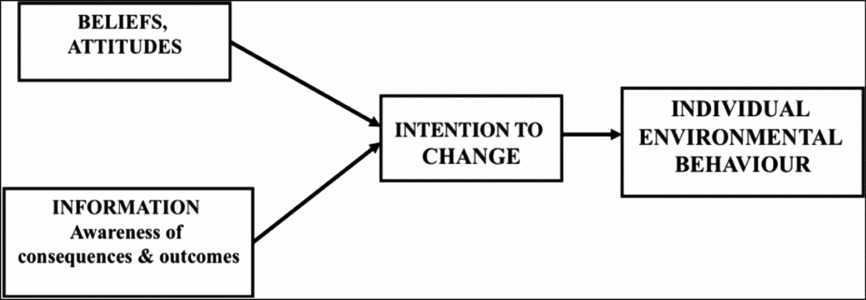
The article draws together results from five case studies. One or more authors were associated as a participant and/or researcher with each case study. The case studies were selected because they illuminated particular effects of drama in an environmental education setting as well as different ways of using drama (theatre-in-education — case studies 1, 2 and 3; play-building — case studies 1 and 5; and a multi-arts performance — case study 4). In addition, the five case studies were selected because, collectively, they provided evidence of the arts affecting some of the key factors that influence environmental behaviour (Figure 1).
Simplified model to explain factors that influence environmental behaviour of individuals, taking elements from Triandis’ Theory of Interpersonal Behaviour and Schwartz's Norm Activation Theory (Jackson, Reference Jackson2005).

To connect our observations with theories that explain why people adopt pro-environmental behaviour we have used a simplified model for environmental behaviour taking elements of Triandis’ Theory of Interpersonal Behaviour and Schwartz's Norm Activation Theory (Jackson, Reference Jackson2005; Figure 1). In this model, knowledge (i.e., awareness of consequences) and attitudes and beliefs influence an intention to change behaviour, and this is an important precursor to actually adopting pro-environmental behaviour. We recognise that this model is necessarily simplistic — a more complete model for the integration of the arts and environmental behaviour is provided by Curtis, Reid, and Reeve (in press).
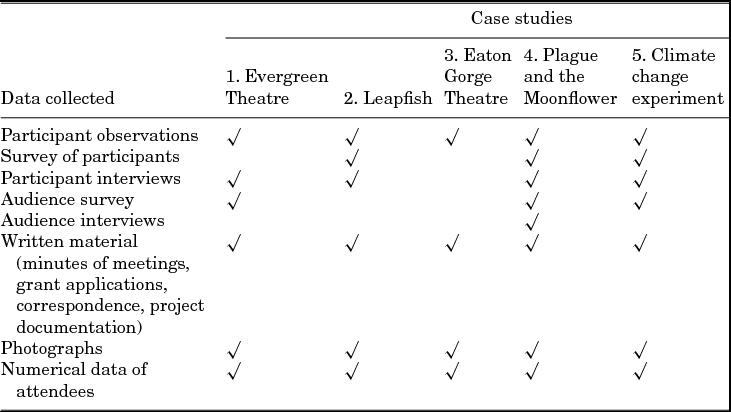
The methods used in these case studies are summarised in Table 1. Quantitative data were collected for case studies 1, 2, 4 and 5 from surveys and questionnaires of audience members and participants. Survey methods and analysis are summarised with the descriptions of individual case studies in the next section. Surveys and interview questions and more details on analyses are available from the authors on request. Additional qualitative data were collected, including participant observations and documentary evidence (all case studies) and informant interviews and focus group interviews (case studies 1, 2, 4 and 5). Analysis of qualitative data followed Neumann (Reference Neumann1997). While considerable qualitative data were collected, for conciseness we have mostly used quantitative data to summarise particular insights and supplemented these with our own participant observations.
Summary of Methods Used in the Case Studies

As a way of connecting the case studies, we drew on narrative inquiry (Clandinin & Connelly, Reference Clandinin and Connelly2000). We recognise that providing five case studies that differ in their methods and level of methodological rigour, instead of a single case study analysed in greater detail, means that we run the risk of reduced reliability in our results. Narrative inquiry allows researchers to construct a coherent story from different types of data (Clandinin & Connelly, Reference Clandinin and Connelly2000). It seemed to us, as researchers and practitioners, that these case studies when seen together, provided a clear narrative. Using narrative inquiry allowed us to combine different types of sociological data to create a coherent story, provide a context for the work, insert ourselves as the researchers into the narrative, and integrate own observations with the findings of other authors to create an overarching thematic analysis.
Before presenting each case study, we briefly describe the context of each case study.
Case Study Contexts
Case study 1: Evergreen Theatre
Evergreen Theatre is based in Calgary, Canada (Evergreen Theatre, 2002). Author Ryan was founding Artistic Director. The company performs across Canada, the United States and Australia, and uses drama to teach scientific and ecological research, basing their material on the Canadian science curriculum. They mostly perform at schools and have created shows on the greenhouse effect (global warming), garbage and recycling, biodiversity, ecology, the water cycle, energy, electricity and other aspects of science. The company uses both theatre-in-education and play-building techniques. The intent of the scripts is to be humorous and playful (making much use of painted foam), and sets are minimalist (usually consisting of an appliquéd cloth backdrop held up with PVC pipe, and transported in a bag). This case study was examined through survey data from the show WINGing It on the physics of flight and how flight is used by animals. The audience of Grade 6 students were surveyed using a set of quizzes designed to test their knowledge of the subject matter in the show. The survey contained questions that tested the subjective and objective knowledge of the student. Students were tested just before the show, immediately after the show, and then 2–3 months later.
Case Study 2: Leapfish
Leapfish is an environmental education company based in Sydney, Australia (www.leap.com.au). Author Blomfield founded the company and is Artistic Director. Leapfish uses theatre-in-education techniques in environmental education projects on themes such as the history of electricity, global warming and the greenhouse effect, water conservation, recycling and ecological footprints. These themes are explored through a combination of circus skills, magic, dramatic narrative and audience participation in performances at festivals, schools, museums and conferences. Leapfish's show Cool Solutions (and its associated workshop) was performed at 13 schools. A survey of participating students and families was undertaken at the beginning of each program and a second approximately 3 months after program completion. The first survey asked a series of questions about patterns of energy or water use in the home and asked families to devise a plan comprising three activities to reduce their energy or water consumption. In a second survey, families recorded their consumption and their utility bill information for the previous 3 months and the bill information for the same time in the previous year. Copies of the survey questionnaires and material associated with the program are available from the authors upon request. A full description of the case study and its analysis is provided in Reeve (Reference Reeve2009).
Case Study 3: Eaton Gorge Theatre Company
Eaton Gorge Theatre Company is based in the Illawarra region of Australia (http://www.egtc.com.au). Authors Scrine and McColm founded the company and are joint Artistic Directors. The company writes and produces plays especially for children relating to environmental issues such as water conservation and climate change. They mostly work with local government to assist in their environmental programs and in schools, and use both theatre-in-education and play-building performance types. The case study of their show on water conservation Tapstar is examined through the participant observations of authors Scine and McColm.
Case Study 4: Plague and the Moonflower
This is an ecological oratorio by Ralph Steadman and Richard Harvey. The community of the Australian rural city, Armidale, staged the work in 2002 (Curtis, Reference Curtis2003), and in 2003 took it to the Woodford Folk Festival and performed as one of its major amphitheatre events (Curtis, Reference Curtis2006, Reference Curtis2010). It involved approximately 300 participants, including orchestra, adult choir, children's choir, dancers, actors and Indigenous performers. The chorale tells the story of the Plague Demon, which represents the side of humanity that destroys the natural environment. The Plague Demon is transformed through his encounter with the Moonflower — a rare plant that grows in submerged Amazonian rainforests and was brought alive by the artist Margaret Mee. Author D. Curtis coordinated and designed the production and author F. Curtis directed and performed in it.
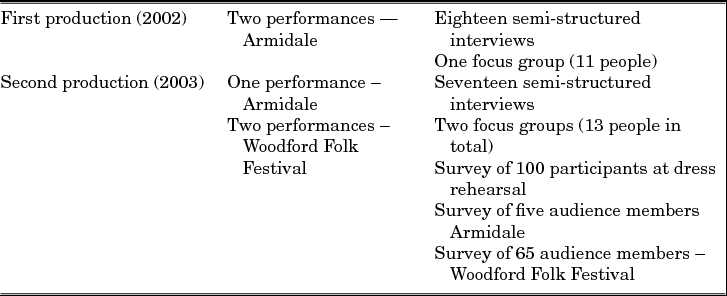
The case study was examined through analysis of survey data and interviews of participants and audience members (Table 2). A full description of the qualitative analysis is provided in Curtis (Reference Curtis2007, Reference Curtis2010) and the quantitative analysis in Curtis (Reference Curtis2007). In the second set of performances (2003), initial hypotheses framed after the first concerts were tested using a standard survey. The participants were surveyed about a week before the first performance (at the dress rehearsal). Questionnaires were distributed to the cast, and 100 were returned. Immediately after the Armidale performance, five audience members filled in a similar questionnaire. At Woodford on the day after each performance, seven volunteers were stationed for 1–2 hours at a location at the festival where many people were passing. They asked people in the crowd on a random basis (roughly every fifth person passing) whether they could fill in the questionnaire, and 65 were completed. Mostly, people filled it in themselves, although some of the volunteers asked the questions and filled in the form. The ages of respondents were grouped into quartiles: under 18, 19–40, 41–50, 51 and over. The survey data were analysed using the SPSS software (SPSS Inc., 2001).
Summary of Performances and Data Collection for Plague And The Moonflower Case Study
Case Study 5: Climate Change Play-Building Experiment
About 240 Grade 9 to 10 Drama students (aged 14–15) were involved, from three schools. Author F. Curtis organised the experiment in one of these schools, and authors D. Curtis and Reeve conducted the experimental aspects and data analysis. Each school group consisted of four classes. One class from each school group received a 40- to 50-minute Powerpoint-assisted scientific presentation on climate change by author Howden. These classes were provided with uniform reading material on climate change that they supplemented with internet research. They then developed a 20- to 30-minute theatre piece summarising or responding to the scientific information. The time for devising the shows was 6–8 weeks, and they were then performed to audiences of secondary school students derived from the remainder of the school group.
Tests containing questions on knowledge and behaviour were conducted before and after exposure to the material. Knowledge was assessed as the percentage of correct answers to 36 multiple-choice questions. Environmental behaviour was scored on the basis of 13 questions about student behaviour on a scale from 1 (where the person had never done the particular pro-environmental behaviour) to 4 (where the person had often done the behaviour). An additional question was asked on what the student planned to do to lower their greenhouse emissions. The questionnaire was pretested to ensure that it was pitched at a level that adequately separated respondents and measured improvement. It was subjected to a discriminator analysis (Kerhoe, Reference Kerhoe2000) to ensure multiple-choice options were evenly balanced and modifications made accordingly. Five groups were tested: (1) audience who only saw the scientific lecture; (2) audience who only saw the performance; (3) audience who saw both the lecture and the performance; (4) a control group that saw neither the lecture nor the performance; and (5) the performers. Complete questionnaire data was compiled from one school (presented here). The first questionnaires (those of the participants) were not labelled with student names in the pretest. This meant that individual student performance for each question could not be traced through time, so an independent samples t test was employed. This problem was rectified for subsequent tests and the more powerful paired t test was employed. For the measure of planned behavioural change, the Wilcoxon signed ranks test was used where a paired sample was available and a chi-squared test was used where it was not. Qualitative data was compiled from all three schools to compare the approaches of the teachers and elucidate participant outcomes.
Data Presentation
Knowledge and Awareness of Consequences
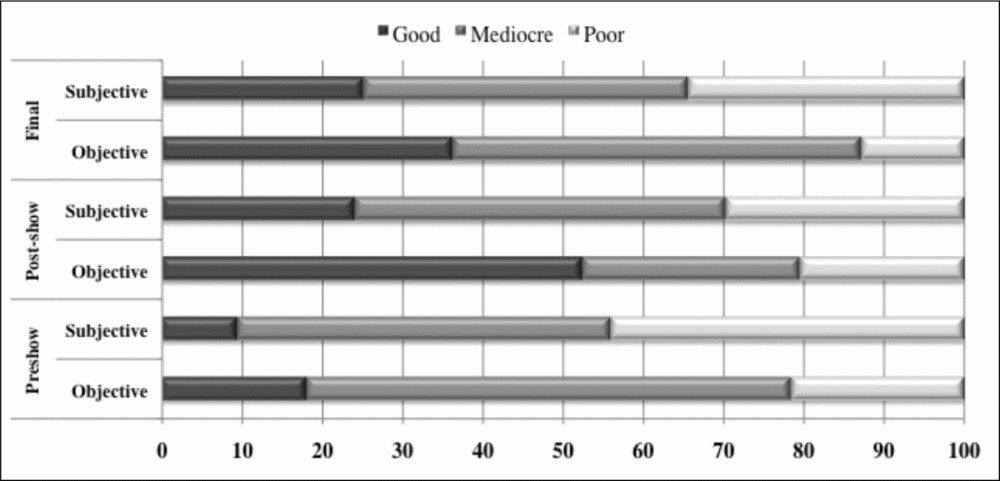
Four case studies provided quantitative and qualitative data on increasing student understanding following drama intervention. Audience surveys of Evergreen Theatre showed increases in understanding by students (Figure 2). Those who achieved good results in the preshow test increased after the show (‘post-show’). For example, the objective tests went from 18% getting good results pre-show to 52% after the show. Two to three months later (‘Final’) there were still 36% of audience members achieving a good score. Poor to mediocre results went down a corresponding amount.
Test data of students who saw the show Physics of Flight and How Flight is Used By Animals, by Evergreen Theatre. The audience were tested immediately before the show, immediately after the show, and then 2–3 months later.
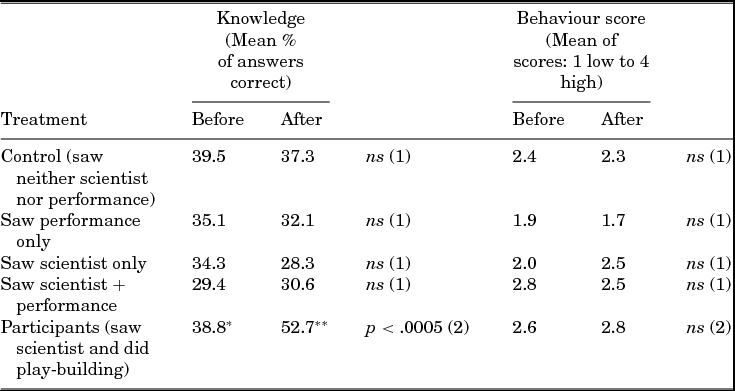
In Plague and the Moonflower, 43% of participants (mostly people under the age of 18) said it allowed them to learn about environmental issues (Curtis, Reference Curtis2006Footnote 1). Eaton Gorge Theatre achieved high recalls on the messages in their water saving play, indicating that their work achieved an increase in awareness. In the play-building experiment, those students who developed a play increased their knowledge more than any of the audience groups, from an average of 39% to 53% of questions answered correctly and this was statistically significant (Table 3; p < .0005, independent samples t test). Thus, the process of developing a piece of theatre enabled these students to significantly improve their knowledge of the science of climate change. This was illustrated when the performance group performed a second time to a local primary school. Following the show, the performers led a question and answer session. It was clear that they had gained considerably in confidence over the material and were able to explain much of the science to the younger students.
Summary of Questionnaire Results for the Different Student Groups Involved in the Climate Change Play-Building Trial
Note: (1) Paired-samples t test; (2) Independent-samples t test; n.s. = not significant. * combination of 2 classes (39 students); **one class only (22 students)
Beliefs and Attitudes
One case study provided quantitative data on an effect of the drama intervention on beliefs and attitudes. In Plague and the Moonflower, 74% of survey respondents (a combination of audience and participants) reported that it made them reflect about humanity's relationship with the natural environment (Curtis, Reference Curtis2006):
[It] inspired me to appreciate [the] beauty of nature and the environment more [and to] appreciate clean air and absence of ‘Plague’ in my environment. It was more appreciation rather than action . . . I guess that appreciation feeds that action. It was an aesthetic appreciation. It's that beauty. . . . To me the whole performance was so beautiful it was inspiring. (Female adult audience member)
Sixty per cent of respondents reported that it made them feel strongly towards the natural environment, while 59% reported that it affirmed their beliefs about humanity's relationship with the environment.
Intention to Change Behaviour
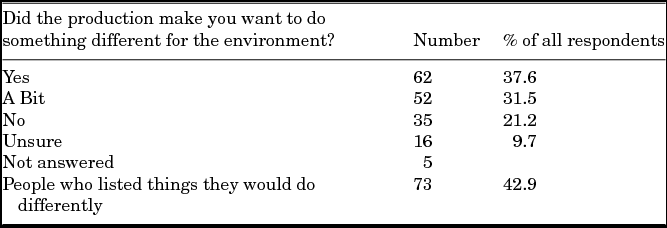
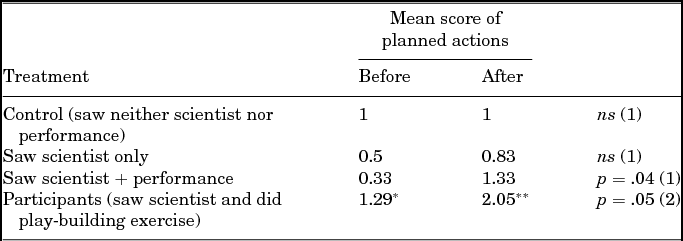
Two case studies provided data on the intentions of audience members to change their behaviour. Sixty-seven per cent of survey respondents said experiencing Plague and the Moonflower made them intend to change their environmental behaviour in some way (Table 4). In the play-building experiment there was a shift in the way students answered ‘What do you plan to do to lower your greenhouse gas emissions?’ The participants in the play-building and the audience members who saw the scientist and the performance in combination were more likely to list actions that they would do differently to any other group, and this was statistically significant (using the independent-samples t test for the participants and the paired-samples t test for audience members — see Table 5).
Effects of Plague and the Moonflower on People's Intention to Change Their Environmental Behaviour
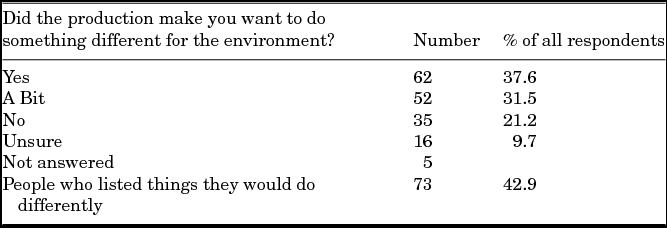
Note: Combined responses for audience members and participants. One hundred participants and 70 audience members were surveyed (170 in total). Percentages are of those who answered (2.9% of respondents did not answer).
The Effect of Attending and Participating a Performance and Attending a Presentation by a Scientist on Student Behaviour
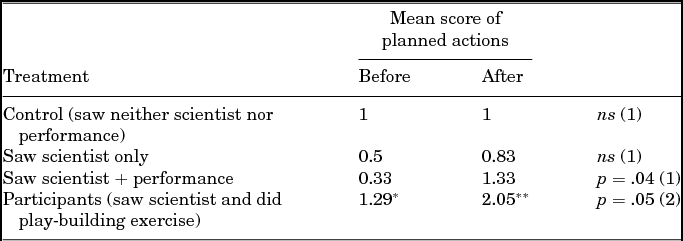
Note: (1) Paired-samples t test; (2) Independent-samples t test. Scoring of planned actions: 0 = do nothing; 1 = seek information; 2 = unspecified action; 3 = one specified action; 4 = two specified actions; 5 = three specified actions; 6 = four specified actions; 7 = five specified actions.*combination of two classes (39 students); **one class only (22 students).
Changes in Environmental Behaviour
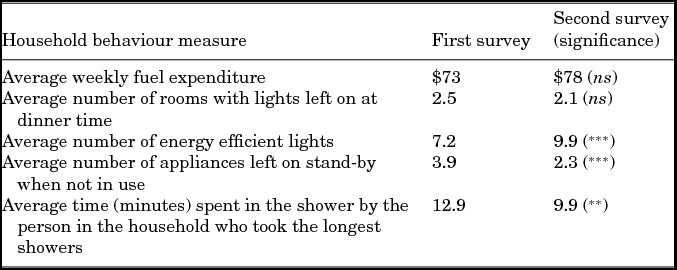
Leapfish's Cool Solutions provided data on actual changes to people's behaviour following a drama intervention. The families of the children exposed to the performance and workshop reduced daily electricity consumption by an average of 16% (Reeve, Reference Reeve2009). There was a 38% increase in the numbers of low energy light bulbs installed, a 23% decrease in the length of showers people were taking and a 41% decrease in the number of appliances left on standby when not in use (Table 6).
Changes in a range of household behaviour measures between the two surveys following Leapfish's show Cool Solutions.
Note: A paired t test was used to test the significance of each change: ns = not significant, *p < .05, **p < .01, ***p < .001.
Following Eaton Gorge Theatre Company's show Tapstar, the water supply agency (Shoalhaven Water) measured a significant reduction in water use across the municipality. Eaton Gorge's performance was part of an award-winning overall social marketing program to reduce water consumption. Work was not done by the agency to separate the effects of the different components of the program. However, in statements made to co-authors Scrine and McColm, the agency considered that the impact of the Tapstar show was significant in its success.
Reasons Why Drama Has Positive Effects in Environmental Education: Connecting Our Findings With the Literature
Taken together, our five case studies demonstrate that incorporating drama into environmental education can have positive effects on each of the key stages of our behavioural model (Figure 1) in building knowledge, changing beliefs and attitudes, and encouraging an intention to change behaviour. According to Kollmus & Agyeman (Reference Kollmus and Agyeman2002), these factors are important in influencing how people act toward the environment and even in actually changing environmental behaviour. In this section, we reflect on why drama may have these effects, referring to our objective results from the previous section, interviews conducted with the practitioner co-authors, and the relevant literature.
Drama Can Be Integrated With Other Activities
Environmental education places considerable emphasis on experiential learning (Stone & Barlow, Reference Stone and Barlow2005). Adcock & Ballantyne (Reference Adcock and Ballantyne2007) concluded that drama is a holistic tool that is useful for addressing serious issues in an engaging, non-confrontational and inspiring manner that gets people thinking. Our case studies confirmed that the characteristics articulated by Adcock and Ballantyne make drama of benefit when integrated with environmental education. The case studies by Leapfish, Evergreen Theatre and Eaton Gorge all successfully integrate performances that are engaging and non-confrontational with experiential learning activities such as workshops. These activities provide their audiences with simple solutions (such as turning off the lights) that they can do immediately. They have found that unless the performance is integrated with an active environmental program it runs the risk of being just entertainment, a problem that has been long recognised in theatre-in-education (O'Toole, Reference O’Toole1976).
Process Drama Combines All Learning Styles
Process drama combines all the learning styles which traditional reading, writing and arithmetic methods of teaching do not (Poston-Anderson, Reference Poston-Anderson2008; Sinclair, Jeanneret & O'Toole, Reference Sinclair, Jeanneret and O’Toole2009). People learn in different ways, whether as audio or visual learners, or symbolics who learn through reading and writing, or kinaesthetic learners who learn through doing. As Adcock and Ballantyne (Reference Adcock and Ballantyne2007) concluded, drama provides a multi-sensory experience that reinforces the interpretive messages. Case studies 1 and 5 demonstrated this aspect of drama. In setting up devised theatre projects, Evergreen Theatre would ensure that students use all learning modalities. Typically, students would do some reading and research in the starting point of their devising. This would tend to be very focused reading because they were conducting research to find creative, dynamic, problem-driven, character-based things that would excite them. They would then typically incorporate other learning modalities such as audio (often through music) and kinaesthetic (through movement). Similar processes were at work in the play-building experiment. We found that devising the piece of theatre was possibly more important than the final performance. While the performance is important to aim for, play-building allows the students to explore and sometimes even redefine themselves and engages the student on many levels. While processing information, they would also create ideas and make original connections.
. . . the thing that makes the process valid is that it engages you on so many different levels . . . you’re processing information, but you’re also processing and creating ideas and making original connections . . . somehow all of a sudden you’re going ‘ha ha’ and suddenly . . . you’ve made a connection . . . that's why scientists are so passionate about what they do because they’ve had to research and explore and do experiments, and that process creates a passion and a connection. . . . So in this case kids are making connections because they take that research material and they are trying to find new ways to make connections based on stories . . . you’ve got the power of the story and the phrenastic connection that kids make, or any humans make, when they have a new idea. (Tara Ryan, interview, November 27, 2002)
Developing a play also allows students to teach a topic by performing for their peers or younger students. This enables them to consolidate their own learning and to act as role models for younger students. If what they do is presented and seen as exciting, younger children can empower the ideas and so the process of interest keeps building. Students engaged in play-building in case studies 1 and 5 did this and affirmed what Madruga and da Silveira (Reference Madruga and Silveira2003) found — that younger children can be effectively taught and motivated by older children through environmentally oriented drama.
A Means of Presenting Scientific Information That Excites Audiences and Creates Fertile Soil for Later Engagement
Researchers who have examined the use of drama in environmental or science education remark on the ability of the drama to excite students (Adcock & Ballantyne, Reference Adcock and Ballantyne2007; Dorion, Reference Dorion2009; Lovett, Reference Lovett2004; McShane, Reference McShane1999). Adcock & Ballantyne (Reference Adcock and Ballantyne2007) concluded that drama has an ability to grab and maintain attention and facilitate the emotional and imaginative engagement of audiences or participants, and that it has broad appeal. As Dorion (Reference Dorion2009) remarked ‘. . . drama-based approaches may be viewed as a potentially rich classroom resource for interactive and imaginative learning’. McShane (Reference McShane1999) and Lovett (Reference Lovett2004) recognised the ability of the arts to provide an empathetic connection to the natural environment and to help in transcending a purely scientific or technocratic approach to natural resources management (NRM). Without the ‘celebration, fun and enjoyment’ that flows from the arts, Lovett argued, fewer people involve themselves in NRM than could be the case. She argued strongly for a broadening of the approach to NRM outreach in Australia to include music, literature and other art forms, as occurs more frequently in Canada.
Our case studies confirmed these observations. In each example, scientific information was synthesised and presented in exciting, creative and multilayered ways:
. . . the reality is, if something better [than drama] came along tomorrow that allowed us to excite, inspire, provoke, engage, new ways of thinking, new ways of seeing the environment, and the issues around that, I’d take it, I’d snap it up in a second. What I strongly believe on a gut level, is that there isn't anything better. (Tara Ryan, interview, November 27, 2002)
Blomfield speaks of drama's ability to find that ‘illogical jump, that totally irrational thing that people didn't think of, that actually brings together or reconciles or integrates into areas of conflict’ (Thor Blomfield, interview, April 14, 2003). He recognises the importance of being a role model to his audience, and finds that theatre is a good way to take his audience on the same journey of discovery that he had made in researching the show.
Providing this engagement resulted (in case studies 1, 2, 4 and 5) in qualitative improvements in understanding scientific issues, as was also found by McFee and Degge (Reference McFee and Degge1980), DeMoss and Morris (Reference DeMoss and Morris2002), and Peleg and Baram-Tsabari (Reference Peleg and Baram-Tsabari2011). From our observations, drama can also provide an interest in audience members that opens them for later engagement in the environment, which they may receive in more formal settings. Despite these kinds of results, we have observed that some scientists do not think using drama is valid as it does not ‘get into graphs or charts’. However, we would argue that if one creates an interest for people, the graphs and charts can follow. If the drama practitioner engages and interests people, a base has been created from which further interest might grow.
One of the major ways that drama can synthesise complex information is through the conversion to stories (Adcock & Ballantyne, Reference Adcock and Ballantyne2007; Vargas, Reference Vargas1995). This tool was used in case studies 1, 2, 3 and 4. The theatre practitioners involved in these case studies have all found that conversion of scientific information into stories helped children to remember information:
I think that because we are a story culture, that is how we remember things . . . that's why we’re addicted to things like TV and movies . . . the beauty of theatre is it's a way of telling stories . . . the mutual powers of the story is that it empowers the concept. So a person may not leave from a show and say ‘gosh, darn it, I understand climate change way better than I ever did before’ but they will leave with a positive feeling and once they have solutions . . . they won't be distracted by a lot of the details around it. . . . There's nothing linear about memory. Memory tends to grab images . . . it often grabs very random things, but we remember those images very clearly and the beauty of theatre is we get a chance to have those pictures imprinted in our minds. (Tara Ryan, interview, November 27, 2002)
Drama varies in its effects depending on the way it is employed. In the play-building experiment (case study 5), the value of play-building in combination with exposure to expert knowledge is demonstrated in the increase of climate change knowledge of the students by 36% (Table 3) and increase in their planned environmental actions by 59% (Table 5). However, audience members in the experiment did not demonstrate that they had learnt much from either exposure to the scientific talk or the performances of the students. A number of things in this trial led to this unsatisfactory result. The questionnaire was not sufficiently coordinated with the scientific presentation. Some student groups (particularly those who saw the show only) did not have enough time to answer the whole test in the pretest, giving rise to many missing values. The performers were not given time to memorise and rehearse the script once it was finalised to ensure that performances were clear and unambiguous before performing it to the audience that was tested. With the repeat performance to a primary school, the show was clearer in intent, subject matter and delivery. The students need to have access to scientific input as they develop their play also. They made common errors, such as mixing up the ozone hole with the greenhouse effect; and the teachers involved, while skilled in drama, all admitted requiring more scientific input in script development. All of these problems could be overcome in repeats of the trial.
Nevertheless, the trial did confirm what practitioners in the performance companies have found: that integration of strong content knowledge with drama can influence both knowledge and behaviours. If the intention is to teach an audience about an issue from a performance, the script needs to be crafted by more skilled practitioners, as was done in case studies 1, 2 and 3 and by Peleg and Baram-Tsabari (Reference Peleg and Baram-Tsabari2011), than a group of teenagers can do from the start over a few lessons. Providing an already partly completed script that covers the relevant science (as Evergreen Theatre does) is one way to get around this problem. However, we have found that there is a difference between demonstration and pedagogical theatre. In demonstration theatre, the aim is interpretation, provocation and stimulation. In an hour-long show, everything cannot be covered in detail. Watching a show does not operate at a deep cognitive level, whereas in pedagogical theatre, a ‘deep learning’, with a slow building up and layering, can take place. However, a combination of the two may have some impact — for example, seeing the scientist and the performance gave a greater percentage increase in response (300%) than seeing the scientist and doing the play-building (59%) (Table 5).
It could be argued that any students who do extra work on a topic will learn more than those who just sit in an audience and are spoken to. This is not in dispute. What the play-building trial showed was that devising theatre pieces is a valuable science education tool for students who were not necessarily science orientated. As the case studies collectively show, drama has many additional advantages, such as making the topic fun and engaging, mentoring younger students, and getting beyond seeing scientific issues as just relevant to the science classroom.
The idea that the arts have an educative function has a long history (Belfiore & Bennett, Reference Belfiore and Bennett2006). Interpretive sociologists suggest that ideas may ultimately influence how people behave and that symbols with shared meanings provide the basis of human communication (Weber, Reference Weber, Gerth and Wright Mills1946; Alexander, Reference Alexander2003). The arts are a potent means of conveying ideas and hence influencing attitudes, and the use of symbols is central to the arts’ role in communication and creating an awareness of consequences of one's actions — a crucial element in some models that aim to explain environmental behaviour (Jackson, Reference Jackson2005). Certainly, our case studies demonstrated theatre's potential to expose the audience to environmental information and ideas (Evergreen Theatre can perform to 75,000 children in a year, Leapfish's Cool Solutions show performed to 4,000 students, Eaton Gorge Theatre Company performs to up to 10,000 children per year, and Plague and the Moonflower performed to over 10,000 people). While attendance numbers do not necessarily indicate improved environmental knowledge, the results from the surveys reported in this article would indicate there is great potential in using drama to improve the environmental knowledge of large groups of people.
Kollmus and Agyeman (Reference Kollmus and Agyeman2002) highlight many social and institutional constraints that can provide barriers to students adopting pro-environmental behaviour, regardless of their attitudes or intentions (the ‘attitude-action gap’). These barriers can include lack of money, lack of time, lack of family support, cultural norms and infrastructure or institutional limitations. Such barriers may impact greatly on young people who experience events such as those described in our case studies and thus hamper their ability or desire to adopt direct pro-environmental actions. Nonetheless, we found that these barriers can be overcome through the careful design of drama-based environmental education activities with low cost actions for the participants to adopt (see Table 6). Kollmus and Agyeman (Reference Kollmus and Agyeman2002) also highlight that an awareness of consequences and pro-environmental attitudes can lead to a person adopting indirect pro-environmental actions, such as donating or supporting an environmental organisation (which can in turn assist in reducing some of the situational constraints to adopting direct pro-environmental actions). This distinction of direct and indirect actions was not explored in these case studies, but could prove to be a fruitful area for future research.
Conclusion
This article consolidates observations from five case studies that incorporated drama into environmental education activities and builds on the work of Adcock and Ballantyne (Reference Adcock and Ballantyne2007), confirming their conclusions. In observing and participating in these case studies, we reflect that drama has several characteristics that make it valuable in environmental education:
• It provides a means of synthesising and presenting scientific information in ways that are creative and multi-layered and which excite students and help maintain their attention and facilitate their emotional engagement.
• It can create fertile conditions for later engagement with environmental or scientific topics that are presented in a more traditional manner.
• Process drama combines all learning styles, which allows deep learning to take place.
• Drama activities can be readily integrated with other activities such as workshops to enrich the educational experience.
To provide a theoretical underpinning of our observations, we related them to social-psychological theories that explain why people adopt pro-environmental behaviour (Jackson, Reference Jackson2005), and to key factors that influence environmental behaviour: knowledge (i.e., awareness of consequences), attitudes and beliefs, and intention to change behaviour (Figure 1). Observations from our five case studies have led us to conclude that drama can be effective in helping people learn about environmental issues and influencing attitudes and beliefs towards the environment. These effects can encourage people to declare an intention to adopt pro-environmental behaviour. Four case studies provided quantitative and qualitative evidence for drama-based activities, leading to an improvement in knowledge about the environment and the consequences of one's actions. One case study provided quantitative evidence that a performance-based approach can influence beliefs and attitudes while two case studies provided quantitative data on a drama-based approach that led to participants signalling they intended to change their behaviour. Another case study led to significant reductions in water and energy consumption among children and their families exposed to environmental theatre and associated workshops.
The trial comparing different ways of exposing students to climate change science revealed interesting interactions between traditional means of providing information and utilising performance methods and begs further exploration.
Author Biographies
David Curtis is Adjunct Research Fellow at the Institute of Rural Futures, University of New England. He has over 30 years of practical and theoretical experience of revegetation, farm forestry, landcare and conservation in rural and urban areas in Australia. His career has included work as a national and regional manager, university lecturer, environmental educator, researcher and policy adviser. His ecological research included a 10-year study into the regeneration and rehabilitation of ecosystems impacted by rural dieback. His trans-disciplinary sociology research examined the role that the arts have in shaping environmental attitudes and behaviours. It found that the arts could significantly affect environmental attitudes through aiding in the communication of environmental information, creating empathy for the natural environment, and catalysing ecological sustainability. He has organised several large community arts events and is founder, and current president, of EcoArts Australis Inc.
Mark Howden is a Chief Research Scientist and Theme Leader with CSIRO, Canberra, Australia and is an Honorary Professor at Melbourne University. Mark's research has focused on the impacts of climate variability and climate change on systems we value and how to adapt to these impacts, addressing: agriculture and food security and the people involved, the natural resource base, ecosystems and biodiversity, energy, water, and urban systems. He has also helped developed the national and international greenhouse gas inventories for the agricultural sector and assessed sustainable methods of reducing these emissions. Mark has worked on these issues for over 25 years in partnership with farmers, farmer groups, catchment groups, industry bodies, agribusiness, urban utilities and various policy agencies. He has been a major contributor to the Intergovernmental Panel on Climate Change (IPCC) 2nd, 3rd, 4th and 5th Assessment reports and various IPCC Special Reports, sharing the 2007 Nobel Peace Prize with other IPCC participants and Al Gore. He sits on the US Federal Advisory Committee for the National Climate Assessment and several other science and policy advisory bodies.
Fran Curtis has a Bachelor of Arts (UNSW) and a Diploma of Education (Sydney Teachers’ College) and is currently Head Teacher of Performing Arts at Wollongong High School of the Performing Arts. She has over 20 years experience teaching Drama in NSW schools. She has also taught Drama Method and held a position as an Adjunct Lecturer in the Faculty of Education, Health and Professional Studies at the University of New England. Fran is also a graduate of NIDA. She completed a Graduate Diploma in Dramatic Art in Voice Studies and has run workshops on voice for students, teachers, lawyers, management students and the tourism industry, as well as private clients.
Ian McColm has been involved in the entertainment industry for the past 25 years as a performer, administrator, director and writer and has performed on stage and screen. He has been trained in improvisational theatre and uses these skills as a trainer for both high school students and adults. He currently teaches at The EGTC Theatre School, Wollongong Performing Arts high school, and the Illawarra Grammar School and works with local disability group Greenacres in their Drama for Recreation and Transition to Work programs. Ian works full time for Eaton Gorge Theatre which is a national touring Company.
Juliet Scrine has worked in radio, film and television, working as an event organiser, drama teacher and actor. With Ian McColm, she founded Eaton Gorge Theatre Company, which specialises in performances with environmental education themes for young people. She has appeared as an actor in film and television in a large number of short films and advertisements, as well as in theatre. Juliet has worked as a Drama teacher with the Disability Trust (actors with disabilities) and the Disability Trust (The Altogether Drama Company), as well as the Youth Performance Group with Roo Theatre and at Wollongong School for the Performing Arts.
Thor Blomfield worked as a performer for over 20 years, co-founding the Legs on the Wall Theatre Company. The company pioneered physical theatre with story-telling and won a Greenroom award and toured the world. Following Legs, Thor founded Leapfish — a not-for-profit environmental education company. Leapfish creates shows, events and installations that combine arts and performance with education. For the past 10 years Leapfish has worked with over 20 local councils, 200 schools and numerous government agencies and communities.
Ian Reeve is an Adjunct Research Fellow and former Senior Group Leader at the Institute for Rural Futures on the campus of the University of New England. Over the past 28 years, he has undertaken applied and contract research at the Institute in fields that include soil science, soil and water conservation, professional, agricultural and adult education, environmental and agricultural policy, and environmental sociology. Recent publications of which he is a co-author include a discourse analytical study of citizen attitudes to wood smoke pollution, landscape futures analysis of climate change impacts on coastal settlements and communities in north eastern New South Wales, and risk analyses of weed spread in Australia.
Tara Ryan. Arts can change the hearts and practices of people, but can they change their day-to-day lives? Tara Ryan struggles with this dilemma in her own life — trying to balance her love of theatre (15 years as the Artistic Director of Evergreen Theatre and 13 seasons developing environmental theatre with parks in Canada) with her passion for working in the wild places throughout North America (seven seasons tripping with horses in the Rockies to almost a decade guiding folks on walking tours with polar bears and swimming with belugas in the northern reaches). For Tara, combining the natural world and theatre is a joy, both in the field and on the stage.