Introduction
Phasmatodea, the stick and leaf insects, is today composed of more than 3000 described phytophagous species that range mostly throughout the tropics and subtropics, and less commonly in the temperate zone. Their fossil record has been thought by some to include a variety of species extending back to the Permian (e.g., Sharov Reference Sharov1971; Gorochov and Rasnitsyn Reference Gorochov and Rasnitsyn2002; Willmann Reference Willmann2003); however, some of these may not belong to the order; all pre-Cenozoic species assignable to the order now appear to be stem-group Phasmatodea, the Susumanioidea, a group that is perhaps paraphyletic with regard to extant Euphasmatodea and Timema Scudder (Tilgner Reference Tilgner2000; Bradler and Buckley Reference Bradler and Buckley2011; Shang et al. Reference Shang, Béthoux and Ren2011; Wang et al. Reference Wang, Béthoux, Bradler, Jacques, Cui and Ren2014). The youngest previously reported stem-group phasmatodeans are from the Paleocene of Alberta, Canada (Kevan and Wighton Reference Kevan and Wighton1981, placed in the Susumanioidea by Gorochov Reference Gorochov2000). Euphasmatodea appears in the early middle Eocene, with a leaf insect (Phylliinae) in the earliest Lutetian at Messel, Germany (Wedmann et al. Reference Wedmann, Bradler and Rust2007). They remain rare in the fossil record after this, appearing, for example, in deposits at Clarno (Oregon, United States of America), Florissant, and in Baltic and Dominican ambers (Tilgner Reference Tilgner2000). The other extant group of Phasmatodea, the Timematodea, with the one extant genus Timema, is reported as a fossil from a single species in late Eocene Baltic amber (Wedmann et al. Reference Wedmann, Bradler and Rust2007).
Here, we report five new specimens from the early Eocene Okanagan Highlands of far-western North America: two from the Klondike Mountain Formation of Republic, Washington, United States of America, which we assign to a new species, and three from McAbee, British Columbia, Canada, belonging to at least two further species. We associate these with the stem-group phasmatodeans, expanding our knowledge of the diversity and temporal range of these enigmatic insects into the early Eocene.
Materials and methods
We examined five specimens in lacustrine shales. Two are isolated forewings from two nearby exposures of the early Eocene (late Ypresian, 49.4±0.5 Ma old: Wolfe et al. Reference Wolfe, Gregory-Wodzicki, Molnar and Mustoe2003) Klondike Mountain Formation in the town of Republic, north-central Washington. The other three are partially to fairly complete, but faintly preserved specimens from the early Eocene (mid-Ypresian, 52.90±0.83 Ma old: Archibald et al. Reference Archibald, Bossert, Greenwood and Farrell2010) locality at McAbee, British Columbia, Canada, almost 300 km northwest of Republic. The McAbee specimens are housed in the collections of Thompson Rivers University (TRU), Kamloops, British Columbia, Canada and The Burke Museum of Natural History and Culture (BM), Seattle, Washington, United States of America; the Republic specimens in the Stonerose Interpretive Center (SR) in Republic, Washington, United States of America. Measurement of most morphology of the McAbee specimens is approximate due to preservation. Ma is the abbreviation of mega-annum, meaning a million years.
McAbee and Republic are part of a series of fossiliferous shale localities collectively known as the Okanagan Highlands, deposited in the latter half of the early Eocene in lake basins scattered across a roughly 1000 km transect from Driftwood Canyon in west-central British Columbia to Republic in the south (Archibald et al. Reference Archibald, Greenwood, Smith, Mathewes and Basinger2011a). McAbee and Republic had mesic, upper microthermal climates with mild, frost-free winters that sustained a forest similar to the modern mixed mesophytic forests of the eastern United States of America, but also contained floral elements that are today extinct, or persist in East Asia or low latitudes (Greenwood et al. Reference Greenwood, Archibald, Mathewes and Moss2005; Moss et al. Reference Moss, Greenwood and Archibald2005; Archibald et al. Reference Archibald, Kehlmaier and Mathewes2014).
We follow the theoretical framework and nomenclature for wing vein identities as employed by Wang et al. (Reference Wang, Béthoux, Bradler, Jacques, Cui and Ren2014), which is discussed therein.

Etymology. The generic name is a combination of Eo-, for Eocene, -pre- and -phasma indicating its identity as a stem-group phasmatodean. Gender is neuter.
Diagnosis. As in the diagnosis of its only species, forewing easily distinguished from all other Phasmatodea by CuA+CuPaα forked with two branches, posterior fused with CuPaβ basally.
Type species. Eoprephasma hichensi Archibald and Bradler, new species here designated.
Description. As for its sole species below.

(Fig. 1)
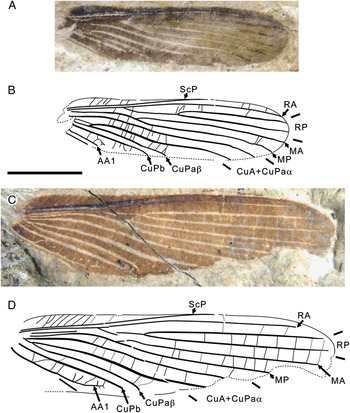
Republic specimens: Eoprephasma hichensi, new species. (A), Photograph of the paratype, SR 93-10-02; (B), drawing of SR 93-10-02; (C), photograph of the holotype, SR 12-004-007; (D), drawing of SR 12-004-007. Scale bar=5 mm.

Type material. Holotype: SR 12-004-007 (part only), a rather complete and well-preserved forewing, missing only a small portion of the distal posterior margin; collected by Keir Hichens at Klondike Mountain Formation Republic exposure B4131, 20 October 2012; housed in the SR collection. Paratype: SR 93-10-02 (part only), a well-preserved and rather complete forewing with only a portion of the basal-most region missing; collected by Michael Spitz at Klondike Mountain Formation Republic exposure A0307, 1 August 1993; housed in the SR collection.
Etymology. The specific epithet is a patronym formed from the surname of Keir Hichens of Seattle, the finder of the holotype, recognising this and his generosity in donating it to the Stonerose Interpretive Center.
Diagnosis. This sole species of Eoprephasma is distinctive by CuA+CuPaα forked with two branches, posterior fused with CuPaβ basally.
Description. Holotype forewing: length 22 mm as preserved, width ∼5.5 mm near mid-wing. Membrane dark throughout; with light, at times wide main veins; with light, narrow crossveins. Costal space expanded in basal quarter, with numerous veinlets, at least one detected branched. Main veins sub-parallel, slightly fanning from base. ScP joins C mid-wing. R branches at about basal quarter, RA rather straight to terminus in distal wing; RP with two branches, diverging mid-wing. M branching to MA, MP just distad RP origin. CuA+CuPaα with two branches. Posterior branch of CuA+CuPaα fused with CuPaβ basally, briefly. CuPb simple, basal-most portion not preserved. AA1 rather straight, terminating on margin in basal quarter. Possible (poor preservation) portion of unidentified vein posterior to AA1. Wing basad-posteriad not preserved. Numerous crossveins throughout.
Paratype forewing: As for holotype, except: smaller, length ∼15.5 mm as preserved, width ∼4 mm mid-wing; greater portions of basal-most area missing.

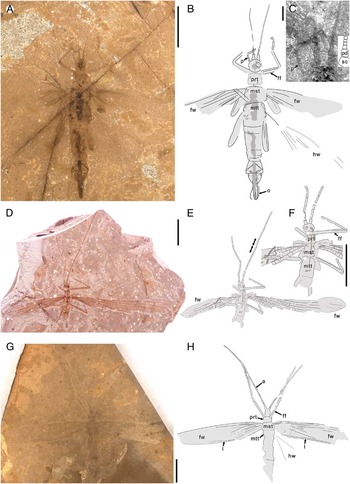
McAbee specimens. (A), Photograph of F-846; (B), drawing of F-846/951 (part+counterpart), distal portion of forewings indicated by light colouration grades to indistinguishable, apical boundaries depicted here are approximate; (C), close-up photograph of head of the part (F-846); (D), photograph of PB-3825; (E), drawing of PB-3825 (double-headed arrows indicate flagellomeres measured); (F), close-up drawing of PB-3825 body; (G), photograph of F-1392; (H), drawing of F-1392/1393 (part+counterpart). Darker areas in F-846/951 appears to mostly represent gut contents (as seen in specimens drawn by Ren Reference Ren1997: figures 1 and 4) but also some places of more heavily sclerotised integument (e.g., the ovipositor); in PB-3825 this appears to represent external colour patterning. Abbreviations: a, antenna; ff, foreleg femur; fw, forewing; hw, hind wing; l, leg (middle or hind); mst, mesothorax; mtt, metathorax; o, ovipositor, concealed by the operculum; p, palp; pd, pedicel; prt, prothorax; sc, scape. Scale bar for A, B and D–H is 1 cm and for C is 1 mm.

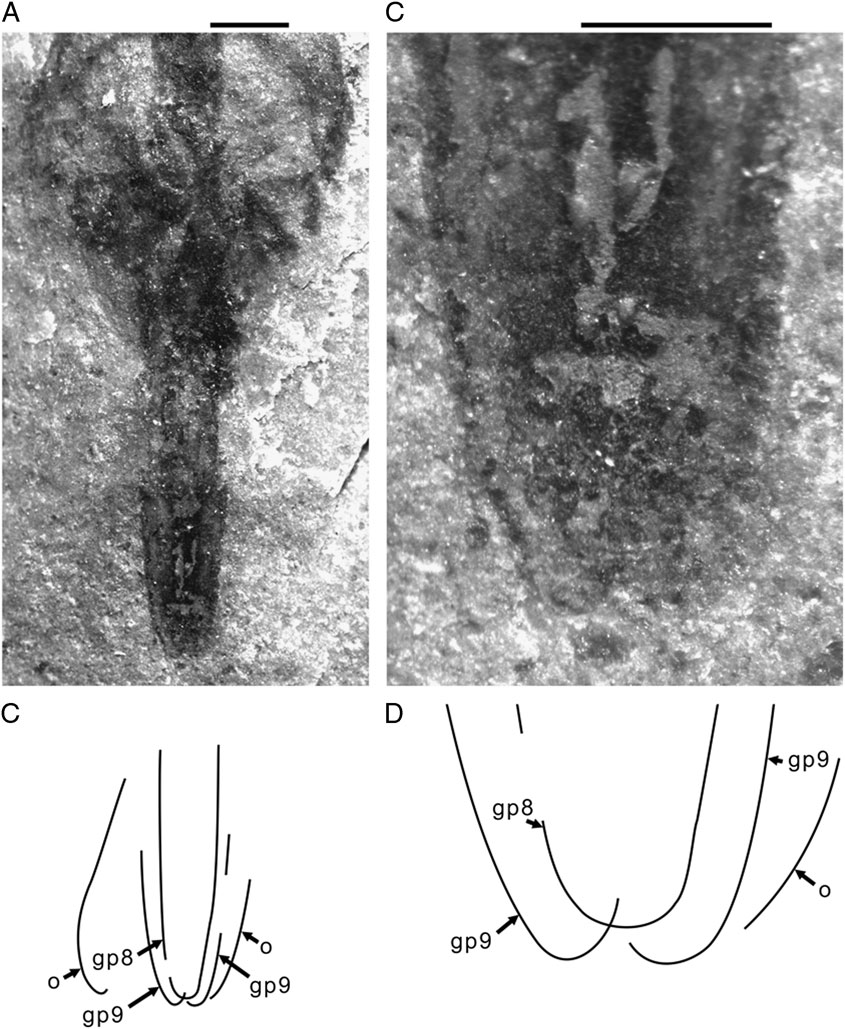
Close-up of F-951 terminalia: photographs (A, C) and drawings (B, D) showing two pairs of gonapophyses (gp) (=valves) and the operculum (o), displaced on the left (as depicted here: left and right is relative to part and counterpart of the fossil). Scale bar=2 mm.
Material. F-846 (part), and F-951 (counterpart): a rather complete, but faintly preserved insect in dorsal aspect with mostly indistinct wings; housed in the TRU collection.
Description. Phasmatodean-like in general form; without detected spines or projections. Female. Overall body length excluding antennae (front of head capsule to end of ovipositor) 34 mm. Antenna (left) 12 mm preserved (may be longer); scape, pedicel robust; flagellomeres small, beadlike; representative basal flagellomere roughly 0.2 mm wide and long. Head capsule: sub-spherical; length, width about 3 mm. Maxillary (? see discussion) palp length 4.3 mm (possibly incomplete), 2.0 mm before bend (see text), 2.3 mm after. Prothorax roughly 3 mm in length, 4.0 mm in width; mesothorax roughly 4.0 mm in length, 5.0 mm in width; metathorax roughly 4.0 mm in length, 5.4 mm in width. Wings poorly known due to preservation. Forewing: not reduced; main veins sub-parallel; with dense crossvenation. Hind wing very faintly preserved. All legs gressorial. Foreleg: femur straight, left femur length 4.5 mm; right tibia length 4.7 mm; right tarsus length 3.0 mm, tarsomeres not distinguishable. Mid legs and hind legs faintly preserved. Ovipositor well developed with at least two pairs of long gonapophyses (valves) present, accompanied by equally elongate, narrow operculum (abdominal sternum 8), total length of ovipositor about 9.4 mm, extending beyond abdomen (i.e., hind margin of 10th tergum) about 3.9 mm.
Material. PB-3825 (part), F-1099 (counterpart): a partly complete but damaged specimen in dorsal aspect, with much of the antennae, head, thorax, forelegs, somewhat damaged forewings, and partial abdomen preserved; PB-3825 housed in the BM collection, F-1099 in the TRU collection.
Description. Phasmatodean-like in general form; without detected spines or projections. Antennae: long, as preserved (left) 31.5 mm (incomplete); scape, pedicel robust; flagellomeres robust, long, covered with long setae, lengths of representative flagellomeres (see double-headed arrows, Fig. 2E): distal, 3.5 mm, proximal 3.2 mm. Head capsule: sub-spherical; length about 2.0 mm, width about 2.7 mm. Thorax: dorsum light coloured with three dark longitudinal stripes visible; prothorax length about 2.3 mm, width about 2.3 mm; mesothorax length about 2.9 mm, width about 2.6 mm, metathorax length about 5.3 mm, width about 3.6 mm. Foreleg femur: straight, without projections; length about 8.4 mm; light with three dark, longitudinal stripes. Foreleg tibia: straight; length about 7.2 mm (likely incomplete); with two dark, longitudinal stripes. Mid (presumably) legs fragmentary, hind legs missing. Forewing: length about 40 mm, width not determinable; major veins sub-parallel, their identities not determinable by preservation; dense crossvenation visible throughout preserved portions (on apical portion, especially on counterpart F-1099). Abdomen: anterior portions only, faintly preserved.

Material. F-1392 (part), and F-1393 (counterpart): a partly complete specimen in dorsal aspect, rather indistinctly preserved with much of the antennae, head, thorax, forelegs, forewings, and partial abdomen missing most of its distal portion; mid and hind legs absent or faintly preserved; hind wings very faintly preserved; housed in the TRU collection.
Description. Phasmatodean-like in general form; without detected spines or projections. Antenna: long (left) >32 mm as preserved (likely incomplete); scape, pedicel robust; flagellomeres robust, long, similar to species B. Head capsule: sub-spherical; length, width about 2.5 mm. Thorax: prothorax length about 2.4 mm, width about 3.5 mm; mesothorax length about 3.5 to 4 mm, width >5 mm; metathorax apparently somewhat shorter, narrower than mesothorax. Forewing: fully developed, left length about 36 mm (incomplete); main veins detected sub-parallel, with dense crossveination. Foreleg: femur straight; length about 8.8 mm; tibia likely similar in length. Abdomen: faint, partially preserved.
Okanagan Highlands taxa as stem-group Phasmatodea
A number of fossil insects previously thought by some authors to belong to the Phasmatodea cannot be assigned to the order (Tilgner Reference Tilgner2000; and see recent review by Wang et al. Reference Wang, Béthoux, Bradler, Jacques, Cui and Ren2014). Morphology of the terminalia, however, was decisive in establishing a Phasmatodea affinity for those grouped together in the Susumanioidea, currently considered as stem-group Phasmatodea, which includes insects ranging from the Jurassic of Asia through the Paleocene of Alberta, Canada (e.g., Kevan and Wighton Reference Kevan and Wighton1981; Ren Reference Ren1997; Gorochov Reference Gorochov2000; Tilgner Reference Tilgner2000; Nel and Delfosse Reference Nel and Delfosse2011; Shang et al. Reference Shang, Béthoux and Ren2011; Wang et al. Reference Wang, Béthoux, Bradler, Jacques, Cui and Ren2014). Within this group, species known only by wings are associated with the taxon by concordance of their venation with members that are confidently assigned to it by genitalic characters. The Susumanioidea might, however, be paraphyletic with regard to Euphasmatodea or Euphasmatodea+Timema, and represent stem-group Phasmatodea (Tilgner Reference Tilgner2000; Bradler and Buckley Reference Bradler and Buckley2011; Shang et al. Reference Shang, Béthoux and Ren2011; Wang et al. Reference Wang, Béthoux, Bradler, Jacques, Cui and Ren2014).
The morphology of the E. hichensi forewing is consistent with that found in the majority of Susumanioidea of Gorochov (Reference Gorochov2000), and the subsequently described Renphasma Nel and Delfosse, Adjacivena Shang et al., and Cretophasmomima Kuzmina (see figures in Rice Reference Rice1969; Birket-Smith Reference Birket-Smith1981; Kevan and Wighton Reference Kevan and Wighton1981; Kuzmina Reference Kuzmina1985; Gorochov Reference Gorochov1988, Reference Gorochov2000; Nel and Delfosse Reference Nel and Delfosse2011; Shang et al. Reference Shang, Béthoux and Ren2011; Wang et al. Reference Wang, Béthoux, Bradler, Jacques, Cui and Ren2014). The vein RP has two branches, as in all Susumanioidea except Phasmomimoides Sharov and Adjacivena, which bear three; the RP of Promastacoides was interpreted by Kevan and Wighton (Reference Kevan and Wighton1981) as having five branches, although, as they note, the region where these putatively originate is damaged and obscured, and their identities and relationships are somewhat conjectural. Much of the rest of the wing venation in the Susumanioidea appears rather conservative, except for the branching of CuA+CuPaα and its relationship with CuPaβ (which is distinctive in E. hichensi). The size difference between the holotype and paratype is consistent with sexual dimorphism.
Placement of the McAbee specimens is based on other characters, as they lack well-preserved wing venation. The Euphasmatodea is characterised by derived character states such as the significantly shortened tegmina in flighted forms, basally curved fore femora forming a notch to accommodate the head in daytime catalepsy position, a notably elongated mesothorax and metathorax, and a shortened primary ovipositor (Wedmann et al. Reference Wedmann, Bradler and Rust2007; Bradler Reference Bradler2009). The contrary character states found in species A of forewings fully developed (1), fore femora straight (2), mesothorax and metathorax not notably elongate (3), and the primary ovipositor valves (gonapophyses) elongate (4) are individually rare within Euphasmatodea (Bradler Reference Bradler2009) where they most probably represent derived characters states, and are never found in combination. These traits are most likely plesiomorphic in species A, implying a closer affinity with fossil taxa that share them: a variety of susumanioid Chinese Mesozoic stem-Phasmatodea and the early Eocene Gallophasma longipalpus Nel et al. (Phasmatodea: Gallophasmatidae) (Nel et al. Reference Nel, Delfosse, Robillard and Petrulevičius2010) from French amber, an insect that might not belong to the order at all (Tilgner Reference Tilgner2000; Bradler and Buckley Reference Bradler and Buckley2011). Although Timema shares character states (2) and (3) with the McAbee insects, it is clearly separated from them the by (1) and (4).
Species A and G. longipalpus share character states (1)–(4), and are both ∼53 million years old – a time when forests covered high latitude tectonic land connections between Europe and North America, with associated large-scale biotic interchange including insects (Archibald et al. Reference Archibald, Johnson, Mathewes and Greenwood2011b and references therein). In G. longipalpus, the maxillary palp is extremely extended, about two and a half times head length. The preserved palp of the species A holotype is not unambiguously determined as either labial or maxillary, although the latter appears more plausible, as it is always longer in known Phasmatodea. It is about 1.4 times the head length; while not as extremely extended as in G. longipalpus, this is unusually long. It is possible, but not likely, that the section identified as the portion of the palp distad the bend (Fig. 2A–2C) is in fact a part of the tarsus from the left foreleg that has been disarticulated and shifted to this position postmortem – however, even the remainder is long relative to head length.
Palp morphology is the sole character state that favours a gallophasmatid affinity for species A. Genitalic evidence may be more informative. A further characteristic of the Euphasmatodea is that the usually internal ovipositor is concealed by an operculum, an enlarged subgenital plate formed by abdominal sternum 8 (character state 5) (Wedmann et al. Reference Wedmann, Bradler and Rust2007; Bradler Reference Bradler2009). This is also – most plausibly, we believe – present in species A (Fig. 3), as it is in Susumanioidea. An operculum is clearly absent in Gallophasma, which is preserved in full detail within amber.
Aethephasma megista Ren, Hagiphasma paradoxa Ren, and Orephasma eumorpha Ren (Phasmatodea: Hagiphasmatidae), from the Early Cretaceous Yixian Formation of Liaoning, China (age: Chang et al. Reference Chang, Zhang, Renne and Fang2009) also bear character states (1)–(5). Renphasma sinica Nel and Delfosse (Phasmatodea: Susumaniidae), also from the Yixian Formation, possesses character state (1), and apparently (2) and (3), as evident in Nel and Delfosse’s photograph (2011: figure 1). It is only known from a male specimen. Adjacivena rasnitsyni Shang et al. (Phasmatodea: Susumaniidae) of the Middle Jurassic Jiulongshan Formation, Daohugou, China bears a strong superficial resemblance to species A based on character states (1), (4) and possession of an operculum (5); the foreleg and thorax are not known. Details of wing venation and other character states diagnostic of hagiphasmatid and susumaniid species and genera cannot be compared with species A because of preservation. Comparison at the genus and species level with susumanioids known from body fossils is also problematic: they appear very similar at a higher taxonomic level based on their preserved character states, but, those possibly useful to separate them at the genus and species levels are not available for comparison. For these reasons, although this insect is otherwise rather complete, we leave the species in open nomenclature, awaiting more detail in future fossils.
Distinguishing this and the other new McAbee insect species by age is also not possible. Kevan and Wighton (Reference Kevan and Wighton1981) gave the age of the Paskapoo Formation exposures where the Alberta susumanioid specimens were recovered as late Paleocene, Torrejonian–Tiffanian, i.e., about 60 Ma old, an estimation recently supported by Lerbekmo et al. (Reference Lerbekmo, Heaman, Baadsgaard, Muehlenbachs, Evans and Sweet2008). This would place these sediments roughly seven million years older than McAbee. Grimaldi and Engel (Reference Grimaldi and Engel2005) suggested that the average insect species might persist some 3–10 million years, and Hörnschemeyer et al. (Reference Hörnschemeyer, Wedmann and Poinar2010) list individual cases where extant insect species are indistinguishable from insects as old as the Eocene, including one from the ~53 million-year-old Okanagan Highlands locality at Driftwood Canyon, north of McAbee. Particularly given the size variation assumed for the Republic species, and the damaged and indistinct nature of the McAbee wings and the damaged nature of the Alberta wings, species A (and the other McAbee specimens discussed here) cannot be confidently separated from the Alberta species – nor from the Late Cretaceous species of Canada, Europe, and Siberia (see list of Gorochov Reference Gorochov2000). Therefore, we decline to assign this (or the other McAbee specimens) to a species or genus level taxon. New specimens with more clearly preserved wings are needed.
Species B shares character states (1), (2), and (3) with species A; and ovipositor morphology (4), (5), is not determinable due to preservation. The antennae are much longer than in species A as preserved, and the flagellomeres are robust and long, distinctly different. We strongly suspect that it belongs to a different species than species A.
In F-1392/1393, which we treat as stem-Phasmatodea incertae sedis, character states (1)–(3) agree with species A and B and (4) and (7) are not determinable due to preservation. Antennal morphology is similar to that of PB-3825/F-1099, indicating that it might belong to species B, or be closely related.
Stem-group Phasmatodea in the Eocene
Molecular clock analysis provides a minimum age for the origin and radiation of Euphasmatodea as Eocene, around Okanagan Highlands time (Buckley et al. Reference Buckley, Attanayake and Bradler2009), however, fossils supporting this supposition are extremely rare (Tilgner Reference Tilgner2000; Wedmann et al. Reference Wedmann, Bradler and Rust2007). If this does represent the true time of origin and diversification of Euphasmatodea, it would be consistent with the general pattern of Paleogene diversification of modern phytophagous insect groups during the expansion to dominance of angiosperm forests that began in the Cretaceous (Crane et al. Reference Crane, Friis and Pedersen1995), which was at least partially interrupted by the K-Pg extinction event (e.g., Labandeira et al. Reference Labandeira, Johnson and Wilf2002; Wilf and Johnson Reference Wilf and Johnson2004; Wilf et al. Reference Wilf, Labandeira, Johnson and Ellis2006; Iglesias et al. Reference Iglesias, Wilf, Johnson, Zamuner, Cúneo and Matheos2007; Wappler et al. Reference Wappler, Currano, Wilf, Rust and Labandeira2009), and underwent subsequent recovery and diversification by Okanagan Highlands times (e.g., Grimaldi and Engel Reference Grimaldi and Engel2005; Archibald et al. Reference Archibald, Mathewes and Greenwood2013, Reference Archibald, Kehlmaier and Mathewes2014; Labandeira Reference Labandeira2013 and references therein). Other significant insect groups such as ants and bees apparently originated in the Mesozoic and maintained a small diversity and ecological community presence until a radiation in the early Paleogene (Wilson and Hölldobler Reference Wilson and Hölldobler2005; Cardinal and Danforth Reference Cardinal and Danforth2013).
The more ancient lineages of stem-group stick insects bear morphology indicating the possibility of coevolution with gymnosperms before the establishment of angiosperm-dominated forests, perhaps associated with ginkgos specifically (Wang et al. Reference Wang, Béthoux, Bradler, Jacques, Cui and Ren2014). Ginkgo Linnaeus (Ginkgoaceae) was present in the Paleocene deposits of Alberta, Canada where Susumanioidea is known (Crane and Stockey Reference Crane and Stockey1985), is well represented at McAbee and Republic (e.g., Greenwood et al. Reference Greenwood, Archibald, Mathewes and Moss2005; Moss et al. Reference Moss, Greenwood and Archibald2005), and is relictual today, with wild populations restricted to a region of the Dalou Mountains of southwest China (Tang et al. Reference Tang, Yang, Ohsawa, Yi, Momohara and Su2012) (although a host change is also possible).
The expanded presence of stick insects largely resembling Mesozoic taxa into the early Eocene comes as a surprise, indicating a transitional phase in which they may have persisted during the radiation of crown Phasmatodea. These ancient stick insects are not seen after the early Eocene Okanagan Highlands species, which were replaced by modern forms in a world of changing forest communities, climates, and plant–insect interactions.
Acknowledgements
The authors thank Dong Ren (Capital Normal University, Beijing, China) for providing copies of his papers; John Leahy for donation of PB-3825/F-1099 and David Langevin for donation of the other two McAbee specimens to TRU, Nancy Van Wagoner (TRU) for their loan; Keir Hichens and Michael Spitz for donation of Republic specimens to SR; Catherine Brown (SR) for their loan; Vladimir Makarkin (Far Eastern Branch of the Russian Academy of Sciences, Vladivostok, Russia) for helpful suggestions on a draft of this manuscript; Marlow Pellatt (Parks Canada, Vancouver, British Columbia, Canada) for use of microphotography equipment; Karen Needham, Don Griffiths, and Randal Mindell (University of British of Columbia, Vancouver) for use of macrophotography equipment; S.B.A. funding provided by Rolf Mathewes (Simon Fraser University, Burnaby, British Columbia, Canada) and David Greenwood (Brandon University, Brandon, Manitoba, Canada).