Implications
Over the past decades, a variety of husbandry systems for organic pigs have been developed ranging from pasture systems all year round to indoor systems with concrete outdoor runs. With increasing interest in organic pigs, there is a need to categorise these systems and to evaluate their impact on animal welfare, health and productivity. The results of this paper can provide evidence for organic associations when revising organic standards regarding pig husbandry systems, support farmers’ decision making and allow informed choices for consumers when buying organic pork.
Introduction
With almost one million heads (live pigs) in 2015, organic pigs represented only 0.68% of the total number of pigs in Europe (European Comission, 2016). However, this number increased by 46% between 2007 and 2015 in Europe (Willer et al., Reference Willer, Schaack and Lernoud2017). Organic pigs are produced according to the general principles of organic farming (IFOAM, 2014), European legislation (EC No. 834/2007 and 889/2008) (Council of the European Union, 2007 and 2008), national legislation and private labels of organic associations (e.g. BioAustria, Bioland, SoilAssociation). Generally, these standards require that pigs are fed with organically produced feedstuffs, including roughage, have a minimum lactation length of 40 days, and set limitations regarding mutilations and the use of allopathic medicinal products. Regarding husbandry conditions, regulation EC No. 2007/834 required ‘animal husbandry practices, … including regular exercise and access to open air areas and pastureland where appropriate’. However, during a research project (COREPIG) in six European countries (Früh et al., Reference Früh, Bochicchio, Edwards, Hegelund, Leeb, Sundrum, Werne, Wiberg and Prunier2014), it was found that this regulation was interpreted very differently within Europe: pigs of all ages may be kept outdoors (OUT) on pasture during the whole year or indoors (IN) with access to a partly roofed concrete outdoor run. Furthermore, these indoor and outdoor systems may be combined (POUT) on the same farm for different production stages (with, e.g. outdoor sows and indoor weaners and fatteners) or during different seasons.
Until now, only a few studies have been published on the animal health and welfare status of organic pigs, with information either gained from clinical measures assessed on-farm on the live animal (Day et al., Reference Day, Kelly, Martins and Edwards2003; Bernardi, Reference Bernardi2015) and/or by slaughterhouse findings (Baumgartner et al., Reference Baumgartner, Leeb, Gruber and Tiefenbacher2003; Kongsted and Sørensen, Reference Kongsted and Sørensen2017). Earlier reviews have considered the general health and welfare of organic animals (Lund and Algers, Reference Lund and Algers2003; Kijlstra and Eijck, Reference Kijlstra and Eijck2006; Sutherland et al., Reference Sutherland, Webster and Sutherland2013) and, more recently, the main health and welfare concerns of the different age categories of organic pigs have been reviewed in detail (Edwards et al., Reference Edwards, Prunier, Bonde and Stockdale2014).
So far, on-farm studies of organic pig production systems have been conducted either in one husbandry system only (Baumgartner et al., Reference Baumgartner, Leeb, Gruber and Tiefenbacher2003; Day et al., Reference Day, Kelly, Martins and Edwards2003; Rangstrup-Christensen et al., Reference Rangstrup-Christensen, Krogh, Pedersen and Sorensen2018), or across systems but without a direct comparison of these (Dippel et al., Reference Dippel, Leeb, Bochicchio, Bonde, Dietze, Gunnarsson, Lindgren, Sundrum, Wiberg, Winckler and Prunier2014). High variability in prevalences of animal-based parameters (across different animal categories) between organic pig farms has repeatedly been reported (Dippel et al., Reference Dippel, Leeb, Bochicchio, Bonde, Dietze, Gunnarsson, Lindgren, Sundrum, Wiberg, Winckler and Prunier2014; Kongsted and Sørensen, Reference Kongsted and Sørensen2017). However, the husbandry system can impact certain aspects of pig health and welfare, for example, outdoor pigs can have fewer respiratory infections diagnosed at slaughter (Guy et al., Reference Guy, Rowlinson, Chadwick and Ellis2002; Bonde et al., Reference Bonde, Toft, Thomsen and Sørensen2010) due to a better air quality, or reduced levels of swellings on their legs (Kongsted and Sørensen, Reference Kongsted and Sørensen2017) resulting from a softer lying area. Advantages of completely indoor systems compared to conventional and organic partly outdoor systems have also been reported, including reduced levels of milk spot livers, arthritis and abscesses (Baumgartner et al., Reference Baumgartner, Leeb, Gruber and Tiefenbacher2003; Alban et al., Reference Alban, Petersen and Busch2015; Kongsted and Sørensen, Reference Kongsted and Sørensen2017).
Objectives of the study
The overall objectives of the present paper are to describe pig health and welfare in three different organic pig husbandry systems which are common in Europe: indoor, partly outdoor and outdoor. The specific aims are as follows:
∙ To characterise the three husbandry systems.
∙ To assess the animal health and welfare status in these systems based on animal-based indicators.
∙ To compare the effect of the three husbandry systems on animal health, welfare and productivity.
The hypothesis was, that there is more variation between farms within systems than between systems and that each husbandry system can ensure good animal health and welfare.
Material and methods
The present study is based on data from 74 pig farms in eight European countries (Austria: 16 farms; Switzerland 9; Czech Republic 1; Germany 16; Denmark 11; France 4; Italy 9; United Kingdom 8), which were collected during summer/autumn 2012 (all countries), as well as over the winter 2012/13 (Denmark, UK, Germany). The winter recordings comprised all three husbandry systems, thus not introducing a seasonal bias.
Organic pig farmers were recruited via organic farming advisors, producer associations, agricultural journals or personal contacts. Farms had to be certified organic for at least 2 years and combined farrow-finish farms with more than 20 sows in the herd and 100 finishing places were chosen when available. In addition, special needs persons’ farms, research and teaching farms were excluded. Recruitment of farms was also based on the type of husbandry system, with the aim to obtain the same number of farms per system. However, due to decreasing numbers of organic farms in the United Kingdom at that time, OUT farms were not as available as expected.
Husbandry systems
Farms were categorised as indoor, partly outdoor or outdoor according to the combination of husbandry systems across age categories:
IN: all age categories of pigs live in buildings with permanent access to an outdoor run with concrete or soil flooring, which is a small area for permanent pig use and not integrated into a crop rotation.
OUT: all age categories of pigs live permanently outdoors in paddocks with shelter (temporary hut or permanent building) and access to the soil. The paddock (mostly as pasture) is usually integrated in a crop rotation and not just a sacrifice area for pigs.
POUT: part of the pig production cycle is indoors and another part outdoors: this means that at least one of the age categories is being housed indoors with permanent access to an outside run while the rest of the herd is outdoors (e.g. pregnant sows kept outdoors, whilst lactating sows, weaners and finishers are indoors) or that pigs spend part of the year indoors and the rest outdoors (seasonal housing).
If only a small percentage of the animals (<10% in herds of ⩽300 pigs, or <5% in larger herds) were kept in a different system, the farm was classified according to the predominant system. Animals needed to be kept in the system for more than 10% of the year, so that only short term accommodation was not considered. Further details of the herds in each category are given in the ‘Results’ section, or can be found in Rudolph et al. (Reference Rudolph, Hörtenhuber, Bochicchio, Butler, Brandhofer, Dippel, Dourmad, Edwards, Früh, Meier, Prunier, Winckler, Zollitsch and Leeb2018).
Assessment of animal health and welfare
Based on literature (Welfare Quality® Consortium, 2009; Dippel et al., Reference Dippel, Leeb, Bochicchio, Bonde, Dietze, Gunnarsson, Lindgren, Sundrum, Wiberg, Winckler and Prunier2014; Bernardi, Reference Bernardi2015) and expert knowledge, a standardised on-farm assessment protocol was developed. The final protocol consisted of (1) an interview: management and husbandry procedures; (2) evaluation of records: productivity and treatment data; and (3) direct assessment of health and welfare parameters in weaners (WE): pigs from weaning until transfer to the fattening unit at around 35 kg, fatteners (FA): pigs weighing more than 35 kg, and sows (SO): dry or pregnant sows or gilts from first insemination onwards. Due to safety considerations, lactating sows and their piglets were not directly assessed for clinical parameters, although data on treatments (Mastitis – Metritis – Agalactia Syndrome (MMA), suckling piglet diarrhoea) and productivity (mortality) were collected. Per country, all assessments were carried out by one trained observer during a 1-day visit to each of the farms (details of observer training, standardisation procedures and inter-observer repeatability assessments are given in Supplementary Material S1 and Supplementary Table S1).
Treatment records and productivity data were assessed during the farm visit on the basis of recordings from the farmer, the veterinarian and slaughter protocols covering the 12 months before the farm visit. If possible, assessments were carried out in all pens/paddocks of a given farm. If this was not possible, the following sampling strategy adapted from the ‘Real Welfare’ scheme (Pandolfi et al., Reference Pandolfi, Stoddart, Wainwright, Kyriazakis and Edwards2017) was applied:
∙ <10 pens/paddocks: full sampling
∙ 10 to 25 pens/paddocks: 10 pens/paddocks (as random as possible choice of pens across fields/buildings/animal categories)
∙ >25 pens/paddocks: 15 pens/paddocks (as random as possible choice of pens across fields/buildings per animal categories)
The number of animals assessed per pen was based on the following sampling strategy:
∙ <25 animals in pen/paddock: full sampling
∙ 25 to 100 pigs in pen/paddock: 25 animals (randomly five pigs in five different places)
∙ >100 pigs in pen/paddock: 50 animals (randomly five pigs in 10 different places)
Clinical parameters assessed on the live animal
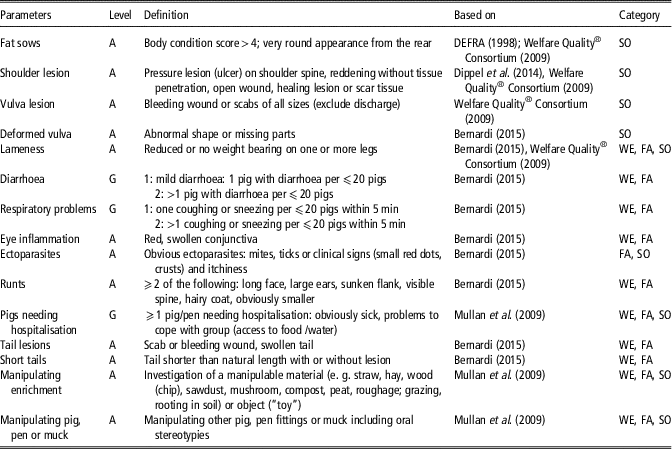
The clinical parameters (Table 1) were either assessed as presence of a given severity level of the respective parameter in the group (respiratory problems, diarrhoea and presence of pigs requiring hospitalisation) or as prevalence based on counts of individual animals per group (e.g. lameness, short tails). Whilst walking slowly around the whole pen or paddock and encouraging all pigs to stand up, the assessment was carried out visually from a distance of ~0.5 m looking at individual pigs and also looking on the floor for the presence of diarrhoea. In addition to the definitions of all measures provided in Table 1, diarrhoea was defined as the presence of at least two signs of abnormal faeces (abnormal consistency, colour, odour) either on a pig or on the floor.
Overview of pig welfare assessment: definitions and scoring scales for animal-based parameters used

A = animal level: % of animals with finding per animal category based on total number of animals scored; G = group level: % of groups observed with finding per animal category).
Animal categories: SO = pregnant sows; WE = weaner; FA = fattener.
Behavioural observations
Before the assessment of clinical parameters, in each pen or paddock exploratory behaviour of all standing and sitting, but not feeding or drinking pigs was assessed from outside. Observations started after a 2-min period to standardise for the response of pigs towards the observer. Following Mullan et al. (Reference Mullan, Browne, Edwards, Butterworth, Whay and Main2009), a single scan sample of pigs either in contact with manipulable material or pen fittings, muck or other pigs was recorded (Table 1). In systems with restricted feeding, observation was not carried out immediately before or after feeding.
Statistical analysis
All calculations were performed at farm level with SAS 9.2 and 9.3. For this purpose, clinical parameters were aggregated by calculating the median of pen prevalences (count measures at pen level such as tail lesions) or by calculating the prevalence of affected groups (e.g. diarrhoea). Treatments were described as incidence per 100 animals per year. Productivity data were also expressed for a one-year period. Farm level values of behavioural measures were calculated as median percentage of active (standing or sitting) animals performing the respective behavioural category.
In order to explore differences in animal health and welfare between the three husbandry systems, a non-parametric Kruskal–Wallis test was used, as data did not meet the requirements for parametric analysis (non-normal distribution with a high prevalence of zero values), which was also not achieved through transformation of data. When a significant effect of the husbandry system was revealed, pairwise comparisons were performed using the Wilcoxon Two-Sample (Rank sum) test. P-values were adjusted for the three tests using the step-down Bonferroni method (Holm, Reference Holm1979).
Results
The predominant husbandry system (Supplementary Table S2) in Germany, Switzerland and Austria was IN, whereas mainly farms in Italy and the United Kingdom kept all age groups OUT all year round. POUT farms were present in all countries, predominantly in Denmark (the only country, where nose ringing in sows was performed) and France, where all farms kept their animals partly outdoors. POUT farms were mostly farrow to finish farms (Supplementary Table S3) with commonly sows kept on pasture and weaners and fatteners in indoor systems with outside runs (except in France where fatteners had no access to an outside run, which was allowed at the time of assessment) POUT farms kept the highest numbers of animals and used both conventional breeds (Large White, Landrace, F1 (crosses of Large White and Landrace), commercial Hybrids) and crosses with traditional breeds. In contrast to this, IN farms kept the lowest number of sows, weaned at the lowest median age of 42 days and used mostly conventional breeds (23 farms) or crosses with traditional breeds (11 farms). OUT farms were mostly farrow to finish units with an intermediate herd size, which kept only traditional breeds such as Cinta Senese or Tamworth (six farms) or crosses with conventional breeds (six farms). All farms fulfilled at least the minimum requirements of the European Organic Regulation No 889/2008 (Council of the European Union, 2008) for indoor and outdoor space allowance. IN systems predominantly used pens with concrete floor (one-third of the farms partly slatted) and straw bedding (in few farms as deep litter) for all age categories. Across all systems, most weaners and fatteners were fed ad libitum dry food (median 89% to 100%), with the exception of fatteners in OUT, where only 17% had ad libitum access to food. More details regarding floor type, number of animals/drinker and nutrition at the production chain level (from farrow to finish) are described in Rudolph et al. (Reference Rudolph, Hörtenhuber, Bochicchio, Butler, Brandhofer, Dippel, Dourmad, Edwards, Früh, Meier, Prunier, Winckler, Zollitsch and Leeb2018).
Measures directly assessed on the animal
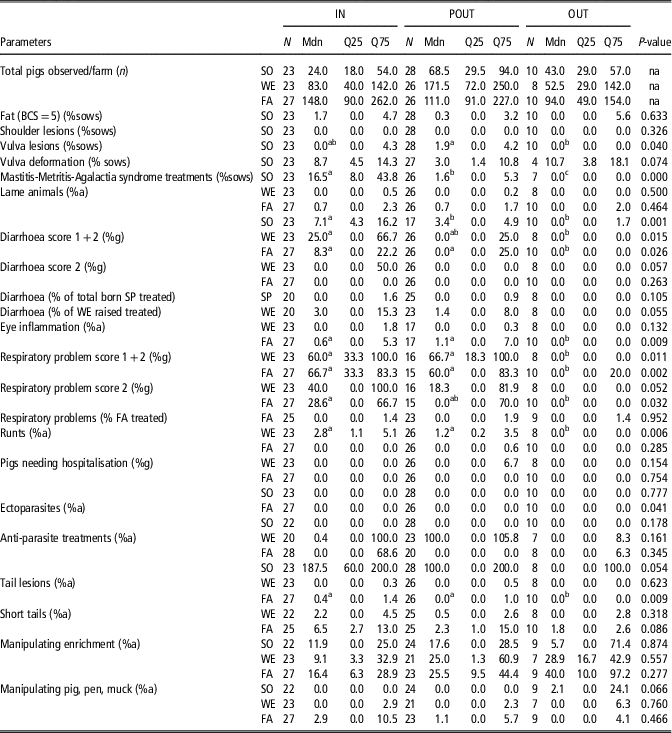
Overall, for many clinical measures (Table 2) low median prevalences were found across all systems, and median prevalence (and Q75) was 0% (e.g. pigs needing hospitalisation, shoulder lesions). No clinical signs of ectoparasites were seen in any of the systems, with most sows in IN and POUT and weaners in POUT treated at least once a year against parasites.
Pig health and welfare outcomes: clinical and behavioural measures at day of visit

N = number of farms; Mdn = median; Q25 = lower quartile; Q75 = upper quartile; SO = sows; SP = suckling piglets; WE = weaners; FA = fatteners; BCS = body condition score; %a = per cent of affected animals; %g = per cent of affected groups; na = not tested for differences.
Mdn prevalences and Q25, Q75 for assessed animals per farm system (IN = indoor; POUT = partly outdoor; OUT = outdoor); P = result of global Kruskal–Wallis test for system effect.
a,b,cPrevalences with different superscripts within a row differ at P⩽0.05 in a pairwise system comparison with Wilcoxon rank sum tests and Bonferroni-Holm correction for three tests.
Sow-specific problems
Very few over-fat sows, but also no sows with shoulder lesions were found in all three systems. Across all systems, vulva lesions were seldom recorded, but OUT sows showed fewer vulva lesions than sows in POUT (P = 0.043). However, vulva deformation, the long-term outcome of lesions and therefore more indicative of the problem, was observed in all three systems, with no system effect. Regarding treatment of MMA, all systems differed from each other (P < 0.001 to P = 0.018); IN had the highest incidence of MMA treatment, POUT was intermediate and OUT lowest. Similarly, IN had the highest prevalence of lame sows compared to POUT and OUT (P = 0.024; P = 0.007).
Growing pig problems
For weaners and fatteners, median lameness prevalence was <1% in all three systems. Moreover, the prevalence of runts was low in weaners, with OUT lowest compared to IN (P = 0.037) and to POUT (P = 0.049), and almost no runts were observed in fatteners across all systems.
The treatment incidence of diarrhoea in suckling piglets was low and did not differ between systems. Treatment incidence was also low in weaners, but decreased from IN and POUT to OUT (P = 0.055). Diarrhoea was less frequent in weaners kept outdoors than indoors (P = 0.044), whereas pigs in partly outdoor systems showing intermediate prevalence which did not differ statistically from these. Similarly, fattener groups in OUT showed a lower prevalence of diarrhoea than in POUT (P = 0.048) and IN (P = 0.029).
Fewer fatteners with eye inflammation were seen in OUT compared to IN and POUT (both: P = 0.021). Regarding respiratory problems observed per pen, weaners and fatteners were affected less in OUT compared to IN (P = 0.020; P = 0.0.003) and POUT (P = 0.037; P = 0.045). Furthermore, prevalence of severe respiratory problems (score 2 only) was lower in fattener groups in OUT than in IN (P = 0.043), while POUT was intermediate and differed from neither. Treatment incidence of respiratory disease in fatteners was low and did not differ between systems.
Exploratory behaviour and tail lesions
Manipulation of enrichment was observed in all animal categories in all three systems, but manipulation of pen/muck or other pigs rarely occurred in any system. Very few fresh tail lesions were seen in all systems, but there was a lower prevalence in fatteners in OUT compared to IN (P = 0.010) and POUT (P = 0.048). Short tails were found more frequently than tail lesions, especially in fatteners, with decreasing prevalence from IN to POUT and OUT (P = 0.086).
Productivity data
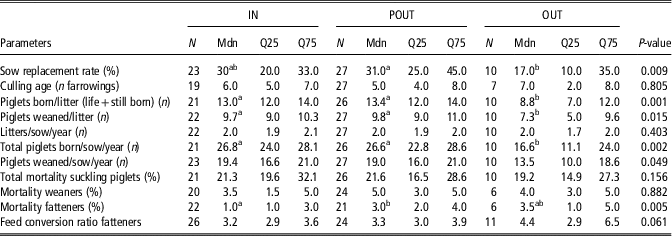
Productivity data per husbandry system (IN, POUT, OUT) and results of tests for system effects are summarised in Table 3: culling age of sows (number of farrowings before culling) did not differ between systems, but replacement rate was lower in OUT than in POUT systems (P = 0.013). Furthermore, in OUT the lowest numbers of piglets born (OUT v. IN: P = 0.003; OUT v. POUT: P = 0.004) and weaned per litter (both: P = 0.032) was found in OUT (compared to IN and POUT). This was also the case for total piglets born (P = 0.008; P = 0.009) and weaned (P = 0.069; P = 0.091) per sow per year, respectively. Litters per sow per year and relatively high total suckling piglet losses (around 20%) were similar across systems. Losses in weaners did not differ between systems, but losses in fatteners recorded in IN were lower than in POUT (P = 0.007) and OUT (P = 0.259), although data were only available for 6 OUT farms. Across systems, feed conversion ratio of fatteners was numerically better in IN and POUT than OUT (P = 0.061).
Productivity data and treatments of assessed pig farms: (1 year preceding the farm visit)

N = number of farms; Mdn = median; Q25 = lower quartile; Q75 = upper quartile.
Mdn values per farm system (IN = indoor; POUT = partly outdoor; OUT = outdoor); P = result of global Kruskal–Wallis test for system effect.
a,bData with different superscripts within a row differ at P⩽0.05 in a pairwise system comparison with Wilcoxon rank sum tests and Bonferroni-Holm correction for three tests.
Discussion
To our knowledge, the present study is the first one which examines differences in animal welfare, health and productivity between three typical commercial organic pig husbandry systems in Europe. It provides benchmarks for a large range of animal-based parameters and identifies areas to improve across husbandry systems (e.g. total piglet mortality). When animals were kept indoors, they were affected with more lameness and treated more frequently against MMA (sows) and had more respiratory problems and diarrhoea (weaners and fatteners). On the other hand, in OUT husbandry systems, productivity was lower with fewer piglets born and weaned per sow and increased feed conversion ratio in fatteners.
Even though the described husbandry systems IN, POUT, OUT are primarily characterised by the location where the animals are kept, other factors such as, for example, breed or country are integral parts of the system. Therefore, interpretation of results has to take this point into account: one example is the predominant use of traditional breeds in OUT farms, which is likely to contribute significantly to the reduced number of piglets weaned per sow and year and the overall poorer feed conversion ratio.
To assess pig health and welfare as comprehensively as possible within a 1-day visit, existing protocols had to be shortened, covering only aspects of health, welfare and productivity. However, even though some issues (e.g. social or play behaviour) are hard to capture in cross-sectional studies, the combination of animal-based assessment during the day of the visit as well as medicine and productivity records from the year preceding the visit allow a relatively comprehensive view on the current as well as long-term situation.
Measures directly assessed on the animal
Prevalence of physical conditions of animals varied between herds, as reported in comparable studies (Baumgartner et al., Reference Baumgartner, Leeb, Gruber and Tiefenbacher2003; Dippel et al., Reference Dippel, Leeb, Bochicchio, Bonde, Dietze, Gunnarsson, Lindgren, Sundrum, Wiberg, Winckler and Prunier2014; Kongsted and Sørensen, Reference Kongsted and Sørensen2017). Across all husbandry systems, the median prevalence of several recorded animal health and welfare problems, such as pigs needing hospitalisation, ectoparasites, tail lesions or runts was (close to) 0%. This is indicative of good management of obvious welfare problems in all systems.
Thin sows and related shoulder lesions were rarely present on organic farms (Bernardi, Reference Bernardi2015), which is supported by our findings. The husbandry system did not influence the prevalence of shoulder lesions, which is in contrast to KilBride et al. (Reference KilBride, Gillman and Green2009), where conventional outdoor sows showed lower prevalences than indoor sows (2.4% v. 12.1%). However, an explanation of our results might be the obligatory straw bedding in organic pig farming.
Vulva biting leads to vulva lesions, and in the long term to vulva deformations, which can be associated with competition around feeding, especially if malfunctioning electronic sow feeders are used (Remience et al., Reference Remience, Wavreille, Canart, Meunier-Salaün, Prunier, Bartiaux-Thill, Nicks and Vandenheede2008). Fresh vulva lesions were less frequent compared to other studies, with reported median prevalences of 4.3% and 3.2%, respectively (Dippel et al., Reference Dippel, Leeb, Bochicchio, Bonde, Dietze, Gunnarsson, Lindgren, Sundrum, Wiberg, Winckler and Prunier2014; Bernardi, Reference Bernardi2015). In contrast, prevalences of vulva deformation in the present study were higher than reported in these previous studies, which could be due to different scoring systems.
The higher treatment incidence of MMA in IN can be explained by less space to move around and to separate the dunging and lying area in an indoor situation, which can lead to constipation and/or increased soiling of the udder with Escherichia coli – both risk factors for MMA (Gerjets and Kemper, Reference Gerjets and Kemper2009; Jenny et al., Reference Jenny, Vidondo, Pendl, Kümmerlen and Sidler2015). However, lower treatment incidences in OUT do not necessarily mean that less MMA occurs outdoors, but farmers might observe MMA less easily and therefore treat less.
Lameness is assumed to indicate pain, restricts access to resources and is reported as a common reason for premature culling of sows (Nalon et al., Reference Nalon, Conte, Maes, Tuyttens and Devillers2013). Lameness affected mainly sows kept in IN. Sows in OUT, as well as those in POUT which were mainly kept in outdoor paddocks, showed lower levels of lameness, which can be explained by softer flooring, less exposure to manure and increased activity. These findings agree with others (Day et al., Reference Day, Kelly, Martins and Edwards2003; Knage-Rasmussen et al., Reference Knage-Rasmussen, Houe, Rousing and Sørensen2014), who have found fewer lame sows in outdoor paddocks and a decreased risk of sows with bursitis.
For weaning diarrhoea, score 1 (one sign of loose faeces per 20 pigs) was found in one quarter of all farms in IN, indicating a common, but relatively mild problem. Furthermore, treatment incidence for weaners (in all three systems) was very low. Consideration of these two parameters in combination suggests that mainly non-infectious, mild problems caused the symptoms, as severe diarrhoea would have been treated by farmers using antibiotics in order to avoid losses. More groups of IN weaners and fatteners were affected compared to OUT, though prevalence was only numerically higher than in POUT. This seems logical, as weaners and fatteners in POUT were mostly kept in indoor pens, but might still have some advantages arising from the suckling period in outdoor paddocks. The reliability of assessing diarrhoea outdoors may be lower as observers could have missed signs of diarrhoea in outdoor paddocks. However, the lower prevalence in outdoor piglets, might be explained by exposure to soil and from earlier exposure to different kinds of food (Leeb et al., Reference Leeb, Hegelund, Edwards, Mejer, Roepstorff, Rousing, Sundrum and Bonde2014). In addition, the higher median weaning age in OUT (49 days) and POUT (50 days) might have been beneficial to reduce weaning diarrhoea.
In contrast to sows, for which respiratory problems have been rarely reported (Dippel et al., Reference Dippel, Leeb, Bochicchio, Bonde, Dietze, Gunnarsson, Lindgren, Sundrum, Wiberg, Winckler and Prunier2014), median prevalence in weaners and fatteners in Austrian organic pig farms was 50% and 43%, respectively (Bernardi, Reference Bernardi2015). This is comparable to the IN and POUT situation in the present study. This high prevalence has to be seen in the light of the definitions used; the signs observed were mostly coughing and sneezing of individual animals within a group, indicating only early symptoms, with almost no fatteners treated with antibiotics in all three systems. The respiratory problems in IN and POUT (where in most farms weaners and fatteners were kept indoors), and the higher median prevalences of eye inflammations in fatteners in IN and POUT, may be explained by higher levels of dust caused by dry feeding as well as straw bedding in indoor conditions, even when animals are also supplied with a concrete run (Kijlstra and Eijck, Reference Kijlstra and Eijck2006). In a recent Danish study (Kongsted and Sørensen, Reference Kongsted and Sørensen2017), no difference between production systems (conventional indoor, conventional outdoor and organic outdoor) was found regarding airway infections detected at the abattoir. However, the ‘outdoor’ systems also comprised typical Danish POUT systems, with finishing pigs kept mostly in indoor pens with outside runs.
Ecto- and endoparasites are repeatedly reported to be a special challenge for organic and outdoor pig production (Baumgartner et al., Reference Baumgartner, Leeb, Gruber and Tiefenbacher2003; Day et al., Reference Day, Kelly, Martins and Edwards2003; Kongsted and Sørensen, Reference Kongsted and Sørensen2017). Baumgartner et al. (Reference Baumgartner, Leeb, Gruber and Tiefenbacher2003), for example, found ectoparasites (detected in skin scrapings) in 29% of organic indoor farms with sow units, and in 59% farms with indoor fattening units. In contrast, in the present study very few signs of ectoparasites were observed on fatteners and sows across the three husbandry systems, which is similar to a Austrian survey on 60 organic pig farms (Bernardi, Reference Bernardi2015). Almost all sows in IN and POUT were treated at least once a year against parasites, which will have contributed to the fact that very few signs of ectoparasites were observed.
Exploratory behaviour did not differ between systems and manipulation of muck, pen structures and other pigs was very low, probably because European organic regulations require that, at least, straw is available for pigs in all organic husbandry systems. In addition, exploration was not differentiated further into, for example, rooting, chewing, grazing, which would have allowed to differentiate between pigs with access to pasture or kept indoors. A similar study (Temple et al., Reference Temple, Manteca, Velarde and Dalmau2011), looking at intensively and extensively kept Iberian pigs, also found no difference regarding manipulation of material between the two systems.
Tail lesions, and consequently short tails, may be a result of tail biting, with lack of appropriate enrichment material as the main cause. Tail-biting is more frequently observed in pigs in intensive indoor systems (Taylor et al., Reference Taylor, Main, Mendl and Edwards2010 and Reference Taylor, Parker, Mendl, Edwards and Main2012), but may be seen in pigs in outdoor production systems as well (Walker and Bilkei, Reference Walker and Bilkei2006). In organic suckling piglets, tail necrosis (black tails, partly falling off) was observed in 7% of newborn piglets in one study (Bernardi, Reference Bernardi2015), where it was assumed that this was not caused by tail-biting but by other causes (e.g. mycotoxins, microorganisms). In the same study, prevalences of tail lesions and short tails in weaners were relatively low (median of 0.0% and 3.4%, respectively), although higher prevalences were reported for fatteners (0.5% and 13.3%, respectively). Compared to these data, generally fewer problems were found in the present study, with an even lower level of tail lesions of fatteners in OUT. It can be suggested that only in OUT, where pigs had access to soil and pasture from birth, was sufficient diverse material for exploration and investigation available at all times.
Productivity
Overall, productivity figures were in the range of previous studies in organic pig farms (Prunier et al., Reference Prunier, Dippel, Bochicchio, Edwards, Leeb, Lindgren, Sundrum, Dietze and Bonde2014). The highest culling age and the lowest replacement rate was found in OUT. This could be explained by a more extensive management of these herds in connection with traditional breeds. Replacement rates (at 40% to 50%) are similar to conventional farms in Europe (Agriculture and Horticulture Development Board, 2018; Landbrug and Fødevarer F.m.b.A., 2018). Number of litters per sow per year was similar in all three husbandry systems, but in OUT the lowest numbers of piglets were born and weaned per litter. This can be explained by an effect of the outdoor conditions (e.g. climatic conditions, predators, reduced supervision of farrowing) but also by the use of traditional breeds, especially since the total piglet mortality did not differ between systems. Similar results have been described for an ‘extensive style’ outdoor system identified by Prunier et al. (Reference Prunier, Dippel, Bochicchio, Edwards, Leeb, Lindgren, Sundrum, Dietze and Bonde2014), which was characterised by local breeds, small herd size, high weaning age and lack of strategic management regarding feeding and farrowing. There, total mortality was 29%; however, in the present study total mortality was lower (19.2% to 21.6%) and no differences between systems were found. This level slightly exceeds total mortality rates reported in reviews of conventional production: In simple farrowing pens, designed pens and outdoor systems, a total mortality of 18.4%, 16.5% and 15.2% was found, respectively, when corrected for a standardised litter size of 11 piglets (Vosough Ahmadi et al., Reference Vosough Ahmadi, Stott, Baxter, Lawrence and Edwards2011; Baxter et al., Reference Baxter, Lawrence and Edwards2012). Calculated fatteners’ feed conversion ratio was numerically better in IN and POUT than OUT. Again, this result might be expected due to the traditional breeds, higher activity, greater climatic challenge and potentially also more feed losses in OUT (Stern and Andresen, Reference Stern and Andresen2003). It is difficult to identify a reason for the lower mortality of fatteners recorded in IN than in POUT, as in both systems fatteners are kept mainly indoors. However, the larger herd size of POUT could be one explanation, as potentially one person had to manage more pigs.
To conclude, the hypothesis that good health and welfare can be ensured in all three organic husbandry systems (IN, POUT, OUT) can be confirmed and the variation in parameters assessed was, in most cases, higher within a husbandry system than between systems. While low prevalences of most health and welfare issues were found, respiratory problems (IN, POUT), diarrhoea (IN), short tails (IN, POUT) and total suckling piglet losses in all husbandry systems could be improved. Due to the environmental conditions, OUT appeared to have advantages regarding respiratory problems (better air quality), diarrhoea (less exposure to faeces) and lameness (softer flooring and lying surfaces). This is further supported by the health and welfare status for POUT farms, which in most cases kept sows outdoors and weaners and fatteners in similar conditions to IN farms. The results provide benchmarks for organic pig producers and organisations that can be used in strategies to promote health and welfare improvement. Furthermore, in future research, the identified health and welfare issues should be addressed, specifically considering effects of husbandry systems.
Acknowledgements
The results presented in the paper have been obtained as part of Gwendolyn Rudolphs’ PhD thesis within the project ‘ProPIG’. The authors would like to thank all involved farmers for their hospitality and openness and all National Agencies for funding within the framework of the 1st call on Research within Core Organic II. G.I. was supported by the Ministry of Agriculture of the Czech Republic, institutional support MZE-RO0718.
Declaration of interest
The authors declare no conflicts of interest.
Ethics statement
For the present study which involved no interventions, no ethical approval was needed in any of the involved countries.
Software and data repository resources
Data and models are not deposited in an official repository.
Supplementary material
To view supplementary material for this article, please visit https://doi.org/10.1017/S1751731119000041