INTRODUCTION
Few marine systems have evaded the marks of human activity (Jackson et al. Reference Jackson, Kirby, Berger, Bjorndal, Botsford, Bourque, Bradbury, Cooke, Erlandson, Estes, Hughes, Kidwell, Lange, Lenihan, Pandolfi, Peterson, Steneck, Tegner and Warner2001; Roberts Reference Roberts2007). Globally, most wild fisheries are now considered fully exploited or overfished (Watson & Pauly Reference Watson and Pauly2013). Increasing human populations and ongoing environmental degradation are likely to further impact any relatively intact marine wilderness (Costello et al. Reference Costello, Ovando, Hilborn, Gaines, Deschenes and Lester2012). The Coral Sea is one example of an isolated marine system removed from coastal impacts (Pandolfi et al. Reference Pandolfi, Bradbury, Sala, Hughes, Bjorndal, Cooke, McArdle, McClenachan, Newman, Paredes, Warner and Jackson2003; Wilkinson & South Reference Wilkinson, South and Zethoven2008). It is believed to be one of the few remaining places on earth where fish populations have not been severely depleted, and one of the last tropical oceanic coral reef areas with high biodiversity and an ecosystem that is relatively untouched (Wilkinson & South Reference Wilkinson, South and Zethoven2008; Young et al. Reference Young, McKinnon, Ceccarelli, Brinkman, Bustamante, Cappo, Dichmont, Doherty, Furnas, Gledhill, Griffiths, Hutton, Ridgway, Smith, Skewes, Williams and Richardson2012).
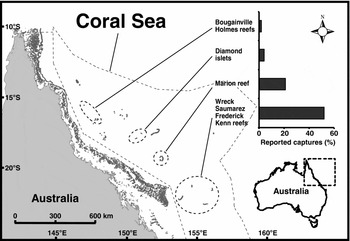
Situated east of Australia, the Coral Sea is bound by Papua New Guinea to the north, the Tasman Front to the south, and the Solomon Islands, Vanuatu and New Caledonia to the east. A proposed Coral Sea Marine Reserve (CSMR) has recently been the subject of much discussion (Hunt Reference Hunt2013). Extending eastwards from the outer boundary of the Great Barrier Reef Marine Park (GBRMP) to the limit of Australia's exclusive economic zone, the CSMR would cover 0.99 million km2 (Fig. 1). Together, the GBRMP and CSMR would encompass an area of 1.3 million km2 and form one of the largest marine protected areas in the world (Hunt Reference Hunt2013).
Map of the Coral Sea reef network within Australia's Exclusive Economic Zone (EEZ). The dashed line delineates the outer boundary of the EEZ and the inner boundary along the Great Barrier Reef Marine Park. The inset graph shows the percentage of total reported spearfishing captures at known locations within the Coral Sea.

Primary literature on the ecology of the Coral Sea and the impacts of fishing in the region are sparse, therefore there has been little information for recent CSMR discussions (Wilkinson & South Reference Wilkinson, South and Zethoven2008; Hunt Reference Hunt2013). Only four of the 36 mapped reefs have been the subject of community-level scientific study (Ceccarelli Reference Ceccarelli2012) and most research comprises new species descriptions or geophysical studies (see Borsa et al. Reference Borsa, Bearez, Paijo and Chen2013; Kessler & Cravatte Reference Kessler and Cravatte2013). Thus, in implementing and managing a CSMR an understanding of human impacts, and fishing activity in particular, would be invaluable. Obtaining this information remains a challenge, as there are few monitored fishers.
The Coral Sea Fishery (CSF), the Eastern Tuna and Billfish Fishery (ETBF) and the recreational and charter fishing industries exploit fish populations within the Coral Sea. Commercial landings and by-catch data for the CSF and ETBF are described as limited at best (Ceccarelli Reference Ceccarelli2011; Hunt Reference Hunt2013). Recreational and charter fishing within the Coral Sea is even less well understood, with almost no data on catch history, trends or composition (Zethoven Reference Zethoven and Zethoven2008; Ceccarelli Reference Ceccarelli2011). Recreational game fishing also occurs within the Coral Sea, but data from the long-term Game Fish Tagging Program indicates that only 0.8% of captures are within the Coral Sea (Ceccarelli Reference Ceccarelli2011).
Recreational fishing is a growing component of global harvest fisheries (Cooke & Cowx Reference Cooke and Cowx2004; Post Reference Post2013). However, monitoring data on recreational fisheries is typically sparse or non-existent, thus restricting scientific knowledge of past trends in exploitation (Cooke & Cowx Reference Cooke and Cowx2004). The lack of data on fisheries of the Coral Sea, in particular recreational fishing, highlights the importance of alternative non-traditional sources of data in providing insights into current and historical extractive practices (Pauly Reference Pauly1995). Non-traditional data can provide valuable knowledge of historical trends and help to address the ‘shifting-baseline syndrome’ (Pauly Reference Pauly1995; McClenachan Reference McClenachan2009). Here we present the first study to investigate recreational spearfishing in the Coral Sea. We examine historical catch data from a chronology of spearfishing magazines to uncover trends in reported captures, including the size of fish captured and the species composition. These data are compared to records from the adjacent Great Barrier Reef (GBR). Our aim is to provide information on the history and trends in recreational spearfishing within the Coral Sea.
METHODS
We extracted a broad spectrum of data from trip reports, competition reports, club outing reports, reader reports and photographs published in a chronology of spearfishing magazines from 1953 to 2009 (see Young et al. Reference Young, Foale and Bellwood2014 for title chronology). This extensive coverage of data from various sources within the magazines provides valuable insights into historical catches. We examined four magazine issues in each odd year (due to the high volume of data). In most years only four issues were published and thus our sampling provided complete annual coverage. In years with more published issues, we randomly sampled four for consistency, although only three issues were available in the National Library of Australia archives for 1995, 1997 and 1999. Data on trophy fish species (namely fish worthy of being reported in magazines), their size (weight or length), the trip type (charter or private) and location of capture were extracted from the reports. Fish were identified to the lowest practical taxonomic level, usually to species. Length estimates were converted to weights using length-weight relationships published on Fishbase (Froese & Pauly Reference Froese and Pauly2013). In cases where published relationships were not available, the length-weight relationship of a closely related, similarly sized species was substituted. Reported captures that did not include size data or photographs were not included in weight analyses.
Of the total Australian fish captures reported in sample magazines, we calculated the annual percentages from the Coral Sea and GBR for all odd years from 1953–1975 and 1993–2009. Between 1975 and 1993 the growing popularity of scuba and rising environmental awareness led to a decrease in spearfishing participation. During this ‘conservation era’ (described in Young et al. Reference Young, Foale and Bellwood2015), reports on fish captures virtually disappeared and data from these years were not suitable for analyses. To examine trends in historical catch composition, we calculated the percentage of the total annual reported catch comprised by the various taxonomic groups within each region. Where specific sites within the Coral Sea could be identified, we also examined the percentage of the total catch from each of these sites, to identify the locations most visited by spearfishers. The mean estimated weights of fishes were also calculated for each taxonomic group, with data combined for each region and period to provide a regional and temporal comparison between pre-1975 and post-1993 years on the GBR.
Simple least-squares regression models were fitted to the percentage of reported captures from the GBR and Coral Sea through time, using the statistical package R. Weight data were analysed with a Kruskal-Wallis test (in XLSTAT) and homogeneous subsets identified with a Dunn's two-tailed test. Spatial variation and temporal changes in the taxonomic composition of catches were visualized using a non-metric multidimensional scaling (MDS) ordination based on a Gower's distance matrix calculated from square-root transformed data. Species correlations and an ordination biplot were constructed using multiple partial correlations in PRIMER 6 (Anderson et al. Reference Anderson, Gorley and Clarke2008). Correlations were examined and a cutoff of 0.2 was applied to identify the species to be included in the biplot. Differences between the Coral Sea and the two GBR periods were tested using a one-way analysis of similarities (ANOSIM) in PRIMER 6.
RESULTS
Historical catch reports
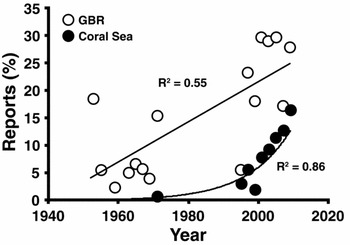
The percentage of Australian spearfishing captures reported from the GBR increased significantly between 1953 and 2009 (linear regression: R2 = 0.55, F1, 14 = 17.21, p < 0.001; Fig. 2). A single early report from the Coral Sea emerged in 1971 (Fig. 2). However, it was not until after 1995 that the percentage of reported captures from the Coral Sea exhibited rapid growth (exponential regression: R2 = 0.86, F1, 7 = 43.08, p < 0.001). By 2009, reports from the Coral Sea had increased to approximately 50% of those reported from the GBR (Fig. 2). At least 92% of all reported fish captures from the Coral Sea were taken on recreational charter trips. Private vessels contributed 2% of reported captures; 6% were of unknown origin.
The percentage of total annual fish captures reported in spearfishing magazines from 1953 to 2009. Open symbols represent reports from the GBR, closed symbols from the Coral Sea.

Significant differences in mean trophy fish weight between periods and regions were also detected (Kruskal-Wallis: K = 156.634, p < 0.0001; Fig. S1, see Supplementary material). Pre-1975 GBR weights (23.67 kg ± 4.62 SE) and post-1993 Coral Sea weights (22.93 kg ± 1.14 SE) were remarkably similar. However, post-1993 GBR weights (8.76 kg ± 0.4 SE) were markedly lower than the pre-1975 GBR or post-1993 Coral Sea values. The post-1993 GBR records are less than half the weights previously recorded from the GBR or still recorded from the Coral Sea.
Fish captures from within the Coral Sea and Australian EEZ boundary were reported from eight locations (Fig. 1). Wreck, Saumarez, Frederick and Kenn reefs, located in close proximity toward the southern extent of the Coral Sea region, comprised 52% of all reported captures from the Coral Sea. Marion Reef comprised 21% of reports, while just 4% were reported from the Diamond Islets and 2% from Bougainville and Holmes Reefs. A further 21% of reports emerged from unspecified regions of the Coral Sea.
Catch composition
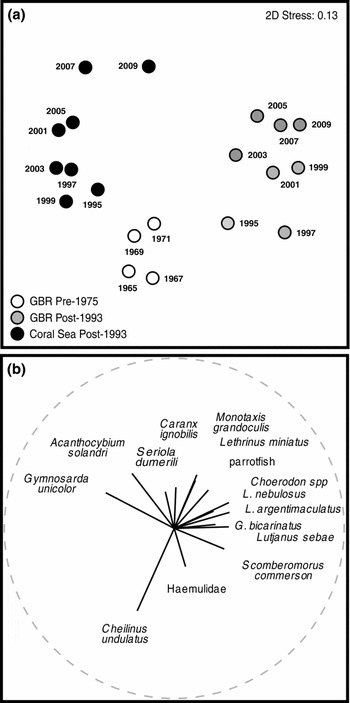
Although the Coral Sea and GBR both represent tropical coral reef habitats, the catches from the two regions are clearly separated in the MDS ordination (Fig. 3 a). Dimension one separated, in sequence, the Coral Sea, GBR pre-1975 and GBR post-1993. The pre-1975 years for the GBR also separate from the post-1993 Coral Sea on Dimension 2.
Multidimensional scaling analysis (MDS) of (a) spearfishing catch composition through time on the GBR and in the Coral Sea, and (b) biplot vectors of the main taxonomic groups; the circle indicates a correlation coefficient of 1.

Coral Sea catch was primarily characterized by reports of large semi-pelagic species, wahoo (Acanthocybium solandri; mean weight 25 kg ± 1.64 SE), dogtooth tuna (Gymnosarda unicolor; 33.4 kg ± 2.18 SE) and giant trevally (Caranx ignobilis; 28.71 kg ± 2.58 SE) (Fig. 3 b; Figs S2 and S3, see Supplementary material). The GBR was characterized by the capture of reef fish, snappers (Lutjanus sebae; mean weight 6.02 kg ± 0.58 SE, Lutjanus argentimaculatus; 4.86 kg ± 0.36 SE), wrasses (Choerodon spp; 7.89 kg ± 0.78 SE) and emperors (Lethrinus nebulosus; 4.49 kg ± 0.61 SE), as well as two inshore pelagic species, the Spanish mackerel (Scomberomorus commerson; 10.47 kg ± 0.85 SE) and shark mackerel (Grammatorcynus bicarinatus; 8.23 kg ± 1.04 SE) (Fig. 3 b and Fig. S2, see Supplementary material). The pre-1975 years on the GBR and the early years of spearfishing in the Coral Sea were also characterized by the capture of Maori wrasse (Cheilinus undulatus; mean weight 42.43 kg ± 5.57 SE GBR, 35.33 kg ± 4.94 Coral Sea).
ANOSIM analysis of regional and period groupings demonstrated strong separation (ANOSIM global R = 0.882, p = 0.001). Pairwise tests found that both the Coral Sea (global R = 0.973, p = 0.002) and GBR pre-1975 (global R = 0.903, p = 0.002) were well separated from the GBR post-1993. Although the Coral Sea and GBR pre-1975 exhibit some overlap the groupings are significantly different (global R = 0.746, p = 0.002).
DISCUSSION
The Coral Sea is widely perceived to be relatively untouched (Wilkinson & South Reference Wilkinson, South and Zethoven2008; Young et al. Reference Young, McKinnon, Ceccarelli, Brinkman, Bustamante, Cappo, Dichmont, Doherty, Furnas, Gledhill, Griffiths, Hutton, Ridgway, Smith, Skewes, Williams and Richardson2012), yet our evidence suggests the region has been subjected to recreational spearfishing for at least 43 years, and reports from the region are growing. However, like commercial fishing, most spearfishing activity has occurred in the more accessible southern extent of the proposed CSMR (Ceccarelli Reference Ceccarelli2011; Hunt Reference Hunt2013). Recreational fishing is acknowledged to be strongly limited in both extent and intensity by distance and cost (Zethoven Reference Zethoven and Zethoven2008; Hunt Reference Hunt2013). However, as in other fisheries, technological advances and the proven ability of fishers to push further afield (Berkes et al. Reference Berkes, Hughes, Steneck, Wilson, Bellwood, Crona, Folke, Gunderson, Leslie, Norberg, Nyström, Olsson, Österblom, Scheffer and Worm2006; Watson & Pauly Reference Watson and Pauly2013), may change future patterns of exploitation.
In the Coral Sea, 36 mapped reefs and shoals, and 14 seamounts account for just 1.3% of the surface area (Harris et al. Reference Harris, Heap, Passlow, Sbaffi, Fellows, Porter-Smith, Buchanan and Daniell2003; Ceccarelli Reference Ceccarelli2012), and hard corals are not particularly abundant or diverse (DEWHA [Department of the Environment, Water, Heritage and the Arts] 2009). Thus, it is interesting that recreational spearfishers travel vast distances, and at great expense to these comparatively few and isolated reefs. With large reef fish possibly less available to fishers on the GBR, potentially due to overfishing, self-regulation (namely a conservation ethic), and/or government regulation, the Coral Sea may have provided an opportunity to target a new suite of trophy fish. At the same time, technology has improved access to more distant locations and advances in spearfishing equipment may have provided spearfishers with the ability to effectively target large pelagic species (such as G. unicolor and A. solandri) that were previously difficult to capture or less available on the GBR (Fig. S3, see Supplementary material).
Although pelagic species dominate the reported catch from the Coral Sea, reef fish species were also recorded (Fig. S2, see Supplementary material). Maori wrasse, for example, partially characterize the early 1990s in the Coral Sea. This is noteworthy because large reef fish species are potentially more vulnerable to population declines than pelagic species when subjected to targeted fishing (see for example Russ Reference Russ and Sale1993; Lloret et al. Reference Lloret, Zaragoza, Caballero, Font, Casadevall and Riera2008). Many of these conspicuous species are slow growing, long-lived, inquisitive, and relatively scarce (Young et al. Reference Young, Foale and Bellwood2014). Due to these characteristics, they are often among the first species to be removed by fishing and are unlikely to be replenished quickly (Jennings et al. Reference Jennings, Reynolds and Mills1998; Coll et al. Reference Coll, Linde, Garcia-Rubies, Riera and Grau2004). In terrestrial habitats, trophy hunting has had undesirable evolutionary consequences by decreasing the average size and lifespan of animals (Coltman et al. Reference Coltman, O’Donoghue, Jorgenson, Hogg, Strombeck and Festa-Bianchet2003). In the marine environment, the selective hunting of large sedentary fish could lead to similar consequences (Young et al. Reference Young, Foale and Bellwood2014). However, the high mobility of most pelagic fish and the physical limitations of spearfishing would make the selective targeting of the largest pelagic individuals difficult (Young et al. Reference Young, Foale and Bellwood2015). A selection of large-bodied reef fish taxa (such as Epinephelus lanceolatus and C. undulatus) have been protected since 2003 in Queensland waters due to concerns over potential population declines (IUCN [International Union for Conservation of Nature] 2014). Careful regulation of the harvesting of functionally important reef species would also be a sensible measure to limit the potential ecological impacts of future changes in fishing activity (Bellwood et al. Reference Bellwood, Hoey and Hughes2012). Current regulation in Australia offers little or no protection for many of these species (Bellwood et al. Reference Bellwood, Hughes, Folke and Nyström2004).
While recreational spearfishing has the capacity to cause declines in vulnerable species (Lloret et al. Reference Lloret, Zaragoza, Caballero, Font, Casadevall and Riera2008; Godoy et al. Reference Godoy, Gelcich, Vasquez and Castilla2010; Young et al. Reference Young, Foale and Bellwood2014), the extractive power of recreational spearfishing on pelagic fish species should be assessed in context. Relative to commercial fishing in the Coral Sea (Ceccarelli Reference Ceccarelli2011), the intensity of recreational spearfishing is likely to be low. However, due to gaps in knowledge on the life histories of many pelagic species and the potential importance of the Coral Sea for spawning aggregations (Ceccarelli Reference Ceccarelli2011), some caution is needed. Dogtooth tuna, for example, may be more vulnerable to targeted fishing than previously thought (Bentley et al. Reference Bentley, Harvey, Newman, Welch, Smith and Kennington2014). Fortunately, spearfishers are likely to be among the first to observe, report and respond to potential declines in target species (Young et al. Reference Young, Foale and Bellwood2014). Thus, communication between fishers and regulatory authorities remains key to managing this fishery.
If impacts on vulnerable and functionally important fishes are minimized, the available evidence suggests that spearfishers currently exert limited pressure on the ecology of Coral Sea reefs.
ACKNOWLEDGEMENTS
We thank the staff at the National Library of Australia for archival material, Barry Andrewartha for images, Chris Goatley for technical assistance, the Australian Research Council for support, and David Welch and two anonymous reviewers for invaluable constructive comments.
Supplementary material
To view supplementary material for this article, please visit Journals.cambridge.org/10.1017/S0376892915000272.