Implications
Previous research reported that finishing steers on forage decreases growth performance when compared to finishing on grains. In this study, we demonstrated that finishing diets based on legume–grass pasture plus grain supplementation provided sufficient nutrients to produce carcasses with similar weight when compared to a corn-based diet. Carcass weight is the most important attribute for grid pricing in countries that do not have quality and yield grading systems. Finishing steers with diets based on legume–grass pasture, pasture plus corn supplementation or corn only generate carcasses with desirable traits, ∼500 kg and fat thickness between 3 and 6 mm. Therefore, beef cattle producers may use different finishing systems (FS) to obtain similar results.
Introduction
Pasture is the main feed source for cattle in the world, and pasture finishing is considered to be less costly than finishing cattle on grain. The economic viability of producing livestock using grazing systems depends on consistent supply and quality of forage (Redfearn et al., Reference Redfearn, Venuto, Pitman, Alison and Ward2002). This can be achieved by using a mixture of grasses and legumes grown in the cold season (from late fall through spring). Using a mixture of temperate grasses such as oats (Avena strigosa Schreb.) and ryegrass (Lolium multiflorum Lam.) increases forage production and extends grazing season. Oats and ryegrass mixtures are widely used in southern Brazil (Patino et al., Reference Patino, Medeiros, Pereira, Swanson and Mcmanus2015). Oat is a cool-season annual forage that is cultivated in the autumn to be utilized in the beginning of the winter. Oat grows faster than ryegrass, which has slow initial development and reaches maximum forage production at the end of the winter and beginning of spring (Noro et al., Reference Noro, Scheffer-Basso, Fontanelli and Andreatta2003).
The combination of legumes such as white clover (Trifolium repens) and red clover (Trifolium pratense) in mixtures of grasses increases the nutritional quality of pastures due to nutrient digestibility and protein content when compared to monoculture grasses (Buxton et al., Reference Buxton, Hornstein, Wedin and Marten1985; Sleugh et al., Reference Sleugh, Moore, George and Brummer2000). In addition, legumes fix atmospheric nitrogen (Vinther, Reference Vinther2006) resulting in increased forage production (Gierus et al., Reference Gierus, Kleen, Loges and Taube2012). Finishing steers on temperate pastures plus grain supplementation is a common system in the southern hemisphere (Aguerre et al., Reference Aguerre, Cajarville, Kozloski and Repetto2013). The utilization of whole corn grain (WCG) as an energy source improves growth performance and carcass traits (Roberts et al., Reference Roberts, Kerth, Branden, Rankins, Kriese-Anderson and Prevatt2009). Currently, utilization of WCG has also been found to be as efficient as ground corn regarding weight gain when added in concentrate-based diets for finishing cattle (Carvalho et al., Reference Carvalho, Chizzotti, Schoonmaker, Teixeira, Lopes, Oliveira and Ladeira2016).
Although feedlot FS substantially grew over the last 10 years in Brazil, beef cattle has been predominantly finished on pasture (Oliveira and Miller, Reference Oliveira and Millen2014). Beef from steers finished on pasture has a healthier fatty acid profile and improved oxidative stability (Fruet et al., Reference Fruet, Stefanello, Rosado Júnior, De Souza, Tonetto and Nörnberg2016). These benefits, allied to marketing strategies that link product to local producers and feeding systems are important factors that support grazing and allows producers to explore niche markets. Recently, a governmental Uruguayan campaign to promote its beef as ‘Uruguayan grass-fed beef’ was developed to establish a premium brand based on country-of-origin labeling and beef characteristics of production systems based on pasture (Realini et al., Reference Realini, Font i Furnols, Sañudo, Montossi, Oliver and Guerrero2013).
Previous research reported that limitations of forage-finished beef include lower carcass weight (Duckett et al., Reference Duckett, Neel, Lewis, Fontenot and Clapham2013) and longer periods of time to achieve similar weight when compared to cattle finished on grains (Roberts et al., Reference Roberts, Kerth, Branden, Rankins, Kriese-Anderson and Prevatt2009). However, Chail et al. (Reference Chail, Legako, Pitcher, Griggs, Ward, Martini and MacAdam2016) demonstrated that it is possible to obtain similar hot carcass weights (HCWs) by finishing steers on legume pastures or with high grain diets. Dierking et al. (Reference Dierking, Kallenbach and Grün2010) observed that steers finished on grass-only had lower weight gain when compared to steers finished on legume–grass pasture. Based on both studies, we hypothesized that finishing steers on pastures including black oats, ryegrass, white clover and red clover would provide similar carcass traits when compared to carcasses finished on pasture with WCG supplementation or with WCG only. In our study, we evaluated growth performance, carcass traits and incidence of digestive disorders of steers finished on three systems including legume–grass pasture and a high grain diet based on WCG.
Material and methods
Animals, diet and finishing management
The study was conducted at the Instituto Federal Farroupilha (IFF), RS, Brazil. Handling and care of steers were approved by the IFF Ethics Committee on the Use of Animals (protocol 003/2015). Eighteen British and Zebu crossbred steers (18 to 20 months of age, initial BW (BW) 333 ± 27.87 kg) were randomly allocated to three FS based on legume–grass pasture (PAST), legume–grass pasture supplemented with WCG (14 g WCG/kg BW, SUPP) and a grain-only diet consisting of 85% WCG and 15% protein–mineral–vitamin supplement (GRAIN).
The pasture area of 6 ha was conventionally prepared by plowing and disking with a density of 80 kg/ha of black oat seeds, 30 kg/ha of ryegrass seeds, 3 kg/ha of white clover seeds and 3 kg/ha of red clover. For seeding, the following concentrations were used: 300 kg/ha of N–P2O5–K2O (10/30/20) and 90 kg/ha of nitrogen fertilizer in the form of urea, divided into three applications: 29 June, 24 July and 3 August of 2015. The pasture was divided in 12 paddocks of 0.6 ha for the PAST treatment (n = 6) and 0.4 ha for SUPP (n = 6). A feeding trough containing mineral salt and/or WCG was available in all paddocks. Steers were individually allocated into paddocks and had ad libitum access to mineral supplementation. Throughout the trial, forage mass availability was maintained at desirable levels by using put-and-take stocking animals (n = 4). The put-and-take method consists of using additional animals during a specific period with a periodic adjustment in animal number to attempt maintaining desired grazing pressure on each treatment (Allen et al., Reference Allen, Batello, Berretta, Hodgson, Kothmann, Li, McIvor, Milne, Morris, Peeters and Sanderson2011).
For the PAST treatment, steers were kept on pastures of black oat (A. strigosa), ryegrass (L. multiflorum), white clover (T. repens) and red clover (T. pratense). The average composition of the PAST diet in dry matter (DM) was: 209 g/kg CP, 495 g/kg insoluble NDF corrected for ash, 291 g/kg insoluble ADF corrected for ash,144 g/kg non-fibrous carbohydrates (NFC), 10.54 MJ/kg of metabolizable energy (ME). For the SUPP treatment, steers were allocated to a treatment identical to PAST, but supplemented with 14 g/kg of WCG of BW. The average composition of the SUPP diet considering a supply of 50 : 50 in DM was: 159 g/kg CP, 309 g/kg NDF, 169 g/kg ADF, 435 g/kg of NFC, 11.51 MJ/kg ME.
Steers fed GRAIN were kept in feedlot regime and were fed exclusively with 28 g/kg BW of concentrate. Diet consisted of 850 g/kg of WCG and 150 g/kg of protein–vitamin–mineral pellet supplement. The composition of the GRAIN diet were as follows: 149 g/kg CP, 168 g/kg NDF, 65 g/kg ADF, 622 g/kg of NFC and 12.09 MJ/kg de ME. Steers were confined in a covered facility, in individual pens of 13.5 m2 (n = 6), with concrete floor and a trough for feeding. Steers from all treatments had ad libitum access to water. Prior entering the experiment, steers went through an adaptation period of 21 days (gradual supply of concentrate for WCG adaptation). Thus, a total of 18 experimental units were randomly assigned to PAST, SUPP and GRAIN (six replications per treatment).
Steers and grazing performance evaluations were carried out according to Roberts et al. (Reference Roberts, Kerth, Branden, Rankins, Kriese-Anderson and Prevatt2009) in three experimental periods (EPs) (0 to 28, 29 to 56 and 57 to 91 days), totaling 91 days of finishing. Confined steers were fed twice daily, whereas grazing steers were fed DM adjusted by estimated forage mass. Steers from treatment SUPP received WCG once daily. In order to calculate concentrate intake and feed conversion, amounts of WCG were measured before and after steers had access to the trough. Total weight gain (TWG) was determined by weighing steers on the first experimental day (IBW) and at the end of third period after a 14-h fasting period (BW at slaughter, BWS). Steers were slaughtered at the end of the third period by exsanguination preceded by mechanical stunning (captive bolt).
Pasture assessment
A continuous grazing system with variable stocking rate was adopted by following the methodology described by Mott and Lucas (Reference Mott and Lucas1952). Desired forage mass was maintained between 1200 and 1500 kg DM/ha. Forage mass was evaluated based on the visual estimation technique described by Campbell and Arnold (Reference Campbell and Arnold1973) at intervals of 14 days. Briefly, 15 estimated evaluations were performed followed by four standard evaluations, assisted by squares of 0.25 m2 area. These evaluations also assessed the height of grazing and two sub-samples were collected from each paddock for determination of DM. In addition, two exclusion cages per paddock were used during grazing to estimate herbage accumulation rate (kg DM/ha per day). These values were determined by the difference between the initial and final DM present in the exclusion cages, divided by days of period.
Stocking rate adjustment calculation was estimated according to Heringer and Carvalho (Reference Heringer and Carvalho2002). The stocking rate (kg of BW per ha) was calculated as the sum of the weight of the steers (test and put-and-take stocking steers) multiplied by the days spent in the pasture, divided by the total days of the EPs. Forage allowance (kg DM/100 kg of BW) was calculated by the ratio between the availability of forage and the stocking rate. In order to obtain production per hectare per day, stocking rate was divided by the average weight of steers and that value was multiplied by the average daily weight gain (DWG). This value multiplied by pasture time (days) indicated the TWG per area.
Chemical composition of forage was evaluated by the hand plucked method. Briefly, the method consisted of manually collecting forage material for visual evaluation of the area, forage height and remains of consumed forage (Campos et al., Reference Campos, Nicácio, Sarmento, Cruz, Santos, Faria, Ferreira, Conceição and Lima2016). Subsequently, samples were dried in a forced air circulation oven at 55°C for 72 h. Then, samples were ground in a Wiley mill and packed in sealed plastic containers. Dry matter, CP and mineral matter (MM) were determined according to the methodology described by the Association of Official Analytical Chemists (1995). Insoluble NDF corrected for ash and insoluble ADF corrected for ash were quantified according to Van Soest et al. (Reference Van Soest, Robertson and Lewis1991), a method that uses thermostable α-amylase to proper estimate NDF by removing starch interference. The in situ digestibility of DM was measured using four cannulated steers, which received an adaptation diet containing pasture and 1% DM of WCG for 15 days. This diet provided to steers development of ruminal bacteria able to digest the dietary treatments performed in this trail. All samples were incubated for 48 h before analysis (Ørskov et al., Reference Ørskov, Deb Hovell and Mould1980).
Carcass traits
Hot carcass weight was recorded after slaughter. Carcasses were split in halves that were chilled for 24 h at 2°C. After 24 h, values of pH were assessed in the longissimus thoracis muscle at the 12th rib. Dressing percentage was calculated as (chilled carcass weight × 100)/BWS. Chilling loss was calculated by:
 ${\rm Chilling}\,{\rm loss}\,\,\%\,{\equals}100{\minus}\left( {{{{\rm chilled}\,{\rm carcass}\,{\rm weight}{\times}100} \over {{\rm hot}\,{\rm carcass}\,{\rm weight}}}} \right)$
In this experiment kidney, pelvic and heart fat weight was not included in the carcass weight analysis. Ribeye area and subcutaneous fat thickness were measured at the 12th to 13th rib interface following the method described by the American Meat Science Association (2001). Marbling score was assessed subjectively by using a 10-point scale (1 = devoid to 10 = abundant) (Mader et al., Reference Mader, Montanholi, Wang, Miller, Mandell, Mcbride and Swanson2009). Carcass traits were evaluated by the Federal University of Santa Maria research personnel.
To evaluate carcass composition, 9th and 11th rib sections from right sides were removed and weighed. In this section, the physical separation of the lean trim fraction (longissimus thoracis and muscle mixed with fat), fat (subcutaneous and intermuscular) and bone was carried out for calculation of yield of each portion, as described by Lunt et al. (Reference Lunt, Smith, Mckeith, Savell, Riewe, Horn and Coleman1985). Samples of longissimus thoracis and mixture of meat and fat were collected to determine the lipid fraction by the technique of Hara and Radin (Reference Hara and Radin1978). The value of total lipids was subtracted from the weight of the lean trim fraction and added to weight of intramuscular/intermuscular fat. The total fat included subcutaneous and intramuscular/intermuscular fat.
Macroscopic and microscopic evaluation of the gastric tract and liver
The rumen, omasum, abomasum, reticulum and liver from all steers were collected after evisceration. Gastric tract was opened, cleaned and a macroscopic evaluation of all gastric tract was performed to identify any presence of lesions or abnormalities. Macroscopic pictures were obtained with a Canon™ T2i camera (Canon, Ota, Tokyo, Japan). The ruminal epithelium was classified according to the incidence of macroscopic lesions that characterize ruminitis on a scale from 0 (no injury) to 10 (severe disseminated ulcerations) (Bigham and Mcmanus, Reference Bigham and Mcmanus1975). The severity of hepatic abscesses was also scored from zero (no abscess) to three (one or more abscesses larger than 2.5 cm or more than four small abscesses) (Brink et al., Reference Brink, Lowry, Stock and Parrot1990). After macroscopic evaluation, samples of evaluated tissues, regardless presence of injury or not, were placed in 10% buffered formalin and sent to the Veterinary Pathology Laboratory. Samples were stained with hematoxylin–eosin for subsequent histological analysis. Histological pictures were obtained by using a Leica DM500 light microscope (Leica Microsystems, Wetzlar, Germany) equipped with a Leica ICC50 HD camera (Leica Microsystems, Wetzlar, Germany), and it was processed through the software Leica Application Suite LAS EZ.
Statistical analysis
Data were analyzed by using SAS® 9.3 package (SAS Institute Inc., USA). For nutritional quality and parameters of pasture, concentrate intake and DWG, a completely randomized design with repeated measures (along EPs) design was used. The model was: Y ijk = µ + P i + T j + PT ij + a (i)k + e ijk , where Yijkl is the mean value obtained for each observation; µ the overall mean of the variable in the experiment; P i the effect of the EP, where i = 1, 2 and 3 EP; T j the effect of treatment j, with j = three FS (the GRAIN diet was not included in the analysis for pasture nutritional quality and production); PT ij the interaction between EP and FS; a (i)k the effect of repetition within FS; e ijl . the experimental error, l = six repetitions. The data were analyzed using PROC MIXED. Best covariance structure was selected by using the lower values for Akaike information criteria and Bayesian information criteria. Statistical differences were identified by Tukey test (P < 0.05).
A completely randomized design was used for analysis of TWG per hectare, feed conversion, TWG and carcass traits. The model applied was: Y ij = µ + T i + e ij , where Yij is the mean value obtained for each observation; µ the general mean of the variable in the experiment; T i the effect of treatment i, with i = three FS; e ij . the experimental error, j = six repetition. Initial BW was used as a covariate for TWG, BWS and HCW. Therefore, adjusted Least Squares means were presented for these traits. When treatment effect was significant in the ANOVA (P⩽0.05), means were compared by the Tukey test. The nonparametric data including the score of ruminal lesions and liver abscesses were analyzed by the NPAR1WAY procedure. Means were compared using the Kruskal–Wallis test.
Results
Nutritional quality and pasture production
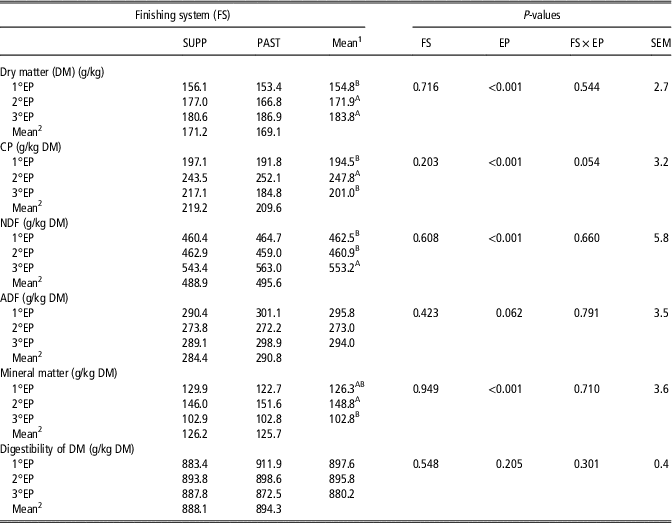
Pasture of paddocks where steers were assigned to SUPP and PAST treatments showed similar nutritional quality (P > 0.05) (Table 1). During the experiment, there was an increase in levels of DM (second and third periods were the highest, P < 0.001) and NDF (third was the highest, P < 0.001), while the ADF values (P = 0.062) and DM digestibility (P = 0.205) remained constant during the experiment. Crude protein content was higher in the second experimental period when compared to the first and third (P < 0.001). Crude protein values were statistically similar for first and third periods (Table 1).
Pasture attributes of legume–grass paddocks grazed by steers finished with (SUPP) or without (PAST) supplementation during three experimental periods (EP)

A,B Values within a column with different superscripts differ significantly at P < 0.05.
1 Means of EP.
2 Means of FS.
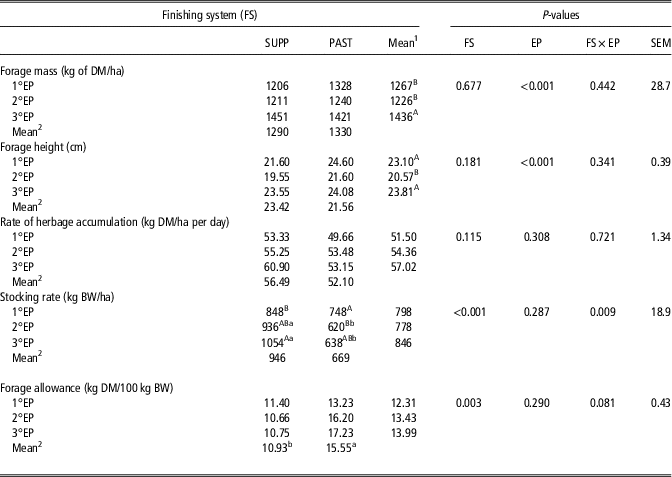
There was no effect of feeding system on forage mass (P = 0.677) and on forage height (P = 0.181). However, these traits were affected (P < 0.001) by experimental period (Table 2). In the third period, forage mass was higher (P < 0.001) than the first and second periods. Forage allowance values remained statistically similar during all periods (P = 0.291) and differed only between treatments (P = 0.003). The rate of herbage accumulation was not affected by experimental period (P = 0.308) and finishing diet (P = 0.115).
Parameters of legume–grass mixture pasture with (PAST) or without supplementation (SUPP) over the three periods (EP) of finishing steers

DM = dry matter.
A,B Values within a column with different superscripts differ significantly at P < 0.05.
a,b Values within a row with different superscripts differ significantly at P < 0.05.
1 Means of EP.
2 Means of FS.
The SUPP treatment led to increased weight gain per hectare when compared to PAST, 292 v. 167 kg of BW/ha (P < 0.001, SEM = 12.33). Higher stocking rate (Table 2) and higher DWG of steers (Table 3) led to increased weight gain per area. There was an interaction effect between period and FS for stocking rate (P = 0.009). Stocking rate values were higher in the third experimental period for SUPP steers due to intensified forage production caused by access of steers to supplementation and the need of maintaining desirable forage mass.
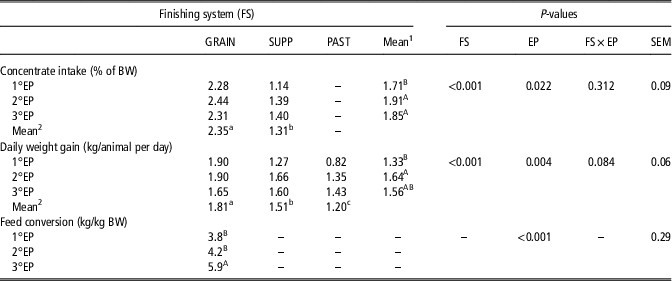
Intake of concentrate and daily weight gain during the experimental periods (EP) of finishing steers in feedlot with exclusively concentrate (GRAIN), legume–grass mixture pasture with (SUPP) or without supplementation (PAST)

A,B Values within a column with different superscripts differ significantly at P < 0.05.
a,b,c Values within a row with different superscripts differ significantly at P < 0.05.
1 Means of EP.
2 Means of FS.
Animal performance
Steers finished on GRAIN led to greater DWG, followed by steers from SUPP and PAST (P < 0.001) (Table 3). Consequently, TWG also differed among the three treatments (P = 0.005) (Table 4). Effect of experimental period was observed for DWG (P = 0.004). Daily weight gain on the first experimental period was significant lower when compared to the second, whereas values observed on the third period were similar when compared to the first and second. This is in agreement with data observed when evaluating concentrate intake. Feed conversion of steers fed GRAIN was 3.8B, 4.2B and 5.9A kg/kg BW, for period 1, 2 and 3, respectively (P < 0.001, SEM = 0.29).
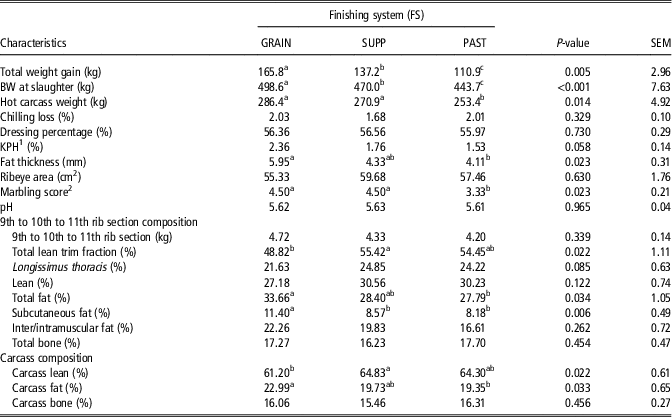
Carcass characteristics, on 9th to 11th rib section and carcass composition of steers finished in feedlot with exclusively concentrate (GRAIN), legume–grass mixture pasture with (SUPP) or without supplementation (PAST)

a,b,c Values within a row with different superscripts differ significantly at P < 0.05.
1 Kidney, pelvic and heart (KPH) fat weight.
2 Marbling was assessed subjectively, using a 10-point scale (1 = devoid, 2 = practically devoid, 3 = traces, 4 = slight, 5 = small, 6 = modest, 7 = moderate, 8 = slightly abundant, 9 = moderately abundant and 10 = abundant).
Carcass traits
Body weight at slaughter (P < 0.001), HCW (P = 0.014), fat thickness (P = 0.023) and marbling (P = 0.023) were higher in carcass from steers fed GRAIN when compared to PAST (Table 4). Rib sections from steers fed GRAIN showed higher values of total fat when compared to PAST (P = 0.034) and lower total lean trim fraction when compared to carcass from steers fed SUPP (P = 0.022) (Table 4). Subcutaneous fat from GRAIN carcasses were higher than SUPP and PAST carcasses (P = 0.006). However, FS treatments did not alter intramuscular/intermuscular fat ratio (P = 0.262). Feeding systems altered carcass composition by shifting between lean tissue development to fat deposition. Steers finished on GRAIN had lower carcass lean values (%) when compared to SUPP (P = 0.022) and higher fat (%) when compared carcass from steers fed the PAST diet (P = 0.033) (Table 4).
Macroscopic and microscopic evaluation of the gastric tract and liver
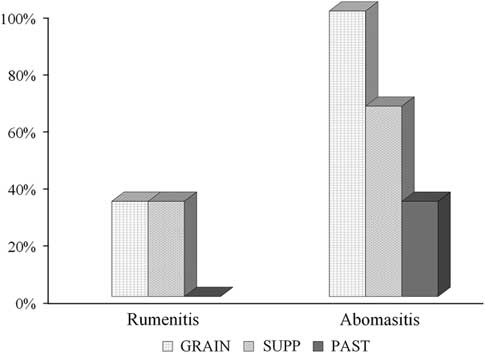
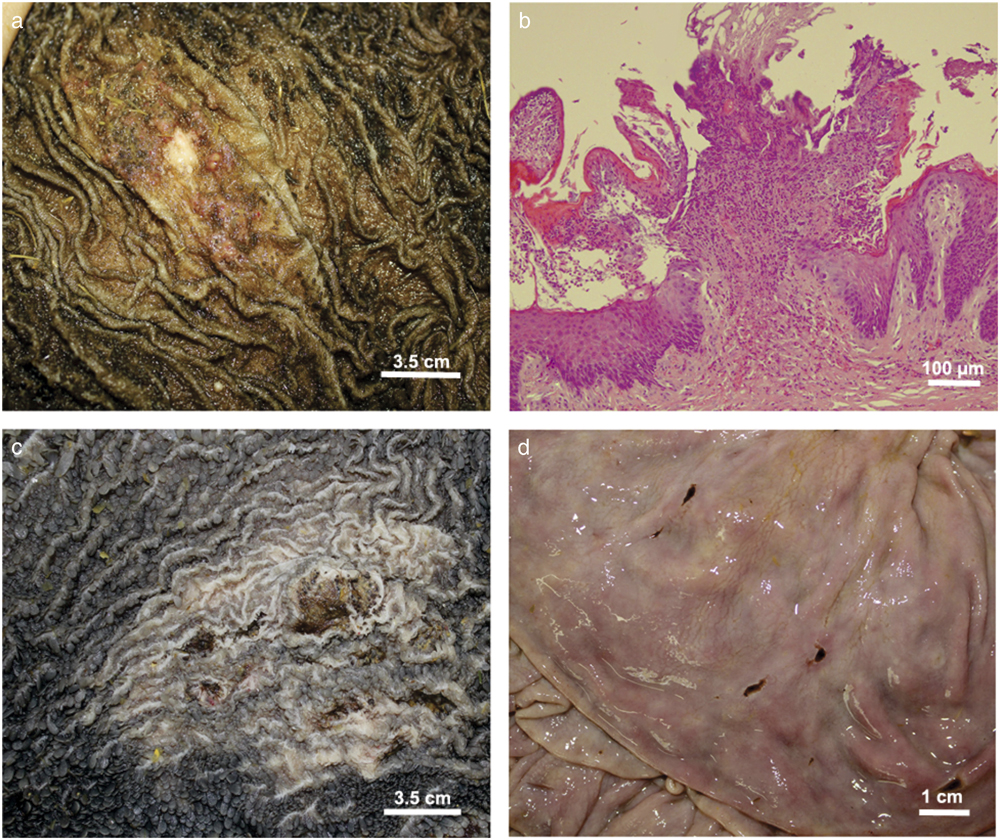
No macroscopic and microscopic lesions were observed in the reticulum, omasum and liver abscesses of cattle. The prevalence of rumenitis in finished steers from GRAIN and SUPP treatments was 33.3% (P = 0.296) (Figure 1). Ruminal macroscopic lesions, characterized by multifocal areas of scar retraction in the mucous membrane with loss of ruminal papillae were observed in the rumens from two steers finished on GRAIN and one finished on SUPP (Figure 2c). Rumen from one SUPP steer presented a focally extensive hyperemic area, with loss of papillae and detachment of the ruminal mucous membrane (Figure 2a). Microscopic evaluations showed lesions on the rumens from two GRAIN and from two SUPP steers. Lesions consisted of multifocal areas of loss of epithelium coating replaced by fibrous connective tissue. Rumens from steers fed GRAIN (n = 1) and SUPP (n = 1) showed multifocal areas of ulceration of the rumen epithelium, covered by fibrin, intact and degenerated neutrophils, erythrocytes and cellular debris (Figure 2b). This suggests a mild rumenitis with a score of 0.33 for those steers whereas no signs of lesions (score = 0) was observed in rumens from steers fed PAST (P = 0.362).
Prevalence of ruminal lesions (rumenitis) and abomasites (abomasitis) in steers finished in feedlot with exclusively concentrate (GRAIN), legume–grass mixture pasture with (SUPP) or without supplementation (PAST).

(a) Rumen. Reactive area with loss of papillae and mucosal detachment, characterizing subacute rumenitis injury in steers finished on legume–grass pasture with supplementation (SUPP). (b) Rumen. Area of ulceration of ruminal mucous, with replacement by neutrophils, fibrin and cellular debris observed in steers finished in feedlot with exclusively concentrate (GRAIN) and SUPP. Hematoxylin–eosin (H&E), objective 10×. (c) Rumen. Multifocal areas of scar retraction of the mucous and loss of papillae, characterizing chronic rumenitis injury observed in steers finished in GRAIN and SUPP. (d) Abomasum. Multifocal areas of mucosal erosion observed in steers finished in all finishing systems.

Macroscopically, abomasitis were observed in all steers finished on GRAIN, in 66.6% in steers finished on SUPP and in 33.3% of steers finished on PAST (P = 0.049) (Figure 1). Lesions were characterized by circular (Figure 2d) and linear erosions ranging from 0.2 to 1.5 cm in diameter and 1 × 0.5 cm to 4 × 0.5 cm, respectively, microscopic lesions were also observed on abomasum and were characterized by multifocal areas of mucosal erosion, covered by fibrin, intact, and degenerated neutrophils and cellular debris. These lesions indicated the presence of mild multifocal erosive abomasitis.
Discussion
Nutritional quality and pasture production
Values for DM, CP, NDF and MM in the pasture significantly differed among experimental periods. Values of NDF increased along experimental periods due to improved forage maturity (Redfearn et al., Reference Redfearn, Venuto, Pitman, Alison and Ward2002). Aguerre et al. (Reference Aguerre, Cajarville, Kozloski and Repetto2013) and Roberts et al. (Reference Roberts, Kerth, Branden, Rankins, Kriese-Anderson and Prevatt2009) reported that higher values for NDF may limit feed intake. In this experiment, increased values of NDF did not affect digestibility of DM. This effect is due to the increase of hemicellulose values, which can be digested by ruminants, since ADF values were constant along the experimental periods.
The utilization of mixed pastures containing grasses and legumes provides animals a feed with high digestibility of DM (Sleugh et al., Reference Sleugh, Moore, George and Brummer2000) and protein concentration above to what is recommended by the National Research Council (NRC, 2000). Differently than a monoculture pasture, legume–grass mixtures increase yield and uniformity of forage quality over long periods of grazing (Gierus et al., Reference Gierus, Kleen, Loges and Taube2012). Grasses benefit from nitrogen fixation performed by species of legume forage, resulting in increased production and elevated levels of CP in pasture (Gierus et al., Reference Gierus, Kleen, Loges and Taube2012). At the end of the grass cycle, when a decline in nutritional quality of the pasture was expected, quality remained high due to the presence of legumes. In this study, the mix of black oats, ryegrass, white and red clover provided at least 194 g/kg of DM of CP, and 880 g/kg of digestible DM during the experiment. These values were directly affected growth performance of steers.
According to Mott (Reference Mott1984), forage mass values must be between 1200 to 1600 kg DM/ha to avoid limiting feed intake and poor growth performance. In this study, forage mass values were maintained in the appropriate range and a significant increase was observed in period 3 due to the pasture growth stage. These results are in agreement with Redfearn et al. (Reference Redfearn, Venuto, Pitman, Alison and Ward2002), who reported that ryegrass grew 60% at the end of its production cycle and 30% at the beginning of the reproductive stage. The ryegrass growth resulted in an increased stocking rate in the last period and constant forage allowance during the whole experiment. The difference of forage allowance between treatments (P = 0.003) is a desirable factor that maximizes the performance of the SUPP system. The SUPP diet contained WCG as an additional energy source which reduces the forage offer requirement. Bargo et al. (Reference Bargo, Muller, Kolver and Delahoy2003) recommended forage allowance twice greater than the expected intake when finishing steers with supplementation. When finishing cattle on pasture only, forage allowance should be three to five times greater than the expected DM intake. In this study forage allowance was provided based on Bargo et al. (Reference Bargo, Muller, Kolver and Delahoy2003) recommendations. In addition, steers fed SUPP were supplemented with high levels of energy (WCG). This combination led to a 40% increase in pasture productivity per area when compared to the pasture used for PAST (where steers did not receive supplementation). Supplementing energy during grazing is a determining factor that contributes to increased growth performance per ha (Roberts et al., Reference Roberts, Kerth, Branden, Rankins, Kriese-Anderson and Prevatt2009).
Animal performance
The highest daily and total gains observed on steers finished on GRAIN, followed by steers finished on SUPP and PAST are directly related to WCG inclusion. The use of concentrate is a strategy to increase weight gain since it contributes to a better balance between protein and energy (Poppi and McLennan, Reference Poppi and McLennan1995). If energy is available, amino acids will be transaminated or used directly for microbial protein synthesis. Moreover, carbohydrates can be used as carbon skeletons for protein synthesis in combination with ammonia (Bach et al., Reference Bach, Calsamiglia and Stern2005). Feeding higher levels of starch raises ruminal production of volatile fatty acids, which are used as a primary source for hepatic gluconeogenesis (Aguerre et al., Reference Aguerre, Cajarville, Kozloski and Repetto2013; Carvalho et al., Reference Carvalho, Chizzotti, Schoonmaker, Teixeira, Lopes, Oliveira and Ladeira2016). When animals are fed medium to high levels of concentrate, 30% of glucose needed for basal metabolism comes from starch that is not fermented in the rumen and is available in the intestines (Huntington, Reference Huntington1997). Therefore, concentrate diets contribute to high glucose availability, and the remaining energy generated from hepatic gluconeogenesis can be directly used for growth and finishing.
According to NRC, in order to gain 1.36 kg/day, steers weighing 425 kg require 70% of dietary total digestible nutrient (TDN) (NRC, 2000). In this study, the combination of black oat, ryegrass, white and red clover produced enough TDN to meet NRC requirements. This led steers finished on PAST to show higher DWG when compared to forage-fed steers from other studies (Roberts et al., Reference Roberts, Kerth, Branden, Rankins, Kriese-Anderson and Prevatt2009; Duckett et al., Reference Duckett, Neel, Lewis, Fontenot and Clapham2013).
Although digestibility remained constant (Table 1), DWG was smaller in the first experimental period when compared to second (P = 0.004). This may be related to the pasture development stage and increased availability of white and red clover throughout the experiment. These legumes have great palatability, which contributes to stimulate the intake of DM in the mixed pastures with grasses (Graves et al., Reference Graves, Mclean, Jones and Martin2012). Clover and ryegrass have similar development during growth stage. However, clover has higher yields during the end of the grass stage (Carrère et al., Reference Carrère, Louault, De Faccio Carvalho, Lafarge and Soussana2001). The presence of legumes in mixture pastures may have contributed to possible increased intake of DM and DWG throughout the experiment. In the third period, steers fed the GRAIN diet had similar concentrate intake and increase of feed conversion when compared to the second period. This is due to increased fat deposition in the carcass, resulting in significant increase in feed conversion during the final stages of finishing. Overall fat accretion efficiency is ∼1.7 times that of protein (Owens et al., Reference Owens, Gill, Secrist and Coleman1995), which increases feed conversion.
Carcass traits
In Brazil, the optimal slaughter weight for steers is ∼500 kg, whereas subcutaneous fat thickness must range from 3 to 6 mm (Carvalho et al., Reference Carvalho, Chizzotti, Schoonmaker, Teixeira, Lopes, Oliveira and Ladeira2016). Carcasses with those characteristics were observed in steers from all three FS (PAST, SUPP and GRAIN) and attained the best Brazilian quality grades. The BWS and HCW are expected to be greater in carcasses from steers receiving high-concentrate diets when compared to grass-fed if both are finished on similar time endpoints (Duckett et al., Reference Duckett, Neel, Lewis, Fontenot and Clapham2013). In our study, steers finished on GRAIN had high BWS and HCW than steers fed PAST, however, steers fed SUPP showed similar HCW when compared to steers fed GRAIN. Possibly, this happened due to improved nutritional values of the legume–grass pasture when compared to grass pastures. Combinations of legume–grass pastures and concentrate sources may provide sufficient nutrient balance to promote similar HCW when compared to concentrate diets (Poppi and McLennan, Reference Poppi and McLennan1995). Therefore, using a mixture of black oat, ryegrass, white and red clover plus WCG supplementation as finishing diets is an alternative that provides similar HCW when compared to finishing on grain diets. In countries that do not have beef carcass grading systems based on quality and yield grades, HCW is the most important grid pricing parameter related to producer revenue.
Regarding fat deposition, our findings agree with Duckett et al. (Reference Duckett, Neel, Lewis, Fontenot and Clapham2013), who reported higher fat content on carcasses and greater marbling in grain-fed beef when compared to grass-fed. In this study, we evaluated the effects of diets on the longissimus thoracis muscle, however, deposition of fat in the lean may vary since muscle my show different composition and morphology. Li et al. (Reference Li, Yan, Gao, Yan, Choi and Smith2018) demonstrated that adipogenic gene expression is higher in muscles from the loin compared to chuck or round muscles.
The increased fat deposition in GRAIN carcasses supports the notion that feed conversion increased in the third period of this treatment due to the energetic value of lipids (Owens et al., Reference Owens, Gill, Secrist and Coleman1995). In addition, changes in carcass composition, which shifted between lean tissue and fat, can be attributed to the degree of maturity of animals. When animals approach maturity, there is a significant decrease in lean tissue development, which can decline to 0 when the animal reaches adult body size. In this situation, as long as there is no energy limitation, cattle can continue depositing fat, raising the proportion of adipose tissue in relation to lean (Owens et al., Reference Owens, Gill, Secrist and Coleman1995).
Macroscopic and microscopic evaluation of the gastric tract and liver
Diets with high amounts of concentrate increase production of volatile fatty acids, decrease ruminal pH values, increase acidosis and lead to digestive epithelium damage (rumenitis) (Penner et al., Reference Penner, Steele, Aschenbach and Mcbride2011). In this study a similar prevalence of rumenitis was observed in rumens from steers fed SUPP and GRAIN. Our findings suggest that these injuries are not only related to feeding concentrate (14 or 28 g/kg of BW), but also to adaptation of the ruminal epithelium (Penner et al., Reference Penner, Steele, Aschenbach and Mcbride2011) and rapid stabilization of rumen pH of animals adapted to the level of concentrate (Schwaiger et al., Reference Schwaiger, Beauchemin and Penner2013). Supplementing grains once a day during grazing to finish cattle is a common practice in the southern hemisphere. This leads to greater variation of ruminal pH when compared to feeding total mixed diets (forage plus concentrate) (Aguerre et al., Reference Aguerre, Cajarville, Kozloski and Repetto2013). In our study, supplementing concentrate once during the day contributed to equal prevalence of rumenitis on steers fed SUPP and GRAIN.
Erosions were observed on abomasa of steers from all three FS, however, increased prevalence of erosions were observed on abomasa from steers fed SUPP and GRAIN. Abomasitis is commonly found in cattle from all production systems, whereas adult animals develop this type of injury due to an imbalance between aggression (volatile fatty acids concentration) and defense mechanisms (protective mucus layer), compromising the integrity of the abomasal mucous (Hund et al., Reference Hund, Beer and Wittek2016). The inclusion of WCG increased the prevalence of injuries on the abomasum, possibly due to higher concentrations of volatile fatty acids.
The use of legume–grass pasture provided adequate nutritional requirements to obtain carcasses with yield targets based on Brazilian standards. Finishing diets containing WCG only promoted greater weight gain when compared to mixed pasture and pasture plus WCG. The exclusive concentrate diet increased fat deposition on carcasses, but provide similar HCW to pasture plus WCG. Even though differences in some carcass traits were observed, all three FS produced carcasses that met Brazilian industry requirements. Results of this research showed that it is possible to produce carcasses with desirable traits by finishing steers on legume and grass pasture including oat, ryegrass, white and red clover.
Acknowledgements
The authors would like to thank the Coordination for the Improvement of Higher Education Personnel (CAPES) for the PhD scholarship provided the Program of Social Demand to the first author.
Declaration of interest
The authors declare no conflicts of interest.
Ethics statement
All animal procedures were conducted in accordance with the approved for handling and care of steers by the IFF Ethics Committee on the Use of Animals.
Software and data repository resources
None of the data were deposited in an official repository.