Introduction
Although people with dementia have an increased interface with the healthcare system, through more frequent hospital admissions and emergency room visits relative to older adults without dementia, their daily lives and preferences are not defined by their healthcare experiences. This is particularly the case for those older adults with milder degrees of cognitive impairment or early-stage dementia (2020 Alzheimer’s disease facts and figures, 2020). Even within institutional and long-term care settings, there has been a push toward incorporating individual psychosocial preferences in the everyday lives of residents, with the goal of optimizing person-centered care (Van Haitsma et al., Reference Van Haitsma2013). For instance, previous work has explored preferences and experiences related to diet (Hanssen and Kuven, Reference Hanssen and Kuven2016; Milte et al., Reference Milte, Shulver, Killington, Bradley, Miller and Crotty2017), music (Garrido et al., Reference Garrido, Stevens, Chang, Dunne and Perz2018; Thomas et al., Reference Thomas, Baier, Kosar, Ogarek, Trepman and Mor2017), and sexual activity (Syme et al., Reference Syme, Johnson and Fager2020; Wilkins, Reference Wilkins2015) for older adults with cognitive impairment living in the nursing home setting.
Outside of institutional settings, studies of preferences for older adults with cognitive impairment have generally focused on aspects of care such as home support services (Chester et al., Reference Chester2018; Fæø et al., Reference Fæø, Bruvik, Tranvåg and Husebo2020), advance care planning and end-of-life care (Geshell et al., Reference Geshell, Kwak and Radhakrishnan2019; Harrison Dening et al., Reference Harrison Dening, King, Jones, Vickerstaff and Sampson2016; Pettigrew et al., Reference Pettigrew2019), diagnostic disclosures (van den Dungen et al., Reference van den Dungen2014), and transitions to institutional living environments (Garvelink et al., Reference Garvelink, Groen-van de Ven, Smits, Franken, Dassen-Vernooij and Légaré2019). Prior work has addressed everyday preferences and experiences of community-dwelling older adults without cognitive impairment (Van Haitsma et al., Reference Van Haitsma2013). There has been limited investigation to date, however, of the everyday preferences of older adults with cognitive impairment and mild dementia, outside of general analyses of accuracy of proxy assessments (Carpenter et al., Reference Carpenter, Kissel and Lee2007; Wilkins et al., Reference Wilkins2020). In recent work using the Preferences for Everyday Living Inventory (PELI) in a cohort of older adults with cognitive impairment, we found significant participant-care partner discrepancy in assessment of the importance of “social engagement” preferences (e.g. regular contact with family, meeting new people, volunteering) (Wilkins et al., Reference Wilkins2020).
There remains, nevertheless, a paucity of information about the relative importance of various everyday preferences for community-dwelling older adults with cognitive impairment and the factors driving greater importance of different preferences. The current study will: (1) expand on the characterization of the everyday values and preferences of community-dwelling persons with cognitive impairment; (2) address cognitive impairment severity, demographic factors, and neuropsychiatric symptom burden as potential predictors of the importance of various everyday preferences for older adults with cognitive impairment.
Methods
Study sample
The sample included 62 community-dwelling persons with cognitive impairment (Clinical Dementia Rating (CDR) global score ≥ 0.5). Participants living in long-term care (assisted living facility or skilled nursing facility) were not included in this study. Participants were recruited from the Massachusetts Alzheimer’s Disease Research Center (MADRC) Clinical Core longitudinal cohort; the recruitment scheme was described previously (Wilkins et al., Reference Wilkins2020). Briefly, all cohort participants with CDR global score ≥ 0.5 (i.e. persons with either mild cognitive impairment (MCI) or physician-determined clinically meaningful cognitive impairment without meeting formal MCI criteria) who presented to the MADRC with a care partner over a 13-month period from 2017 to 2018 were invited to participate in the current study; those who agreed to participate were enrolled.
There was approximately 67% enrollment among cohort participants who were approached for the study. Reasons for non-enrollment included refusal to participate, residence in long-term care, and cognitive impairment too severe to complete the study measures. Some participants did not have enough time to complete study measures. For example, participants sometimes arrive late to their appointment times due to the heavy traffic to/from the Boston location of the ADRC; thus, for reasons unrelated to psychosocial activities outside the study, there was insufficient time to complete the study measures, as the priority was completion of the required Uniform Data Set (see below). Participants provided written informed consent, and the Partners HealthCare Institutional Review Board reviewed and approved this study.
Measures – predictors/covariates
MADRC cohort participants and their care partners complete annual evaluations that follow the Alzheimer’s Disease Centers Uniform Data Set (UDS) protocol (Weintraub et al., Reference Weintraub2009). Briefly, the evaluation features a standard battery of cognitive assessments (e.g. in memory, attention, executive function, fluency, etc.), ascertainment of demographic information, the CDR (Morris, Reference Morris1993), behavioral and symptom measures (e.g. Neuropsychiatric Inventory brief Questionnaire [NPI-Q] (Kaufer et al., Reference Kaufer2000) and 15-item Geriatric Depression Scale [GDS-15] (Yesavage and Sheikh, Reference Yesavage and Sheikh1986)), and general cognitive testing (e.g. Montreal Cognitive Assessment [MoCA] (Nasreddine et al., Reference Nasreddine2005)), as well as a medical history and neurological examination.
Measures – dependent variables/preferences assessment
Persons with cognitive impairment completed the PELI, which is a validated preferences assessment tool for older adults with current preferences rated on a 4-point Likert scale ranging from 1 (most important) to 4 (not at all important) (Van Haitsma et al., Reference Van Haitsma2013). PELI data from participants were collected in a cross-sectional fashion and no longitudinal data were included in the analyses. Our previous work used exploratory factor analysis to derive potential latent sub-scales embedded within the 55-item PELI, and identified four factors, which were labeled: “autonomous choice” (involving 14 items), “social engagement” (15 items), “personal growth” (14 items), and “keeping a routine” (6 items) (see Supplementary Material, Table S1 for the items in each sub-scale) (Wilkins et al., Reference Wilkins2020). For this analysis, our assumption is that the numeric scales across these four domains are conceptually equivalent, that is, a given numeric score on one domain measures the same strength of preference for that domain as the same numeric score for the other domains. To account for missing data and differences in the number of items across the domains, a mean domain score was calculated for each participant per domain; this score was calculated as the average of the non-missing importance ratings of only those PELI items contributing to that respective domain. Missing preference data was only 1.3% of the total items that could have been completed (40/3185).
Statistical analyses
Within-subjects analysis of variance (ANOVA) was used to test for significant differences in the mean domain scores for the four domains of the PELI, as this method accounts for the correlation between domain scores (pairwise Pearson correlations among domains, degrees of freedom, df = 60, ranged from r = 0.28 to 0.54, p = 0.03 to < 0.0001). Tukey–Kramer-adjusted post hoc tests were used to assess significance between pairs of domains, following any significant main effect of the domain. Because of the scaling of the PELI, lower scores denote assignment of higher importance and higher scores denote assignment of lower importance.
To identify predictors of importance ratings for each domain of the PELI, multivariable-adjusted general linear models (GLM) were used. The dependent measure was the mean domain score for the various PELI domains. Model predictors were CDR global score, total NPI-Q score, GDS-15 score, as well as participant age (years), sex, years of education, marital status, and race. Given low counts for marital status categories besides married/domestic partner, marital status was collapsed to two categories: (1) “Married/Domestic Partner” and (2) “Widowed,” “Divorced,” “Separated,” or “Never Married.” Similarly, given low counts for race other than White, race was collapsed to two categories: (1) “White” and (2) “Black or African American,” “American Indian or Alaska Native,” or “Asian.” To control for type I error, we corrected the omnibus model p corresponding to the four dependent variable models with the stepdown Šidák correction. For the models that remained significant after this correction, further investigation of the significance of the individual predictors in the models was pursued.
MoCA score was not included as a predictor in the models due to significant correlations with total NPI-Q and CDR global score (pairwise Pearson correlations, df = 56, r = −0.42 and −0.54, p ≤ 0.0015). For similar reasons of avoiding multi-collinearity, CDR global score and CDR sum-of-boxes (CDR-SB) could not both be included in the model; CDR global score was used instead of the CDR-SB because the models including CDR global score had higher R-square values. Graphical analyses of residuals from these GLMs were conducted to confirm assumptions of normality and homoscedasticity were reasonably met. All statistical analyses were performed using SAS Version 9.4 (SAS, Cary, NC, USA).
Results
Participant characteristics are shown in Table 1. The cohort was just over half male (57%) and predominately White (89%), highly educated (average years of education was 16.5), and married/in a domestic partnership (76%). Approximately 21% had dementia (77% with an amnestic syndrome including Alzheimer’s disease), 36% had MCI, and 44% fell into the ADRC program’s “cognitively impaired, not MCI” category (i.e. CDR global score = 0.5 but without MCI criteria-level evidence of objective deficits on neuropsychological testing) (Besser et al., Reference Besser2018). Regarding cognitive assessment variables, 82% of participants had CDR global score of 0.5, mean CDR-SB was 2.4, and mean MoCA was 23.4 points.
Description of participants: demographic and clinical characteristics. All scores based on n = 62, unless otherwise noted

Percentages might not add up to 100% due to rounding.
a n = 60.
b n = 58.
c n = 54.
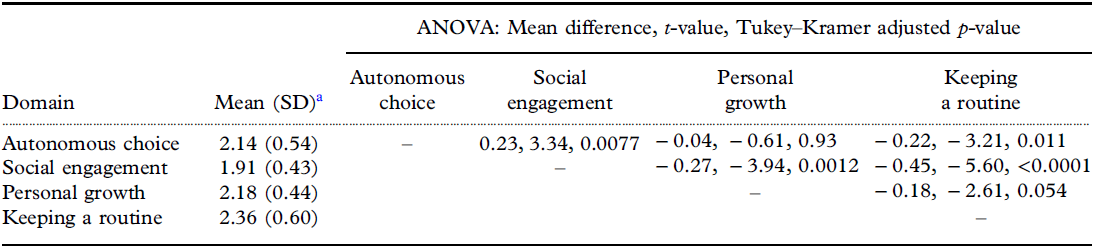
The preferences domain that was ranked as most important among participants was “social engagement,” followed by “autonomous choice,” “personal growth,” and “keeping a routine” respectively (Table 2). There were significant differences in mean domain scores of importance by within-subjects ANOVA (F(3,61) = 10.84, p < 0.0001). Post hoc testing (Tukey–Kramer) revealed statistically significant (p < 0.05) differences between all pairwise domain comparisons, except for the comparisons of “autonomous choice” with “personal growth” and of “personal growth” with “keeping a routine” (Table 2 and Supplementary Material, Figure S1). We conducted an additional analysis that further included a subject-level measure of severity of cognitive impairment (CDR global score) as a covariate interacting with domain. The interaction was not significant, indicating that there was no evidence that relative domain preferences were related to variation in severity of cognitive impairment within the range studied here (data not shown).
Results of within-subjects analysis of variance (ANOVA) comparing the mean domain scores for the four domains of the Preferences for Everyday Living Inventory (PELI). F(3,61) = 10.84, p < 0.0001. N = 62

SD, Standard Deviation.
PELI items are ranked on a 4-point Likert scale with 1 = very important, 2 = somewhat important, 3 = not very important, and 4 = not at all important.
a Mean domain score for each domain is calculated as the average of the importance ratings of PELI items contributing to that domain.
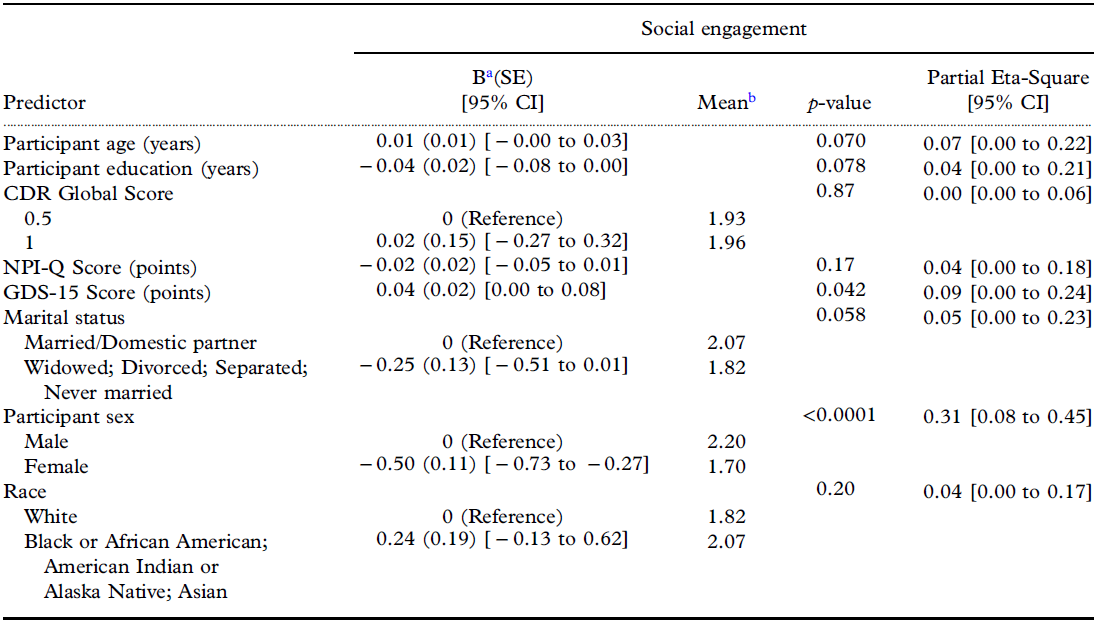
Multiple regression was then used to identify predictors of importance ratings separately for each of the four domains of the PELI. The model for “social engagement” (R 2 = 0.43; F(8,44) = 4.07, stepdown Šidák corrected p = 0.0044) showed a significant effect of the set of predictor variables as a whole. The models for “autonomous choice” (R 2 = 0.20; F(8,44) = 1.33, corrected p = 0.44), “personal growth” (R 2 = 0.28; F(8,44) = 2.14, corrected p = 0.15), and “keeping a routine” (R 2 = 0.09; F(8,44) = 0.57, corrected p = 0.80) were not significant. For the “social engagement” preferences domain, female sex was significantly associated with higher importance (B −0.50, p < 0.0001), while depressive symptoms (i.e. higher GDS-15 score) were significantly associated with lower importance ratings (B 0.04, p = 0.042 (Table 3). Effects size as determined by partial eta-square (i.e. the variance in the importance rating uniquely explained by the predictor, adjusting both the dependent variable and predictor) was large for participant sex (0.31) and moderate for depressive symptoms (0.09) (Table 3). Residuals from all significant models above conformed to an assumption of normality.
Multiple regression of key predictors of the mean domain importance score for “social engagement” preferences of the Preferences for Everyday Living Inventory (PELI); N = 53; degrees of freedom = 8, 44

a B is the unstandardized partial regression coefficient from the model.
b Adjusted means of the domain importance score for each of the categories of the given categorical predictor. Because of the scaling of the PELI, lower scores denote assignment of higher importance and higher scores denote assignment of lower importance.
Discussion
This study offers a novel window into the everyday experiences and preferences of community-dwelling older adults with cognitive impairment and mild dementia. In this sample “social engagement” preferences (e.g. regular contact with family, meeting new people, volunteering) were rated as significantly more important than preferences for other domains of everyday living (“autonomous choice,” “personal growth,” and “keeping a routine).” Of note, although “social engagement” preferences emerged as particularly important for people with cognitive impairment, we found in prior work that proxy ratings completed by care partners tended to significantly underestimate the importance of “social engagement” preferences for people with cognitive impairment (Wilkins et al., Reference Wilkins2020).
Regarding predictors of the domain of “social engagement,” female sex and depressive symptoms were significantly associated with importance ratings. “Social engagement” activities were rated with significantly higher importance for women than men. Indeed, in prior work we found that male care partners significantly underestimated the importance of “social engagement” preferences for people with cognitive impairment relative to the proxy ratings of female care partners (Wilkins et al., Reference Wilkins2020). Other work looking at human values found that older adult women tended to score more highly than men on supra-personal values (e.g. beauty, knowledge, maturity) and existence values (e.g. health, stability, survival) (Vilar et al., Reference Vilar, Liu and Gouveia2020). Thus, one speculative explanation for our finding is that such sex differences in human values may be reflected in the “social engagement” preferences domain in our study population.
With respect to depression, higher depressive symptoms were significantly associated with lower importance ratings of “social engagement.” We are unable to infer, however, either causality or directionality of this association with a cross-sectional design. It may be that the anhedonic, anergic, and amotivational features of depression lead to a lower emphasis on social engagement; alternatively, it may be that decreased social engagement leads to increased depressive symptoms. Regarding the latter possibility, a previous prospective cohort study showed that increasing social engagement for older adults led to decreased depressive symptoms, particularly for women (Hajek et al., Reference Hajek2017). Thus, placed in the context of prior work, our results suggest that “social engagement” could have implications for monitoring and/or treatment of depression in the context of cognitive impairment.
Strengths of this study included comprehensive assessment of everyday preferences in a well-characterized sample and use of gold-standard cognitive and neurobehavioral assessments. Study limitations included a relatively small sample size, a cross-sectional design, increased type I error rate given the exploratory analyses, limited racial diversity, and an average higher level of education compared to similarly aged participants nationally. Another potential limitation was the lack of a cognitively normal control group for comparison, to assess whether these findings are specifically relevant to living with cognitive impairment versus aging in general. Results from the additional analyses showing a lack of significant interaction of CDR global score with preferences domain score provided some indication that effect estimates were not influenced by severity of cognitive impairment, at least within the range of cognitive impairment studied here.
Overall, this study added to the body of literature on everyday preferences among community-dwelling older adults with cognitive impairment and mild dementia, and it identified the importance of “social engagement” as well as the influences of sex and depression on the perceived importance of “social engagement” experiences. It appears that in our sample, there is a relatively large effect size of participant sex with a more moderate effect size for depressive symptoms on the importance of “social engagement” preferences. Future work may further assess the magnitude of these estimates in a larger sample as well as the role of any thus far unmeasured predictors. Also, given the disproportionate impacts of COVID-19 and social distancing on older adults, there may be future opportunities to reconsider the importance of social engagement, as well as its predictors, for older adults with cognitive impairment in a world that is increasingly reliant on virtual and remote meeting interfaces.
Conflict of interest
None.
Description of authors’ roles
James M. Wilkins, MD, DPhil (study concept and design, acquisition of subjects and/or data, analysis and interpretation of data, and preparation of manuscript); Joseph J. Locascio, PhD (study concept and design, analysis and interpretation of data, and preparation of manuscript); Jeanette M. Gunther (study concept and design, acquisition of subjects and/or data); Liang Yap, PhD (study concept and design, acquisition of subjects and/or data); Teresa Gomez-Isla, MD (study concept and design, acquisition of subjects and/or data, and preparation of manuscript); Bradley T. Hyman, MD, PhD (study concept and design, acquisition of subjects and/or data, and preparation of manuscript); Deborah Blacker, MD, ScD (study concept and design, acquisition of subjects and/or data, analysis and interpretation of data, and preparation of manuscript); Brent P. Forester, MD, MSc (study concept and design, analysis and interpretation of data, and preparation of manuscript); Olivia I. Okereke, MD, SM (study concept and design, acquisition of subjects and/or data, analysis and interpretation of data, and preparation of manuscript).
Acknowledgements
Grateful acknowledgement is made of the contributions of Emily Merrill in data collection and processing as well as the MADRC participants and study staff. This work was supported by the Dupont Warren Fellowship, Harvard Medical School, Department of Psychiatry (JMW); Livingston Award, Harvard Medical School, Department of Psychiatry (JMW); Alzheimer’s Association Clinician Scientist Fellowship (JMW); National Institutes of Health Loan Repayment Award, L30 AG060475 (JMW); grant P30 AG062421 from the National Institutes of Health (BTH).
This work was conducted with support from Harvard Catalyst | The Harvard Clinical and Translational Science Center (National Center for Advancing Translational Sciences, National Institutes of Health Award UL 1TR002541) and financial contributions from Harvard University and its affiliated academic healthcare centers. The content is solely the responsibility of the authors and does not necessarily represent the official views of Harvard Catalyst, Harvard University and its affiliated academic healthcare centers, or the National Institutes of Health.
Supplementary material
To view supplementary material for this article, please visit https://doi.org/10.1017/S1041610220003956