

Energy security has become a big concern in China. In order to enhance its energy security, the government tries hard to bolster its national oil companies' (NOCs) foreign energy quest. In explaining the three most daunting challenges for China's “peaceful rise” (heping jueqi 和平崛起), Zheng Bijian 郑必坚, one of China's leading thinkers and an advocate of the “peaceful rise” theory, highlights lack of resources and particularly energy as the top challenge.Footnote 1 To support the NOCs' overseas expansion, China's financial institutions are required to give credit and foreign exchange support to aid firms investing in strategic resources in foreign markets, carrying out foreign resource exploration and production (E&P), or transferring China's surplus productivities and ripe technologies.Footnote 2 Zhang Xiaoqiang 张晓强, vice-chairman of China's National Development and Reform Commission (Guojia fazhan gaige weiyuanhui 国家发展改革委员会), said that China will encourage domestic firms to become actively involved in market competition and global allocation of oil, gas, minerals and other types of resources.Footnote 3
Despite a few voices against China's “oil diplomacy,”Footnote 4 most Chinese scholars and think tanks are delighted to see Chinese companies' foreign energy quest; they urge the Chinese government to render necessary support through diplomatic and financial means, as well as the necessary institutional reshuffles.Footnote 5 As argued by Dong Xiucheng 董学成, a renowned energy expert from China Petroleum University (Zhongguo shiyou daxue 中国石油大学), “So long as we control more energy from upstream, China can be protected from the drastic fluctuations of international energy prices so as to stabilize domestic energy prices.”Footnote 6
In practice, Chinese NOCs have been proactive in investing abroad in the name of serving national energy security.Footnote 7 Incomplete statistics show that by 2007, more than 180 overseas oil/gas E&P projects were conducted by Chinese companies.Footnote 8 The year 2009 in particular saw a sudden surge in overseas investment by China's NOCs, which were reported to have spent more than US$30 billion snapping up assets around the globe.Footnote 9
A large body of research has paid attention to Chinese investment, but no research has been conducted to examine the implications of Chinese NOCs' energy quest on China's energy security. Policy makers, the business community, think tanks and scholars involved in this topic tend to embrace the idea, explicitly or implicitly, that Chinese NOCs' foreign energy quest could enhance China's energy security. This is, however, an untested hypothesis.
This article aims to fill this gap. It finds that the Chinese NOCs have made some progress in their foreign energy quest, which contributes to their coffers and reserves, but that does not mean that China's energy security is greatly enhanced; in particular, the diversity and reliability of China's foreign oil sources are questionable. The next section briefly reviews preceding studies, followed by an introduction of the analytical framework. In the fourth section, the extent to which Chinese NOCs' energy quest has enhanced China's energy security is systematically examined by reference to the designed benchmarks. The fifth section examines the relationship between the state and NOCs from the institutional perspective.
China's Outward Direct Investment: Literature Review
The literature on outward direct investment (ODI) is large. Much attention has been given to the motivations behind China's ODI, patterns, spatial and/or sectoral distributions, the advantages of Chinese enterprises, and the impact of ODI. This section deals only with those studies that have a direct bearing on the impact of China's ODI.
The intellectual community overwhelmingly focuses on the impact on other countries or regions, with the exceptions of Cai and Liu et al. Cai examined the implications of China's ODI on its integration into the regional and global economy,Footnote 10 while Liu et al. analysed whether China's ODI follows an established, universal pattern.Footnote 11 Insufficient weight was given to the implications on China's energy security although much of Chinese ODI aims to acquire more foreign energy resources.
Studies on the impact on other countries or regions tend to fall at opposite ends of the spectrum. At one end are alarmists who tend to regard China's NOCs as proxies of Beijing's strategic actions and ODI by them as a menace to the West and a destabilizing force in the international energy market. Their painstaking efforts to secure foreign oil are bound to intensify inter-state competition for scarce resources, which would further lead to confrontations.Footnote 12 “Rising energy-related insecurities combined with larger uncertainties surrounding China's future and the commitment of the US to remain the region's preeminent security guarantor after the end of the cold war represented a potent admixture with ominous implications for peace and stability.”Footnote 13
At the other end are those who are more sympathetic towards China as a latecomer to the world market. Criticizing Chinese NOCs' overseas expansion as mercantilists, which views the scramble for oil as a zero-sum game, “exaggerates the differences between Chinese and American oil policies.”Footnote 14 Instead of regarding China's energy quest as a threat, they argue that the global energy market is highly integrated and China's energy quest has expanded world energy supply. Thus, the view of clashes for oil has been exaggerated.Footnote 15
A third interpretation takes a more eclectic standpoint. He and Lyles argued that the thesis of either China fever or China fear, two opposite responses by the American public towards Chinese ODI, is shortsighted and not solidly based on an accurate understanding of China's increasing economic power.Footnote 16 While acknowledging that China's growing demand for energy and its efforts in meeting the enormous challenges will have major repercussions for the rest of the world, Cornelius and Story maintain that conflict between the US and China is far from inevitable, as long as “the global price mechanism operates reasonably efficiently and Washington and Beijing can operate in partnership rather than rivalry.”Footnote 17 Although their “scramble for Africa” may irritate, Xu rebukes the alarmist view that competition for oil/gas in Africa between China and the US will cause direct confrontation.Footnote 18
The above analyses tend to presuppose, explicitly or implicitly, that the Chinese NOCs' foreign energy quest could enhance China's energy security. The first alarming interpretation unambiguously contends that the NOCs' ODI solely serves China's national interests at the expense of other oil importing countries. The second and third interpretations may not directly make such a pre-assumption; nevertheless, they believe that China's energy security interest is in line with the global market, and hence China could benefit from its NOCs' ODI by enlarging global oil/gas supplies. This is, however, an untested hypothesis.
Using that logic, the NOCs were often described as the proxies of the Chinese government,Footnote 19 and their foreign quest allegedly intended to bring more oil and resources to feed China's surging appetite.Footnote 20 However, the advantages the NOCs can enjoy are necessary, but not sufficient, conditions for them to be the arms of the government. After all, this nominal relationship is liable to conceal their interest concerns which overlap in some issue areas and conflict in others.
Moreover, studies on China's ODI predominantly assessed its impact on other countries or regions, but no research has been conducted to examine the implications on China's energy security. In methodology, most previous research has provided descriptions of ODI trends,Footnote 21 coupled with in-depth case studies on a small number of high-profile Chinese multi-national enterprises.Footnote 22 Conclusions based on such methods are debatable.
Energy Security in China and Research Framework
Energy security has gained wide currency since the first oil crisis in the 1970s. However, it has different meanings for different countries.Footnote 23 In the case of China, most Chinese scholars and think tanks believe that oil security is the core. Some scholars stress that utilization of energy should not be a big threat to the ecological environment,Footnote 24 but most of them regard energy security as a condition in which continuous and stable oil supplies are available to satisfy domestic oil demands in order to ensure national survival, social stability and economic development.Footnote 25
Bo Kong posits it important to consider China's actual and perceived insecurity and that it is the government's perceptions about insecurity that drives China's energy policy.Footnote 26 What the Chinese government perceives, as most foreign analysts hold, is “state-centric, supply-side biased, overwhelmingly focused on oil, and tends to equate security with self-sufficiency,”Footnote 27 notwithstanding the different view by Constantin.Footnote 28
Therefore the availability, reliability and affordability of oil are not the whole story of China's energy security, but they remain the core. This article does not seek to examine the impact of China's foreign energy quest on its energy security in every aspect, but primarily in the supply-side sense. Before elaborating on Chinese NOCs' foreign investment, it is necessary to learn the backdrop against which the Chinese government supported the NOCs to “go out” (zou chuqu 走出去).
That domestic production of hydrocarbon resources can hardly meet domestic demand is where the shoe pinches for China. The leading energy source is coal, followed by oil; gas has merely played a marginal role in China's energy equation. In 2007, the proportion of coal reached 69.5 per cent, while oil and gas accounted for 19.7 per cent and 3.5 per cent respectively.Footnote 29 However, China can be self-sufficient with regard to coal whereas it has to rely on foreign oil/gas sources to meet domestic surging demands.
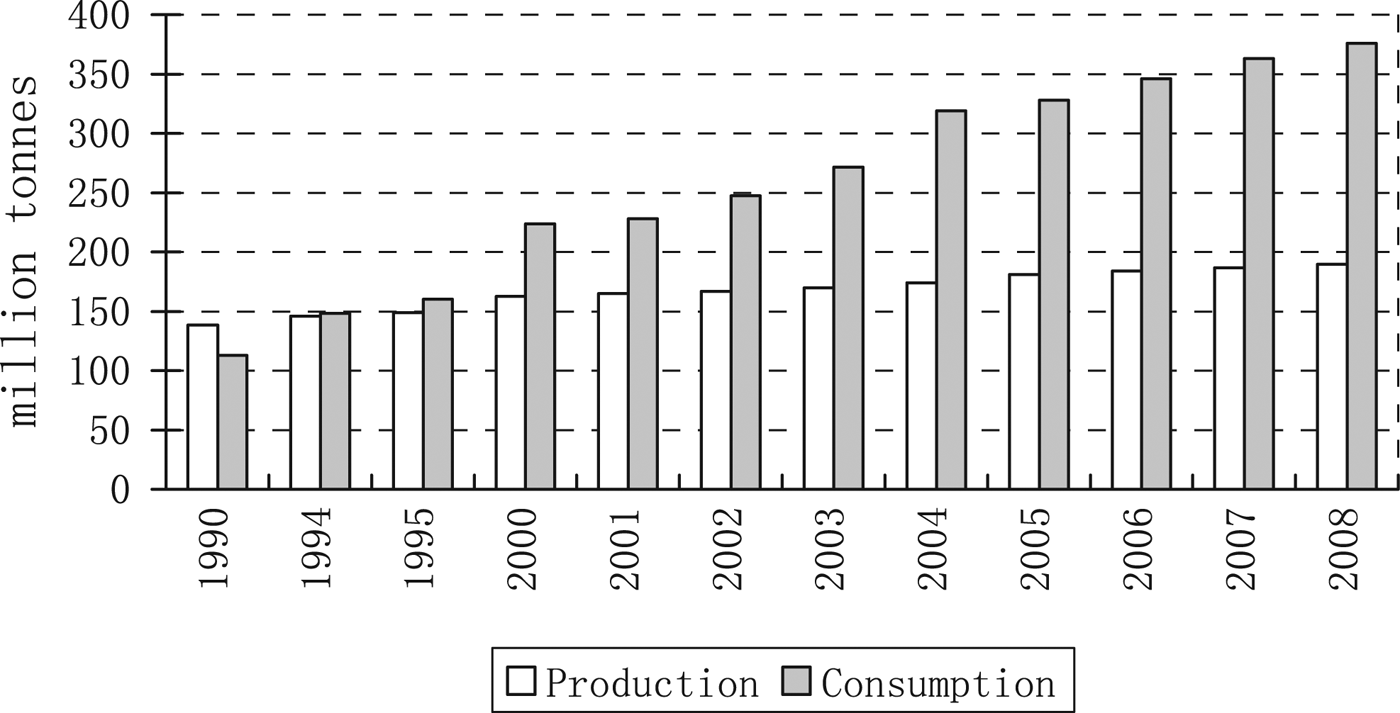
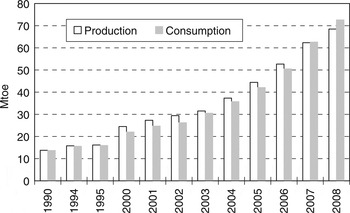
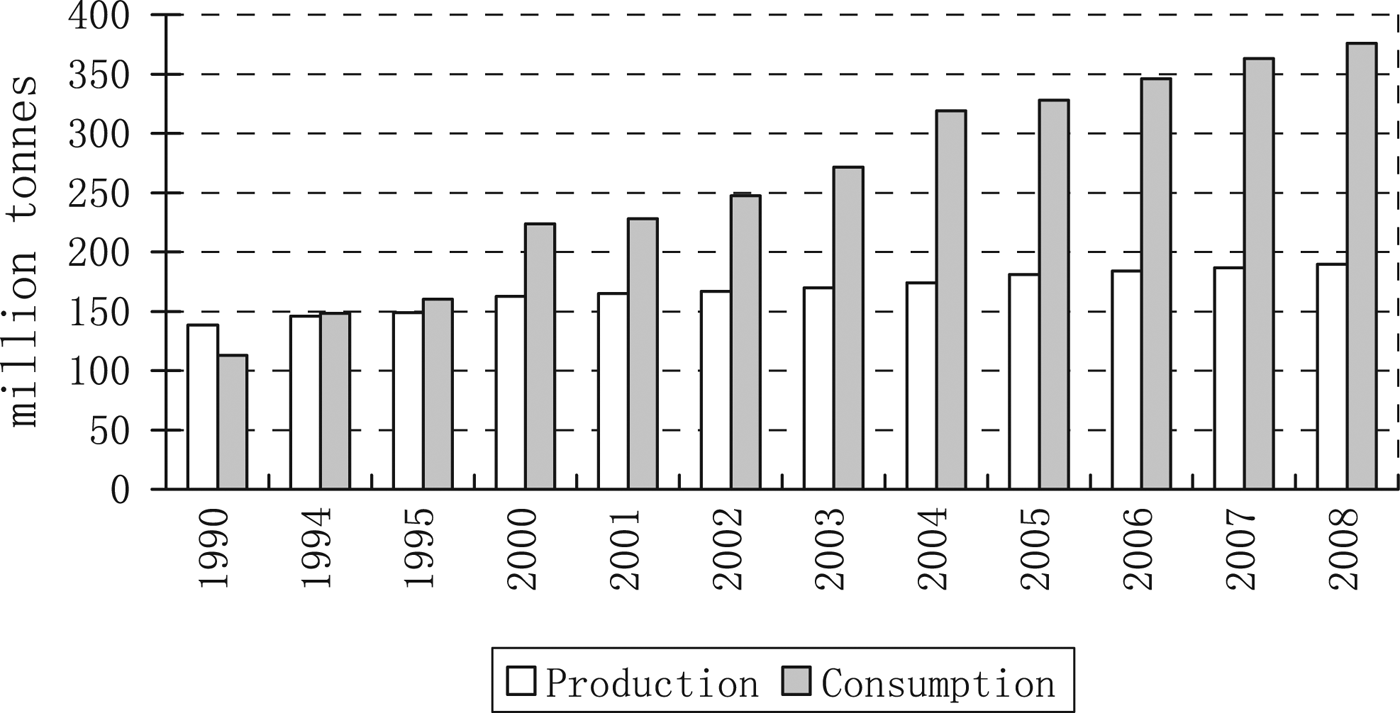
As shown in Figure 1, China's indigenous oil production rose from 138 million tons (Mt) to 190 Mt between 1990 and 2008, growing only 37 per cent, whereas domestic oil demand in 2007, 376 Mt, was 2.3 times that of 1990. An increasing imbalance has thus resulted from China's fast-growing demand and insufficient indigenous energy supply. Likewise, natural gas consumption has grown rapidly in the last few years. It rose 102.5 per cent from 13.7 million tonnes oil equivalent (Mtoe) in 1993 to 72.6 Mtoe in 2008. Indigenous natural gas output was able to meet domestic consumption until 2007 (see Figure 2). According to the International Energy Agency, imports will reach 37 Bcm by 2030, constituting 29 per cent of total natural gas consumption (162 Bcm).Footnote 30
China's Oil Production & Consumption
China's Gas Production and Consumption

China therefore has to rely more on foreign markets. Securing more fossil fuels from abroad has become one of the priorities of China's foreign relations and an important part of its foreign strategies. The government expects the NOCs to play this role, a reason why they have state support in their foreign energy quest.Footnote 31
Currently the NOCs are the major players, though a few Chinese private firms, much smaller in scale, have also started to “go abroad.” The NOCs are tasked to acquire more equity oil/gas, diversify oil/gas imports, and secure pipelines or long-term supply contracts with foreign oil/gas producers. “Equity oil” (fen'e you 份额油) is a practice by petroleum firms to participate in foreign oil or gas projects in the form of share of stocks or investments; in return, they can annually obtain a certain portion of oil/gas produced from those projects. This is a form preferred by the NOCs because the upstream (E&P) sector is the most profitable part of the business.Footnote 32 Marketization and corporatization in the reforms have forced their management teams to assume responsibility for their own balance sheets.Footnote 33
Based on statistical analysis, this study analyses the impact of Chinese NOCs' foreign energy quest on the country's energy security from institutional and international comparative perspectives. The international comparative approach is used to examine the progress made by Chinese NOCs in securing foreign energy resources and the prospects in that regard. Data are mainly from international organizations, Chinese government agencies and NOCs.
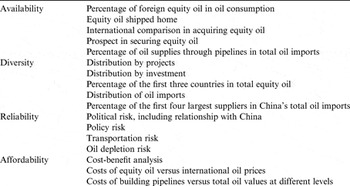
The article sets out four vectors to measure the impact of Chinese NOCs' foreign oil acquisitions on its energy security. These are availability, diversity, reliability and affordability. Under each vector some specific indicators have been developed (see Table 1). The following starts from the forms and quantity of energy flows that the NOCs have acquired.
Four Indicators of China's Energy Security

Availability
A sufficient oil/gas supply is the central component of energy security. There are two major forms that are supposed to contribute to energy security in China: one is equity oil and the other is long-term oil supplies, either through pipelines or on the basis of contracts. To gauge the impact of the NOCs' foreign energy acquisition on China's energy security from the angle of availability, the share of foreign equity oil in China's oil consumption and the pipeline capacity in China's oil consumption were used as indicators.
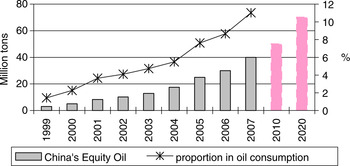
As indicated in Figure 3, the Chinese NOCs have made tremendous progress in securing equity oil from foreign countries. Acquisitions reached 40 Mt by 2007, over eleven times those of 1999. Accordingly, its proportion in China's oil consumption rose from 1.4 per cent to 11 per cent between 1999 and 2007. By 2020, equity oil is projected to hit 70 Mt, accounting for 12 per cent of China's oil consumption.
China's Foreign Equity Oil

Despite the seemingly striking progress, not all the equity oil produced abroad was shipped back to China. In 2005 equity oil constituted 15 per cent of China's oil imports, but 93 per cent of the NOCs' foreign production was sold in local markets. In 2006 China's NOCs pumped a combined total of 685,000 b/d of oil abroad, but at least two-thirds of it was sold on the international market.Footnote 34 “Even in Sudan, Chinese companies have at times sold much more of their oil production to Japan than they have sent home.”Footnote 35 Hence, the argument that China's unfair competition has intensified inter-state competition can hardly stand true. That most equity oil is sold overseas is either because Chinese refineries can hardly process sour crude oil,Footnote 36 or because the NOCs are reluctant to bring it home because it makes less economic sense. Even if they are willing to ship it back home, in time of emergency, it is still questionable whether China can ensure its safe transportation.
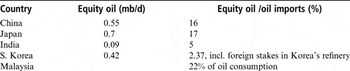
Compared with its Asian neighbours, China seems to have made impressive progress in securing equity oil overseas. With 0.55 mb/d in 2005, the equity oil acquired by Chinese NOCs was less than Japan's 0.7 mb/d, but was higher than South Korea's and India's (see Table 2).
Equity Oil from Overseas in 2005: An International Comparison

Source:
John Mitchell and Glada Lahn, “Oil for Asia,” Chatham House Briefing Paper, March 2007.
In terms of the prospect of securing equity oil, in the short run China would be in a good position to acquire foreign hydrocarbon assets, but in the long term the prospect might be grim due to growing competition among oil importing countries and energy nationalism in producing countries, where governments impose tougher terms on foreign companies. In the short term, oil price plunges as a result of the financial turmoil have dealt a heavy blow to many oil companies and oil exporting countries. In an effort to attract foreign capital to bail them out, countries like Russia have to tone down their energy nationalism and change their closed-door policy, a kind of policy used to bar foreign investors from their oil/gas blocks. This has provided some opportunities for the Chinese NOCs to expand their businesses further. It was in such a context that Moscow took the initiative to approach China in November 2008 with the offer of a branch oil pipeline to Daqing 大庆, a discussion which had originally stayed in a deadlock for over a decade.
In the long run, the prospect of securing more foreign oil/gas equities may not be so sanguine. For one thing, resource nationalism might be revived with economic recovery and the world's growing demand for oil/gas. Even today, more than three-quarters of the world's oil reserves are still closed to foreign equity investment.Footnote 37 For another, fierce competition among Asians would further aggravate China's access to foreign equities. China has set a target that foreign equity oil/gas will reach 50 Mtoe by 2010 and 70 Mtoe by 2020. Other major oil consumers have also set their own targets. India expects to expand its equity oil/gas to 20 Mtoe by 2010 and 60 Mtoe by 2025. Similarly Japan's and South Korea's foreign equity oil requirements will reach 40 per cent and 35 per cent of their crude imports, whereas in 2007 that proportion was only 15 per cent for Japan and 4.1 per cent for Korea.Footnote 38 Hence, it is conceivable that inter-state contest for fossil fuels will intensify in the future.
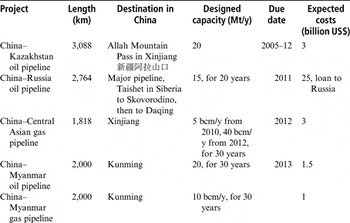
Securing long-term oil/gas supplies through pipelines or on the basis of contracts is another means by which China prefers to enhance its energy security. Since February 2009, China has clinched long-term oil supply contracts with Brazil, Russia, Kazakhstan and Venezuela. There are currently five pipelines directly connecting China with foreign countries, either working or under construction, including the Sino-Kazakhstan oil pipeline, China–Myanmar oil/gas pipelines, China–Central Asian gas pipeline and China–Russia oil pipeline.
As the first project in use, the Sino-Kazakhstan pipeline is an alternative to the Malacca pathway to deliver oil to China from abroad. The 3,000 km pipeline, from Atasu in north-western Kazakhstan to China's north-western Xinjiang region, was constructed in three phases. The last phase was completed in October 2009, but Kazakhstan has been exporting oil to China through the available pipeline since May 2006.
China made a loan-for-oil deal with Russia in 2009. The China Development Bank agreed to provide a US$25 billion loan to the Russian state oil exporter Rosneft and pipeline company Transneft. In exchange, Russia will build an oil pipeline to Daqing, China's oil bonanza in the north-east, and will export 300 Mt of crude oil (around 241 thousand b/d or 15 Mt per annum) over a 20-year period through the pipeline.Footnote 39
The China–Central Asian gas pipeline is China's first cross-border natural gas channel, running from Turkmenistan through Uzbekistan and Kazakhstan to Xinjiang, where it will be connected with China's West–East pipeline as the second line. Gas through the second line will be transported to 14 provinces and municipalities including Hong Kong. This project was officially launched in December 2009. Now it can pump five bcm annually with a planned increase of up to 40 bcm by 2012.
On 27 March 2009 China and Myanmar signed an agreement to build an oil pipeline and a gas pipeline, with a planned expenditure of US$1.5 billion and US$1 billion respectively. The oil pipeline will transport Middle East and African crude oil from Myanmar's Arakan coast to China's south-western Yunnan 云南 province, while the gas pipeline will tap into Myanmar's reserves at the Shwe gas fields. Construction of the two pipelines has begun and is expected to be completed by 2013. CNPC (Zhongshiyou 中石油) holds a 50.9 per cent stake in the project, with the rest owned by the Myanmar Oil and Gas Enterprise.Footnote 40
As shown in Table 3, the aggregate designed capacities of the oil pipelines described above reach 55 Mt each year. If they are operated to full capacity, they could account for 26 per cent of China's oil imports based on 211.4 Mt in 2007.Footnote 41 Hence, China still needs to depend heavily on the Malacca Strait. There are several points worth noting. First, not all the pipelines are ready for use, the promised capacity may only last for a certain number of years, and much depends upon oil resources available to China's partners. Second, China's oil imports in the coming years are set to rise as long as it maintains an economic growth mode of low energy efficiency, implying that more imported oil needs to traverse Malacca. Third, the above discussion does not take China's oil exports and trade of other commodities into account.
Major Pipelines from Abroad

Diversity
Importing oil from a single source is generally deemed far riskier than from multiple sources.Footnote 42 With multiple suppliers, importers will be less vulnerable and will experience only minor disruptions to their total supply should one supplier fall victim to war, terrorism, natural disasters, regime change or other export-damaging events.Footnote 43 Hence, as stated by Yergin, since Churchill's day “the key to energy security has been diversification,” which is also the foremost way in which importing countries enhance energy security.Footnote 44
To gauge the impact of Chinese NOCs' foreign energy quest on the country's energy security from the dimension of diversity, this article looks at both equity oil and oil import sources with the following indicators: distribution by projects, distribution by investment, percentage of the first three countries in total equity oil, distribution of oil imports, and percentage of the first four countries in China's total oil imports.
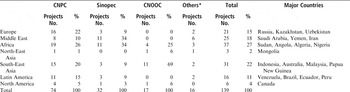
As shown in Table 4, simply from the perspective of the number of overseas energy projects, CNPC is the leading Chinese player in the international market. It owns over half of Chinese foreign energy projects. Other than the three oil giants, Chinese state-owned enterprises such as Sinochem (Zhonghua gongsi 中化公司) and CITIC (Zhongxin gongsi 中信公司), in addition to private firms, have also embarked on foreign oil-related investments in recent years when international oil prices kept surging. In terms of continents, Chinese foreign investments spread from Africa, South-East Asia, the Middle East, Europe and Latin America, in that order. Major countries where Chinese oil companies are investing include Sudan, Angola, Russia, Kazakhstan, Saudi Arabia and Indonesia.
Distribution of Overseas Investments by Chinese Oil Companies

Note:
*The other companies primarily include Sinochem, Zhuhai Zhenrong, China Aviation Oil, China National Oil & Gas Exploration and Development Corp., China National Power Equipment Corp., China Oilfield Services Ltd.
Source:
Yang Bonny Lin, “Weak vertically and competing horizontally: an analysis of relation between and within the Chinese central government and national oil company,” unpublished paper, University of Michigan, 2005, available in Zhongguo hangye yujing wang (China Industry Warning Net), http://www.calert.com.cn/ReadNews.asp?NewsID=362, accessed 12 May 2011.
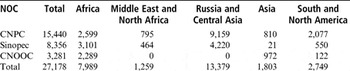
Based on distribution by investment, again CNPC is the heavyweight with foreign investments of 57 per cent during 1995–2006 (see Table 5). All the three NOCs have substantial investments in Africa, indicating the growing importance of this “lost continent” to China's energy security and these corporations' takeoff. Both CNPC and Sinopec (Zhongshihua 中石化) invest heavily in Russia and Central Asia. Among Chinese oil companies' overseas investments, Russia and Central Asia account for 49 per cent, and Africa attracts 29 per cent, showing the importance of the two continents to China.
Distribution by Investment 1995–2006 (million US$)

Source:
Chatham House Report, Trends in Asian National Oil Company Investment Abroad (March 2007).
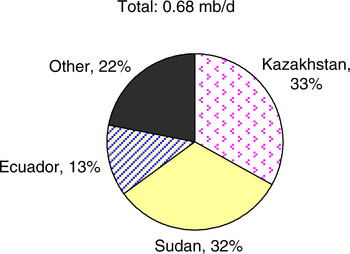
In terms of the percentage of the first three countries in total equity oil, as shown in Figure 4, foreign equity oil production by Chinese NOCs came up to 0.68mb/d in 2006, 78 per cent of which was produced in Kazakhstan, Sudan and Ecuador, whereas equity oil supplies from other countries only had a share of 22 per cent. This implies that China's equity sources are highly concentrated.
Foreign Equity-Oil Production, 2006

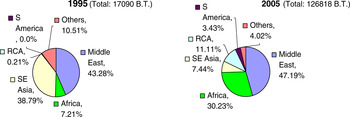
As to the distribution of oil imports, China's efforts to diversify have had some success. Figure 5 indicates that China's crude oil imports from Africa have risen sharply over the past decade. By 2005, its share reached 30 per cent, making it the second largest source of supply. In contrast, crude imports from South-East Asia declined dramatically from 39 per cent in 1995 to just 7 per cent in 2005. With three-quarters of crude coming from the Middle East, China's dependence on that region seems to have been growing, but crude imports from Russia and Central Asia, and South America also saw an 11 per cent and 3 per cent increase between 1995 and 2005. In a nutshell, with China's growing reliance on foreign oil, it will strive harder to diversify the import sources, with the Middle East and Africa remaining as significant players in China's energy supply security.
Crude Imports, 1995 and 2005

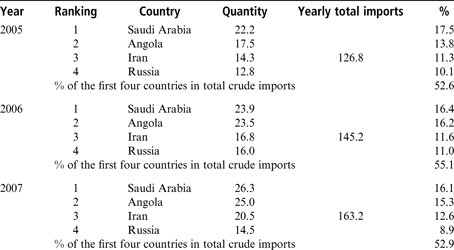
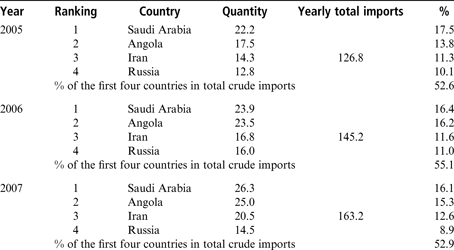
Based on the percentage of the first four countries in total oil imports, over the past three years Saudi Arabia, Angola, Iran and Russia, in that order, have become the four largest suppliers of China's crude oil. Crude imports from these four countries have consistently accounted for more than half of China's aggregate crude imports (see Table 6a).
Major Sources of China's Crude Oil Imports (million tons)
Source: Ministry of Commerce of PR China, China Commerce Yearbook, 2007–2008.
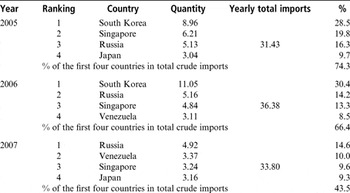
In contrast to its increasing imports of crude oil, China is less dependent on foreign refined oil imports. As shown in Table 6b, it primarily imports refined oil from neighbouring countries. One exception is Venezuela. As a general trend, it seems that the import sources of China's refined oil are now more evenly spread, in that the proportion of imports from the four largest suppliers had declined from 77 per cent in 2005 to 66 per cent in 2006, and to 44 per cent in 2007. More research needs to be done to understand China's import pattern.
Major Sources of China's Refined Oil Imports by country (million tons)

Source: Ministry of Commerce of PR China, China Commerce Yearbook, 2007–2008.
Reliability
Reliability is defined as the extent to which China's energy supplies are exposed to various types of risk in their major foreign energy investment and import countries. For any company overseas, success in business means avoiding catastrophic commercial losses, expropriation of assets, major accidents causing casualties or extensive environmental damage, uncongenial relationships with local communities, or extreme security breaches. There are many different types of risk that can result in oil/gas supply disruption and thus jeopardize a country's energy security. Although it is hard to measure them accurately, a rough picture of these risks in the major countries where China's equity oil and oil imports come from may help an understanding of China's energy security.
As indicated in Figure 4 and Table 6, China's equity oil is overwhelmingly concentrated in Kazakhstan, Sudan, Ecuador, Angola and Nigeria, while crude oil imports primarily come from Saudi Arabia, Angola, Iran, Russia, Oman and Sudan, and refined oil primarily from South Korea, Russia, Venezuela, Singapore and Japan. There are also oil pipelines connecting China with Russia, Myanmar and Central Asian states. In addition to the problems associated with the NOCs, an analysis of risks mainly focuses on these countries.
The problems for China's NOCs comprise three main aspects. One is that, unlike their international oil company counterparts, they lack systematic procedures for identifying, assessing and managing risks. Second, local operational managers have to shoulder the responsibility for the tasks of risk management and protection of their companies' reputation. While expeditious expansion of the NOCs' foreign businesses has left little time for learning on the job, local managers are accustomed to domestic practices with few pressures of external scrutiny thanks to the high standing of the NOCs and China's media control. Third, as shown below, inconsistency between China's national interest and the NOCs' corporate interest, plus poor oversight, has left room for the NOCs to overuse government support. Hence, their management and practice in foreign countries can be a source of risk per se.Footnote 45 Externally, the risks highlighted in this article are primarily political (including the relationship with China), or are concerned with policy, transportation and oil depletion.
Political risk is defined as “the possibility that political decisions or political and social events in a country will affect the business climate in such a way that investors will lose money or not make as much money as they expected.Footnote 46 There are three major consequences for a multi-national company resulting from political risks. First, policy or environment changes might slash returns or even cause losses and bankruptcy. Second, a company's assets could be coercively expropriated by any punitive action or nationalization measure by a host country. Third, property damages and casualties might result from civil wars, riots and terrorist incidents. In general, as Campos and Nugent pointed out, it is now regarded as a “stylized fact” that political risk has a negative impact on economic growth since political instability increases uncertainty in the economic environment, thereby disrupting production and reducing capital investment.Footnote 47
The political risk that China's equity oil and oil imports are exposed to is mixed. At the end of low political risk are oil-producing countries which could help promote China's energy security. For example, both the Sino-Kazakhstan oil pipeline and the Saudi direct crude supply to the jointly invested refineries in China help to expand China's energy supply and reduce its reliance on the Malacca Strait.
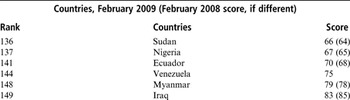
At the other end of high political risk, Sudan, Angola, Myanmar and Nigeria have all been torn apart by internal conflicts, and countries like Ecuador and Venezuela have tense relations with neighbouring states. Foreign oil companies have often been plagued by repeated incidents of kidnap and killing of foreign workers in local oilfields, and sabotage of local petroleum facilities. This forced Shell to withdraw from Nigeria. Attacks on Chinese oil workers and oilfields also happened in countries like Nigeria, Sudan and Ethiopia. Iran, Venezuela and Sudan's hostile relations with the United States and sanctions imposed by the latter have also made China's reliance on them very vulnerable. In the middle, countries like Russia are actively playing the energy card. According to an assessment of operational risk by The Economist on 150 markets in the world, among the ten most risky countries, six are major oil partners of China (see Table 7).
Operational Risk

Note:
This is the ranking on operational risk from 150 markets on a scale of 0–100, with higher numbers indicating more risks. The overall scores are an aggregate of underlying scores for ten categories of risk: security; political stability; government effectiveness; legal and regulatory; macroeconomic; foreign trade and payments; financial; tax policy; labour market; and infrastructure.
Source:
Economist Intelligence Unit.
Policy risk refers to the risk of loss of investment returns or the disruption of trade caused by changes in policies, such as tax laws, tariffs, expropriation of assets or restriction in repatriation of profits. For example, a company may be affected by nationalizing oil blocks, expropriation or tightened foreign exchange repatriation rules, or increased credit risk if the government changes its policies to make it difficult for the company to pay creditors. As energy nationalism widely exists in oil-producing countries, particularly in times of oil price spikes, such policy risks cannot be ruled out. The nationalization wave in the Middle East and Latin America in the 1970s is such a reminder.
In recent years, Ecuador's windfall scheme of imposing a 99 per cent tax of petroleum special profits, as well as its tough renegotiation of oil contracts, has caused foreign investors including Chinese ones to panic and led to a series of disputes. The Chinese NOCs have also run into breaches of contract, policy changes and price increase requests from Russia, Kazakhstan, Turkmenistan and Uzbekistan. For instance, CNPC had to accept a request to raise oil prices by Rosneft in January 2008 notwithstanding their long-term oil purchase contract clinched in 2004. Chinese NOCs encountered similar risks with Central Asian states' commercial contract breaches.Footnote 48
Transportation risk refers to factors that may jeopardize the safety of energy transportation on its way to its destination, which may include terrorists, pirates, maritime obstruction or military embargo. China's oil imports, including equity oil shipped home, face the highest transportation risk as 80 per cent of them have to pass through the Malacca Strait.Footnote 49 Currently the Malacca Strait is the busiest waterway in the world, with about 50,000 ships plying the route annually, carrying half the world's oil and one-third of the world's trade. The oil from the Persian Gulf and Africa has to go through the Strait of Hormuz, another chokepoint vulnerable to power politics and regional confrontations in the Middle East, thus adding another layer of risk.
In order to reduce its reliance on the Malacca Strait, China has endeavoured to expand oil/gas resources from Russia and Central Asia while trying to find other alternative routes that can bypass Malacca, as mentioned above. For Beijing, the pipelines connecting China with Kazakhstan, Russia, Myanmar, Uzbekistan and Turkmenistan serve two purposes: to enlarge energy supplies and to mitigate transportation risk. With these sources, smooth supplies of oil/gas can be piped into China with more assurance. But uncertainties remain. First, oil/gas flows through pipelines are not necessarily safer than those via vessel shipment in the sense that they are easy targets for hostile forces such as terrorists.Footnote 50 Second, running the pipelines also faces the risks of insufficient oil/gas supplies, resulting either from indigenous oil/gas depletion or slower pace in E&P. For instance, Gibson and EU predicted that oil production in Russia would “stagnate for two or three years” and then decline, while its gas production would diminish as early as 2008.Footnote 51 Third, any pipeline in use should be able to lubricate bilateral relations, but in the case of a worsening relationship, countries at the recipient end may be exposed to a risk of deliberate cut-off of oil/gas supplies by supplier states. Ukraine's pro-Western course after the 2004 “Orange Revolution” was believed to be a fundamental cause of a number of gas disputes with Russia, where Russia cut off gas supplies passing through Ukrainian territory.Footnote 52
Can the China–Myanmar oil/gas pipelines help China surmount the nightmare that its maritime lifeblood might be interupted in time of war? The two pipelines can divert some Chinese oil/gas imports from the Malacca Strait route and thus alleviate Beijing's deep concern about the so-called “Malacca dilemma” (Maliujia kunju 马六甲困局), but at the same time they bring new risks since their safe operation is closely associated with the situation in Myanmar. Moreover, it is also possible that China's oil imports from Africa and the Persian Gulf might be disrupted in the Strait of Hormuz by a hostile force before they reach the China–Myanmar pipelines.
With a capacity of 400,000 bbl/d, the China–Kazakhstan oil pipeline carries 5 per cent of China's total demand at maximum capacity,Footnote 53 thus making Kazakhstan one of China's biggest providers of crude oil. The China–Central Asian gas pipeline is also significant for China as it provides Beijing with a secure and cost-efficient delivery of natural gas from Central Asia. These Central Asian states have a more stable environment both at home and abroad than Myanmar, and, unlike Moscow, they do not have a power status that allows them to play the energy card wantonly. That being the case, are the pipelines with Central Asia more reliable than the China–Russia and China–Myanmar ones? Some risks “under the table” may deserve noting.
One risk is the existence of separatist forces in Xinjiang, an area through which the pipelines run, though it has not presented a security threat so far. Another is related to the geopolitical struggle among the US, Russia, China, Iran and other powers in Central Asia. Behind the building of these pipelines is China's strong desire to avoid the “Malacca dilemma,” but the US is gaining greater influence in Azerbaijan and Kazakhstan.Footnote 54 With a “multi-vectored foreign and security policy,” Kazakhstan is showing an interest in being involved in NATO.Footnote 55 Meanwhile, many Kazakhs feel unease about their eastern neighbour.Footnote 56 In particular, oil from the Atasu region supplying the China–Kazakhstan pipeline has to be mixed with other crude oils from Russia or its Aktobe region in order to avoid being frozen in the cold winters.Footnote 57 As a result, neither Kazakhstan and other Central Asian states nor these pipelines can be extricated from the shadow of Moscow.
Affordability
Affordability can be measured in two ways: comparing the costs of acquiring equity oil and the costs of directly purchasing oil from the international market, and in terms of a country's GDP per capita growth relative to oil price fluctuations. To examine China's affordability, this section gives a simple cost-benefit analysis and an evaluation of whether equity oil can buffer a country from oil price shocks.
A cost-benefit analysis of China's foreign energy investments shows that, other things being equal, the total value of China's equity oil – equivalent to the total equity oil received by Chinese oil companies multiplied by the annual average crude oil prices – was larger than its total investments (Table 8). This implies that simply from a cost-benefit analysis, Chinese NOCs have reaped some returns. In particular, returns rose substantially in 2007, largely because of the increase in equity oil as well as the sharp hike of world oil prices in that year. The total value of equity oil goes up with the rise of oil prices in the supposed scenarios of different oil price levels.
Cost-Benefit Analysis of Chinese NOCs' Overseas Investments

Note:
Only reported investment figures were used; 1 tonne of crude oil equals 7.3 barrels.
Source:
Crude oil prices: BP Statistical Review of World Energy, 2007; Overseas investment: Chatham House Report, Trends in Asian National Oil Company Investment Abroad.
Nevertheless, China's investment shown here only covers reported investment figures, which do not include the Chinese government's loan waiver, foreign aid and other assistance like infrastructure construction in oil-producing countries. For instance, in 2006 China exempted 31 African countries from 156 debts amounting to 10.9 billion yuan; it also provided large infrastructure assistance.Footnote 58 Although this debt relief and foreign assistance are not directly associated with China's energy quest, they may have helped facilitate its energy deals in that continent. Given that the debt relief and foreign aid are provided by the Chinese government, it is understandable that the NOCs have strong but little risk-averse motives to venture abroad.
The role of equity oil is controversial: can it buffer a country including China from oil price shocks? There are two opposite views. Proponents believe that the cost of equity oil will be less than international oil prices because it is priced according to finding, development and operating costs, but companies owning equity oil will gain more returns with the rise of international market prices.Footnote 59 Opponents, who are normally neo-liberal institutionalists and globalization theorists,Footnote 60 believe that equity oil is unlikely to buffer China from price shocks because the oil market is a global market and oil prices are the same at the border of every country.Footnote 61 Even if the Chinese government can successfully force the NOCs to sell oil to Chinese consumers at below world market prices, this can hardly last long.
However, such a debate needs to take account of world oil price levels and the host country's taxation policy. It is apparent that the higher the price of international crude oil, the more likely it is that equity oil will be economical for countries which possess it. Not only do different countries have different types of taxes and royalties, but also their rates vary. For instance, Malaysia imposes a 10 per cent royalty on oil/gas, while this rate is 20 per cent in Saudi Arabia, between 1 and 16.7 per cent in Venezuela, and between 8 and 20 per cent in Norway.Footnote 62 Indeed, the cost of equity oil in some countries is below 10 dollars per barrel, but taxes and royalties add up to 80–90 per cent of the economic rent of oil exports.Footnote 63
As mentioned above, the costs of equity oil are composed of E&P cost, producing countries' taxes and royalties, and other miscellaneous costs, whereas China's affordability is decided by its GDP per capita and world crude prices in the simplest sense. Indeed, the double-digit growth in the past ten years has greatly enhanced China's affordability for oil imports, but as verified in the last oil-price-spike years, it was badly hit by high inflation and the repeated oil shortage crisis. Moreover, expectations of surging oil prices produce stronger energy nationalism, a factor that prompts energy-exporting countries to change the rules of the game in their favour, thus heightening the risks and dealing a blow to foreign investors including China.
Problems from the Institutional Perspective
The preferences of the Chinese government and the NOCs do not coincide.Footnote 64 They have different interests or goal priorities in securing fossil fuels abroad. The Chinese government encourages the NOCs to catch up by “going out” to become China's multinational companies, but at the same time expects them to help ensure China's energy supply security. When necessary, they should put social and political obligations above commercial interests. For the NOCs, however, corporation and marketization have made them more market-oriented and become self-interest motivated playersFootnote 65; their priority in foreign markets is to expand their energy reserves and fiscal coffers. Hence, they are not inclined to be merely obedient to state mandates.
NOC “defections” are set to run counter to China's national interests. Above all, they may do harm to China's foreign interests and soft power. Fierce inter-corporate competition often forces the Chinese companies to curtail costs through reducing wages, working conditions and safety standards, irrespective of local customs and laws. Such practices can incur local grievances and even protests. For instance, Sinopec was accused of desecrating the forest in its exploration at the Loango National Park in Gabon in October 2006.Footnote 66 In addition, anti-China sentiments have been created in some developing countries by cheaper China-made commodities which forced out some local players. The NOCs thus face a daunting challenge when handling relations with host governments, sub-national governments, local communities and local employees.Footnote 67 To salvage China's image, the government issued a regulation calling for Chinese companies to practise “localization” (in the sense of abiding by local laws, customs and regulations) when carrying out business abroad in order to protect China's national interests.Footnote 68
Against the backdrop of world oil prices staying at record highs in recent years, Chinese enterprises are more enthusiastic about going abroad to acquire more oil/gas equities. Not only are CNPC, Sinopec and CNOOC, the three largest Chinese oil giants, working hard to venture across the world, other state-owned enterprises and even private firms are also attracted by the potentially lucrative returns and are joining the quest for foreign oil/gas. For instance, China CITIC Group, whose major business lies in financial services, has embarked on upstream oil/gas E&P business as well. The company successfully acquired the Kazakhstan oil assets of Canada's Nations Energy Company for US$1.91 billion in December 2006.
Competition is so fierce that sometimes the Chinese NOCs even bid against each other over foreign projects, disregarding the government's directives not to do so. There have been contests between PetroChina and Sinopec in Sudan and Libya as well as between CNOOC and Sinopec in Brazil.Footnote 69 Beijing is obviously reluctant to see such a situation as it can only lead to state asset dissipation. The government has therefore made efforts in recent years to reconcile foreign bids, but it remains to be seen whether these co-ordination efforts will be foiled by the NOCs. The NOCs' “defection” behaviour could be exacerbated by the problem of “weak government and strong NOCs” and the different information available to the government and the NOCs regarding the costs and profits of the latter's foreign operations, as well as the high costs involved in monitoring their overseas behaviour.Footnote 70
Conclusion
Despite scholarly reports on securing strategic resources and capabilities as key motives for Chinese multinationals’ ODI, insufficient attention has been attached to its impact on China's energy security. This article has developed an assessing framework to examine such an impact. Our research suggests that from the perspective of availability, besides five oil/gas pipelines, Chinese NOCs have impressively expanded equity oil production since they embarked on ODI in the 1990s, but most equity oil was sold in the international market. In terms of reliability, the sources of both equity oil and crude oil imports remain concentrated in a few countries. If these countries were to reduce or cut oil supplies to China, Beijing's energy security would be severely hit. More worrying is that China's major oil sources rely on a handful of countries which are either threatened with unrest or in dispute with the United States. Theoretically, oil/gas pipelines linking China with its neighbouring countries should be conducive to China's energy security, but uncertainties remain. In terms of affordability, it is controversial whether equity oil can buffer China from oil price shock. Economic growth has indeed enhanced its purchasing capability, but surging oil prices could still deal a blow to its economy with its burgeoning demand for oil/gas.
For convenience or other reasons, most studies and media reports on China's ODI tend to regard the Chinese government and the NOCs as a monolithic body staying together at all times, or always sharing an overlapping interest on all issues, as the term “China, Inc.” illustrates. This is, however, not true, as shown in this article. The monolithic mercantilism image to a large extent has been a result of misperception and/or misunderstanding. The advantages the NOCs can enjoy are only necessary conditions for them to be the arms of the government, but are not sufficient ones. Despite their state ownership, findings show that the NOCs are not always obedient to government mandates.
Many studies have analysed the drivers for China's foreign energy quest. For instance, Peter J. Buckley et al. have investigated the determinants of Chinese ODI and the extent to which the three categories of motives (capital market imperfections, special ownership advantages and institutional factors) can be applied to explain the motives of Chinese firms.Footnote 71 Although these explanations help explain the Chinese NOCs' foreign energy quest, it remains a puzzle as to how the NOCs will utilize the resources acquired overseas and for whose purpose. This study at least partially shows that the NOCs “go out” not solely for sake of improving China's energy security.
In fact, the NOCs have benefited a lot from their foreign energy quest since it has contributed to enlarging their energy reserves and fiscal coffers; however that does not necessarily mean it will enhance China's energy security in view of the huge state financial and diplomatic support, the great risks involved, damages to China's soft power by the NOCs' behaviour overseas, and the limited amount of equity oil being transported home. On a positive note, the global financial crisis may provide a good opportunity for China to diversify its foreign investments and acquire oil/gas equities in countries that used to be inaccessible. However, the government will have to face the fundamental problem of whether an augmentation of corporate interests will enhance China's energy security.
As the state ownership of the NOCs has worried other countries with misgivings about Chinese state involvement, a better way to alleviate their concern is to bring Chinese private companies in. The foreign energy quest may help mitigate China's energy security, but a more effective way to enhance such security is to pay more attention to energy conservation.