A case is made for the ubiquity of anticipatory behavior by the sensory-motor system, including visual perception. There is no question that anticipation is ubiquitous; however, that ubiquity tends to prompt assumptions about the world which may not be warranted. For instance, “the fundamental assumption of compensation for visual delays, […] which states: ‘In the absence of mechanisms compensating for visual delays, many behaviors in otherwise healthy animals would be disrupted.’”(target article, sect. 6.1, para. 2; italics in original).
The nature of these compensating mechanisms is of particular importance. If a tacit assumption which goes along with “the fundamental assumption” is that those compensation mechanisms are forward models, then the assumption may not be fundamental. The existence of alternative explanations for anticipatory behavior strongly suggests that the assumption should not be regarded as axiomatic. Moreover, the term compensation connotes both the presence of error and active correction. The term anticipation will be used to avoid these implications.
Here, we present an alternative paradigm for anticipatory systems, which may be useful when considering the anticipation for visual delays. This alternative comes in the form of anticipating synchronization (Ciszak et al. Reference Ciszak, Marino, Toral and Balle2004; Voss Reference Voss2000). In one of its simplest manifestations, anticipating synchronization is a coupling of two dynamical systems such that the slave system is able to synchronize with the future of the master system. The general form of this coupling is shown in the following system of equations:

When two dynamical systems are coupled in this way, values of y synchronize (after a transient) with the future of x. Put another way, y becomes very close to a phase-shifted copy of x. This method of anticipating synchronization is an instance of the theoretical notion of strong anticipation (Dubois Reference Dubois2003; Stepp & Turvey Reference Stepp and Turvey2007). As opposed to weak anticipation, which involves the use of models for explicit prediction, strong anticipation utilizes law-based facts together with ordinary intrinsic dynamics. In other words, the system above is anticipatory because it has no opportunity not to be.
The delay term y(t−τ), representing delayed feedback in the slave, should attract special attention. It is notable that without this delayed feedback, the system above would not exhibit anticipatory behavior. Typically, delays are taken to be a liability, for which there must be explicit compensation. The alternative perspective suggests that delays are an asset, which can be the source of anticipatory behavior. In the succeeding paragraphs, one may see how delay-coupling addresses the features of behavior generally taken to imply a forward model.
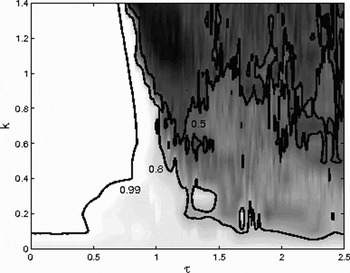
Returning to the “fundamental assumption” itself, consider the fact that increased delay induces a breakdown of anticipatory ability, for example, demyelination in multiple sclerosis patients. This fact is cited as the starting point for the assumption of compensating mechanisms. Increasing the τ parameter of a delay-coupled system is known to show this same feature. Figure 1 shows the (k,τ) parameter space associated with a delay-coupled system such, where the function f is the Rössler system. There is a sharp drop (shift from white to black) in anticipatory ability on increasingτ. Thus, anticipatory ability is lost after τ is increased past a critical value. The effect does not require an internal model.
For many (k,t) combinations, the slave system (y) was incrementally shifted relative to the master system (x), and maximum correlations recorded. White corresponds to a maximum correlation of 1.0; black corresponds to 0.0.

Nijhawan makes the important point that mysterious self-anticipation applies to the entire sensory-motor system. For a delay-coupled system showing anticipating synchronization, this behavior is expected by definition. Considering again the system of equations above, the delay is inherent in the slave system, y – the same system which is anticipating its master, x. Therefore, y is indeed anticipating its own delay. Furthermore, this anticipation is made possible not through an internal model, but falls out of the normal functioning of the correctly organized system.
Knowing something about delay-coupled systems and anticipating synchronization, we may turn to the flash-lag effect. The pertinent aspect of this effect is that continuously moving stimuli are led by the perceiver, whereas flashes are not. As noted by Nijhawan, this effect shows itself in animal behavior as a virtual lack of delay while tracking a moving object. Viewing through the lens of anticipating synchronization, this also comes as no surprise. In fact, one might be surprised if this effect were not the case. Recall, anticipating synchronization, like all dynamical synchronizations, goes through an initial transient. A flash, because of its short duration, does not allow this transient to take place. Alternately, in the case of continuous stimuli, we expect that the transient has taken place, allowing for anticipation.
To reiterate, the evidence presented for the existence of anticipation of visual delays is sound. However, the existence of anticipating synchronization in particular, and strong anticipation in general, restricts assumptions that can be made about the nature of that anticipation. What is seen as “compensation” by an internal forward model may simply fall out of the ordinary dynamics of the components in question because of the way in which they are organized with respect to their stimulus. The above may be taken both as a counterexample to the necessity of compensatory forward models and as an alternative framework for investigating anticipatory behavior.