Implications
This study shows that feeding lactating cows with chopped wheat hay might increase intake resulting in higher yields of milk and energy-corrected milk than feeding long hay. In addition, this study shows that feeding wheat silage-ration increases yields of milk and energy-corrected milk compared with cows fed wheat hay diets either long or chopped. Thus, when preparing diets based on wheat, silage should get higher net energy value than either chopped or long wheat hay (1.55 v. 1.40 or 1.45 Mcal net energy/kg dry matter (DM), respectively).
Introduction
With current annual production at over 735 million tons, wheat is among the largest crop in the world, and an essential source of carbohydrates for millions of people (FAO, 2015). In places over the globe suffering from lack of summer falls, limited winter falls and winter-spring temperature up to 25°C, wheat has become the main forage used as hay, silage or straw to feed productive ruminants (FAO, 2015). However, although many studies have examined the effect of particle size of temperate forages on rumen pH and digestibility, there is limited knowledge about the effect of dietary physically effective neutral detergent fiber (peNDF) content on intake, digestibility, rumen pH and lactation performance in cows fed diets based on wheat silage or hay as the sole roughage source. Wheat silage and hay grown under hot climate and limited amount of winter rainfall, are characterized by low quality as expressed in high NDF content (55% to 60% of DM) and limited in-vitro DM digestibility (60% to 63%, Ben-Ghedalia et al., 1995). Such low-quality roughages are included in lactating cow total mixed rations (TMR) at a level of 30% to 35% of TMR DM to provide 18% to 19% roughage-NDF in the diet as recommended (NRC, 2001). In such TMRs the maximal content of peNDF is around 11% of dietary DM. According to the literature, ruminal pH should not be below 5.8 for more than 5 h/day, to minimize health disturbances due to sub-acute ruminal acidosis (SARA) (Zebeli et al., 2012). A model based on 64 studies and 257 different dietary treatments found that increasing the content of peNDF to more than 18.5% of DM in lactating cows rations, prevents SARA (Zebeli et al., Reference Zebeli, Mansmann, Ametaj, Steingass and Drochner2010 and 2012). In view of this model, rations based on low-quality roughages such as wheat hay or wheat silage fed at level of 30% to 35% of TMR DM supplying just 11% peNDF of DM, might cause a risk of SARA to lactating cows. Our hypothesis is that use of 30% wheat hay or silage as the sole roughage source in lactating cow TMR is safe and does not cause SARA.
In contrast to wheat hay, the wheat used for ensiling is usually harvested 2 to 3 weeks later at the soft-dough stage of grain maturation, and therefore silage contains less NDF and more nonstructural carbohydrate than hay. Unfortunately, there is a lack of data pertaining to the effect of wheat forage preservation method (silage v. hay) on voluntary intake, rumen pH, digestibility and lactation performance.
The objective of this study was to evaluate in lactating cows the effect of feeding one of the three TMRs with various wheat roughage sources (either short or long hay or silage), on: voluntary intake, digestibility and lactation performance. Rumen parameters including pH and rumination, cow recumbence time and feed sorting by the cows, were also measured in this study.
Material and methods
Forages and diets preparation
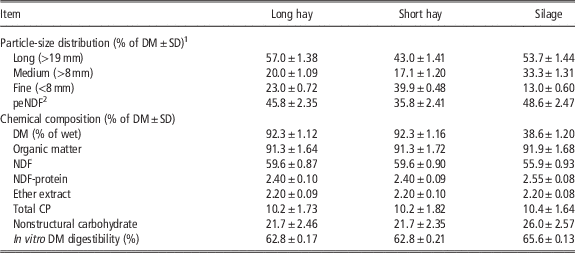
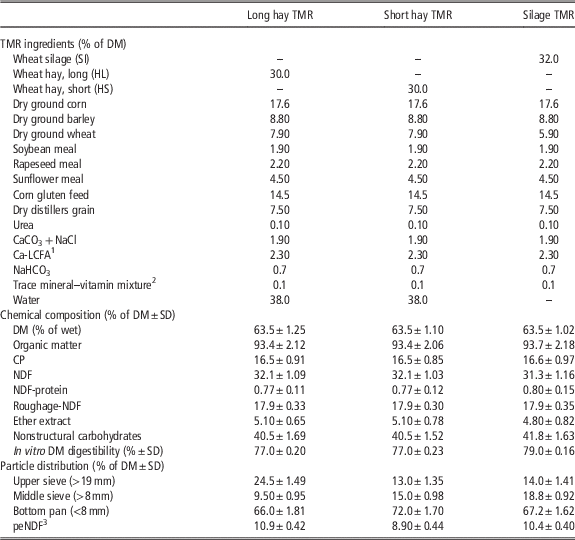
Composition and particle size distribution of the three wheat forages are presented in Table 1, and those of the three TMRs containing these forages are in Table 2. The three TMRs used in this experiment were designed to be similar in roughage-NDF content (17.9% of DM). Therefore, the two hay-based TMRs consisted (on DM basis) of 70% concentrate mixture and 30 wheat hay, whereas the silage-based TMR contained higher forage level (32%) and lower level of added wheat grains. Buffer was added (0.7% of DM) to all TMRs as recommended (NRC, 2001). All wheat forages (Galil variety) were grown in the same field (Yavne, Israel) on 400 mm rainfalls. However, wheat hay was harvested at the early stage of grain maturation while wheat for silage was harvested at the soft-dough stage (as recommended for wheat hay or silage). Upon our measurements at harvest, the plants used for ensiling contained 20% of DM spikes and 80% vegetative mass, whereas the plants used for hay contained only 10% of DM spikes and 90% vegetative mass. Wheat hay was chopped in a chopping mixing wagon with sharp knives (Siloking selfline 1000+3024; SilokingTM, Berlin, Germany) for either 5 min (hay long (HL)) or 30 min (hay short (HS)). Ten tons of each hay type (short or long) were prepared in large batch and preserved in separate barns in Bet-Dagan. Portion of each hay type was mixed with the concentrate mixture and water in a non-chopping mixing wagon for 5 min before feeding the cows. The wheat for silage was harvested by a chopping combine (3 to 6 cm particle length), pressed and ensiled in polyethylene-wrapped bales for 60 days before feeding (Shaani et al., 2016) and kept in Bet-Dagan barn. A portion of the silage was mixed with the concentrate mixture in non-chopping mixing wagon for 5 min before feeding. The pH of wheat silage was 4.2 and that of SI-TMR 4.9.
Chemical composition of wheat silage and hays and their particle-size distribution with the Penn State Particle Separator

1 Particle-size distribution was determined by the Penn State Particle Separator with a 19-mm screen (long), 8-mm screen (medium) and a pan (fine).
2 peNDF=physically effective NDF remaining above the 8 mm plus 19 mm sieves of the separator.
Ingredients, structural and chemical composition of the three experimental total mixed rations (TMRs)

DM=dry matter.
1 Calcium salts of long-chain fatty acids.
2 Containing (g/kg DM mix): Zn, 24; Fe, 24; Cu, 12.8; Mn, 24; I, 1.44; Co, 0.32; Se, 0.32; 16,000,000 IU of vitamin A; 3,200,000 IU of vitamin D3 and 48,000 IU of vitamin E.
3 peNDF=physically effective NDF remaining above the 8 mm sieve.
Structural and chemical analyses and in vitro digestibility
Hays and silage were sampled on a daily basis before mixing into the TMRs. Dietary samples were taken daily from the individual feeders immediately after feeding. The daily samples were combined into a weekly pool during 6 weeks of the experiment. Cows’ orts were weighed and sampled daily. Particle-size distribution of forages, TMRs and orts was determined by a Penn State Particle Separator (PSPS), equipped with a 19-mm screen (long), an 8-mm screen (medium) and a pan (fine) (Lammers et al., Reference Lammers, Buckmaster and Heinrichs1996). The content (on DM basis) of peNDF remaining above the 8-mm and 19-mm sieves of the separator was designated as peNDF in this study as recommended by (Yang and Beauchemin, Reference Yang and Beauchemin2006). Physically effective NDF was calculated according to the equation of Kononoff et al. (Reference Kononoff, Heinrichs and Lehman2003): peNDF (g/kg DM)=g wet fraction from the 8+19 mm sieves×% DM in separated fraction×% NDF in original DM sample/g DM sample inserted.
Samples were dried in an aerated oven at 60°C for 48 h, ground to pass a 1-mm screen in a hammer-mill (Retsch S-M-100; RetchTM, Haan, Germany) and analyzed according to AOAC (1990) for DM (method 925.40), total N (method 984.13), ether extract (EE, method 920.39) and ash content (method 923.03). Crude protein in feeds was calculated as N×6.25. Neutral detergent fiber (aNDF) was determined according to Van Soest et al. (Reference Van Soest, Robertson and Lewis1991) using a heat-stable amylase without sodium sulfite, and N bound to NDF was determined (method 984.13). Acid detergent fiber and ADL were determined using the sequential method of Van Soest et al. (Reference Van Soest, Robertson and Lewis1991). Hemicellulose was calculated as NDF−ADF and cellulose as ADF−ADL. The Ankom Technology apparatus (Ankom220, Macedon, NY, USA) was used for extracting and filtering. Crude protein in NDF was measured nonstructural carbohydrate (NSC) content was calculated as: NSC (g/kg DM)=DM−CP (excluding NDF-bound protein)−NDF−EE−ash. The two-stage digestibility technique of Tilley and Terry (Reference Tilley and Terry1963) was used to determine in vitro DM digestibility of the feeds and TMRs (six weekly samples for each TMR). Substrate (0.5 g, in four replicates per each feed or TMR sample) was incubated in sealed 100 ml glass tubes with 10 ml fresh screened rumen fluid and 40 ml buffer under occasional shaking at 39°C for 48 h. Residual solids in tubes were separated by centrifugation (1000×g) and the liquid phase discarded. Fresh acidic solution of 40 ml 0.1 N HCL+0.2% pepsin was inserted to each tube for a 2nd period of 48 h incubation as described above. The dry residual solids remaining after centrifugation in each tube were designated as the undigested fraction. The rumen fluid used for the in vitro measurement was obtained from two ruminally fistulated dry Holstein cows, fed 7 kg (DM) of wheat hay and 3 kg (DM) of the wheat silage TMR.
Intake, sorting, recumbence, rumination and performance in lactating cows
A total of 42 Israeli Holstein cows were randomly assigned to three groups of 14 cows each that were similar at the onset of the experiment (mean+SE) in lactation number (3.0±0.35), days in milking (132±3.2) and milk yield (49.5±1.54 kg/day). The cows were adapted to the individual dairy barn for 1 week, followed by 2 weeks of gradual adaptation to one of the three TMRs, and 6 weeks of experiment. The TMRs were fed individually once per day at 1000 h ad libitum, allowing for 5% to 10% orts, and cows were milked three times per day at 0600, 1400 and 2200 h. Cows were fed individually via a computerized monitoring system, designed to electronically identify individual cows, allowing entrance of each cow only into her designated feeder, and to record each cow’s daily feed intake (Miron et al., Reference Miron, Yosef, Maltz and Halachmi2003). Daily dry matter intake (DMI) of individual cows was determined based on DM content in TMR and feed refusals sampled daily.
Sorting behavior of the cows was measured by weighting orts and determining of DM intake and of wet particle distribution (0.5 kg DM orts or TMRs from weekly pool samples of each cow) on the three sieves of the PSPS at 12 and 24 h post feeding compared to the offered TMR. Sorting index was calculated as the quantitative ratio between actual DM intake of each particle-size fraction of the PSPS separator (after 12 or 24 h) to predicted DM intake of each fraction (assuming no sorting). A sorting index of 100 indicates lack of any sorting (similar DM intake of the entire TMR and each particle-size fraction measured). Sorting index below 100 indicates sorting by cows against non-consumed large particle >8 or 19 mm. Sorting index above 100 indicates preference to consume small particle (Leonardi and Armentano, Reference Leonardi and Armentano2003).
Recumbence time for each cow, an indicator of animal welfare (Drissler et al., Reference Drissler, Gaworski, Tucker and Weary2005), was recorded daily by an automatic meter located within each cow’s pedometer (Afimilk Ltd., Kibbutz Afikim, Israel). Body weight data were recorded by an automatic walk-over scale three times per day while cows were entering the milking parlor. Changes in BW were calculated as the gap between average BW after adaptation at the week of the onset of the experiment and at week 6 of the experimental period. The cows were equipped with collar-mounted tags (HR-Tags; SCR Engineers Ltd., Hadarim, Netanya, Israel) that monitored and transmitted rumination time (Adin et al., Reference Adin, Solomon, Nikbachat, Zenou, Yosef, Brosh, Shabtay, Mabjeesh, Halachmi and Miron2009). Rumination data were recorded during 6 weeks of the experiment by a special microphone that detected rhythmal sound of rumination and chewing and separate it from eating sound by analyzing vocal signals. Data were stored in 2-h blocks and wire-less uploaded through antenna to the computer three times daily at the milking parlor.
Milk yield (kg) and content of milk fat, protein and lactose, were recorded daily for each cow by an automatic meter equipped with on-line near-infra-red-spectroscopy measurement (Afilab, Afimilk Ltd., Kibbutz Afikim, Israel). In parallel, for validation of the online milk composition measurement, milk samples were collected in three sequential milking’s on a weekly basis throughout the study, stored at 4°C in the presence of 2-bromo-2-nitropropane-1,3-diol, until infrared analysis for fat, protein, urea and lactose content, using a MilkoScan 4000 analyzer (Foss Electric A/S, Hillerod, Denmark).
Fat corrected milk (FCM) yield was calculated using the following equation (NRC, 2001): 4% FCM (kg/day)=0.4×milk (kg/day)+15×fat (kg/day); energy-corrected milk (ECM) yield was calculated using the following equation (NRC, 2001): ECM (kg/day)=milk yield (kg/day)×{[0.3887×milk fat (%)]+[0.2356×milk protein – urea (%)]+[0.1653×milk lactose (%)]}/3.1338 MJ/kg; energy for maintenance according to cows’ BW and energy in BW gain were calculated using the following equation (NRC, 2001): NEm (Mcal)=kg BW0.75×0.08; energy excreted in milk was calculated using the following equation (NRC, 2001): NEL (Mcal/kg)=0.092×fat (%)+0.0547×CP (%)+0.039×lactose (%); animal performance study was conducted according to the guidelines and under the supervision of ARO Animal Care Committee.
Digestibility and rumen pH measurements
After 2 weeks of adaptation and additional 4 weeks of the experiment, 4 days were assigned for daily sampling of TMR, feed refusals, and feces from three subgroups of seven cows each fed the dietary treatments. Each subgroup was similar in average ECM yield, DIM and DMI to the entire 14 cows group. Estimation of daily fecal excretion was based on indigestible NDF concentrations in feces, the TMRs and the orts. Samples of the TMR and refusals were collected every day during 42 days of experiment, composited per week (six pool composites) for each cow, dried (60°C for 48 h), and ground through a 1-mm sieve (S-M-100; Retsch GmbH, Haan, Germany). Fecal grab samples were collected three times daily for the same 4 days, at 8 h intervals, each day 3 h later than the preceding day. Fecal samples from each cow were composited (on a DM basis), dried at 60°C for 48 h in a forced-air oven, ground to pass through 1 mm sieve, and then used for chemical analyses as described above, and for indigestible NDF content in the TMR and fecal pooled samples. The in vitro digestibility technique of Tilley and Terry (Reference Tilley and Terry1963) was used to analyze the content of residual indigestible NDF in the TMRs, orts and the pooled fecal samples of each cow, after incubation with rumen fluid for 96 h followed by incubation for 48 h with HCl-pepsin (Adin et al., Reference Adin, Solomon, Nikbachat, Zenou, Yosef, Brosh, Shabtay, Mabjeesh, Halachmi and Miron2009). The quantitative ratio, indigestible NDF in TMR ingested (without orts contribution)/indigestible NDF in feces, is identical to the ratio fecal DM/DMI of each cow. Thus, in vivo DM digestibility was calculated according to the following equation (Adin et al., Reference Adin, Solomon, Nikbachat, Zenou, Yosef, Brosh, Shabtay, Mabjeesh, Halachmi and Miron2009): DM digestibility=1−(TMR ingested indigestible NDF/fecal indigestible NDF).
The digestibility values of each chemical component (i.e. DM, CP, NDF, fat, cellulose, hemicellulose and NSC) were calculated for every cow using its proportion between intake (including orts sorting contribution) and fecal output according to the equation presented in Adin et al. (Reference Adin, Solomon, Nikbachat, Zenou, Yosef, Brosh, Shabtay, Mabjeesh, Halachmi and Miron2009).
These seven cows from each group were also sampled every day during week 6 of the experiment for rumen fluid. During this week cows were fed once a day at 0600 h for 1 h, following by feed prevention for 6 h and then allowed to eat for ad-lib intake. This feeding routine was chosen since preliminary observations have demonstrated maximal and minimal rumen pH at 1 h pre-feeding and 6 h post feeding, respectively (Shaani et al., 2016). Rumen fluid of 400 ml were collected from each cow with a rumen vacuum connected to a self-made esophageal metal coated rubber pipe (2 m length, 15 mm internal diameter) at 1 h pre-feeding and 6 h after feeding. For each sample, in order to avoid saliva contamination, the vacuum pump was turned on only after the metal coated sampler pipe was inserted through the esophagus and located in the floor of the ruminal sac, and the first 200 ml of rumen fluid were discarded. The rumen pH values were immediately determined by a portable pH-meter (PL 600; MRC, Netanya, Israel). On the day after termination of the data collection (shown in this paper), rumen fluid was sampled every hour around the clock (from 0600 to 0500 h of the next day), from seven cows of each treatment, in order to measure SARA conditions identified as rumen pH below 5.8 for at least 3 h.
Statistical analysis
Comparisons among the three groups of 14 cows, each fed one dietary treatment, with respect to individual DM intake, BW changes, recumbence time, rumination time, yields of milk, 4% FCM and ECM, and milk composition were summarized by day and analyzed using a proc-mixed ANOVA in JMP-5 software (SAS Institute, Reference Shaani, Eliyahu, Mizrahi, Yosef, Ben-Meir, Nikbachat, Solomon, Mabjeesh and Miron2003), with day included as repeated measures. Tukey’s test was used for comparisons among means.
Subgroups of seven cows from each dietary treatment (each subgroup was equal in average performance, DIM and DMI to the entire 14 cows group) were used to compare rumen pH, in vivo digestibility and sorting behavior among treatments. Differences among treatments were tested for significance by F-test using JMP-5 software (SAS Institute, 2003). Tukey’s test was used for comparison among means.
Results
Composition, intake, sorting and digestibility
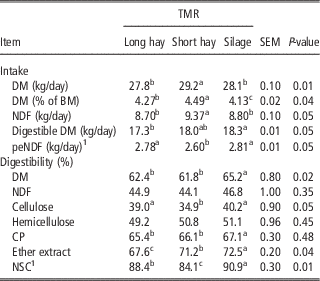
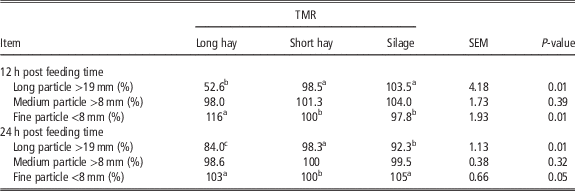
The long wheat hay and the wheat silage had similar peNDF content, higher (P<0.01) than that of the short wheat hay. However, the wheat silage, that contained more NSC than the hays (28.6% v. 25.4%), was characterized by lower NDF content and higher in-vitro DM digestibility than the two hays (Table 1). These differences were reflected in higher in vitro DM digestibility of the SI-TMR than the two hay-based TMRs (Table 2). Voluntary intake of DM and NDF was significantly higher in cows fed the HS-TMR than in the SI and HL groups (Table 3). The HS cows did not sort the TMR, whereas, cows fed the HL and SI-TMRs demonstrated significant sorting behavior after 24 h. The HL and SI cows preferred to consume small dietary particle (<8 mm) and left in the daily orts 16% and 7.7%, respectively, of the large particle (>8 mm; Table 4). Higher consumption of peNDF was demonstrated in the HL and SI cows compared with the HS cows (P=0.05; Table 3). The cows fed SI-TMR had higher digestibility of DM, CP, fat and NSC than the cows fed the HL and HS treatments (Table 3). Apparent digestibility values of NDF were similar in the three dietary treatments. Significant differences were found among the three dietary treatments in intake of digestible DM, which was highest in the SI cow, intermediate in the HS cows and lowest in the HL group.
Effects of the experimental total mixed ration (TMR) on intake and in vivo digestibility

DM=dry matter.
a,b,Means within row marked with different superscripts differ significantly at P<0.05.
1 NSC=non structural carbohydrate; peNDF=physically effective NDF remaining above the middle sieve (8+19 mm sieves) of the Penn State Particle Separator; NDF and peNDF intake data were calculated considering composition of orts residues.
Sorting indexFootnote 1 of the cows at different times post feeding

a,b,cMeans within row marked with different superscripts differ significantly at P<0.05.
1 Sorting index was calculated as the quantitative ratio (%) between actual intake (after 12 or 24 h) to predicted DM intake (without any sorting) of each fraction retained on sieves of the Penn State Particle Separator. A sorting index of 100 indicates lack of any sorting (similar intake of the TMR DM and the fraction). Sorting index below 100 indicates sorting by cows against non-consumed large particle >8 mm. Sorting index above 100 indicates preference to consume small particle (Leonardi and Armentano, Reference Leonardi and Armentano2003).
Rumen pH and rumination
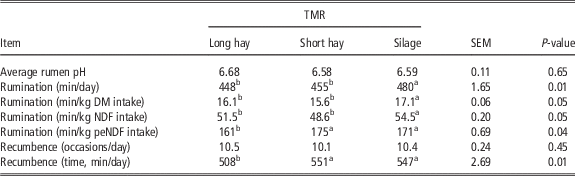
Similar average rumen pH data were found in cows fed the three dietary treatments (6.58 to 6.68; Table 5). Longer daily rumination and rumination per kg DM ingested were found in cows fed the SI-TMR, than in cows fed the two hay TMRs.
Rumen pH, rumination and recumbence behavior in lactating cows fed the experimental total mixed rations (TMRs)

DM=dry matter; peNDF >8 mm=physically effective NDF remaining above the middle sieve (8+19 mm sieves) of the Penn State Particle Separator.
a,b,cMeans within rows with different superscripts differ significantly at P<0.05.
Milk yield and composition
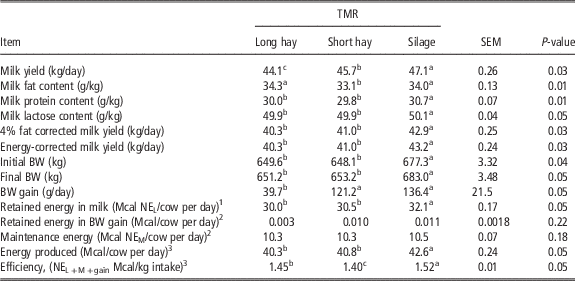
The higher intake of digestible DM in the SI cows resulted in 6.8% and 3.1% higher milk yield of this group compared with the HL and HS cows, respectively (Table 6). Milk fat content was similar in the SI and HL groups and higher than that of the HS cows, whereas milk protein content was higher in the SI cows than in the hay fed groups. Consequently, higher yields of 4% FCM and ECM were found in cows fed the SI-TMR compared with the two groups fed the hay-based TMRs. Average daily BW gain was higher in the SI and HS cows than in the HL group.
Lactation performance of cows fed the three experimental total mixed rations (TMRs)

a,b,cMeans within rows with different superscripts differ significantly at P<0.05.
1 Milk energy was calculated (NRC, 2001) as: NEL (Mcal/kg)=0.092×fat (%)+0.0547×CP (%)+0.039×lactose (%).
2 Energy for maintenance and energy retained in BW gain were calculated (NRC, 2001) as: NEm or BWgain (Mcal)=kg BW0.75×0.08.
3 Sum of daily energy produced=NEL+NEm+NEBW−gain.
Data of milk yield and composition, BW and BW gain was used for calculation of energy produced (NEL Mcal in milk+BW gain+maintenance) by cows fed the three TMRs. Cows fed the SI-TMR produced more daily energy NEL+M+gain than the HS and HL groups (42.6, 40.8 and 40.3 Mcal, respectively). Thus, efficiency of energy production per kg DMI was highest in the SI cows, intermediate in the HL cows and lowest in the HS cows. Animal welfare, as expressed in daily recumbence time and daily BW gain, was similar in the SI and HS groups and higher than the HL cows (Tables 5 and 6).
Discussion
Effect of wheat chopping on intake, digestibility and rumen parameters
This study used three concentrated TMRs that were similar in wheat forage NDF content (17.9% of DM). The HL and SI-TMRs were also similar in dietary peNDF content (10.4% to 10.9%), whereas the HS-TMR contained less peNDF (8.9%; Table 2). Due to the lower peNDF content of the HS-TMR, cows fed this diet consumed 4.4% and 3.9% more DM than the cows fed the HL or SI-TMRs, respectively (P=0.05), but ingested less peNDF. This is in accordance with the guidelines stated by Zebeli et al. (Reference Zebeli, Mansmann, Ametaj, Steingass and Drochner2010 and 2012) about effect of forage chopping on increasing DM intake. However, the cows fed the three TMRs showed similar average rumen pH (6.58 to 6.68; Table 5). This was expressed in similar NDF digestibility of the three groups (Tables 3). A possible explanation for these pH and NDF digestibility findings, might be associated with the similar daily rumination length of the HL and HS cows (Table 5). In addition, the higher surface area of the short wheat hay particle, and the lack of sorting by cows fed this diet (Table 4), encouraged adhesion to and fast degradation of the short hay NDF components by ruminal cellulolytic bacteria as previously suggested (Miron et al., Reference Miron, Ben-Ghedalia and Morrison2001). These favorable conditions occurred despite of the higher DM intake in cows fed HS-TMR compared with cows fed the HL-TMR. These results are in accordance with previous studies showing that decreasing peNDF content in concentrated diets based on barley or corn silages improved intake and NDF digestibility, positively affected rumen fermentation, and reduced sorting behavior of the cows (Kononoff et al., Reference Kononoff, Heinrichs and Lehman2003; Yang and Beauchemin, Reference Yang and Beauchemin2006).
Using a model based on 64 studies and 257 different dietary treatments, Zebeli et al. (Reference Zebeli, Mansmann, Ametaj, Steingass and Drochner2010 and 2012) found and created guidelines that decreasing peNDF content in the TMR below 185 g/kg DMI might reduce rumen pH below 5.8 and create SARA conditions (Zebeli et al., Reference Zebeli, Mansmann, Ametaj, Steingass and Drochner2010 and 2012). Notwithstanding, results of the present study, show high rumen pH and lack of SARA conditions in cows fed each of the three TMRs, despite of their low peNDF content (in the range of 89.2 to 109 g/kg DM; Table 2). It is suggested that these Zebeli’s guidelines are probably valid only for the high-forage TMRs commonly used in the United States and Europe (500 g/kg forage and 500 g/kg concentrates, Zebeli et al., Reference Zebeli, Mansmann, Ametaj, Steingass and Drochner2010), but are less valid for concentrated TMRs that contain only 300 to 320 g/kg DM wheat forage as used in this study and in other semi-arid areas of the globe.
Effects of feeding wheat hay v. wheat silage
The effect of preservation method (wheat hay short or long v. wheat silage) on rumen parameters and NDF digestibility was examined in this study. The HL-TMR and the SI-TMR were similar in peNDF content but differed in TMR pH (4.7 in the SI-TMR and 6.5 in the hay-based TMRs) and in vitro digestibility. However, cows fed these two TMRs presented similar average rumen pH and had similar DM and NDF intake and similar in vivo digestibility of NDF (Tables 3 and 4). Moreover, SARA conditions (pH below 5.8 for 3 h) were not identified in the present study in any of the three groups of cows fed concentrated TMRs, probably because of the addition of 0.7% NaHCO3 buffer to the diets, and the high daily rumination (448 to 480 min/day) of cows fed the three TMRs. This high rumination rates supplied large quantities of saliva containing internal buffer to the rumen that prevent SARA conditions. These findings are in accordance with previous studies (Jaakkola and Huhtanen, Reference Jaakkola and Huhtanen1993; Murphy et al., Reference Murphy, Akerlind and Holtenius2000) which found no significant difference in rumen pH of cows fed diets that contained either grass silage or grass hay as the sole roughage source in the TMR.
In the present study, wheat silage was harvested at the soft-dough stage of grain maturity, and thus contained 20% spikes’ mass, whereas the two hays were harvested at the beginning of spikes maturation and contained only 10% spikes’ mass. This difference in composition increased in vitro DM digestibility of the wheat silage and SI-TMR while reducing its NDF content compared with the hays (Tables 1 and 2). In accord, the in vivo digestibility of DM was highest in cows fed the SI-TMR (Table 3). These intake and digestibility data, resulted in differences among the three dietary treatments with respect to digestible DM intake, which was highest in the cows fed SI-TMR intermediate in the HS-TMR and lowest in the HL-TMR (P=0.05; Table 3). These differences in digestible DM intake were expressed in daily milk yield that presented similar trend (Table 6); the cows fed SI-TMR had higher milk protein content and higher yields of 4% FCM and ECM in compared with the hay fed groups. However, the larger content and ingestion of peNDF in the SI and HL-TMRs resulted in higher milk fat content in cows fed these two TMRs compared with cows fed the HS-TMR. These differences among the three dietary treatments in intake, digestibility, ruminal conditions and milk yield, were expressed in the energy production of cows (NEL+M+gain Mcal/cow per day), which was higher in the SI cows than in the hay fed cows. However, actual NEL+M+gain content per kg TMR ingested was highest in the SI-TMR, lowest in the HS-TMR and intermediate in the HL-TMR (1.52, 1.40 and 1.45 Mcal, respectively, P=0.05). Animal welfare, as expressed in daily recumbence time and BW gain was similar in the SI and HS groups and higher than the HL cows.
Conclusions
This study shows that in a concentrated TMR containing only 30% to 32% wheat forages, short wheat hay is better than long wheat hay or wheat silage at preventing feed sorting and increasing intake. Replacing long wheat hay with wheat silage (containing 20% spikes mass) increased DM digestibility and intake of digestible DM, and resulted in higher yields of milk, 4% FCM and ECM by lactating cows. Production efficiency of the diet was highest in the cows fed SI-TMR lowest in the cows fed HS-TMR and intermediate in the HL-TMR (1.52, 1.40 and 1.45 Mcal NEL+M+gain/kg DMI, respectively).
Acknowledgments
The authors express their appreciation to Yavne Feeding Center for the TMR production. This study was supported by the Israeli Dairy Board Foundation projects 362-0342 and 362-0375.