1. BACKGROUND
The study of function words and functional categories has been at the forefront of research in almost every domain of linguistic inquiry, including syntax (e.g. Chomsky Reference Chomsky1986), phonology (e.g. Selkirk Reference Selkirk1984), articulatory phonetics (e.g. Jurafsky et al. Reference Jurafsky, Bell, Fosler-Lussier, Girana, Raymond, Mannell and Robert-Ribes1998), sociolinguistics (e.g. Labov Reference Labov1969), first language acquisition (e.g. Whitman, Lee & Lust 1991, Valian Reference Valian, Lewis, Karimi, Harley and Farrar2009) including sign language acquisition (Goldin-Meadow, Mylander & Franklin Reference Goldin-Meadow, Mylander and Franklin2007), and (adult) second language acquisition (e.g. Weber-Fox & Neville Reference Weber-Fox and Neville2001). The significance of functional elements for our understanding of the language faculty can hardly be overstated. Indeed, they may represent an aspect that is unique to human language (Hauser, Barner & O'Donnell Reference Hauser, Barner and O'Donnell2007: 111).
A fundamental question about functional elements is how they are acquired by the child. Since early studies of child language, it has been noted that function words, and in particular auxiliaries, often appear to be missing or to occur only variably in child speech, with the result that child utterances sometimes exhibit verbs with non-finite morphology in seemingly matrix clauses, as illustrated in (1)–(4). Such clauses may occur side by side with utterances in which the auxiliary is overt, as in (2) and (4).
(1) Muchas __ recoger many pick.up.inf (M, 3;03; Ezeizabarrena Reference Ezeizabarrena, Teresa Pérez-Leroux and Liceras2002: 45; Spanish)
(2) Mummy __ fix this. Mummy'll fix this. (Holly, 2;0; Radford Reference Radford and Lust1994: 45)
(3) Auto __ parti. car leave.prt (BM, 2;6; Dye, Foley & Lust Reference Dye, Foley and Lust2002; French)
(4) __ monter Gregoire. Veut monter. (G, 1;9; Dye et al. Reference Dye, Foley and Lust2002; French) climb.inf Gregoire wanna climb.inf'
Various theoretical interpretations of these so-called ‘telegraphic’ productions (Brown Reference Brown1973) have been suggested. More generally, the inconsistent occurrence of function words like auxiliaries in child speech has led to the idea of a deficit in child syntactic representations. Most previous accounts fall into three classes.
According to one broad class of accounts, children's impoverished speech, marked by the inconsistent production of function words, has been interpreted as indicating radically different syntactic representations or no syntactic representations altogether. Child representations have been claimed to consist of classes of symbols and types of rules not found in adult grammar (e.g. Braine's Reference Braine1963 ‘pivot grammar’), or to be semantically instead of syntactically based (e.g. Bowerman Reference Bowerman1973, Grimshaw Reference Grimshaw, Baker and McCarthy1981). In a somewhat similar vein it has been proposed that children might not have any adult-like syntactic categories (Tomasello Reference Tomasello1992).
Within the theory of generative grammar, which assumes a universal language faculty (UG) that is available to children, the idea that child representations might be radically different from adult representations is problematic unless there is some clear account of how to get from child grammar to adult grammar. One attempt to do this is maturation theory, which claims that just like organs of the body, UG undergoes maturational stages (e.g. Radford Reference Radford1990). In particular, it has been claimed that children undergo an ‘optional infinitive’ developmental stage. This type of account assumes that ‘[synthetic] finite and non-finite forms occur in free variation [i.e. randomly]’ (Wexler Reference Wexler, Lightfoot and Hornstein1994: 311; see also Hyams Reference Hyams, Deen, Nomura, Schulz and Schwartz2007: 235). For example, the French child is claimed to generate utterances like (5), where the synthetic finite verb is in the syntactic slot for finite verbs (i.e. preceding negation), in random alternation with utterances like (6), where the non-finite verb is in the syntactic slot for non-finite verbs (i.e. following negation). It is claimed that (5) has a finite/adult-like syntactic representation, whereas (6) has a non-finite/non-adult-like syntactic representation. The purported optionality in representations is said to reflect the maturation of some specific aspect related to functional projections (e.g. Wexler Reference Wexler, Lightfoot and Hornstein1994, Hoekstra & Hyams Reference Hoekstra, Hyams, Koster and Wijnen1996).
(5) Jean ouvre pas. Jean opens not
(6) Jean pas ouvrir. Jean not open.inf
However, evidence shows that change in the overt production of functional material ‘is not discrete and sudden as a stage theory would predict, but gradual and highly subject to individual variation’ (Lust Reference Lust, Bhatia and Ritchie1999: 133; for discussion of variation within and across children, see Bates, Dale & Thal 1995, Lleó & Demuth Reference Lleó, Demuth, Greenhill, Littlefield and Tano1999). Further, a child grammar in which a given property would change from optional to obligatory is arguably unlearnable as obligatoriness cannot be determined by the experienced data (Boser et al. Reference Boser, Lust, Santelmann and Whitman1992: 63).
Another type of UG-based approach to explaining the apparent absence of auxiliaries in child speech is represented by null-aux accounts (Boser et al. Reference Boser, Lust, Santelmann and Whitman1992, Whitman Reference Whitman and Lust1994; see also Phillips Reference Phillips1995, Ingram & Thompson Reference Ingram and Thompson1996, Borer & Rohrbacher Reference Borer and Rohrbacher2002, Josefsson Reference Josefsson2002 for related proposals). Within this approach, in the child representation of a sentence with a non-finite verb, the functional head Infl is occupied by a null aux category, similar to a vacuous do (i.e. lacking semantic and phonological representations), licensed as a syntactic empty category (EC), as in (7) below. Crucially, the null-aux proposal directly accounts for the verb's non-finite morphology and its occurrence in the slot where a non-finite verb normally occurs in the target language, in the case of French, following the negative pas, as in (6), in contrast with finite verbs which precede it, as in (5).
(7) Jean ECAUX pas ouvrir. Jean not open.inf
Compared to maturational accounts, the null-aux hypothesis posits a child representation that is closer to the adult representation but still posits some discontinuity with adult syntax, as the child null aux is a non-adult all-purpose aux category expected to co-occur with just the specific set of forms of the lexical verb. Additionally, the null aux is licensed similarly to pro, that is, differently from the way in which auxiliaries are licensed in adult grammar. One concern here is that the null-aux hypothesis lacks an explanation and that to date no independent evidence for a silent auxiliary has been provided (Labelle Reference Labelle2000). Another concern is that overt auxiliaries may be absent during the periods when non-finite verbs are produced. Wijnen (Reference Wijnen1996/1997) and Schlyter (Reference Schlyter, Dimroth and Starren2003) claimed that auxiliaries were absent during the first recordings of their German or French children aged 1;9, 1;11, 2;0, 2;7 and 2;0, 2;2, 2;3, respectively.
In summary, a common thread among many previous accounts is that children's production of non-finite/ostensibly unauxiliated verbs has often been interpreted to reflect a deficit in syntactic representations. From studies claiming no syntax or radically different syntax, to maturational accounts suggesting a deficit in the syntax of functional projections, to null-aux accounts suggesting difficulties in language-specific syntax (i.e. the nature and licensing of the null aux), scholars have often sought syntactic explanations.
In contrast with earlier work, this article explores the possibility that child syntax is closer to adult syntax than previously thought, but that the child's phonology may considerably impact her overt realizations of auxiliaries.
2. A NEW PROPOSAL
Here we advance a new proposal regarding young children's production of non-finite verbs in apparently matrix clauses – the Phonological Reduction Hypothesis (PRH). The PRH proposes that
(i) non-finite verbs in early child speech are in fact attempted periphrastics (i.e. auxiliary/modal+non-finite verb) and thus child syntax is closer to adult syntax than previously assumed; and
(ii) one factor involved in the apparent lack of the auxiliary in these attempted periphrastics is phonological in nature: the auxiliary is structurally present with semantic content but is subject to extreme phonological reduction, that is, deletion.
The new proposal differs from the old null-aux hypothesis in critical ways. First, the PRH posits phonologically reduced auxiliaries (i.e. a reduction to zero of the phonetic form of the auxiliary), not a syntactic empty category.Footnote 2 Second, it posits specific auxiliaries/modals in connection with specific periphrastics (i.e. the ones available in the target language), as opposed to a generic do-type element. Therefore, under the PRH, the phonologically reduced auxiliaries are expected to have specific semantics and function, in contrast to the previous hypothesis, which posited a semantically vacuous aux element. Finally and perhaps most importantly, the PRH proposes that one factor involved in the reduction of the auxiliary/modal is phonological in nature and therefore differences between adult and child language are, at least partially, located in early phonology.Footnote 3
Some recent research lends support to the PRH. One set of findings involves evidence for more adult-like syntactic representations at early ages than traditionally assumed. Comprehension experiments indicate that during their first year of life infants already encode function words (e.g. Höhle & Weisseborn Reference Höhle and Weisseborn2003, Shi, Werker & Cutler Reference Shi, Werker and Cutler2006) while during the second year they already use function words to compute word reference and syntactically categorize content words (e.g. Höhle et al. Reference Höhle, Weisseborn, Keifer, Schultz and Schmitz2004, Kedar, Casasola & Lust Reference Lust2006, Bernal et al. Reference Bernal, Lidz, Millotte and Christophe2007, Kedar Reference Kedar2009). Of particular relevance here, recent comprehension evidence supports the presence of an abstract representation of the functional category Tense from the onset of combinatorial speech (Valian Reference Valian2006). Additionally, there is now evidence that initially, functional items including auxiliaries may be realized as ‘filler’ vowels (often taking the form of a reduced vowel, e.g. Kilani-Schoch & Dressler Reference Kilani-Schoch and Dressler2001, Bassano et al. Reference Bassano, Laaha, Maillochon and Dressler2004).
Another area of research supporting the PRH concerns evidence implicating phonology in children's omission of functional elements. While determiner omission was initially taken to reflect syntactic difficulties, evidence now points to phonological difficulties. Determiners are produced earlier and more consistently when they occur in prosodically simpler contexts. For example, in child French, determiners (like other unstressed syllables) are more likely to be produced when they can be prosodified as part of a dissyllabic (iambic) foot such as when preceding a monosyllabic noun e.g. [du lait]Foot ‘some milk’, but tend to be omitted when they occur in an unfooted syllable, such as when preceding a dissyllabic noun e.g. la [couronne]Foot ‘the crown’ (e.g. Bassano, Maillochon & Mottet Reference Bassano, Maillochon and Mottet2008, Demuth & Tremblay Reference Demuth and Tremblay2008). Similar findings have been reported for determiners in child English (Gerken Reference Gerken1996, Demuth & McCullough Reference Demuth and Elizabeth McCullough2009), Dutch (Wijnen, Krikhaar & den Os Reference Wijnen, Krikhaar and Os1994), Swedish (Santelmann Reference Santelmann, Greenhill, Hughes, Littlefield and Walsh1998), Spanish (Demuth et al. Reference Demuth, Patrolia, Song and Masapollo2010), and Sesotho (Demuth & Ellis Reference Demuth, Ellis, Guo, Lieven, Budwig, Ervin-Tripp, Nakamura and Ozcaliskan2009).Footnote 4 Prosodic difficulties have also been reported in connection with children's variable production of English pronominal subjects (Gerken Reference Gerken1991, Reference Gerken1996). Very recently, Song, Sundara & Demuth (Reference Demuth and 2009) reported that English verb inflections are more likely to be realized when occurring in simple coda contexts (e.g. sees), but tend to be omitted in complex coda contexts (e.g. needs).
Finally, another area of research supporting the PRH involves the drastic reduction of function words in adult casual speech. Veilleux & Shattuck-Hufnagel (Reference Veilleux and Stephanie1998: 382) point out that ‘one of the often cited reasons for the degradation of ASR [Automated Speech Recognition] performance is the prevalence of severely modified, even deleted, phonemes, or pronunciation variability … Grammatical words … are particularly likely to undergo severe modification’. Evidence shows that, in sharp contrast with content words, function words are much more likely to be reduced, exhibit more variability in their realizations, and incur more drastic reduction (Jurafsky et al. Reference Jurafsky, Bell, Fosler-Lussier, Girana, Raymond, Mannell and Robert-Ribes1998, Veilleux & Shattuck-Hufnagel Reference Veilleux and Stephanie1998, Lavoie Reference Lavoie2002, Bell et al. Reference Bell, Brenier, Gregory, Girand and Jurafsky2009; unstressed syllable production is generally more taxing on the system, e.g. Browman & Goldstein Reference Browman and Goldstein1992). For example, Lavoie (Reference Lavoie2002) compared the phonetic realizations of the lexical item four and the functional item for. In contrast with the former, the latter was found to exhibit a wider range of realizations and more severe reduction. The realizations of the functional item fell on a phonetic continuum ranging from full all the way to minimal pronunciations: [foɹ, fɔɹ, fɚː, fɚ, fə, f]. Similarly, to (but not two or too) has been reported to exhibit a wide range of pronunciations including [thu, thə, də, nə, sə, th, ə] (Veilleux & Shattuck-Hufnagel Reference Veilleux and Stephanie1998). Varying degrees of reduction have also been found in the realization of the English functional items a, the, of, to, I, it, in, and, that and you, one of the most frequent pronunciations observed for each of the first six items being [ə] (Jurafsky et al. Reference Jurafsky, Bell, Fosler-Lussier, Girana, Raymond, Mannell and Robert-Ribes1998). Lastly, the realizations of the auxiliary forms am, are and is in African American Vernacular English have been found to fall on a continuum including full (V(owel)C(onsonant)), reduced (C), and deleted forms (Labov Reference Labov1969).
3. PREDICTIONS OF THE PRH AND OVERVIEW OF THE PRESENT INVESTIGATION
This article tests the PRH on new data from child French. The PRH makes three important predictions, which are outlined below.
Prediction I is that if children's non-finite verbs represent attempted periphrastics with a phonologically reduced/deleted auxiliary, we expect to find phonological evidence for the reduction of auxiliaries. Based on previous research on phonological reduction/deletion (Labov Reference Labov1969, Browman & Goldstein Reference Browman and Goldstein1992, Shockey Reference Shockey2003, Lavoie Reference Lavoie2002, Davidson Reference Davidson2006, Delforge Reference Delforge, Colantoni and Steele2008), we may expect a given child's auxiliary forms to exhibit a range of reductions, from target-like (i.e. no reduction) and near-target forms, down to and including deleted forms (i.e. complete reduction). In other words, a likely expectation is to observe a gradation or a continuum in a given child's phonetic realizations of auxiliaries (Figure 1). Prediction I is examined in Section 4 below.
A predicted continuum in the child's realizations of auxiliaries.

Prediction II of the PRH concerns the semantics of non-finite verbs. If these are attempted periphrastics, their semantics should generally correspond to the semantics of periphrastics in the target language. For example, in child French, the semantics of infinitives should more or less correspond to the semantics of periphrastics with infinitive (i.e. aller ‘gonna’+ infinitive or modals+infinitive). Prediction II is examined in Section 5.
Prediction III of the PRH concerns syntactic contexts of non-finite verbs. If these represent attempted periphrastics, they should be observed mostly in syntactic contexts for periphrastics. In other words, they should be observed when the child's intended utterance involves a periphrastic, but not a synthetic (finite) verb. For example, in child French, they may be expected to occur when the child is attempting to produce je vais ouvrir la porte ‘I'm gonna open the door’, but not j'ouvre la porte ‘I open the door’. Prediction III is tested in Section 6.
The predictions of the PRH contrast with the predictions of previous approaches. Under approaches positing radical differences in child syntactic representations, one would not expect a direct link between children's non-finite forms and adult grammar. Under (optional infinitive) maturational accounts, where these forms are claimed to occur in random alternation with synthetic finite verbs, they are clearly not expected to occur in syntactic or semantic contexts for periphrastics; nor are they expected to show evidence for auxiliary reduction, since such accounts reject the possibility that non-finite verbs involve auxiliaries (e.g. Wexler Reference Wexler, Lightfoot and Hornstein1994, Hoekstra & Hyams Reference Hoekstra and Hyams1998). Under null-aux accounts, since the null aux is both semantically and phonetically empty, much like a null do, children's non-finite verbs are not predicted to show systematic use, systematic function, or specific semantics. Additionally, since the null aux is a syntactic empty category like pro (i.e. lacking a phonological representation), evidence of phonologically reduced auxiliaries is not expected.
The present investigation was carried out on French, a language of great significance to the literature on the forms in question. Child French has been the basis for much theoretical speculation regarding these forms (e.g. Wexler Reference Wexler, Lightfoot and Hornstein1994, Reference Wexler1998), owing primarily to Pierce's (Reference Pierce1992) important work on this language. However, Pierce (Reference Pierce1992) relied on data collected decades ago with older methods and involved a small sample size, which is problematic given the extent of individual variation we now know to exist among children (e.g. de Boysson-Bardies 2001). For these reasons French is especially in need of attention.
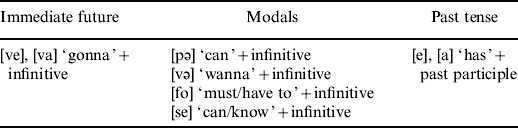
Before turning to the present investigation, a few preliminaries concerning French are in order. First, French periphrastics consist of an auxiliary or modal and a main verb in infinitive or past participle form. A list of common periphrastics used by children is provided in Table 1. Note that many French auxiliaries/modals have monosyllabic (CV) or even monophonemic (V) forms. In fact they involve less than a full syllable, having subminimal (i.e. monomoraic instead of bimoraic) prosodic form. It is thus quite plausible that phonological reduction of these (CV or V) forms may result in complete deletion.
French periphrastics
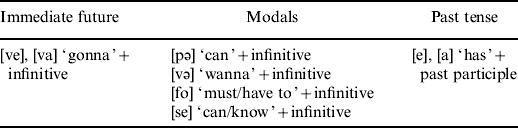
Spoken French relies on periphrastics to a greater extent than Standard French (Lambrecht Reference Lambrecht1981).Footnote 5 The periphrastic future has a wider range of uses; for example, it may be used in place of the synthetic present tense to suggest planning or progression towards a result, or to refer to actions that are simultaneous with the moment of speaking, as in (8) and as is often the case in child French (as shown in the child utterances in (11), (12), and (17) below).
(8) Regarde, on va enlever la photo et on va la mettre ici. Watch 1pl gonna remove.inf the photo and 1pl gonna it put.inf here ‘Watch, we're gonna remove the photo and we're gonna put it here.’
Following previous studies on child French, the periphrastics in Table 1 are here considered monoclausal (e.g. Schlyter Reference Schlyter, Dimroth and Starren2003: 21). Henceforth the term auxiliary is used as shorthand for auxiliary/modal.
Second, in Spoken French (including adult- and particularly child-directed speech, as well as child speech) subject clitics (e.g. j(e) [ʒ(ə)] ‘1sg’, t(u) [t(y)] ‘2sg’, i(l) [i(l)] ‘3sg’, on [õ] ‘1pl’) are often considered to function as agreement prefixes on a tensed verb or auxiliary (e.g. Lambrecht Reference Lambrecht1981, Kilani-Schoch & Dressler Reference Kilani-Schoch and Dressler2001, Culbertson Reference Culbertson2010, Legendre et al. Reference Legendre, Culbertson, Barrière, Nazzi, Goyet, Torrens, Escobar, Gavarro and Gutierrez2010; for an opposing view, see De Cat Reference De Cat2005).Footnote 6 On this view, these elements are generated directly on the finite verb or auxiliary either in the lexicon or post-syntactically (Legendre et al. Reference Legendre, Culbertson, Barrière, Nazzi, Goyet, Torrens, Escobar, Gavarro and Gutierrez2010), e.g. in (9), i ‘3sg’ is part of the auxiliary, much like s in has left is part of the auxiliary, though the French agreement marker is a prefix rather than a suffix.
(9) Jacques i va chanter. Jacques 3sg gonna sing.inf ‘Jacques is gonna sing.’
Preverbal elements such as agreement prefixes show increased phonetic erosion in Spoken French (Lambrecht Reference Lambrecht1981). For example, [ʒə] may occur as [ʒ] (e.g. [ʒ və] ‘1sg want’), [ty] may occur as [t] (e.g. [t a] ‘2sg have’), [il] may occur as [i] (e.g. [i və] ‘3sg want’). The preverbal negative ne is usually omitted (Lambrecht Reference Lambrecht1981). The reduction of these elements in adult speech needs to be taken into account in analyzing child speech involving such forms, and also bears on our claim for auxiliary reduction, since auxiliaries are likewise preverbal elements. With these clarifications in mind, we now turn to the present investigation, which consists of three studies that tested Predictions I, II, and III of the PRH.
4. PREDICTION I: A CONTINUUM IN THE PHONETIC REALIZATION OF AUXILIARIES
In this section we examine the extent to which auxiliaries are produced and whether there is evidence for phonological reduction in children's speech samples. In particular, if the PRH is correct, a likely expectation is to find a gradation or a continuum in a given child's phonetic realizations of auxiliaries, which may include target-like forms side by side with variously reduced forms, down to and including deleted forms. For the present investigation, a new corpus of child French cross-sectional spontaneous speech samples was compiled.
4.1 Participants
We tested 18 monolingual French-speaking typically-developing children (six girls) aged between 1;11 and 2;11 (mean age 2;5) residing in Paris and Nancy, France. This age range was determined based on the following considerations: (a) while children start producing words around their first birthday, it is not until 2;0–2;6 that they begin to produce a sizeable number of verbs (e.g. Bernal et al. Reference Bernal, Lidz, Millotte and Christophe2007: 227), and (b) previous research indicates that the relevant age range for examining the issues at hand is roughly from about 2 years to about 3 years (Boser Reference Boser1997, Ezeizabarrena Reference Ezeizabarrena, Teresa Pérez-Leroux and Liceras2002, Josefsson Reference Josefsson2002, Bassano et al. Reference Bassano, Laaha, Maillochon and Dressler2004), e.g. the forms in question have been said to occur between 1;10 and 2;7 and ‘even later than 2;7, perhaps even later than 3;0’ (Harris & Wexler Reference Harris, Wexler and Clahsen1996: 36, fn. 1). Children were recruited through daycare centers and were interviewed individually in a separate room. Session length was approximately 30 minutes on average.
4.2 Observational data
To ensure that children had ample opportunity to produce a variety of verb forms, we selected a set of toys, activities, and conversation topics conducive to talking about actions, thus triggering utterances with verbs. The speech samples thus obtained included a high density of verb utterances (3438 verb utterances out of a total of approximately 5000 child utterances), allowing for more robust analyses. To render the speech samples from different children more comparable, several aspects of the interview process were standardized, such as conversation topics, activities, toys, interviewers, interviewer training, and interview location.
4.3 Recording
Given the nature of our hypothesis, it was crucial to have detailed data. Function words are easy to overlook during transcription; for example, Labov (Reference Labov, Gleitman and Liberman1995: 28–29) referred to function words in adult speech as ‘small bits of sound that are often hard to hear … in fast speech they all but disappear’. Child speech is even more challenging in this regard. Several measures were taken to ensure that the recordings had the high audio quality necessary to capture function words. We used a Sharp IM-MT880 digital minidisk recorder (24 bit resolution) and a pair of Soundman OKM binaural omni-directional stereo condenser microphones (frequency range: 20 Hz to 20 kHz, sensitivity: 300 mV/Pa). The binaural microphones were worn in the ears, which allowed the interviewer, by simply moving her head, to keep the microphones generally within two feet of the child. The recordings were downloaded onto a computer and edited to enhance children's voices relative to any background noise. In addition, the sessions were videotaped.
4.4 Transcription
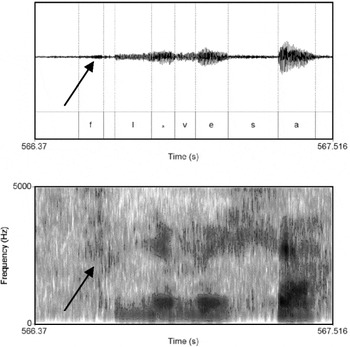
The speech samples were transcribed with WAVpedal v.5.0 transcription software, which allowed bypassing conversion to analog. Speech samples in their entirety (i.e. including both child and adult) were transcribed orthographically by trained native speakers and checked for reliability. Relevant forms were additionally transcribed using broad phonemic transcription. We used a combination of linguistic context, phonetic match and visual information from the video recordings to identify the child's target forms. In some instances, the auxiliary form was uttered in a faint voice (or fast, or whispered) and was not heard even by the interviewer. Such forms were barely audible on the original recordings and required digital amplification to be identified. In other cases the identification of the auxiliary form required spectral analysis. This was carried out in Praat by a French phonologist. In some cases, spectral analysis of what the transcriber heard as a non-finite verb showed clear indications of the consonant from the supposedly absent auxiliary. Figure 2 illustrates such an instance where spectrographic analysis revealed the presence of a fricative, [f], preceding what was heard as a non-finite verb. Inspection of the linguistic and pragmatic context of this utterance showed that in fact it occurred in a sequence where the child P39 uttered faut lever [fo ləve] ‘must lift’ several times in self-addressed speech. The element preceding the non-finite verb was thus a half pronunciation of the auxiliary faut [fo] ‘must’.
Spectrogram of P39's f lever ça [f ləve sa] (=faut lever ça [fo ləve sa]) ‘must lift.inf this’.

4.5 Coding
Coding took place in a relational database and followed systematic procedures based on methodological principles developed in an ongoing project by Barbara Lust and colleagues at Cornell University. To test Predictions I and II of the PRH, all verb clauses were divided into three categories: clauses with periphrastics, clauses with synthetic finite verbs, and clauses with non-finite verbs which we argue to be periphrastics with phonologically deleted auxiliaries.
For a verb clause to be coded as containing a periphrastic, it had to have both a non-finite verb and phonetic evidence for the presence of the auxiliary. Periphrastics included aux+infinitive, modal+infinitive, and aux+past participle. Periphrastics were divided into five types, according to the phonetic form of the auxiliary:Footnote 7
(i) Periphrastics in which all segments of the auxiliary were adult-like were coded as periphrastics with target-like auxiliaries, e.g. [(il) va uvrir] (3sg) gonna open.inf ‘he's gonna open’, [(il) a uvεr] (3sg) has leave.prt ‘he has left’.
(ii) Periphrastics in which at least one segment of the auxiliary was different from the target were coded as periphrastics with near-target auxiliaries, e.g. [(il) ka/vu uvrir].
(iii) Periphrastics in which the auxiliary was missing a segment were coded as periphrastics with truncated auxiliaries, e.g. [(il) v/a uvrir], where [v] or [a] are contracted pronunciations of [va].
(iv) Periphrastics in which the auxiliary was realized as a (mid, non-back) vowel were coded as periphrastics with vowel auxiliaries e.g. [(il) ə uvrir], [(il) ə uvεr] (such vowels were not separated from the non-finite verb by any pause); in some instances, the context did not allow determining the intended auxiliary, i.e. the vowel may correspond to more than one possible auxiliary. Longitudinal studies of child French indicate that such vowels are precursors of auxiliaries (Kilani-Schoch & Dressler Reference Kilani-Schoch and Dressler2001, Bassano et al. Reference Bassano, Laaha, Maillochon and Dressler2004).Footnote 8
(v) Periphrastics in which the presence of the auxiliary was signaled (only) by an agreement prefix were coded as periphrastics with agreement prefix e.g. [il uvrir], [il uvεr].Footnote 9
Clauses with synthetic verbs included present tense, imperative or imperfect verbs. The last category of verb clauses involved the forms that represent the focus of our investigation, i.e. clauses with non-finite verbs, which we argue to be periphrastics with deleted auxiliaries and which are given in the column labeled ‘deleted’ in Table 2 (see next page). These included unambiguous infinitive forms (e.g. [uvrir] ‘open.inf’), unambiguous past participle forms (e.g. [uvεr] ‘open.prt’),Footnote 10 and non-finite forms ending in [e], which are ambiguous between infinitive and past participle (e.g. [ʃ ãte] was orthographically transcribed chantE and glossed ‘sing-E’ to capture this ambiguity, see example (22) below). The results reported below refer to number of tokens.
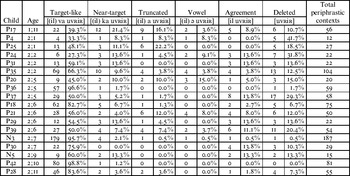
Number and percentage of periphrastics by auxiliary type, by child and age

4.6 Results
A range of phonetic realizations of auxiliaries was observed in children's speech samples, as expected under Prediction I. Auxiliaries were produced variably along a continuum from full pronunciation to complete deletion. Table 2 summarizes the number and percentage of periphrastic clauses produced by each child, according to the phonetic form of the auxiliary. Percentages for each column were calculated out of total periphrastic contexts. As seen in Table 2, (overt) auxiliaries were produced by even the youngest children (e.g. age 1;11), contra previous studies (Wijnen Reference Wijnen1996/1997, Schlyter Reference Schlyter, Dimroth and Starren2003). All children produced periphrastics with target-like auxiliaries (with variation ranging between 27.3% and 98.8%). Likewise, all children produced at least one type of reduction (i.e. near-target, truncated, vowel, or agreement), and most children showed multiple types of reduction. No child exhibited only deleted auxiliaries.
Below we illustrate each of the columns in Table 2 with example utterances.Footnote 11 As we will see, many of children's approximations of the target auxiliary can be described in terms of common child phonological processes operating on adult forms (cf. Smith Reference Smith1973).
4.6.1 Periphrastics with target-like auxiliaries
The child utterances in (10) and (11) illustrate instances where the phonetic form of the auxiliary was target-like:
(10) P29, age 2;6
C J'veux sortir = J'veux sortir. [ʒ və sɔrtir] [ʒ və sɔrtir] 1sg.wanna leave.inf 1sg.wanna leave.inf ‘I wanna leave.’
(11) P35, age 2;2
C Vais l'enver ça = J'vais l'enlever ça. [ve l ãve sa] [ʒ ve lãləve sa] gonna it.remove.inf this 1sg.gonna it.remove.inf this ‘I'm gonna remove this.’
4.6.2 Periphrastics with near-target auxiliaries
Examples in this category often involved one of the most common phonological processes in child language, namely segment substitution (e.g. Ingram Reference Ingram1976). Examples (12) and (13) illustrate stopping: the fricative in the auxiliary [va] ‘gonna’ was substituted with [k] or [p], respectively. Fricatives require a greater degree of articulatory precision than stops; they are difficult for young children, particularly as onsets and in weak syllables, and may be substituted with a stop (e.g. Ingram Reference Ingram1976, Vihman Reference Vihman1996, de Boysson-Bardies Reference de Boysson-Bardies2001: 144).
(12) P37, age 2;5
C Onka pas mette là = On va pas mettre là [õka pa mεt la] [õ va pa mεt la] 1pl gonna not put.inf there 1pl gonna not put.inf there ‘We're not gonna put [it] there.’
(13) P29, age 2;6
C Bah pa prendre son bavoirFootnote 12 = Bah, i va prendre son bavoir[ ba pa prãdr sõ bavwar] [ba i va prãdr sõ bavwar] well gonna take.inf his bib well 3sg gonna take.inf his bib‘ Well, he's gonna take his bib.’
Example (14) illustrates another process common in child language, namely consonant assimilation/harmony (e.g. de Boysson-Bardies 1999: 145, Lust Reference Lust2006). Given the linguistic and pragmatic context of this utterance, the intended auxiliary was [və] ‘wanna’; however, the fricative was assimilated to the following consonant [l], resulting in the form [lə].
(14) P17, age 1;11 (asking the adult to remove a sticker)
C Ca, leux l'ever ça! = Ça, j'veux l'enlever ça! [sa lə l əve sa] [sa ʒ və lẽ ləve sa] this wanna it.remove.inf this this 1sg.wanna it.remove.inf this ‘This, I wanna remove this!’
I Aaah, tu veux enlever ça?oooh you wanna remove.inf this
4.6.3 Periphrastics with truncated auxiliaries
Example (15) shows a truncated form of the auxiliary [və] ‘wanna’, i.e. [v].Footnote 13
(15) P39, age 2;6
C J'v'ouer avec le tast fort moi = J'veux jouer avec le château fort moi. [ʒ v we avek lə tast for mwa] [ʒ və ʒwe avek lə ʃ ato for mwa] 1sg.wanna.play.inf with the fortress I 1sg.wanna play.inf with the fortress I‘I wanna play with the fortress.’
Example (16) shows a truncated form of the auxiliary [fo] ‘must’, i.e. [o].
(16) P20, age 2;5
C O pas l'enlerFootnote 14 = Faut pas l' enlever. [o pa l ãle] [fo pa l ãləve]must not it.remove.inf must not it.remove.inf ‘We shouldn't remove it.’
In (17), [e] represents a truncated form of the auxiliary [ve] ‘gonna’, resulting from another typical process in early language, i.e. reduction of a consonant cluster to a singleton consonant (e.g. Kirk Reference Kirk2008), in this case, [ʒve] >[ʒe] ‘1sg gonna’.
(17) P4, age 2;1 (child announces her intention)
C J'ais donner a saussu à bébé = J'vais donner des chaussures au bébé. [ʒe done a sosy a bebe] [ʒ ve done de ʃ osyr o bebe] 1sg.gonna give.inf shoes to baby 1sg.gonna give.inf some shoes to.the baby ‘I'm gonna give the baby some shoes.’
I Tu vas donner des chaussures au bébé.you are.gonna give some shoes to.the baby
In other children, reduction of the cluster in [ʒve] ‘1sg gonna’ involved coalescence (Kirk Reference Kirk2008), resulting in the forms [ʒe] or [se], where [ʒ] and [s] preserve the coronal feature of [ʒ] and the manner specification of both [ʒ] and [v].
4.6.4 Periphrastics where the auxiliary is realized as a reduced vowel
In (18) the auxiliary [fo] is realized as a reduced vowel. A common process in early phonological development is the realization of unstressed syllables as reduced vowels (e.g. Vihman Reference Vihman1996). Production of unstressed syllables is taxing even for adults who may also realize them as reduced vowels.
(18) P24, age 2;2 (trying to find a slot to place a dog figurine)
C É pas mett' chien = Faut/J'peux pas mettre le chien. [e pa mεt ʃ jẽ ] [fo/ʒ pə pa mεtr lə ʃ jẽ ]vowel.aux not put.inf dog must/1sg.can not put.inf the dog ‘We shouldn't/I can't place the dog.’
4.6.5 Periphrastics where the auxiliary is implied by an agreement prefix
The utterances in (19)–(22) illustrate cases in which only the agreement prefix on the auxiliary was realized overtly. The importance of the discovery of such utterances cannot be overstated. This type of utterance (agreement prefix+non-finite verb) was previously claimed not to occur in child language, which was further taken to indicate that clauses with non-finite verbs had non-finite/non-adult-like representations (e.g. Pierce Reference Pierce1992, Wexler Reference Wexler, Lightfoot and Hornstein1994). However, in the new data such utterances were observed in all children,Footnote 15 and involved a variety of agreement prefixes (e.g. i ‘3sg’, on ‘1pl’, je ‘1sg’), a discovery which provides strong counterevidence to the old claim regarding non-finite representations.
(19) P24, age 2;2
I Et qu'est-ce qu'il va faire Timothée avec sa maman? and what.is.it that.he gonna do.inf Timothée with his mom
C I dormir = I va dormir. [i dɔrmir] [i va dɔrmir]3sg sleep.inf 3sg gonna sleep.inf‘He's gonna sleep.’
(20) P37, age 2;5
C On mett' ta = On va/peut mettre ça. [õ mε t ta] [õ va/pə mε tr sa] 1pl put.inf that 1pl gonna/can put.inf that‘We are gonna/can put this.’
(21) N5, age 2;9 (describing picture of a dog without its hat)
C Le sss i pédu son bonnet = Le chien il a perdu son bonnet. [lə sss i pedy sõ bone] [lə ʃ jẽ i a pε rdy sõ bone] the dog 3sg lose.prt his hat the dog 3sg has lose.prt his hat ‘The dog has lost its hat.’
(22) P20, age 2;5 (negative context; past or future)
C I pas sauE, … sauE pus haut = I a/va pas sauté/sauter plus haut. [i pa soe soe py o] [i a/va pa sote ply o] 3sg not jump-e jump-e more high 3sg has/gonna not jump.prt/inf more high ‘He didn't/isn't gonna jump higher.’
4.6.6 Periphrastics with deleted auxiliaries
Finally, in (23) and (24), there was no measurable trace of the auxiliary, i.e. it was completely deleted:Footnote 16
(23) P24, age 2;1 (correcting the adult's action)
C Pas mett' comme ça = Fo pas le mettre comme ça. [pa mε t kom sa] [fo pa lə mε t kom sa] not put.inf like that must not it put.inf like that‘We shouldn't put it like that.’
(24) P39, age 2;6 (about a toy; not clear if past or future reference)
C rentrE na maison = Il est rentré/va rentrer à la maison. [rãtre na mezõ] [il e rãtre/va rãtre a la mezõ] return-e the home 3sg has return.prt/gonna return.inf to the home ‘He came back/is gonna come back home.’
The same target auxiliary was realized with different degrees of reduction ranging over all or part of the continuum by the same child and during the same session, sometimes only seconds apart. For example, successive attempts at the periphrastic [pə uvrir] ‘can open’ by subject P37 included [pu], [pe], and [ə] as the realizations of the auxiliary. Indeed, a hallmark of child speech is the phonetic variability that a child exhibits in her pronunciations of a given word (e.g. Ingram Reference Ingram1976: 232, de Boysson-Bardies Reference de Boysson-Bardies2001: 145). The sequence in (25) below illustrates successive attempts at the periphrastic [ʒə və rəmõte] ‘1sg wanna go.back.up.inf’ by subject P25. The child's various realizations of this periphrastic range from a target-like form to a form involving minimal phonetic evidence for the auxiliary, namely a breath/pause.Footnote 17 This minimal overt realization of the auxiliary is consistent with Carter & Gerken's (Reference Carter and Gerken2004) findings that children leave a pause when they delete the initial unstressed syllable of a multisyllabic word, which suggests that, in some cases, children have planned for the apparently missing syllable even if no segmental content was realized.
(25) P25, age 2;1 (asking to go back upstairs)
C Qu'à haut, [breath] remoter = là haut, j'veux remonter [ka o rəmote] [la o ʒ və rəmõte]up there go.back.up.inf up there 1sg.wanna go.back.up.inf ‘Up there, I wanna go back up.’
C Eux remoter = J'veux remonter.[ərəmote] [ʒ və rəmõte]wanna go.back.up.inf 1sg.wanna go.back.up.inf
C Veux romoter = J'veux remonter. [vəromote] [ʒ və rəmõte]wanna go.back.up.inf 1sg.wanna go.back.up.inf
C [breath] remonter = J'veux remonter. [ rəmõte] [ʒ və rəmõte]wanna go.back.up.inf 1sg.wanna go.back.up.inf …
C Eeux monter! = Je veux monter. [e ə mõte] [ʒə və mõte]1.sg.wanna go.up.inf 1sg wanna go.up.inf …
C Zeveux monter = Je veux monter.[ʒəvə mõte] [ʒə və mõte]1sg wanna go.up.inf 1sg wanna go.up.inf
Given that the phenomena of phonological reduction and deletion are closely related (e.g. Labov Reference Labov1969, Brown Reference Brown1973: 267), that French auxiliaries (having subminimal prosodic form) are particularly prone to deletion, and that we found children's phonetic realizations of auxiliaries to fall on a continuum, it is only reasonable to expect to observe instances of periphrastics with completely reduced, i.e. deleted, auxiliaries in child speech. We propose that non-finite forms in early speech are just this: the expected periphrastics with deleted auxiliaries. They belong on this continuum.
The discovery of non-finite verbs co-occurring with agreement prefixes (i.e. the forms in the column labeled ‘agreement’ in Table 2 and exemplified in (19)–(22)) lends further support to this interpretation. These forms instantiate periphrastics in which the auxiliary is signaled by a phonetic trace (i.e. the prefix). These newly discovered periphrastics in which the auxiliary is signaled by a phonetic trace may be thought of as the ‘missing link’ between periphrastics with phonetically realized auxiliaries and periphrastics with completely deleted auxiliaries.
4.7 Additional evidence in support of the PRH
Three additional observations lend support to the proposal that non-finite verbs in early speech represent attempted periphrastics in which the auxiliary undergoes phonological deletion. These are presented in Sections 4.7.1–4.7.3.
4.7.1 Replacement with periphrastics
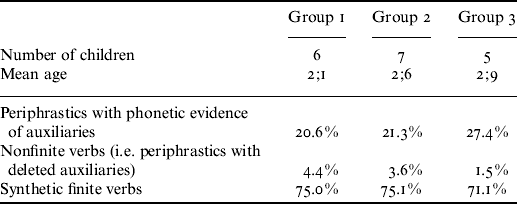
The first observation is that non-finite verbs are likely to be replaced with periphrastics, and not with synthetic verbs, in the course of development. In order to infer the fate of these verbs over time, the 18 children were divided into three age groups such that the groups included similar numbers of children. For each age group, we calculated mean percentage of periphrastics with phonetic evidence of auxiliary (which encompassed the columns labeled ‘target-like’, ‘near-target’, ‘truncated’, ‘vowel’, and ‘agreement’ in Table 2 above), mean percentage of synthetic finite verbs, and mean percentage of non-finite verbs (which we argue to be periphrastics with deleted auxiliaries, and which in Table 2 are listed in the column labeled ‘deleted’). The results are reported in Table 3.
Mean percentage of verb clauses, by type, by age group
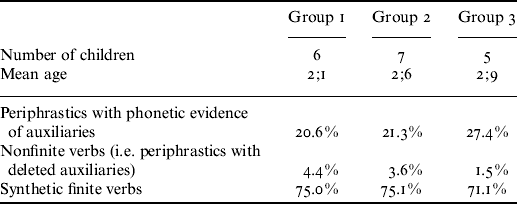
Table 3 shows that the mean percentage of the verbs in question decreases over time: from 4.4% for Group 1, to 3.6% for Group 2, to only 1.5% for Group 3. The mean percentage of synthetic verbs remains the same or decreases from one group to the next (75.0% to 75.1% to 71.1%), suggesting that synthetic verbs are not likely to replace the forms in question over time. In contrast, the mean percentage of periphrastics with phonetic evidence of auxiliaries increases from Group 1 (20.6%) to Group 2 (21.3%) to Group 3 (27.4%), suggesting that the verbs in question are replaced with periphrastics in the course of development.
4.7.2 Adult speech
The second observation is that instances of non-finite verbs in apparently matrix contexts were also observed in the adult interviewer, as illustrated in (26).Footnote 18 Such instances occurred in fast speech contexts, i.e. under increased production pressures, suggesting phonological reduction/deletion (e.g. Hock & Joseph Reference Hock and Joseph1996). To our knowledge, this is the first study to report auxiliary deletion in adult French usage (note that auxiliaries are obligatory in French). The deleted auxiliary was vais [ve] ‘gonna’.
(26) I Regard, je't montrE = Regarde, je vais te montrer. [rəgar ʒə t mõtre] [rəgard ʒə ve tə mõtre] look 1sg.to.you show-E look 1sg gonna to.you show.inf ‘Look, I'm gonna show you.’
The fact that non-finite verbs in apparently matrix clauses were observed in adult speech is significant because syntactic knowledge is not an issue for adults and it thus adds weight to the proposal that extra-syntactic factors (such as phonology) are involved. Additionally, it suggests that such forms can be expected in children as well. Indeed, children may very well be reducing the auxiliary much like adults do under production pressures, but given increased production pressures in children, they may exhibit a greater extent of reduction.
4.7.3 Less deletion with progressive reiteration
The third observation concerns children with the lowest percentage of the forms in question. The lowest percentages of these forms were observed for P42 (age 2;10) 0%, P36 (age 2;5) 1.7%, and N3 (age 2;7) 0.5% (see Table 2 above, column labeled ‘deleted’). P42 (age 2;10) was one of the oldest children, which might account for her 0%. Setting P42 aside, we found that a distinctive characteristic shared by both P36 and N3 was the production of what we call progressive reiterations before articulating an utterance in full, as illustrated in (27) and (28).
(27) P36, age 2;5
C Oh, i v…, i va pa…, i va pa… partir oh, 3sg gon… 3sg gonna le… 3sg gonna le… leave.inf ‘Oh, he's gonna leave.’
(28) N3, age 2;7
C I veut, i veut tuer, i veut tuer papa 3sg wanna 3sg wanna kill.inf 3sg wanna kill.inf daddy‘He wanna kill daddy.’
The youngest child, P17 age 1;11, also exhibited this speech style and she likewise had a relatively low percentage of periphrastics with deleted auxiliaries (10.7%), especially for her age. The salient difference between these three children (P36, N3, P17) and the rest of the children is that these three appear to take their time in articulating their words. Since phonological reduction/deletion is often associated with fast speech (e.g. Hock & Joseph Reference Hock and Joseph1996), the observation that the children who produced words slowly exhibited fewer deleted auxiliaries supports the involvement of phonological factors in auxiliary omission.
To summarize, all the children examined showed competence for auxiliaries; the children exhibited a phonetic continuum in their realizations of the auxiliary element in periphrastics, supporting Prediction I. Their non-finite verbs are best interpreted as attempted periphrastics, in which the auxiliary has undergone extreme phonological reduction, that is, deletion. This interpretation is supported by three additional observations: (i) the replacement of non-finite verbs with periphrastics in the course of development; (ii) the occurrence of non-finite verbs in adult speech, suggesting that such forms cannot be due to immature syntax; and (iii) the observation that children with slow articulation have a lower count of deleted auxiliaries, suggesting difficulties of a phonological nature involved in auxiliary deletion.
5. PREDICTION II: SEMANTICS OF PERIPHRASTICS
In this section we examine the (temporal) semantics of children's non-finite verbs (which we argue to be periphrastics with deleted auxiliaries). According to Prediction II of the PRH, the semantics of these forms should closely correspond to the semantics of target periphrastics. The present study examined the temporal semantics of a subset of these forms, namely, unambiguous infinitives. (Forms ambiguous between infinitive and past participle cannot be used for temporal semantic analyses; past participles usually refer to accomplished events, e.g. Josefsson Reference Josefsson2002: 287.) French periphrastics with infinitive, which include the future and modal periphrastics (see Table 1 above), express imminence or intentionality; they are not used to express past tense as in some other languages (e.g. Basque). Therefore, unambiguous infinitives in children's samples were expected to predominantly express imminence or intentionality, that is, to have unaccomplished rather than accomplished reference.
5.1 Methods
Prediction II was examined on the basis of the same observational data as those described in Section 4. Previous research has pointed out the difficulty of assigning meaning to a child utterance, and particularly to an utterance containing a non-finite form (e.g. Josefsson Reference Josefsson2002: 284). Two measures were taken in this regard. First, we reduced the range of possible topics by using the same set of topics and props across the children. Second, to increase the objectivity and therefore the reliability of the analysis, instead of attempting to determine what an utterance could mean (e.g. does it have modal/present/future meaning), we determined the timing of the event referred to in a child sentence relative to the time of uttering, thus minimizing the need for interpretation. All clauses with an unambiguous infinitive received one of the following three codes: ‘accomplished’ if the event described occurred prior to the time of the utterance, ‘unaccomplished’ if it occurred at a time not prior to the utterance, and ‘undeterminable’ if it was impossible to determine the intended temporal reference.Footnote 19
5.2 Results
Out of the total 95 clauses with non-finite verbs (column labeled ‘deleted’ in Table 2 above), 27 tokens (28.4%) involved unambiguous infinitives. Table 4 summarizes the distribution of the three classes of semantics we found for the unambiguous infinitives.
Temporal semantics of unambiguous infinitives

Twenty-two (81.5%) of the 27 unambiguous infinitive tokens referred to an unaccomplished event, three (11.1%) referred to an accomplished event, and two (7.4%) had undeterminable reference. Infinitives with unaccomplished reference were statistically significantly different from infinitives with accomplished reference (Wilcoxon matched-pairs signed-ranks test, p=0.001). The difference between infinitives with accomplished reference and infinitives with unaccomplished reference remained significant even when including infinitives with undeterminable reference in the latter set (Wilcoxon matched-pairs signed-ranks test, p=0.006). Infinitives thus occurred significantly more often with unaccomplished than accomplished reference, supporting Prediction II of the PRH.
An example of an infinitive form referring to an unaccomplished event is provided in (29). Here, the child is holding a sealed zipper bag containing some figurines and is asking the adult to open it; the act of opening occurs only after the child's production of the form ouvri ‘open.inf’.
(29) P4, age 2;1 (question intonation; child asks interviewer to open bag)
C Ouvri ça? open.inf this ‘Can you/we open this?’
I D'accord … (adult opens zipper bag) ‘OK ’
C Messi! Messi! (child thanks interviewer for opening the bag)
‘Thank you! Thank you!’
Only three tokens seemed to have accomplished reference. Out of these three, the one that most clearly refers to an accomplished event is provided in (30). Here the child is asking about a sticker already glued on the book she is looking at. The adult form involves the past tense periphrastic form a mis ‘has put’, the child misusing the infinitive instead of the past participle and deleting the auxiliary a.
(30) P21, age 2;6
C Qui qui mett' ça? who who put.inf this ‘Who put/has put this?’
In summary, the semantic analysis shows that unambiguous infinitives tend to occur with unaccomplished (rather than accomplished) reference.Footnote 20 Their temporal semantics thus corresponds to the temporal semantics of target periphrastics with infinitive (i.e. modals and the immediate future). The results of the semantic analysis therefore support Prediction II of the PRH.
6. PREDICTION III: SYNTACTIC CONTEXTS FOR PERIPHRASTICS
According to Prediction III of the PRH, children's non-finite verbs should be observed in syntactic contexts for periphrastics. In other words, they should occur when the child's intended utterance involves a periphrastic rather than a synthetic verb. To pin down what the child intends to say when she produces non-finite verbs, we used an elicited imitation task, in which children repeated sentences with either periphrastic or synthetic verbs. We expected that if children produce any non-finite verbs in their responses, they would occur predominantly in attempting stimuli with periphrastics (rather than synthetic) verbs. This technique was chosen not only because it makes it possible to know with greater certainty the child's target sentence but also because previous research has demonstrated that it involves active analysis and reconstruction of the stimuli (not passive imitation, e.g. Lust, Flynn & Foley 1996 and references therein).
6.1 Participants
The participants in the experiment were monolingual French-speaking typically-developing children residing in Paris and Nancy, France. A total of 16 children (11 girls) aged between 2;1 and 3;1 (mean age 2;8) participated in the experimental task. Six of these children also participated in the spontaneous speech sessions. The age range for this study was determined on the basis of the considerations mentioned in Section 5 above and, additionally, with regard to the fact that (a) in many experimental verb tasks, children show difficulties which persist past age 4;0 (Bernal et al. Reference Bernal, Lidz, Millotte and Christophe2007), and (b) previous experimental work on the forms in question was carried out with children ages 2;2–3;5 (Schütze & Wexler Reference Schütze, Wexler, Howell, Fish and Keith-Lucas2000). The children were recruited through daycare centers and were tested individually in a separate room.
6.2 Elicited imitation experiment
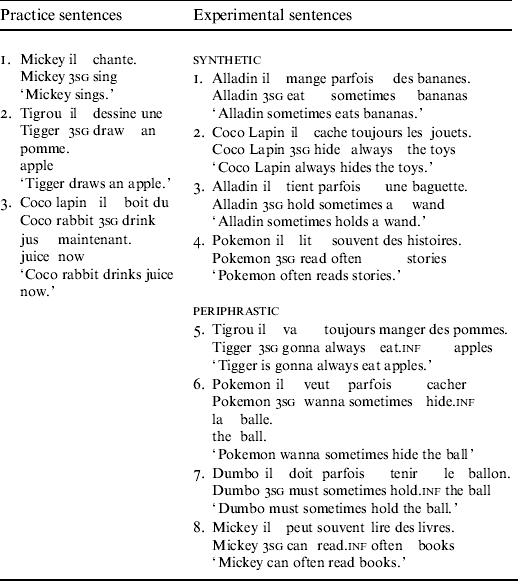
The design of the experiment involved two conditions: (i) sentences with periphrastics (four tokens), and (ii) sentences with synthetic verbs (four tokens). All sentences were simple, affirmative and transitive (see Appendix for the complete list of stimuli). The verbs in the synthetic condition were in the present tense form. The verbs in the periphrastic condition occurred in infinitive form embedded under one of the auxiliaries aller ‘gonna’, vouloir ‘wanna’, pouvoir ‘can’ or devoir ‘must’, with the auxiliary in the present tense form. The stimulus sentences were matched with regard to overall length (10–11 syllables, determined on the basis of previous research with this age group, Lust et al. Reference Lust, Flynn, Foley, McDaniel, McKee and Cairns1996), structure, word order, lexicon, pragmatics, person and number of the verb forms (i.e. 3sg), and (in)animacy of subjects and objects.Footnote 21 The stimuli were presented in random order.
The task was presented as a game in which the child's role was to repeat to a puppet the ‘little stories’ heard from the experimenter. The experimenter did not intervene between the administration of the stimulus and the child's response in order not to confound the model sentence. The child was praised after each response regardless of her performance. To ensure understanding of the task, children were first given three practice sentences (see Appendix).
If Prediction III is correct, then if children produce any non-finite verbs at all, they should occur predominantly in attempting stimuli with periphrastics. The null hypothesis is that the type of verb in the stimulus should not matter, that is, any non-finite verbs that are produced should occur in attempting either synthetic or periphrastic stimuli. This experiment may have the following three outcomes: (i) non-finite verbs might occur significantly more often in attempting sentences with periphrastics, in which case Prediction III would be supported; (ii) non-finite verbs might be as likely to occur in attempting sentences with periphrastics as in attempting sentences with synthetic verbs, in which case the null hypothesis would be supported; or (iii) non-finite verbs might occur significantly more often in attempting sentences with synthetic verbs, in which case neither Prediction III nor the null hypothesis would be supported and a different explanation would be needed.
6.3 Results
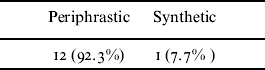
Overall, 19 (14.8%) stimuli received no response, 22 (17.2%) received responses without verbs, 63 (49.2%) received responses with periphrastics or synthetic verbs (according to verb type in the stimulus), 11 (8.6%) involved conversions of synthetic to periphrastic verbs or vice versa, and 13 (10.2%) received responses with non-finite verbs. Responses with non-finite forms, which are the focus of this study, represented 14.9% of all responses with verbs. They did not have an even distribution, but rather were clustered in seven children (aged 2;2, 2;6, 2;6, 2;8 2;8, 2;9, and 3;0, respectively). Table 5 summarizes the distribution of the 13 responses with non-finite verbs according to stimulus type.
Responses with nonfinite verbs by stimulus type
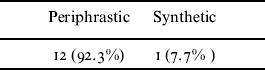
Out of the 13 non-finite verb tokens, 12 occurred in responses to periphrastic stimuli and one occurred in response to a synthetic stimulus. The one instance in which a non-finite verb was produced in response to a synthetic stimulus came from a child aged 2;6 who also produced a non-finite verb in response to a periphrastic stimulus. The difference between non-finite verbs produced in periphrastic contexts and non-finite verbs produced in synthetic contexts was statistically significant (Wilcoxon matched-pairs signed-ranks test, p=0.026). Non-finite verbs occurred significantly more often in periphrastic contexts than in synthetic contexts. Prediction III of the PRH is therefore supported by these data. Alternatively, it might be supposed that omitting the auxiliary from a periphrastic stimulus is easier than substituting one verb form for another, in this case, an infinitive for a synthetic verb. However, we saw that in 11 responses children converted a periphrastic to a synthetic verb or vice versa. Similarly, in a German imitation experiment, children substituted synthetic verbs with periphrastics, indicating that they can and do substitute one verb form with another (see Boser et al. Reference Boser, Lust, Santelmann and Whitman1992, Boser Reference Boser1997). Thus, both the present results and the German results argue against such an alternative interpretation of the present experiment. We therefore conclude that non-finite forms occur primarily in periphrastic contexts.
7. GENERAL DISCUSSION
For decades, early child speech has been deemed ‘telegraphic’, that is, has been assumed to mostly lack function items such as auxiliaries, children being often said to produce non-finite verbs in apparently matrix clauses. The new data challenge the traditional notion of ‘telegraphic’ speech. In contrast with data described in previous work, in the present data, (bare) non-finite verbs were observed side by side with non-finite verbs preceded by variously reduced auxiliary forms. Child speech is not as impoverished as previously thought (see also Bates et al. Reference Bates, Dale, Thal, Fletcher and MacWhinney1995 and de Boysson-Bardies Reference de Boysson-Bardies2001: 208). The discovery of various degrees of realization of auxiliary forms does not support a simple all-or-nothing analysis; rather it suggests a need to revise the notion of what it means for auxiliaries, or other functional items for that matter, to be ‘present’.
It seems likely that the contrast between the present data and those reported in previous literature is due to the improved methodology used in the present study: a larger sample size providing more representative data, the use of a standard set of topics conducive to triggering utterances with verbs and auxiliaries leading in turn to higher density of utterances with the forms under investigation and more reliable interpretation of children's utterances (thus less discarded data), and particularly the use of advanced recording technology and acoustic analyses. This improvement in methodology is likely to have made it possible to capture and identify to a greater extent unstressed subminimal elements, such as French auxiliaries or agreement prefixes, and their even more reduced versions often encountered in child speech. Such elements are difficult to capture or identify even in adult speech (Labov Reference Labov, Gleitman and Liberman1995) and some of these may have been overlooked in studies based on older data, collected with less sensitive equipment and/or not subjected to acoustic analyses. This is consistent with Lleó's (Reference Lleó, Fabri, Ortmann and Parodi1998: 194) observation that her identification of determiner forms at ‘the one-word stage, … much earlier than it has ever been reported for any language up to date’ was largely due to her use of detailed data collected with the purpose to study phonological acquisition (see also Peters & Menn Reference Peters and Menn1993: 746). It is also consistent with the growing literature on the existence of ‘covert contrasts’ in young children's utterances. Recent evidence indicates that adult listeners, including trained phoneticians, are unable to detect auditorily certain phonemic contrasts that a child is in fact producing and that acoustic analysis is needed (see e.g. Scobbie et al. Reference Scobbie, Gibbon, Hardcastle and Fletcher2000). This evidence highlights the difficulty of accurately transcribing early child speech and the possibility that some auxiliary forms may have been overlooked in previous research. Demuth (Reference Demuth and 2009: 193) similarly notes that the fact that covert contrasts are often missed in traditional phonetic transcription ‘raises questions about the extent to which other “omissions” in child speech may be realized at some level of analysis’.
This article has advanced a new hypothesis, the Phonological Reduction Hypothesis, according to which non-finite verbs in early child speech are in fact attempted periphrastics and one explanatory factor underlying the apparent lack of auxiliaries in these periphrastics is phonological in nature. Based on the data presented in this paper, there is ample evidence that non-finite verbs in early child speech are attempted periphrastics. Consistent with Prediction I, we observed a continuum in children's realizations of auxiliaries (Section 4). The discovery of the continuum suggests that children have competence for periphrastics, and that auxiliaries are present in child syntactic representations, that is, that the child knows the slot and the function of the category auxiliary. The continuum ranged from target or near-target forms down to barely audible forms (some of which required identification through spectral analysis) or even puffs of air. It is, thus, reasonable to expect that the auxiliary is at times completely reduced, i.e. deleted, resulting in apparently unauxiliated verbs/apparently non-finite matrix verbs. In other words, the discovery of varying degrees of auxiliary reduction and particularly the discovery of forms involving minimal phonetic evidence for the auxiliary suggest that cases without phonetic evidence for the auxiliary are also periphrastics, i.e. they involve the same syntactic representation. This interpretation is bolstered by the finding that, consistent with Prediction II, the instances of periphrastics with deleted auxiliaries exhibited the semantics of periphrastics (Section 5). Consistent with Prediction III, we found that children produced non-finite verbs precisely when their intended utterance involved periphrastics (but not synthetic finite verbs, Section 6). Additionally, the data revealed that over the course of development, non-finite verbs are replaced with periphrastics (and not with synthetic verbs, Section 4). Finally, instances of non-finite verbs in apparently matrix clauses were also observed in the speech of the adult interviewer, suggesting that the production of such forms cannot be due to immature syntax, and supporting their interpretation as incomplete periphrastics.
The present investigation has additionally uncovered evidence for the involvement of phonology in children's deletion of the auxiliary in their attempted periphrastics. Based on previous research (Labov Reference Labov1969, Browman & Goldstein Reference Browman and Goldstein1992, Shockey Reference Shockey2003, Lavoie 2002, Davidson Reference Davidson2006, Delforge Reference Delforge, Colantoni and Steele2008), the observed continuum in children's realization of auxiliaries, showing varying degrees of reduction from no reduction to complete reduction, is indicative of the involvement of phonology. This is further supported by the fact that many of the children's realizations of auxiliary elements involved common phonological processes in early language (Section 4). It was additionally observed that those children whose speech production was characterized by progressive reiterations (i.e. children who take their time to get their words out) exhibited lower rates of deleted auxiliaries. Since phonological reduction/deletion is typical of fast speech, this observation was also suggestive of the involvement of phonology. Finally, this was further corroborated by the fact that auxiliary deletion was observed in fast speech contexts in adults.
The full set of results reported here is difficult to explain under most previous approaches, that is, is difficult to reconcile with approaches positing radically different or no syntactic representations. Evidence for the presence of auxiliaries in early language provides strong counterevidence to proposals that children do not represent functional elements. The occurrence of non-finite verbs in syntactic contexts for periphrastics and with the semantics of periphrastics is incompatible with optional infinitive accounts, which claim that children's non-finite verbs occur in alternation with synthetic finite verbs. The discovery that non-finite verbs co-occur with agreement prefixes seriously challenges the old claim that the clauses containing them are represented as matrix non-finite clauses. The evidence that non-finite verbs involve phonologically reduced auxiliaries is not expected under either a maturational or a null-aux account (as the latter posits the null aux to be a pro-like syntactic empty category).
The results of the present investigation, however, are consistent with the findings of several recent studies. The finding that non-finite forms in early speech are in fact attempted periphrastics corroborates findings from child German and Swedish suggesting that these verbs tend to occur in contexts where adults would normally use periphrastics (Ingram & Thompson Reference Ingram and Thompson1996, Josefsson Reference Josefsson2002), and from child Dutch, German and French suggesting that with age, as the production of the non-finite verbs decreases, the production of periphrastics increases (Jordens Reference Jordens1990, Boser Reference Boser1997, Bassano et al. Reference Bassano, Laaha, Maillochon and Dressler2004). The evidence uncovered by the present investigation that the category auxiliary is present in early syntactic representations is consistent with a growing literature that has adduced evidence for the presence of functional categories such as the category determiner in child syntactic representations, already during the child's first and second years of life, even before this category is instantiated in production (e.g. Höhle Reference Höhle and Bavin2009, Kedar Reference Kedar2009, Valian Reference Valian, Lewis, Karimi, Harley and Farrar2009). Likewise, the present discovery of phonological difficulties in the realization of auxiliaries in early speech coheres with recent evidence for the involvement of phonological/prosodic factors in the overt realization of other functional elements (e.g. determiners), as discussed in Section 2.
The present investigation is significant for a number of reasons. First, it challenges the long-standing view that children's production of non-finite verbs in apparently matrix clauses reflects the absence of syntactic representations or the presence of drastically different syntactic representations in early language. The demonstration that non-finite verbs in early speech are in fact attempted periphrastics indicates that child syntactic representations are closer to adult representations than previously thought. Note, however, that while the present findings indicate that on a macro level, child syntax is closer to adult syntax, there remains the possibility of syntactic difficulties on a micro level, i.e. with regard to auxiliary reduction, a possibility that needs to be examined in future work.Footnote 22
Second, the present investigation has uncovered difficulties of a phonological nature associated with children's productions of apparently unauxiliated verbs. In so doing, it has offered an explanation as well as independent evidence for the apparent lack of auxiliaries, namely phonological reduction. Whereas previous studies posited, on theoretical grounds, a null aux category, a null Infl head or null finite suffixes on the verb itself, what has been missing in the literature has been both an explanation and independent evidence for why any of these should be null. The present study begins to fill this theoretical and empirical gap.
The demonstration of a role for phonology in children's auxiliary omission opens up a new direction of research, that is, the exploration of which specific aspect(s) of phonology might be involved, for example, phonological representations, over-application of rules, prosodic representations, articulatory issues, or possibly a combination of some or all of these.
One possibility is that development involves change in the child's phonological processes. The full/adult auxiliary form may be available to the child as her phonological representation of the auxiliary, but the phonological realization processes it undergoes lead to the observed reduced/deleted child forms (see Smith Reference Smith1973). Although the data examined here do not allow for a complete examination of this possibility (since we have looked at many children, no child exhaustively, and each may have a slightly different phonology), they do provide some evidence in this direction. First, we have seen that children produce at least some instances of the adult form; secondly, some of their non-adult forms can be described in terms of common phonological processes in child language operating on adult forms (e.g. substitution, consonant harmony). In this scenario, development would consist in re-ordering or re-ranking phonological processes. For example, in Optimality Theory terms, child language may involve a constraint REDUCE FUNCTIONAL HEAD that is more highly ranked in children than in adults and that accounts for why the former have more reduced forms than the latter. It would also include constraints such as STOP FRICATIVE or CONSONANT HARMONY that are absent or very low-ranked in adult grammars. Learning the adult ranking is part of the acquisition process.
At the same time, there is some indication that it may be premature to dismiss the possibility that children's difficulties involve the underlying phonological representation of the auxiliary. This is because at least some of the child approximations of the adult auxiliary form did not seem to be accounted for by common phonological processes and because in some cases the same auxiliary occurred with multiple varying pronunciations in the same session.
Additionally, auxiliary production in early language may be constrained by development in prosodic representations. Similarly to what Demuth and colleges have argued for determiners (see Demuth Reference Demuth, Belikova, Meroni and Umeda2007), early auxiliaries may be more likely to be produced when they can be represented at lower levels of the Prosodic Hierarchy (Selkirk Reference Selkirk1984), such as the Foot, than otherwise. On this view, as prosodic representations develop, children will be better able to produce functional items in a wider range of contexts, including those which, in the adult language, involve higher levels of prosodic structure such as the Prosodic Word or the Prosodic Phrase.
Yet another possibility is that auxiliary reduction/deletion involves production difficulties. As discussed in Section 2, adult speech exhibits drastic reduction of function words (in contrast with content words), including minimal pronunciations such as [f] for for (Lavoie Reference Lavoie2002) or [ə] for a, the, of, to, I, it (Jurafsky et al. Reference Jurafsky, Bell, Fosler-Lussier, Girana, Raymond, Mannell and Robert-Ribes1998). Within the framework of Gestural Phonology (Browman & Goldstein Reference Browman and Goldstein1992), where underlying forms consist of articulatory gestures, the more drastic reduction observed in the pronunciation of function words has been argued to reflect decreased magnitude of the articulatory gestures, higher overlap in such gestures and looser intergestural timing specifications, all associated with the higher integration of functional items into their contexts (Browman & Goldstein Reference Browman and Goldstein1992, Jurafsky et al. Reference Jurafsky, Bell, Fosler-Lussier, Girana, Raymond, Mannell and Robert-Ribes1998, Lavoie 2004, Bell et al. Reference Bell, Brenier, Gregory, Girand and Jurafsky2009). On this view, one may expect even more reduction (including deletion) in toddlers' realizations of functional items such as auxiliaries, since they have much poorer control over their articulatory gestures (particularly the finer gestures required in unstressed syllables), and have significant difficulties with intergestural timing (e.g. Kent Reference Kent, Ferguson, Menn and Stoel-Gammon1992, Grigos & Patel Reference Grigos and Patel2007, Inkelas & Rose Reference Inkelas and Rose2007). Indeed, children's ability to pronounce unstressed syllables (particularly in initial position) reaches adult-like levels only late, sometimes as late as age seven (Nittrouer Reference Nittrouer1993, Vihman Reference Vihman1996).
Furthermore, the present findings open the door for testing whether additional factors beyond phonology may be involved in auxiliary reduction/deletion. It has been hypothesized that a combination of multiple factors may determine which elements are omitted/produced in early utterances (Valian & Aubry Reference Valian and Aubry2005, Lust Reference Lust2006, Clark Reference Clark2009, Song et al. Reference Song, Sundara and Demuth2009). It would thus be interesting to examine whether factors (shown to affect the variable production of other functional items) such as memory/processing (Valian & Aubry Reference Valian and Aubry2005), pragmatics (Sorace et al. Reference Sorace, Serratrice, Filiaci and Baldo2009), sentential structural complexity (Bloom Reference Bloom1970), and/or interactions between these and phonology may influence the reduction/deletion of auxiliaries. The potential involvement of fine-grained syntax problems in children's auxiliary reduction also needs to be assessed. Additionally, the present investigation needs to be extended to other languages, other functional elements, and other populations (e.g. children with specific language impairment and bilingual children).
8. CONCLUSION
The present investigation has revealed that non-finite verbs in early speech are attempted periphrastics, that therefore child syntactic representations are more adult-like than previously assumed, and that in these periphrastics the auxiliary has undergone complete phonological reduction, i.e. deletion. The new results have implications for theories of language acquisition. Taken together with a growing evidence for infants' pre-verbal knowledge and use of functional categories in language comprehension, our production-based evidence for more adult-like syntactic representations of functional structure lends support to proposals for the primacy of syntax in language acquisition (Demuth Reference Demuth and 1994; Lust Reference Lust, Bhatia and Ritchie1999, Reference Lust2006; Dye et al. Reference Dye, Foley, Blume and Lust2004; Valian Reference Valian, Lewis, Karimi, Harley and Farrar2009).
The new findings also have methodological implications, suggesting that future research on children's production of functional elements requires corpora to be collected with more sensitive technology, larger samples, and more detailed analyses, including, where necessary, acoustic analyses. They further have implications for the calculation of mean length of utterance (MLU), which critically requires determining what should count as a morpheme or a word in early child utterances. For example, to what extent should partial pronunciations be counted for MLU purposes, particularly when such pronunciations involve only one phoneme which may or may not be audible but which is observable on a spectrogram?
In conclusion, whereas over the past decades children's production of ostensibly unauxiliated verbs has often been interpreted as indicative of radically different syntax or no syntax, the present study has demonstrated a role for phonology, thereby opening the door to a new direction for research in the acquisition of auxiliaries.
APPENDIX
Materials for the elicited imitation experiment