Efforts to improve diagnosis and treatment of Clostridioides difficile infection (CDI) in children must address important challenges and knowledge gaps. Several studies of CDI in adults have demonstrated that patients who test positive by a toxin test (eg, enzyme immunoassay [EIA] or cell cytotoxicity neutralization assay) experience a longer duration of diarrhea, more CDI-related complications, and higher mortality than patients who test positive by nucleic acid amplification test alone. Reference Longtin, Trottier and Brochu1–Reference Polage, Gyorke and Kennedy3 However, toxin EIA has suboptimal sensitivity, generating potential for false-negative results in patients at risk of poor outcomes. Reference McDonald, Gerding and Johnson4 Another challenge is that criteria for identifying severe CDI are based on expert opinion. Although elevation of white blood cell (WBC) count and creatinine level at diagnosis have been associated with treatment failure and recurrence in adults, Reference Bauer, Hensgens and Miller5 these criteria have poor discriminatory value as markers of severity in pediatric CDI, Reference Tschudin-Sutter, Tamma, Milstone and Perl6 and concomitant medical conditions and therapies preclude their use in accurate classification of CDI severity in children. Reference Kociolek, Patel, Shulman and Gerding7 These gaps are important clinically because guidelines recommend several options for treatment of CDI in children, Reference McDonald, Gerding and Johnson4 but it remains unclear which children might benefit most from receipt of specific therapeutic agents to treat acute disease or to minimize the likelihood of recurrence.
Using single-molecule array (Simoa) technology, an ultrasensitive and quantitative assay has been developed that can measure concentrations of C. difficile toxins A and B in stool with a very low limit of detection (clinical cutoff for positive result for each toxin = 20 pg/mL). Reference Pollock8,Reference Pollock, Banz and Chen9 In adults with CDI, median baseline stool toxin concentrations as measured by Simoa are higher in patients with baseline severe CDI (using various proposed severity criteria), severe outcomes judged to be primarily attributable to CDI, and recurrence, compared with patients without these presentations or outcomes. Reference Alonso, Kelly and Garey10 If the same associations were true in children with CDI, toxin quantification could have a role in classifying severity and could be incorporated into clinical trials of CDI therapies in pediatric patients to evaluate its role as a potential predictor of severe outcomes or recurrence. Therefore, we evaluated whether stool toxin concentrations are associated with severe CDI, CDI-attributable severe outcomes, or recurrence in children. Additionally, we evaluated whether plasma cytokine measurements might assist in the distinction between CDI and non-CDI diarrhea, as we have observed in adults. Reference Kelly, Chen and Williams11
Methods
Study population, clinical data collection, and attribution
Eligible inpatients at Boston Children’s Hospital (Boston, Massachusetts) and Ann & Robert H. Lurie Children’s Hospital of Chicago (Chicago, Illinois) were prospectively enrolled between July 13, 2016, and April 4, 2019, under protocols approved by the institutional review boards at each institution, which allowed capture of discarded stool and blood specimens with waiver of informed consent. We included the patients aged 2–17 years with positive stool C. difficile glutamate dehydrogenase (GDH) or toxin test or nucleic-acid amplification test (NAAT), for whom CDI therapy had been initiated, and who had acute diarrhea defined as (1) ≥3 unformed bowel movements during any 24 hours in the 48 hours before or the 24 hours after the time of stool collection, (2) persistent diarrhea in the same time window, as indicated in multiple provider notes, (3) pseudomembranous colitis, or (4) in patients with chronic diarrhea, a clear change in stool consistency or frequency. In most cases, definition 1 was applied. Children aged <2 years were excluded because higher colonization rates in that age group produce uncertainty about whether C. difficile is the most likely cause of diarrhea.
Assessment for the presence of diarrhea included review of nursing logs for number and consistency of stools and detailed chart review. The diagnostic clinical stool sample (submitted for routine C. difficile testing) was captured as a discarded sample. A paired plasma sample, taken within ± 1 day of stool sample collection, was also captured as a discarded specimen when available. Patients were excluded if they had chronic diarrhea without clear exacerbation, if they had a diagnostic specimen of insufficient volume (<500 µL) or >72 hours old, if they received CDI treatment for >48 hours prior to stool collection, or if they had a colostomy. Patients with a prior history of CDI were not excluded. Peak white blood cell (WBC) count, creatinine level, and nadir albumin values within 5 days before to 2 days after stool collection were recorded.
Patients were followed for 40 days from study enrollment (starting from the date of diagnostic stool sample) via chart review or by phone calls if the patient or caregiver consented to being contacted. Duration of CDI treatment, diarrhea resolution, severe outcomes, and recurrence of CDI were monitored during this period. The duration of CDI treatment was measured as the number of days from initiation to the first discontinuation in treatment. Resolution of diarrhea was achieved if the patient had improved consistency or frequency of bowel movements and no longer met our diarrhea definition. Severe outcomes were defined as intensive care unit (ICU) admission, colectomy, or death within 40 days of study enrollment. Severe outcomes within 30 days were also recorded. One clinician (from each study site) assessed each severe outcome (independent of clinical or research C. difficile testing results) and attributed it as either “CDI not contributing,” “CDI contributed,” or “CDI primary reason (primarily attributable).” This approach was used to judge the attribution of CDI outcomes in a published study of adult patients. Reference Alonso, Kelly and Garey10 In cases in which the attribution was unclear, a second clinician was consulted and consensus was reached. Recurrent CDI was defined as resolution of diarrhea for ≥48 hours off CDI-directed therapy followed by new diarrhea meeting our definition, clinician diagnosis of CDI recurrence, and reinitiation of CDI therapy. Patients were excluded from analysis of recurrence if they remained on CDI treatment throughout the 40-day follow-up period. The study team assigned baseline CDI severity (severe or nonsevere) using IDSA–SHEA criteria: severe CDI was defined as WBC count ≥15,000/µL and/or creatinine level ≥1.5 g/dL. Reference McDonald, Gerding and Johnson4
As a secondary analysis, to compare plasma cytokine concentrations between patients with diarrhea who did and did not have CDI, we also enrolled a control cohort of children with non-CDI diarrhea. Eligible patients were inpatients aged 2–17 years who met the diarrhea criteria outlined above (except pseudomembranous colitis, which was not part of the definition for non-CDI diarrhea) and tested negative for C. difficile by a clinical GDH/toxin or NAAT test. The diagnostic clinical stool sample (submitted for routine C. difficile testing) was captured as a discarded sample. A paired plasma sample (± 1 day of stool sample collection as above) was captured as a discarded specimen. Exclusion criteria and testing for WBC, creatinine, and albumin were applied and performed as described above.
Sample processing and analysis
Eligible stool samples were captured, refrigerated, aliquoted, and frozen at −80°C within 72 hours of stool sample collection. Lurie Children’s Hospital stool samples were clinically tested by the Xpert C. difficile assay. Cycle thresholds (Ct values) for the C. difficile tcdB gene were recorded. Boston Children’s Hospital study stool samples were tested with the Xpert C. difficile/Epi assay to capture tcdB Ct value data. Toxin A and toxin B measurements were performed using Simoa assays at bioMérieux (Lyon, France) as previously described. Reference Pollock, Banz and Chen9,Reference Alonso, Kelly and Garey10 Any toxin A or toxin B measurements below the clinical cutoff of 20 pg/mL were converted to zero for analysis. A positive toxin result for either toxin A or B was therefore defined as ≥20 pg/mL, as previously described. Reference Alonso, Kelly and Garey10
For patients in the CDI and non-CDI diarrhea cohorts with available discarded plasma samples, we measured the following: plasma cytokine (interleukins [IL]-1β, -2, -4, -6, -8, -10, -13, and -15, granulocyte colony-stimulating factor [GCSF], tumor necrosis factor α [TNF-α], monocyte chemoattractant protein [MCP]-1, and vascular endothelial growth factor [VEGF]-A) concentrations (pg/mL). We used a Milliplex magnetic bead kit and Luminex analyzer (MAGPIX) (Millipore Sigma, Burlington, MA) according to the manufacturer’s instruction manual, as previously described. Reference Kelly, Chen and Williams11
Statistical methods
Continuous variables were summarized using medians and interquartile range (IQR); categorical variables were summarized using counts and percentages. Nonparametric Wilcoxon and Fisher exact tests were used to assess for significance of differences in continuous and 2×2 tables as applicable. Tests were 2-sided where applicable and P < .05 was considered statistically significant. A receiver operating characteristic (ROC) curve was used to assess the predictive accuracy of plasma GCSF concentrations for CDI classification. SAS version 9.4 software (SAS Institute, Cary, NC) was used for all analyses.
Results
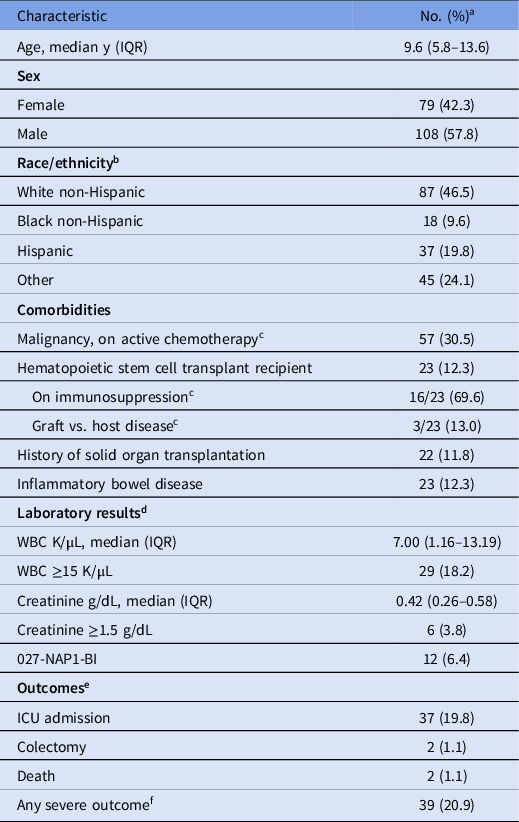
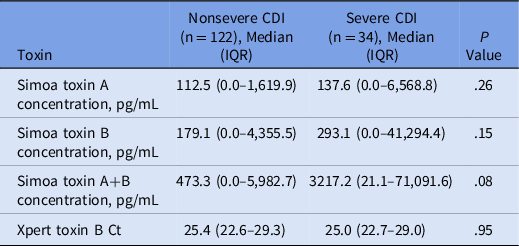
Of 1,150 specimens positive for C. difficile, we enrolled 187 patients. Table 1 displays demographics, comorbidities, baseline laboratory results, and severe outcomes for the complete cohort. The median age was 9.6 years (IQR, 5.8–13.6). Of 156 pediatric patients with available laboratory data, 34 (21.8%) had severe baseline CDI. Supplementary Table 1 displays the proportion of participants with inflammatory bowel disease or immunocompromised status by presence of severe baseline disease and recurrence. Patients with severe disease had higher median stool toxin A+B concentration than those without severe disease, but this difference did not reach statistical significance (P = .08) (Table 2).
Demographics, Comorbidities, Baseline Laboratory Features, and Clinical Outcomes for Study Participants With CDI (N = 187)

Note: CDI, Clostridioides difficile infection; IQR, interquartile range; ICU, intensive care unit; WBC, white blood cell.
a Data are no. (%) unless otherwise indicated.
b Race/ethnicity information available for 187 patients.
c These variables were assessed at the time of CDI diagnosis.
d WBC and creatinine available for 159 and 158 patients, respectively; NAP-1 information available for 187 patients.
e There were 34 ICU admissions (18.2%), 1 colectomy (0.5%), and 2 deaths (1.1%) within 30 d. ICU admission, colectomy, and death were assessed within 40 d of enrollment.
f Any severe outcome included ICU admission, colectomy, or death within 40 d.
Association of Baseline Stool Toxin Concentration With Baseline CDI Severity by IDSA-SHEA Score a

Note: CDI, Clostridioides difficile infection; IDSA, Infectious Diseases Society of America; SHEA, Society for Healthcare Epidemiology of America; IQR, interquartile range; Simoa, single-molecule array; Ct, cycle threshold.
a Of 187 patients, 156 had data allowing assignment of an IDSA-SHEA severity score.
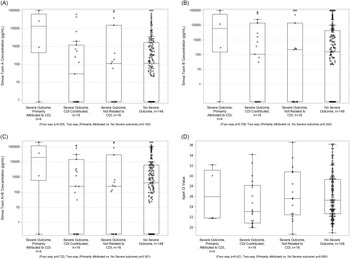
Of the entire cohort of 187 pediatric patients, 39 (20.9%) had 41 severe outcomes; 2 patients had 2 severe outcomes each: 1 had an ICU admission and colectomy and 1 had an ICU admission and died. After attribution of each outcome, 4 patients (2.1%; 3 without comorbidities and 1 with history of stem cell transplantation) had a severe outcome primarily attributed to CDI, including 3 ICU admissions and 1 colectomy. Also, 19 others (10.2%) had a severe outcome with contribution from CDI; 16 others (8.6%) had a severe outcome unrelated to CDI; and 148 (79.1%) had no severe outcome. ICU admissions accounted for most of the severe outcomes observed. Of the 2 colectomies that occurred, one was judged to be primarily caused by CDI and the other (in a patient with inflammatory bowel disease) was considered unrelated to CDI. Also, 2 children died within 40 days after enrollment, and CDI was considered not to have contributed to either death. Median toxin A+B concentration was nonsignificantly higher in children with a primarily attributed severe CDI outcome (n = 4) compared with those without a severe outcome (n = 148; 19,472.6 vs 429.1 pg/mL; P = .301) (Fig. 1).
Dot plots showing distribution of toxin concentrations (measured by Simoa) and Ct values (measured by Xpert NAAT) in patients with a severe outcome primarily attributable to CDI, those in whom CDI contributed to a severe outcome, those who had a severe outcome unrelated to CDI, and those without a severe outcome. (A) Simoa Toxin A concentration. (B) Simoa Toxin B concentration. (C) Simoa Toxin A+B concentration. (D) Xpert Ct value. The bottom and top edges of the boxes for each cohort indicate the interquartile range, the horizontal line bisecting the box indicates the median value, and the whiskers represent 1.5 times the IQR from the top and bottom of the box. Data points that exceed these values are outliers. P values for comparison of the respective medians (4-way, all 4 groups compared; 2-way, only primarily-attributable severe outcome compared with no severe outcome) are shown. Note. CDI, Clostridioides difficile infection; Simoa, single molecule array; Ct, cycle threshold; NAAT, nucleic acid amplification test.

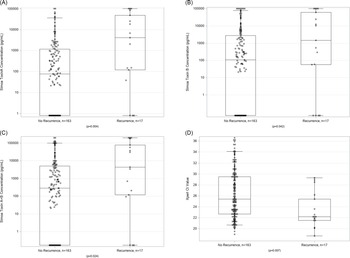
Of 180 children with eligible data, recurrence occurred in 17 (9.4%). The median baseline toxin A+B concentration was significantly higher in patients with versus without recurrence (4,398.8 vs 280.8 pg/mL; P = .024) (Fig. 2). In contrast to baseline severity (Table 2) and severe primarily-attributed outcomes (Fig. 1D), for which median Ct values were not significantly different between patients with versus without those presentations, median Ct values were significantly lower (ie, higher C. difficile stool burden) in patients with recurrence versus those without recurrence (22.2 vs 25.4; P = .007) (Fig. 2D). Supplementary Figure 1 (online) displays the correlation between total toxin concentration and Ct value for participants with toxin A+B concentration ≥20 pg/mL (n = 130).
Dot plots showing distribution of toxin concentrations (measured by Simoa) and Ct values (measured by Xpert NAAT) in patients without CDI recurrence and with CDI recurrence within 40 days. (A) Simoa Toxin A concentration. (B) Simoa Toxin B concentration. (C) Simoa Toxin A + B concentration. (D) Xpert Ct value. The bottom and top edges of the boxes for each cohort indicate the interquartile range, the horizontal line bisecting the box indicates the median value and the whiskers represent 1.5 times the IQR from the top and bottom of the box. Data points that exceed these values are outliers. P values for comparison of the respective medians are shown. Patients were excluded from analysis of recurrence if they remained on CDI treatment throughout the 40-day follow-up period. There were 180 patients (from the initial cohort of 187 patients) included in the recurrence analysis. Note. CDI, Clostridioides difficile infection; Simoa, single-molecule array; Ct, cycle threshold; NAAT, nucleic-acid amplification test.

We enrolled and obtained plasma cytokine concentrations from 36 patients in the non-CDI diarrhea cohort; demographic and laboratory characteristics of this group in comparison with the 66 children in the CDI cohort with available plasma cytokine data are displayed in Supplementary Table 2 (online). The median age, sex, race and ethnicity, WBC count, and creatinine level were similar in the 2 groups. Concentrations of plasma cytokines in the CDI and non-CDI diarrhea cohorts are shown in Supplementary Table 3 (online). Median plasma concentration of GCSF was significantly higher in CDI patients compared with non-CDI diarrhea controls (165.5 vs 28.5 pg/mL; P < .001). The median concentrations of 5 other cytokines (IL-6, IL-8, IL-10, IL-15, and MCP-1) were also significantly higher in CDI patients compared with non-CDI controls, but there was more overlap in the distributions between the groups for these 5 markers. The ROC curve analysis for GCSF concentrations in CDI (case) versus non-CDI diarrhea (control) cohorts demonstrated an area under the curve (AUC) of 0.78 (95% confidence interval, 0.69–0.87).
Discussion
In this study, we demonstrated that higher baseline concentrations of toxins A and B in the stool of children with CDI are significantly associated with recurrence. We did not detect significant differences in toxin concentrations in children with severe baseline disease or severe outcomes primarily attributed to CDI. However, we likely had inadequate power to detect significant differences because of the extremely small number of children with a primarily attributed severe outcome; median toxin A+B concentration was 45 times higher in these 4 children than in those without such an outcome. This trend mirrors the significant association between toxin concentrations and severe outcomes demonstrated in adults with CDI. Reference Alonso, Kelly and Garey10 Clinicians could benefit from availability of a marker to guide selection of antibiotics to treat children with CDI. For example, either vancomycin or fidaxomicin would be preferred over metronidazole in children with severe disease, but current severity metrics even for adults are largely based on expert opinion, and these metrics have been challenging to apply and poorly predictive of outcomes in pediatric CDI. Reference Tschudin-Sutter, Tamma, Milstone and Perl6,Reference Kociolek, Patel, Shulman and Gerding7 Adults with severe CDI (as categorized using 4 different severity criteria) have higher stool toxin concentrations than those with nonsevere CDI, providing external validity to the notion of someday using toxin concentration in this manner; our observed trend toward higher toxin concentrations in children with severe CDI by IDSA-SHEA criteria is at least consistent with findings in adults. Reference Alonso, Kelly and Garey10 Similarly, the significant association we observed in children between baseline stool toxin concentration and CDI recurrence (a finding also observed in adults Reference Alonso, Kelly and Garey10 ) could be used to understand which children might benefit from receipt of fidaxomicin and its associated lower recurrence rate. In our study, lower Ct values (consistent with higher bacterial burden) were found in children with recurrence, supporting findings from a previous study. Reference Kociolek, Palac, Patel, Shulman and Gerding12 Because toxin concentrations and Ct values roughly correlate, Reference Pollock, Banz and Chen9 we expect categorically low Ct values to be a reasonable proxy for categorically high toxin concentrations. In addition to bacterial burden, other factors (eg, characteristics of the C. difficile isolate or host immune status) may also influence stool toxin concentrations.
CDI management has evolved in recent years. In 2021, fidaxomicin was recommended as the preferred treatment for adults with a primary episode or a first recurrence of CDI. Reference Johnson, Lavergne and Skinner13 This change from prior guidance (which had recommended either oral vancomycin or fidaxomicin as first-line therapy in adults) occurred primarily in recognition of the demonstrated increase with fidaxomicin treatment in sustained clinical response (ie, lack of CDI recurrence) 4 weeks after the end of therapy, compared with vancomycin. Reference Louie, Miller and Mullane14–Reference Mikamo, Tateda, Yanagihara, Kusachi, Takesue and Miki17 Although vancomycin is still considered an acceptable alternative, the potential benefit for patients of fewer recurrences was judged to be an important factor in therapeutic decisions. For children with CDI, current guidelines recommend either vancomycin or metronidazole for treatment of a nonsevere primary episode or first recurrence. Reference McDonald, Gerding and Johnson4 This recommendation was made because of a lack of prospective data comparing outcomes of these 2 agents in pediatric CDI and because, at the time of guideline publication, fidaxomicin had not yet been approved for use in children. Since that time, fidaxomicin has been shown to be safe and more effective than vancomycin in producing a sustained clinical response in children with CDI. Reference Wolf, Kalocsai and Fortuny18 However, the lack of a marker to predict which children are more likely to experience a severe outcome or recurrence makes it unclear which patients might benefit most from specific CDI therapies. One potential challenge of eventually using toxin concentrations for treatment decisions is that for an individual patient, a high baseline toxin concentration alone does not equate to severe baseline disease or outcomes, given that some children with high toxin concentrations did not have or develop these consequences (consistent with adult data Reference Pollock, Banz and Chen9,Reference Alonso, Kelly and Garey10 ).
As a secondary goal, we assessed plasma concentrations of 12 cytokines in children with CDI compared with controls with non-CDI diarrhea; concentrations of several of these host immune markers have been shown to be significantly higher in adults with CDI compared with controls (adults with non-CDI diarrhea, C. difficile colonization, or NAAT-negative/no diarrhea) and thus offer the potential to improve the specificity of disease diagnosis. Reference Kelly, Chen and Williams11 We detected significantly higher concentrations of 6 different cytokines in the pediatric CDI group, and GCSF concentration distributions provided the best discrimination between CDI and non-CDI diarrhea, consistent with adult data. Notably, all 6 of the cytokines with significantly higher median concentrations in pediatric CDI versus non-CDI diarrhea patients were also significantly higher in adult CDI versus all other groups. Reference Kelly, Chen and Williams11 The AUC of the ROC curve for GCSF indicated acceptable but not excellent discriminatory ability. Sample sizes were insufficient to meaningfully assess associations between plasma cytokine concentrations and outcomes in children with CDI, and further research in this area is warranted.
This study had several limitations. First, enrolled patients with CDI did not undergo standardized testing for alternative pathogens that could cause diarrhea, but this scenario is representative of children aged >2 years who are tested and treated for CDI in real-world settings. It is not possible or cost-effective to exclude every potential alternative cause of diarrhea in this age group, and even when other pathogens representing potential coinfection are identified, assigning causality to a specific agent adds potential for error. Limiting our cohort to patients aged >2 years, in whom colonization rates mirror those of adults and for whom guidelines recommend a diagnostic approach similar to that for adults, was expected to mitigate this limitation substantially. Second, the number of severe outcomes, especially colectomies and deaths, was very small (as expected in children with CDI), which likely limited our power to detect statistically significant differences in toxin concentrations in that group compared with patients without severe outcomes. Third, because our cohorts were enrolled from inpatient settings, the results may not be generalizable to pediatric outpatients with CDI.
Our goals are to develop objective measures that can accurately distinguish between CDI and C. difficile colonization with diarrhea from another cause and to improve diagnosis, outcome prediction, and management of CDI for these patients. The best approach to achieving these goals may be the combination of quantitative stool toxin concentration and measurement of specific host immune markers in blood or stool. We encourage additional work to validate these promising findings in new cohorts of pediatric patients with and without CDI. In addition, we advocate for incorporation of stool toxin concentration measurements into clinical trials of CDI treatments in children to better define which participants have CDI and to evaluate the ability of toxin concentration to predict outcomes in a rigorous and controlled manner with larger sample sizes.
Supplementary material
To view supplementary material for this article, please visit https://doi.org/10.1017/ice.2022.310
Acknowledgments
The content is solely the responsibility of the authors and does not necessarily represent the official views of the National Institutes of Health.
Financial support
This work was supported by grants from the National Institutes of Health, National Institute of Allergy and Infectious Diseases (grant no. 5 R01 AI116596 to N.R.P. and C.P.K. and grant no. K23 AI123525 to L.K.K.). T.J. Savage was supported by the Eunice Kennedy Shriver National Institute of Child Health & Human Development of the NIH (Bethesda, MD) (grant no. T32HD040128).
Conflicts of interest
Simoa assays were performed by bioMerieux, and A.B. is an employee of bioMerieux. L.K.K. receives grant support from Merck, unrelated to this study. C.P.K. has acted as a paid consultant to Artugen, Facile Therapeutics, Ferring, First Light Biosciences, Finch, Janssen (J&J), Matrivax, Merck, Seres, Pfizer and Vedanta. K.W.G. has received grant support from Acurx, Paratek, Summit, and Tetraphase Pharmaceuticals. T.J. Savage received salary support via a contract to Brigham & Women’s Hospital by UCB. All other authors report no potential conflicts of interest.