1. Introduction
Linguistic convergence, where contrastive features in two or more languages progressively become less contrastive, is a phenomenon traditionally studied diachronically in the field of language contact. However, the concept has also been applied synchronically in the field of bilingualism (e.g. Bullock & Toribio, Reference Bullock and Toribio2004; Cook & Bassetti, Reference Cook and Bassetti2011; Pavlenko, Reference Pavlenko and Pavlenko2011a). This paper argues that convergence between linguistic systems may also be a normal part of second language acquisition, even at lower proficiency levels.
We investigate monolingual and bilingual descriptions of motion, focusing on how semantic information is structured syntactically.Footnote 1 Given the cross-linguistic differences that have previously been reported in the clausal packaging of semantic information between Japanese and English (Allen, Özyürek, Kita, Brown, Turanli & Ishizuka, Reference Allen, Özyürek, Kita, Brown, Turanli, Ishizuka, Beachley, Brown and Conlin2003; Kita & Özyürek, Reference Kita and Özyürek2003, though note different findings for Japanese in Brown & Gullberg, Reference Brown and Gullberg2012), we observe how native Japanese users of English with intermediate-level knowledge of their second language may reconcile potential differences between their first (L1) and second (L2) languages in this domain. We examine the possibilities for bi-directional cross-linguistic influence, that is, the process by which an L1 and L2 affect one another. We ask to what extent this influence is mutual and whether L1 and L2 systems converge within an individual bilingual mind.
2. Background
2.1 Convergence in bilingualism
The notion of convergence has been discussed in the field of language contact, where it is commonly viewed as the diachronic outcome of contact between speech communities whereby languages come to be more similar to one another (Muysken, Reference Muysken and Thomason1997). Early discussions of convergence in individual bilingualism were framed in the “one system – two systems” debate and were restricted to advanced bilinguals, i.e. those with very advanced proficiency in two languages, revolving around such issues as combined versus separate mental lexicons (e.g. Schwanenflugel & Rey, Reference Schwanenflugel and Rey1986, versus Taylor, Reference Taylor1971), or the extent of language selectivity in lexical processing (e.g. Gerard & Scarborough, Reference Gerard and Scarborough1989, versus Dijkstra & van Heuven, Reference Dijkstra and van Heuven2002). More recent work has taken a less categorical and more process-oriented approach, allowing for “emergent” and potentially “transitional” relationships between the languages of a bilingual (e.g. Bullock & Toribio, Reference Bullock and Toribio2004).
This paper employs Pavlenko's framework (e.g. Reference Pavlenko1999, Reference Pavlenko, de Groot and Kroll2005, Reference Pavlenko and Pavlenko2011a), which provides a broad definition of bilingual, enabling the inclusion of those with less than advanced or functional proficiency in one or more of the languages. Pavlenko's framework defines convergence as one of seven processes involved in the restructuring of bilingual systems. These processes are outlined below:
1. Co-existence – the maintenance of language-specific categories or preferences in each of a bilingual's two languages.
2. Influence of the L1 on the L2 – the shaping of L2 performance in terms of L1 categories or preferences.
3. Convergence – differentiation of bilingual L1 and L2 performance from monolingual speakers of each of the respective languages.
4. Restructuring toward L2 – the gradual movement away from L1 categories or preferences towards those more typical of the L2.
5. Internalization of new categories – adoption of categories or preferences from the L2 that are absent in the L1.
6. Influence of the L2 on the L1 – the shaping of L1 performance in terms of L2 categories or preferences.
7. Attrition – loss of categories or preferences typical in the L1 as a result of an increasingly dominant L2.
(based on Pavlenko, Reference Pavlenko and Pavlenko2011a, pp. 246–248)
The seven restructuring processes are argued to take place over time depending on linguistic domain and on shifts in language development and use. Moreover, the mechanisms involved are not claimed to be mutually exclusive and may alternate or occur simultaneously. Under this framework, evidence of convergence may be found in cases where the two language systems of a bilingual are undifferentiated and where the bilingual patterns are distinct from monolingual patterns in a given linguistic domain. Such patterns are often characterized as “in-between performance” (Pavlenko, Reference Pavlenko and Pavlenko2011a, p. 247) or L1–L2 “integration” (Bylund, Reference Bylund2011, p. 63), but can also consist of unique patterns which do not lie between the source and target languages (Bassetti & Cook, Reference Bassetti, Cook, Cook and Bassetti2011) and sometimes arise from “hypersensitivity” to features in one or both languages (Czechowska & Ewert, Reference Czechowska, Ewert, Cook and Bassetti2011).
Investigations of convergence are relatively scarce in comparison to investigations of other components of Pavlenko's (Reference Pavlenko and Pavlenko2011a) taxonomy, in part due to the absence of studies incorporating within- and between-subject alongside within- and between-language designs.Footnote 2 Using between-subject analyses, an enormous amount of research has been dedicated to the influence of the L1 on the L2, which is widely attested in almost all linguistic domains and at various levels of L2 proficiency (see overviews in Cenoz, Hufeisen & Jessner, Reference Cenoz, Hufeisen and Jessner2001; DeAngelis, Reference DeAngelis2007; Gass & Selinker, Reference Gass and Selinker1992; Jarvis & Pavlenko, Reference Jarvis and Pavlenko2008; Kellerman & Sharwood Smith, Reference Kellerman and Sharwood Smith1986; Odlin, Reference Odlin1989, Reference Odlin, Robinson and Ellis2008; Ringbom, Reference Ringbom2007). In such work, attention is typically on L2 performance with little, if any, consideration of the L1 as an object of study, except as it affects the L2. However, a growing body of work has started to acknowledge influences of the L2 on the L1 in a number of linguistic domains (see overviews and papers in Cook, Reference Cook2003b; Cook & Bassetti, Reference Cook and Bassetti2011; Jarvis & Pavlenko, Reference Jarvis and Pavlenko2008; Pavlenko, Reference Pavlenko2011b), although Pavlenko (Reference Pavlenko and Pavlenko2011a) argues that research to date cannot distinguish between influence of the L2 on the L1 from the effects of L1 attrition, which is particularly problematic in studies examining bilinguals resident in the L2 community.
A few studies have explicitly included within-subject L1–L2 analyses and provided some direct support for the existence of L1–L2 convergence (in the sense of Pavlenko's (Reference Pavlenko and Pavlenko2011a) third process as identified above) in different areas of the linguistic system. In a study of event conceptualization, Bylund (Reference Bylund2011) showed that in each of their languages, functionally bilingual Spanish–Swedish speakers displayed convergence in patterns of event segmentation. They encoded more events in L2 Swedish narratives than monolingual Swedish speakers did, but fewer events in L1 Spanish narratives than monolingual Spanish speakers did, resulting in an integration of L1–L2 performance in this area. However, these same speakers resembled their monolingual counterparts in each of the languages in the use of anaphoric linking devices, resulting in differentiated L1–L2 performance in temporal structuring. L1–L2 convergence in bilingual systems has been found in further linguistic areas such as lexicalization (Filipovic, Reference Filipovic2011); lexical categorization (e.g. Ameel, Malt, Storms & Van Assche, Reference Ameel, Malt, Storms and Van Assche2009; Gathercole & Moawad, Reference Gathercole and Moawad2010); pragmatics (e.g. Cenoz, Reference Cenoz and Cook2003); and phonetics (e.g. Flege, Reference Flege1987). A merged L1–L2 system has been found in conceptual representations of number (Athanasopoulos, Reference Athanasopoulos2006), gender (Bassetti, Reference Bassetti, Cook and Bassetti2011), temporal sequencing (Chen & Su, Reference Chen, Su, Cook and Bassetti2011), motion (Czechowska & Ewert, Reference Czechowska, Ewert, Cook and Bassetti2011), color (Athanasopoulos, Sasaki & Cook, Reference Athanasopoulos, Sasaki and Cook2004), and shape (Cook, Bassetti, Kasai, Sasaki & Arata Takahashi, Reference Cook, Bassetti, Kasai, Sasaki and Takahashi2006); as well as recognition memory for events (Filipovic, Reference Filipovic2011), although the process may be mediated by factors such as age of exposure to the L2 (e.g. Bylund, Reference Bylund2009; Mennen, Reference Mennen2004).
The majority of work on L1–L2 convergence thus far has focused on those with very high formal and functional proficiency in both of their languages, who are generally resident in the L2 community. Much less research has observed speakers with lower proficiency in the L2, including those still resident in the L1 community. The little work that does exist has generated somewhat mixed results.
Experiments on categorization of inanimate objects/substances by Japanese L1 speakers of English L2 have shown strong effects of L2 proficiency (Athanasopoulos, Reference Athanasopoulos2007), specifically no convergence between the L1 and an L2 at “intermediate” levels of L2 proficiency (Athanasopoulos, Reference Athanasopoulos2006) or with less than three years’ residence in the L2 community (Cook et al., Reference Cook, Bassetti, Kasai, Sasaki and Takahashi2006). Similarly, differences between monolingual and bilingual performance in categorical similarity judgments of motion events based on differences in Manner or Path were found for high proficiency (Cambridge Certificate in Advanced English (CAE) level) but not for intermediate L2 proficiency (Cambridge First Certificate in English (FCE) level) Polish L1 speakers of English L2 (Czechowska & Ewert, Reference Czechowska, Ewert, Cook and Bassetti2011). Furthermore, in contrast to the bilingual results above, L1–L2 convergence in Voice Onset Time was not found among English-speaking learners of French with a moderate degree of L2 proficiency (though proficiency was not formally tested) and less than a year of residence in the L2 community (Flege, Reference Flege1987) (see also Chen & Su, Reference Chen, Su, Cook and Bassetti2011, for a similar lack of effects in perceptions of temporal sequencing among lower proficiency Chinese learners of English). Finally, in terms of the directness of strategies for making requests, Chinese learners of English with intermediate as well as advanced L2 proficiency displayed potentially converging patterns midway between those of monolingual speakers of each of the languages, but still differentiated their L1 and L2 (Su, Reference Su2010).
In contrast, other work has revealed merged L1–L2 performance at intermediate levels of proficiency with no residence in the L2 community. In work on sentence processing in Chinese L1 speakers of English L2, Su (Reference Su2001) detected Chinese dominant patterns in L1 and L2 at beginning levels of L2 English proficiency (influence of L1 on L2), mixed L1–L2 patterns at intermediate levels of L2 proficiency (convergence), and English dominant patterns in L1 and L2 at advanced levels of L2 proficiency (restructuring of L1 towards L2). However, the same results did not hold for English L1 speakers of Chinese L2, who differentiated their L1 and L2 strategies. A series of studies on Japanese L1 speakers of English L2 at an intermediate level of L2 proficiency, on the other hand, showed convergence in several linguistic domains. These bilinguals used a converged L1–L2 system of motion event construal, such that they encoded the goal or endpoint of the motion significantly more often in their L1 and L2 than monolingual speakers of Japanese and English (Brown & Gullberg, Reference Brown and Gullberg2011). In addition, the bilinguals patterned between monolingual speakers of Japanese and English with respect to how information about motion was distributed across speech and gesture (Brown & Gullberg, Reference Brown and Gullberg2008) and in the viewpoint, character versus observer, taken in gestures depicting motion (Brown, Reference Brown2008) (see also Czechowska & Ewert, Reference Czechowska, Ewert, Cook and Bassetti2011, for in-between performance among intermediate level Polish speakers of English in ratings of the salience of trajectories of motion, as well as other effects of early L2 exposure in children and in adults after training, e.g. Boroditsky, Reference Boroditsky2001; Boroditsky, Schmidt & Phillips, Reference Boroditsky, Schmidt, Phillips, Gentner and Goldin-Meadow2003; Kecskes & Papp, Reference Kecskes and Papp2000; Yelland, Pollard & Mercuri,1993).
To summarize, in comparing the work on advanced bilinguals versus lower proficiency second language users, we see that work on advanced bilinguals often refers to dominant and non-dominant languages, but tends to assume the existence of at least partial interaction between the two languages and focuses on identifying the nature of that interaction. Therefore, in the context of Pavlenko's (Reference Pavlenko and Pavlenko2011a) taxonomy, all processes involving interaction are addressed, with substantial evidence provided for the existence of convergence between advanced bilingual language systems. In contrast, most of the studies on second language learners have generally considered performance solely in the second language, which can provide evidence of only one side of cross-linguistic interactions: L1 influence on the L2. From the studies that have examined both the L1 and L2 of a second language learner, we have a picture that is far from complete and partially conflicting. At moderate levels of L2 proficiency, the evidence suggests differentiation between the L1 and L2 in some conceptual representations and pragmatics, but integration of the L1 and L2 in other conceptual representations, event construal, sentence processing, and gesture patterns, with differential effects of immersion in the L2 community. To contribute to the debate on the extent of interaction between languages in the developing bilingual mind, this study investigates L1–L2 convergence in the syntactic packaging of semantic information in descriptions of motion. The domain of motion, specifically the syntactic structuring of information about Manner and Path at the level of the clause, is one that offers cross-linguistic differences rich enough to make potentially converging L1–L2 patterns more visible.
2.2 Clausal packaging of motion in English and Japanese
Description of motion is a domain that varies cross-linguistically with respect to the ways in which semantic elements are mapped onto lexical items. Talmy (Reference Talmy and Shopen1985, Reference Talmy1991, Reference Talmy2000a, Reference Talmyb) has argued that the encoding of Manner of motion, i.e. the way in which a protagonist moves (e.g. jump, roll), depends on how Path of motion, i.e. the trajectory followed by protagonist (e.g. up, down), is encoded. In so-called satellite-framed languages such as English, Path is typically lexicalized in a satellite outside the main verb root, leaving the main verb slot free for lexicalization of Manner. This is demonstrated in example (1), with Manner and Path expressions in bold. In contrast, verb-framed languages such as Japanese tend to lexicalize Path in a main verb root, leaving Manner to be lexicalized in a participial adverbial or subordinated verb as shown in examples (2) and (3) respectively.Footnote 3
(1) The ball rolls down the hill.
(2)

(3)
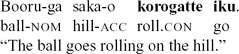
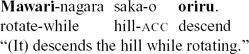
Although such distinctions are rarely obligatorily grammaticalized, and both satellite- and verb-framed languages have alternative options available for description of motion, these differences appear to affect how semantic information is syntactically structured at the level of the clause. The constructions employed by satellite-framed languages, e.g. Manner main verb + Path satellite, facilitate the packaging of Manner and Path in a single clause. The constructions employed by verb-framed languages e.g. Manner main verb + Path main verb, in contrast, generally entail the production of multiple clauses. Indeed, the use of directional adpositional phrases in combination with main verbs of Manner is argued to be restricted in verb-framed languages such that they cannot be used for telic events (Aske, Reference Aske1989) or events involving state changing boundary crossing (Slobin & Hoiting, Reference Slobin and Hoiting1994). Support for a cross-linguistic difference in clausal packaging has been found for English and Japanese (Allen et al., Reference Allen, Özyürek, Kita, Brown, Turanli, Ishizuka, Beachley, Brown and Conlin2003; Kita & Özyürek, Reference Kita and Özyürek2003). However, recent work challenges the clausal packaging pattern attributed to Japanese. In a study of monolingual speakers of Japanese and native Japanese speakers with knowledge of English, Brown and Gullberg (Reference Brown and Gullberg2012) found that monolinguals lexicalized Manner in a variety of ways and preferred single-clause packaging of Manner and Path, a pattern normally associated with satellite-framed languages. Non-monolingual Japanese speakers, in contrast, produced significantly fewer single-clause constructions, displaying an equal preference for both packaging types. As discussed in Brown and Gullberg (Reference Brown and Gullberg2012), the discrepancy between this and earlier studies could be due to methodological differences in the segmentation of spontaneous speech or to the possibility that the participants in other studies were not monolinguals but bilinguals. Either way, precise characterizations of Japanese and English are somewhat unclear.
3. The current study
This study investigates the potential for linguistic convergence between established and emerging linguistic systems within the bilingual mind. We compare language production from monolingual English and Japanese speakers to L1 and L2 production from native Japanese speakers with intermediate knowledge of English as a foreign and second language, manipulating residence in the L2 community as a variable in order to examine the effects of immersion experience among the ESL speakers, and at the same time control for the possibility of attrition among the ESL speakers. The clausal packaging of semantic information in descriptions of motion serves as the focus of enquiry. With cross-linguistic between- and within-participant analyses, we seek to (i) investigate how L1 Japanese users of L2 English as a foreign versus second language distribute information about Manner and Path across clauses as compared to monolingual speakers of the source and target languages, and (ii) ask whether L1–L2 convergence in the domain of clausal packaging is possible at an intermediate level of L2 proficiency. Following Pavlenko (Reference Pavlenko and Pavlenko2011a), we interpret differentiation between bilinguals and monolinguals but a corresponding lack of differentiation within individuals, specifically bilinguals in L1 and L2, as evidence of convergence.
4. Method
4.1 Participants
Fifty-six adults aged 18–48 years participated in this study: 15 monolingual speakers of Japanese resident in the Kansai region of Japan, 13 monolingual speakers of English resident in and around Boston, USA, 15 native Japanese speakers with knowledge of English resident in the Kansai region of Japan (speakers of English as a foreign language – EFL), and 13 native Japanese speakers with knowledge of English resident in and around Boston, USA (speakers of English as a second language – ESL). The contrast in residence among the L2 speakers enabled examination of effects of L2 immersion, while at the same time controlling for the possibility of L1 loss (cf. Pavlenko, Reference Pavlenko and Pavlenko2011a). Effects seen only in the production of ESL speakers might be explained by immersion in the L2 community with the additional possibility of loss of the L1, but similar patterns in both the ESL and EFL groups would render such an explanation less likely.
All participants were recruited initially on the basis of their responses to a detailed questionnaire targeting biographical information and information on language usage (Gullberg & Indefrey, Reference Gullberg and Indefrey2003). As it is practically impossible to find truly monolingual speakers of any language, individuals who reported relatively minimal exposure to an L2, no active study of an L2, and no use of an L2 in their everyday lives were considered “functionally monolingual” for the purposes of this study. In contrast, participants reporting active use of their L2 were considered bilingual (“second language users” in Cook, Reference Cook and Cook2003a).
The monolingual speakers of Japanese all reported exposure to English in grade-school and one also reported previous study of Spanish. The monolingual speakers of English reported some exposure to a variety of languages, including French, German, Italian and Spanish. However, no participant in either monolingual group reported any recent second language study or use. The Japanese EFL speakers reported that they had never lived in an English-speaking country, had acquired English primarily through formal study in Japan, and used English on a daily basis. The Japanese ESL speakers had been residents in the USA for between one and two years at the time of testing, had acquired English through formal study in Japan and the USA, and also reported daily use of the language.Footnote 4 Although both groups could be considered functional bilinguals, the ESL group reported significantly greater daily use of English than the EFL group (t(24) = –3.085, p = .005).Footnote 5
To control for knowledge of English, proficiency was measured in three different ways. All Japanese-speaking participants, monolingual and bilingual, reported age and length of exposure and rated their own proficiency in speaking, listening, writing, reading, grammar, and pronunciation. Two additional standardized measures of English proficiency were administered to the bilinguals.Footnote 6 First, oral proficiency was evaluated using the Cambridge English to Speakers of Other Languages (ESOL) oral testing rubric for the FCE, a mid-level exam in the Cambridge suite of exams. The rubric was applied to the narrative data elicited as part of the study, and two ex-Cambridge-certified examiners scored grammar and vocabulary, discourse management, pronunciation, and global achievement. Finally, bilingual participants also completed the first grammar section (cloze test – a quarter of the entire exam) of the Oxford Placement Test (Allan, Reference Allan1992).
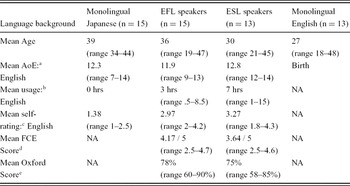
The Japanese monolingual and two groups of bilingual speakers significantly differed in self-ratings of English proficiency, (χ2(2) = 12.101, p < .001), with the monolingual speakers (M: 1.38/5) rating themselves significantly lower in knowledge of English than both the EFL speakers (M: 2.97/5, p < .001) and the ESL speakers (M: 3.27/5, p < .001), who did not significantly differ from each other (p = .406). In the standardized measures, the Japanese EFL speakers (M: 4.2/5) were slightly more proficient than the Japanese ESL speakers (M: 3/6/5) as measured by the Cambridge FCE criteria, a difference that was statistically significant (t(26) = 2.232, p = .034), but the groups did not significantly differ according to the Oxford Placement Test (M: 78% versus 75%, t(25) = .795, p = .434).Footnote 7 From Cambridge ESOL's standard setting equivalence estimates, the FCE exam maps onto level B2, “independent user”, of the Common European Framework of Reference for Languages (CEFR) developed by the Council of Europe, a level preceded by the A1 and A2 “basic user” levels and followed by the C1 and C2 “proficient user” levels. Overall, despite a slight difference in proficiency as measured by the FCE rubric, both groups of bilingual speakers could be considered “intermediate” CEFR B2 level users of their L2 according to the majority of L2 proficiency measures. Table 1 summarizes participants’ language usage and English proficiency data.
Summary of language usage/proficiency data.

a Age of exposure; b Hours of current usage per day; c A composite score of self-ratings of individual skills (listening, speaking, reading, writing, grammar, and pronunciation) over a maximum score of 5; d A composite score of Cambridge First Certificate in English ratings (grammar and vocabulary, discourse management, pronunciation, and global impression) over a maximum score of 5; e Scores from the first half of the grammar portion of the Oxford Placement Test.
4.2 Procedure
Participants were asked to watch the Sylvester and Tweety cartoon, “Canary Row” (Freleng, Reference Freleng1950) and describe the events. Monolingual participants narrated in their L1 only. Second language speakers narrated in both their L1 and L2 in a counter-balanced order across participants. Bilinguals were requested to attend their second appointment at least three days after their first and interacted with a native speaker of the relevant language, either an English- or Japanese-speaking confederate in order to control for the effects of “language mode” (Grosjean, Reference Grosjean1998). Prior to narrative elicitation, the participant and experimenter engaged in small talk in the target language to promote a “monolingual mode”. In order to maximize the potential for mention of individual motion events, the cartoon was broken down and shown in scenes, separated by a blank screen (see McNeill, Reference McNeill1992). The experimenter asked participants to watch the series of scenes and describe each one immediately after viewing. The confederate was trained to appear engaged in the descriptions, but to avoid asking and answering questions, particularly with respect to Manner or Path of motion.
Prior to narrating in the L2, second language speakers were provided with a word list containing key, low frequency nouns from each scene, e.g. birdcage, trolley, which were predicted to be difficult in the L2, English, at this level of proficiency. The word list remained accessible throughout the appointment, and participants were free to consult it at any time, which reduced the likelihood of requests for lexical assistance from the listener.
4.3 Clausal segmentation and coding
Native speakers of English and Japanese transcribed narratives in their respective languages. Transcriptions were linearly segmented for coding using the framework developed by Berman and Slobin (Reference Berman and Slobin1994). Narratives were divided into “clauses”, defined as “any unit that contains a unified predicate . . . (expressing) a single situation (activity, event, state)” (p. 660). Descriptions of four specific motion events that were reliably mentioned by participants were initially selected for examination. These target motion events contained different combinations of Manner and Path:
climb + trough – in which the protagonist, Sylvester, climbs up through the inside of a drainpipe in order to reach Tweety.
roll + down – in which Sylvester, having swallowed a bowling ball, seemingly rolls down a street into a bowling alley.
clamber + up – in which Sylvester clambers up the outside of a drainpipe in order to reach Tweety.
swing + across – in which the Sylvester swings on a rope across a street up in order to reach Tweety.
Only those event descriptions that included mention of both Manner and Path could subsequently be coded for clausal packaging. Talmy's (Reference Talmy1991) original framework predicted that speakers of verb-framed languages may omit Manner from motion descriptions, and this has been found in empirical work on languages such as Spanish (e.g. Slobin, Reference Slobin, Hickman and Robert2006) and specifically Japanese (Brown & Gullberg Reference Brown and Gullberg2008). Analyses of clausal packaging of Manner and Path were therefore based on a total of 201 event descriptions in which both Manner and Path were mentioned naturally and without prompting (27 from monolingual Japanese speakers, 47 from monolingual English speakers, 32 from Japanese EFL speakers in L1 and 37 in L2, and 26 from Japanese ESL speakers in L1 and 32 in L2).
Calculations of the frequency of mention of motion largely depends on the morphosyntactic recourses examined. When lexical items other than verbs are examined, for example, speakers of verb-framed languages are found to mention Manner more often than would normally be predicted (see Naigles, Eisenberg, Kako, Highter & McGraw, Reference Naigles, Eisenberg, Kako, Highter and McGraw1998). Therefore, a fairly inclusive system was followed by which any element encoding information about the source, direction, goal, and form of the protagonist's translocational motion was coded. For expression of Path, this included deictic verbs (e.g. go), adverbs (e.g. up), and adpositions (e.g. to, kara “from”). For expression of Manner, this included main, subordinated, and compound verbs (e.g. roll, while rolling, koroge-ochiru “roll-fall”), adverbial participials (e.g. korogatte iku “rolling go”), mimetics (e.g. gorogoro “roll”), and comparison phrases (e.g. like Tarzan).
Examples of clausal segmentation and coding in descriptions of the swing across event in English and Japanese are shown in (4) and (5), with clause boundaries marked by brackets and Manner and Path expressions in bold.
(4) [he's just going to swing across into the window from one building to the next]
(5)

Example (4) from a native speaker of English contains a Manner verb, swing, with four adverbial Path expressions, across, into, from, and to, combined in a single clause. Example (5) from a native speaker of Japanese describing the same event shows multiple clauses separating the components of Manner and Path: Manner expressed as a main verb, yurasu “swing”, in the first clause, and Path expressed in a main verb, iku “go”, in the third clause.
The segmentation and coding of L2 data was complicated by the numerous false starts, repetitions, and unclear semantics typical of this level of proficiency. A particularly problematic example from an EFL speaker describing the roll down event is provided in (6), with potential Manner and Path expressions in bold.
(6) [there was sucked into the ah the cat sucked into the bowling center]
One possibility for clausal segmentation in example (6) would have been to treat the noun phrase the cat as the object of an initial passive construction was sucked into, and then to segment a new clause, without an overt subject, beginning at the second instance of the verb. Crucially for analyses of clausal packaging, this would have yielded two clauses each with Manner and Path. Given the disfluency marked by a hesitation and subsequent repetition, however, the first five words were treated as a false start and were not included in the clause proper. For the purposes of segmentation, the clause was determined to begin at the cat as the subject. Coding was further complicated by the fact that the verb suck is not an appropriate description of the cat rolling into the bowling alley. Since this is arguably a representation of Manner of motion and no other expressions in the description more appropriately fit the stimulus, this expression was coded as a target Manner verb. In general, when at least parts of a preceding phrase were repeated, the first phrase was treated as a false start and maintained as part of the main clause, only one instance of a repeated expression was coded, and details of the stimuli were used to interpret unclear semantics.
4.4 Reliability of coding
To establish inter-rater reliability, 15% of the entire data set was segmented and coded by a second coder. For L1 data in English and Japanese, 95% agreement was reached on the selection of relevant clauses for coding, and of these, 100% agreement was reached on semantic coding. For L2 data in English, 90% agreement was reached on the selection of relevant verb clauses for coding, and of these, 100% agreement was reached on semantic coding. Disagreements were settled by accepting the judgment of the initial coder.
4.5 Analyses
Four main analyses were conducted:
1. A between-participant analysis compared clausal packaging of Manner and Path in the EFL speakers versus the ESL speakers in both their L1 and L2 to test for any differences between the Japanese speakers residing in Japan vs. in the USA.
2. A between-participant analysis compared clausal packaging in the L1 groups: English monolingual, Japanese monolingual, native Japanese speakers with knowledge of English in their L1, Japanese.
3. A between-participant analysis compared clausal packaging in monolingual L1 versus L2 groups: English monolingual, Japanese monolingual, native Japanese speakers in their L2, English.
4. A within-participant analysis compared clausal packaging in the L1 and L2 of the second language speakers.
Since the types of clausal packaging types considered – single and multiple – were categorical and mutually exclusive, we focused all analyses on the use of single-clause packaging of Manner and Path. Given the sample sizes and data distributions, non-parametric equivalents of ANOVA, independent-sample and paired-sample t-tests, were used throughout, specifically Kruskal-Wallis for multiple-group analyses, Mann-Whitney for between-group analyses, and Wilcoxon for repeated-measures analyses.
5. Results
5.1 Clausal packaging in bilingual production by residence
The first between-participant analysis examined clausal packaging of Manner and Path within languages by the EFL speakers versus the ESL speakers first in their L1, Japanese, and second in their L2, English, focusing on how often speakers packaged Manner and Path together in single clauses. Table 2 shows the mean proportion of single clauses containing both Manner and Path in event descriptions that mentioned both Manner and Path across groups.
Mean proportion (SD) of clauses containing both Manner and Path in EFL and ESL speakers in L1 and L2.

a Participant numbers vary slightly across groups as all participants mentioned Manner and Path in event descriptions in their L2 but not necessarily in their L1.
There were no significant differences between the EFL speakers in Japan versus the ESL speakers in the USA in the L1 (z = –0.249, p = .803) or the L2 (z = –1.664, p = .096); therefore, residence in the L2 community appeared not to have an impact on clausal packaging among Japanese speakers of English. EFL and ESL groups were subsequently collapsed across residence, although not across language, for all further analyses.
5.2 Clausal packaging in L1 production
The second between-participant analysis examined clausal packaging cross-linguistically across L1 groups. All L1 speakers exhibited some variety in clausal packaging of Manner and Path. Brown and Gullberg (Reference Brown and Gullberg2012) demonstrated that monolingual Japanese speakers structured information in the packaging type commonly associated with verb-framed languages, with Manner and Path expressed in separate clauses as illustrated in (7).
(7)

However, they were also shown to produce alternative constructions with Manner and Path expressed in a single clause such as those listed in examples (8)–(11), a pattern generally associated with satellite-framed languages (Brown & Gullberg, Reference Brown and Gullberg2012).
(8)
(9)
(10)
(11)

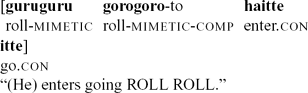


In (8) there is use of a mono-clausal, complex motion predicate (Mastumoto, Reference Mastumoto1996), a combination of a Manner participial, korogatte “rolling”, and deictic Path verb, iku “go”; in (9) a combination of Path verbs, haitte “entering” and iku “go” and Manner mimetics, “words which imitate sound or shape” (Weingold, Reference Weingold, Egli, Pause, Schwarze, von and Weingold1995, p. 319), guruguru “roll” and gorogoro “roll”; in (10) the use of a Manner–Path compound verb, tobi-utsuru “fly-move” with a Path postposition, ni “to”; and in (11) with a Manner-Path compound verb alone, yoji-noboru “clamber up”.
Brown and Gullberg (Reference Brown and Gullberg2012) also showed that Japanese EFL and ESL speakers in their L1, Japanese, frequently structured information in the packaging type predicted for verb-framed languages, with Manner and Path expressed in separate clauses as illustrated in (12). Yet like their monolingual counterparts, they also produced alternative single-clause packaging types more typical of satellite-framed languages, such as those shown in examples (13)–(16).
(12)
(13)
(14)
(15)
(16)


These examples contain many of the same types of constructions used by monolingual speakers of Japanese: in (12), a Manner verb, hashiru “run” in one clause followed by a combination of a Path postposition and Path verbs, made “to/until”, haitte “entering”, and iku “go”; in (13) a mono-clausal, Manner-Path complex motion predicate consisting of a Manner participial, kakette “running”, and a deictic Path verb, iku “go”; in (14) a mono-clausal combination of Manner mimetics, syuu “swing”, a Manner adverbial, taazan mitai-ni “looks like Tarzan”, and a Path verb, iku “go”; in (15) the use of a mono-clausal Manner-Path compound verb, tobi-utsuru “fly-move” with Path postpositions, kara “from” and e “to”; and in (16) a mono-clausal Manner-Path compound verb alone, yoji-noboru “clamber up”.
The new dataset presented here showed that monolingual English speakers structured information about motion in the packaging type predicted for satellite-framed languages with a main Manner verb, e.g. climb, and associated Path adverbial e.g. up, expressed in a single clause, as illustrated in (17).
(17) [he climbs up the drainpipe]
They also produced alternative constructions such as that shown in example (18), with one clause containing only a Manner verb, swing, followed by a second clause containing a Path verb and adverbial, get over.
(18) [and he swings] [and tries to get over there]
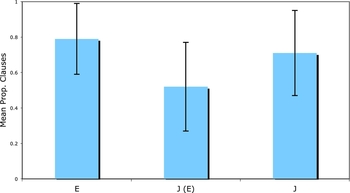
Again, a quantitative analysis focused on the frequency of use of the single-clause packaging type among native Japanese and native English speakers. Figure 1 shows the mean proportion of clauses containing both Manner and Path in event descriptions where both Manner and Path were mentioned by monolingual English speakers, monolingual Japanese speakers, and native Japanese speakers with knowledge of English in their L1, Japanese.
Mean proportion of clauses containing both Manner and Path in L1 groups: E (monolingual English), J (E) (Japanese–English speakers in their L1, Japanese), and J (monolingual Japanese).

The groups differed significantly in the mean number of single clauses packaging both Manner and Path (χ2 (2, n = 53) = 9.916, p = .007). Follow-up tests revealed that native Japanese speakers with knowledge of English in their L1, Japanese, produced significantly fewer single clauses packaging both Manner and Path than monolingual Japanese speakers (z = –2.252, p = .024) and monolingual English speakers (z = –2.806, p = .005), who did not differ from one another (z = –0.824, p = .410). In sum, between-participant analyses of the L1 demonstrated clear differentiation between monolingual and bilingual L1 performance.
5.3 Clausal packaging in L2 production
The third between-participant analysis contrasted clausal packaging from L2 English speakers with that from monolingual speakers of the source language, Japanese, and target language, English. Representative data from the monolingual speakers can be found in examples (7)–(11) for Japanese and (17) and (18) for English. English L2 users produced a variety of packaging types as shown in examples (19)–(22).
(19) [he climbs up the wall pipe]
(20) [the cat was climbing on drainpipe] [and he finally got the floor]
(21) [and he was kept running] [and he went into the bowling place]
(22) [and then like swing like a Tarzan] [and then get to the other side]
Example (19) represents the predicted single-clausal package for Manner and Path in English, with the Manner verb, climb, plus Path adverbial, up, which was indeed used with considerable frequency in monolingual English discourse. With the exception of the lexical choice, wall pipe, this example can be considered target-like. However, just like monolingual target language speakers, L2 speakers also produced other packaging types. Example (20) contains a Manner-only clause with the Manner verb, climbing, followed by a clause containing Path, expressing the endpoint of the trajectory in a verb, got. Example (21) illustrates a Manner-only clause with a Manner verb, running, followed by a Path-only clause with a verb and preposition, went into. Finally, in example (22), a Manner-only clause with a verb and comparison phrase, swing like a Tarzan, is followed by a Path-only clause, again expressing the endpoint of the trajectory in a verb and preposition, get to. Such examples demonstrate the multiple-clause packaging type most commonly associated with verb-framed languages.
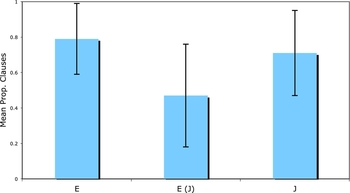
The distribution of the frequency of single clauses combining Manner and Path was calculated across the groups. Figure 2 shows the mean proportion of clauses containing both Manner and Path in event descriptions that mentioned both Manner and Path from monolingual English speakers, monolingual Japanese speakers, and native Japanese speakers with knowledge of English in their L2, English.
Mean proportion of clauses containing both Manner and Path in L1 and L2 groups: E (monolingual English), E (J) (native Japanese speakers in their L2, English), and J (monolingual Japanese).

Again, the groups differed significantly in the mean number of single clauses packaging both Manner and Path (χ2 (2, n = 56) = 12.992, p = .002). Native Japanese speakers in their L2, English, produced significantly fewer clauses packaging both Manner and Path than monolingual English speakers (z = –3.180, p = .001) and monolingual Japanese speakers (z = –2.588, p = .01), who, as shown above, did not differ significantly from each other. Again, between-participant analyses, this time of the monolingual L1 and bilingual L2, showed clear differentiation between monolingual and bilingual performance.
5.4 Clausal packaging in bilingual L1 and L2 production
The final, within-participant analysis examined clausal packaging from the same native Japanese speakers in their L1 and L2. Examples of data from these speakers can be found in (12)–(16) for the L1, Japanese, and (19)–(22) for the L2, English. Examples (23)–(24) below are taken from individual speakers, who used both clausal packaging types in their L1 and L2.
(23)

Example (23) shows an EFL speaker describing the roll down event in the L1, packaging Manner in one clause with the verb hashiru “run”, and Path in the following mono-clausal complex motion predicate with a postposition, made “to/until” and two verbs haitte “entering” and iku “go”. When describing the same event in the L2, the speaker once again used multiple clauses, with the Manner verb run followed by the Path verb and preposition go into. However, the very same speaker then used a mono-clausal construction to describe the swing across event in the L1, expressing Manner through a mimetic syuutto “whoosh” and comparison phrase taazan mitai-ni “looks like Tarzan”, and Path through a verb iku “go”. Similarly, in the L2 description of the climb up event, the speaker combined Manner and Path in the same clause though a verb, climb, and adverb, up, respectively.
(24)

Example (24) depicts the parallel case from an ESL speaker. In her description of the roll down event in the L1, she packaged Manner in one clause with the verb korogaru “roll”, and Path in the following clause with a postposition, made “to/until” and verb hairu “enter”. The speaker's description of the same event in the L2 also employed multiple clauses, with the verb roll followed by the verb reach. Like the previous EFL speaker, this ESL speaker also used single-clause constructions, for the roll down event in the L1, with a Manner-Path compound verb embedded in a complex motion predicate, korogari-ochite iku “roll-descending go”, and for the swing across event in the L2, with a Manner verb, jump, and Path preposition, in (the first instance of into was deemed a false start and not coded).
A repeated measures analysis within the combined group of ESL and EFL speakers showed no significant differences in single-clause packaging of Manner and Path in the L1, Japanese, and L2, English (z = –0.157, p = .875). Therefore, strikingly, there was no differentiation in clausal packaging between the L1 and L2 within individuals, even though they were speaking two languages traditionally regarded as typologically different in the domain of motion event expression.
6. Discussion
This study examined how monolingual and bilingual Japanese–English speakers syntactically structured semantic information, specifically how Manner and Path of motion were packaged into clauses. Two possible construction types, single versus multiple clause, were identified following the satellite- and verb-framed typological distinction in lexicalization of motion (Talmy, Reference Talmy and Shopen1985, Reference Talmy1991, Reference Talmy2000a, Reference Talmyb).
Results for monolinguals revealed that, in line with predictions (Allen et al., Reference Allen, Özyürek, Kita, Brown, Furman, Ishizuka and Fujii2007), monolingual English speakers preferred single clauses packaging Manner and Path together, typically in main Manner verbs with Path adverbials. This matches the surprising pattern previously found for monolingual Japanese speakers (Brown & Gullberg, Reference Brown and Gullberg2012), in which speakers also preferred single clauses packaging Manner and Path together and employed constructions such as complex motion predicates with a Manner participial and deictic Path verb, Path verbs in combination with Manner mimetics, and Manner-Path compound verbs. As a result, there was no cross-linguistic, monolingual baseline difference in patterns of clausal packaging corresponding to the typological distinctions found in patterns of lexicalization of motion, at least with respect to syntactic packaging of both Manner and Path.
Despite the rather striking lack of difference between source and target language production in the monolingual baseline, comparisons of monolingual data and data from native Japanese speakers with intermediate knowledge of English as an L2 yielded within-language differences and between-language similarities. In both their L1, Japanese, and L2, English, bilingual speakers produced fewer single-clause constructions packaging Manner and Path than both monolingual Japanese and English speakers. Furthermore, a within-participant analysis revealed no significant difference between the L1 and the L2 of the bilingual speakers. Importantly, these results did not appear to be affected by immersion in the L2 community. In other words, Japanese speakers of English patterned similarly in their L1 and L2 and EFL speakers in Japan patterned similarly to ESL speakers in the USA. With a lack of differentiation between the L1 and L2 within individuals but differentiation between the L1–L2 performance of bilinguals versus monolingual speakers of each of the languages, this appears to fit Pavlenko's (Reference Pavlenko and Pavlenko2011a) criteria for convergence with seemingly no effects of attrition, particularly for the L1. From these results, then, we propose that there is convergence between a Japanese L1 system and an English L2 system within individual language speakers at an intermediate level of L2 proficiency in the syntactic organization of semantic information, specifically clausal packaging of Manner and Path of motion.
An obvious question is why Japanese L1 speakers of English L2 exhibit this unique and convergent pattern in clausal packaging. Convergence often arises as a result of bi-directional, cross-linguistic influences, hence its frequent characterization as “in-between” performance (see Pavlenko, Reference Pavlenko and Pavlenko2011a). In such cases, visible cross-linguistic contrasts in a given linguistic domain between monolingual speakers of two different languages may appear less contrastive or not contrastive at all for bilingual speakers of those same two languages. Voice Onset Time, as discussed previously, is a classic example, where a language with a longer VOT, e.g. English, significantly differs from a language with a shorter VOT, e.g. French, when monolingual production is considered. However, between-language VOT durations become more similar when bilingual French–English production is observed (Flege, Reference Flege1987). On the surface, however, with a lack of contrast between monolingual speakers of the source and target languages, as seen among the monolingual Japanese and English speakers here, it is problematic to conceive of the bilingual Japanese–English patterns as the result of cross-linguistic influence. Their performance with respect to clausal packaging cannot be characterized as “in-between” Japanese and English.
One possible explanation for the unique syntactic organization of semantic information seen in bilingual production may involve cross-linguistic influence in a linguistic domain below the level of the clause, e.g. the domain of lexicalization. In English, while alternatives exist, Manner is generally lexicalized in a main verb, as shown in examples (17)–(18) from monolingual speakers. In Japanese, on the other hand, speakers can choose between a number of options: main verbs, participial forms, compound verbs, and mimetics. Although these options are very frequent and accessible, they are not all equal with respect to simultaneous expression of Path. Manner can only co-occur with Path in the same clause in an adverbial participial form (25), in a compound form (26), and in mimetics (27) (examples repeated here for convenience). However, Manner expressed as a main verb can generally not co-occur with Path in the same clause, as shown in the hypothetical example in (28).
(25)
(26)
(27)
(28)


Under a cross-linguistic influence account, focusing on influence of the L2 on the L1 in the area of Manner expression, bilingual Japanese–English speakers might be prompted by their knowledge of English, which overwhelmingly prefers to lexicalize Manner in a main verb, to employ this option, which is grammatical and available, in their L1, Japanese. In contrast, monolingual Japanese speakers, with no influence from English, might encode Manner in ways that do not syntactically constrain simultaneous expression of Path within a clause, i.e. participial forms, compound forms and mimetics. Any elevated use of main Manner verbs in Japanese by Japanese–English bilinguals would entail a syntactic constraint, leaving Path to be expressed in a separate clause and ultimately yielding a multi-clause construction for Manner and Path.
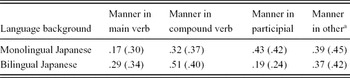
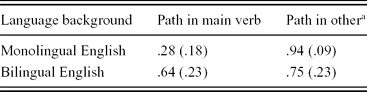
A preliminary post-hoc analysis of the data for lexicalization of Manner suggests that monolingual and bilingual Japanese speakers broadly follow the pattern hypothesized above. Table 3 displays the frequencies of lexicalization of Manner in the different constructions possible in Japanese: main verb, compound with Path verb, participial within a complex motion predicate, and other adverbial forms, e.g. mimetics and comparison phrases.
Mean proportion (SD) of clauses containing Manner with lexicalization of Manner as a main verb, compound verb, complex motion predicate, or other in monolingual and bilingual Japanese discourse.

a “Other” comprises Manner in mimetics or comparison phrases. As categories of Manner expression could be combined, they are not mutually exclusive.
The general picture from this analysis is that bilingual Japanese–English speakers appear to lexicalize Manner in a main verb or a compound verb in their L1, Japanese, more often than monolingual Japanese speakers do, and conversely that they lexicalize Manner in participial forms and other adverbial forms (e.g. mimetics and comparison phrases) less often than monolingual Japanese speakers do. None of these differences are statistically significant, although the difference in frequency of use of participials approaches significance (z = –1.675, p = .09). However, collectively, the results suggest a trend for bilingual Japanese–English speakers to lexicalize Manner in their L1 in ways that syntactically constrain expression of Path in the same clause and for monolingual Japanese speakers to lexicalize Manner in ways that syntactically license expression of Path in the same clause.
If differential lexicalization of Manner is indeed a plausible explanation for bilingual L1 performance, we must consider in parallel what would yield the multi-clause pattern also observed in the L2 of bilingual Japanese–English speakers. As we have seen, use of main Manner verbs in English should not block simultaneous expression of Path in the same clause. And as shown in examples (19)–(22), bilingual Japanese–English speakers did indeed encode Manner in mains verbs in their L2. An explanation for clausal packaging in the L2 might be found in a simultaneous influence of the L1 on the L2 in the area of Path expression. Such an influence might have caused these learners, whose first language, Japanese, lexicalizes Path in main verbs, to adopt the same strategy for their L2, English. This pattern can be seen in examples (21) and (22), and several studies have shown influence of the L1 on the L2 in areas such as this (e.g. Cadierno & Ruiz, Reference Cadierno and Ruiz2006; Inagaki, Reference Inagaki2002a; Navarro & Nicoladis, Reference Navarro, Nicoladis and Eddington2005; Negueruela, Lantolf, Jordan & Gelabert, Reference Negueruela, Lantolf, Jordan and Gelabert2004). Indeed, the use of a combined strategy of both verbs and adverbials for lexicalization of Path from these Japanese speakers of English has been found in previous analyses of both the L1 and L2 (Brown & Gullberg, Reference Brown and Gullberg2011).
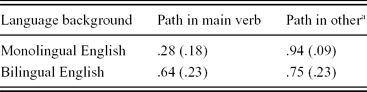
Again, a post-hoc analysis of the data for lexicalization of Path suggests that Japanese speakers of English do lexicalize Path in verbs. Table 4 displays the frequencies of lexicalization of Path in the different constructions possible in English: main verb or other adverbial forms, e.g. adverbs and prepositions.
Mean proportion (SD) of clauses containing Path with lexicalization of Path as a main verb or other in monolingual and bilingual English discourse.
a “Other” comprises Path in adverbs or prepositional phrases, which could be combined with main verbs; thus, the categories are not mutually exclusive.
Here, the difference between bilinguals and monolinguals is much clearer. Bilingual Japanese–English speakers lexicalize Path in a main verb in their L2, English, significantly more often than monolingual English speakers do (z = –3.866, p < .001), and lexicalize Path in other forms (e.g. adverbs and prepositions) significantly less often than monolingual English speakers do (z = 3.057, p = .002).
Taking these two proposed scenarios together, i.e. (i) the presence of L2 English causing Manner to be expressed in main verbs in L1 Japanese, and (ii) the presence of L1 Japanese causing Path to be expressed in main verbs in L2 English, we would predict bilingual Japanese–English speakers to employ separate clauses, each packaging Manner and Path in main verbs, in each of the languages. Importantly, as Manner and Path can both be expressed in main verbs and adverbials in both of the languages, such predictions for use of multiple clause packaging would not be categorical, but rather distributional. This can clearly be seen in the data, as use of a given type of clausal packaging was not categorical for any of the language groups.
If such bi-directional, cross-linguistic influences are responsible for the converging patterns between the L1 and L2 seen here, this may be the result of the frequency with which certain construction types, e.g. main verbs expressing Manner and Path, are encountered in English and Japanese. A frequency-based explanation would be in line with other usage-based accounts of language knowledge in general (see overview in e.g. Ellis, Reference Ellis, Gass and Mackey2011), as well as usage-based accounts of multilingual language knowledge in particular (e.g. Hall, Cheng & Carlson, Reference Hall, Cheng and Carlson2006). In addition, such influences would support models that predict convergence in areas of similarity between bilingual grammars (e.g. Bullock & Toribio, Reference Bullock and Toribio2004; Döpke, Reference Döpke1998; Filipovic, Reference Filipovic2011; Müller & Hulk, Reference Müller and Hulk2001; Nicol, Teller & Greth, Reference Nicol, Teller, Greth and Nicol2001). In their introduction to a special issue on convergence in functional bilingualism, Bullock and Toribio (Reference Bullock and Toribio2004) define the phenomenon as a synchronic process of enhancement of similarities between two grammars, which engenders some kind of emergent and potentially transitional change in the linguistic system(s) (p. 91). The similarities exploited by Japanese L1 speakers of English L2 would be the availability of main verbs to lexicalize Manner and Path in each of the languages, which might subsequently yield the transition to an emergent structure for clausal packaging, i.e. multi-clause constructions. One might further argue that the use of these constructions among bilinguals reflects a gradual elimination of the more complex language specificities of one language in favor of the less complex specificities of another language, a model proposed by Ameel et al. (Reference Ameel, Malt, Storms and Van Assche2009).
Although an explanation for the unique bilingual patterns of clausal packaging of Manner and Path in terms of bi-directional cross-linguistic influences seems plausible, further research needs to consider competing hypotheses. These include the possibility that bilingual speakers in general tend to differentiate semantic components in syntax more than monolingual speakers, as has been proposed for children acquiring their L1 (cf. Bowerman, Reference Bowerman and Strauss1982), perhaps related to the generally slower language production observed among bilinguals (see e.g. Runnqvist, FitzPatrick, Strijkers & Costa, in press), for which an examination of the clausal packaging of semantic elements other than Manner and Path would be needed. In addition, data from other language pairings would serve to tease apart language specific, cross-linguistic influences from more general effects of bilingualism, labeled “micro” and “macro” effects by Bassetti and Cook (Reference Bassetti, Cook, Cook and Bassetti2011) (see Jarvis, Reference Jarvis2000, Reference Jarvis, Roberts, Howard, Ó. Laoire and Singleton2010, for discussion of the evidence needed to verify the existence of cross-linguistic influence). Future research should also address weaknesses in the current study such as the slightly different levels of formal L2 proficiency between the two groups of bilinguals as measured by the FCE test, the second language knowledge of the “monolinguals”, which in the case of the English speakers included knowledge of verb-framed languages, the time span (a minimum of three days) between L1 and L2 testing, which reduced drop-out rates but was less likely to reduce the effects of memory for the stimulus, and the fact that this study only examined narratives in which Manner and Path were both present, a clear subset of the entire corpus.
The convergence demonstrated here may not be permanent. Ameel et al. (Reference Ameel, Malt, Storms and Van Assche2009) define convergence in the mind of a bilingual as an “outcome” in opposition to a “process of evolution” (p. 271), but convergences in L1–L2 grammars may alternatively be viewed as intermediate stages in development, and therefore part of a larger process. Pavlenko (Reference Pavlenko and Pavlenko2011a) highlights the dynamism of two languages in interaction within a single mind, arguing that the restructuring of bilingual systems is a developmental phenomenon, but one that is complex and non-linear. It remains to be seen, then, whether the L1 and L2 patterns seen among the native Japanese speakers with intermediate level knowledge of English would prevail if and when the individuals reached a more advanced state of L2 proficiency. Indeed, in a study of sentence combining in Chinese L1 speakers of English L2, Chen (Reference Chen2006) found that bilingual L1 patterns only differed from monolingual L1 patterns at an intermediate but not an advanced level of L2 proficiency (see Tversky, Kugelmass & Winter, Reference Tversky, Kugelmass and Winter1991, cited in Bassetti & Cook, Reference Bassetti, Cook, Cook and Bassetti2011, for initial effects of bilingualism that weaken over time). We are very far from an understanding of the development of and interaction between the seven processes in Pavlenko's (Reference Pavlenko and Pavlenko2011a) restructuring framework. For that, longitudinal studies observing different linguistic domains and different language pairings would surely provide valuable insights.
The need for further research notwithstanding, there are clear implications from the findings presented here. “Interlanguage” (Selinker, Reference Selinker1972) is a concept traditionally only associated with L2 performance, and interlanguage performance that differs from target language performance is generally regarded as non-target-like. A partial analysis of bilingualism observing only “interlanguage” L2 production might have simply concluded that L2 users at this level of proficiency do not yet possess the target-like syntactic capability to package Manner and Path in a single clause. However, given that the same speakers show parallel patterns in their L1, we may begin to see the flip side of interlanguage, to question the notion of what constitutes native speakerhood, and to query assessments of non-target-like performance. Furthermore, Bassetti and Cook (Reference Bassetti, Cook, Cook and Bassetti2011) state that the “most straightforward” bilingual research generally proceeds from a previously observed gap between the source and target languages. This research was undertaken following the same principle, albeit with a conflicting picture of clausal packaging of Manner and Path in Japanese (cf. Allen et al., Reference Allen, Özyürek, Kita, Brown, Furman, Ishizuka and Fujii2007; Brown & Gullberg, Reference Brown and Gullberg2012; Kita & Özyürek, Reference Kita and Özyürek2003). If the lack of a monolingual baseline difference between these particular source and target languages had been clearly known from the outset, there would have been little reason to predict a gap between the first and second language that Japanese speakers of English would have to reconcile and little motivation for any empirical investigation. This would have concealed an interesting domain in which monolingual and bilingual L1–L2 performance is differentiated. The findings presented here point to a need for more exploratory work beyond the “most straightforward” bilingual research, which does not limit itself to parts of the language system where cross-linguistic differences lie in monolingual baselines, but to broader investigations that seek to characterize the bilingual linguistic system more fully.
Similar cautionary notes can be found elsewhere in the literature. Grosjean (Reference Grosjean1989) has argued that a bilingual should not be expected to resemble two monolinguals in one. Likewise, Cook (Reference Cook1992) has proposed the concept of “multicompetence”, in which the multiple competencies exhibited by multilinguals differ from single competencies exhibited by monolinguals, proposing that “the two or more languages of multicompetence form a total language system rather than independent systems” (p. 566). These positions impact fields such as language assessment, where benchmarking against a perceived native speaker “standard” is common practice (cf. Zhang & Elder, Reference Zhang and Elder2011), and language typology, where language descriptions based on language use do not often consider the psycholinguistic effects of multilingualism (see Gullberg, Reference Gullberg2012). One clear message from all such work is that prudent research and pedagogy will not view an individual's multicompetent performance in one language in isolation from their performance in the other language.
To conclude, this paper argues that, in addition to situations of language contact between speech communities and individual cases of advanced bilingualism, convergence between linguistic systems may also operate in the context of an individual who is arguably still in the process of developing a second language. Thus, convergence between bilingual systems may be a phenomenon that emerges much earlier in natural language development than has previously been thought (cf. Athanasopoulos, Reference Athanasopoulos2006; Cook et al., Reference Cook, Bassetti, Kasai, Sasaki and Takahashi2006; Flege, Reference Flege1987; Nicol et al., Reference Nicol, Teller, Greth and Nicol2001). Furthermore, L1 Japanese speakers of L2 English even at this CEFR B2 “independent” but still “intermediate” stage of L2 proficiency may exhibit evidence of at least four of the processes involved in the restructuring of the bilingual grammar outlined by Pavlenko (Reference Pavlenko and Pavlenko2011a). Coexistence of the L1 and L2 can be seen in the speakers’ continued use of lexicalization patterns employed by monolingual speakers of the source and target languages. Influence of the L1 on the L2 may be seen in the L2 English speakers’ use of verbs to lexicalize Path, a pattern typical of their source language. Influence of the L2 on the L1 may be seen in the L1 Japanese speakers’ lexicalization of Manner in main verbs, a pattern typical of the target language. And convergence can be seen at the level of the clause, where L1–L2 bilingual performance is differentiated from monolingual source and target language performance. Importantly, we claim that the possible additional process of attrition is not at work since results from the EFL speakers, who continue to reside in the source language community, match those of ESL speakers, who have become immersed the target language community (although see Schmid & Kopke, Reference Schmid, Kopke, Schmid, Kopke, Keijzer and Dostert2007, for a broader view of attrition). Finally, we propose that although they may be a consequence of bi-directional cross-linguistic influences elsewhere in the system, convergent L1–L2 patterns may not fall between divergent monolingual baselines but occupy a unique place of their own (cf. Bassetti & Cook, Reference Bassetti, Cook, Cook and Bassetti2011). The convergence shown here may be transitional, may be restricted to native Japanese speakers with intermediate-level knowledge of English, and may not be seen in all areas of the linguistic system, but convergence should be considered a possibility at any stage in the development of a bilingual grammar.