1 Introduction
Since at least the early 1980s, linguists have noted that phonological neutralisation does not always yield phonetically identical segments (Mitleb Reference Mitleb1981b, Port et al. Reference Port, Mitleb and O'Dell1981, Port & O'Dell Reference Port and O'Dell1985). In this ‘incomplete’ neutralisation, phonological neutralisation is complete (i.e. the segments are assumed to share an identical phonological representation), yet a phonetic trace of the underlying phonological distinction is present in the surface form. Incomplete neutralisation presents a challenge to traditional modular feed-forward models (Chomsky & Halle Reference Chomsky and Halle1968, Keating Reference Keating and Kleinhenz1996, Pierrehumbert Reference Pierrehumbert, Gussenhoven and Warner2002, Bermúdez-Otero Reference Bermúdez-Otero and de Lacy2007), in which only the output of phonology can influence phonetic realisation.Footnote 1 In incomplete neutralisation, it appears that the underlying contrast between forms – which is supposedly obscured from the phonetic module after phonological neutralisation occurs – still plays a role in phonetic realisation. While the classical model predicts that phonologically neutralised sounds should be realised identically, incomplete neutralisation yields surface distinctions between phonologically neutralised segments.
In spite of the predictions of the traditional model, incomplete neutralisation has been found in a wide variety of languages and phenomena. Perhaps the most frequently cited cases of incomplete neutralisation involve processes of final devoicing – a voicing contrast is phonologically neutralised, but phonetic distinctions are evident between devoiced segments and their underlyingly voiceless counterparts (see §1.1 for further details and an extensive list of cases of incomplete neutralisation in both processes of devoicing and in other contexts).
Due to this apparent contradiction, incomplete neutralisation has been called a ‘theoretical bad dream’ (Manaster Ramer Reference Manaster Ramer1996a, Port Reference Port1996). In this paper, I argue that incomplete neutralisation is not an intractable problem, but rather that it can be viewed as a tension between two independently motivated grammatical forces: faithfulness to a base form (Benua Reference Benua1997, Steriade Reference Steriade, Broe and Pierrehumbert2000, Albright Reference Albright2002b) competes with adherence to a segment's canonical realisation. This tension is modelled in a phonetic grammar which uses weighted phonetic constraints (Legendre et al. Reference Legendre, Miyata and Smolensky1990, Zsiga Reference Zsiga2000, Flemming Reference Flemming2001), which I term the Weighted Paradigm Uniformity theory of incomplete neutralisation.
The remainder of the paper is organised as follows. §1.1 defines and describes several cases of incomplete neutralisation. In §2, I present Japanese monomoraic noun lengthening as a case study of incomplete neutralisation. §3 lays out existing theories of incomplete neutralisation, and provides theoretical background for the model proposed in this paper, which is described in §4. In §5 I discuss the predictions of this model as compared to other theories of incomplete neutralisation.
1.1 Incomplete neutralisation
The best-studied case of incomplete neutralisation is undoubtedly final devoicing in German (Mitleb Reference Mitleb1981a, b, Port et al. Reference Port, Mitleb and O'Dell1981, Port & O'Dell Reference Port and O'Dell1985, Röttger et al. Reference Röttger, Winter, Grawunder, Kirby and Grice2014, as well as Taylor Reference Taylor and Reich1975 (for some places of articulation) and Dinnsen & Garcia-Zamor Reference Dinnsen and Garcia-Zamor1971 (for disyllables only)). Under the assumptions of the modular feed-forward model, German /ʁat/ ‘advice’ and /ʁad/ ‘wheel’ should surface identically, given that the final obstruents are both voiceless in the phonological output. Contrary to this expectation, a trace of the underlying voicing distinction is present on the surface: the vowel in /ʁad/ is longer than the one in /ʁat/.Footnote 2 More specifically, Port & O'Dell's (Reference Port and O'Dell1985) study of German final devoicing found that vowels preceding devoiced final obstruents were approximately 15 ms longer than vowels preceding underlyingly voiceless obstruents (among other surface distinctions).
With this example in hand, we can now provide the definitions of both complete and incomplete neutralisation in (1).Footnote 3
(1)


If, contrary to fact, German final devoicing were completely neutralising, we would expect that the surface acoustic realisation of the voicing contrast between /ʁad/ and /ʁat/ (e.g. duration of preceding vowels) should be identical. As the facts actually are – that this contrast is incompletely neutralised – the surface acoustic cues to the voicing contrast are distinct, yet not as distinct as the realisation of the voicing contrast in non-neutralising contexts. As noted above, the difference in preceding vowel duration between devoiced (underlyingly voiced) and underlyingly voiceless final obstruents is only about 15 ms, as compared to non-neutralising contexts in which this duration difference may be more than doubled (Mitleb Reference Mitleb1981a, b).Footnote 4
Incomplete neutralisation of final devoicing has also been reported in Catalan (Dinnsen & Charles-Luce Reference Dinnsen and Charles-Luce1984), Dutch (Warner et al. Reference Warner, Jongman, Sereno and Kemps2004, though see the article itself and Warner et al. Reference Warner, Good, Jongman and Sereno2006 for caveats), Russian (Dmitrieva Reference Dmitrieva2005, Kharlamov Reference Kharlamov2012, Matsui Reference Matsui2015) and Polish (Gianinnia & Cinque Reference Gianinnia and Cinque1978, Slowiaczek & Dinnsen Reference Slowiaczek and Dinnsen1985, Slowiaczek & Szymanska Reference Slowiaczek and Szymanska1989, though see Jassem & Richter Reference Jassem and Richter1989 for counterevidence). In addition to incomplete neutralisation in final devoicing, incomplete neutralisation has been found in flapping in American English (Fisher & Hirsh Reference Fisher and Hirsh1976, Fox & Terbeek Reference Fox and Terbeek1977, Zue & Laferriere Reference Zue and Laferriere1979, Herd et al. Reference Herd, Jongman and Sereno2010, Braver Reference Braver2014), morphological tone in Cantonese (Yu Reference Yu2007),Footnote 5 coda aspiration in Eastern Andalusian Spanish (Gerfen Reference Gerfen2002) and monomoraic noun lengthening in Japanese (Braver Reference Braver2013, Braver & Kawahara Reference Braver2014, Reference Braver and Kawahara2016).
The case of monomoraic noun lengthening in Japanese will be discussed in detail in §2, though at this point it is worth mentioning two features of this process that differ from final devoicing. First, Japanese monomoraic noun lengthening is a more convincing case of truly phonological neutralisation than final devoicing. In the cases of final devoicing cited above, there is not clear evidence to confirm that ‘devoiced’ segments are treated as voiceless by independent phenomena (indeed, Barnes Reference Barnes2006 argues that incomplete neutralisation of final devoicing should be treated as a purely phonetic affair – that at the phonological level, devoiced and underlyingly voiceless segments remain distinct, but happen to have phonetic targets which are nearly identical). In the Japanese case, as will be shown in more detail in §2, lengthened monomoraic nouns are treated the same as underlyingly bimoraic nouns for purposes of a bimoraic minimality constraint, and can carry pitch accent – a property reserved for words of two moras or greater.
Second, there are a large number of phonetic correlates to voicing, including duration of the preceding vowel, the correlate most frequently discussed with respect to incomplete neutralisation in final devoicing (Chen Reference Chen1970), closure duration (Kluender et al. Reference Kluender, Diehl and Wright1988) and F0 and F1 (Kingston & Diehl Reference Kingston and Diehl1994, Hombert et al. Reference Hombert, Ohala and Ewan1979). In the Japanese case, however, the primary correlate of vowel length is (unsurprisingly) vowel duration (see e.g. Hirata Reference Hirata2004), with only secondary non-durational correlates (Behne et al. Reference Behne, Arai, Czigler, Sullivan, Ohala, Hasegawa, Ohala, Granville and Bailey1999, Kinoshita et al. Reference Kinoshita, Behne and Arai2002, Hirata & Tsukada Reference Hirata and Tsukada2009), thus simplifying the analysis.
2 Japanese monomoraic noun lengthening
In this section, I describe the phenomenon of incomplete neutralisation in Japanese monomoraic noun lengthening (Mori Reference Mori2002, Braver & Kawahara Reference Braver2014, Reference Braver and Kawahara2016). This case will be used in §4 to illustrate the proposed model.
2.1 Background: bimoraicity requirement
Japanese requires that all prosodic words (ω) have at least two moras (Itô Reference Itô1990, Mester Reference Mester1990, Poser Reference Poser1990, Mori Reference Mori2002, Itô & Mester Reference Ito, Mester, Honma, Okazaki, Tabata and Tanaka2003). This bimoraicity requirement is observed in many word-formation patterns, all of which are based on a bimoraic template, including nickname formation, geisha-client name formation, loanword abbreviation, verbal root reduplication, scheduling compounds and telephone number recitation.
For instance, in the nickname formation pattern, a full name must be truncated to two moras before the suffix -chan can be applied.Footnote 6 For example, the five-mora name Wasaburoo can be truncated to two moras, as in (2a), but not one. Similarly, the three-mora name Kotomi can be truncated to either two monomoraic syllables, or a single bimoraic syllable, as in (2b). It cannot, however, be shortened to a single mora.
(2)

To summarise, a prosodic word must contain at least one foot, and the foot must be binary (at the moraic level in Japanese; McCarthy & Prince Reference McCarthy and Prince1986, Reference McCarthy and Prince1993), as in (3).
(3)

In spite of this bimoraicity requirement, there are monomoraic nouns in the Japanese lexicon; e.g. [ki] ‘tree’, [i] ‘stomach’ and [e] ‘picture’. When these monomoraic nouns appear in isolation within a prosodic word (e.g. without a case particle), they are produced with vowels of intermediate length – longer than canonical short vowels, but shorter than underlyingly long vowels (Mori Reference Mori2002, Braver & Kawahara Reference Braver2014, Reference Braver and Kawahara2016). Underlyingly bimoraic nouns in the same environment do not show such lengthening. Mori thus concludes that the lengthening is caused by the phonological bimoraic minimality requirement: monomoraic nouns with a case particle within their ω satisfy the bimoraicity requirement (by virtue of the particle's mora), as in (4a), while monomoraic nouns without a particle must gain an additional mora to satisfy this requirement, as in (4b). No lengthening is required for underlyingly bimoraic nouns, as in (4c).
(4)

2.2 Monomoraic lengthening is incompletely neutralising
In spite of the identical surface mora counts in (4b) and (4c) (due to lengthening in the case of (4b)), Braver & Kawahara (Reference Braver and Kawahara2016) found that the vowel durations of lengthened monomoraic nouns were not identical to those of underlyingly long nouns. In that study, twelve native speakers of Japanese were presented with 15 sets of three nouns: (a) a short noun with a case particle (no lengthening), (b) a short noun without a case particle (lengthening expected) and (c) an underlyingly long noun. (5) shows a sample triplet, with nouns in a frame sentence. The target nouns (the first word in each frame sentence) for all three members of the triplet share identical segmental material, differing only in the presence/absence of a case particle and underlying vowel length.
(5)

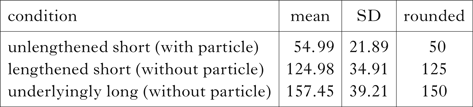
Braver & Kawahara (Reference Braver and Kawahara2016) found that lengthened nouns were on average 32.47 ms shorter than underlyingly long nouns, as summarised in Table I. In other words, the short/long vowel contrast is incompletely neutralised: lengthened short vowels are more like long vowels than short vowels in non-neutralising contexts, but they are not identical to long vowels.
Means, standard deviations and rounded values for vowel duration of nouns (in ms), from Braver & Kawahara (2016) (12 speakers, 15 sets of 3 nouns (= 45 items in total), 7 repetitions).

For ease of explication, in §4 I will focus on the overall means (across speakers and vowel qualities), and will use the rounded values for the target durations of short, lengthened and long vowels given in the rightmost column of Table I.
2.2.1 Bimoraic nouns with and without case particles
It should be noted that the nouns used in the underlyingly long condition in the Braver & Kawahara (Reference Braver and Kawahara2016) study were not followed by a case particle (e.g. kii, rather than kii-mo). An anonymous reviewer points out that in order for the length contrast to be incompletely neutralised, the duration difference between monomoraic nouns with and without a particle (e.g. ki-mo ~ ki, involving degree of lengthening) must be smaller than the duration difference between monomoraic and bimoraic nouns with particles (e.g. ki-mo~kii-mo, with an underlying length contrast). In other words, to be an actual case of incomplete neutralisation, the degree of lengthening in putatively incompletely neutralised lengthened monomoraic nouns must be less than the normal length contrast found in the non-neutralising context of monomoraic vs. bimoraic nouns with particles.
There are two reasons to believe that the degree of lengthening (69.99 ms; see Table I) is indeed less than the underlying length contrast. First, Mori (Reference Mori2002) shows that bimoraic nouns hardly differ in duration when uttered with vs. without particles – those without case particles are only longer by 5–6 ms (4–5%). Even if we assume that particle-less kii is 10% longer than kii-mo, we should expect kii-mo to be approximately 143 ms. Assuming this generous estimate, the underlying length contrast is 88.15 ms – a great deal larger than the degree of lengthening in monomoraic nouns.
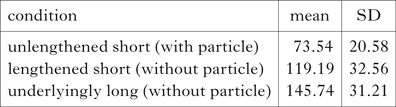
Second, an earlier version of the Braver & Kawahara (Reference Braver and Kawahara2016) study included a condition with bimoraic nouns with particles (e.g. kii-mo; Braver & Kawahara Reference Braver and Kawahara2014). In this first experiment, such bimoraic nouns were on average 26.55 ms longer than lengthened particle-less monomoraic nouns (e.g. ki-mo ~ ki) – much smaller than the underlying contrast between monomoraic nouns with particles and bimoraic nouns with particles (e.g. ki-mo ~ kii-mo) of 72.20 ms. These results are summarised in Table II.
Means and standard deviations for vowel duration of nouns (in ms), from Braver & Kawahara (2014) (7 speakers, 11 sets of 3 nouns (= 33 items in total), 10 repetitions).

2.2.2 Lengthened nouns are phonologically bimoraic
As discussed in the introduction, monomoraic noun lengthening is perhaps a more compelling case of truly phonological neutralisation than final devoicing. There are two pieces of evidence to support this claim: (i) lengthened monomoraic nouns are allowed in phonological contexts which require bimoraic minimality, and (ii) lengthened monomoraic nouns can carry a pitch accent.
Japanese pitch accent is realised as H*L – a high tone on the accented mora, followed by a low tone realised on the following mora. Since the tone-bearing unit in Japanese is the mora (Haraguchi Reference Haraguchi1977, McCawley Reference McCawley and Hyman1977), any word which manifests both the H* and L tones of the Japanese pitch accent must be minimally bimoraic. This property is exemplified in the pitch tracks in Fig. 1 for the sentence sho’/sho'u (mo) dokusenshita yo ‘book/chapter (also) monopolised disc’. (Following Japanese transliteration conventions, accent is marked as <’> between the moras expressing H and L tones, and the long vowel in sho'u is represented as ou, but pronounced [oː].)
Pitch tracks for Japanese nouns in a carrier sentence (male speaker reading sho'/sho'u (mo) dokusenshita yo ‘book/chapter (also) monopolised DISC’): (a) underlyingly long; (b) short with particle; (c) lengthened short noun (no particle).

In the pitch track for sho'u dokusenshita yo in Fig. 1a, the start of the long vowel [oː] is realised as a high tone, descending to a low tone by the end of the second mora. Similarly, in sho’ mo dokusenshita yo in Fig. 1b, the high tone is realised on the first (and only) mora of sho, while the descent to a low tone extends beyond the word boundary and into the mora of mo. If lengthened monomoraic nouns can show pitch accent (and are therefore phonologically two moras), we should expect the fall from H* to L in sho’ dokusenshita to spread across the two moras of the lengthened o – and this is precisely what occurs (Fig. 1c).
In addition to the pitch-accent data, there is additional evidence that the particle-less context described above does indeed require two moras. If a monomoraic noun without a particle is followed by a glottal stop or a pause, these additions can provide the relevant ω with the requisite mora (Mori Reference Mori2002). Mori argues that this possibility is allowed because the additional glottal stop or pause takes up a similar amount of time as a second mora would.
3 Theories of incomplete neutralisation and background
3.1 Previous accounts
Perhaps the earliest theoretical account of incomplete neutralisation is due to Anderson (Reference Anderson1975), who argues that some phonetic rules can precede phonological ones. Without using the term incomplete neutralisation, Anderson points out that flapping in American English, where /t/ and /d/ become /ɾ/ in certain prosodic contexts, leads to a gradient distinction in the duration of the preceding vowel: vowels preceding /d/-flaps are slightly longer than vowels preceding /t/-flaps. He further notes that a standard rule-based analysis of this phenomenon, as in (6), cannot account for the data.
(6)

Under the analysis in (6), vowels lengthen first, followed by /t/ and /d/ becoming flaps. This ordering – which is necessary to ensure that vowels are lengthened only before /d/-flaps and not /t/-flaps – contradicts the modular feed-forward model, since the gradient (and hence phonetic) vowel-lengthening rule precedes the (phonological) flapping rule. In order to resolve this conflict, Anderson proposes that (some) phonetic rules may, in fact, precede (some) phonological rules.
More recently, van Oostendorp (Reference Oostendorp2008) has argued that incomplete neutralisation in German final devoicing can be accounted for by ensuring that devoiced (underlyingly voiced) and underlyingly voiceless segments have distinct phonological representations. Under this analysis, based on Turbidity Theory (Goldrick Reference Goldrick2000), segments can stand in two possible relations with a given feature: (i) the projection relationship, which is an ‘abstract, structural relationship’, and (ii) the pronunciation relationship, which ‘describes the output realisation of structure’ (van Oostendorp Reference Oostendorp2008: 1368). The turbidity model analyses incomplete neutralisation in coda devoicing by providing different structures for underlyingly voiceless and voiced segments: in the phonological output, devoiced segments maintain a projection relation (but not a pronunciation relation) with a [voice] feature, but underlyingly voiceless segments are not related by projection or pronunciation to [voice]. Since underlyingly voiceless and devoiced segments are thus distinct in the phonological output, the phonetic module can differentiate between them, allowing longer vowels to precede devoiced segments, for example.
Another proposal, due to Gouskova & Hall (Reference Gouskova, Hall and Parker2009), capitalises on the idea of a segment's derivational history. They present a study showing that epenthetic vowels in Lebanese Arabic are either shorter, backer or both shorter and backer than their lexical counterparts. In order to model this phenomenon in a phonological grammar, they argue that the phonetics must have access to an intermediate stage of phonological derivations. Following the assumptions of Optimality Theory with Candidate Chains (OT-CC; McCarthy Reference McCarthy2007: ch. 3), they take a candidate to consist of a derivational chain from the phonological input to the phonological surface form, with gradual, incremental steps along the way. Under this approach, the epenthetic vowel [i] goes through a number of steps – starting as null, then gradually becoming more and more like a full vowel, forming a chain like the one in (7) (Gouskova & Hall's (8)).
(7)

If the phonetics can access the entire chain, they argue, rather than just the last step in the chain, epenthetic vowels in Lebanese Arabic might be realised as one of the other steps in the chain – explaining why some speakers produce the epenthetic vowel more like [ɨ] or [ə], rather than [i]. Underlying /i/, however, has no such chain of changes, and therefore must surface as canonical [i].
A different class of analysis, which I draw on in the model presented below, concerns paradigm uniformity among morphologically related forms (e.g. Benua Reference Benua1997, Steriade Reference Steriade, Broe and Pierrehumbert2000, Yu Reference Yu2007). The effects of paradigm uniformity can be observed when a given allomorph avoids a language-general pattern in favour of similarity to some morphological neighbour. Steriade (Reference Steriade, Broe and Pierrehumbert2000) argues, for example, that words within a morphological paradigm share certain phonological and phonetic properties. She describes the (optional) process of schwa deletion in French, which renders forms such as (8a) (with surface schwa) as (8b) (schwa deleted).
(8)

Crucially, the underlined [ʁ] in (8b) (with schwa deletion) is not phonetically identical to the one in (8c), where there was no underlying schwa. The [ʁ] in (8b) surfaces with ‘qualities that would only be appropriate if the schwa was still present’ (Steriade Reference Steriade, Broe and Pierrehumbert2000: 327; cf. Rialland Reference Rialland, Wetzels and Sezer1986, Fougeron & Steriade Reference Fougeron and Steriade1997). On Steriade's phonetic analogy analysis, forms that have undergone schwa deletion as in (8b) are influenced by forms like (8a), with surface schwa, thus accounting for their similarity.
An assumption of many theories of incomplete neutralisation is that speakers have relatively fine-grained control over phonetic implementation. In the model proposed by Yu (Reference Yu, Goldsmith, Riggle and Yu2011), the phonology has just such control over phonetic implementation of contrast. Following Kingston & Diehl (Reference Kingston and Diehl1994: 420, n.2), an allophone is simply ‘any phonetic variant of a distinctive feature specification or arrangement of such specifications that occurs in a particular context’. That is to say, contrastive features can vary considerably in their realisation, depending on their context. For example, [+voice] in English may be realised with closure voicing intervocalically, but as voiceless unaspirated word-initially. Kingston & Diehl (Reference Kingston and Diehl1994) argue that speakers can therefore choose between the various methods to articulate a feature such as [+voice]. Yu (Reference Yu, Goldsmith, Riggle and Yu2011) claims that subphonemic differences, such as incomplete neutralisation and near-merger, should be seen in a similar light. In incomplete neutralisation of final devoicing, the non-final voiced ‘allophone’ and the word-final voiceless ‘allophone’ are distinct, even if their phonetic cues are so impoverished as to ‘escape detection by traditional methods of linguistic data collection … Nonetheless, the contrast is maintained from the perspective of the native speaker, albeit covertly’ (Yu Reference Yu, Goldsmith, Riggle and Yu2011: 311).
A final model of incomplete neutralisation makes use of ‘phonetic traces’. In their study of tongue-twister errors, Goldrick & Blumstein (Reference Goldrick and Blumstein2006) show that ‘traces’ of an intended target can have an effect on pronunciation. For example, in the mistaken use of [g] rather than [k], VOT is longer than in intended pronunciations of [g] – the mistaken production of [g] shows a trace of the intended [k] target. This phenomenon is modelled in a system with ‘cascading activation’ – information flows unidirectionally from the phonological module to the phonetic module; however, earlier stages in this process can generate and transmit multiple representations downstream. In the case of mistaken [g] for [k], representations of both [g] and [k] are activated at the phonological level and transmitted to the phonetics. Goldrick & Blumstein (Reference Goldrick and Blumstein2006) argue that this sort of analysis can be applied to incomplete neutralisation: in German final devoicing, a devoiced [d̥] is pronounced in a ‘t-like’ fashion, due to partial activation of the underlying /t/ being sent to the phonetic module.
3.2 Weighted phonetic constraints and paradigm uniformity
The model presented in this paper relies on two independently motivated theoretical mechanisms: weighted phonetic constraints (Legendre et al. Reference Legendre, Miyata and Smolensky1990, Zsiga Reference Zsiga2000, Flemming Reference Flemming2001) and paradigm uniformity (Benua Reference Benua1997, Steriade Reference Steriade, Broe and Pierrehumbert2000). These are discussed in the following sections.
3.2.1 Weighted phonetic constraints
A crucial component of the model is the idea that competing phonetic demands must reach a compromise. This idea is familiar from the phonetic literature: both Zsiga (Reference Zsiga2000) and Flemming (Reference Flemming2001) argue for weighted constraint grammars (Legendre et al. Reference Legendre, Miyata and Smolensky1990, Pater Reference Pater2009) that can operate over phonetic information. Zsiga (Reference Zsiga2000) argues for a set of ‘phonetic alignment constraints’, which apply separately from the phonology; on the other hand, Flemming (Reference Flemming2001) articulates a unified model of phonetics and phonology, deriving both categorical and gradient phenomena from the same set of weighted constraints.
Key to both these systems is the use of weighted constraints, as opposed to strictly dominating ranked constraints as in classical Optimality Theory (Prince & Smolensky Reference Prince and Smolensky1993). Crucially, weighted constraints can generate compromise. With ranked constraints, conflict is resolved by acceding to the demands of the highest-ranked constraint. Under weighted constraints, neither conflicting constraint must be satisfied categorically in order to yield an optimal output. The candidate which represents the best compromise between two highly weighted constraints may yield a lower overall cost (or equivalently, higher overall harmony) than a candidate which follows completely the demands of any one constraint. As argued by Zsiga (Reference Zsiga2000: 96–97), this attribute of weighted constraint systems makes them optimal for the analysis of gradient phenomena.
The two models differ, however, in their relationship between phonological and phonetic processes. Zsiga (Reference Zsiga2000) envisions a model with two constraint-based grammars: a phonological grammar first manipulates phonological representations (in terms of, for example, features, segments and prosodic units), followed by a phonetic component which takes the output of the first grammar as its input, and assesses candidates which consist of phonetic realisations in terms of gestural targets. Constraints in the phonetic component can require alignment of gestural targets, or specify goals such as ‘be distinct’ or ‘conserve energy’.
Flemming's (Reference Flemming2001) proposal is conceptually similar to Zsiga's model, with the major distinction that the phonetic and phonological components are merged. Constraints in this joint phonetics/phonology module can refer both to phonological structures and to raw phonetic values (in milliseconds, Hertz, etc.). For example, in order to model cross-linguistic differences in coarticulatory effects, competing constraints pressure segments to match phonetic targets (e.g. a particular F2 value) on the one hand, and to be similar to neighbouring segments on the other. Varying the weight of these constraints determines how the conflict is resolved.Footnote 7
For the sake of concreteness, I assume a two-grammar model along the lines of Zsiga (Reference Zsiga2000), in which an OT-like grammar implements phonological processes first, followed by a weighted-constraint phonetic grammar which takes the output of phonology as its input. Further, I assume that phonetic constraints may make reference to both phonological categories and raw phonetic details – in particular, raw phonetic duration. As such, the constraints defined below are similar in spirit to Flemming's (Reference Flemming2001) F2(C)=L and F2(V)=T constraints, in which a segment is gradiently penalised for phonetic distance from its target: for example, a consonant that misses its F2 target by 200 Hz is assigned a cost of 200 by F2(C)=L, and a vowel that misses its F2 target by 50 Hz is assigned a cost of 50 by F2(V)=T.
3.2.2 Paradigm uniformity
Paradigm uniformity, as discussed in §3.1, requires morphologically related forms to be faithful to one another phonologically (Benua Reference Benua1997) and/or phonetically (Steriade Reference Steriade, Broe and Pierrehumbert2000). I formalise the phonetic pressure to remain faithful to a base in the constraint OO-Id(dur), defined below in (18).
The effects of paradigm uniformity are evident when a given form avoids a language-general pattern in favour of similarity to a morphological relative. For example, in Canadian Raising, vowels preceding voiceless segments generally raise from /aɪ/ to [ʌɪ] (e.g. ride [ɹaɪd] ~ write [ɹʌɪt]). This raising overapplies in the case of writer /ɹaɪtɹˌ/ → [ɹʌɪɾɹˌ], *[ɹaɪɾɹˌ], even though the vowel precedes a voiced segment (a flap). Under a paradigm-uniformity analysis, the language-general pattern in which /aɪ/ does not raise before voiced segments is violated so that the vowel in writer can match the vowel in its morphologically related base, write [ɹʌɪt].
Under Benua's (Reference Benua1997) classic formulation, a candidate must be faithful to its ‘base’ – a form that is in the same paradigm as the candidate and is less morphologically complex than the candidate (e.g. penguin can serve as the base for penguin-like, but not vice versa). In §3.3 I discuss this model of basehood, and compare it to alternative proposals, arguing that informativeness, rather than morphological complexity, is the most appropriate method of base selection for Japanese monomoraic lengthening.
3.3 Choosing a morphologically related base
There are four major approaches to choosing the base to which a form must be faithful: morphological complexity, orthography, frequency and informativeness. In the Japanese case, the base to which a monomoraic noun must be faithful is the form with a particle (e.g. ki mo), not the bare form (e.g. ki) – this ensures that when monomoraic nouns lengthen, they are prevented from becoming as long as underlyingly long nouns. This section briefly describes these approaches, and argues that informativeness most unambiguously selects the form with particles as the base in monomoraic lengthening.
3.3.1 Morphological complexity and orthography
As noted above, Benua (Reference Benua1997) argues that basehood is determined by relative degree of morphological simplicity: a base must be a licit word which is morphologically less complex than the target word. Depending on one's analysis of the structure of particle-less nouns, basehood based on morphological simplicity may be incompatible with the facts of Japanese monomoraic lengthening. Assuming that nouns without particles have no additional structure (e.g. they don't have a particle which just happens to be silent), the particle-less noun is morphologically simpler than a noun with a particle. In this case, [ki Ø]ω would either have to serve as its own base, or have no base at all.
A second approach to basehood, especially in the literature on incomplete neutralisation, is an appeal to orthography. It has been argued that incomplete neutralisation is the result of interference from speakers’ orthographic knowledge or ‘hypercorrect spelling pronunciation’ (Fourakis & Iverson Reference Fourakis and Iverson1984: 142; see also Manaster Ramer Reference Manaster Ramer1996b, Piroth & Janker Reference Piroth and Janker2004, Warner et al. Reference Warner, Good, Jongman and Sereno2006). As an example, consider again English writer and rider: the medial stop neutralises to [ɾ], but traces of the underlying word are detectable on the surface (i.e. vowels before /d/-flaps are longer than those before /t/-flaps). The orthography-based approach argues that this surface difference is caused not by reference to the underlying voicing status of the medial consonant, nor by influence from paradigmatically related forms like write and ride, but rather by the speaker either seeing the orthographic t or d at the time of utterance, or by recalling the orthographic contrast at the time of utterance. In this way, the orthographic form serves as the base.
One argument against this orthographic approach in general is that some languages, such as Catalan (Dinnsen & Charles-Luce Reference Dinnsen and Charles-Luce1984), do not orthographically encode the contrast of interest in relevant positions, yet still exhibit incomplete neutralisation of these contrasts (see Kharlamov Reference Kharlamov2012 for further discussion). In the case of Japanese monomoraic lengthening, too, there are reasons to think that orthography is not the main factor behind incomplete neutralisation, and that orthographic forms do not serve as bases. In the Braver & Kawahara (Reference Braver and Kawahara2016) study, out of 13 short/long noun pairs, only one short noun was written in a phonetic script, the katakana syllabary: ソso ‘5th note of the diatonic scale’. In this instance, it is plausible to argue that the base of a lengthened so is its orthographic representation ソ, and, as such, the degree of lengthening might be diminished, in allegiance to the short syllable represented in the orthography. In most cases, though, target nouns were presented in kanji – a primarily logographic system which does not directly encode phonological length (e.g. 麩 fu ‘gluten’ ~ 封 fuu ‘seal’). In the case of lengthened fu, the orthographic base would be 麩, which does not encode length, and as such should not influence duration.
3.3.2 Frequency
Another approach to basehood relies on frequency: the most frequent member of a morphological paradigm serves as the base (Mańczak Reference Mańczak1958). To examine whether this approach is appropriate in the case of Japanese monomoraic noun lengthening, the NINJAL Parsed Corpus of Modern Japanese (NPCMJ) was searched for nouns and their immediately following morpheme.Footnote 8 Of the 6550 nouns in the corpus, 5786 (88.34%) were immediately followed by a particle, while the remaining 764 nouns were followed by some other part of speech, such as another adjective, a noun or number (i.e. not a particle). The five most frequent particles are shown in Table III.
Frequency of most common particles in the NPCMJ corpus. Percentages indicate frequency among all nouns (n=6550).

Given that the caseless nouns are less frequent than those followed by o, no, ni or ga, the frequency approach to basehood predicts, given the data above, that the base for Japanese nouns should be a noun with a case particle – the desired outcome. Putting aside for the moment which particular case particle attaches to the base, the base of a monomoraic noun will always contain sufficient material to meet the bimoraicity requirement, by virtue of the case particle.
One question raised by this analysis, pointed out by an anonymous reviewer, is whether base frequency is computed as the cumulative frequency of all suffixed forms vs. unsuffixed forms, or whether one particular suffixed form must be more frequent than unsuffixed forms. In the analysis presented above, any one of o, no, ni or ga is more frequent in the corpus data than unsuffixed forms, and could therefore be a licit base.
It should be noted, however, that the omission of a case particle is more frequent in informal speech than in writing. Since the NPCMJ is based on written Japanese, it is possible that the relative frequency of dropped particles is higher in spoken Japanese than in the corpus. If unsuffixed nouns were even slightly more frequent in speech than in the corpus, unsuffixed nouns could become relatively more frequent than any one of the suffixed forms. If this were the case, the frequency analysis would, in order to accurately represent the facts, necessarily have to take the cumulative frequency of all suffixed forms into account, rather than that of any one suffixed form. In this event, the vowel duration of the base could be computed as, for example, the mean vowel duration across all suffixed forms.
3.3.3 Maximal informativeness
A final method for selecting a base is to choose the base which is ‘most informative’ (Albright Reference Albright2002a, b). Under this approach, the base for a given paradigm should be the form which preserves the most contrasts and which allows for accurate generation of as many members of the paradigm as possible. Phonological neutralisations obscure underlying contrasts, therefore forms which undergo neutralisation may be less informative than forms which do not. I argue in the rest of this section that this principle is evident in the case of monomoraic lengthening – monomoraic nouns with case particles are more informative than unsuffixed monomoraic nouns.
3.3.3.1 Vowel length and the informativeness of incompletely neutralised contrasts
Albright (Reference Albright2002a: 6) argues that the maximally informative form is the one that ‘suffer[s] from the fewest phonological neutralisations, and maintain[s] the most contrasts’. Intuitively, the reduced contrasts of incomplete neutralisation should be less informative than a fully maintained contrast. In the minimal generalisation learner formulated in Albright (Reference Albright2002b), the reliability of a grammatical rule is defined as the number of input forms that the rule accurately derives, divided by the number of forms in which the rule could potentially apply. While this measure considers categorical phonological alternations, the definition of a rule's reliability is not impacted by degree of neutralisation or perceptibility of a contrast. I argue that forms displaying incomplete neutralisation should be considered less informative than those which maintain a complete contrast, but more informative than those in which a contrast is completely neutralised.
In the Japanese case, therefore, incomplete neutralisation of the vowel-length contrast provides reduced reliability and informativeness as compared to forms without any vowel-length neutralisation, and thus might be considered less informative. As such, monomoraic nouns with case particles make better bases than monomoraic nouns without case particles.
If we adopt this analysis, it is crucial to determine whether relative degree of neutralisation factors into determining a form's informativeness. In monomoraic vowel lengthening, the incompletely neutralised contrast yields a surface distinction on the order of 30 ms. This is larger than in some other cases of incomplete neutralisation, such as German final devoicing (approximately 15 ms in the duration of preceding vowels, as noted in §1.1) and flapping in American English (roughly 6 ms; Herd et al. Reference Herd, Jongman and Sereno2010, Braver Reference Braver2014). While we might expect that incompletely neutralised forms in German and English are less informative than those in Japanese, I assume here that neutralised monomoraic nouns are still less informative than non-neutralised forms, and thus that monomoraic nouns with particles (which don't neutralise the length contrast) are better bases than those without particles (which display incomplete neutralisation of the length contrast).
A second neutralisation may further indicate that monomoraic nouns without particles provide less information than those with particles: neutralisation of pitch-accent.
3.3.3.2 Japanese pitch-accent neutralisation
Another locus of neutralisation is Japanese pitch accent. In Standard Japanese, phonological words (which may include, for example, a noun and its following particle) may have a pitch accent, usually realised as high tone on the accented mora, followed by a drop in pitch on all following moras in the phrase. (In words of two or more moras, if no accent is present in the first two moras, these moras usually show an LH pattern.) Consider the minimal pairs in (9), from Kawahara (Reference Kawahara and Kubozono2015).
(9)

In phrases ending with short syllables,Footnote 9 it is sometimes impossible to determine whether the final mora is accented or unaccented: if a word is recited in isolation (with no carrier sentence), as in (10), from McCawley (Reference McCawley1968), the presence or absence of a final accent is, for most speakers, not apparent.Footnote 10
(10)

This accentual ambiguity is remedied if the word is followed by another mora, such as is provided by a case particle – the following mora surfaces as low if the word has a final accent, but as high if the word does not, as in (11).
(11)

By definition, monomoraic words will end (and, indeed, begin) with a short syllable, making them subject to accent neutralisation in phrase-final position. The neutralisation of tone in isolated monomoraic words is shown in (12a), with the contrast being realised when a case particle is present, as in (12b).Footnote 11
(12)

While it is true that a mora may be supplied by any following word in the phonological phrase, nouns in isolation lacking case particles are clearly less informative than those with case particles as regards final pitch accent. This suggests that nouns with case particles may be better bases than those without – the desired result – on the basis of informativeness.
3.3.4 Summary of basehood
Given these four approaches to choosing a base, morphological complexity and orthography are least applicable to the case of Japanese monomoraic noun lengthening. While both frequency and informativeness can produce the desired result – namely, that the base be a monomoraic noun with a particle – I will assume the informativeness definition throughout.
One reason for this assumption stems from the concern about the cumulative vs. individual frequency of particles. If a frequency-based approach is chosen, the corpus data suggests that any of o, no, ni or wa could be the particle of choice for the base. As was noted above, however, the corpus data comes from written, rather than spoken, Japanese. If the proportion of particle-less nouns (11.66%) were to rise even slightly in spoken contexts, such forms could overtake any individual particle (e.g. o, the most frequent particle in the corpus, was found with 17.11% of nouns). This would force a definition of frequency-based basehood that groups all forms with particles together, creating a sort of meta-base – a complication that the informativeness-based approach avoids.
4 The Weighted Paradigm Uniformity theory
In this section I introduce the Weighted Paradigm Uniformity (WPU) theory of incomplete neutralisation. As described in §3.2, the WPU model combines two independently motivated theoretical mechanisms: paradigm uniformity and weighted phonetic constraints.
4.1 Duration targets for monomoraic and bimoraic nouns
I assume here that, for any given segment, there is some language-specific target duration. For the case of Japanese, I propose two cover targets that govern the duration of all monomoraic and bimoraic segments: all segments which bear one mora in the output have a target duration represented as TargetDur(μ), and all segments which bear two moras in the output have a target duration represented as TargetDur(μμ). Using the rounded values from Braver & Kawahara (Reference Braver and Kawahara2016), shown in Table I, unlengthened monomoraic short vowels have TargetDur(μ) = 50 ms and underlyingly bimoraic long vowels have TargetDur(μμ) = 150 ms. In non-neutralising contexts, both of these targets are generally met.
Along the lines of Flemming's (Reference Flemming2001) C-duration and σ-duration constraints, I assume that candidates are under pressure to conform to language-specific duration targets. This pressure is codified in two constraints of the family Dur(x)=TargetDur(x). Dur(μ)=TargetDur(μ), defined in (13), penalises monomoraic candidates which fail to match their target duration. In a parallel fashion, Dur(μμ)=TargetDur(μμ) penalises bimoraic candidates which do not meet their target duration.Footnote 12
(13)

To see Dur(μ)=TargetDur(μ) in action, consider the tableau in (14) (which assumes a constraint weight of 1).
(14)

The Dur(μ)=TargetDur(μ) column shows the cost of each candidate for that constraint; the parentheses show the calculation used to reach that cost. For example, in candidate (14a), the cost associated with Dur(μ)=TargetDur(μ) is calculated as in (15), where the candidate's duration (Dur(cand)) is 30 ms and the target duration for a single mora (as per the rounded data) is 50 ms.
(15)

As can be seen in (14), Dur(μ)=TargetDur(μ) penalises short vowels whose duration differs from the target (50 ms); as candidates’ durations diverge from this target, the cost increases.
Dur(μμ)=TargetDur(μμ) works nearly identically, with two moras instead of one. As can be seen in the tableau in (16), candidates with surface-bimoraic vowels (both underlyingly long vowels as in (16a) and lengthened short vowels as in (b)) decrease in cost for Dur(μμ)=TargetDur(μμ) as they approach TargetDur(μμ) (150 ms).
(16)

In order to prevent candidates which fail to epenthesise a second mora, and thus vacuously satisfy Dur(μμ)=TargetDur(μμ), the tableau in (16) also contains two additional constraints not yet discussed: FtBin(μ) prefers feet to be minimally bimoraic (with a cost of 1 per monomoraic foot), and Dep(μ) assesses a cost of 1 per epenthesised mora. When FtBin(μ) is weighted above Dep(μ) (here w FtBin(μ) = 2, w Dep(μ) = 1), candidates like (16b.iv) cannot win by failing to epenthesise and thus vacuously fulfilling Dur(μμ)=TargetDur(μμ). In all future tableaux and cost tabulations, I exclude monomoraic candidates which fail to lengthen, on the assumption that a weighting in which FtBin(μ) outweighs Dep(μ) prevents such candidates from being viable optima.
4.2 Paradigm uniformity in lengthened monomoraic nouns
Given the constraints Dur(μ)=TargetDur(μ) and Dur(μμ)=TargetDur(μμ), it is clear how unlengthened short vowels and underlyingly long vowels are under pressure to reach their duration targets. We are left, however, with vowels in lengthened short nouns, which, with an average duration of 125 ms, meet neither the target for short nouns (50 ms) nor the target for long nouns (150 ms). Because lengthened short nouns are surface-bimoraic, they are subject to the constraint Dur(μμ)=TargetDur(μμ); note, however, that they do not comply completely with this constraint. I claim that the distinction between underlyingly long nouns on the one hand and lengthened short nouns on the other is caused by pressure on lengthened short nouns to maintain a degree of faithfulness to canonical short vowels – a pressure that underlyingly long vowels do not face. To see how this works, we will first examine a single example based on the rounded data in Table I, and then proceed to a more formal definition.
Consider the three utterances in (17), which contain (a) unlengthened short vowels, (b) lengthened short vowels and (c) underlyingly long vowels. Vowel durations of the underlined words are given in parentheses.Footnote 13
(17)

The vowel in (17b) has two surface moras (due to lengthening), and is thus pressured by Dur(μμ)=TargetDur(μμ) to reach a target of 150 ms. It does not, however, reach this target. This failure is due to pressure from a competing constraint, which requires faithfulness to a morphologically related base form (i.e. paradigm uniformity).
As per the discussion in §3.3, we will take the base to which monomoraic nouns must be faithful to be a form which contains the noun and a following case particle. I formalise this faithfulness to a morphologically related base in the form of an output–output constraint, OO-Id(dur), which enforces faithfulness between a given segment in a candidate and the corresponding segment in the candidate's base, as in (18).
(18)

To see this more concretely, let us apply OO-Id(dur) to the lengthened [ki Ø]ω in (17b). As stated above, the base to which (17b) must be faithful has a vowel duration of 50 ms. OO-Id(dur) therefore pressures [ki Ø]ω to attain a vowel duration of 50 ms.
The effect of OO-Id(dur) on lengthened short nouns can be seen in the tableau in (19): the cost of this constraint increases as vowel durations move away from 50 ms.
(19)

4.3 Interaction of OO-Id(dur) and Dur(µµ)=TargetDur(µµ)
We consider now the tension between paradigm uniformity and the canonical duration of a segment – in other words, between OO-Id(dur) and Dur(μμ)=TargetDur(μμ). It should be noted that Dur(μ)=TargetDur(μ) is not relevant for assessing lengthened short vowel inputs, because it only penalises mora-bearing units with a single mora on the surface. Since lengthened short candidates by definition have two moras on the surface, Dur(μ)=TargetDur(μ) does not apply, and will not be shown in the tableaux that follow. Similarly, as discussed above, the relative weighting of FtBin(μ) over Dep(μ) prevents lengthened nouns from surfacing with only one mora; the costs of these two constraints will be left out of the calculations below, to simplify the exposition.
The key tension between Dur(μμ)=TargetDur(μμ) and OO-Id(dur) can be expressed in terms of their role in setting target durations for lengthened short candidates. Dur(μμ)=TargetDur(μμ) is least costly for lengthened short candidates whose durations approach TargetDur(μμ) (150 ms), while OO-Id(dur) is least costly for those candidates whose durations approach TargetDur(μ) (50 ms), since their base has only one mora. The relative strength of these constraints – as reflected in their weighting – determines how the conflict between these two pressures is resolved. As the weight of Dur(μμ)=TargetDur(μμ) increases relative to that of OO-Id(dur), the candidates with the lowest cost are those that approach 150 ms. Conversely, as the weight of OO-Id(dur) increases relative to that of Dur(μμ)=TargetDur(μμ), the candidates with the lowest cost are those that approach 50 ms.
The degree to which a candidate satisfies the compromise between Dur(μμ)=TargetDur(μμ) and OO-Id(dur) can be assessed by its total cost – the sum of the costs of all constraints for that candidate. The candidate which best satisfies the compromise (and is therefore the winner) is the one which has the lowest overall cost. Given our two constraints, the total cost of a candidate is as in (20).
(20)

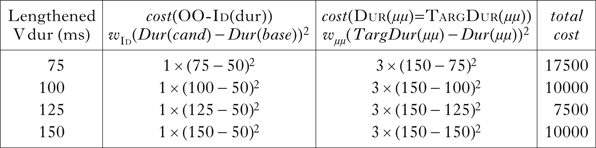
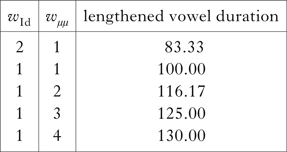
As shown in Table IV, with the weighting <w Id = 1, w μ μ = 3> (and with the same assumptions about durational targets as above), the total cost of a candidate decreases as the duration of lengthened vowels approaches 125 ms – the minimum cost is attained by candidates of 125 ms (our desired winner).
Costs for given lengthened short vowel durations, where w Id=1, w μμ=3, TargetDur(μ)=50 ms and TargetDur(μμ)=150 ms.

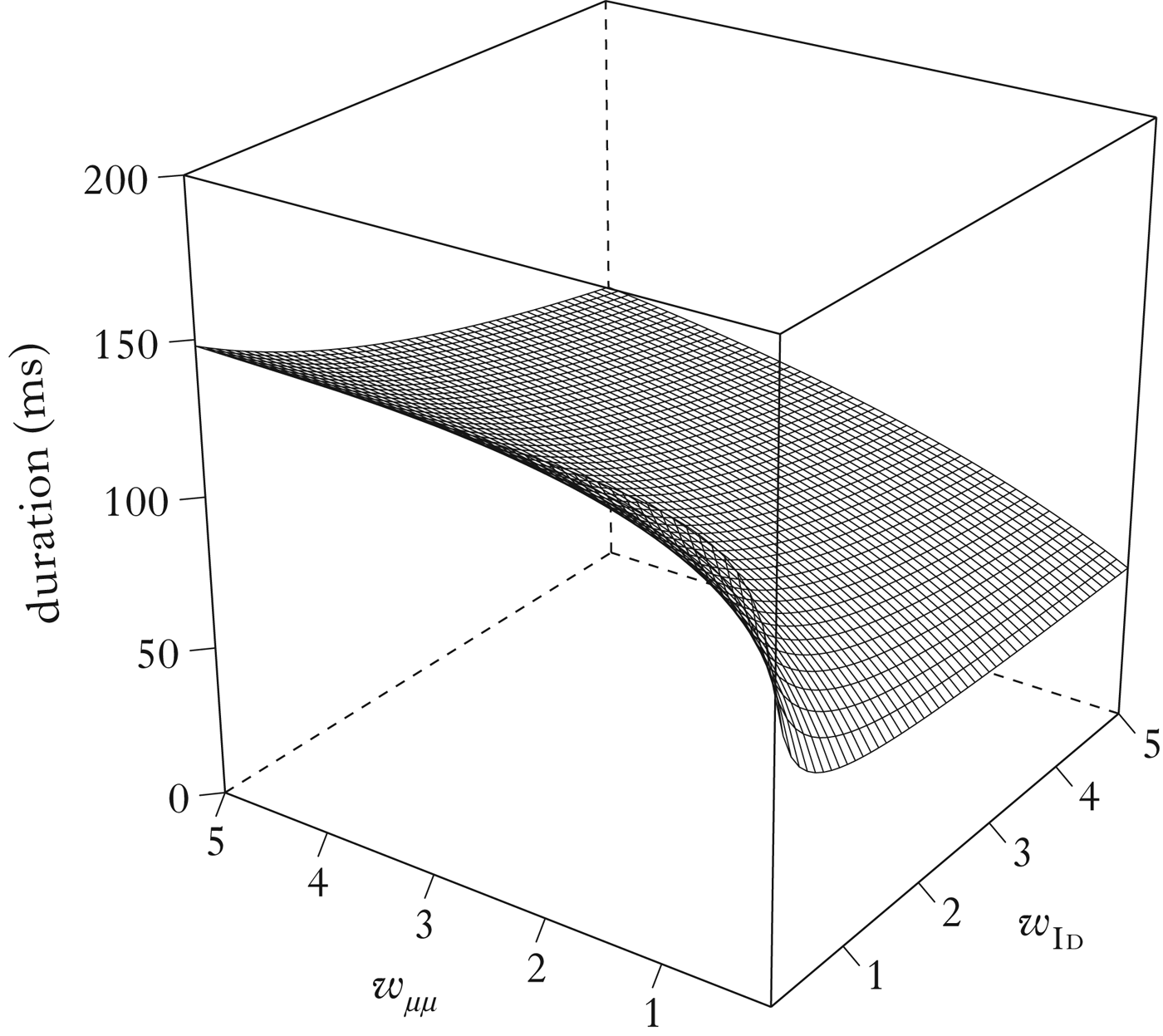
Varying the weights of these two constraints results in a different minimum to the cost function, and a different degree of neutralisation, as might be expected to be found in other languages, as shown in Table V. As the weight of w Id increases relative to that of w μ μ, the duration of the lengthened vowels is predicted to decrease (and, vice versa, to increase). This principle can also be seen in the graph in Fig. 2, in which the x- and y-axes represent the weights of OO-Id(dur) and Dur(μμ)=TargetDur(μμ) (w Id = x; w μ μ = y; 0 < x, y ≥ 5), and the z-axis represents the predicted duration of lengthened vowels: the WPU model can generate languages anywhere along the plotted surface.
Predicted lengthened vowel duration, given weights for w Id and w μμ (TargetDur(μ)=50 ms; TargetDur(μμ)=150 ms).

Predicted lengthened short vowel durations (in ms) for sample weightings of OO-Id(Dur) (w Id) and Dur(μμ)=TargetDur(μμ) (w μμ), where TargetDur(μ)=50 ms and TargetDur(μμ)=150 ms.

5 Discussion
The preceding sections have laid out the case of Japanese monomoraic lengthening and its analysis in the WPU model. In this section I outline the relation between the WPU model and other theories of incomplete neutralisation, and discuss their typological predictions.
5.1 Relation to prototype and exemplar models
It is worthwhile to note that the notions of canonical realisation and bases determined by frequency are, in many ways, reminiscent of prototype models (Posner & Keele Reference Posner and Keele1968, Reed Reference Reed1972, Rosch Reference Rosch1973, Smith & Minda Reference Smith and Minda2000) and exemplar models (Nosofsky Reference Nosofsky1986, Lacerda Reference Lacerda, Elenius and Branderud1995, Goldinger Reference Goldinger1996, Johnson Reference Johnson, Johnson and Mullenix1997, Pierrehumbert Reference Pierrehumbert, Bybee and Hopper2001a, inter alia). Such models and their close kin have been applied to the study of incomplete neutralisation. For example, Yu (Reference Yu2007) gives a clear account of a case of near-merger in Cantonese tone in terms of an exemplar-based model. On this view, near-merger occurs when two or more exemplar clouds begin to overlap, but category membership remains distinct.
Relatedly, Kirby (Reference Kirby2010) uses a computational model with a number of similarities to exemplar models to analyse incomplete neutralisation in Dutch word-final obstruents (as described by Warner et al. Reference Warner, Jongman, Sereno and Kemps2004). This work shows that when only a single acoustic cue to incomplete neutralisation is considered, complete neutralisation may be predicted, but that as more cues are added to the model, incomplete neutralisation is more likely. While the WPU model developed here is not formally related to prototype or exemplar models, it does share the idea of ‘typicality’. The WPU model, then, serves to formalise these properties of prototype and exemplar models in the language of a more traditional generative framework. As pointed out by an anonymous reviewer, there are few, if any, exemplar models of incomplete neutralisation that are sufficiently worked out to produce quantitative predictions, though nothing about such models is inherently incompatible with them. The WPU model is offered, then, as an example of the manner in which quantitative predictions can be made in a framework that exploits the notion of typicality.
5.2 Typological predictions of the WPU model of incomplete neutralisation
The WPU model of incomplete neutralisation described in this paper makes four predictions: (i) incomplete neutralisation can occur even when no underlying association between a segment and a feature (or prosodic unit) has been delinked, (ii) there can be gradient degrees of neutralisation, (iii) morphological and/or phonetic information can influence incomplete neutralisation and (iv) incomplete neutralisation can occur even when only one relevant process is at play.
5.2.1 Lack of underlying associations
The WPU model of incomplete neutralisation predicts that incomplete neutralisation can occur in processes that do not result, in autosegmental terms, in the delinking of a feature (or prosodic unit) from a segment. This contrasts with Turbidity Theory, which allows incomplete neutralisation only when such a delinking occurs.
As an example, the turbidity model of incomplete neutralisation, as applied to final devoicing, argues that underlyingly voiceless and devoiced segments have distinct representations at the level of the phonological output. More specifically, underlyingly voiceless segments have neither a projection nor a pronunciation relation with a [voice] feature (and thus surface as voiceless), whereas devoiced segments have a projection relation only. In van Oostendorp's (Reference Oostendorp2008) formulation, incomplete neutralisation results when this lone projection relation plays a role in phonetic interpretation – devoiced segments will be coloured by the presence of the projection relation with [voice], even though they lack a pronunciation relation with [voice].
The projection relation, Goldrick (Reference Goldrick2000: 2–3) suggests, is akin to a delinked association line: in final devoicing, devoiced segments originate with an association line to a [voice] feature, but this line is cancelled, leaving only an abstract, structural relation, as in (21b). Goldrick also suggests that pronunciation relations are similarly equivalent to (dotted) association lines (as will be seen in (22)).
(21)

In essence, projection marks the segment under discussion as having underlyingly been associated with a [voice] feature. The turbidity approach to incomplete neutralisation capitalises on the fact that, in this model, underlying voicing status is available to the phonetic module (via the presence/absence of a projection relation). Incomplete neutralisation, then, occurs where an underlying association between a segment and a feature (or prosodic unit) has been delinked – or, in turbidity terms, originates with both types of relations but ends with only a projection relation. The case of Japanese monomoraic lengthening, where no such delinking occurs, does not follow this principle: rather than a lone projection relation causing incomplete neutralisation, in Japanese the link between a second mora and a lengthened segment consists of a pronunciation relation, as in (22).
(22)

One option for turbidity theorists wishing to allow this sort of incomplete neutralisation would be to add a stipulation that the phonetic implementation of moras linked only by a pronunciation relation should be different from that of moras linked by both relations. This potential remedy does not, however, come without a cost. Normally, segments with a production relation to a feature should exhibit a canonical manifestation of that feature (e.g. in the case of (de)voicing, /d/ → [d] has a pronunciation relation with [voice], and is canonically pronounced as voiced). In the Japanese case, the addition of a pronunciation relation to the second mora does not result in the canonical manifestation of a second mora (i.e. it is not as long). Allowing non-canonical manifestations of features related by pronunciation would seem to change the predictions of Turbidity Theory in general, allowing a new kind of ‘unfaithful’ pronunciation.
The case of incomplete neutralisation in American English flapping also presents a problem for the turbidity approach, due to its requirement for underlying associations: the realisation of segments with only a projection relation to [voice] would differ significantly between flapping and final devoicing. In final devoicing, as in (21), devoiced segments are related to [voice] by a projection relation. Such segments are pronounced more like voiceless segments than voiced ones – they have shorter preceding vowels, less voicing into closure and more aspiration (Port & O'Dell Reference Port and O'Dell1985). Flaps deriving from /t/, however, have no underlying relation to [voice]; they must gain a pronunciation relation to [voice] during the derivation. These segments, unlike the devoiced segments, are pronounced more like voiced segments than voiceless ones. This suggests that segments with only a projection relation to [voice] must be realised differently in different languages and/or circumstances.
Consequently, the WPU model predicts incomplete neutralisation both in cases where underlying associations exist (e.g. devoicing) and in cases where they don't (e.g. Japanese monomoraic lengthening), while the turbidity approach would require additional stipulations to account for the latter type.
5.2.2 Gradient degrees of neutralisation
The WPU approach to incomplete neutralisation, in contrast to the OT-CC model (Gouskova & Hall Reference Gouskova, Hall and Parker2009), predicts a relatively unrestricted set of possible ‘degrees’ of neutralisation (for example, where a segment lies on a continuum between voiced and voiceless, or how long a lengthened vowel is relative to underlyingly short vs. long vowels). OT-CC's limits on possible degrees of neutralisation follow from two assumptions of the theory: (i) constraints refer to phonological, rather than phonetic units, and (ii) steps along the chain represent, at least in most formulations, a change that incurs exactly one violation of a faithfulness constraint. This contrasts with the WPU model, which allows for a gradient degree of neutralisation.
In the OT-CC model, incomplete neutralisation results when the phonetic module chooses an intermediate stage of the candidate chain, rather than the final step of the chain. In Lebanese Arabic, then, epenthesis of [i] actually results from a chain of changes: <CC, CɨC, CəC, CiC>, where each step in the chain is a step up the sonority hierarchy. Speakers who incompletely neutralise this contrast produce a form from the middle of the chain.
It is not clear, however, what intermediate step would be relevant in monomoraic lengthening. One approach would be to assume that the insertion of a mora and its linking to a segment represent two steps along the chain – in this way, a stray unlinked mora might be interpreted by the phonetic module in such a manner that it results in a slight degree of lengthening. This approach, though, seems to come up against a problem: assuming that the Japanese bimoraicity requirement is only satisfied by moras that are linked to segmental content, the insertion of a second (empty) mora in a short noun is not a harmonically improving step.
A similar issue arises with incomplete neutralisation of final devoicing: there are, under most views, only two values for voicing: voiced or voiceless. As such, no intermediate steps between voicing and voicelessness are created along the chain – and there is therefore no intermediate step to select for incompletely neutralised forms. A plausible resolution might be to assume that there is indeed a third value for voicing features – perhaps a candidate underspecified for voice intervenes between voiced and voiceless segments. I leave aside here the debate regarding non-binary features, but note that it is not obvious that segments underspecified for voice should be produced as incompletely neutralised.
A potential remedy to this problem would be to allow OT-CC constraints to refer directly to phonetic values, with a concomitant stipulation that steps along a candidate chain can differ only to some particular degree along a phonetic continuum – perhaps being restricted to steps of a just noticeable difference. Indeed, McCarthy (Reference McCarthy2009) discusses reference to phonetic details, as encoded in the P-map (Steriade Reference Steriade, Hanson and Inkelas2009), in Harmonic Serialism; however no such claims seem to have been explored with respect to OT-CC, and the typological properties of such a system are not known. Setting aside the precise details of such a proposal, one might imagine a candidate chain for vowel lengthening to consist of vowels of increasing duration: <Ø, V[10 ms], V[20 ms], V[30 ms], …>. If a mechanism for choosing the correct step along the chain could be developed (a non-trivial task), vowels of intermediate durations might be selected in cases of incomplete neutralisation.
Applying this remedy to cases of final devoicing appears to be significantly more complicated than for vowel duration. While vowel duration is easily quantified in a single measurement (i.e. duration itself), voicing contrasts are manifested across a wide variety of acoustic cues, including duration of the preceding vowel (Chen Reference Chen1970), closure duration (Kluender et al. Reference Kluender, Diehl and Wright1988) and F0 and F1 (Hombert et al. Reference Hombert, Ohala and Ewan1979, Kingston & Diehl Reference Kingston and Diehl1994). Organising these properties into clear steps along a single continuum – while ensuring that each step along the chain increases in harmony – seems like a task that is not sufficiently motivated by the incomplete neutralisation data alone. The WPU model of incomplete neutralisation, in contrast to OT-CC, predicts cases of incomplete neutralisation where the neutralised segment is not clearly defined by a single violation of a faithfulness constraint, as in the Japanese case and in final devoicing.
5.2.3 Reference to phonetic and paradigmatic information
The WPU model of incomplete neutralisation, by virtue of its dependence on phonetic and paradigmatic information, assumes that such information can influence incomplete neutralisation. In contrast, the turbidity approach predicts that only phonological information should play a role in determining incomplete neutralisation. This is because turbidity relies on relations with an underlying feature or prosodic unit, neither of which is generally assumed to provide information about the phonetic implementation of the relevant segment or about the realisation of paradigm members. Two sorts of incomplete neutralisation processes could help to determine whether this prediction is desirable: (i) processes that necessarily refer to phonetic detail, rather than phonological structure, and (ii) processes that clearly map to a morphological relative rather than an underlying form.
5.2.4 Incomplete neutralisation in single processes
The WPU model predicts that incomplete neutralisation can occur when only one relevant process occurs. In the Japanese case, the only change involves the duration of a vowel. This contrasts with cases of final devoicing and flapping in which these processes are accompanied by the additional process of vowel lengthening.
Under Anderson's (Reference Anderson1975) rule-ordering approach to incomplete neutralisation, a flapping rule in American English interacts with a rule that lengthens vowels before voiced segments. Crucially, the vowel-lengthening rule must apply first, since the flapping rule feeds lengthening by changing voiceless /t/ to a (voiced) flap. Because the vowel-lengthening rule is gradient, while the flapping rule is categorical, Anderson argues that some gradient phonetic rules (like vowel lengthening) must be allowed to precede some categorical rules (like flapping). The prediction of this theory is that any pair of categorical and gradient rules can be interleaved, resulting in otherwise opaque rule application. This analysis can be extended to cases of final devoicing – a gradient vowel lengthening rule (e.g. V→Vˑ/ _ C[+voice]) could apply before a categorical rule of obstruent devoicing, yielding longer vowels before devoiced segments than before underlyingly voiceless segments.
It is unclear, however, how such an analysis would apply to the Japanese monomoraic lengthening process described above, since there is only one rule at play (/μ/ → μμ / [ _ ]ω). If this lengthening rule is gradient, we should not expect the lengthened vowels to fulfil the categorical bimoraicity requirement. If we instead assume that this rule is categorical, we do not predict that lengthened vowels should be intermediate in length. Flapping and final devoicing avoid this issue, because two distinct processes are involved – e.g. vowel lengthening and flapping, or vowel lengthening and final devoicing. As such, rules for each of these processes can be interleaved, allowing a gradient process to precede a phonological one. In the Japanese case, however, only one process is involved: vowel lengthening is either categorical or gradient – it can't be both. More generally, the rule-ordering approach predicts incomplete neutralisation only in cases where multiple processes are interacting.
6 Conclusion
6.1 The functional explanation for incomplete neutralisation
A functional explanation for incomplete neutralisation is proposed by Port & Crawford (Reference Port and Crawford1989), who argue from experimental evidence that speakers vary the completeness of incompletely neutralised contrasts depending on the communicative situation. This result mirrors those from other phenomena in which speakers manipulate their productions for the benefit of hearers (see e.g. Lindblom Reference Lindblom, Hardcastle and Marchal1990, Scarborough Reference Scarborough2003, Reference Scarborough2010, Flemming Reference Flemming2010, Syrett & Kawahara Reference Syrett and Kawahara2013). On this view, speakers maintain a small trace of an underlying contrast, even in neutralising positions, to aid the listener in comprehending what is said.
This functional explanation provides a clear motivation for cases of incomplete neutralisation with a relatively large surface distinction: maintaining a contrast is worthwhile, as long as the listener can perceive it. Less clear, though, is how this idea explains cases of incomplete neutralisation with magnitudes (on average) so small as to be imperceptible. This includes both individual speakers with small contrasts and processes which maintain a small contrast across multiple speakers. Some processes which result in incomplete neutralisation have shown consistently small contrasts: for example, Braver (Reference Braver2014) found that the distinction between vowels preceding /d/-flaps and those preceding /t/-flaps was on average only 5.69 ms (the speaker with the largest distinction showed a 15.28 ms difference). Estimates for the just noticeable difference (JND) in vowel length vary, but generally range between 10 and 25 ms (Fujisaki et al. Reference Fujisaki, Nakamura, Imoto, Fant and Tatham1975, Klatt & Cooper Reference Klatt, Cooper, Cohen and Nooteboom1975, Nooteboom & Doodeman Reference Nooteboom and Doodeman1980), suggesting that vowel duration in incomplete neutralisation of English flapping may be below the threshold for discrimination, while the Japanese data from Braver & Kawahara (Reference Braver and Kawahara2016) might just exceed the highest end of that JND range.
In terms of the WPU model, speakers would be weighting OO-Id(dur) high enough to cause a surface trace of the underlying contrast, but at the same time so low that listeners cannot perceive that trace. In spite of the growing body of evidence that speakers have deep knowledge of the perceptibility of contrasts (e.g. Steriade Reference Steriade, Hanson and Inkelas2009), it would seem that this knowledge may not always be involved in calculating the weighting of OO-Id(dur) in incomplete neutralisation.
6.2 Final remarks
The WPU model of incomplete neutralisation makes use of two independently motivated grammatical mechanisms: weighted phonetic constraints and paradigm uniformity. By casting incomplete neutralisation in terms of weighted phonetic constraints, the WPU model pits faithfulness to a morphologically related base against the canonical target duration of non-neutralised segments, generating quantitative predictions about incompletely neutralised contrasts. The model also makes typological predictions that are distinct from existing theories of incomplete neutralisation, as shown by the ability of the WPU model to capture the Japanese monomoraic lengthening data.