INTRODUCTION
Relationships between plants and their animal pollinators are complex and mediated by factors that bridge scales across the properties of individuals, populations and species (Ghazoul Reference GHAZOUL2005, Johnson et al. Reference JOHNSON, PETER, NILSSON and ÅGREN2003). For example, most tropical tree species are characterized by having spatially sparse populations, by rejecting their own pollen to varying degrees (from total to partial self-incompatibility), and by being dependent on animal pollinators for outcrossing (Bawa et al. Reference BAWA, PERRY and BEACH1985, Ward et al. Reference WARD, DICK, GRIBEL and LOWE2005). These characteristics make the fecundity of many tropical tree species an outcome contingent on interactions among the spatial structure of populations, the behaviour and availability of pollinators, and the community context in which individuals are embedded (Ghazoul Reference GHAZOUL2005, Jones & Comita Reference JONES and COMITA2008).
Proximity among synchronously flowering plants is important for self-incompatible species because they require pollen from neighbours to set fruit and to produce viable seeds (Duncan et al. Reference DUNCAN, NICOTRA, WOOD and CUNNINGHAM2004, García-Camacho et al. Reference GARCÍA-CAMACHO, MÉNDEZ and ESCUDERO2009). The typically sparse population of tropical trees makes pollination difficult in many cases, and demands accounting for the effects of distance and density of conspecifics in order to fully understand variation in fecundity (Fukue et al. Reference FUKUE, KADO, LEE, NG, MUHAMMAD and TSUMURA2007, Ghazoul Reference GHAZOUL2005). This is because pollinators tend to visit locations that maximize rewards while minimizing energetic expenditures in foraging (Pyke Reference PYKE1984). Therefore, at the level of individual trees, pollinators adjust visitation rates in response to the number of available flowers and/or visual cues (de Jong et al. Reference DE JONG, WASER, PRICE and RING1992, Lázaro et al. Reference LÁZARO, LUNDGREN and TOTLAND2009). Additional external factors such as the presence of other flowering species that share the same pollinators can also affect fecundity by causing competition or facilitation (Takakura et al. Reference TAKAKURA, NISHIDA, MATSUMOTO and NISHIDA2009, Waser Reference WASER1978). Thus, the availability of pollinators and the way they respond to plant spatial patterns are important elements that contribute to variance in the fecundity of tropical trees (Ghazoul Reference GHAZOUL2005, Stacy et al. Reference STACY, HAMRICK, NASON, HUBBELL, FOSTER and CONDIT1996).
Typically, low rates of flower visitation by pollinators translate into decreased seed set by causing pollen limitation (Burd Reference BURD1994, Haddad & Tewksbury Reference HADDAD and TEWKSBURY2005). Low seed set due to pollen limitation is common in tropical trees, especially for self-incompatible species (Nayak & Davidar Reference NAYAK and DAVIDAR2010, Sunnichan et al. Reference SUNNICHAN, MOHAN RAM and SHIVANNA2004). Widespread degradation of tropical forests decreases tree population sizes and increases isolation, two conditions that further reduce pollen transfer among trees and thus lower fecundity (Schulke & Waser Reference SCHULKE and WASER2001, Wagenius & Lyon Reference WAGENIUS and LYON2010). The combination of pollen limitation and habitat destruction is believed to be especially harmful for populations of uncommon self-incompatible trees in biodiversity hotspots where pollination services can be limited and high deforestation rates are prevalent (Vamosi et al. Reference VAMOSI, KNIGHT, STEETS, MAZER, BURD and ASHMAN2006).
In this study we examined the effects of plant characteristics and spatial aggregation on the pollinator visitation and fecundity in the mainly self-incompatible tropical tree Goetzea elegans, a rare endemic of the Caribbean Islands Biodiversity Hotspot (Myers et al. Reference MYERS, MITTERMEIER, MITTERMEIER, DA FONSECA and KENT2000). Specifically, we examined how the distance to the nearest reproductive conspecific tree (nearest neighbour distance; hereafter NND), the number of open flowers on a tree, and tree height influence pollinator visitation rates, fruit production and seed viability. We expected an increase in pollinator visits and fecundity (because of increased pollen outcrossing rates) for trees with many versus few flowers, as plants with many flowers have been found to be more attractive to pollinators, thus increasing their visitation rate (Klinkhamer et al. Reference KLINKHAMER, DE JONG and DE BRUYN1989, Mitchell & Waser Reference MITCHELL and WASER1992). We also expected a decrease in fecundity (i.e. fruit set and seed viability) with increasing NND, as greater isolation reduces the probability of outcrossing (Cascante et al. Reference CASCANTE, QUESADA, LOBO and FUCHS2002, Mimura et al. Reference MIMURA, BARBOUR, POTTS, VAILLANCOURT and WATANABE2009).
METHODS
Study species
The genus Goetzea is part of an ancient lineage in the nightshade family (Solanaceae). The genus contains two tree species, G. elegans Wydler and G. ekmanii O.E. Schulz, both endemic to the Caribbean (Santiago-Valentín & Olmstead Reference SANTIAGO-VALENTíN and OLMSTEAD2003) and both endangered (IUCN Red List of Threatened Species (C2a version 2.3) available at http://www.iucnredlist.org, Peguero et al. Reference PEGUERO, JIMÉNEZ, VELOZ, CLASE and GARCÍA2003, USFWS 1987). Goetzea elegans is only known from several populations on the northern and eastern region of the island of Puerto Rico (including Vieques Island). Although G. elegans was once considered as critically endangered, with about 50 individuals in three populations (USFWS 1987), new populations have been discovered. The total number of trees is now estimated at about 820 individuals in 12 populations. In north-western Puerto Rico there are eight populations with over 550 individuals. Here, the trees are restricted to karstic ravines in the Municipalities of Isabela and Quebradillas. In north-eastern Puerto Rico there are over 20 individuals in one population in the Municipality of Fajardo, and Vieques Island has one fragmented population of about 300 individuals scattered in ravines in the western region of the island.
Goetzea elegans often grows to 10 m tall in the wild, and some trees reach 18 m. It produces flowers and fruits throughout the year, with peak flowering occurring between February and July (Little et al. Reference LITTLE, WOODBURY and WADSWORTH1974, Santiago-Valentín Reference SANTIAGO-VALENTÍN1995). The flowers are perfect with no fragrance perceptible to humans. The pale yellow corolla is funnel-shaped, up to 2 cm long and 1.3 to 2 cm across, with six stamens and a single pistil. The fruits are orange drupes about 4 cm long covered by velvety hairs with a persistent calyx. The seeds are elliptical and about 0.7 cm in size (Little et al. Reference LITTLE, WOODBURY and WADSWORTH1974).
Although the flowers of G. elegans exhibit a bird pollination syndrome (Knapp Reference KNAPP2010), they are visited by both birds and insects. The most frequent flower visitor is the native nectarivorous bananaquit Coereba flaveola Bryant (Coerebidae), which is the most abundant bird in Puerto Rico (Raffaele et al. Reference RAFFAELE, WILEY, GARRIDO, KEITH and RAFFAELE1998) and has been shown to be a pollinator of G. elegans (Caraballo-Ortiz & Santiago-Valentín Reference CARABALLO-ORTIZ and SANTIAGO-VALENTÍN2011). Although C. flaveola robs nectar from flowers of other plant species (Kodric-Brown et al. Reference KODRIC-BROWN, BROWN, BYERS and GORI1984), in G. elegans it only visits flowers legitimately (Caraballo-Ortiz Reference CARABALLO-ORTIZ2007). Another common visitor and pollinator is the honey bee Apis mellifera L. (Apidae; Caraballo-Ortiz & Santiago-Valentín Reference CARABALLO-ORTIZ and SANTIAGO-VALENTÍN2011). This introduced bee is commonly found visiting flowers throughout the island and lives in both managed and wild colonies. Previous experiments of Caraballo-Ortiz & Santiago-Valentín (Reference CARABALLO-ORTIZ and SANTIAGO-VALENTÍN2011) demonstrated that both C. flaveola and A. mellifera pollinate G. elegans with similar efficiency. Infrequent visitors to flowers of G. elegans flowers are two native hummingbird species (Anthracothorax dominicus aurulentus Audebert & Vieillot and Eulampis holosericeus holosericeus L.; Santiago-Valentín Reference SANTIAGO-VALENTÍN1995; M. A. Caraballo-Ortiz, pers. obs.).
Previous experiments on the breeding system of G. elegans indicate that the species is mainly self-incompatible, producing significantly higher fruit set, seed set and seed viability from outcrossed pollen than from pollen from the same plant (Caraballo-Ortiz & Santiago-Valentín Reference CARABALLO-ORTIZ and SANTIAGO-VALENTÍN2011).
Study site
We worked in the largest continuous natural population of G. elegans (N = 197 trees) located at Quebrada Bellaca (18°28΄30΄΄N, 66°54΄13΄΄W) in the municipality of Quebradillas, in the karstic region of north-west Puerto Rico. Quebrada Bellaca is a wooded, seasonally dry ravine about 3.25 km long, with some segments forming small canyons, which drains north into the Atlantic Ocean. Altitude along the ravine ranges from 1 to 100 m asl. Climate at the site is classified within the subtropical moist life zone (Holdridge system: Ewel & Whitmore Reference EWEL and WHITMORE1973).
Tree characterizations
All G. elegans individuals in the study site were mapped using a GPS (Trimble®, Sunnyvale, California) with an accuracy of ± 2 m. Distances between trees were calculated using the ‘Hawth's Analysis Tools for ArcGIS’ extension (version 3.26, available at http://www.spatialecology.com/htools) from a digital map of all G. elegans trees at the study site generated in ARCGIS 9 (ARCMAP version 9.1, ESRI, Redlands, California). To examine the spatial aggregation pattern of G. elegans trees in the population, we performed a nearest neighbour analysis using Crime Stat III (version 3.3, Ned Levine & Associates, Houston, TX, and the National Institute of Justice, Washington, DC). We also recorded the height of all trees using a clinometer.
Pollinator visits
We recorded pollinator visits using systematic focal observation of 25 flowering trees selected at random during peak flowering in March and April 2005. Each tree was observed once during 4 h on the same day: in the morning from 08h00–10h00, and in the afternoon from 15h00–17h00. These time periods were selected based on preliminary observations to capture peaks of foraging activity for both C. flaveola and A. mellifera. For each sampled tree, we counted the total number of open flowers during the observation period (for large trees with many flowers, we counted all the open flowers and observed a randomly selected upper branch), the number of flowers visited by each pollinator, and the number of flowers of conspecifics and of other species (heterospecifics) present in a 20-m radius from the sample tree (modified from Saracco et al. Reference SARACCO, COLLAZO, GROOM and CARLO2005). For heterospecifics, we only selected trees with flowers visited by C. flaveola and/or A. mellifera, and for these we counted all the flowers in a randomly selected upper branch (or all the branches in trees with few flowers). For small-flowered trees, we estimated the total number of flowers on the branches based on the average number per inflorescence.
We used multiple regression to assess the effects of the total number of open flowers on the observed tree during the observation period, tree height and neighbourhood variables (NND and the total number of flowers of conspecifics and heterospecifics in the neighbourhood) of each tree on the frequency (total number of visits to the flowers of each observed trees during the 4 h of observations) of pollinator visits (i.e. C. flaveola, A. mellifera, pooled species). Visitation data for C. flaveola and A. mellifera were summed to obtain a total for pollinator visits, and then normalized using a logarithmic transformation. The flower number and NND data were also normalized using a logarithmic transformation. We entered all the variables and interaction terms in the model (standard least square) and used a stepwise backward procedure with probability to remove variables set to 0.10 (JMPIN software, version 4.0.2., SAS Institute, Cary, North Carolina).
Fecundity measures
We measured fecundity for each of the 105 that were reproductive during the peak of flowering in April 2005. On a weekly basis we counted the number of all aborted flowers and fruits that had fallen beneath each tree. We continued weekly counts of aborted flowers until the first week of May, and of fruits until June, since fruits require approximately 45 d after pollination to mature and abscise (Santiago-Valentín Reference SANTIAGO-VALENTÍN1995). Aborted flowers in turn abscise an average (± SD) of 3.4 ± 0.82 d after opening (Santiago-Valentín Reference SANTIAGO-VALENTÍN1995). Aborted flowers and fruits could be assigned to the tree above them with confidence, because putative ancestral mammalian and reptilian seed dispersers are extinct, because the high walls of the ravine prevent movement by wind, and because strong rain events, which can lead to movement by water flowing down the ravine, did not occur during this dry month. We randomly selected up to 32 fruits per tree (minimum: one fruit; median: 15.5 fruits) to extract seeds for a test of their viability. Fruits not chosen were removed from beneath the parental tree and dispersed to the surrounding forest in places where other G. elegans trees were not present, so as not to include them in the next weekly count and so as to assist in dispersal of the species. To test for seed viability we germinated them in a humid peat bed with low sunlight conditions (to simulate natural germination conditions) from June to September 2005. All seeds collected from an individual tree were planted in a block, and all the blocks were positioned at random along the peat bed. Total flower number for the month of April was defined as the sum of aborted flowers and fruits collected under each tree. We also calculated the percentage of flowers set as fruit for each tree and the percentage of planted seeds that germinated.
We used multiple regression to assess the effects of the total number of flowers produced during the month of April, tree height, and NND on fruit set and seed viability, following the procedure described above. We also used regression to assess the effect of NND on the number of aborted flowers, and a t-test to compare abortion rate in trees with NND values above and below the mean for the population (14 m). Flower number, number of aborted flowers, tree height, and NND were normalized using a logarithmic transformation, while fruit set and seed viability were normalized using an arcsine transformation.
RESULTS
Pollinator visits
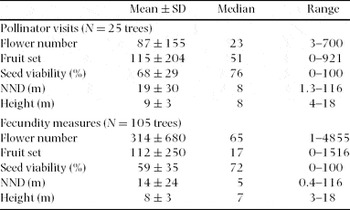
We recorded 7654 pollinator visits to G. elegans flowers, of which 95% were by C. flaveola. The remaining 5% of the visits were by A. mellifera. No other visitor was recorded visiting G. elegans flowers during the observation period. More than half (60%) of all C. flaveola visits were during afternoon hours. In contrast, 77% of all A. mellifera occurred during morning hours. The 25 G. elegans trees selected for quantifying pollinator visits produced a mean of 87 flowers during the observation period, with a mean tree height of 9 m and a mean NND of 19 m (Table 1).
Descriptive statistics of flower number, fruit set, seed viability, nearest neighbour distance (NND), and height of focal Goetzea elegans trees used in observations of pollinator visits and for the whole population monitored during April 2005 in Quebradillas, Puerto Rico.

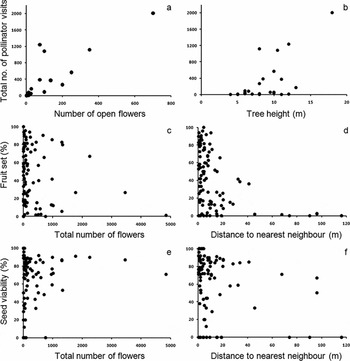
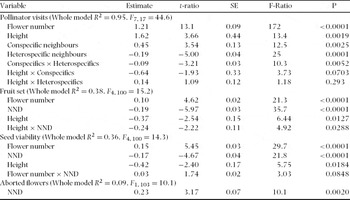
The regression model identified significant effects of the total number of open flowers on the observed G. elegans trees, the number of flowers from heterospecific neighbours, the height of G. elegans trees, and the number of flowers on conspecific neighbours, on pollinator visits. The most important variable predicting pollinator visits was the flower number of focal trees, which accounted for 68.6% of the explained whole-model variance (Table 2). Important predictor variables with a positive effect on pollinator visits included flower number, tree height, and the number of flowers on conspecific neighbours, while the number of flowers from heterospecific neighbours and the interaction between conspecific and heterospecific neighbours had a negative effect on visits (Table 2). The relationship between the number of open flowers and tree height on the number of pollinator visits is presented in Figure 1a and 1b.
Relationships between the number of flowers, tree height, and distance to the nearest reproductive conspecific neighbour (nearest neighbour distance) on the pollinator visits, fruit set and seed viability in Goetzea elegans (Solanaceae). Total number of open flowers on the observed trees versus total number of pollinator visits (a). Tree height (m) versus total number of pollinator visits (b). Total number of flowers in April versus percentage of fruit set (c). Nearest neighbour distance (m) versus percentage of fruit set (d). Total number of flowers in April versus percentage of seed viability (e). Nearest neighbour distance (m) versus percentage of seed viability (f).

Results of multiple regression models testing the effects of individual attributes of trees (flower number, tree height), contextual variables (nearest neighbour distance (NND), flower number of conspecific and heterospecific neighbours) and their interactions on pollinator visits, fruit set, seed viability and aborted flowers in Goetzea elegans.

Fecundity measures
Trees in the population were highly aggregated, with 75% growing within 15 m of their nearest conspecific neighbour. The mean NND was 13.8 m (± 27.8 m), with an expected NND of 80 m, a mean dispersed distance of 172 m, and a nearest neighbour index of 0.173 (Z = −16.2, SE = 4.08, P < 0.0001). The mean height of the trees was 8 m, and flower production ranged from 1 to 4855 (median: 65 flowers; Table 1). In the regression model the NND, the total number of flowers produced during the month of April, the height of G. elegans trees, and the interaction between tree height and NND were identified as significant predictors of fruit set. The most important variable predicting fruit set was NND, accounting for 19.8% of the explained whole-model variance (Table 2). The only important predictor variable with a positive effect on fruit set was the total number of flowers, while the NND, the height of G. elegans trees and the interaction between tree height and NND had a negative effect on fruit set (Table 2). The interactions between the number of flowers and the height of trees, and between the number of flowers and the NND were not identified as significant predictors of fruit set and were excluded from the model. In trees with a NND greater than 45 m, fruit set dropped below 50%. The relationship between the total number of flowers and NND on fruit set is presented in Figure 1c and 1d.
For seed viability, the regression model identified significant effects from the total number of flowers produced during the month of April, the NND and the height of G. elegans trees. The most important variable predicting seed viability was the total number of flowers, which accounted for 17.7% of the explained whole-model variance (Table 2). The only important predictor variable with a positive effect on pollinator visits was the total number of flowers of G. elegans trees, while the NND and the height of G. elegans trees had a negative effect on seed viability (Table 2). The interactions between the total number of flowers and the height of trees, and the NND and the height of trees were not identified as significant predictors of seed viability and were excluded from the model. Seeds from trees with NND within 20 m had the highest viability, and viability declined below 85% when NND was greater than 40 m. In fact, the only plants in the sample that achieved germination values of 100% were individuals with flowering neighbours within 4.5 m. The relationship between the total number of flowers and NND on seed viability is presented in Figure 1e and 1f. Finally, the number of aborted flowers showed a positive correlation to the NND (Table 2). Trees with NND greater than the mean of 14 m experienced significantly more flower abortion than trees with NND below the mean (t = 5.28; df = 103; P < 0.0001).
DISCUSSION
Although previous studies have recognized the importance of spatial and individual tree characteristics on fecundity metrics, ours is one of the few tropical studies that have accounted for all of these variables at once, estimating the relative contribution of each to the fecundity of an endangered and partially self-incompatible tree. Our results indicate that G. elegans requires highly clumped populations to optimize its reproductive investments, with effective NND of less than 15 m – a strikingly small scale over which to observe strong Allee effects (Groom Reference GROOM1998). On the other hand, heterospecific flowering neighbours appeared to compete with G. elegans by drawing away shared pollinators, which illustrates how a highly generalized island pollination network can limit plant fecundity (Olesen et al. Reference OLESEN, ESKILDSEN and VENKATASAMY2002). Curiously, tree height increased visitation by pollinators, but also decreased fecundity, suggesting that an increment in flower number can increase geitonogamy, i.e. pollination among flowers of the same tree (de Jong et al. Reference DE JONG, WASER, PRICE and RING1992).
Pollinator visits
A dependence of pollinators such as C. flaveola and A. mellifera on visual cues for attraction could explain the positive relationships we detected between both the total number of open flowers on the observed trees and tree height and rate of pollinator visits. Per-flower rates of pollinator visits often are positively related to the size of floral displays of individual plants (Feinsinger et al. Reference FEINSINGER, TIEBOUT and YOUNG1991, Rodríguez-Robles et al. Reference RODRÍGUEZ-ROBLES, MELÉNDEZ and ACKERMAN1992, Willson & Price Reference WILLSON and PRICE1977). Another possibility is that pollinators learned and could recall the locations of larger and taller trees and returned to these preferentially due to their larger overall supplies of nectar reward (Pyke Reference PYKE1984, Sih & Baltus Reference SIH and BALTUS1987). Although we did not detect any odour in the flowers of G. elegans, nor have floral fragrances been reported for any Antillean Goetzoideae (Santiago-Valentín & Olmstead Reference SANTIAGO-VALENTíN and OLMSTEAD2003), we do not discard the possibility that pollinator visits in G. elegans might be also influenced by odour cues detected by pollinators but imperceptible for humans.
Aggregation of focal trees with other conspecifics and heterospecifics might also serve to attract more visits (Johnson et al. Reference JOHNSON, PETER, NILSSON and ÅGREN2003). In general, pollinators appear to be more attracted to groups of flowering plants than to isolated individuals, probably because of richer resources (Pyke Reference PYKE1984, Wunderle & O'Brien Reference WUNDERLE and O'BRIEN1985). However, in our system it appeared that competition for common pollinators between G. elegans and other species outweighed any facilitative effect of aggregation on rate of visits. In some cases, G. elegans appears to have been the preferred resource for C. flaveola, which was observed more frequently on G. elegans than on neighbouring species (M. A. Caraballo-Ortiz, unpubl. data). In contrast, visits of A. mellifera to G. elegans flowers were rare, perhaps because honey bees prefer flowers of other species. Indeed, we observed A. mellifera visiting blooming trees of Andira inermis (W. Wright) H. B. K. (Fabaceae), Mangifera indica L. (Anacardiaceae), Spondias mombin L. (Anacardiaceae), Roystonea borinquena O. F. Cook (Arecaceae) and other trees at the site, suggesting that honey bees were present but did not prefer G. elegans. We also observed that, when C. flaveola forages on G. elegans, it visits a few flowers and moves on to a different tree (even for trees with many flowers), this behaviour promoting pollen outcrossing. Unlike C. flaveola, A. mellifera usually foraged during long periods in single G. elegans trees with many flowers, this promoting selfing pollination (M. A. Caraballo-Ortiz, pers. obs.).
Fecundity measures
The decline in seed viability with increasing NND is suggestive of an increase in deposition of self pollen and resulting inbreeding depression. Previous work with G. elegans showed that seeds derived from selfing are less viable than those derived from outcrossing (Caraballo-Ortiz & Santiago-Valentín Reference CARABALLO-ORTIZ and SANTIAGO-VALENTÍN2011). More isolated trees may suffer from higher rates of within-plant pollen movement, i.e. geitonogamy, if pollinators are more likely to visit larger numbers of flowers before leaving such trees. Lower viability of seeds from isolated trees has been documented with other tropical species (Cascante et al. Reference CASCANTE, QUESADA, LOBO and FUCHS2002, Naito et al. Reference NAITO, KANZAKI, IWATA, OBAYASHI, LEE, MUHAMMAD, OKUDA and TSUMURA2008, Nason et al. Reference NASON, ALDRICH, HAMRICK, Lawrence and BIerregaard1997).
Although the positive correlation of fruit set and seed viability with the total number of flowers during April suggests that a large floral display contributes strongly to successful reproduction in G. elegans, complete germination was realized only for seeds from some individuals with small displays of fewer than 50 flowers. Such trees therefore were proportionately more successful than trees with more flowers. However, this remarkable result might be explained by the small NND values (< 4.5 m) of the most successful trees. Spatial aggregation may be of particular importance for young trees with few flowers.
Our results suggest that pollinator visits and aspects of fecundity of G. elegans depend both on the attributes of individual plants, and on those of the community of other nearby plants. To be sure, our approach was correlative, since it was impractical to manipulate individual and community-level factors, and we did not directly measure such things as genetic relatedness of conspecific trees as a function of their proximity (Jones & Comita Reference JONES and COMITA2008). Thus our conclusions about causation and about mechanism must remain somewhat speculative. Furthermore, final realized reproductive success in G. elegans may be influenced by both pre- and post-dispersal seed predation (DeMattia et al. Reference DEMATTIA, CURRAN and RATHCKE2004, Raghu et al. Reference RAGHU, WILTSHIRE and DHILEEPAN2005). Conserving this rare endemic species for future generations requires not only protecting extant populations, but perhaps also intervention to increase fecundity. Possible examples are the planting of additional trees close to isolated trees and special effort to maintain large trees which can facilitate nearby smaller trees.
ACKNOWLEDGEMENTS
The authors thank J. M. Wunderle, J. D. Ackerman, T. Giray, R. Tremblay, E. Meléndez, J. E. Aukema, J. Thomlinson, C. Restrepo, A. Sabat, P. Yoshioka, B. Rivera, N. Rios, J. Fumero, J. Simpson, D. Atha, M. L. Flores, A. W. Norris, N. M. Waser, and two anonymous reviewers for their helpful and insightful comments on the manuscript. We also thank W. Hernández Aguiar, M. Vives Heyliger, S. Flecha Flecha, J. Soltero, K. Umpierre, V. Mangual, S. Hernández, L. Rivera, E. Napoleón, C. Díaz, J. Colón, F. Ortiz, J. Rosario, C. Calo, B. Carrión, M. Miranda, N. M. Martínez, R. L. González Marrero, D. Torres, V. del Hoyo, R. Rivera, G. S. Ross, N. I. Cacho, R. Rodríguez, O. Ortiz, N. Rivera, I. Galanes, M. Mercado, R. Rivera Martínez, J. Llanos, A. Rodríguez, I. Vicens, J. Mercado, W. Caraballo Castaing, L. Ortiz Ortiz and W. Caraballo Ortiz for assistance. We are grateful to the Botanical Garden of the University of Puerto Rico and the Conservation Trust of Puerto Rico for use of their facilities, and to the International Institute of Tropical Forestry, the Conservation Trust of Puerto Rico and the Institute for Tropical Ecosystem Studies for providing support with GPS and GIS. This research was funded by NSF-CREST (HRD-0206200) through the Center for Applied Tropical Ecology and Conservation of the University of Puerto Rico. This is scientific contribution number 003 of the Herbarium of the University of Puerto Rico Botanical Garden (UPR).