Pulmonary arterial hypertension is a considerable post-operative complication in children after congenital heart surgery.Reference Bando, Turrentine and Sharp1 The perioperative aetiology of pulmonary arterial hypertension is dynamic in CHDs and sometimes difficult to discern due to the complex anatomical variations.Reference Adatia, Atz, Jonas and Wessel2,Reference Curran, Mavroudis, Backer, Sautel, Zales and Wessel3 It has also been postulated that the exposure to cardiopulmonary bypass during congenital heart surgery increases the pulmonary vascular tone, potentially worsening any pre-existing pulmonary arterial hypertension.Reference Atz and Wessel4–Reference Beghetti, Silkoff, Caramori, Holtby, Slutsky and Adatia6 Furthermore, the inflammatory response elicited by cardiopulmonary bypass may induce reperfusion injury.Reference Wessel, Adatia, Giglia, Thompson and Kulik5,Reference Mathru, Huda, Solanki, Hays and Lang7
There are limited effective treatments for pulmonary artery hypertension in this setting. Inhaled nitric oxide is a particularly attractive therapy due to its fast onset of action and wide therapeutic profile.Reference Shah and Szmuszkovicz8,Reference Barr and Macrae9 However, evidence is relatively weak for the use of inhaled nitric oxide during or after cardiopulmonary bypass, particularly due to variable protocols, timing of initiation, and duration of therapy.Reference Bizzarro, Gross and Barbosa10 We, therefore, performed a systematic review and meta-analyses to determine the effect of inhaled nitric oxide on haemodynamics, gas exchange, and hospitalisation characteristics in children immediately after cardiopulmonary bypass.
Materials and methods
Manuscript search and identification strategy
A systematic review of the literature was performed to identify manuscripts describing haemodynamics, gas exchange, and hospital characteristics in children who received inhaled nitric oxide after undergoing cardiac surgery utilising cardiopulmonary bypass. This was a newly conducted review with no previous review protocol being present.
Published manuscripts were identified by searching PubMed, EMBASE, and the Cochrane databases from 1980 to 2018. The following search terms were used individually and various combinations to query these databases: “inhaled nitric oxide,” “cardiopulmonary bypass,” “cardiac surgery,” “pediatric,” “congenital heart disease,” “hemodynamics,” and “gas exchange.” Only English language publications were reviewed and there was no restriction on the year of publication. Manuscripts were initially screened using the title and by reviewing the abstract. Full text of manuscripts was retrieved for manuscripts felt to be pertinent to the review after the initial screen using the title and abstract.
Once full-text manuscripts were obtained, these were then reviewed by two of the authors (SF, RL). Manuscripts were deemed suitable for inclusion if they met the following requirements: (1) had children defined as being under 18 years of age, (2) patients must have undergone cardiac surgery utilising cardiopulmonary bypass, (3) at least some patients in the study must have received inhaled nitric oxide after cardiopulmonary bypass, (4) must have been crossover in design such that data were available for the same patient before and after inhaled nitric oxide or the study must have been randomised such that comparative data were available for patients receiving inhaled nitric oxide and for patients not receiving inhaled nitric oxide, and (5) must have been published in English.
Manuscripts meeting these inclusion criteria were then assessed for quality and bias. The Cochrane Handbook for Systematic Reviews was used for quality evaluation. Any discrepancies between authors were discussed and a resolution was achieved by group decision.
Endpoints
Once manuscripts were identified for inclusion, a list of all the endpoints in each manuscript was created. Endpoints with data present from two or more studies were then kept for pooled analyses. These included the following: mean pulmonary artery pressure, mean systemic artery pressure, left atrial pressure, cardiac index, systemic vascular resistance, pulmonary vascular resistance, heart rate, arteriovenous difference, arterial hydrogen ion concentration, arterial oxygen concentration, arterial carbon dioxide concentration, duration of mechanical ventilation, cardiac ICU length of stay, and hospital length of stay.
Data extraction
Study-level data were extracted from the manuscripts identified for inclusion. Baseline characteristics such as patient age and cardiac lesion were collected along with the dose of inhaled nitric oxide. Data for the aforementioned endpoints were then collected as well. Data were extracted by two authors (SF, RL) and reviewed by a third author (SA). Discrepancies in extracted data were then reviewed by the entire group. Authors of included manuscripts were not contacted for any data in addition to what was present in the manuscript.
Bias analysis
Bias analysis was performed at the study level with specific attention paid to patient selection, intervention selection, endpoint inclusion, and result reporting.
Data analysis
Meta-analyses were characterised using Comprehensive Meta-Analysis Version 3.0 (Biostat, Englewood, NJ). Heterogeneity was assessed using the Q-statistic and its resultant p-value as well as the I2 value. A p-value of less than 0.05 for the Q-statistic was considered or an I2 value of greater than 50% was considered to be indicative of significant heterogeneity. If significant heterogeneity was not noted, then a fixed-effects model was used and if significant heterogeneity was noted, then a random-effects model was used.
All endpoints included were continuous variables and so mean and standard deviation were utilised as the effect data for comparison. For all endpoints except for arteriovenous difference, the analyses were conducted utilising mean difference. For arteriovenous difference, the standardised mean difference was used as the units used were variable between studies. Pooled results are presented as either mean difference or standardised mean difference along with the 95% confidence interval. Results are graphically demonstrated by use of forest plots.
For studies in which patient data were presented for more than two groups, each pair of patient groups was treated as a separate study in the meta-analyses. Data from both crossover and randomised studies were included together in the analyses as has been done previously. For endpoints where this was done, a sensitivity analysis was conducted to determine if study type was impacting the pooled result.
Meta-regression was not conducted due to the low number of included studies. Publication bias was assessed for endpoints with three or greater studies included using the Egger’s test.
Results
Manuscript identification and characteristics
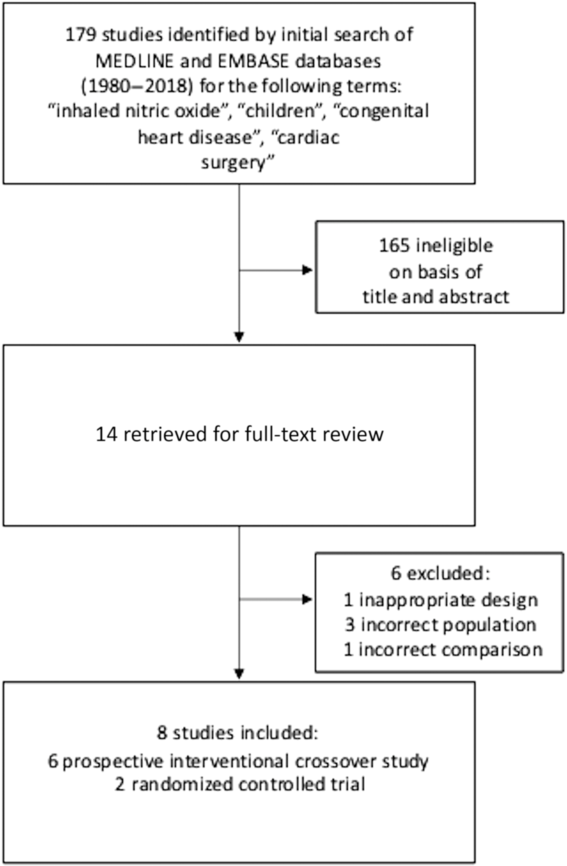
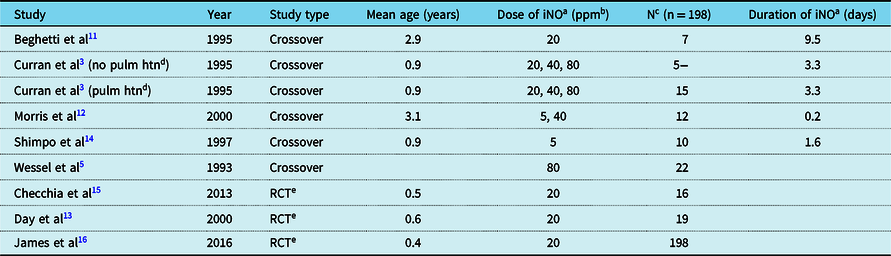
A total of 179 manuscripts were identified initially with 135 remaining after removal of duplicates. Titles and abstracts for these 135 manuscripts were reviewed and a total of 14 had their full text reviewed. After elimination of manuscripts not meeting the previously described inclusion criteria, a total of eight studies were deemed appropriate for inclusion (Fig 1 and Table 1).
Flowchart demonstrating the search strategy and search results for published manuscripts.

Study characteristics

aiNO, inhaled Nitric Oxide; bppm, parts per million; cN, sample size; dpulm htn, pulmonary hypertension; eRCT, randomised controlled trial
Average age of patients in the included studies was 7 months. The median dose of inhaled nitric oxide at initiation was 20 [range 20–80]. All but one of the studies outlined the included cardiac lesions. A total of 304 patients with 124 cardiac lesions were reported with the most frequent being atrioventricular septal defect in 34, ventricular septal defect in 24, and tetralogy of Fallot in 18.
It should be noted that two studies provided inhaled nitric oxide through the cardiopulmonary bypass circuit itself. These were deemed appropriate for inclusion.
Bias analysis
Included studies were found to have low levels of bias.
Mean pulmonary artery pressure
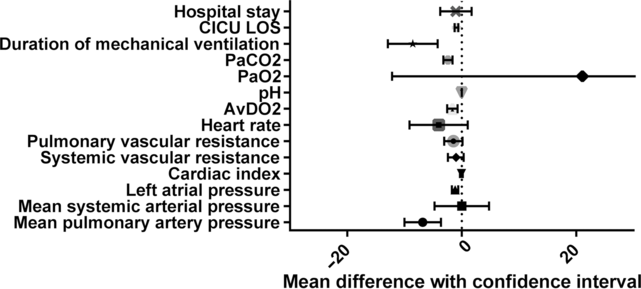
A total of 5 studies with 61 patients were pooled for the analysis of mean pulmonary artery pressure. The Q-statistic had a p-value of less than 0.001 and the I2 value was 82%, indicating the presence of significant heterogeneity. Because of this, a random-effects model was used. There was a significant difference noted with lower mean pulmonary artery pressures being noted in the inhaled nitric oxide group. A mean difference of −6.82 mmHg was noted (95% confidence interval −10.01 to −3.63, p-value < 0.001) (Fig 2).
Combined forest plot demonstrating impact of inhaled nitric oxide on all outcomes. CICU, cardiac ICU.

The p-value for the Egger’s test was 0.987, demonstrating no significant publication bias.
Mean systemic artery pressure
A total of 4 studies with 46 patients were pooled for the analysis of mean systemic artery pressure. The Q-statistic had a p-value of 0.045 and the I2 value was 71%, indicating the presence of significant heterogeneity. Because of this, a random-effects model was used. There was no significant difference noted with a mean difference of 0.01 mmHg (95% confidence interval −4.75 to 4.77, p-value 0.997) (Fig 2).
The p-value for the Egger’s test was 0.462, demonstrating no significant publication bias.
Left atrial pressure
A total of 3 studies with 72 patients were pooled for the analysis of left atrial pressure. The Q-statistic had a p-value of less than 0.001 and the I2 value was 82%, indicating the presence of significant heterogeneity. Because of this, a random-effects model was used. There was a significant difference noted with a mean difference of −1.16 mmHg (95% confidence interval −1.73 to −0.600, p-value < 0.001) (Fig 2). Thus, inhaled nitric oxide was noted to be associated with lower left atrial pressure.
The p-value for the Egger’s test was 0.837, demonstrating no significant publication bias.
Cardiac index
A total of 3 studies with 39 patients were pooled for the analysis of cardiac index. The Q-statistic had a p-value of 0.788 and the I2 value was 0%, indicating the absence of significant heterogeneity. Because of this, a fixed-effects model was used. There was no significant difference noted with a mean difference of −0.06 litres/min/m2 (95% confidence interval −0.31 to 0.18, p-value 0.595) (Fig 2).
The p-value for the Egger’s test was 0.071, demonstrating no significant publication bias.
Systemic vascular resistance
A total of 2 studies with 34 patients were pooled for the analysis of systemic vascular resistance. The Q-statistic had a p-value of 0.704 and the I2 value was 0%, indicating the absence of significant heterogeneity. Because of this, a fixed-effects model was used. There was no significant difference noted with a mean difference of −1.04 woods units/m2 (95% confidence interval −2.43 to 0.34, p-value 0.141) (Fig 2).
An Egger’s test was not conducted due to the number of pooled studies.
Pulmonary vascular resistance
A total of 3 studies with 39 patients were pooled for the analysis of pulmonary vascular resistance. The Q-statistic had a p-value of 0.003 and the I2 value was 82%, indicating the presence of significant heterogeneity. Because of this, a random-effects model was used. There was no significant difference noted with a mean difference of −1.45 woods units/m2 (95% confidence interval −3.06 to 0.15, p-value 0.077) (Fig 2).
The p-value for the Egger’s test was 0.654, demonstrating no significant publication bias.
Heart rate
A total of 3 studies with 72 patients were pooled for the analysis of heart rate. The Q-statistic had a p-value of 0.018 and the I2 value was 75%, indicating the presence of significant heterogeneity. Because of this, a random-effects model was used. There was no significant difference noted with a mean difference of −4.02 beats per minute (95% confidence interval −9.11 to 1.05, p-value 0.121) (Fig 2).
The p-value for the Egger’s test was 0.916, demonstrating no significant publication bias.
Arteriovenous oxygen difference
A total of 2 studies with 17 patients were pooled for the analysis of arteriovenous oxygen difference. The Q-statistic had a p-value of 0.007 and the I2 value was 86%, indicating the presence of significant heterogeneity. Because of this, a random-effects model was used. There was a significant difference noted with a standard mean difference of -1.63 (95% confidence interval −2.54 to −0.72, p-value < 0.001) (Fig 2). Thus, inhaled nitric oxide was associated with a lower arteriovenous oxygen difference.
An Egger’s test was not conducted due to the number of pooled studies.
Arterial hydrogen ion concentration
A total of 2 studies with 82 patients were pooled for the analysis of arterial hydrogen ion concentration. The Q-statistic had a p-value of 0.013 and the I2 value was 83%, indicating the presence of significant heterogeneity. Because of this, a random-effects model was used. There was no significant difference noted with a mean difference of -0.01 (95% confidence interval −0.02 to 0.01, p-value 0.341) (Fig 2).
An Egger’s test was not conducted due to the number of pooled studies.
Arterial oxygen concentration
A total of 2 studies with 82 patients were pooled for the analysis of arterial oxygen concentration. The Q-statistic had a p-value of 0.034 and the I2 value was 77%, indicating the presence of significant heterogeneity. Because of this, a random-effects model was used. There was no significant difference noted with a mean difference of 21.08 mmHg (95% confidence interval −12.18 to 54.36, p-value 0.214) (Fig 2).
An Egger’s test was not conducted due to the number of pooled studies.
Arterial carbon dioxide concentration
A total of 3 studies with 70 patients were pooled for the analysis of arterial carbon dioxide concentration. The Q-statistic had a p-value of 0.005 and the I2 value was 81%, indicating the presence of significant heterogeneity. Because of this, a random-effects model was used. There was a significant difference noted with a mean difference of −2.41 mmHg (95% confidence interval −3.22 to −1.60, p-value < 0.001) (Fig 2). Thus, inhaled nitric oxide was associated with lower arterial carbon dioxide concentration.
The p-value for the Egger’s test was 0.897, demonstrating no significant publication bias.
Duration of mechanical ventilation
A total of 2 studies with 214 patients were pooled for the analysis of duration of mechanical ventilation. The Q-statistic had a p-value of 0.230 and the I2 value was 30%, indicating the absence of significant heterogeneity. Because of this, a fixed-effects model was used. There was a significant difference noted with a mean difference of −8.56 hours (95% confidence interval −12.91 to −4.22, p-value < 0.001) (Fig 2). Thus, inhaled nitric oxide was associated with a shorter duration of mechanical ventilation.
An Egger’s test was not conducted due to the number of pooled studies.
Cardiac ICU length of stay
A total of 2 studies with 214 patients were pooled for the analysis of cardiac ICU length of stay. The Q-statistic had a p-value of 0.749 and the I2 value was 0%, indicating the absence of significant heterogeneity. Because of this, a fixed-effects model was used. There was a significant difference noted with a mean difference of −0.91 days (95% confidence interval −1.24 to −0.59, p-value < 0.001) (Fig 2) favouring the inhaled nitric oxide group.
An Egger’s test was not conducted due to the number of pooled studies.
Hospital length of stay
A total of 2 studies with 214 patients were pooled for the analysis of hospital length of stay. The Q-statistic had a p-value of 0.011 and the I2 value was 84%, indicating the presence of significant heterogeneity. Because of this, a random-effects model was used. There was no significant difference noted with a mean difference of −1.02 days (95% confidence interval −3.75 to 1.709, p-value 0.463) (Fig 2).
An Egger’s test was not conduced due to the number of pooled studies.
Discussion
In this systematic review and meta-analysis, we synthesised the evidence of eight studies, including children undergoing congenital heart surgery who received inhaled nitric oxide during the end of, or immediately after, cardiopulmonary bypass. The analysis of the pooled data demonstrated that patients receiving inhaled nitric oxide demonstrated a significant decrease in the mean pulmonary arterial pressure.Reference Curran, Mavroudis, Backer, Sautel, Zales and Wessel3,Reference Wessel, Adatia, Giglia, Thompson and Kulik5,Reference Beghetti, Habre, Friedli and Berner11,Reference Morris, Beghetti, Petros, Adatia and Bohn12 There were also significant decreases for the inhaled nitric oxide groups in studies reporting mean left atrial pressure,Reference Wessel, Adatia, Giglia, Thompson and Kulik5,Reference Morris, Beghetti, Petros, Adatia and Bohn12,Reference Day, Hawkins, McGough, Crezee and Orsmond13 arteriovenous oxygen difference,Reference Beghetti, Habre, Friedli and Berner11,Reference Shimpo, Mitani and Tanaka14 and arterial carbon dioxide concentration.Reference Wessel, Adatia, Giglia, Thompson and Kulik5,Reference Day, Hawkins, McGough, Crezee and Orsmond13,Reference Shimpo, Mitani and Tanaka14 Additionally, the analysis identified that mechanical ventilation and ICU duration were shorter in the patients receiving inhaled nitric oxide.Reference Checchia, Bronicki and Muenzer15,Reference James, Millar, Horton, Brizard, Molesworth and Butt16
There were no significant differences in the mean systemic arterial pressure,Reference Curran, Mavroudis, Backer, Sautel, Zales and Wessel3,Reference Wessel, Adatia, Giglia, Thompson and Kulik5,Reference Beghetti, Habre, Friedli and Berner11,Reference Morris, Beghetti, Petros, Adatia and Bohn12 cardiac index,Reference Curran, Mavroudis, Backer, Sautel, Zales and Wessel3,Reference Wessel, Adatia, Giglia, Thompson and Kulik5,Reference Morris, Beghetti, Petros, Adatia and Bohn12 pulmonary vascular resistance,Reference Curran, Mavroudis, Backer, Sautel, Zales and Wessel3,Reference Wessel, Adatia, Giglia, Thompson and Kulik5,Reference Morris, Beghetti, Petros, Adatia and Bohn12 systemic vascular resistance,Reference Wessel, Adatia, Giglia, Thompson and Kulik5,Reference Morris, Beghetti, Petros, Adatia and Bohn12 arterial hydrogen ion concentration,Reference Wessel, Adatia, Giglia, Thompson and Kulik5,Reference Day, Hawkins, McGough, Crezee and Orsmond13 arterial oxygen concentration,Reference Wessel, Adatia, Giglia, Thompson and Kulik5,Reference Shimpo, Mitani and Tanaka14 hospital stay,Reference Checchia, Bronicki and Muenzer15,Reference James, Millar, Horton, Brizard, Molesworth and Butt16 and heart rate.Reference Wessel, Adatia, Giglia, Thompson and Kulik5,Reference Morris, Beghetti, Petros, Adatia and Bohn12,Reference Day, Hawkins, McGough, Crezee and Orsmond13 All analysed variables did not demonstrate publication bias.
Of the included studies, five were prospective and three were randomised controlled trials. One of the randomised controlled trials targeted patients with pulmonary hypertension after cardiopulmonary bypass, whereas the other two studies excluded patients with elevated pulmonary vascular resistance to focus on the potential cardioprotective effects of inhaled nitric oxide during cardiopulmonary bypass as measured by myocardial biomarkers levels (i.e., brain natriuretic peptide and troponin)Reference Checchia, Bronicki and Muenzer15 and the incidence of low cardiac output syndrome).Reference James, Millar, Horton, Brizard, Molesworth and Butt16 The inhaled nitric oxide dose was variable among studies ranging from 2 to 80 parts per million. Unfortunately, meta-regression was not conducted due to the low number of included studies to account for the dose difference.
Our main finding of a decreased mean pulmonary arterial pressure is unsurprising because it has been well documented that even in the presence of endothelial dysfunction, inhaled nitric oxide is able to exert vasodilatory effects on smooth muscle in the pulmonary vasculature.Reference Checchia, Bronicki and Goldstein17 The decreased arterial carbon dioxide concentration by hyperventilation has been previously shown to decrease pulmonary vascular resistance, but this mechanism compromised systemic haemodynamics; an adverse effect not seen with inhaled nitric oxide.Reference Morris, Beghetti, Petros, Adatia and Bohn12
Left atrial pressure can be used as a surrogate for pulmonary blood flow.Reference Beghetti, Habre, Friedli and Berner11,Reference Fullerton, Jones, Jaggers, Piedalue, Grover and McIntyre18 It would be expected and as previous studies have demonstrated, small increases in left atrial pressure associated with drops in pulmonary pressure.Reference Wessel, Adatia, Giglia, Thompson and Kulik5 Interestingly, analysis of the pooled data demonstrated a drop in left atrial pressure. In the studies included, pulmonary vascular resistance trended towards – but did not reach – significance (p < 0.077).Reference Curran, Mavroudis, Backer, Sautel, Zales and Wessel3,Reference Wessel, Adatia, Giglia, Thompson and Kulik5,Reference Morris, Beghetti, Petros, Adatia and Bohn12 We can hypothesize that if the mean pulmonary artery pressure and left atrial pressure decrease by the same amount, then the pulmonary vascular resistance may not demonstrate a significant decrease if pulmonary blood flow remains similar. Our analysis identified that the mean pulmonary artery pressure dropped by 6.86 mmHg and the left atrial pressure decreased by 1.16 with pulmonary vascular resistance non-significantly decreasing pulmonary vascular resistance by 1.45 woods units/m2. These values are not decreasing proportionately, suggesting that the pulmonary blood flow is also decreasing though the mechanism is not clear. Additional studies, performed similar to the one by Latus et al, should examine this finding to better understand the mechanism.Reference Latus, Gerstner and Kerst19
Curran et al reported non-significant differences for pulmonary vascular resistance and this is of note, because within this study, there were two patient populations differentiated by the timing of the inhaled nitric oxide delivery (pre-/intra-operative and post-operative).Reference Curran, Mavroudis, Backer, Sautel, Zales and Wessel3 The post-operative pulmonary hypertension group received inhaled nitric oxide as a therapeutic measure and saw clinical benefit, but access to measure pulmonary vascular resistance was unavailable, whereas the intra-operative group measured pulmonary vascular resistance, but had only minor residual pulmonary hypertension and effects of inhaled nitric oxide may not have been as consequential as reported in other studies.Reference Adatia, Atz, Jonas and Wessel2,Reference Curran, Mavroudis, Backer, Sautel, Zales and Wessel3
In Day et al, there were no significant improvements in pulmonary haemodynamics. However, within their study, a subset of patients that experience post-operative pulmonary hypertensive crisis and inhaled nitric oxide did result in improved pulmonary haemodynamics.Reference Day, Hawkins, McGough, Crezee and Orsmond13 This is of considerable importance because Day et al explicitly state their decision to include patients with anatomic obstructions and they acknowledge that these patients may not be responsive to inhaled nitric oxide treatment.Reference Adatia, Atz, Jonas and Wessel2,Reference Day, Hawkins, McGough, Crezee and Orsmond13 Adatia used inhaled nitric oxide as a diagnostic tool in a study where 15 patients received inhaled nitric oxide and the only 6 that did not show improvement all had anatomic obstructions to pulmonary blood flow.Reference Adatia, Atz, Jonas and Wessel2
Checchia et al reported significantly shorter mechanical ventilation and cardiac ICU stay, but this amounted to about 23 hours in the cardiac ICU and 8 hours on the ventilator.Reference Checchia, Bronicki and Muenzer15 In James et al, there were no differences in ventilator durations but in a subgroup analyses by age, ICU stay was nearly halved (84 to 43 hours) for ages 6 weeks to 2 years suggesting that age may be a contributing factor. However, for most patients reported, using inhaled nitric oxide offers no clinical benefit regarding duration of mechanical ventilation, ICU stay, and hospital stay. Additionally, Tzanetos et al studied the cost of inhaled nitric oxide in the paediatric ICU for any use and found that the only factor to decrease costs was early recognition of non-responders and subsequent termination of therapy.Reference Todd Tzanetos, Housley, Barr, May and Landers20 The cost of such an intervention must be considered as inhaled nitric oxide is patient and centre-wide costly treatment.Reference Todd Tzanetos, Housley, Barr, May and Landers20
A large-scale randomised trial needs to be conducted to properly answer which patient populations would most benefit from inhaled nitric oxide therapy. To capture the necessary data, the trial should collect the information we have presented in this review: pulmonary artery pressure, systemic pressure, pulmonary vascular resistance, systemic vascular resistance, cardiac index, arterial hydrogen ion concentration, arterial oxygen concentration, arterial carbon dioxide concentration, duration of ventilation, duration of cardiac ICU stay, and duration of hospital stay. The delivery method, duration, and amount of inhaled nitric oxide should also be established. It is also important the standardisation of weaning protocols and early identification of non-responders. Subgroup analyses should be performed on different types of cardiac abnormalities, especially those that may contribute to anatomic obstructions of the pulmonary artery. Additionally, subgroups should consider the age of the patient as James et al saw significant differences between age groups.Reference James, Millar, Horton, Brizard, Molesworth and Butt16 Secondary outcomes such as low cardiac output syndrome, pulmonary hypertensive crises, and post-operative extracorporeal membrane oxygenation use may also be of utility.
The pooled analyses provide valuable insight into the haemodynamic changes and clinical outcomes after the administration of inhaled nitric oxide during or following cardiopulmonary bypass and is strengthened using comprehensive search strategies, rigorous screening and eligibility criteria, and by transparent reporting of our findings. However, some limitations were identified. For instance, even though all studies were prospective, they were small, with limited representation of cardiac lesions, and thus at risk of selection bias. Even though most studies attempted to measure the concentration of inhaled nitric oxide at the delivery equipment end, the amount, duration, and method of delivery differed among studies potentially generating confounders. Additionally, the time points of data collection varied, potentially misrepresenting some of the results. The data pooled from the studies span 20 years in which time, treatment, and management strategies evolved and may contribute to the heterogeneity of the studies.
Conclusion
Inhaled nitric oxide in children immediately after cardiopulmonary bypass decreases mean pulmonary artery pressure significantly and decreases the arterial carbon dioxide concentration significantly without significantly altering other haemodynamic parameters. This results in a statistically shorter duration of mechanical ventilation and cardiac ICU length of stay without altering overall hospital length of stay. Larger randomised trials including all haemodynamic and hospital characteristics along with a cost analysis are required.
Acknowledgement
None.
Financial support
This research received no specific grant from any funding agency, commercial or not-for-profit sectors.
Conflicts of interest
None of the authors have any pertinent conflicts of interest to disclose.
Ethical standards
All study procedures complied with the ethical standards of the Helsinki Declaration and have been approved by Institutional Research Board of Cincinnati Children’s Medical Center.
Supplementary material
To view supplementary material for this article, please visit https://doi.org/10.1017/S1047951120001717