1. Introduction
During the last few decades, data have been amassed both on the influence of affective states on semantic processes, as well as on the reverse influence of semantic processes on the perception of emotional and painful stimuli. For example, Dillmann, Miltner, and Weiss (Reference Dillmann, Miltner and Weiss2000) investigated the effects of different semantic primes on the processing of painful stimuli and discovered a greater recognition of pain-related vs. neutral adjectives in migraine patients compared to healthy participants. Using a sentence completion task, Rusu, Pincus, and Morley (Reference Rusu, Pincus and Morley2012) demonstrated that participants with pain and depression exhibit a cognitive bias specific to negative aspects of health. In emotion research, Niedenthal, Halberstadt, and Setterlund (Reference Niedenthal, Halberstadt and Setterlund1997) provided evidence that being in an emotional state facilitates responses to words categorically associated with that emotion. More recently, researchers have also focused on the impact of emotional sensitivity on the cognitive processing of emotion words. Instead of inducing certain emotions to test whether and how strongly cognitive processes are inhibited or facilitated while undergoing certain emotions, researchers have investigated the importance of people’s emotional sensitivity for specific cognitive tasks. For example, Silva, Montant, Ponz, and Ziegler (Reference Silva, Montant, Ponz and Ziegler2012) have found that sensitivity to disgust affects lexical decision performance; Rak, Kontinen, Kuchinke, and Werning (Reference Rak, Kontinen, Kuchinke, Werning, Knauff, Pauen, Sebanz and Wachsmuth2013) show that people’s ability to feel empathy with others exerts an influence on the integration of emotion words. Despite these advances in the study of emotions, little research has been devoted to questions regarding the relation between the semantic processing of words on the one hand, and pain sensitivity on the other, where pain sensitivity is generally assumed to refer to subjects’ responsiveness to noxious stimuli.
Thus, the primary aim of our study was to investigate the hitherto unexplored question of whether individual differences in pain sensitivity, as measured by people’s self-report, have a substantial influence on the cognitive processing of words, as measured by people’s ratings of the pain-relatedness of words. Pain sensitivity is known to vary greatly within culturally homogenous populations (Nielsen, Staud, & Price, Reference Nielsen, Staud and Price2009). This not only allowed us to test participants with a similar linguistic, cultural, and educational background, but also reduced the number of factors that may provide alternative explanations for our results. Consequently, any positive correlation between pain sensitivity and the cognitive processing of words is likely to be based on a causal process linking them (but see the Section 4 for a more detailed analysis). In order to evaluate differences in people’s processing of experimental verbal stimuli, we had to build a large database. This database consists of a total of 600 nouns and includes 330 pain-related words, which we envisage will be a valuable tool for pain researchers and which is available in the online supplementary material (available at: <http://dx.doi.org/10.1017/langcog.2016.29>). Additionally, we divided the pain-related words into concrete and abstract nouns. Recent controversies have emerged surrounding the question of whether abstract and concrete nouns are processed in different regions of the brain (Binder, Desai, Graves, & Conant, Reference Binder, Desai, Graves and Conant2009), and how this would affect the processing of various word types. Accordingly, if the degree to which people are more or less pain-sensitive depends on activity in some of these brain regions, then we might well observe a differential impact of pain sensitivity on people’s evaluation of abstract and concrete nouns. The results we present in this study will be of immediate relevance to this debate.
A positive correlation between pain sensitivity and the cognitive processing of the pain-relatedness of words confirms the predictions of the body specificity hypothesis. According to this hypothesis, individual differences in the way in which people interact with the world lead to corresponding differences in the way in which they construct concepts and word meanings (Casasanto, Reference Casasanto2011). Thus, while the body specificity hypothesis predicts an effect of pain sensitivity on the cognitive processing of the pain-related aspects of concepts, theories according to which word meanings are primarily shaped by the language community in which speakers grow up are not consistent with such a prediction.
A further question arises in regard to the mechanism that can account for individual differences in the cognitive processing of pain-related words. At least three theoretical frameworks seem to provide plausible explanations: (1) attention and memory bias: people’s decisions and judgments can be influenced by attentional preference or memory selectivity for certain stimuli, e.g., studies with healthy subjects reveal that individuals who are more pain-sensitive show an enhanced attentional engagement with pain-related stimuli (Baum, Huber, Schneider, & Lautenbacher, Reference Baum, Huber, Schneider and Lautenbacher2011); (2) prototype analysis: concepts consist of various elements which have an unequal status. Differences in the cognitive processing of words need to take into account the prototypical fashion in which concepts are stored; (3) embodied cognition: concepts and word meanings are constituted by implicit simulations of bodily experiences. Differences in the cognitive processing of words might be related to differences in simulated bodily experiences.
After presenting the methods and results of our experiment in the next sections, we will discuss our results in light of these three mechanisms.
2. Methods
2.1. participants
One hundred and eighty-nine participants took part in our survey. We only accepted responses from those 141 participants who completed the survey. Ten further subjects had to be excluded from our analysis because they were not German native speakers, and data of another subject had to be dismissed because the person stopped responding differentially after 25% of the words were presented. Of the remaining 130 people, 70 were female, 60 were male, 18 years or older, with a mean age of 28.04 years (SD = 8.97). All subjects who participated in our survey were recruited through the Ruhr University Bochum and were mostly students. They were not reimbursed for their participation, but among all participants who submitted their email address, four book vouchers were drawn. The study follows the principles set by the Declaration of Helsinki and was approved by the local ethics committee of the Faculty of Psychology (Ruhr-University Bochum, Germany).
2.2. stimuli
We assembled a list of 330 German pain words. All words were two-syllabic nouns and fell roughly into three categories: (A) nouns (N = 147) that refer to objects, the use of or contact with which may be associated with having pain, e.g., Dorne ‘thorn’, Hagel ‘hail’, Hammer ‘hammer’, Krücken ‘crutch’, Panzer ‘tank’, Schlange ‘snake’, Scherbe ‘shard’; (B) nouns (N = 69) that refer to body parts or inflictions of body parts that are often associated with having pain, e.g., Blinddarm ‘appendix’, Eiter ‘pus’, Genick ‘neck’, Knochen ‘bone’, Narbe ‘scar’; (C) abstract nouns (N = 114) that refer to states of affairs that often involve being in pain, e.g., Geburt ‘birth’, Notfall ‘emergency’, Seuche ‘epidemic’, Folter ‘torture’. We then supplemented this list with 270 two-syllable nouns, 90 with a positive valence, e.g., Adler ‘eagle’, Frühjahr ‘spring’, Saphir ‘sapphire’, 90 with a neutral valence, e.g., Hering ‘herring’, Lupe ‘magnifying glass’, Pendel ‘pendulum’, and 90 with a negative valence but presumably not pain-related, e.g., Falte ‘wrinkle’, Rasse ‘race’, Spion ‘spy’. Whereas the pain-relatedness of the 330 ‘pain words’ was not independently determined (as far as we know, no similar list has so far been assembled), the 270 additional words were randomly selected from the Berlin Affective Word List (Võ, Conrad, Kuchinke, Hartfeld, Hofmann, & Jacobs, Reference Võ, Conrad, Kuchinke, Hartfeld, Hofmann and Jacobs2009).
2.3. procedure
The list of 600 words was divided into six surveys, each including 100 words (55 pain-related nouns, 15 positive, 15 neutral, and 15 negative nouns were randomly put together). Each participant was randomly assigned to one of the six surveys that they filled out using the survey platform kwiksurvey. Before they were presented with the list of words, they were informed that they would be asked to rate the physical pain that they associate with that concept. After reading each word x, the person was asked to answer the question “How strongly do you associate an x with pain?” (Wie stark assoziieren Sie ein(e) x mit Schmerzen?) on a 5-point Likert scale, anchored at “1” meaning “not at all” and “5” meaning “very strongly”. The average rating for all words and all subjects was 2.37 (SD = 0.99). The pain ratings for all 600 German words are available in the online supplementary material which we hope to be of use for many other pain researchers.
After evaluating 100 words, participants were prompted to provide demographic data on age, gender, and mother tongue. Subsequently, they were asked to self-assess their pain sensitivity: Would you consider yourself to be pain-sensitive? (Würden Sie sich als schmerzempfindlich bezeichnen?) Possible responses were: (a) yes, (b) not so much, (c) definitely not, and (d) I don’t know. Only twelve people evaluated their pain sensitivity as low. This can be explained by the actual wording of the response options. Arguably, fewer people are willing to state that they do not consider themselves to be pain-sensitive than having a low pain sensitivity. Nine subjects, who claimed not to know whether they were pain-sensitive, were excluded from statistical analysis. While a person’s pain sensitivity is usually assessed in the laboratory setting using controlled experimental stimuli in a number of stimulus modalities, such as heat, cold, and pressure, it has been shown that the use of self-reports to assess pain sensitivity is a viable means (but see Edwards & Fillingim, Reference Edwards and Fillingim2007): Ruscheweyh, Marziniak, Stumpenhorst, Reinholz, and Knecht (Reference Ruscheweyh, Marziniak, Stumpenhorst, Reinholz and Knecht2009) developed a pain sensitivity questionnaire (PSQ) including seventeen questions and found a significant positive correlation with experimental pain ratings. We furthermore asked subjects to report on the frequency with which they feel pain by asking “How often do you experience pain?” (Wie oft haben Sie Schmerzen?) Possible responses were (a) very rarely, (b) now and then, (c) quite often, (d) chronic pain. Additionally, people were asked to assess their emotional sensitivity: “Would you describe yourself as emotional?” (Würden Sie sich als emotional bezeichnen?). Possible responses were: (a) yes, (b) not so much, (c) definitely not, and (d) I don’t know. The completion of the survey took between 10 and 25 minutes.
Repeated-measures ANOVAs were computed with participants’ pain ratings as the dependent measure at an apriori significance level of p = .05. Significant main effects were further examined by Bonferroni-corrected pairwise comparisons; only significant results were reported. Based on our above considerations regarding the different theoretical predictions of pain sensitivity effects in abstract and concrete concepts, separate follow-up ANOVAs were computed for abstract and concrete words.
3. Results
3.1. main effect
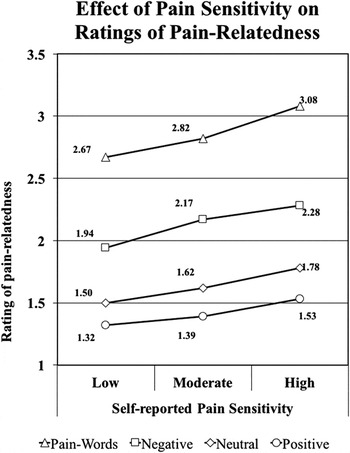
Participants were divided into three groups (High (N = 31), Moderate (N = 78), and Low (N = 12)) depending on the self-assessment of their pain sensitivity (see Section 2.3 above). We divided the list of words into those that were preselected as being likely to be associated with pain, so called pain words, and those that were randomly selected to complement the list (see also Section 2.2). The average values of the ratings of low, moderate, and high pain-sensitive participants for each word category are displayed in Figure 1. Regardless of pain sensitivity, pain-related words are evaluated to be more strongly associated with pain, 2.86 (SE = .06), compared to all three control categories. In order to analyze the influence of self-assessed pain sensitivity and word category on people’s Rating, we applied a repeated-measures ANOVA with pain sensitivity (low, moderate, high) as a between-subjects factor and word category (pain-related, negative, neutral, positive) as a within-subjects factor.
Effect of self-assessed pain sensitivity and word type on average ratings of the pain-relatedness of words.

There was a significant main effect of pain sensitivity (F(2,118) = 3.55, p = .03), as well as a significant effect of word category (F(1,118) = 270.91, p < .001). No interaction between pain sensitivity and word category was found (F(2,118) = 0.82, p = .44). Pairwise post-hoc comparisons revealed highly significant differences between all four word categories (all ps < .001). The average ratings for each level of pain sensitivity were 2.19 (low, SE = .11), 2.32 (moderate, SE = .08), and 2.52 (high, SE = .09). Bonferroni-corrected post-hoc tests showed marginally significant differences between the high and moderate group (p = .07) as well as between the high and low group (p = .05) No significant result was found between the moderate and the low group.
3.2. abstract vs. concrete nouns
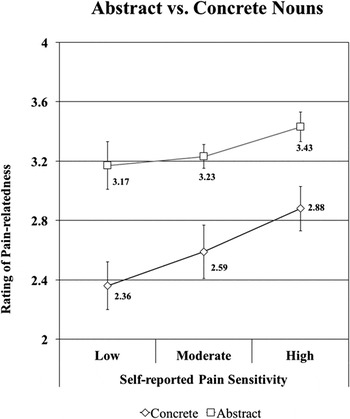
Participants were presented with both concrete pain-related nouns, e.g., ‘syringe’, ‘cactus’, but also abstract pain-related nouns, e.g., ‘birth’, ‘emergency’. Given the divergent predictions different theories make regarding the processing of abstract and concrete nouns (see Section 4), we were interested in whether there was any difference between people’s ratings of abstract and concrete words. To test the influence of concept type on people’s pain rating we divided pain-related words into abstract words (N = 108) and concrete words (N = 190) on the basis of experimenter intuition. We deliberately excluded all concepts that have both concrete and abstract features, e.g., ‘tyrant’, ‘foul’. The average values of the ratings of low, moderate, and high pain-sensitive participants are depicted in Figure 2.
Effect of self-reported pain sensitivity on average ratings of abstract and concrete pain-related nouns.

The average value of ratings for abstract nouns is considerably higher, 3.27 (SE = .17), compared to concrete nouns, 2.64 (SE = .14). We assessed the impact of pain sensitivity on the participant’s ratings of abstract and concrete words by conducting a repeated-measures ANOVA. The independent factor pain sensitivity was significant (F(2,118) = 3.58, p = .03). The within-subjects factor word category was also significant (F(1,118) = 146.34, p < .001). However, despite the greater difference between participant’s ratings in the low and high group (0.52) for concrete words compared to abstract words (0.27), no significant interaction was observed (F(2,118) = 1.33, p = .27). Given the different predictions the three accounts under consideration make (see Section 4), we ran a planned comparison of the effect of pain sensitivity on the ratings of concrete and abstract words separately. Whereas the impact of pain sensitivity on the ratings of abstract words was found to be not significant (F(2,118) = 1.62, p = .20), an analysis of its influence on ratings of concrete words yielded a significant outcome (F(2,118) = 5.05, p = .01).
3.3. pain frequency and emotional sensitivity
Not only did we prompt people to assess their pain sensitivity, we also asked them to tell us how frequently they felt pain. Of all 130 participants who completed the survey, 38 reported feeling pain very rarely, 68 felt pain now and then, 18 claimed to feel pain frequently, and 6 participants said they were in chronic pain. An ANOVA was carried out to test for a significant effect of frequency on participants’ rating. No such effect was found (F(3,125) = 0.13, p = .95). Similarly, emotional sensitivity did not have any significant effect on participants’ pain ratings (F(3,125) = 0.71, p = .55).
4. Discussion
The main purpose of this study was to determine whether individual differences in pain sensitivity influence the way in which words are cognitively processed. Considering recent advances in the study of the effects of emotional sensitivity on several cognitive tasks, our starting hypothesis was: people with different levels of pain sensitivity should also evaluate words differently. We selected words that were intended to differ in terms of their pain relevance. The collected ratings of these stimuli confirmed that pain words were significantly more strongly associated with pain than negative, neutral, and positive control words. This allowed us to ask an additional question concerning whether pain-related words would lead to differential effects compared to negative, neutral, and positive control words.
Our results demonstrate that pain sensitivity is a significant predictor for people’s ratings of the pain-relatedness of words. Those participants who reported to be more sensitive to pain produced higher ratings of the pain-relatedness of words compared to people who reported to be less pain-sensitive. This was true regardless of word category: no significant interaction was found between pain sensitivity and word category, indicating that the effect of pain sensitivity is not significantly different for pain-related and control words.
However, the question remains whether people rate these words in terms of the sensory and affective component of pain (e.g., a needle stings and hurts), or rather in terms of some accompanying emotional feeling associated with those stimuli (e.g., fear of the needle). Given that we did not find any relation between pain ratings and people’s self-reported emotional sensitivity, we suggest that the evaluation of the pain-relatedness of words is not determined by the activation of some higher-order emotion associated with these stimuli. Recent results of a study from Richter, Eck, Straube, Miltner, and Weiss (Reference Richter, Eck, Straube, Miltner and Weiss2010) rather suggest that the processing of stimuli which are evaluated as highly pain-relevant leads to the activation of regions of the brain that are also active when people actually feel a pain. The results we present in this study nicely complement this finding. We show that the pain-relevance of stimuli varies from one person to the next according to people’s pain sensitivity. Thus, if “words hurt”, as claimed in Richter et al.’s study, they hurt differently for people with different levels of pain sensitivity. This finding invites some cautiousness from researchers interested in the cognitive processing of words, as it suggests that attention has to be paid not only to the features of the verbal stimuli to be processed, but also to the potential individual differences among the people who are asked to process the stimuli.
Our results are in agreement with recent theoretical as well as empirical advancements of the body specificity hypothesis, which claims that differences in bodily experiences will lead to differences in the way in which concepts and word meanings are constructed (Casasanto, Reference Casasanto2011). Using handedness as a test bed, effects of body specificity were found in fMRI studies comparing right- and left-handers’ brain activity during motor imagery (Willems, Toni, Hagoort, & Casasanto, Reference Willems, Toni, Hagoort and Casasanto2009) and action verb understanding (Willems, Hagoort, & Casasanto, Reference Willems, Hagoort and Casasanto2010). Their results suggest that body-specific activation of the motor system plays a functional role in processing hand action verbs (Willems, Labruna, D’Esposito, Ivry, & Casasanto, Reference Willems, Labruna, D’Esposito, Ivry and Casasanto2011). Considering pain sensitivity as a novel variable in analogy to handedness, our results can be interpreted in light of the body specificity hypothesis, which predicts that individual differences in the way in which people experience painful stimuli (i.e., differences in pain sensitivity) will also lead to differences in the processing of words.
While the results we have retrieved in this study provide support for the body-specificity hypothesis, there are several mechanisms with which such an effect may be implemented. Thus, understanding the mechanism by which the observed effect takes place can help elucidate the general issue of how individual variables affect cognitive processing. Even if our data does not allow us to provide a final answer to this question, we want to contribute to the debate by identifying three plausible mechanisms that could be drawn upon to account for our results.
Attention and memory biases. The influence of pain sensitivity on words’ ratings could be explained by appealing to preferences in attending to and retrieving pain-related information for those people who are highly pain-sensitive. It has been recently shown that individuals who are highly pain-sensitive, as measured by experimental pain sensitivity, are also attentionally more engaged with pain-related stimuli (Baum et al., Reference Baum, Huber, Schneider and Lautenbacher2011). In a classical Stroop task (Pearce & Morley, Reference Pearce and Morley1989), highly pain-sensitive people were slower than less pain-sensitive subjects in naming the color of the words when they were presented with pain-related stimuli, thus showing an attentional bias towards pain-related information.
Memory bias may also be a candidate to account for our results. Highly pain-sensitive people might selectively store pain-related information in contexts associated with painful experiences, which would lead them to give higher ratings of pain-relatedness to those words that reactivate pain-related memories. Whereas there is evidence demonstrating memory biases in individuals with chronic pain (e.g., Knost, Flor, Braun, & Birbaumer, Reference Knost, Flor, Braun and Birbaumer1997), we are not aware of any study showing such a bias in healthy subjects or relating it to pain sensitivity. Memory and processing time biases in healthy volunteers though have been correlated with the frequency of pain episodes (Koutantji, Pearce, & Oakley, Reference Koutantji, Pearce and Oakley2000). This might lead to the hypothesis that more frequent experiences of pain in highly pain-sensitive individuals would determine memory biases which, in turn, would account for the differences in the ratings of pain-related words. Our study, however, did not reveal any association between pain sensitivity and the frequency of pain episodes. It should be noted, though, that an effect of the frequency of pain episodes on the processing of pain-related words has been reported in patients with chronic pain experiences, who show enhanced activations of the pain-matrix, as compared to healthy subjects, when asked to generate mental images in response to the presentation of pain-related words (Eck, Richter, Straube, Miltner, & Weiss, Reference Eck, Richter, Straube, Miltner and Weiss2011).
Prototype analysis. An alternative account of how pain sensitivity affects the ratings of words is that individual differences in pain sensitivity affect the way in which people form concepts. This view is in line with prototype theory, which predicts that concepts vary from one person to the next on the basis of individual experiences with exemplars of a certain category (Rosch, Reference Rosch, Margolis and Laurence1999). People who are more sensitive to pain would, on this account, record more often the occurrence of the attribute ‘painful’ for experienced exemplars of a certain concept. Thus, this attribute is more likely to be integrated into their concepts as compared to the concepts of people who are less sensitive to pain. For instance, for highly pain-sensitive people, experiences with syringes will have in common the attribute of painfulness. It follows that the central tendency and the representation of this range of experiences will include their painfulness, that is, the property of being painful will become part of the prototypical representation of a syringe.
Consequently, when highly pain-sensitive people are asked to evaluate the pain-relatedness of certain words, the average value of their evaluations is predicted to be higher compared to the average value produced by people who are less pain-sensitive. Assuming a prototype analysis, it is indeed likely that the prototypical representations of concepts which are closely associated to pain differ among individuals according to their pain sensitivity. However, it is less likely that this difference holds also for those concepts which are not closely associated with pain, because experiences with exemplars of those concepts (e.g., a book) do not generally involve any pain. The prototypes formed by highly pain-sensitive people should then be expected to differ from those formed by less sensitive people only when it comes to concepts associated with pain, leading to differential effects of the type of words whose pain-relatedness people are asked to evaluate. In contrast to this prediction, our results do not reveal any significant differences between pain-related and non-pain-related words.
Embodied cognition. A third interpretation of the reported findings claims that pain sensitivity corresponds to higher ratings of the pain-relatedness of words because both processes depend on the functioning of the same cognitive and neural mechanisms. Such an explanation is consistent with the embodied account of cognition, according to which the processing of concepts and word meanings is grounded in implicit simulations of actual actions, perceptions, and emotions (Barsalou, Reference Barsalou1999; Cosentino, Baggio, Kontinen, Garwels, & Werning, Reference Cosentino, Baggio, Kontinen, Garwels, Werning, Bello, Guarini, McShane and Scassellati2014; Prinz, Reference Prinz, Zwaan and Pecher2005; Pulvermüller, Reference Pulvermüller2001; Pulvermüller & Fadiga, Reference Pulvermüller and Fadiga2010; Werning, Reference Werning, Werning, Hinzen and Machery2012; Werning, Tacca, & Mroczko-Wasowicz, Reference Werning, Tacca, Mroczko-Wasowicz, Gähde, Hartmann and Wolf2013). For example, understanding the meaning of a word like ‘syringe’ is assumed to partially re-activate visual areas of the brain that are involved in perceiving syringes, and motor areas that are relevant to the affordances of syringes, as well as emotional and pain-related circuits that encode affective states triggered by the interaction with syringes. Crucially, the embodied cognitive account of language predicts that the semantic processing of pain-related words will re-activate the areas of the brain that are active when people actually experience pain (i.e., the pain matrix). Thus, the observed effect between pain sensitivity and the evaluation of pain-related words is explained by assuming that individual differences in the activation of the pain matrix determine individual differences in pain sensitivity and thus differences in the processing of pain-related words. It has been recently shown (Coghill, McHaffie, & Yen, Reference Coghill, McHaffie and Yen2003) that differences in pain sensitivity are indeed associated with stronger activation of the pain matrix. Thus, if the processing of pain-related words involves the re-activation of the brain regions that are active when people actually experience pain, as recently shown by Richter et al. (Reference Richter, Eck, Straube, Miltner and Weiss2010), then differences in activation as reflected by differences in pain sensitivity should also lead to differences in the processing of pain-related words.
While the body specificity hypothesis is consistent with all three implementation mechanisms, the effects of bodily characteristics have already been demonstrated to be successfully implemented applying an embodied account. Willems et al. (Reference Willems, Hagoort and Casasanto2010) not only revealed body-specific patterns of activation in right- and left-handers’ premotor hand areas, they have also shown that when the activity in these areas was modulated using theta-burst repetitive transcranial magnetic stimulation (rTMS), subjects’ ability to distinguish meaningful manual action verbs from pseudo-words was affected only by rTMS to the premotor cortex in the hemisphere that controls their dominant hand, but not in the other hemisphere.
Comparison between the three accounts. Even if our results do not allow us to provide final arguments to rule out any of these three accounts, the observed differences between concrete and abstract words favor an interpretation of the body-specific finding in terms of the embodied cognition account. As reported in Section 3, although not statistically significant, the difference in participant’s ratings in the low and high pain-sensitive groups was greater for concrete words compared to abstract words. Whereas the attention and memory biases as well as a prototype analysis do not predict any difference in the ratings of abstract and concrete words in terms of their relation with pain sensitivity, such a difference could be readily explained assuming embodied cognition. While it is generally acknowledged that concrete concepts are processed in brain regions devoted to action and perception, different hypotheses have been formulated regarding the encoding and processing of abstract concepts. The more traditional accounts state that the processing of abstract concepts may rely more strongly on linguistic information, thus activating brain areas that are involved in language processing, e.g., the left perisylvian network (see Binder et al., Reference Binder, Desai, Graves and Conant2009, but see Vigliocco et al., Reference Vigliocco, Kousta, Della Rosa, Vinson, Tettamanti, Devlin and Cappa2014). On the other hand, embodied accounts of abstract concepts have been suggested, which emphasize the role of metaphorical mapping (Lakoff & Johnson, Reference Lakoff and Johnson1980) or introspective states and event sequence simulation (Barsalou, Reference Barsalou1999). Regardless of one’s favorite interpretation, abstract concepts are thought to rely to a lesser extent on sensorimotor systems and activate also other brain areas. If so, we would in fact expect to find a stronger relation between pain sensitivity and the processing of concrete words than abstract words given that they are assumed to depend more strongly on the activation of different brain regions. Although no significant interaction was obtained between pain sensitivity and the processing of abstract or concrete words, planned comparisons revealed that the effect of pain sensitivity is visible for concrete words only. It seems likely that the different numbers of abstract and concrete words examined contributed to the initial null effect for the interaction term. Still, the results we obtained in comparing the effects of pain sensitivity on concrete and abstract words are consistent with this prediction and indicate a greater influence of pain sensitivity for concrete words. Although these considerations cannot be used to finally adjudicate among the accounts considered, we hope that they will be useful to stimulate future research on these topics.
5. Conclusion
In this study we investigated whether and how people’s pain sensitivity influences their ratings of the pain-relatedness of words. We also examined the association of both abstract and concrete words with pain. Our results demonstrate that subjects with higher pain sensitivity are likely to associate words with greater amounts of pain than subjects with lower pain sensitivity. Furthermore, the difference in the ratings of high and low pain-sensitive groups is greater for concrete words than for abstract words. This study provides new supporting evidence for the body specificity hypothesis using pain sensitivity as a novel variable. We have considered three different accounts which provide plausible explanations for how the body-specific effect may be implemented: attention and memory biases, prototype analysis, and the embodied cognition account. We have suggested that our data seem to favor an interpretation in terms of embodied cognition to the extent to which this account seems better suited to account for differences in the processing of abstract and concrete words. However, further experiments are needed to adjudicate among these theories.
A number of interesting, almost unexplored, questions are still open, such as the nature of the relation between pain sensitivity and the cognitive representation of pain, and how motivational, emotional, and attentional factors contribute to determine people’s sensitivity to pain. The urgency of these questions is not only determined by their scientific value, but also by their potential practical implications in developing further tools for pain diagnosis and treatment.
Supplementary materials
For supplementary material for this paper, please visit http://dx.doi.org/10.1017/langcog.2016.29.