Introduction
Max Weber considered genuine charisma as an inherently unstable type of authority that either produces social structures destined to routinization—that is, to be transformed into traditional or bureaucratic authority structures—or perish. However, the fate of charismatic authorities has been a source of ongoing debate among scholars (Baehr Reference Baehr2008; Bendix and Roth Reference Bendix and Roth1978; Dow Reference Dow1969; Eisenstadt Reference Eisenstadt1968; Schluchter Reference Schluchter1981, Reference Schluchter1989; Shils Reference Shils1965). In this article, we explore the transformation of charisma by examining miracle making in early modern Europe (1588–1751). Specifically, we examine the relationships between miracle workers, their acolytes, and an institution of monumental importance, the Catholic Church. We show that some charismatic cults of miracle workers were able to preserve the charisma of their leaders even after their death. The preservation of charisma, at least in this case, was inextricably linked with the miracle workers cults’ ability to obtain recognition from the Catholic Church as saints, and we explore the conditions that facilitated such recognition.
Miracle making in early modern Europe provides an outstanding opportunity to examine the dynamics of charismatic domination. Like Max Weber's ideal type, miracle workers were not bound by any tradition or procedure, and their authority depended solely on their ability to perform extraordinary feats. The miracle worker's acolytes (staff) were recruited ad hoc and enjoyed no institutionalized remuneration beyond occasional gifts.
The death of a miracle worker presented the staff with a special version of the problem of succession, which figures prominently in Weber's discussion of the transformation of charisma. Whereas the death of a charismatic warlord, for example, presents a challenge of appointing a successor, the death of a miracle worker did not initiate a search for a successor because the acolytes, as well as the general population, believed that miracle workers could perform postmortem miracles. Thus the challenge for acolytes was to somehow stabilize the nascent authority structure of the miracle worker without replacing the (deceased) person who stood at its center. To accomplish this, acolytes created the conditions for the occurrence of postmortem miracles. Specifically, acolytes created opportunities for the performance of miracles by retelling stories of their hero's past accomplishments. Based on these stories, acolytes were invited to visit sick people in need of a miracle and perform special rituals at the sickbed using relics from the miracle worker's very body. Crucially, the acolytes engaged in interpretive framing that allowed people to identify as miracles the otherwise ambiguous events that happened in conjunction with the ritual. As in the case of the live miracle worker, the recruitment of new followers occurred through the performance of miracles—but this time it was postmortem miracles.
Instead of trying to stabilize authority on their own, acolytes of miracle workers appealed to Rome for recognition. Canonization provided acolytes with a radical simplification of the otherwise uncertain process of producing postmortem miracles. The (dead) canonized charismatic leaders, now officially saints, became miracle makers by definition. The ongoing performance of postmortem miracles allowed acolytes not only to recruit new followers but also to receive gifts and donations and to gradually stabilize their authority. Those acolytes who managed to secure recognition for their leaders as saints had much better chances of establishing permanent orders.
While the Church, in general, was concerned over the proliferation of magic, its attitude toward miracle workers during the Counter-Reformation was not completely hostile. Instead of repressing these potentially disruptive centers of worship, the Church attempted to regulate miracle making by introducing new canonization procedures. Our analysis shows that these new procedures were biased in favor of miracle-maker cults that were capable of mustering robust local support. This strategy allowed the Church to selectively funnel potentially disruptive charismatic leaders into its fold and discredit other less influential miracle workers. Most importantly, it allowed the Church to regain some of its lost legitimacy within its territorial core (Evennett Reference Evennett1968).Footnote 1 Close analysis of the relationships between miracle workers and the Church, therefore, provides an important clue for understanding how charismatic authorities sometimes withstood pressures to routinization and managed to preserve their charismatic structure.
Our incorporation of the institutional context in the dynamics of charismatic domination extends the theory of charisma and suggests a path for overcoming some of the weaknesses in the extant literature on the topic. Many scholars argue that some elements of charisma can be discerned in more routine settings (Bendix and Roth Reference Bendix and Roth1978; Bourdieu Reference Bourdieu, Lash and Whimster1987; Dow Reference Dow1969; Eisenstadt Reference Eisenstadt1968; Schluchter Reference Schluchter1981, Reference Schluchter1989; Shils Reference Shils1965). Building on Weber's work on the “charisma of office,” Wolfgang Schluchter (Reference Schluchter1981, Reference Schluchter1989) explored the “depersonalization of charisma,” wherein changes in the charismatic mission allow for a more stable association that is not strictly personal but yet is charismatic. Our analysis concurs with Schluchter's main argument but points to an additional possibility in which charisma remains highly personalized, in the sense that the miracle worker remains the bearer of a gift of grace, but is placed on a more stable institutional basis. We call this phenomenon the preservation of charisma.Footnote 2
Furthermore, the existing literature, following Weber, typically focuses on ties between the leader and the staff and laity but provides little guidance when it comes to understanding which charismatic authorities (undoubtedly a small minority) successfully stabilize their authority and why. More generally, current work on charisma is incapable of explaining how the institutional context of charismatic authorities shapes their ability to stabilize their power. Our analysis suggests that the preservation of charisma hinges on the ability to secure recognition from exogenous and more stable authority structures, which allows otherwise unstable cults to recruit new followers, secure the services of permanent staff, and identify the conditions that allow for such relationships to be developed.
The preservation of charisma is relevant beyond the idiosyncratic world of early modern miracle making. Wine makers, celebrity chefs, fashion designers, and even CEOs of modern corporations are sometimes recognized as charismatic leaders that enjoy some extraordinary gift of grace (Biggart Reference Biggart1990; Kantola Reference Kantola2009; Khurana Reference Khurana2002). The employees of these leaders—their staffs—devote extraordinary efforts in these enterprises not only in return for a salary but also because they are inspired by the visions of their leaders. Sooner or later, however, the charismatic structures must confront the departure of the founder of the brand. As in the case of our miracle workers, the staff's ability to repeatedly deliver magic in the name of their leader (whether it is exceptional wine or a new line of designer shoes), we argue, depends heavily on securing recognition from more stable consecrating institutions (like the ratings of the Wine Advocate or the fashion reviews of Anna Wintour). Such recognition helps not only in attracting customers but also, fundamentally, in securing the services of the staff, without which the extraordinary vision of the leader evaporates. Extending the argument along a spatial rather than temporal axis, the preservation of charisma is relevant in personalized brands with multiple branches, as, for example, in the multiple restaurants of celebrity chefs. The staffs in these branches have to produce culinary magic on an everyday basis, without the presence of the charismatic chef. Our analysis suggests that receiving recognition from external authorities—from the Michelin Guide, for example—is central for turning dining into an extraordinary experience in these circumstances.
The remainder of the article is divided into five sections. “Charisma and Its Transformation” explains why charismatic authorities may seek recognition and support from existing institutions. “Miracle Making and Charisma in Early Modern Europe” introduces the case of miracle workers in early modern Europe as an example of charismatic authorities, and “The Transformation and Preservation of Miracle Making” specifies the problem of transformation that miracle workers faced. “Exogenous Factors and the Preservation of Charisma” explores the relationships between the Church and the charismatic cults of miracle workers using descriptive network analysis and a logit model. In “Discussion,” we discuss the implications of the findings and explore the preservation of charisma in the fields of politics and culture.
Charisma and Its Transformation
Charisma—and the transformation of charisma—are central to Weber's theory of domination. In charisma, one can see with unusual clarity the delicate threads that constitute power. While charismatic leaders are able to impose their will on followers, the locus of this power remains elusive. The leader performs feats, and the followers identify these feats as signs of a gift of grace. The power of charismatic authority is relational—it exists somewhere between a leader's capacity to inspire recognition of his or her extraordinary gifts and the followers’ willingness to recognize these gifts and dutifully follow the charismatic leader.
While to some extent charisma is the most absolute type of authority—the charismatic leader is not bound to any tradition or procedural rule, and the sphere of authority is unlimited—it is also very fragile. This is so for two interrelated reasons. First, although the recognition of charisma is considered a duty, followers and disciples routinely test their leaders. In Weber's words:
The charismatic leader gains and maintains authority solely by proving his strength in life. If he wants to be a prophet, he must perform miracles; if he wants to be a warlord, he must perform heroic deeds. … (Reference Weber1948: 249)
The subjects of charismatic authorities submit without reservation only on the condition that their leaders provide constant proofs of their gifts. The need to assure followers of the ongoing existence of a gift by continuously performing all kinds of extraordinary feats is a tremendous challenge for the leaders.Footnote 3
Second, charismatic authority faces exceptional challenges when it comes to securing the support of a staff. In the first place, following a charismatic leader is never a matter of calculating the likelihood of receiving a reward (Dow Reference Dow1969: 316). The followers expect charismatic leaders to address their particular needs, but their expectations of reward are anchored in their belief in the leader's capacities, not the calculated likelihood of such a reward. To make things more difficult, unlike traditional and bureaucratic authorities, charismatic authorities have no institutionalized means of recruiting and rewarding their staffs. Charismatic authority creates no career path for the staff and provides nothing that even resembles a stable salary. The compensation for charismatic staff, the “charismatic aristocracy” in Weber's (Reference Weber1978: 1112–13, 1136) terms, typically comes in the form of gifts or booty. The irregularity of this form of remuneration means that the staff members must sometimes provide for themselves. Therefore, charismatic authority is particularly ill-equipped when it comes to tying staff to rulers.
The challenges of performing extraordinary feats and securing the services of staff are interrelated. The performance of extraordinary feats is greatly assisted by the presence of committed staff members who engage in the interpretive task of attribution, which turns ambiguous gestures into something that others can perceive as a display of grace (and sometimes excuse obvious failures). Without the support of a dedicated staff, turning human action into inhuman action is a superhuman feat. For these reasons, Weber saw genuine charisma as “naturally unstable” (Reference Weber1978: 1114).
Routinization, Impersonalization, and Preservation of Charisma
Given the inherent instabilities of charismatic domination, Weber invested much energy in describing what happens to charismatic authorities over time. He famously used the term routinization to describe this process, by which he meant the process through which traditional or legal-bureaucratic principles gradually replace charisma.
Contrary to everyday ways of thinking about routinization as the natural calming of emotions or the spontaneous emergence of habits, the transformation of charisma is not a default occurrence but rather, a rare accomplishment. The process of routinization, according to Weber, is propelled by the supporters, and especially by the staff of a charismatic leader.Footnote 4 Over time, the staff members tend to become privileged “table companions” of the charismatic leader and therefore develop a vested interest in promoting the continuation of the authority structure. Importantly, the interests of the staff spell not only the perpetuation but also the changing of the nature of authority. The genuinely charismatic leader enjoys unrestricted discretion and control over every sphere of the life of the followers. In contrast, members of the staff typically wish to escape the whims of the leader and also engage in activities that lie beyond the leader's sphere of authority (most importantly, establishing families). For these reasons, the staffs of charismatic leaders have a special stake in introducing sacred traditions or bureaucratic procedures that limit the discretion of the charismatic leader and secure their position (Weber Reference Weber1978: 246, 1122).
The problem of succession illustrates particularly well the challenge of transforming charisma. The death of a charismatic leader forces the followers into a striking dilemma. Strict adherence to the personal characteristics of a charismatic authority would result in the disintegration of that authority. The problem is not quite that of biological death. The prevalent belief in the efficacy of the dead implies that the leader does not necessarily lose charisma when the last breath leaves the body. Nevertheless, a deceased leader may be less able to respond to the changing needs of the laity and the staff. Succession, however, provides an opportunity for the introduction of other principles of authority into what was once genuinely charismatic leadership. For example, when the charismatic staff initiates a search for a successor, as in the case of the Dalai Lama, the legitimacy of the new leader becomes bound to old-age customs that distinguish him or her, and thus the structure gravitates toward traditional domination (Reference Weberibid.: 246–49). Weber identified the possibility that charisma will become a permanent characteristic of an institution, especially in what he labeled “charisma of office” (Reference Weberibid.: 248–49, 1139–41, 1164–65), but, as Sung Ho Kim points out, Weber typically contrasted office charisma with personal charisma, which he treated as the only genuine type of charisma (Reference Kim2004: 85). Thus the general thrust of Weber's analysis is toward the gradual elimination of charisma from the world.
A number of scholars suggest that Weber's thesis of routinization—that is, the idea that charisma ultimately gives way to traditional or bureaucratic domination—is too constricting (Bendix and Roth Reference Bendix and Roth1978; Eisenstadt Reference Eisenstadt1968; Schluchter Reference Schluchter1989; Shils Reference Shils1965). Edward Shils and Shmuel Eisenstadt associate charisma with the ability to articulate collective goals and to crystallize accepted norms. In society, they argue, there is “a widespread disposition to attribute charismatic propensity to ordinary secular roles, institutions, symbols, and strata of aggregate persons” (Shils Reference Shils1965: 200; see also Eisenstadt Reference Eisenstadt1968). While this is intriguing, Shils and Eisenstadt ultimately treat charisma as an instance of moral consensus and ignore the crucial dynamic between rulers and their staffs and laity.Footnote 5 Wolfgang Schluchter offers a more consistent reformulation. The instability of charisma, he argues, is a by-product of its weak economic relatedness—that is, its inability to secure the continued support of a dedicated staff—rather than of its personalized character. Therefore, he suggests that charismatic authorities may undergo a process of reorientation that allows them to become more economically related without replacing the charismatic principle of legitimation (Schluchter Reference Schluchter1981: 121–28; Reference Schluchter1989: 399–403). In ancient Christianity, for example, Pauline congregations developed a conception of a mission that was no longer anchored in a particular person but retained strong charismatic elements (Schluchter Reference Schluchter1989: 218–27). The drive toward routinization was sidestepped by avoiding structural differentiation. The members of the congregations relied on communal consumption and had no clearly distinct staff.
Schluchter's reformulation suggests that it may be possible to stabilize charismatic authority structures without affecting the charismatic principle of legitimacy. Accomplishing this requires, above all, finding ways to increase the economic relatedness of the charismatic authority. Charismatic cults, we suggest, can improve their economic relatedness by establishing symbiotic relationships with more stable authority structures. Such relationships may provide the staffs of charismatic leaders with the means to continuously perform extraordinary feats and thereby secure their positions without completely eliminating the charismatic principle of legitimacy. Unlike Schluchter's impersonalization, which is relevant only for those rare cases in which the charismatic community avoids structural differentiation, this process, that we call the preservation of charisma, is relevant in a wide variety of situations.
The preservation of charisma, while consolidating the core of the charismatic authority, generates an authority structure that is different from genuine charisma. Weber insists that genuine charisma is intrinsically hostile to existing authorities. The genuine charismatic leader replaces existing demands with new ones, of her or his own creation (Reference Weber1978: 1115–17). In contrast, the authority that emerges from the preservation of charisma is not entirely independent but rather derives at least some of its legitimacy from other institutions. Nevertheless, to the extent that such authority continues to derive legitimacy from a belief in the gift of grace of a particular leader, it is justifiable to continue to speak about charisma in this context. Symbiotic relations with more stable authority structures merely help the charismatic staff to balance the contradiction between the duty to obey charisma and the demand for proof of the leader's gift of grace.
Weber's work, as well as subsequent elaborations of his framework, provides an impressive typology of possible solutions to the problem of succession (Reference Weber1978: 246–49). However, Weber and his key followers focus on the motivations that propel the transformation of charisma and the outcomes of this process more than on the conditions and practices that allow or prevent charismatic authorities from establishing stable authority relations. Specifically, Schluchter, like Weber, focuses on endogenous factors, namely the relationships between leaders, staffs, and laity, and pays less attention to the context within which charismatic authorities operate. To be sure, Schluchter is aware of the fact that charismatic movements depend on more stable authority structures, and he notes that both Jesus and St. Paul used the Pharisaic institution of the synagogue to disseminate their messages (Schluchter Reference Schluchter1989: 209–10). Weber likewise alludes to such dependency in his analysis of the relationship between hierocratic and monastic institutions (Reference Weber1978: 1166–68). Neither of them, however, treats these relationships as integral and potentially constitutive elements in the transformation of charisma. As a result, extant literature provides little guidance when it comes to explaining which charismatic authorities would be able to stabilize their structures and which would fail to do so. Our analysis suggests a path for studying the transformation of charisma more broadly.
Taking into account the wider contexts in which charismatic structures operate is in complete agreement with Pierre Bourdieu's argument vis-à-vis the constitution of a religious field (Reference Bourdieu, Lash and Whimster1987: 25). Bourdieu suggests that the religious field is characterized by struggles for symbolic capital between different religious specialists. Following Weber, Bourdieu examines the tensions between priests (bureaucracy) and prophets (charisma). However, while generally emphasizing the tensions between these specialists, Bourdieu suggests that, depending upon the configurations of powers between them, these groups can sometimes form alliances. Our data allow us to identify the conditions that facilitate the formation of such alliances, and we show that the canonization procedures that Rome introduced in 1588 were sensitive to the acolytes’ mobilization skills. Those acolytes who managed to create heterogeneous and densely connected networks of supporters were more likely than others to secure canonization for their leaders. This analysis adds specificity to the content of the compromise forged between charismatic cults and the Church. The Church provided acolytes not just with a space for the exercise of religious virtuosity (see Weber Reference Weber1978: 1166–68 on the handling of monks) but also with the means to designate the actions of their deceased leader (now a saint) as extraordinary feats. Indeed, canonized miracle workers continued to perform miracles for which the Church required no further investigation.
Miracle Making and Charisma in Early Modern Europe
In this section, we construct a narrative history of miracle making and relate it to Weber's and Schluchter's works on charisma.
The Case
We base our analysis on the peculiar but historically important case of miracle making in early modern Europe. As mentioned previously, in 1588 the Catholic Church instituted official procedures for canonizing saints (Papa Reference Papa2001; Veraja Reference Veraja1988). Canonization had existed for centuries as an informal and strictly local phenomenon, but prior to 1588 it was not tightly controlled by Rome (Vauchez Reference Vauchez2000). This development is fascinating and well worth closer investigation; one of the authors of this article has reconstructed it in detail elsewhere (Parigi Reference Parigi2006).Footnote 6 For the current purpose, the records of the canonization trials, which are stored in the Vatican Secret Archive (ASV), the Vatican Apostolic Library (BAV), and the Archive of the Congregation for the Causes of the Saints (ACS), provide a rare opportunity to trace the actions of charismatic leaders and the structure of their authority. Given the fleeting and disorganized nature of charismatic authority, the availability of such records is far from trivial. Bureaucratic organizations record events and positions as a matter of everyday routine, but it is safe to hypothesize that the vast majority of charismatic authorities disappear without leaving a trace. We use the records of the trials to elucidate the predicament of this group of charismatic leaders and to reconstruct the relationships between the acolytes of specific miracle workers and the Church.
Our data suffer from obvious limitations. The charismatic miracle workers whose acolytes did not seek recognition from the Church are not represented here, and the number of cases we were able to observe in full is limited. However, despite its limitations our data set represents a unique and largely unexplored source for studying the microlevel interactions at the basis of charismatic authority.
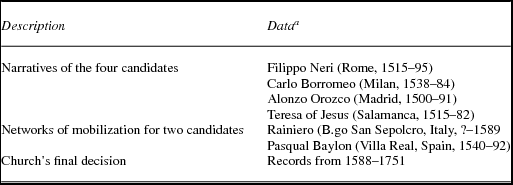
Our data come in three different forms. We have narrative data on the lives of six miracle workers and on the mobilizing efforts that the acolytes of two of these candidates organized in order to secure Rome's recognition. Also, as stated in the introduction, we have data on the final decisions of the Church on all of the candidates who stood trial in Europe from 1588 to 1751 (N = 262),Footnote 7 the nearly two hundred years spanning the creation of the special Vatican commission in charge of investigating sainthood and the publication of the first volume of the Encyclopédie in 1751, which marks the end of the Counter-Reformation. Table 1 describes how we organized the data.
Structure of the data

a Data comes from the Vatican Apostolic Library, the Vatican Secret Archive, and the Archive of the Congregation for the Causes of the Saints.
To handle this diverse data, the methods we employ are mixed. We use the full records of the canonization trials to reconstruct the charismatic authority of the miracle workers and specify the challenge of routinization they faced. In order to gain insight into the relationship between the cults formed around the miracle workers and the Church, we use network analysis and a multivariate analysis. Specifically, we compare the complete networks of the miracles performed by two exemplary miracle workers, one that managed to secure the status of saint (Pasqual Baylon) and another that failed to secure Rome's recognition (Rainiero of Borgo San Sepolcro). To further explore the intuitions gleaned from the networks, we use a logit model to predict the likelihood of Rome's approval, conditioned on several covariates, including the level of local mobilization.
Miracle Workers as Charismatic Leaders
In this subsection, we examine the doings of miracle workers and the types of connections they established with their followers, and we show that miracle workers provide an excellent example of charismatic leaders.Footnote 8
Throughout the Middle Ages and early modernity, miracle workers commanded followers who believed in their extraordinary capacities.Footnote 9 Miracle workers, commonly referred to as “saints” by their followers (regardless of official recognition), performed an extraordinary range of wonders. Typically, miracles had to do with healing (everything from mental illness and organic or contagious diseases to wounds, fractures, and paralysis). In addition, miracle workers sometime resuscitated the dead, brought water to arid places, liberated captives, and ended sterility (Mecklin Reference Mecklin1941; Sallmann Reference Sallmann1994; Stanko Reference Stanko2000). Depending upon the context, a huge range of events could fall under the rubric of “miracle” (Parigi Reference Parigi2010).
In general, miracles addressed the anxieties of potential followers. Women, for example, were five times more likely than men to be healed of mental illness (reflecting the popular belief that women were more susceptible to the malaise). Urban miracle workers tended to perform different miracles from those performed by miracle workers located in rural areas (Parigi Reference Parigi2010). Supernatural powers, in other words, emerged at an intersection of the believers’ needs and expectations and the miracle workers’ abilities to meet those expectations.
Although their authority was highly personal, miracle workers were not lone wolves. Miracle workers were followed by acolytes who served as their staffs. The recruitment of acolytes did not follow a clear procedure. Typically, acolytes were either receivers of or witnesses to miracles that the miracle worker performed while still alive. Such was the case for Filippo Neri and Francesco della Molara. Neri—one of the miracle makers presented in table 1—encountered della Molara, who was wandering around Rome under the impression that he was Belzebu (the devil). Neri instructed della Molara to be happy and start singing, whereupon della Molara started following Neri. At a certain point, Neri grabbed della Molara's head and whispered incomprehensible words to him, perhaps in Latin. By the end of the exchange della Molara was healed and considered himself the recipient of a miracle (Incisa della Rocchetta and Vian Reference Incisa della Rocchetta and Vian1957). Examples of this sort could fill several pages. The main point, however, remains consistent, which is that the supernatural powers attributed to the miracle workers were the basis of their authority and their ability to recruit acolytes.
Describing acolytes as mere “followers” would be a mistake. The acolytes provided opportunities for miracle making, and it was the acolytes who worked out an interpretive frame that allowed ambiguous events to be received as miracles. Take, for example, the following miracle, again from the trial of Neri. When Fulvia de Cavalieri's cousin apparently died, de Cavalieri asked an acolyte to bring his leader to the scene. Neri came and said to the dead woman: “You are not going to die today.” The woman replied: “Father, I am already dead!” Neri assured her that she would feel better, which she subsequently did (Incisa della Rocchetta and Vian Reference Incisa della Rocchetta and Vian1957). In this case, at least, the acolyte was the agent that provided Neri with the opportunity to resuscitate a dead woman, and his presence in the scene helped frame the event as a miracle.Footnote 10 Each new miracle—performed in collaboration with the miracle worker, the acolytes, and the laity—increased the reputation of the miracle worker and attracted more followers to the miracle worker's cult. In a very substantial manner, the acolytes were the bearers of the miracle worker's fama sanctitatis (literally, “fame of holiness”).
Over time, the acolytes who formed small cults around the miracle worker became dependent on the perpetuation of their leader's fame (for a similar point about social movement leaders, see Della Porta and Diani Reference Della Porta and Diani1999). Acolytes occupied important positions in the orders that their leaders founded or reformed. For example, Giovanni Francesco Bascapé, one of Carlo Barromeo's acolytes, earned an appointment as a bishop and was also the secretary of the Barnabiti, the religious order of Barromeo. Similarly, Ana Garcia, the first spiritual sister that Teresa ordained in the monastery of Saint Joseph in Avila, became Teresa's faithful companion and was beatified in 1917 with her religious name, Ana of Saint Bartolomeo. In the early stages, however, the miracle workers and their acolytes had no source of revenue other than occasional donations from the saved (Bossy Reference Bossy1985; Caciola Reference Caciola1996).
The evidence extracted from the lives of four miracle workers suggests that these individuals formed a highly personal charismatic authority structure. Miracle workers were sometimes also religious officers, but their authority stemmed from the performance of miracles and not from their position in the Church. Miracles served to increase the reputation of the leader, recruit the staff of acolytes, and generate material support for the miracle worker's cult.
The Transformation and Preservation of Miracle Making
If miracle workers and their acolytes formed a charismatic authority structure, this structure was also subject to the ultimate predicament of its transformation. The death of the miracle worker, just like the problem of succession that Weber discusses, illustrates this predicament well, with one noticeable difference. Whereas the problem of succession in Weber's writings is resolved with the transference of authority to another entity (a successor, a council of elders, or a bureaucratic office holder), the authority of the miracle workers did not dissolve upon their deaths. On the contrary, acolytes expected their leaders to be resurrected in Paradise. This is perfectly symbolized by the expression “dies natalis”—that is, the day of birth, to indicate the day of the leader's death. The death of the leader also provided an excellent opportunity for miracle making. On May 19, 1592, two days after Pasqual Baylon died, his body was exposed to the public in Villa Real (Spain). Baylon opened his eyes during the mass and moved his arms, and from his body dripped a sweet liquid capable of healing people. Further, one of Baylon's most famous miracles was knocking from within his coffin, reinforcing the idea that he never really died—not on that day, at the very least (ACS Storico, 123, 345)! Still, if left idle, the memory of the leader's miracles would dissipate with the death of the last witnesses of in vitam miracles. Therefore, the problem of succession in our special case was the succession of acolytes, not of the miracle workers.
The only way to prevent the dissipation of the cult after the death of the last acolyte was to recruit new people, and this was accomplished by forcing the miracle maker to perform postmortem miracles. These miracles, just like the in vitam miracles, functioned as a channel of recruitment to the miracle worker's cult. In practice, the predicament of the acolytes boiled down to two challenges. On the one hand, they had to create conditions that would allow the dead leader to continuously do miracles—that is, they had to engage in the making of a miracle and, at the same time, render their labor invisible so that the miracles would be attributed to the deceased miracle worker. On the other hand, the acolytes had to make sure that they, and not anyone else, would continue to serve as the catalysts for the miracles.
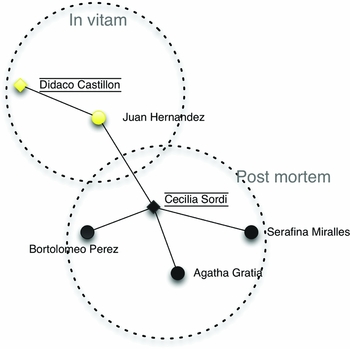
Figure 1 presents the dynamic of such a recruitment process, as it was represented in the canonization trial of friar Pasqual Baylon. While alive, Baylon was gifted with the ability to read the future. A witness to one of these miracles was friar Juan Hernandez. Baylon predicted the exact day when a disease (not specified) would strike Didaco Castillon, a fellow friar in the same monastery where Baylon and Hernandez lived (BAV 2768). Thereafter, Hernandez became one of Baylon's main acolytes. After the death of Baylon, Hernandez helped catalyze a postmortem miracle on Cecilia Sordi. Cecilia's arm and hand had been paralyzed for more than seven months. She visited Baylon's tomb and met Hernandez. After hearing of Cecilia's disease, Hernandez placed a necklace that had once belonged to Baylon on Celia's hands and arm (or collar, not clear from the records), and the woman was healed on the spot. The figure illustrates Hernandez's role in carrying on Baylon's fame through the facilitation of postmortem miracles. Note, however, that despite his importance, at no point has the miracle perform on Cecilia been attributed to Hernandez. The locus of the charismatic relationships remained between the (dead) miracle worker and the beneficiaries of his grace.
From miracles to networks

To create opportunities for postmortem miracles, acolytes established contact with people in need of a miracle by retelling the virtues of their leader, just as they did when the miracle worker was alive. In addition, in order to allow the deceased miracle worker to act, the acolytes developed special rituals, modeled to a large extent on what the miracle worker did in vitam and assisted by relics from the corpse.Footnote 11 Upon arrival at the sick person's house, the acolyte would invite everyone present to pray, often instructing them to kneel and pray aloud together. During the prayer, the acolyte would ask the miracle worker for grace for the sick person, and at this point the acolyte usually took out one of the candidate's relics and applied it to the invalid. Those present would notice an improvement in the invalid's condition immediately or within a few days.Footnote 12 The saved and the witnesses to the miracle would sometimes reciprocate with gifts and become supporters of the miracle worker.
The ritualization of miracle making generated a predictable path of events, starting with a prayer, kneeling, and placing relics over the person in need, and ending with a predictable outcome, the miraculous healing of the sick. This predictable path helped create the mental frame that turned ambiguous events into miracles. By carefully imitating the miracle worker's behavior and using the relics, the acolytes carried on the achievements of their leader without becoming the performers of the miracle.
To an extent, performing a postmortem miracle was as easy or hard as performing an in vitam one. In both cases, the acting hand of God had to be discerned in somewhat less than clear-cut events. Take, for example, the following story extracted from the trials of Orozco (see table 1). Maria Jaraz de Arraya had almost completed her pregnancy, but on April 28, 1620 she suddenly fell ill. Antonio Gutierez, her husband, ran through the streets of Madrid seeking a surgeon to help deliver the baby and a doctor to help his wife. A priest arrived on the scene, and while the doctor and the surgeon went to work, the priest placed several relics on de Arraya's body. Nothing worked, and de Arraya lay there, rigid and cold, on the verge of death. Juan de Herrera, Orozco's most active acolyte, learned what was happening at the Gutierez house and rushed over unexpectedly. He requested that all the other relics be removed, and invited everyone to pray while he placed Orozco's belt on the woman's womb. Half an hour later, de Arraya recovered her strength and delivered a stillborn baby. Everyone present proclaimed the event a miracle, even though the baby did not survive (ASV 3033). In this case, like many others, the acolytes performed not only the ritual of healing and praying but provided the whole interpretive framework that allowed such events to appear as miracles.
Nevertheless, in important respects, performing postmortem miracles was harder than performing in vitam miracles. In the first place, the acolytes had to make do with only pieces (literally) of the charismatic leader. More fundamentally, the ritualization of postmortem miracles, while creating vital mental scaffolding for the whole event, also placed constraints on the acolytes’ work. Whereas the charismatic miracle worker enjoyed almost complete discretion when it came to the choice of what in vitam miracles to perform, the acolytes were bound to facilitating those same miracles postmortem. As a result, the acolytes were less able to respond flexibly to the changing needs of the laity.
The use of relics also introduced an additional challenge of monopolizing miracle making. Given the widespread belief in their efficacy, the laity, too, wanted to obtain relics. When, on August 23, 1589, friar Rainiero died, a large crowd gathered outside the monastery in Borgo San Sepolcro in central Italy. At some point, the crowd broke down the barriers put up by the friars and rushed to the body that lay inside the church. Egidio de Amelia, a friar in the same monastery, described the scene as follows: “the crowd cut five or six uniforms and a cape that I myself had thrown on [Brother Rainiero] because he had remained almost naked. Three scissors were brought in…his hair was cut along with his beard and his eyelashes. His nails were removed along with the flesh; the crowd removed one of his teeth” (ASV 3239, fol. 81). The laity, it seems, were eager to cut out the middlemen acolytes and enjoy the services of Rainiero directly, which posed a tremendous challenge to the acolytes. If the laity obtained their own relics the acolytes would no longer be necessary, and their nascent authority would quickly disintegrate.
As discussed in the preceding text, Weber believed that the transformation of charisma inevitably leads to routinization and disenchantment. In contrast, the process we describe here places charisma on more stable grounds without displacing the miracle maker or the importance of his or her gift of grace. The charismatic power that saved people when the miracle worker was alive remained preserved in the relics. Moreover, the personal deeds of the miracle worker continued to play a key role in the recruitment of new acolytes to the emerging cults. As discussed in the preceding text, the acolytes played a crucial role in the propagation of miracles but the struggles over the control of relics clarify that they did not become the bearers of the tradition of the deceased leader (as happens in routinization toward traditional authority). The emerging religious orders, to the extent that they managed to stabilize their authority, continued to derive their legitimacy from a particular person who performed miracles.
The preservation of the authority structures built around the miracle workers after their deaths required solving two interrelated problems. First, the acolytes had to create conditions for the creation of miracles without the live presence of the miracle worker. Second, the acolytes had to prevent miracles from becoming too independent. Failing to accomplish either of these challenges would have spelled the disintegration of the cult surrounding the deceased miracle worker.
Exogenous Factors and the Preservation of Charisma
Weber believed that charisma is essentially inimical to other forms of authority, and he focused on the relationships among the leader, the staff, and the laity. In our case, however, many acolytes did more than simply facilitate postmortem miracles. A good number of cults also appealed to the Church and demanded that their miracle worker be recognized as a saint. Understanding the relationship between Rome and these local cults provides a key to understanding the preservation of charisma.
Understanding the motivation of the acolytes is easy. Canonization was an official recognition that their leaders indeed performed miracles, and it therefore secured a flow of pilgrims to their orders. Of the 262 cults in our data, only those acolyte cults that successfully secured canonization for their leaders managed to create permanent orders. Clearly, canonization was vital for the preservation of these cults.
In our case study, the only institution that could offer the acolytes recognition was the Catholic Church, and it had a good reason to do so. In the aftermath of the Protestant Schism, the Church faced a deep crisis of legitimacy (Bossy Reference Bossy1985; Dickens Reference Dickens1968; Ginzburg Reference Ginzburg1976). Rome was also in a dire financial crisis following the devastating sack at the hands of the imperial troops in 1527. Rome reacted to this crisis by introducing the Inquisition (in 1542 the Santo Ufizio was created) and—this is less known—by implementing a meticulous reorganization of the government of the Church. Because doubts related to the supernatural powers of saints were at the root of the Protestant accusations, the adjudication of miracles became a significant part of this reorganization (Gotor Reference Gotor2004; Papa Reference Papa2001; Rusconi Reference Rusconi and Rosa1992). Interestingly, the Church did not squelch the mushrooming cults of miracle workers but instead attempted to regulate these cults so as to make sure that the abuses of the past—as Pope Urban VIII wrote, “that had crept into and in time were continuing to creep into the honoring of somebody with fame of being a saint or a martyr”—would not continue (Decreta in Papa Reference Papa2001: 322).
Comparing this approach with what the Church did before shows some important differences. From the fall of the Western Roman Empire to the Protestant Schism, Rome did not have a monopoly over the proclaiming of saints. Many different versions of sainthood existed simultaneously, and agreed upon criteria for making a particular person a saint were largely absent. The papacy may have been biased in favor of learned and elite forms of sainthood (see Vauchez Reference Vauchez2000), but it was not able to discredit the sanctity of many others. After 1588, Rome divided the category of “saint” into two categories and recognized particular candidates as either “blessed” or “saint.” More importantly, for our purpose, is that Rome for the first time introduced a widely followed procedure for the recognition of either category and could deny that status to those who fell out of favor.
The selective incorporation of potentially disruptive local religious movements into the Church was in the interests of Rome. This motivation can be gleaned from the words of Giovanni B. Coccini, titular archbishop of Damascus and a member of the congregation that adjudicated sainthood. In a summary report that he wrote in 1618 for the Pope about a candidate, he explained:
…it is not sufficient that somebody is written in the book of life of the triumphant Church in order to determine God's judgment, just as all the predestined people are, but an ulterior requisite, is to be written in the aforementioned book according to existing justice, just as those who are informed and promoted by [their] works and that are helped by the instructions and the examples of the Church. (Relatio, quote in Papa Reference Papa2001: 247, emphasis added)
In this passage, the archbishop enumerates the qualifications required to become a saint. In addition to doing good works—that is, performing miracles—Coccini emphasizes the importance of existing justice—that is, local sentiments—and following the instructions of the Church. The importance he attributes to existing justice is remarkable. Instead of trying to decipher God's verdict by focusing on the candidate's deeds alone, the Congregatio considered the candidate's popularity and showed preference to popular candidates whose canonization would bolster its position in local communities.Footnote 13 Church officials, in other words, recognized that canonization was an opportunity for channeling legitimacy toward the wounded core of the Church.Footnote 14
Canonization, as many historians have noted (Boesch-Gajano Reference Boesch-Gajano1999; Veraja Reference Veraja1988), was a costly procedure, and the decision to begin the process was not religiously ordained. Nevertheless, for the acolytes, the new process of canonization presented an outstanding opportunity. Recognition from Rome meant that their candidate was indeed a saint—that is, somebody capable of performing miracles—and this status was invaluable for attracting pilgrims to the candidate's tomb, which, in turn, generated a steady flow of donations. This allowed the acolytes to stabilize their otherwise shaky position.
To some extent, the facts that acolytes appealed for recognition of their leaders from the Church and that the Church provided for such a venue corroborates our main contention: that acolytes appealed to Rome implies that they wanted to win recognition. In order to gain a deeper insight into the exchange between acolytes and Church authorities, however, it is useful to move beyond the content of the testimonies given in the canonization trials and explore the networks of interrelations that these testimonies reveal. To do that, we look in detail at the canonization trials of two candidates—Pasqual Baylon (1540–92) and Rainiero of Borgo San Sepolcro (1511–89)—whom we choose because of their sharp contrast. While Baylon is one of the most famous saints of Spain, Rainiero is a completely forgotten venerable of central Italy. Whereas Baylon's authority structure underwent successful preservation, that of Rainiero disintegrated. Yet they had many similarities: they operated in rural areas and commanded large followings while alive. They were both Franciscan friars and performed roughly similar types and numbers of miracles.Footnote 15 Rainiero's first trial took place in Todi, Italy in 1628, while Baylon's first trial took place in Villa Real, Spain in 1592.
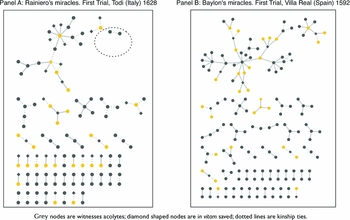
The transcripts of the canonization trials make it possible to reconstruct the network of relationships among the testifiers. For each miracle, several witnesses had kinship relationships with the saved and with each other, while for other testifiers the only relationship between them was that of having witnessed a miracle together. For both Baylon and Rainiero, we pooled both types of relationships across time in order to create networks. We coded relationships in the manner illustrated in figure 1 and repeated the procedure for all the miracles reported in the trials of Baylon and Rainiero, creating two networks comprising, respectively, 86 witnesses and 43 recipients of miracles for Baylon and 63 witnesses and 56 recipients of miracles for Rainiero. The results can be seen in figure 2.
The networks of mobilization in two communities

The networks of Rainiero and Baylon tell an interesting story. The two miracle workers performed a similar number of miracles while still alive and a similar number of witnesses testified on their behalf, mostly from the lower social classes. Yet, the structural features of the networks their miracles created are strikingly different. In figure 2, the panel on the left (A) shows Rainiero's network, and the panel on the right (B) presents the network for Baylon. In Rainiero's case, the network is fragmented into multiple small clusters made of a recipient of a miracle and a few witnesses. In contrast, in Baylon's case the network has a very identifiable component that includes the majority of his miracles and almost 60 percent of the testifiers.
The different network configurations suggest that Rainiero's and Baylon's acolytes adopted different mobilization strategies, with strikingly different results. Recruiting new acolytes through the performance of miracles required considerable skill, and, simply put, some acolytes managed to create more cohesive networks than others. Take, for example, the highlighted cluster at the top of panel A. A spirit possessed Antea d'Antinoro (represented as the node at the center of the component) for twenty years. One day she ran into Rainiero. Seeing the woman's poor health, the magic friar made the sign of the cross moving his hands in front of Antea's face, and the spirit finally left her body. This experience transformed Antea into one of the most fervent believers of Rainiero, making her an active catalyst of postmortem miracles. Yet all the miracles she propitiated after Rainiero's death remained confined within her family—Antea's husband, Francesco, was once saved, then her sister's son, then her cousin. While the details of these miracles are impressive, the crucial point for our argument is that Antea never managed to propagate miracles involving people other than her own relatives (ASV 3239). A similar narrative applies to several of the small clusters of miracles in Rainiero's network. The absence of one large component in his network suggests that Rainiero's acolytes failed to mobilize people outside of the original group of believers (Parigi Reference Parigi2006).
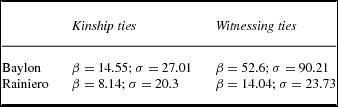
Although Rainiero and his acolytes performed more miracles than Baylon and his acolytes, Baylon's miracles were more likely to connect individuals across kinship lines. Table 3 presents a quantitative estimate of this difference. The table shows the average betweenness (and its standard deviation) for the two types of ties portrayed in the networks of figure 2—kinship and witnessing. Betweenness measures how much a tie is “in between” the paths of each pair of nodes in a network. The higher the betweenness, the more central that particular tie is.Footnote 16 As expected, witnessing ties are on average more important than kinship ties in both networks, which suggests that it is these ties that generate large components. More strikingly, however, the average betweenness of witnessing ties for Baylon is almost four times that of Rainiero. Table 3 suggests that Rainiero's acolytes put forward miracles that remained mostly isolated (consider the many dyads in Rainiero's network) and within kinship (look at the several larger components that in Rainiero's network are made exclusively of kinship ties), whereas Baylon's acolytes were more successful at bridging across kin groups.
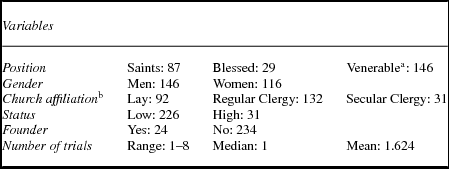
Description of the variables in the Logit model

a The position of Venerable is the union of two statuses (a) venerabile and (b) servo di Dio.
b Regular clergy are brothers, friars, and nuns; secular clergy are priests and higher level clergy in contact with secular people.
Average betweenness (β) and standard deviation (σ), for the two networks

Both the more qualitative evidence and the networks for the two candidates suggest that acolytes were instrumental in facilitating postmortem miracles and that these miracles served to mobilize a community in support of their leader's candidacy for sainthood. More importantly, for our purpose, Rainiero's acolytes failed to attract the Church's recognition, whereas Baylon's acolytes succeeded in securing the Church's approval of their leader. As a consequence, while nobody today remembers friar Rainiero, the deeds of friar Baylon are well-known throughout Spain.Footnote 17 Baylon's acolytes, with some help from the Church, managed to preserve the charisma of their leader. Rainiero's charisma, in contrast, simply evaporated with the last acolytes, leaving almost no trace. While we are obviously limited by the tiny sample, the Church's discriminating reaction to these two cults suggests that it was sensitive to the influence of different miracle workers and that its response played a role in determining the fates of the miracle workers’ cults.
To explore the suggestion that the Church's procedure was biased in favor of acolytes with more influence, we construct a logit model that predicts the likelihood of Rome's approval conditioned on several covariates, including the level of local mobilization. For each charismatic religious leader that became a candidate for sainthood in the period from 1588 to 1751, we coded whether or not the Church proclaimed him or her blessed. From our viewpoint, the statuses of blessed and saint can be lumped together because the social consequences of these two types of recognition were similar. In fact, almost all of the candidates who were proclaimed blessed went on to eventually become saints. This contrasts sharply with the status of venerable, which effectively meant a denial of Church recognition.
We conditioned the likelihood of becoming blessed on the covariates listed in table 3.
To remain loyal to the social realities of the period, we used the Church's classification that distinguishes candidates by their institutional affiliation. Thus, regular clergy candidates were monks, friars, or nuns—that is, persons who spent the bulk of their lives away from secular life. Conversely, a secular clergy candidate was someone, such as a priest, who lived in close contact with secular people. Candidates who either started a new religious order or led the reform of an established order were coded as founders, regardless of whether or not they belonged to regular or secular clergy. This is the first measure we used to capture mobilization. Because the reforming effort related to starting a new order occurred when the miracle worker was still alive, this measure of mobilization captures the amount of support that the living candidate was capable of mustering. To capture the acolytes’ role in mobilization, we looked at how many trials they started before their candidate reached the status of blessed. These trials, which Rome designated as “ordinary trials” (Processus Ordinario), were started on the initiative of local leaders and required a substantial amount of resources (Boesch-Gajano Reference Boesch-Gajano1999; Veraja Reference Veraja1988). To some extent, ordinary trials were superfluous because the final decision with regard to a miracle worker's status was reserved for the “apostolic” trial, which was the trial that the Roman authorities carried out. Nevertheless, the number of ordinary trials performed on behalf of particular miracle workers provides us with a strong indication of the strength of the local mobilization their followers commanded.Footnote 18 We also used the year 1642 as a dummy to capture the new regulations on matters of sainthood and miracles that the Church consolidated into a coherent new code in that year. Historians have pointed out the importance of 1642 in marking the beginning of modern sainthood (Papa Reference Papa2001; Pastor Reference Pastor1938; Veraja Reference Veraja1988).
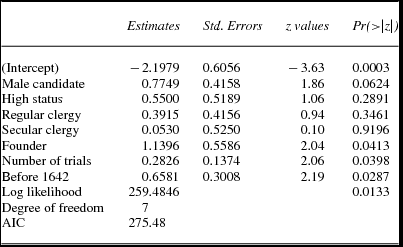
In table 4, three predictors (Founder, Number of trials, and Before 1642) and the intercept are statistically significant. Being a founder of a religious order and having several ordinary trials significantly increased the chances of receiving Rome's recognition as blessed. Table 4 also shows that these chances decreased after the reforms of 1642 (see also Gotor Reference Gotor, Fiorani and Prosperi2000) and that for lay female candidates of lower status—the residual categories in the intercept—the chances of receiving approval were significantly diminished (see also Prosperi Reference Prosperi and van Kessel1986). Interestingly enough, the status of a candidate was not significant.
Logit model of the likelihood of becoming blessed

Data source: Registry of the Congregation for the Causes of Saints.
N = 262.
The model in table 4 confirms our broad hypothesis that Rome paid attention to the mobilization that the miracle worker and his acolytes created in a local community. The model suggests that, for each additional ordinary trial that acolytes organized, the chances that their candidate would receive recognition from Rome at some point in the future increased by
 $(\frac{e^{28}}{1+e^{28}})/4 $
, or 14 percent at the most (Gelman and Hill Reference Gelman and Hill2006). Furthermore, if miracle workers were founders of new religious orders or were reformers, their likelihood of receiving the status of blessed went up by 76 percent. Importantly, the fact that higher status is not statistically significant is relevant for our argument because it suggests that the procedures of canonization were more sensitive to the degree of local mobilization than to the cult's access to economic resources. While the model shows that it was harder to obtain recognition after 1642, the interaction effect is not significantly associated with likelihood of approval, which suggests that acolytes’ efforts remained equally important before and after the reforms of 1642.
Finally, the bias against women that the model picks up (the reference category of the model) is consistent with the historical literature on sainthood. In short, this literature suggests that the Congregatio discriminated against women. This is often attributed to the Church declaring certain types of supernatural capacities associated with women, such as visions, to be “illegal” (Prosperi Reference Prosperi and van Kessel1986).
Together, Rainiero's and Baylon's networks and the results of the logit model suggest that in the aftermath of the Protestant Schism the Catholic Church adopted procedures that were sensitive to the degree of mobilization garnered by local acolytes and showed marked preference toward those cults that proved their ability to muster local support for their miracle workers. These findings support the idea that the institution of modern sainthood became a part of a set of reforms instituted by the Church in an effort to regain control over Europe.
Discussion
In this article, we examine early modern miracle making to suggest that, at least in some cases, charismatic authorities can escape the predicament of routinization and preserve their charismatic character by establishing mutually beneficial relations with existing institutions. Cults of charismatic miracle workers attempted to preserve their charismatic authority by appealing to the Church for recognition of their leader as a saint. The Church bestowed the status on influential miracle workers while denying it to less influential candidates. Even if not explicitly planned this way, the new process of canonization created an affinity between the needs of the acolytes and the interests of the Church. On the one hand, canonization guaranteed a stable stream of pilgrims that supported the emerging orders of the miracle workers. The Church, on the other hand, incorporated into its ranks the most potentially threatening miracle workers, thereby channeling the fervor they induced back into the church and reasserting Rome's dominance. These symbiotic relations occurred at a crucial juncture in the history of Catholicism—the aftermath of the Protestant Schism—when the Church experienced severe political and financial crisis.
By “preservation of charisma” we do not mean that the charisma had become a static feature of an authority structure or that it had undergone no changes. Whereas Weber's “genuine charisma” recognized absolutely no external authority, the cults of acolytes examined in this article were deeply dependent on the Church. Nevertheless, they continued to derive their legitimacy, to a large extent, from the gift of grace of their leader and the continued performance of extraordinary feats. Furthermore, the process we describe is different from traditionalization because the acolytes did not manage to establish monopoly over the interpretation of the miracle worker's tradition, and in that sense, authority remained imbued in the person of the miracle worker, as illustrated in the struggle over the control of his relics. While the recognized religious orders became more robust in comparison with those cults that failed to achieve recognition, the charisma they enjoyed was by no means static. Church recognition merely provided acolytes with a relatively reliable problem of balancing the contradiction between the duty to obey charismatic leaders and the demand for proof. While this solution was extremely valuable, it was nothing more than a useful ground for continuing and enacting charisma over time, not a fail-safe guarantee.
That charismatic leaders and established institutions sometimes work together is not a new observation. Shils, for example, identifies charisma in a wide array of institutions and suggests that charisma “not only disrupts social order, it also maintains or conserves it” (Reference Shils1965: 200; see also Ake Reference Ake1966; Eisenstadt Reference Eisenstadt1968; Riesebrodt Reference Riesebrodt1999). But our account of this observation is different. Shils and Eisenstadt attribute the ubiquity of charisma to a general propensity to impute charismatic qualities to actions, persons, institutions, and cultural objects. Allegedly, this propensity is linked to a universal quest for order and meaning, which charismatic personalities provide. But by identifying charisma everywhere, and by linking it to general human characteristics, they diffuse Weber's model completely (Dow Reference Dow1969: 314; Riesebrodt Reference Riesebrodt1999). In contrast, our explanation uses the critical dynamics Weber identified—the predicament of providing proofs of election and the crucial importance of the staff—to develop a more satisfactory account of the relationships between charismatic authorities and existing institutions. It was this dynamic that prompted the acolytes to seek canonization for their leaders. Furthermore, the comparison of Rainiero's and Baylon's networks, although tentative in nature, suggests that the skill and acumen of the staff is important. Both miracle workers seem to have been able to muster similar enthusiasm while alive, but Baylon's acolytes’ strategy of expansion resulted in a wider and more tightly connected network, a fact that proved instrumental for the preservation of charisma.
Many contemporary commentators have explored the possibility that charisma would be maintained within permanent institutional structure (Eisenstadt Reference Eisenstadt1968; Riesebrodt Reference Riesebrodt1999; Schluchter Reference Schluchter1989; Shils Reference Shils1965). While our examination largely supports this possibility, it is important not to discount the brittleness of charismatic authorities and the difficulties involved in preserving charisma within permanent institutional structures. With Weber, we believe that charisma is potentially disruptive and cannot easily be incorporated into other authority structures. For hundreds of years, the Church either ignored or attempted to squelch the practice of miracle making, and it was only during the Counter-Reformation, when the church was pressed to the wall, that it introduced procedures that allowed for the incorporation of potential troublemakers (i.e., miracle makers). Even then, the Church did not grant canonization indiscriminately but rather reserved recognition for those cults of miracle workers that were well organized and effective in mobilizing followers. Thus we suggest that the incorporation of charisma into existing institutions is not an omnipresent phenomenon but rather a rare outcome.
Weber and others suggest that charismatic leaders are likely to appear in times of crisis or extraordinary distress. Weber links this emergence of charismatic leaders to the type of solution charismatic authorities offer. Unlike traditional or bureaucratic authorities, who offer solutions to ordinary troubles, the charismatic leader offers extraordinary and magical solutions for extraordinary distress. Thus, the greater the need for miracles, the greater is the likelihood that the laity will recognize certain personalities as possessing the capacity to deliver magical solutions. Although possessing intuitive appeal, this quasipsychological explanation is not without problems. Times of crisis, as our case makes amply clear, are also very often times of doubt and suspicion. It is not clear, then, why the laity, which shows great capacity to question established forms of authority (whose rationale of domination is deeply engrained), would gullibly follow a new leader who claims to possess a gift of grace. Taking account of the interaction between existing institutions and the charismatic authorities suggests an alternative explanation for the visibility of charismatic authorities in times of crisis, one that relates not so much to the emergence of charismatic authorities but rather to the preservation of charisma. It may be the case that the greater visibility of charismatic leaders is a by-product of the fact that in times of crisis existing institutions seek to create mutually beneficial relationships with charismatic authorities. From this perspective, what makes the link between crisis and charisma is that times of crisis provide fertile ground for the preservation of charisma.Footnote 19
Our analysis of the preservation of charisma provides useful tools for thinking of a plethora of contemporary phenomena. Movie stars, celebrity chefs, and even CEOs of major corporations (Biggart Reference Biggart1990; Kantola Reference Kantola2009; Khurana Reference Khurana2002) are sometimes recognized as charismatic visionaries. As in the case of our miracle makers, these authority structures confront the departure of their leaders and may attempt to preserve the charisma of their leaders after their departure.Footnote 20 The case of personalized brands is particularly useful for illustrating this point. Lee McQueen fashion house confronted this problem dramatically when the stylist committed suicide in 2010. Dissolution of the fashion house was, however, only one of the options; the other option, and the one indeed taken, was for the brand's designers—the staff of Lee McQueen—to try to keep the spirit of McQueen going. In such circumstances, recognition from consecrating institutions, such as Anna Wintour of Vogue magazine, is key for the preservation of the brand. At the same time, the institution has an incentive to gain the legitimacy that comes from the incorporation of new, cutting-edge individuals into its fold and to enjoy the broader audiences that come with it. Analytically speaking, therefore, our analysis of the preservation of charisma can fruitfully be used in diverse fields in which individual genius is considered particularly important and one can identify one (or a few) consecrating institutions capable of bestowing effective recognition.
The analysis of the preservation of charisma can also be extended to situations in which a charismatic leader is still alive but the need to perform extraordinary feats extends beyond her or his immediate presence. Celebrity chefs, for example, are widely recognized as culinary “miracle makers,” but they often own more than one restaurant. As in the case of our miracle workers, we argue that their ability to repeatedly deliver magic even without their immediate presence in the kitchen depends heavily on securing recognition from more stable consecrating institutions (such as the Michelin Guide in the case of chefs). Such recognition helps in securing the services of capable staff, which is the main condition for turning good performance into a sign of a gift of grace. In principle, one may expect to see instances of the preservation of charisma in many spheres of activity beyond religion and culture, but the limits of this phenomenon are quite clear. External consecrating institutions, our argument suggests, are absolutely crucial for the preservation of charisma. In the absence of such consecrating institutions, therefore, the preservation of charisma is much less likely to occur. In the field of politics, for example, where sovereign action takes place, few consecrating institutions exist, and these do not tend to recognize personalized gifts of grace. Therefore, in politics, despite the central role it plays in Weber's thinking, one may be hard-pressed to find instances of the preservation of charisma.Footnote 21
More generally, our discussion of Lee McQueen and celebrity chefs illustrates not only the contemporary relevance of the preservation of charisma but also its limits. While celebrity chefs may enjoy some charismatic aura, their power in the Weberian sense—that is, their ability to impose their will even against the wills of others—is obviously quite limited. While celebrity chefs can impose their will on their staffs, to a guest they can only recommend trying a new recipe, and this is obviously the case with many other types of cultural producers. Nevertheless, to the extent that the analysis of the dynamic relations between leaders, staffs, laity, and external institutional structures adds to our understanding of the longevity of these charismatic or even quasicharismatic forms, our extension holds merit.