INTRODUCTION
The Ethiopian government has followed a policy of trade reform since 1993. The reform dismantled the quantitative restrictions used in the earlier regime and reduced the high tariff rates. During the previous Derg era,Footnote 1 the tariff reached as high as 230% on certain luxury consumer goods. The quantitative import restrictions on imports by the private sector included direct import prohibition (a long ‘negative list’), quotas, strict licensing and foreign exchange rationing. Currently, quantitative import restrictions are applied only to used clothes, harmful drugs and armaments for security reasons (MTI 2003). The declared aim of revising the tariff code was to move to a six-band tariff structure of 5, 10, 15, 20, 30 and 35% by 2002 (ibid.).
Under a liberalised trade regime, new cheap imports from Asia, particularly from China, have dominated the footwear sector in Ethiopia. The tariff that applies to imported shoes is 35%. This is low compared with the old tariff regime, though it is the highest in the present tariff structure. The Chinese imports compete in the domestic market. They have relegated informal firms to supplying the most basic traditional types of footwear, and have forced them to desperately compete with the cheap imports (Knorringa & Pegler Reference Knorringa and Pegler2004). The small-scale factories which produce for the more expensive domestic market segment are also affected, as the quality of imports improves (ibid.). On the other hand, firms faced with such disequilibrium have continued to survive and operate in the domestic market. This indicates that firms have developed coping strategies that enable them to survive in the market or even grow. On the policy side, the need to enhance the footwear sector in the face of increased pressure and competition should be given the utmost importance in order to make the sector fulfil its potential role and form the basis for the industrialisation of the country. Against this background, it is therefore interesting to examine the impacts and strategies of firms more closely. This study, conducted in the shoe cluster of Addis Ababa, the capital city of Ethiopia, does so by presenting firm-level evidence from qualitative and quantitative data.
Primary data for the study were collected using a survey, which aimed to derive a cross-section view of the micro, small and medium enterprises concerning the effects of Chinese imports and coping strategies of firms. In total, 96 enterprises were surveyed, of which 66 were micro and 30 were small and medium enterprises. Enterprises up to 15 workers were classified as micro enterprises while those above 15 were classified as small and medium. The selection procedure followed a two stage sampling for micro enterprises. In the first stage, three kebeles Footnote 2 where the highest concentration of micro enterprises are found were selected purposively. These were kebeles 12,Footnote 3 5 and 17. A census of all micro enterprises in these kebeles was undertaken using local guides. A total of 330 micro enterprises were listed; 20% of the enterprises were selected from each kebele randomly. This gave a total of 66 enterprises which were surveyed using a structured questionnaire with the help of enumerators.
Small and medium enterprises are scattered in different kebeles, and are known by their brand names. A list was prepared with the help of key informants. A total of 75 enterprises were listed; 40% or 30 enterprises were selected randomly from the list. This number permits statistical generalisations. Small and medium enterprises are over sampled due to smaller size of their population. A total of 94 of the 96 questionnaires were utilised. Two were discarded because of insufficient information. While surveys provide insight into the general pattern of the firms’ characteristics and features in question, they fell short of providing an in-depth perspective into the processes and dynamics of individual firms. A case study method was used to complement information from surveys and derive a deeper understanding of the issues. Information-rich case studies were purposefully chosen from entrepreneurs who were willing to volunteer information. Accordingly, six cases, three from micro enterprises and three from small and medium enterprises, were selected. In-depth interviews, using an unstructured checklist, were carried out to study firm-level activities and coping strategies.
The paper is organised as follows: after this introductory section, section two presents a brief theoretical perspective on impacts of trade reform. The third section presents an overview of the footwear sector in Ethiopia. The fourth presents some descriptive data to provide an overview of the firms studied. The fifth section discusses firm-level evidence on the impact, coping strategies and ways forward. The firm-level evidence is presented under four subsections: domestic market requirement and competitive advantages of Chinese and local shoes; the impact of Chinese imports; the coping strategies of local firms; and ways forward. The last section concludes.
IMPACTS OF TRADE REFORM AND TRADE RELATIONS
Neoclassical theory asserts that trade liberalisation has both static and dynamic benefits. The static argument refers to the reduction of inefficiencies arising from resource misallocation. Import substitution policies have resulted in encouraging high cost industries and did little to increase productivity over time (Rodrick Reference Rodrik1993). Trade liberalisation on the other hand will improve economic performance and increase productivity growth as a result of more competition from imports, greater economies of scale, and increased availability of imported inputs, enabling firms to utilise their productive capacity (Jenkins Reference Jenkins1997). Since trade policy removes export barriers, exports will become more attractive and competitive. The dynamic efficiency gains come from greater capacity utilisation, greater specialisation, enhanced technological capabilities, greater learning by doing, and higher process and product innovation (Rabellotti Reference Rabellotti1999). The conventional wisdom in this regard is that imports, by creating competition in domestic products in the home market, provide incentives for firms to improve their operations. On the other hand, exporting firms, in response to competition in foreign markets, keep up with modern technology in order to maintain or improve their market position. In the survey of empirical literature at firm, industry and country level, Rodrick (Reference Rodrik1993) found that though many studies have causality and measurement problems, the various studies taken together indicate that countries with fewer price distortions, particularly on the trade side, tend to grow faster.
On the other hand, the literature on the impact of trade liberalisation on economic performance has focused on middle-income and semi-industrialised countries, while less-developed countries with a small industrial base and limited infrastructure have not featured prominently (Jenkins Reference Jenkins1997). It is difficult to draw conclusions on the impact of trade liberalisation on the poorest countries from the findings of semi-industrialised countries. In Bolivia, a country similar to a number of sub-Saharan African countries, trade liberalisation has not resulted in the expected gain. Though it caused a shift of resources from manufacturing to non-manufacturing and within manufacturing, it did not result in labour productivity and export growth. Within the manufacturing sector, the impact was the closure of some firms and production cutbacks in others.
Bilateral trade relations are also important in shaping the impacts of trade reform. In discussing bilateral trade relations between China and SSA countries, Kaplinski et al. (Reference Kaplinski, McCormick and Morris2006) note that trade relations may be complementary or competitive, and direct or indirect. Competitive direct relations occur when China's export of consumer goods displaces local producers leading to competitive impacts on workers and entrepreneurs in these sectors, while complementary direct relations occur when China provides SSA countries with appropriate capital goods and cheap consumer goods, with SSA providing China with commodities it requires. From the foregoing discussion, we can hypothesise that (1) the import of Chinese shoes has inflicted heavy damage on local producers; and (2) local producers resort to the ‘low road’ of competition in order to cope with the imports.
THE FOOTWEAR SECTOR IN ETHIOPIA: AN OVERVIEW
The footwear sector (and its allied clothing sector) is well positioned in the Ethiopian industrialisation drives. This emanates from two advantages. First, the country is heavily endowed with livestock resources. Its livestock population is one of the largest in Africa.Footnote 4 Such comparative advantage is further underlined by the fact that the cost of raw hides and skins constitutes on average between 55–60% of the production of semi-processed leather (van der Loop Reference van der Loop, McCormick and Rogerson2004). Second, current government policy has a particular focus on the leather (also textile) sector to enhance export growth. A recent white paper on industrial strategy in Ethiopia identifies the meat, leather and leather products sector as one of the priority sectors in Ethiopian industrial development.Footnote 5 The leather (including canvas) footwear industry is given a special emphasis, since it is labour-intensive and produces for export. The footwear sector, however, is not yet able to spearhead development in the envisaged manner. A lot needs to be done in order to invigorate the sector.
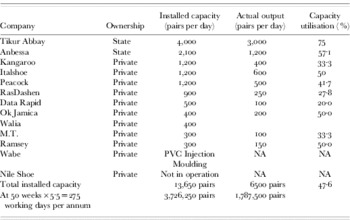
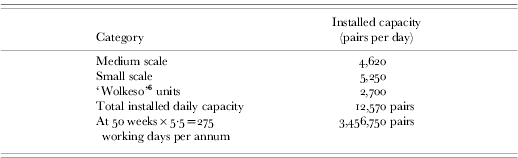
The leather master plan study classified the footwear industry into two groups, namely the large mechanised footwear industries, and the micro, small and medium enterprises (UNIDO & MTI 2005). The mechanised footwear industries are found in the formal sector, and constitute large and medium industries. The installed capacities and the actual output of these industries are given in Table 1. Some of these industries are state owned while most are privately owned. The table shows that the capacity utilisation of these firms is 48%, an indication of problems faced by firms. The other group of industries constitute medium, small and informal producers. According to the master plan (ibid.), the medium-scale producers have about 30–40 workers and number about 3–40 units, the small-scale producers have about 15–20 workers and number about 75–100 units. The informal producers are home based, and are estimated to number about 400–500 units. Knorringa and Pegler (Reference Knorringa and Pegler2004) also estimated that these industries number about 400. These factories are dominated mainly by a single ethnic group, the Gurages, who seasonally move between farm work or petty trading in their native areas and footwear production in Addis Ababa (ibid.). They produce low-quality cheap footwear using manual methods. The targets are rural traders and farmers. The small-scale producers are semi-mechanised and produce for shops in the city. They have their own brand names, and some even attempt to enter the export market but lack capability to do so. The medium scale producers have better machines and workshops, and better known product brands, and mostly sell their products in their own shops (UNIDO & MTI 2005). The total estimated yearly production capacity of the footwear informal sector is given in Table 2. The major drawback faced by all enterprises in the sector is the shortage and poor quality of hides and skins. In addition, there is lack of integration between tanning and leather products. The bulk of the tanning industry output (86%) is exported in semi-processed form.
Installed yearly production capacity of the major footwear industries in Ethiopia

Source: UNIDO and Ministry of Trade & Industry, 2005.
Installed capacity of informal sector
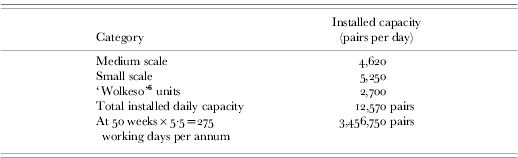
Source: McCillan cited in UNIDO and Ministry of Trade & Industry, 2005.
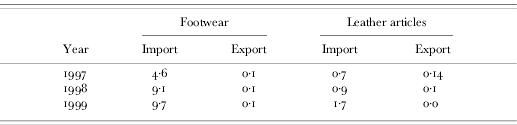
International trade in the footwear sector shows that the country is a major importer (Table 3). Export is only in its infancy or does not exist in the footwear sector. The poor quality of domestic leather and high cost of imported inputs are cited as possible reasons for not being competitive in the international market (Berhanu & Kibre Reference Berhanu and Moges2002). To this is added the stigmatisation of the country. As the country is prone to natural disaster and famine, it does not have an image of producing high-quality shoes (Knorringa & Pegler Reference Knorringa and Pegler2004).
External trade in leather products (million US$)
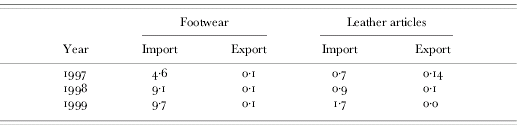
Source: Berhanu & Kibre Reference Berhanu and Moges2002, p. 13.
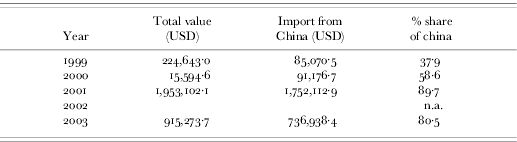
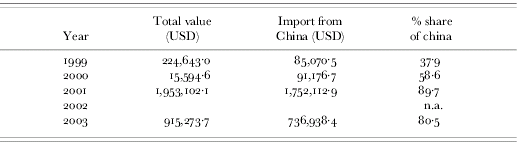
Increased pressure from imported shoes is the major challenge the sector is currently facing. Table 4 shows that leather shoes are mainly imported from China, which accounts for over 80% of the imports since 2001. The domestic market has been flooded with imports, particularly from China, following the trade reform of the country. This affects the performance of the small-scale footwear producers.
Value of annual imports of leather footwear,Footnote * 2003
Source: Ethiopian Customs Authority, unpublished data.
* Only HS code 6403 is used in the table.
n.a.=data not available.
Other factors which may impact on the performance of small-scale footwear producers are related to policy and institutions. On the policy side the government has issued a national micro and small enterprise development and promotion strategy to influence both the informal and formal micro enterprises in 1997 (MTI 1997). The policy, among others, provides direction to create long-term jobs by upgrading the skills and technologies of small-scale enterprises, promoting inter-sectoral linkages within the MSEs, promoting exports by assisting MSEs to participate in international markets, and balancing preferential treatment between the various enterprises in the economy. Though the intention of the strategy is commendable, the existing MSEs are not benefiting from such policy guidance since skills and technologies remain low, there is no promotion of intersectional linkages, and none of the MSEs in the footwear sector is engaged in export.
A proclamation for the establishment and provisioning of micro-financing institutions (MFIs) was also issued, with an objective of delivering financial services (credit, saving and insurance etc.) to the productive but resource-poor people in rural and urban areas (Wolday Reference Wolday2003). The saving products of the MFIs are generally divided into two: agricultural and micro business loans. Manufacturing in the form of handicraft and processing, however, receives a lower proportion of the credit. It is therefore unlikely that the small-scale footwear sector is benefiting from such schemes.
In terms of institutions, the government has established the Federal Micro and Small Enterprises Development Agency (FeMSEDA), and the regional Micro and Small Enterprises Development Agencies (ReMSEDAs), to support small enterprises. The FeMSEDA and ReMSEDAs do not have a separate department to deal with the problems of the footwear sector. These government institutions are totally controlled and managed by civil servants with little input, if any, from the operators of MSEs. Hence, policies and programmes designed and implemented in the sector often fail, as they lack ownership and consensus (Mulat et al. Reference Mulat, Getu and Fereda2005). The other institution of significance to the small-scale footwear sector is the Leather, Leather Products Technology Institute, a recently established support institution believed to be the foundation for capacity building in the leather and footwear sector. The institute is supposed to act as an engine of development in the sector, and provides training in technical, managerial and marketing spheres. The case studies showed that a very small number of producers have received short-term training in different fields such as design and women's shoe making. This is a positive input in dynamising the footwear sector and introducing it to new ideas in the business. The institution, however, focuses on regular training, with a very limited and rather ad hoc programme for on-the-job training. The policies and institutions have not therefore significantly affected the performance of the footwear sectors.
PROFILE OF SAMPLE MSES AND MSE OPERATORS
Most of the enterprises (87·2%) have a single owner. A very limited number (12·8%) are run in partnership. The fact that most of the firms are operated by the owner means that most important decisions about the sale and purchase of inputs, outputs, employment, choice of techniques, etc. are taken by the owner. In fact 89% of the producers mentioned that the owner makes investment decisions in the business. In most of the firms, the owner takes part in the production process or is around to supervise workers.
The gender distribution of owners shows that males are dominant, though some female participants are also observed. The average age reported is 28 and 34 among micro enterprises and medium and small enterprises respectively. Most of the owners (71%) were not born in town or are migrants. With an average length of residence of 14 years, however, these migrants are longtime residents of the town. Most of the owners (65%) of micro enterprises are not married, and this could be explained by their young age. Most of the owners of small and medium enterprises (76·7%), on the other hand, are married.
Shoe making in Ethiopia is highly polarised in terms of ethnic composition. The data showed that 89·4% of the owners are from the Gurage ethnic group, though the Gurages form a much lower proportion of the labour force in Addis Ababa. The fact that shoemaking has an important ethnic dimension implies that networking is an important issue, though this is not supported by Knorringa and Pegler (Reference Knorringa and Pegler2004). On the other hand, it indicates that there is an entry barrier for other ethnic groups as they will face difficulty in benefiting from networking. Studies in Ethiopia have found that the Gurages have a far higher rate of business ownership than other major ethnic groups (Taye Reference Taye2001).
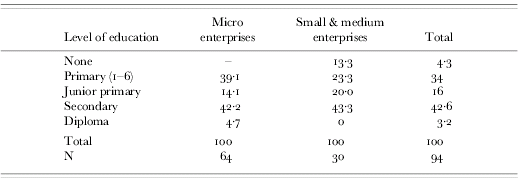
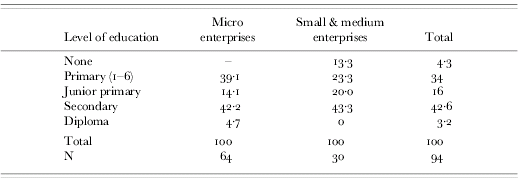
The level of education attained by the owners shows that 100% of the micro enterprise owners and 87% of the small and medium enterprise owners are literate (Table 5). This figure is higher than reported in official publications for the country, which show that 74·49% of those engaged in small-scale manufacturing are literate (CSA 2003). One of the reasons for this could be the fact that shoemaking requires some level of literacy, as it involves measurement, design and calculations. The modal class (42·6%) have secondary education, while a significant proportion (34%) have a primary level education. Those who attained college level education are few. Since most producers work as owner operators, their educational qualification could be a measure of their entrepreneurial talent (Yu Reference Fu-Lai2001). Those with better education are expected to have a better vision and strategy for their enterprises compared with the illiterate.
Distribution of owners by level of education (%)
Source: Own survey.
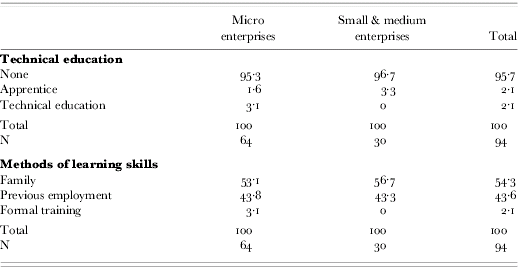
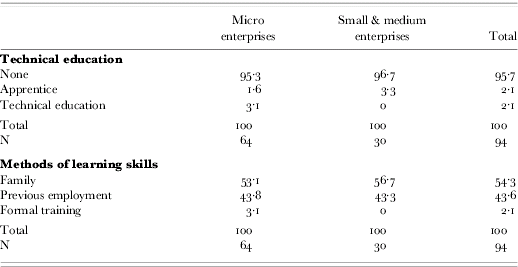
While the formal educational attainment of owners is relatively higher, their technical education however is very poor. The survey shows that 96% of the respondents have received no technical education in formal institutions (Table 6). There is no variation by firm size in this regard. The case studies also reveal that most operators entered the business for family reasons. This is confirmed by the survey data where 54% mentioned the same, implying that families are important sources of skills. The second most important means of learning the skill is through previous employment (43·6%). This agrees with suggestions made by Yu (Reference Fu-Lai2001), who noted that small firms gain their industry experience from previous employment. The shoemaking skills are therefore obtained through on-the-job training (apprenticeship) and traditional means. While apprenticeship training may be a good and cheap way of learning, it cannot ensure a higher level of training if it stands on its own. Small firms produce only what owners learn from their previous employment. Their visions and capabilities will be limited (ibid.). It has to be supported and combined with vocational schooling. The absence of formal technical training indicates that there is a lack of information about modern techniques. This suggests that the producing units are suffering from a low skills trap. The business skills of the owners are also deplorable. The overwhelming majority (95%) have no business training.
Technical education and methods of learning the skills (%)
Source: Own survey.
The shoe business is the only source of income for most of the producers; 82% of the operators depend on shoemaking for their livelihood. The fact that shoemaking is the only source of income is worrisome, particularly for most micro enterprise owners (70·3%) since their production is seasonal. They produce mainly during the peak period, which are the three months of December, January and February, which also coincide with the harvesting seasons of farmers in the country. During off-peak periods production is greatly slowed down, and some may even temporarily migrate to rural areas (Knorringa & Pegler Reference Knorringa and Pegler2004). Most of the small and medium enterprises (66·6%) seem to work throughout the year.
Most operators (97%) work in rented premises. These people could be asked to vacate any time by the owner. This is mentioned as a serious problem in shoemaking, since evacuating the rented premises may mean losing accessibility to the various advantages the cluster may provide. The working conditions of these premises, particularly those occupied by micro enterprises, are deplorable.
Most enterprises have low initial capital. About 84% of the total enterprises and 100% of the micro enterprises have an initial investment of less than 8,000 birr (less than US$ 1,000). About two-thirds or 65·4% start with less than 4,000 birr (less than US$500). The fact that the initial capital is low indicates the low entry barrier to the business. The working capital is similar to the patterns of initial investment. About 91% of the micro enterprises have working capital of less than 8,000 birr (less than US$1,000). For small and medium enterprises, the figure is 57%. The current capital shows a clear differentiation by size. The majority of the small and medium enterprises (93%) indicated a working capital of over 16,000 birr (over US$1,800), while 92% of the micro enterprise have a current capital of less than 16,000 birr (less than US$1,800).
FIRM-LEVEL EVIDENCE
Domestic market requirements and competitiveness of Chinese and local shoes: producers' perceptions
This section aims to understand why Chinese shoes triumph in the domestic market. This is done first by identifying important factors in the domestic market as perceived by producers, and then comparing these with producers' assessment of the advantages of Chinese and local shoes.
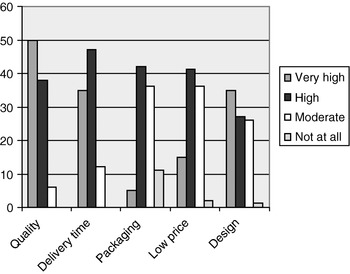
Regarding producers' perception of the domestic market, quality and delivery time are rated very high, along with better design (Figure 1). Producers have to make better designed and good quality shoes and deliver them in time for sales, in order to be competitive in the market. For producers, the time factor is quite important because demand in the shoe industry is highly seasonal. As far as producers are concerned, price is rated fourth at ‘very high’ level and third at ‘high’ level. Though this rating does not totally undermine the role of price, it should be borne in mind that such ratings may be due to the fact that producers sell their products directly to wholesalers at reduced prices, and hence price may not be posed as a major requirement by their clients.Footnote 7
Domestic market requirements (all enterprises).

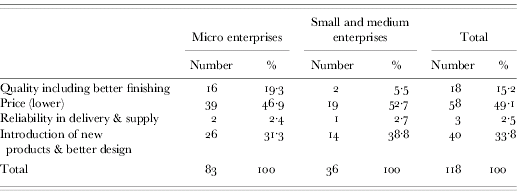
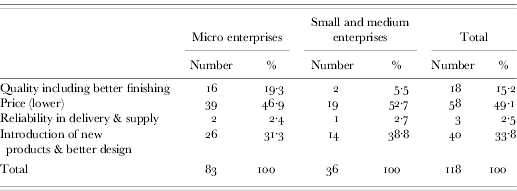
In order to gauge which of these factors are met by Chinese imports and local firms, producers were asked about the competitive advantages of each. Table 7 shows that low price is mentioned as the major advantage of Chinese shoes by many firms (49·1%). This is because Chinese shoes are available in the market at much lower prices than domestic shoes. For instance, the average retail price for men's shoes from China is 60–80 birr ($7–$9·4) while the average retail price for domestic shoes is 100–110 birr ($12–$13). In principle, low prices can force those who cannot offer the same prices out of the market. Informal opinion argues that Chinese shoes are sold at a lower price because of a dumping strategy on the part of China, and Ethiopia should adopt anti-dumping legislation to counter the effect. As in many developing countries, however, the burden of proof lies on Ethiopia. If Ethiopia wants to adopt an anti-dumping policy, it should prove that Chinese shoes are sold in Ethiopia at less than their normal price in the country of origin. This, however, is a difficult task as comparison of goods between the two countries is troublesome (EEA 2003/04). In addition, the country has neither the expertise nor the administrative resources to resist Chinese dumping activity, even if this is found to be true. The major threat voiced by many shoe producers, however, regarding the low price of Chinese shoes is the act of importers who under-invoice imports to avoid taxes. Such under-invoiced goods will fetch a lower price in the domestic market. Producers also complain that lots of shoes are smuggled and find their way into the domestic market, though this is difficult to substantiate with data.
Producers' perceptions of the competitive advantage of Chinese importsFootnote *
Source: Own survey.
* Multiple answers possible.
The other major significant competitive advantage of Chinese shoes is the introduction of new products in the domestic market which have better designs. This was confirmed by nearly one-third of the producers. The case studies also reiterated that Chinese shoes are better designed and more fashionable than domestic shoes. These advantages of price and superior design attract customers who like to have a better-looking shoe at a reduced price. In addition, quality is mentioned by 15% of the respondents as another important advantage of Chinese shoes. This refers to different aspects including the finishing quality of shoes.
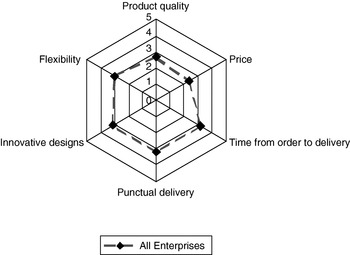
Local producers were also asked to rate their own competitiveness on a scale of 1 to 5. The star diagram shows the ratings made by producers along a number of factors (Figure 2). This shows that all factors are rated more or less similarly, with values ranging between 2 and 3. Local shoes are rated at a value of less than 3 for quality and low price. These are the areas in which local producers feel that they have no competitive advantages. Similarly, innovative design is also rated very low, indicating the poor design quality of shoes. It is only ‘time from order to delivery’ and ‘punctual delivery’ which were rated slightly more than 3, implying that local firms have the capacity to meet orders which are the basis of shoe transactions in the domestic market.
Assessment of own competitiveness by producers.

In view of the producers' ratings of Chinese shoes and local firms' capability vis-à-vis the domestic market requirement, it can be seen that Chinese shoes seem to better fit the domestic market requirement. This is because design and quality which are rated very highly in the domestic market (Figure 1) are easily fulfilled by Chinese shoes, as these two factors have been rated highly as the competitive advantages of the Chinese shoes by 34% and 15% of the producers (Table 7).
Moreover, though producers did not see price as the major factor of domestic market requirement, perhaps because of their interaction with wholesalers as mentioned above, it seems that low price is attractive for consumers and could help Chinese shoes capture the minds of consumers, hence adding to the suitability of Chinese shoes in the domestic market. On the other hand, local firms do not rate themselves high on any of these factors, especially on quality, design and price. This indicates their less competitive position in the domestic market. The only advantage local firms envisage for themselves is ‘punctual delivery’, which is instrumental only to meet the seasonality of demand in the shoe market. But this advantage can easily be eroded if importers plan imports to match seasonal demand. The fact that local firms rated all the competitive factors invariably low indicates that there is a need to make a concerted effort on all fronts in order to make local firms competitive. Under these conditions, it is only natural for Chinese shoes to take over the domestic market and inflict heavy impacts on local firms.
Impacts of Chinese imports
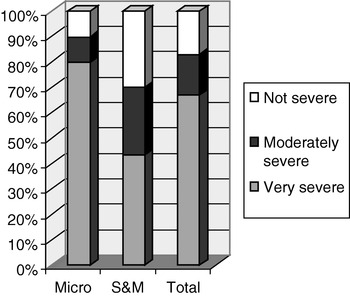
Firms were asked about the severity of the impact of Chinese imports, and the type of influence the imports have on their activity. The majority (63%) described the impact as ‘very severe’ (Figure 3). Micro enterprises however have been hardest hit by the competition, as the responses show: 78% of the micro enterprises responded that the impact was very severe, while about 43% of medium and small enterprises did so. In addition, about 30% or nearly one-third of the small and medium enterprises indicated that it has not been severe. The difference between the two shows that Chinese shoes have been targeting the lower end of the market which is supplied by micro enterprises. This agrees with Knorringa and Pegler's (Reference Knorringa and Pegler2004) observation that those at the lower end of the market were hardest hit by the imports.
Firms' perceptions of the severity of Chinese imports.

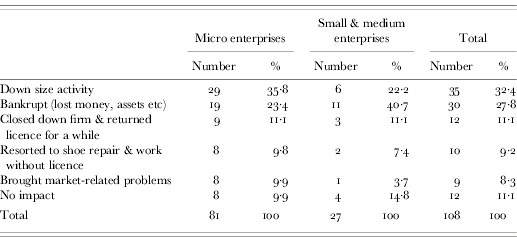
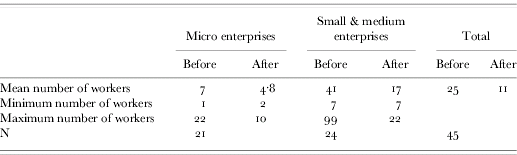
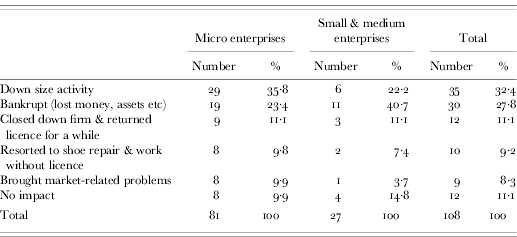
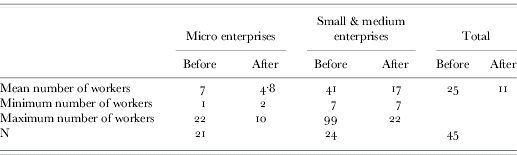
The major impact of Chinese imports has been downsizing the activity of enterprises. This is reported by 32% of the total enterprises, with the highest impact being felt by micro enterprises (Table 8). Downsizing of activity relates to cutting back production, reducing the labour force, reducing working hours etc. The aim is to underproduce, since what is produced cannot be sold in the market. In terms of work force or employment, Chinese imports have resulted in shrinking the labour force working in different firms (Table 9). For instance the mean number of employees per establishment has gone down from 7 to 5 among micro enterprises, and from 41 to 17 in the case of small and medium enterprises.
Firms' responses on the impact of Chinese shoes
Source: Own survey.
Multiple answers.
Mean, minimum and maximum number of workers before and after the Chinese imports
Source: Own survey.
Micro enterprises used to have a maximum number of 22 employees, compared with a maximum of 10 reported at present (Table 9). Similarly the medium and small enterprises used to have a maximum number of 99 employees, compared with the current maximum employment of 22. Such reductions in the labour force result in massive lay offs, affecting not only the firms but also the workers who become the victims of the process.
The other impact of the Chinese shoes reported by firms is bankruptcy, or loss of assets and money. This is reported by about 28% of the respondents. The case studies reiterated that some firms were forced to sell their assets and machinery. In the extreme case, such impact caused firms to permanently exit the market,Footnote 8 while in other cases firms exited and re-entered the market. The case of firm 5 illustrates the latter situation. More specifically, a little over 10% of the surveyed firms reported that they had returned their licence. Others stayed in the business but downgraded their activity to shoe repair, or changed to become informal operators (9·2%).
Box 1 Firm 5 is a micro enterprise with 5 employees. The owner declared that he had stopped work for 4–5 years following the importation of Chinese shoes to the country. He went bankrupt and lost his capital which he mentioned reached up to 200,000 birr. He engaged in other activities, as he was forced to sell his production assets and property.
This indicates that the impact of Chinese imports has certain features. First, the firm-level evidence shows that the impact is very varied, but in most cases has negatively affected the growth of firms. Second, the impact seems to be differentiated by firm size. A higher proportion of small and medium firms reported bankruptcy, while a higher proportion of micro enterprises reported downsizing. The reason for more small and medium enterprises to report loss of assets is because these firms are relatively more asset rich than micro enterprises.
Coping strategies of enterprises to withstand Chinese competition
Firms have followed a number of strategies to withstand Chinese imports and stay in the market. These may be grouped as strategies in line with a ‘high road’, and others which follow a ‘low road’ of competition.
Improved design
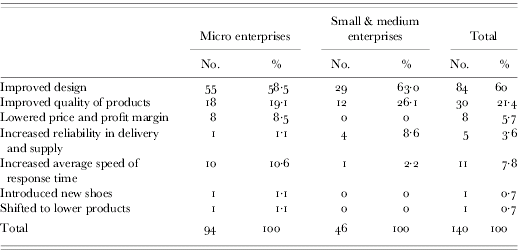
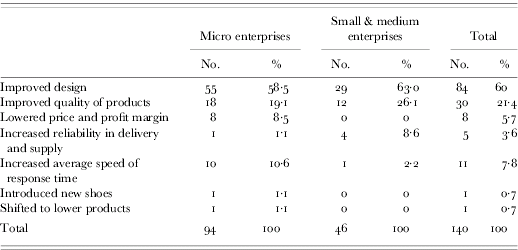
About 60% of the survey respondents indicated that they have been able to improve the design of their shoes following Chinese imports (Table 10). Design improvement is mentioned by many respondents both in the micro enterprises (59%) and small and medium enterprises (63%) as a critical strategy. This strategy emanates from the need to counter the design advantage Chinese shoes have over local shoes.
Enterprise strategy to cope with Chinese shoes
Source: Own survey.
Multiple answers.
The survey showed that shoe designs are created in-house. Most enterprises (59·6%) use freelance designers, while in some firms owners are also designers (33·3%). Owner-designers are slightly commoner in medium and small enterprises. Improving designs in response to import competition has two aspects. First, better designs are prepared by giving attention to different details that matter in design. For instance, a respondent in the case study mentioned that he now uses compasses to draw parallel lines, while previously he used freehand. This shows how competition has forced producers to pay attention to different issues that enter the design of shoes. In addition, better designs are prepared by imitating some imported shoes and using catalogues. Producers, however, face difficulty in directly imitating imported shoes, since they do not have the necessary last, sole etc. that matches the design requirement of the imported shoe. Second, firms have learned that they must continuously change the design of their shoes in order to match the needs and demands of the market. A case study respondent noted that frequent change is necessary.
Box 2 Firm 5 is a micro enterprise with 5 employees. Regarding design the owner mentioned that previously he used the same design over a long period of time. Now, however, one way of coping with the market by the firm is to frequently change designs so as to best suit the tastes and needs of the customers.
Most producers mentioned that they now produce fashionable shoes in order to compete in the market. Though improving design is mentioned as one important competitive strategy, shoe producers have not attained a high level of design capacity. The survey results showed that all of the firms use manual methods of designing. Respondents also mentioned that they have a serious capacity problem in designing. They need to receive training on design (28·1%), secure advanced design machinery (22·7%), and train their staff (22·7%) in order to better improve their design capability. Training and machinery will definitely improve their capacity and make them better withstand the competition. The recently established Leather and Leather Product Technology Institute (LLPTI) is playing some role in upgrading the design and skill capability of shoe producers. Some of the respondents in the case study mentioned that they have now improved their design capacity through short term training. The adequacy and coverage of the training, however, needs to be evaluated before reaching a conclusive decision on the role of LLPTI.
Improving quality
One of the advantages of Chinese shoes over local shoes is their quality in terms of finishing, use of accessories, stitching, etc. Although it is mentioned by fewer respondents (21%), quality improvement is pointed out as one important coping strategy. In particular, producers have realised the importance of finishing quality as a key factor in becoming competitive in the domestic market. Some respondents from the case study mentioned that they had learned about finishing quality from the Chinese shoes.
Quality improvement, however, is given more importance by small and medium enterprises than by micro enterprises. About 84·4% of the micro enterprises rated quality improvement in their firm as low (a score of 2 and less) on a scale of 1–5, compared with about 46·7% or nearly half of the small and medium enterprises, which rated quality improvement in their firm with a score of 3 and above (Table 11). One way to improve quality is the innovation in the use of material and accessories. Nearly 60% of the small and medium enterprises mentioned that they had introduced some kind of innovation, while the overwhelming majority of micro enterprises (86%) have not done so.
Producers' ratings of quality improvements in own firm (%)

Source: Own survey.
Scale: 1=No improvement, to 5=Major improvements.
Investment in machinery
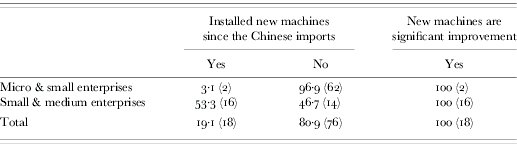
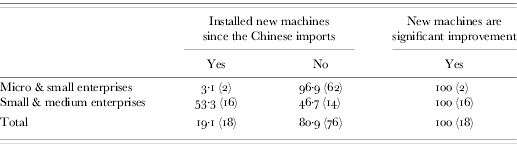
A response to Chinese imports that is well differentiated by firm size is investment in machinery. While slightly over half (53·3%) of the small and medium enterprises have bought new machinery since the Chinese imports, only 3% reported the same among micro enterprises (Table 12). All those who have bought new machinery stated that this is a significant investment and not a mere replacement. Domestic market requirement is considered as an important source of motivation for undertaking such investment by small and medium enterprises. This is reported by 85% of the small and medium enterprises.
Response to Chinese imports in terms of investment in machinery
Source: Own survey.
Figures in parenthesis are number of reporting firms.
Product specialisation
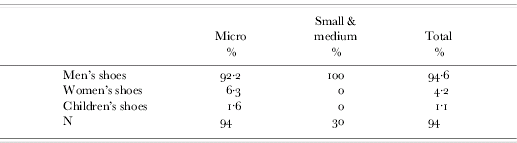
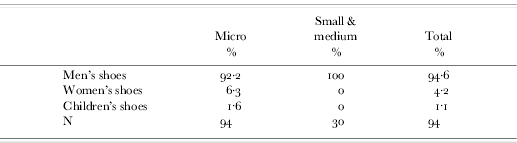
Local producers concentrate on the production of men's shoes. About 92% of the micro enterprise and 100% of the small and medium enterprises reported that they mainly produce men's shoes (Table 13). Women and children's shoes are less important in local shoe production. The main reason is the difficulty of competing in the market, especially in women's shoes. Imported women's shoes are highly fashionable and have a high design and finishing quality. In addition, women's shoes require some inputs such as shank board and steel piece which are not usually used by local producers. This makes locally made women's shoes, particularly high-heeled shoes, uncompetitive in the domestic market. There is therefore a tendency to concentrate on men's shoes, which are mostly chosen for their durability rather than their design in comparison with women's shoes. According to one case study informant, this is a new tendency which has become dominant since the beginning of Chinese imports.
Type of shoes mainly produced by local firms
Source: Own survey.
Use of better quality raw material to raise the durability of shoes
One competitive advantage of local shoes over the Chinese shoes is their durability. All the case studies agree that Chinese shoes lack durability and some of the shoes are made of synthetic materials. Local producers use leather,Footnote 9 which is believed to have a longer life and does not easily produce bad odour. Customers have begun to appreciate this.
Reducing profit margin and lowering quality
Though this is not significantly borne out by the survey, there is an indication that some firms, particularly the micro enterprises (8·5%), have resorted to lowering their price and profit margins in order to stay in the market. This, however, is strengthened by the case studies from the micro enterprises. Two out of three cases from the micro enterprises mentioned that they have reduced their price and profit margins. In addition, they have also resorted to reducing their use of inputs and raw materials in order to produce shoes that can compete in the market. This will lower the quality of the shoes.
Informalisation of production
All the interviewed cases from the micro enterprises revealed that prior to the Chinese imports they were operating formally as registered and licensed businesses. They also had more employees and capital. One case study respondent revealed that his previous capital reached 200,000 birr (US$23,529), another case indicated that he used to have 28 workers and produce 12 dozen pairs of shoes per day, and the third case mentioned that he used to have a large stock of finished shoes in the store. They were all forced to discontinue production for some time following the import of Chinese shoes, but have all re-entered the market as informal sector businesses. They do not have licences and do not pay tax. Indeed, they mentioned that they would be unable to compete in the market if they paid tax. The case of firm 3 illustrates the situation.
Box 3 Firm 3 is a micro enterprise with 8 employees. The impact of the Chinese imports has been very detrimental to the owner. He mentioned that prior to the Chinese imports, the owner used to stock shoes in huge quantity. But since the Chinese imports, the owner could not sell his stock and was forced to sell most of his shoes at a much reduced price in places where cheap shoes are sold. This also led him to return his licence during this period. During the period 1999–2004, he was operating at a much reduced level. Up until now the owner works informally because of lack of capacity to compete in the market if he pays government tax. He mentioned that the way to survive the Chinese shoes is to reduce the profit margin by selling at a very low price and reduce the quality (low road of competition). The owner admitted that Chinese shoes are superior in their design and finishing.
These varied strategies have been instrumental in helping firms stay in the market. In general, the micro enterprises appear to be following the ‘low road’, while the small and medium firms attempt to follow the ‘high road’ of competition. Firm size therefore seems to be an important indicator of the type of coping strategies followed by firms. At this point, it is interesting to examine whether type of coping strategy is related to the performance of firms operating under the pressure of competition.
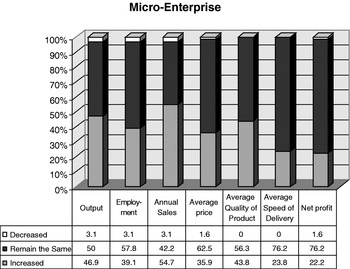
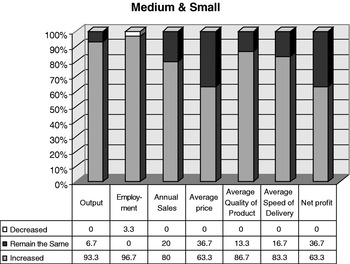
Following other researches (Schmitz Reference Schmitz1999) performance is measured in terms of output, employment, annual sales, net profit, average quality of products, average speed of delivery and price. Firms were asked to rate their performance along these variables. They identified whether each of these variables had increased, decreased or remained the same over the last three years. Figures 4 and 5 show the performance of firms on each of the selected performance variables. The graph shows that most medium and small industries have registered an increase in most of the indicators. Half or more of the micro enterprises on the other hand have reported no change, and some indicated decreases in the indicators. The graph indicates that most of the firms, particularly the small and medium ones, are not doing badly. One possible reason could be that despite the negative effects of Chinese imports the firms become competitive through improving investment, quality, design etc. The low performance of micro enterprises on the other hand is due to their inability to compete on factors that matter most – quality, design and investment – even if they have managed to stay in the market without significant growth and improvement.
Performance of micro-enterprises.

Performance of medium and small enterprises.

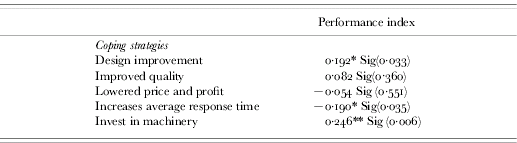
A composite index was constructed out of these variables by assigning values of −1, 0 and 1 for categories of ‘decreasing’, ‘no change’ and ‘increasing’ respectively. The values were summed and divided by the number of variables. This results in an index for each firm. The relationship between performance and coping strategies was examined by computing a Kendall correlation coefficient. The result showed that some types of coping strategies have an association with performance (Table 14). In particular, design improvement is positively and significantly correlated with performance at 0·05 level of significance. In addition, investment in machinery is positively associated with performance at 0·01 level. These imply that improving design and investing in machinery are the key to successful coping. Design is important because customers prefer better designed shoes and this is one of the attractions of Chinese shoes. Design training and use of machinery in design is therefore a must for upgrading. Similarly, one comparative disadvantage of local shoe production is the use of manual methods and obsolete technologies. Increased investment in machinery allows producers to produce effectively and efficiently, adding to their coping capacity and quality improvements. This implies that firms need to invest both in design and technology in order to better cope with Chinese shoes and increase their performance. Other strategies such as improving quality and lowering of prices and profits show no association with performance. In fact lowering of prices and profits, though not significant, has shown a negative relation, hinting that such competition may decrease performance. Increasing the average response time has shown a significant but negative (0·05 level) association with performance. This implies that quick delivery or increased response time as a coping strategy may not be a source of higher performance. This corroborates the previous suggestion that importers can easily plan delivery time and beat the competitive advantages of local shoes in this regard.
Correlation coefficient between performance and types of coping strategies
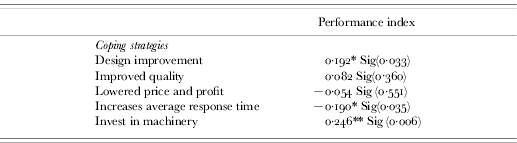
* Correlation coefficient is significant at 0·05 level (2-tailed).
** Correlation coefficient is significant at 0·01 level (2-tailed).
THE WAY FORWARD
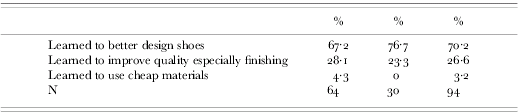
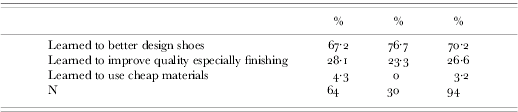
Despite the fact that Chinese competition has inflicted major negative impacts on local firms, it seems that it has also opened a window of opportunity; 75% of firms reported that the impact of Chinese shoes has been both positive and negative. The case studies revealed that the positive impact has been putting pressure on local producers to become innovative and produce better designs in order to become competitive. There are certain lessons that enterprises reported that they have learned from Chinese imports. Specifically, these are better design and the importance of improving the quality of shoes, particularly finishing aspects, in order to become competitive in the domestic market (Table 15).
Lessons learned from the import of Chinese shoes
Source: Own survey.
Producers even perceive that they now have a grip on the domestic market. For example, 82% of the producers perceive that their shoes are now competitive with Chinese shoes. The figure is higher for small and medium enterprises, of which 93% responded in the affirmative, while those who replied positively are about 76% among micro enterprises. There are two reasons for this. First, local production as indicated above has entered a learning stage, particularly in terms of design and improving the quality of shoes. Second, customers have also gradually realised that the competitive advantages of Chinese shoes, which were highly based on price and design, have started to erode as they couldn't outweigh their competitive disadvantage, namely the durability of the product. Durability is mainly related to the materials used in producing the shoes. Case studies revealed that local shoes use better quality material, and hence maintain durability.
Though this is an indication of recovery, there is still no fundamental change in the domestic market, as it continues to be flooded with imports. Local shoe makers continue to struggle to stay in the market. The micro enterprises in particular are staying in the market marginally, given the disastrous consequences they have been subjected to. The internal capability of firms shows that local firms have major deficiencies due to backward technology, lack of skill, poor support services, lack of working premises etc. These reduce their capacity to withstand imports. Local shoe production thus needs to be invigorated if it is to vie with imports. This requires that both the producers and the government which are the main stakeholders in shoe production should work together. The stakeholders should collectively aim to improve their productivity and competitiveness. This is required mainly because firms in isolation find it difficult to grow and prosper in the middle of fierce import competition. The Ethiopian shoe industry has two types of associations. The first is the Ethiopian Tanners, Footwear and Leather Goods Manufacturers Association, and the second is the Ethio-Leather International Association. The former was established as the result of the merger of the Ethiopian Tanners and the Ethiopian Footwear Associations. The micro, small and medium producers are not well represented in this association, which is composed of large and mechanised firms and tanners.
The Ethio-Leather International Association was established as a saving and credit association by the small firms. It is now changing itself into a producers' cooperative. It has about 1,000 members, which include not only micro, small and medium shoe producers, but also input suppliers and shoe distributors. Recently, the association has negotiated with the city government and received working premises. This has necessitated a lot of lobbying which involved inviting top government officials to their working areas. The association, however, is in its infancy, and has not ventured into significant collective action to withstand competition. The association in cooperation with UNIDO has started to sponsor a few producers to receive training in LLPTI. This initiative has to be intensified and expanded. The association should also venture into similar initiatives such as joint actions in the form of joint purchase, marketing and sourcing of raw materials, introduction of new technology, labour training etc. Some of these are highlighted in the business plan of the association but need to be pursued vigorously. The government, on the other hand, as a major stakeholder should buttress and strengthen the association and support the shoe sector through its policy formulation and support services. In particular, the different interventions should be delivered in a package form so as to make a difference in the competitiveness of the shoe industries. The following and other points should be part of the package that need to be provided and facilitated.
Strengthen training to upgrade skills in shoemaking
Training in all spheres of shoemaking such as design, finishing and stitching is needed. In particular, training in design is highly emphasised by firms, as they have a significant gap with respect to Chinese shoes. Training in the use of accessories, stitching and finishing is also required in order to improve the quality of the domestic shoes and make them competitive.
Introduce better technology to improve quality and competitiveness
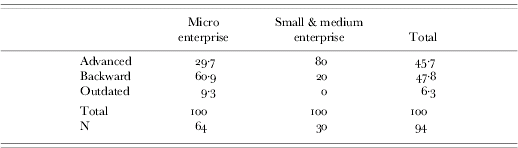
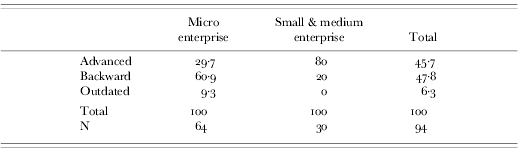
Quality is often a function of the technology available to firms. Micro, small and medium enterprises depend on manual methods or backward technologies for the most part, and have limited or obsolete machinery. Most micro enterprises (61%) characterised their production machinery as backward (Table 16). Most indicated that there are several machines they would like to acquire which are critical to enhance production. Some firms have to use local modified machinery. For instance, many micro enterprises use locally modified lasts, since they are unable to buy new ones. Modified lasts will not yield proper shoes at the end. Similarly, most firms use kerosene stoves for heating purposes to replace an adhesive activator machine, or use manual methods to separate the last from the shoe due to the absence of de-lasting machines. Such practices deform the shoes and eventually affect the quality of the shoes negatively.
Quality of firm's production machinery
Source: Own survey.
In addition, most of the firms (51·6%) in the micro enterprise sector hire or lease their machinery. This implies that the production machinery can be taken away any time by the owners. Others who do not have all the machinery resort to receiving services from others. For instance, a firm which does not have a sciving machine has to derive the service from others. This results in a long queue, affecting the delivery time of shoe producers. Local maintenance is the major means of solving technical problems. Nearly 86% of the firms use local maintenance, while only 4·7% use suppliers to solve technical problems. The fact that local maintenance is used as the major means of solving technical problems indicates that there is little infusion of outside technology in the sector. It is therefore important that these different aspects of technology be addressed by the government.
Branding
Branding, in order to enhance quality assurance, is not widely practised among the producers. All the enterprises mentioned that they use brand names, but the case studies revealed that there is no commitment behind their use. The concept of branding is a new one, and is not used and understood by producers. If enterprises resort to branding, it will improve the quality of their shoes and help them become competitive in the domestic market.
Exporting
A significant absence from the strategy of firms is export to counteract import penetration. Roberts and Thoburn (Reference Roberts and Thoburn2003) found that in South Africa textile firms are exporting for defensive reasons, and threats to the domestic market are an important motivation for export. None of the micro, small and medium enterprises in Ethiopia resort to export to counteract import competition. Several reasons are cited for lack of export by these firms. First, there are responses related to capacity constraints or supply side problems. These are manifested in terms of lack of working capital, working place, skill, training, collateral, machinery, etc. All these problems clearly indicate that micro, small and medium enterprises have a capacity problem in producing for export and meeting its various requirements. Second, there are responses related to market access and information availability. This is a demand side problem that is related to market failure. It requires extra-market intervention to make information available and create market access to producers. Third, there is a response related to the problem of inputs. In particular, the poor quality of raw material is mentioned as a stumbling block in entering the export sector. All these constraints need to be dealt with in an integrated manner to improve export performance.
Quality control
The quality of shoe imports is not controlled by agents in Ethiopia. Though there is a Standard and Quality Control Agency in the country, imported shoes are not checked for their standard. This creates room for some sub-standard shoes to be imported and flood the market. Import quality control, however, will safeguard not only the consumers but also the producers, and force them to compete with quality products instead of sub-standard ones. On top of this, local shoe production should also be subjected to quality controls. Testing and certification to meet basic standards and international acceptability will help improve the quality of local shoes.
Facilitating vertical disintegration and interdependence
Firms in the Addis Ababa shoe cluster operate as independent units, undertaking all the activities of shoemaking by themselves. This, however, is disadvantageous because different phases of shoemaking have different requirements and economies of scale. One of the advantages of a cluster, however, is the opportunity it creates for vertical disintegration. This helps firms to be interdependent and withstand external shocks by doing bits and pieces of the work together. The micro and small enterprises in Addis Ababa should be pushed along this line to collectively stand the competition from Chinese shoes. In this regard it should be borne in mind that an elaborate system of production disintegration would reduce the present negative effects of machine leasing and service sub-contracting, which is done spontaneously with no legal protection or institutionalisation of the activities.
Strengthening the associations of shoe producers and allied actors
Though the presence of the association is a positive aspect, this however needs to be strengthened in order to maintain the interests of its members in different spheres. The association should be able to influence policy, access to raw materials, the market, technology, training, etc., all of which are necessary to improve the competitiveness of the producers.
Continuous benchmarking
Benchmarking is defined as the continuous process of measuring products, services and practices against the toughest competitors recognised as industry leaders in a given sector (UNIDO & MTI 2005). Benchmarking helps to identify those activities which will support local industry and could be used as a learning example. The benchmarking exercise conducted by the recent master plan of the leather sectorFootnote 10 in Ethiopia shows that China has good finishing capacity, good stitching and cutting know-how, good human capital, sufficient social capital and a good level of educational and training structures (ibid.). China has also adopted a policy mix that focuses on price, product and communication. On the contrary these policy areas are not supported in Ethiopia, and local shoe production suffers from a lack of an enabling environment.
* * *
Trade liberalisation and reform has opened the domestic market and subjected the shoe industry in Ethiopia to international competition. The main competition for local shoe production has come from China, which has been the major source of imported shoes in the country in the last five years. Chinese shoes seem to better fit the domestic market, as they have shown superiority in design, quality and price. They have been targeted mainly at the lower end of the market, though small and medium enterprises are also affected by the imports. Trade relations between Ethiopia and China, as far as small-scale footwear enterprises are concerned, are competitive. This is indicated by the number of employees laid off, and from varied impacts on the enterprises, ranging from downsizing, bankruptcy, loss of assets and property, to changing to informal operations or downgrading activity. The hypothesis that the import of Chinese shoes has inflicted damage on local producers gets credence from evidence in the paper. Firms, in line with the expectations of this study, also follow coping strategies to help them stay in the market. These strategies range from those that may be labelled ‘high road’, to those designated as the ‘low road’, of competition. The hypothesis that local producers resort to the ‘low road’ to cope with imports does not apply to all firms. Some firms, particularly micro enterprises, are forced to reduce their profit margin and quality and to informalise their operations. Other firms, particularly the small and medium ones, have attempted to improve their design, and quality, to invest in machinery, and seek the ‘high road’. Those which have resorted to the ‘high road’ are at the learning stage. This is a positive influence of imports. The firms have realised that competing on quality is the best way to withstand Chinese shoes. This may also be used as a starting point for much needed exports, which are non-existent at present. In this regard, Chinese imports have created a window of opportunity for firms to resort to improving domestic production. There are, however, several constraints that need to be addressed in order to provide a push for the shoe sector. Skills and technology are the key ingredients missing from the sector in Ethiopia. Institutional support is needed to facilitate training and use of technology. The recently established Leather and Leather Product Technology Institute will play a key role with regard to training. The focus of the institute to date however is largely on training regular students, with less emphasis on the job skill upgrading which is much needed by small-scale enterprises. There is also a strong need to strengthen the incipient association, and address the real needs of the stakeholders in policy formulation, implementation and facilitation. Ethiopia can also learn a lot from China and others, whose policies may be adjusted and adapted to local conditions. The favourable government disposition and the five-year master plan which views the footwear industry as the driving force in the leather sector seem to open new opportunities for the sector.