Introduction
A loss of taste makes it difficult to detect unhealthy or rotten foods, and reduces the joy of eating nutritious, flavoursome foods. In people with taste disorders, loss of joy in eating can lead to a loss of pleasure in social eating. In addition, taste disorders may become a large factor in reduction of appetite, which can adversely affect health. Thus, taste disorders may have wide-ranging effects. However, in comparison with other sensory organ disorders (e.g. auditory or visual dysfunction), there has hitherto been insufficient research into taste disorders, with only a limited number of clinical case studies published.Reference Deems, Doty, Settle, Moore-Gillon, Shaman and Mester1, Reference Hamada, Endo and Tomita2
One of the characteristics of taste disorders is that they occur most often in the elderly; the number of patients with taste disorders increases with age.Reference Grzegorczyk, Jones and Mistretta3, Reference Schiffman4 The age distribution of Japanese patients with taste disorders peaks in the 50 to 80 year age group.Reference Hamada, Endo and Tomita2 In the USA, 40 per cent of patients with taste disorders and anosmia are aged 65 years or older, and disorders of the chemical senses are more frequent in the elderly.Reference Hoffman, Ishii and Macturk5 Hence, in order to gain a better understanding of these disorders, it is important to examine them from the perspective of age.
In order to study the causative factors of taste disorders in those aged 65 years or older, we examined 408 cases of taste disorder. There is no treatment method which is effective for all cases, because of the different causes of taste disorder. Of the treatment methods available, use of a zinc agent has been suggested to be effective for taste disorders caused by drugs,Reference Henkin and Bradley6 low serum zinc concentration,Reference Yoshida, Endo and Tomita7, Reference Sakai, Yoshida, Endo and Tomita8 renal disordersReference Mahajan, Prasad, Lambujon, Abbasi, Briggs and McDonald9 and radiation treatment.Reference Ripamonti, Zecca, Brunelli, Fulfaro, Villa and Balzarini10 In this study, we also examined the curative effects of a zinc agent on taste disorders, taking into account the causative factors of the disorders and patients' ages.
Materials and methods
Subjects
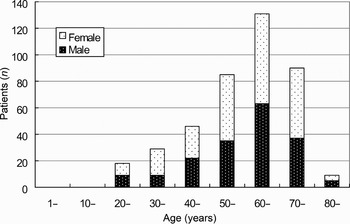
The subjects comprised 408 patients (180 men (44 per cent); 228 women (56 per cent)) who presented to the ENT department of Nihon University Itabashi Hospital complaining of a reduction in their sense of taste. Their ages ranged from 21 to 84 years, the average age being 59 ± 15 years for men and 58 ± 15 years for women. The age distribution peaked in the 60s for both men and women, with patients in their 70s and 50s being the next most affected age groups (Figure 1).
Distribution of 408 subjects with taste disorders, by age and sex.

The subjects were divided into three age groups: 49 years or younger, 50 to 64 years, and an elderly group of 65 years or older. One hundred and seventy-four subjects (43 per cent) were in the elderly group, 141 were in the 50 to 64 years group (35 per cent) and 93 (23 per cent) were in the 49 years or younger group. In order to examine the characteristics of taste disorders in the elderly population, the main comparisons used were between the elderly group (65 years or older) and the 49 years or younger group; however, results from the 50 to 64 years group are also given.
In addition, the curative effects of taste disorder treatment with a zinc agent (polaprezinc, Zeria Pharmaceutical Co., Ltd., Tokyo, Japan) were studied in the three age groups. Curative effects could be evaluated in 252 cases (109 men, 61 ± 13 years old; and 143 women, 59 ± 15 years old). The following 156 cases were excluded from the study: those in which curative effects could not be evaluated because the treatment duration was less than three months (47 cases); those in which adequate taste examination could not be performed in order to assess curative effects (57 cases); and those in which polaprezinc was not used, or not used alone, for treatment (52 cases).
Methods
The causative factors for taste disorders were classified as follows: drug-induced, zinc deficiency, systemic disease, upper respiratory tract inflammation, head injury, glossitis, loss of flavour and idiopathic (i.e. no obvious underlying cause was evident).
Drug-induced taste disorders were defined as cases involving drugs described as causing taste disorders as an adverse drug reaction.
Diagnoses of taste disorder due to zinc deficiency were limited to those cases in which other triggering causes were not known and which showed a reduced serum zinc concentration. A serum zinc concentration of 69 µg/dl or lower was judged to be abnormally low. The reference value was established according to the study by Tomita.Reference Tomita and Tomita11 In a US survey, serum zinc level decreased with age; mean serum zinc levels were 85.6 ± 0.79 µg/dl and 83.5 ± 0.53 µg/dl in men and women aged 65 to 74 years, respectively.Reference Pilch and Senti12 The serum zinc reference value we employed (69 µg/dl) was significantly lower than these values.
Cases diagnosed as mainly due to hyposmia were classified as ‘loss of flavour’. Idiopathic taste disorders were defined as those for which triggering causes were not known and in which clinical examination findings (including serum zinc concentration) were within the normal range. Taste disorders caused by systemic disease were defined as those due to hepatic disorders,Reference Burch, Sackin, Ursick, Jetton and Sullivan13 renal disorders,Reference Mahajan, Prasad, Lambujon, Abbasi, Briggs and McDonald9, Reference Atkin-Thor, Godderd, O'Nion, Stephen and Kolff14, Reference Matsuo, Nakamoto, Nishihara, Yasunaga, Matsuo and Sakomi15 disorders of the digestive organsReference Solomons, Rosenberg, Sandstead and Vo-Khactu16, Reference Harris and Griffin17 and diabetes.Reference Schelling, Tetriault, Lasaguna and Davis18, Reference Hardy, Brennand and Wyse19 Taste disorders due to inflammation of the upper respiratory tractReference Henkin, Larson and Powell20 were defined as those occurring after inflammation of the upper respiratory tract with fever.
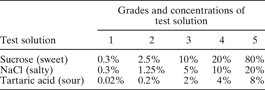
Taste function was evaluated by the filter-paper disc method.Reference Tomita, Ikeda and Okuda21 Solutions of sucrose (for sweet taste), sodium chloride (for salty taste) and tartaric acid (for sour taste) were used. The concentrations of the solutions were graded from one to five (Table I); grade three was set as the upper limit for normal, healthy subjects.Reference Tomita, Ikeda and Okuda21
Taste testing: concentrations used*

* Filter-paper disc method.
The tests were carried out in the right and left region of the chorda tympani nerve (i.e. about 2 cm to the right and left of the proglossis). The minimum concentrations at which sweet taste, salty taste and sour taste could be recognised were determined by the step-up method, and the concentration grades (one to five) of those solutions were defined as the threshold values. The threshold value for a subject with no reaction to a reagent at the highest concentration (i.e. grade five) was defined as six for the purposes of evaluation. Subjects' taste functions were evaluated from their mean values for the six threshold values for sweet, salty and sour taste in the right and left regions of the chorda tympani nerve. Mean threshold values of less than 3.5 were regarded as normal.Reference Yoshida, Endo and Tomita7, Reference Sakai, Yoshida, Endo and Tomita8
The zinc agent polaprezinc was given as a total daily dose of 150 mg/day (administered as 75 mg twice daily). Polaprezinc is a zinc–carnosine complex formulated as white, odourless granules, the primary use of which is the treatment of peptic ulcers. As 75 mg of polaprezinc contains approximately 17 mg of zinc, twice daily administration supplies approximately 34 mg of zinc.
The effects of this zinc agent were studied according to taste disorder causation and age. The therapeutic effects were judged as: cured, improved or no curative effect. ‘Cured’ was defined as an improvement of the mean threshold value to a normal value (i.e. less than 3.5). ‘Improved’ was defined as an improvement of the mean threshold value by one point or more, due to the treatment. All other cases were regarded as showing no curative effect. The number of ‘effective’ cases was the sum of the cured and improved cases.Reference Yoshida, Endo and Tomita7, Reference Sakai, Yoshida, Endo and Tomita8
Statistical analysis was performed using Fisher's exact probability test and Student's t-test.
Results and analysis
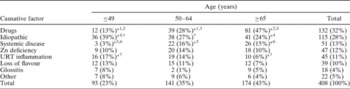
Table II shows the frequencies of the various causative factors of taste disorder, by age group. For the whole population studied, the most frequent cause of taste disorder was drug administration, accounting for 32 per cent of cases, followed by idiopathic factors, systemic disorders and zinc deficiency (in that order). Of the 408 subjects, 116 (28 per cent) showed a low serum zinc concentration, regardless of the cause of their taste disorder. In the elderly group, we found a significantly higher incidence of taste disorders caused by drugs (p < 0.001) and systemic disorders (p < 0.002), compared with the 49 years or younger group. On the other hand, in the elderly group, we found a significantly lower incidence of taste disorders caused by idiopathic factors (p < 0.008) and inflammation of the upper respiratory tract (p < 0.004), compared with the 49 years or younger group.
Subjects' taste disorder causation

Data represent number and percentage for each category. Note that some cases overlapped. *1,2,3,4,5,6,7p < 0.01; †p < 0.041. URT = upper respiratory tract
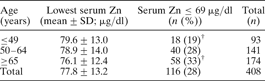
We analysed subjects' minimum serum zinc concentration by age group (Table III). The mean minimum serum zinc concentration was 79.6 ± 13.0 µg/dl in the 49 years or younger group, 78.9 ± 14.0 µg/dl in the 50 to 64 years group, and 76.1 ± 12.4 µg/dl in the elderly group (65 years or older); there were no significant differences between the groups. We then analysed subjects with a minimum serum zinc concentration of 69 µg/dl or lower by age group. A low serum zinc concentration was found in 18 of 93 subjects (19 per cent) in the 49 years or younger group, and in 58 of 174 subjects (33 per cent) in the elderly group; the difference between the groups was significant (p < 0.011).
Subjects' ages and lowest serum zinc concentration before zinc administration*
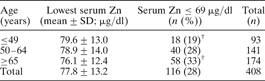
* For 198 cases. †p < 0.011. SD = standard deviation
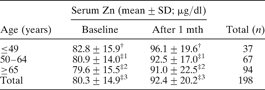
We analysed 198 subjects' serum zinc concentrations before and one month after commencing polaprezinc (Table IV). The mean serum zinc concentration prior to treatment was 79.6 µg/dl in the elderly group and 82.8 µg/dl in the 49 years or younger group. However, one month after commencement of treatment, concentrations had significantly increased, to 91.0 µg/dl (p < 0.001) and 96.1 µg/dl (p < 0.002), respectively. No age-based variations were observed in the serum zinc concentrations before and one month after commencement of treatment.
Changes in subjects' serum zinc concentration after one month of zinc administration*
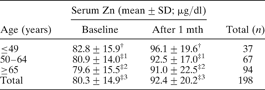
* In 198 cases. †p < 0.002; ‡1,2,3p < 0.001. SD = standard deviation
These results indicate that oral administration of the zinc agent was effective in improving subjects' serum zinc concentrations, independent of their age.
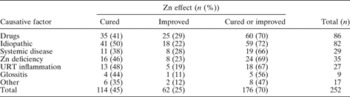
Table V summarises the curative effects of the zinc agent, according to taste disorder causation. A total of 114 of 252 cases (45 per cent) was cured, and 62 of 252 cases (25 per cent) improved. Thus, 176 of 252 cases were cured or improved, with an effective rate of 70 per cent. For taste disorders due to drug administration, systemic disorders, zinc deficiency, upper respiratory tract inflammation and idiopathic factors, effectiveness rates were 66 to 72 per cent.
Taste disorder causation and therapeutic effect of zinc administration*

* In 252 cases. Note that some cases overlapped. URT = upper respiratory tract
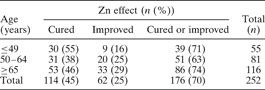
The therapeutic effect of the zinc agent was analysed according to subjects' ages (Table VI). The effectiveness rate of the zinc agent was 71 per cent in the 49 years or younger group, 63 per cent in the 50 to 64 years group, and 74 per cent in the elderly group. No significant differences were observed between the therapeutic effectiveness rates of the three age groups.
Subjects' ages and therapeutic effect of zinc administration*
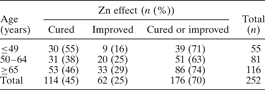
* In 252 cases.
Discussion
The number of patients with taste disorders increases with age.Reference Hamada, Endo and Tomita2–Reference Hoffman, Ishii and Macturk5 In the 1980s, Hamada et al. Reference Hamada, Endo and Tomita2 found that the age distribution of Japanese taste disorder patients peaked in the 50–59 year age group, followed by the 60–69 year age group. In a 1995 US study, 40 per cent of those suffering from taste disorders and anosmia were 65 years or older; thus, it was emphasised that disorders of the chemical senses were more frequent in the elderly.Reference Hoffman, Ishii and Macturk5 In the present study, the age distribution of cases peaked in the 60s for both men and women, with the elderly (i.e. 65 years or older) accounting for 43 per cent of cases.
Taste disorders are symptoms of neurological derangement, and there are various causes. These include systemic diseases,Reference Mahajan, Prasad, Lambujon, Abbasi, Briggs and McDonald9, Reference Burch, Sackin, Ursick, Jetton and Sullivan13–Reference Hardy, Brennand and Wyse19 drug treatment,Reference Henkin and Bradley6, Reference Ackerman and Kasbaker22, Reference Wickham, Rehwaldt, Kefer, Shott, Abbas and Glynn-Tucker23 zinc deficiency,Reference Yoshida, Endo and Tomita7, Reference Sakai, Yoshida, Endo and Tomita8 glossitis and stomatitis,Reference Itoh, Ikui, Ikeda, Tomita and Endo24 inflammation of the upper respiratory tract,Reference Henkin, Larson and Powell20 disorders of the central nervous system,Reference Onoda and Ikeda25 and idiopathic factors.Reference Yoshida, Endo and Tomita7, Reference Sakai, Yoshida, Endo and Tomita8
In the present study, we examined whether the effect of these factors was altered by age. We found that the most frequent causative factor for taste disorders was the administration of drugs to treat other disorders in the elderly; 47 per cent of our elderly subjects experienced drug-induced taste disorders, in contrast to just 12.9 per cent of subjects aged 49 years or younger.
The next most frequent aetiological factor in the elderly group was idiopathic (24 per cent); however, this factor was significantly more frequent in the 49 years or younger group (39 per cent). It is interesting to consider the extent to which physiological taste hypofunction affects taste disorder in the elderly. In our study, the number of idiopathic cases was rather smaller in the elderly group, suggesting that physiological taste hypofunction due to ageing was not a major aetiological factor in this particular population.
The appearance of taste disorders due to zinc deficiency has been reported for nearly 40 years.Reference Henkin and Bradley26 In rats fed a zinc-deficient diet, the serum zinc level decreased with the appearance of taste disorder,Reference Hasegawa and Tomita27, Reference Komai, Goto, Suzuki, Takeda and Furukawa28 and markedly abnormal findings appeared in the fine structure of the taste buds.Reference Kobayashi and Tomita29 In the present study, the serum zinc concentration of patients with taste disorders was quantified to assess the relationship between zinc deficiency and age. The mean minimum serum zinc concentration of the elderly group was not significantly different compared with that of the other two groups. However, a serum zinc concentration of less than 69 µg/dl was observed in 33 per cent of the elderly group, a significantly higher percentage than in the 49 years or younger group. We suggest that zinc deficiency may be a significant causative factor of taste disorder in elderly people.
Since the 1970s, human taste disorders have been observed to improve following the administration of zinc agents.Reference Henkin and Bradley6, Reference Hambidge, Hambidge, Jacobs and Baum30 In several placebo-controlled, double-blind tests, zinc treatment was very effective in the treatment of taste disorders involving a zinc-deficient state.Reference Yoshida, Endo and Tomita7–Reference Ripamonti, Zecca, Brunelli, Fulfaro, Villa and Balzarini10 However, some negative reports on the usefulness of zinc agents for treating taste disorders have been published.Reference Henkin, Shechter, Friedewald, Demets and Raff31
In the present study, the zinc agent was effective (i.e. subjects were either cured or improved) in 70 per cent of the total population; this is almost the same percentage as that obtained in double-blind studies.Reference Yoshida, Endo and Tomita7, Reference Sakai, Yoshida, Endo and Tomita8 The effectiveness rates differed with age, being 71 per cent in the 49 years or younger group and 74 per cent in the elderly group. No difference in effectiveness was observed between groups; the effect of zinc treatment was the same in the elderly group as in the other two age groups.
• A loss of taste makes it difficult to detect unhealthy or rotten foods and also reduces the joy of eating nutritious, flavoursome foods
• One of the characteristics of taste disorders is that they occur most often in the elderly
• This study investigated taste disorder causation in subjects aged 65 years or older
• In those aged 65 years or older, cases of taste disorder induced by drugs, systemic disease and low serum zinc concentration (<69 µg/dl) were significantly more numerous than in those aged 49 years or younger
We analysed the effect of zinc administration according to subjects' taste disorder causation. In patients with taste disorders related to drugs, idiopathic factors, systemic disease, zinc deficiency or upper respiratory tract inflammation, response rates ranged from approximately 65 to 75 per cent. Double-blind studies have demonstrated the efficacy of zinc administration in patients with zinc deficiency or idiopathic taste disorder.Reference Yoshida, Endo and Tomita7, Reference Sakai, Yoshida, Endo and Tomita8 Therefore, in patients with idiopathic taste disorder, marginal zinc deficiency may be present despite a normal serum zinc level.Reference Yoshida, Endo and Tomita7 It has been reported that a drug-related zinc chelate is aetiologically involved in drug-induced taste disorder.Reference Henkin and Bradley6, Reference Sekimoto and Tomita32, Reference Yoshikawa33 In cases of systemic disease, hepatic dysfunctionReference Vallee, Wacker, Bartholomay and Hoch34, Reference Sullivan, Jetton and Burch35 and renal dysfunctionReference Marumo, Tsukamoto, Iwanami, Kishimoto and Yamagami36 affect zinc absorption or enhance zinc excretion. In patients with diabetes, zinc excretion is enhanced.Reference Walter, Uriu-Hare, Olin, Oster, Anawalt and Critchfield37 Upper respiratory tract inflammation causes fever and may lead to the consumption of zinc. Thus, most of our subjects with taste disorders associated with the above aetiological factors probably responded to zinc treatment.