INTRODUCTION
Young children acquire language in the context of social interactions wherein conversational partners tend to repeat each other's words to build on what has just been said. The resultant overlap in content may help young children and their partners to establish common ground while serving to reaffirm and acknowledge each other's communicative efforts (Clark & Bernicot, Reference Clark and Bernicot2008). (Throughout this paper we use the term overlap rather than imitation to refer to utterances with content repeated from a partner's previous turn. Although the two concepts are similar, the term imitation seems less appropriate as a description of utterances where the shared content may be only a single word.) Although conversations between parents and children have been documented to contain notable amounts of imitation and repetition (Bloom, Hood, & Lightbown, Reference Bloom, Hood and Lightbown1974; Bruner, Reference Bruner1983; Dale & Spivey, Reference Dale and Spivey2006), it remains unclear how the overlap in content contributes to the child's language growth over time. A particular aspect that remains unclear is whether it is the parent's or the child's inclination to produce content overlapping with what their partner has just said that contributes more to the child's language development. The existing literature suggests two potentially complementary perspectives: the first emphasizes the ability of young children to grasp the communicative intentions of others and flexibly imitate their words and gestures in order to convey their own similar intentions. Under this view, imitation of parental utterances serves as a powerful means of expanding the child's communicative repertory (Carpenter, Tomasello, & Striano, Reference Carpenter, Tomasello and Striano2005; Tomasello & Carpenter, Reference Tomasello, Carpenter, Hurley and Chater2005). The second emphasizes how maternal responsiveness to infants’ communicative bids provides just-in-time feedback that contributes to the child's language development (Bornstein, Tamis-LeMonda, Hahn, & Haynes, Reference Bornstein, Tamis-LeMonda, Hahn and Haynes2008; Gros-Louis, West, & King, Reference Gros-Louis, West and King2014). The current study considered both views in seeking to identify the role of conversational overlap in promoting growth in sentence structure and vocabulary development in typical infants from 14 to 32 months.
Infants start imitating the vocalizations of others early in the first year of life, with the extent of their imitation increasing dramatically as they approach their first birthdays and acquire their first words (Jones, Reference Jones2007; Masur, Reference Masur1995). Vocal imitation is considered to play a critical role in guiding infants’ vocal productions towards language-specific targets (Kuhl & Meltzoff, Reference Kuhl and Meltzoff1996), as infants try to reproduce sounds based on perceptual representations of what they have just heard. Tomasello (Reference Tsomasello1999) noted toddlers’ tendency to mimic and engage in role-reversal imitation in referring to them as “imitation machines” (p. 159). Role-reversal imitation refers to the child's ability to direct the same communicative intentions that were directed towards them back onto their caregivers (or others) but with the roles reversed. Under this view, role-reversal imitation provides a mechanism for infants to adopt the linguistic and gestural conventions of others for the same or similar purposes (Tomasello, Reference Tomasello2003).
Another line of research, known as the social shaping hypothesis, has highlighted the role of contingent social feedback in facilitating vocal development. The social shaping hypothesis originates from avian research demonstrating that female wing strokes influence song development in male cowbirds (King, West, & Goldstein, Reference King, West and Goldstein2005), and is supported by evidence from human participants that contingent verbal and non-verbal responses to infant communicative bids, such as touching, smiling, or imitating infants’ vocalizations, influence the quality of infant babbling (Goldstein, King, & West, Reference Goldstein, King and West2003; Goldstein & Schwade, Reference Goldstein and Schwade2008) and increase the frequency of communicative bids over time (Gros-Louis et al., Reference Gros-Louis, West and King2014). This creates a developmental spiral as mothers tend to be more socially responsive to infant babbling when it contains more fully voiced, canonical sounds, which suggests that the quality of babbling both regulates and is regulated by social interaction (Goldstein et al., Reference Goldstein, King and West2003; Gros-Louis, West, & King, Reference Gros-Louis, West and King2016).
In the context of mother–child conversation, maternal feedback often takes the form of maternal repetition and/or expansion of what the child has just said (Clark & Bernicot, Reference Clark and Bernicot2008). By following the child's lead, the parent builds on what the child already has in mind, rather than distracting them with a new topic. Such responsive feedback has been associated with increases in infant vocalizations (Dunst, Gorman & Hamby, Reference Dunst, Gorman and Hamby2010) as well as with the timing of early language milestones (Tamis-LeMonda, Bornstein, & Baumwell, Reference Tamis-LeMonda, Bornstein and Baumwell2001). Contingent feedback involves both a semantic and temporal dimension, where the child's uptake of new words is dependent on the immediacy of the adult's response (McGillion, Herbert, Keren-Portnoy, Vihman, & Matthews, Reference McGillion, Herbert, Keren-Portnoy, Vihman and Matthews2013). Maternal utterances that overlap with what the child has just said provide a critical source of indirect negative evidence in correcting the child's pronunciation, recasting their grammatical errors into correct forms, or asking for clarification when the meaning of their utterance is unclear (Bohannon & Stanowicz, Reference Bohannon and Stanowicz1988; Demetras, Post, & Snow, Reference Demetras, Post and Snow1986; Hirsh-Pasek, Treiman, & Schneiderman, Reference Hirsh-Pasek, Treiman and Schneiderman1984). That is, by reformulating the child's utterance to correct an error, the adult provides a conventional form that the child can use in the future (Chouinard, & Clark, Reference Chouinard and Clark2003). Children, in turn, tend to repeat content provided by their conversational partners as a means of acknowledging their understanding, and they are more likely to imitate the correct grammatical morpheme following a corrective recast than any other form of utterance (Farrar, Reference Farrar1990, Reference Farrar1992).
The current study adopted an individual differences approach to examine whether the child's and/or the mother's tendency to overlap – i.e., to produce utterances that repeat back part of what was just said – is predictive of growth in the child's language over time, using the mean length of the child's utterances (MLU), developmental sentence score (DSS; Lee & Canter, Reference Lee and Canter1971), and vocabulary diversity (VOCD; McKee, Malvern, & Richards, Reference McKee, Malvern and Richards2000) as outcome measures. (Note that throughout this paper, we refer to individual differences as pertaining to the range of values observed on the various outcome measures at each age.) We used the automatized command CHIP (Sokolov & MacWhinney, Reference Sokolov and MacWhinney1990), which is part of the CLAN system for analyzing data in the Child Language Data Exchange System (CHILDES; MacWhinney, Reference MacWhinney2000), to compute the proportion of each speaker's utterances that overlapped in content with their partner's prior utterances, and used these measures to predict language outcomes longitudinally. Using an automated coding program guarantees coder reliability because it inherently codes and analyzes the same utterance the same way each time.
Prior work utilizing the CHIP command (Sokolov, Reference Sokolov1993) adopted a multiple case-study design to evaluate the fine-tuning hypothesis that the form of child-directed speech varies as a function of the child's language skills. The fine-tuning hypothesis suggests that child-directed speech serves as a scaffold for the child's emerging language skills, with mothers and other caregivers varying the complexity of child-directed speech based on the child's level of comprehension and vocal expression (Snow, Reference Snow, Bornstein and Bruner1989). Rather than focusing on individual differences in the extent to which mothers and children produced utterances that overlapped in content with their partners, Sokolov (Reference Sokolov1993) focused on the types of modifications within overlapping utterances and how these changed over time – for example, by showing that maternal additions of modal auxiliaries (e.g., can, must) to child utterances decreased over time as children began producing more of these auxiliaries on their own.
To our knowledge, the current study is the first to utilize the CHIP command to explore individual differences in child language outcomes (MLU, DSS, and VOCD) in relation to the amount of conversational overlap, despite the obvious advantages of using an automatized computer program to ensure consistency of coding. Our primary aim was to evaluate the role of maternal versus child overlap in promoting language growth in the child. To address this aim, we used regression analyses with maternal and child overlap measures at earlier time-points serving as predictors of language outcomes at later time-points. Our secondary aim was methodological: we sought to determine whether overlap scores computed as a proportion of total utterances and as a proportion of responses to partner utterances (i.e., opportunities to generate overlapping content) were equally predictive of child language outcomes over time. For toddlers, the two measures tend to yield nearly identical estimates of overlap because the vast majority of child utterances are in response to something their mother has just said. However, mothers produce a far greater number of utterances than their toddlers at the outset of language development; that is, they produce multiple utterances in succession, without intervening child utterances. Hence, estimates of maternal overlap calculated as a function of maternal responses to child utterances tend to be considerably higher than estimates calculated as a function of the total number of maternal utterances.
METHOD
CHILDES corpus
The current study utilized the New England longitudinal corpus (Snow, Pan, Imbens-Bailey, & Herman, Reference Snow, Pan, Imbens-Bailey and Herman1996), accessed through the CHILDES database (MacWhinney, Reference MacWhinney2000; MacWhinney & Snow, Reference MacWhinney and Snow1985). The corpus comprises transcripts of conversational interactions of mother–child dyads recorded at child ages 14, 20, and 32 months. The children were documented as having no evidence of hearing impairment or developmental delay at the age of three years. The 52 dyads in the corpus were a subset of a larger sample of 100 dyads from English-speaking families (Ninio, Snow, Pan, & Rollins, Reference Ninio, Snow, Pan and Rollins1994); the subsample included equal numbers of boys and girls and was representative of the socioeconomic range of the original sample. All recordings were of mother–child pairs with the exception of two children recorded with their fathers at one time-point. These two dyads were excluded in order to hold constant the child's communicative partner across sessions. Four other dyads were excluded because they were not recorded at 20 months, which precluded their inclusion in longitudinal analyses. Additionally, due to attrition, only a subset of the dyads was available at 32 months. Hence, the final sample comprised 46 children (24 girls, 22 boys) recorded with their mothers at 14 and 20 months; 35 of these children (17 girls, 18 boys) were also recorded at 32 months.
At 14 and 20 months, dyads were recorded while engaged in a 5-minute warm-up activity, involving free play with a variety of toys (e.g., slinky, jack-in-the-box), followed by a four-box task, involving exploration of a sequence of four boxes containing a ball, a cloth for peekaboo, paper and crayons, and a book. The session ended only after the mother had engaged with their child in exploring all four boxes, which created variability in session duration (10–25 min). At 32 months, the sessions did not include the warm-up activity and substituted a hand puppet and a toy house for the ball and peekaboo cloth to make the four-box task more age-appropriate.
Automatized data analysis
Transcripts of the play sessions were analyzed at the three time points (14, 20, 32 months) using the fully automated CLAN program (MacWhinney, Reference MacWhinney2000). We used the CHIP command to compute conversational overlap in content across partners, the MLU command to measure the mean length of child and maternal utterances, the DSS command to estimate the complexity of children's complete sentences, and the VOCD command to estimate the vocabulary diversity of child and maternal speech.
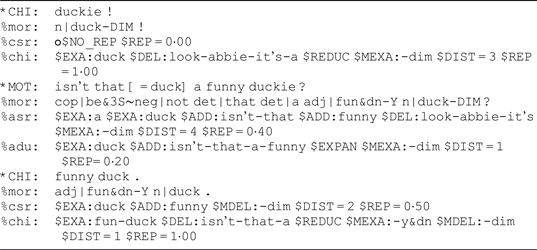
The CHIP command (Sokolov & MacWhinney, Reference Sokolov and MacWhinney1990) compares content across utterances to determine the extent to which individual words match; it processes the transcript line-by-line, identifying each successive utterance to code (i.e., the ‘response’) while searching for a preceding utterance (i.e., the ‘source’) to match with the response. Table 1 shows a portion of an annotated transcript from a child at 20 months after running the CHIP command. Each response utterance in the transcript is matched twice: once with a source utterance generated by the conversational partner (i.e., conversational overlap) and once with a source utterance generated by the same speaker (i.e., self-repetition). For example, if a child's response utterance is being coded, the CHIP command will search for the nearest maternal source utterance and the nearest child source utterance to match with the response. Note that the CHIP command does not require that source and response utterances be adjacent in the transcript. When either speaker produces more than one consecutive utterance, each is matched to the same ‘nearest’ utterance of their conversational partner within a default window setting of six preceding utterances (Sokolov, Reference Sokolov1993). As a result, one source may be matched with multiple responses.
A portion of a CHIP annotated transcript (Dyad 92 from the New England corpus at 20 months)

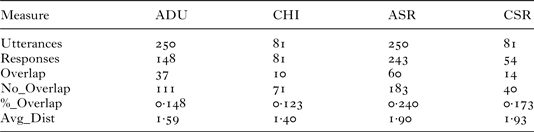
The output of the CHIP command consists of a series of dependent tiers (i.e., codes associated with specific utterances within the transcript), which are of four types: %chi, %adu, %csr, and %asr. The %chi tier provides the overlap between the child's response to a specified adult source utterance; it is used to compute the proportion of child utterances that repeated back part of what the mother had just said. Conversely, the %adu tier provides the overlap between an adult response to a child source utterance; it is used to compute the proportion of maternal utterances that repeated back part of what the child had just said. The %csr tier provides an analysis of child self-repetition (i.e., child utterances are both the source and response), and the %asr tier provides an analysis of adult self-repetition (adult utterances are both the source and response). The current study did not include child or adult self-repetition as a factor in any of the analyses, as preliminary work failed to find any statistically significant relationships to language outcomes across time-points. As part of its summary statistics, the CHIP command provides a value for %_Overlap, which is the proportion of overlapping responses out of the total number of utterances produced by the speaker; see Table 2, which provides a portion of the CHIP output summary for a child at 20 months. The current study used these proportional scores for child overlap of mother and maternal overlap of child as predictors of language outcomes. Additionally, because mothers often produced utterances that were not identified by CHIP as responses to a child utterance, we also calculated the proportion of overlapping responses out of the total number of responses to the partner (i.e., a subset of the total number of utterances), and used these proportions as predictors of language outcomes. For children (N = 6; 3 boys, 3 girls) who did not produce any intelligible speech at 14 months, values of 0 were entered into analyses at 14 months.
A portion of the CHIP command output (Dyad 92 from the New England corpus at 20 months)

As indices of children's sentence complexity, we calculated two measures: mean length of utterance (MLU; Brown, Reference Brown1973) and developmental sentence score (DSS; Lee & Canter, Reference Lee and Canter1971). The MLU command generates the ratio of the number of morphemes divided by the number of utterances produced. It was calculated at each age, with scores of 0 entered at 14 months for the six children who were not yet producing intelligible speech.
The DSS command relies on the part of speech coding provided in the morphological (%mor) tier of each transcript. It incorporates scores from eight different grammatical domains (indefinite pronouns, personal pronouns, main verbs, secondary verbs, negatives, conjunctions, interrogative reversal, and wh-questions). The DSS command extracts up to 50 consecutive sentences for analysis, excluding incomplete sentences, unintelligible utterances, and sentence repetitions (i.e., each sentence included in the analysis must be unique). The DSS command assigns points (corresponding to the eight grammatical domains) to each extracted sentence, and computes an average DSS score by dividing the total points by the number of extracted sentences (Lee & Canter, Reference Lee and Canter1971). Due to insufficient numbers of complete sentences, the DSS command was only computed as an outcome measure at 32 months.
We used the VOCD command to provide a measure of vocabulary diversity that is less sensitive to variation in the size of the corpus than type/token ratio (McKee et al., Reference McKee, Malvern and Richards2000). The VOCD command calculates a measure, referred as D, using iterative random sampling of word tokens from the child's speech. The command generates 16 random samples, ranging in size from 35 to 50 tokens, with tokens selected without replacement; the samples are used to compute estimates of D, which are averaged to compute a D average score. The analysis is then repeated three times to generate an overall VOCD score (i.e., the mean of the three D average scores, which is referred to as the D optimum average), with higher scores indicating greater lexical diversity. We examined VOCD as an outcome measure only at 32 months when all children exceeded the minimum of 50 word tokens required to run VOCD in CLAN.
Analytical approach
We fit mixed-effects Poisson regression models to child and maternal overlap scores at 14, 20, and 32 months to test whether rates of child and maternal overlap increased over time. The models treated the number of utterances with overlapping content as the dependent variable and the logarithm of the relevant denominator as an offset term. An offset term is a variable with a regression coefficient fixed to 1. Using the logarithm of the denominator as an offset term allows proportions to be analyzed using the Poisson distribution. This technique is commonly used to compare rates with different denominators (Gelman & Hill, Reference Gelman and Hill2007). Models were fit in lme4 (Bates, Maechler, Bolker, & Walker, Reference Bates, Maechler, Bolker and Walker2015) in R (R Core Team, 2015). Observations for which the numbers of utterances or responses were 0 were dropped. As a result, some analyses contained different numbers of observations. In some cases, the Poisson regression was over-dispersed, and the model was re-fit using a mixed-effect negative binomial regression. Because inferences did not differ across models, for simplicity only the Poisson regression models are reported.
The relationship between maternal and child overlap and subsequent MLU growth in the child was examined using two mixed-effects linear regressions, one for each definition of overlap. Specifically, MLU at 20 and 32 months (t) was modelled as a function of predictor variables at the previous time-point, 14 and 20 months (t–1), respectively. Predictor variables were the rates of child and maternal overlap. To control for earlier differences in child and maternal MLU, these variables were included as predictor variables as well.
As it was unclear whether the relations between predictors and dependent variables would be the same across both intervals, time of dependent variable measurement was sum coded (–1 for 20 months and 1 for 32 months) and allowed to interact with each of the predictor variables. As a result, the slope for each predictor reflects the average relationship between the predictors and the dependent variable across the two time-points, similar to a main effect in an ANOVA, and the interaction between slopes and the time variable reflects the differences in the slopes across the two time-points. In order to facilitate interpretations of interactions, all predictor variables were centered around their mean at the relevant time-point. For example, each child's MLU at 20 months was standardized around the mean of the entire sample at 20 months. Each model then had the following form: y it = β 0 + (β 1*Xt−1)* β 2*Time + е ti + u i.
All models were estimated using lme4 (Bates et al., Reference Bates, Maechler, Bolker and Walker2015) package in R (R Core Team, 2015). All coefficients were evaluated using t-tests with the Sattherwaite approximation for degrees of freedom, as well as bootstrapped confidence intervals. Additionally, the contribution of each interaction was evaluated using the likelihood ratio test to compare the full model to a reduced model that did not include the interaction. As residuals appeared heteroskedastic and non-normally distributed, all analyses were conducted on the logarithm of MLU.
Both DSS and VOCD scores at 32 months were analyzed using two linear regressions, one for each definition of overlap, with rates of child and maternal overlap at 20 months as predictor variables. The models for DSS included child and maternal MLU at 20 months as predictors. The models for VOCD included child word types and maternal VOCD at 20 months as predictors, instead of child and maternal MLU, as the former variables are indices of vocabulary use as opposed to sentence complexity.
Note that preliminary analyses, reported in Che, Alarcon, Yannaco, and Brooks (Reference Che, Alarcon, Yannaco and Brooks2016), incorporated maternal word tokens at the previous time-point as a predictor of MLU and VOCD to evaluate the influence of the quantity of child-directed speech on outcome measures. This variable did not approach significance and was dropped from the models reported here. Similarly, maternal word types and number of utterances, entered as covariates, did not impact the results. Taken together, the preliminary analyses indicated that the amount of language input at a given age was not predictive of child language outcomes at later ages.
RESULTS
Table 3 presents the mean number of utterances, number of responses, and length of utterances (MLU) for children and their mothers at each age. Note that the number of maternal responses exceeds the number of child utterances because the CHIP command can link multiple responses to the same source utterance, as long as the source and response are within a six-utterance window. Although the CHIP command searches within a window of six utterances, the average distance between source and response utterances was low. For maternal responses, the average distance from the child source utterance was 1·61 utterances (SD = ·52) at 14 months and 1·64 utterances (SD = ·27) at 20 months. For child responses, the average distance from the maternal source utterance was 1·32 utterances (SD = ·59) at 14 months and 1·26 utterances at 20 months (SD = ·33).
Mean numbers of utterances and responses to partner utterances, and mean length of utterance (MLU) in morphemes for child and mother at child ages 14, 20, and 32 months. (standard deviations in parentheses)

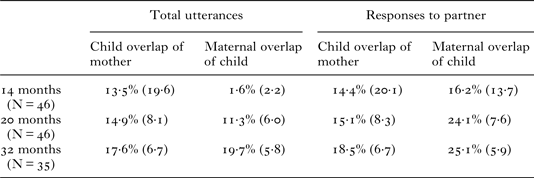
Table 4 provides the mean percentages of child and maternal overlap, wherein the speaker's utterance contained words that overlapped with what their partner had just said. Percentages of overlapping responses were calculated in two ways: (i) as a function of the number of utterances produced by the speaker and (ii) as a function of the number of responses to their partner's utterances. In calculating rates of child overlap of maternal utterances, the two measures yielded nearly identical results, as the overwhelming majority of child utterances were identified as responses to maternal utterances by the CHIP command; bivariate correlations between the two measures at each age were r(N = 46) = ·99, p < ·001 at 14 months, r(N = 46) = ·997, p < ·001 at 20 months, and r(N = 35) = ·97, p < ·001 at 32 months. In contrast, in calculating rates of maternal overlap of child utterances, estimates were substantially higher when the number of responses was used as the denominator, as mothers produced many utterances that were too distant to be identified by CHIP as responses to a child's utterance. Nevertheless, despite the apparent differences in the rates shown in Table 4, the two measures of maternal overlap were significantly correlated, with bivariate correlations of r(N = 46) = ·69, p < ·001 at 14 months, r(N = 46) = ·53, p < ·001 at 20 months, and r(N = 35) = ·88, p < ·001 at 32 months.
Mean percentages of child and maternal utterances overlapping in content with their partner's prior utterance at child ages 14, 20, and 32 months, calculated as a function of the number of utterances or the number of responses to the partner (standard deviations in parentheses)

At each age, rates of child and maternal overlap tended to be only weakly correlated. With overlap calculated as a proportion of the speaker's utterances, bivariate correlations between rates of child and maternal overlap were r(N = 46) = ·29, p = ·052 at 14 months, r(N = 46) = ·33, p = ·027 at 20 months, and r(N = 35) = ·29, p = ·093 at 32 months. Similarly, with overlap calculated as a proportion of responses to the partner, bivariate correlations between rates of child and maternal overlap were r(N = 46) = ·53, p < ·001 at 14 months, r(N = 46) = ·25, p = ·092 at 20 months, and r(N = 35) = ·37, p = ·029 at 32 months.
Changes in overlap over time for both child and mother were analyzed using mixed-effects Poisson regression. When overlap was defined as a proportion of the speaker's total utterances, rates of child overlap did not vary over adjacent time points (14→20 months: B = –0·14, Z = –1·19, p = ·236; 20→32 months: B = –0·02, Z = –0·18, p = ·854; N = 121). However, mothers exhibited significantly more overlap with increasing age of their child (14→20 months: B = 1·88, Z = 28·04, p < ·001; 20→32 months: B = 2·46, Z = 36·13, p < ·001; N = 127).
In contrast, when overlap was defined as proportion of responses, neither rates of child nor maternal overlap varied significantly over adjacent time-points: for child overlap (14→20 months: B = –0·18, Z = –1·58, p = ·115; 20→32 months: B = –0·03, Z = –0·28, p = ·777; N = 121); for maternal overlap (14→20 months: B = –0·05, Z = –0·70 , p = ·485; 20→32 months: B = 0·01, Z = 0·13, p = ·899; N = 121.
Mean length of utterance at 20 and 32 months as a function of overlap
The relationship between maternal and child overlap and MLU growth in the child was examined using mixed-effects linear regression, with regression models computed for each definition of overlap. In each regression model, MLU at 20 and 32 months (i.e., at time t) was examined in relation to predictor variables at the previous time-point, 14 and 20 months (i.e., at t–1), respectively. Predictor variables were the rates of child and maternal overlap at t–1, child and maternal MLU at t–1, and time of observation (t).
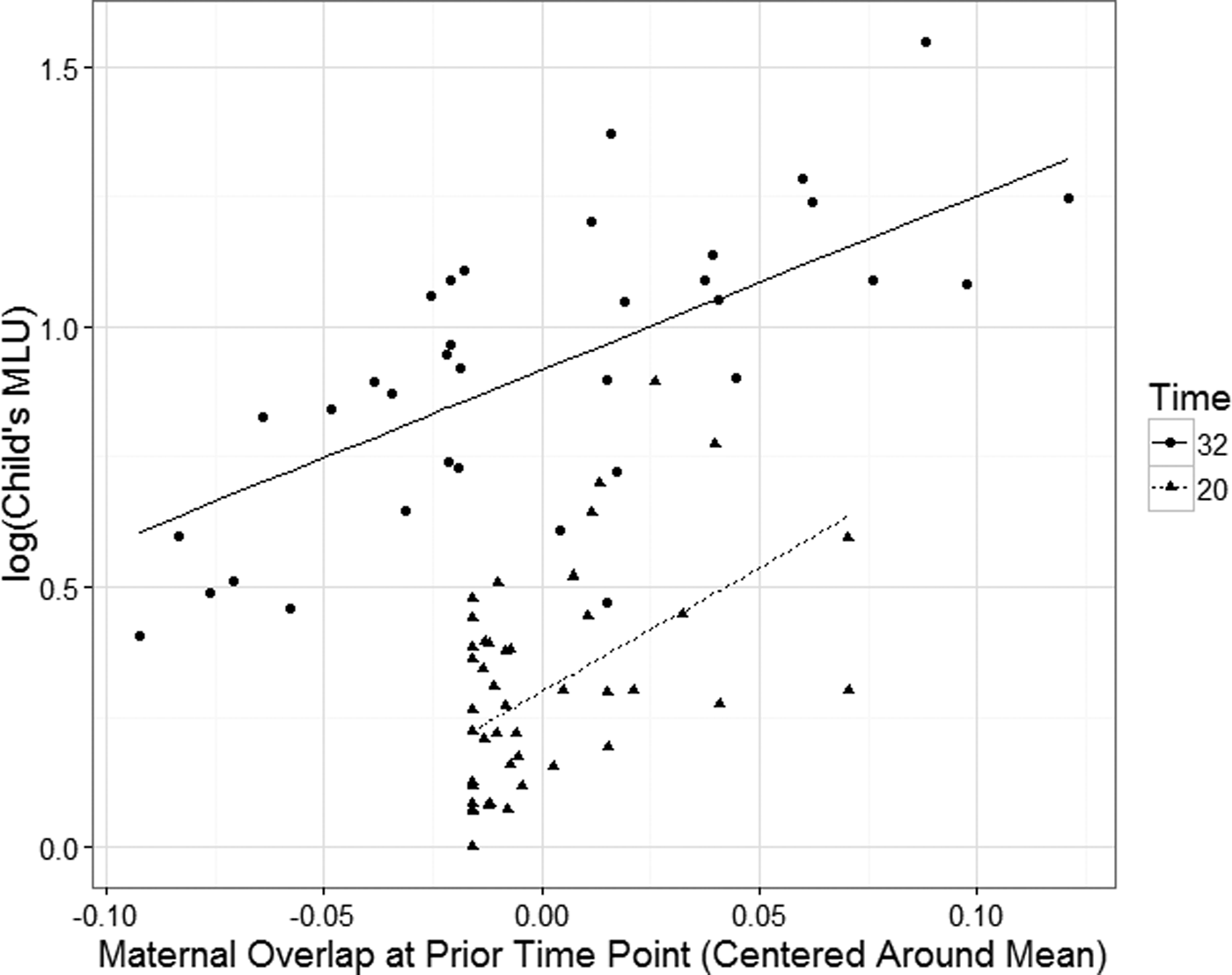
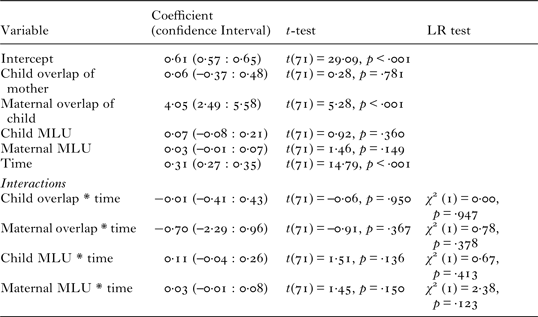
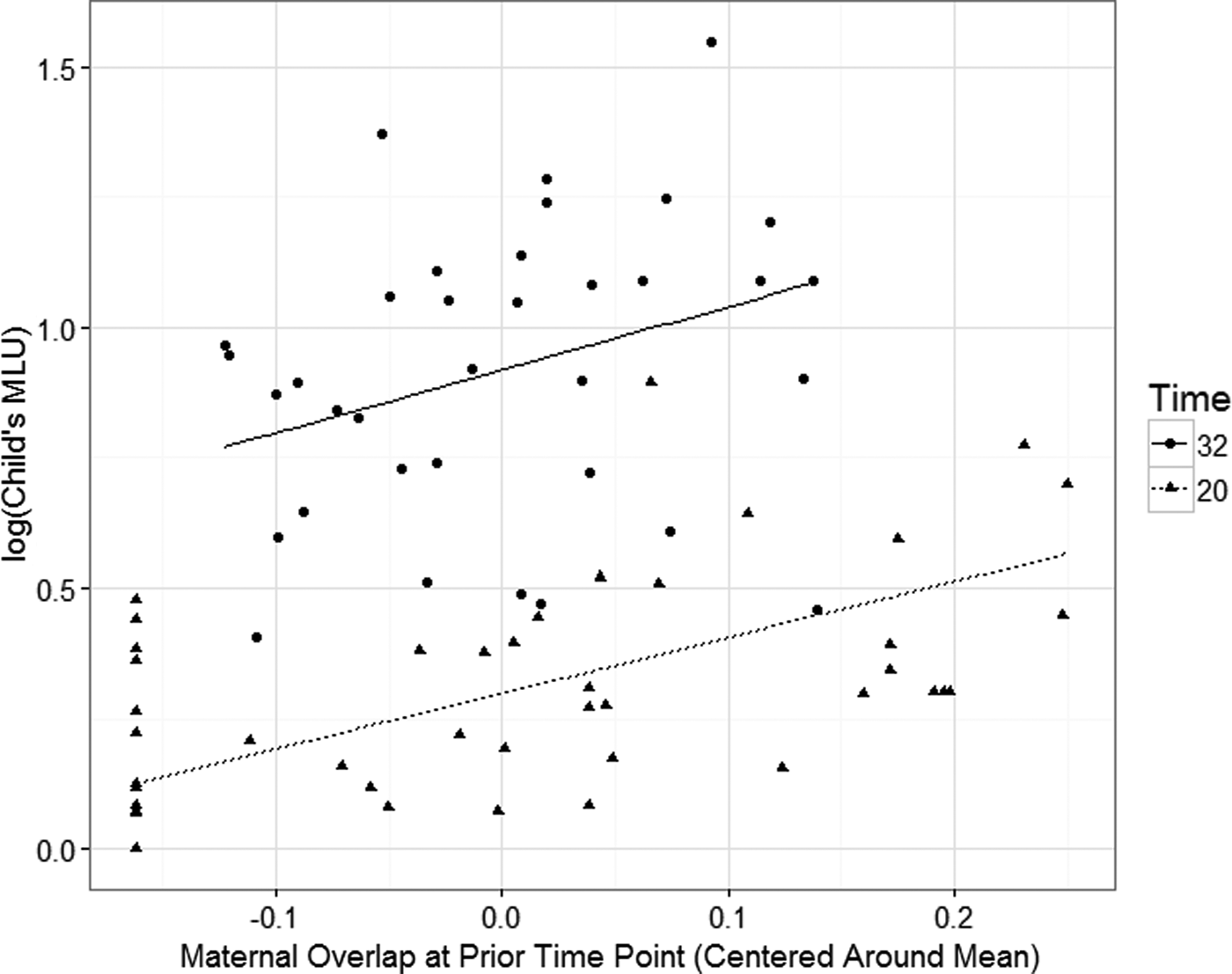
As can be seen from Table 5, when overlap was defined as a proportion of the speaker's utterances, there was a significant main effect of maternal overlap with no significant interaction. The positive sign of this coefficient indicates that children whose mothers provided more overlap at time t–1 had higher MLU scores at time t, even after controlling for the child's MLU at time t–1, as depicted in Figure 1. In contrast to the effect of maternal overlap on child MLU over time, there was no effect of the rate of child overlap on MLU. The only other effect to reach significance in the analysis was an effect of time (i.e., age of child), with the positive coefficient indicating that MLUs increased more between 20 and 32 months than between 14 and 20 months. Note also that six children at 14 months produced no intelligible speech (i.e., utterance count = 0). To determine whether inferences were sensitive to the inclusion of observations for which the child did not produce any utterances, we re-ran all of the models excluding these datapoints. The same qualitative pattern of results was observed (n = 75).
Relationship between maternal overlap of child utterances and subsequent child MLU, controlling for child and mother's prior MLU and child overlap. Overlap defined as a proportion of the speaker's total utterances.

Mixed-effects model predicting MLU at 20 and 32 months from child overlap of mother and maternal overlap of child at prior time-point, with overlap scores calculated using total numbers of utterances (N = 46 participants, N = 81 observations). Additional predictors were child and maternal MLU and time of observation.

note: All predictor variables were measured at time t – 1. Coefficients are on the log scale. Likelihood ratio tests were used to test the contribution of interactions. Each test compares the full model to a model without that interaction but with additive effects of the relevant variable.
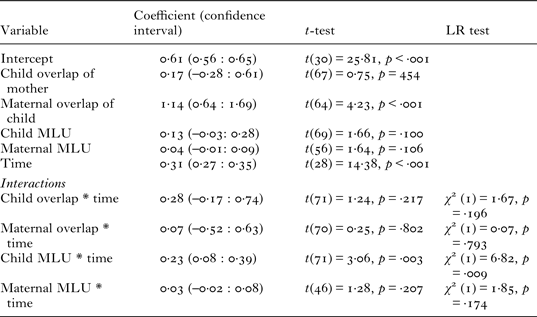
As can be seen from Table 6, nearly identical results were obtained when overlap was defined as a proportion of responses to the partner. Again, there was a significant main effect of maternal overlap and no effect of child overlap on child MLU over time. Consistent with the previous model, the sign of the coefficient was positive, indicating that children whose mothers provided more overlap at time t–1 had higher MLUs at time t, as shown in Figure 2. There was also a significant interaction between child's MLU and time: subsequent regressions revealed that prior MLU was predictive of later MLU at 32 months (B = 0·98, t(30) = 2·52, p = ·012), but not at 20 months (B = –0·13, t(30) = –1·19, p = ·24).
Relationship between maternal overlap of child utterances and subsequent child MLU, controlling for child and mother's prior MLU and child overlap. Overlap defined as a proportion of responses to the partner's utterances.

Mixed effects model predicting MLU at 20 and 32 months from child overlap of mother and maternal overlap of child at prior time-point, with overlap scores calculated using total numbers of responses to the partner (N = 46 participants, N = 81 observations). Additional predictors were child and maternal MLU and time of observation.

note: All predictor variables were measured at time t – 1. Coefficients are on the log scale. Likelihood ratio tests were used to test the contribution of interactions. Each test compares the full model to a model without that interaction but with additive effects of the relevant variable.
Developmental sentence scores at 32 months as a function of overlap
Next we examined associations between maternal and child overlap and developmental sentence scores (DSS) using linear regression. DSS, computed as the average complexity of children's complete sentences, was calculated only at 32 months with a mean of 5·86 (SD = 1·24). In the regression models, child and maternal overlap at 20 months and child and maternal MLU at 20 months were entered as predictors with DSS at 32 months as the outcome variable. When overlap scores were calculated as a proportion of the speaker's utterances, the regression model revealed a positive significant relationship between maternal overlap and DSS (B = 8·56, t(30) = 2·25, p = ·032), and a non-significant relationship between child overlap and DSS (B = –3·46, t(30) = –1·50, p = ·143). That is, higher rates of maternal overlap in the input at 20 months were associated with greater sentence complexity at 32 months. In addition, the effect of maternal MLU at 20 months was positive but not significant (B = 0·39, t(30) = 1·88, p = ·070).
A similar, albeit weaker, pattern of results was observed when overlap scores were defined as a proportion of the responses to the partner. In this model, there was a positive association between maternal overlap and DSS, but it was not statistically significant (B = 4·62, t(30) = 1·83, p = ·077); the relationship between child overlap and DSS remained non-significant (B = –2·53, t(30) = –1·13, p = ·267). (Note also that the results of the regression models for DSS did not change if other maternal variables, i.e., word tokens, word types, number of utterances, were included as predictors.)
Vocabulary diversity scores at 32 months as a function of overlap
As a final set of analyses, we examined whether the impact of overlapping input would extend beyond sentence complexity to vocabulary. For this purpose, we computed vocabulary diversity scores (VOCD) at 32 months, with an observed mean of 49·74 (SD = 18·57). We fit two linear regression models to the data, one for each definition of overlap, with rates of child and maternal overlap at 20 months as predictor variables. The regression models also included child word types and maternal VOCD at 20 months as predictors, rather than child and maternal MLU, as the former variables are indices of vocabulary use as opposed to sentence complexity.
When overlap scores were calculated as a proportion of the speaker's utterances, the model indicated a significant positive association between maternal overlap and child VOCD (B = 153·64, t(30) = 2·20, p = ·036), and a non-significant association between child overlap and VOCD (B = –35·75, t(30) = –1·07, p = ·293). In addition, maternal VOCD at 20 months showed a positive relationship with child VOCD at 32 months (B = 0·52, t(30) = 2·61, p = ·014). Hence, mothers who produced more overlapping utterances and diverse vocabulary at 20 months had children with higher VOCD scores at 32 months.
However, when overlap scores were calculated as a proportion of responses to the partner, the effect of prior maternal overlap on child VOCD was no longer apparent (B = 13·71, t(30) = 0·36, p = ·724), nor was there any effect of child overlap (B = –25·41, t(30) = –0·71, p = ·484). In contrast, both control variables at 20 months yielded positive associations with child VOCD at 32 months (child word types, B = 0·32, t(30) = 2·06, p = ·048; maternal VOCD, B = 0·48, t(30) = 2·24, p = ·034). Thus, children who produced more word types at 20 months and whose mothers used more diverse vocabulary at 20 months had higher VOCD scores at 32 months.
DISCUSSION
Our study explored the impact of conversational overlap, defined as the reuse of one or more of a communicative partner's words in a subsequent response, on the development of sentence structure and vocabulary in toddlers at 14 to 32 months of age. Previous research had established that, in parent–child conversations, partners tended to build on each other's contributions, with repetition of content serving as a means of ratifying the partner and establishing the overlapping content as mutually understood (Clark & Bernicot, Reference Clark and Bernicot2008). Although various theoretical models of language development have emphasized social interaction as providing the critical context for child language development, the literature generates contrasting hypotheses about the role of child overlap versus maternal overlap in promoting child language growth. Usage-based models of language development (e.g., Tomasello, Reference Tomasello2003) view children as adopters of linguistic conventions encountered through child-directed speech, and highlight the child's propensity to imitate, i.e., reuse caregivers’ communicative expressions for their own purposes, as contributing to their subsequent language development. An alternative, but not mutually exclusive, perspective emphasizes mothers and other caregivers as the backbone of a language acquisition support system (Bruner, Reference Bruner1983); under this view, mothers (and others) scaffold interactions to create predictable formats for language learning while providing responsive feedback that indicates that what the child has contributed is worthy of attention and further comment (Bornstein et al., Reference Bornstein, Tamis-LeMonda, Hahn and Haynes2008). Contingent positive (verbal or non-verbal) feedback to an infant's communicative vocalizations appears to be socially rewarding and has been linked to increased rates of vocalization and production of more mature forms of babble (Goldstein et al., Reference Goldstein, King and West2003; Gros-Louis et al., Reference Gros-Louis, West and King2014). The current study explored whether maternal feedback in the form of conversational overlap might similarly be linked with advances in utterance complexity and vocabulary growth in toddlers.
Using an individual differences approach, we used the CHIP command (Sokolov & MacWhinney, Reference Sokolov and MacWhinney1990) to examine how variation in the proportions of utterances with overlapping content might predict growth in the mean utterance length (MLU), sentence structure (DSS), and vocabulary diversity (VOCD) over time. Counter to the hypothesis that children would use imitation as a mechanism for expanding their communicative repertories, we found no evidence that individual differences in children's proclivity to imitate their mothers’ speech facilitated their language development over time. Indeed, for DSS and VOCD, the (non-significant) regression coefficients linking child overlap with language outcomes at a later time-point were negative. In the light of this null result, it is important to consider that the metrics used in our study (proportions of overlapping utterances/responses) may not have been sensitive to the ways that imitation contributes to language development. As reported by Masur and Eichorst (Reference Masur and Eichorst2002) in relation to vocabulary development, toddlers may differentially imitate novel vs. familiar words, with repetition of novel words, but not familiar words, linked with vocabulary growth over time. Indeed, findings from Clark (Reference Clark2007, Reference Clark2010) suggest that young children show heightened rates of repeating new words that they encountered in conversational or book reading contexts.
In contrast to the null findings for child overlap of maternal utterances, we observed that rates of maternal overlap of child utterances at earlier time-points predicted child MLU, DSS, and VOCD at later time-points. These findings build directly on the work of Tamis-LeMonda and colleagues (2001), who reported that rates of maternal imitation and expansion of their infant's vocalizations at 13 months predicted the timing of the infant's future milestones in vocabulary development (50 words in production), combinatorial speech, and past-event talk. Using cross-lagged regression analyses, our results extend the impact of maternal overlap to individual differences in language outcomes (MLU, DSS, and VOCD) at later stages of language development.
Our findings complement prior work by Dale and Spivey (Reference Dale and Spivey2006) that used a multiple case-study approach to study syntactic coordination, i.e., patterns of recurrence of multiword chunks, in three child–parent dyads followed longitudinally (the Abe, Sarah, and Naomi corpora from the CHILDES database). With recurrence defined as repetition of two, three, or four unit chunks within windows of 50, 100, or 150 utterances, all three children and their parents tended to reuse multiword chunks produced by their conversational partner across all of the recorded sessions. Similarly, our analyses, which defined overlap at the word level within a narrower window (i.e., a maximum of six utterance separated source and response utterances, but with average distance under two utterances), found toddlers and their mothers to repeat content provided by their partner in a substantial proportion of utterances/responses. Dale and Spivey further explored whether the parent or the child was playing a greater role in leading the conversation (i.e., introducing new content) versus following (i.e., repeating the partner), and whether this varied as a function of the child's level of language development. Although their analyses were limited to three dyads, they found evidence of variation in conversational patterns in relation to child language abilities. Abe, the child with the highest MLU, tended to lead conversations with his father following along, whereas Sarah, the child with the lowest MLU, more often followed her mother's lead. The observed pattern suggested that a higher rate of parental reuse of chunks extracted from the child's output was associated with the child having more advanced language skills (concurrently). However, given the difficulties of interpreting case studies, the question of how conversational overlap impacts children's language development needed to be revisited.
In analyzing the New England corpus, we considered two possible methods of calculating the proportion of overlap in the input, wherein high rates of maternal overlap reflected the mother's tendency to follow her child's lead, and high rates of child overlap reflected the child's tendency to follow the mother's lead. Because the CHIP command searches for a source utterance within a window of six utterances (by default), many maternal utterances at 14 months were not counted as responses to a child utterance because the child had not produced any utterance within the specified window. That is, with infants contributing only a few utterances to the recorded conversations at 14 months, rates of maternal overlap calculated as a function of the total number of maternal utterances tended to be very low. Hence, we calculated overlap both as a function of the total number of utterances and as a function of the total number of responses to the partner's utterances. For MLU, mixed-effect models yielded similar results irrespective of how we calculated rates of maternal overlap; however, for DSS and VOCD, maternal overlap (at 20 months) yielded a larger effect as a predictor of child language outcomes (at 32 months) when it was calculated as a proportion of total utterances. Indeed, there was an absence of an effect of maternal overlap on VOCD when only the adult responses to the child were considered, rather than all of the adult's speech. As suggested by one of the reviewers, when parents are taking up what their child has just said, the actual range of vocabulary they use is somewhat limited by what the child already knows and can produce. This range for adult speakers may be a lot less extensive than the vocabulary they produce overall in talking to their child. As such, the diversity of maternal vocabulary (VOCD) may be a more impactful predictor of the child's VOCD than overlap.
Our findings are readily interpretable within the framework of the social gating hypothesis (Kuhl, Reference Kuhl2007; Kuhl, Tsao, & Liu, Reference Kuhl, Tsao and Liu2003) that vocal learning in humans, as well as other (avian) species, is tightly linked with brain systems underlying social motivation and reward (Doupe & Kuhl, Reference Doupe and Kuhl1999; Sasaki, Sotnikova, Gainetdinov, & Jarvis, Reference Sasaki, Sotnikova, Gainetdinov and Jarvis2006; Syal & Finlay, Reference Syal and Finlay2011). In humans, proto-conversations emerge in face-to-face interactions at around 6 weeks of age; these dyadic routines establish strong affective bonds between caregivers and young infants and provide a critical motivational context for learning (Rochat, Reference Rochat2007). Engaging in proto-conversations is mutually rewarding for both infants and caregivers and, by 4 months of age, infants demonstrate a preference for the prosodic, affective quality of infant-directed speech (Fernald, Reference Fernald1985; Singh, Morgan, & Best, Reference Singh, Morgan and Best2002), with some of its features potentially enhancing learning (Kuhl et al., Reference Kuhl, Andruski, Chistovich, Chistovich, Kozhevnikova, Ryskina and Lacerda1997). In such interactions, communicative partners coordinate the timing of their behaviours with each other by modulating gaze, touch, and vocalization (Feldstein et al., Reference Feldstein, Jaffe, Beebe, Crown, Jasnow, Fox and Gordon1993), with affective mirroring and vocal matching effectively establishing the dynamics of turn-taking that build rapport and encourage further vocalization (Bloom, Russell, & Wassenberg, Reference Bloom, Russell and Wassenberg1987; Locke, Reference Locke2001; Papoušek & Papoušek, Reference Papoušek and Papoušek1989). Maternal overlap, like other forms of contingent feedback in earlier proto-conversations, may impact language development by serving to elicit more speech from the child (Hoff-Ginsburg, Reference Hoff-Ginsburg1990). The current study, by focusing on what mothers say in relation to their child's utterances, rather than on how they say it, provides support for the view that hearing their own words used by others is rewarding to toddlers and beneficial to their learning. Of course, a limitation of our focus on overlapping utterances is that it fails to consider the impact of maternal responsiveness to their child's non-verbal communication (e.g., actions and gestures) on language development, which remains an important topic for future research.
Maternal overlap constitutes a salient example of just-in-time feedback that affirms the child's communicative efforts while providing input that is relevant to what the child already has in mind. (In the current study, we could not determine the exact timing of maternal responses in seconds, but were able to ascertain that they occurred with an average distance of 1·62 utterances from the child's source utterance.) By building on what the child has just said, within a span of one to two utterances, mothers are effectively following the child's lead, rather than redirecting their focus of attention – a pattern of engagement conducive to establishing joint attention and promoting word learning (Akhtar, Dunham, & Dunham, Reference Akhtar, Dunham and Dunham1991; Wu & Gros-Louis, Reference Wu and Gros-Louis2014). Recent processing accounts of language development (Christiansen & Chater, Reference Christiansen and Chater2016) emphasize the fleeting nature of linguistic input in the context of children's limited working memory capacity, which imposes a ‘now or never bottleneck’ requiring language learning to occur in the here and now. Maternal overlap overcomes this bottleneck by providing just-in-time input perfectly tailored to what the child already has in mind and, as noted by Sokolov (Reference Sokolov1993), fine-tuned to the child's current level of language development. Although one would expect that, at all ages, repetition would serve as a means for speakers to align their perspectives and achieve common ground (Clark, Reference Clark1996; Garrod & Clark, Reference Garrod and Clark1993), the ways that repetition is used in parent–child conversation may change as the child develops. In conversations with very young children, adults may rely on repetition to gain clarification and establish the intended meaning of a child's utterance (Bohannon & Stanowicz, Reference Bohannon and Stanowicz1988; Hirsh-Pasek et al., Reference Hirsh-Pasek, Treiman and Schneiderman1984). In such cases, its effectiveness would presumably be tied to its immediacy in relation to the child's utterance. In contrast, in conversations with older children, both adults and children may use repetition to ground their utterances while adding new information to established topics of interest (Clark & Bernicot, Reference Clark and Bernicot2008). Examining how the functions of overlap (e.g., ratification, correction, grounding of new information) might change with development, and individual differences in their usage by children and their parents, remain important topics for future work.