Children are sensitive to distributional characteristics of language. Long before they are speaking, infants are sensitive to reoccurring sound patterns—segmental, syllabic, and stress patterns—in connected speech (Jusczyk, Reference Jusczyk1997). Frequency of occurrence influences acquisition (Behrens, Reference Behrens2006) and is established as a critical factor in models of language organization and processing (Storkel, Reference Storkel2002). Frequency is also tied to the notion of morphological productivity (Hay & Baayen, Reference Hay and Baayen2005; Windsor & Hwang, Reference Windsor and Hwang1999a), which includes the likelihood that an affix will be used in novel derived forms.
Derivational morphology becomes critical as children reach school. Derived words account for the majority of words in children's vocabularies by third grade; by fifth grade, derived words far outnumber all other words (Anglin, Reference Anglin1993; Nagy & Anderson, Reference Nagy and Anderson1984). Knowledge of derivational processes contributes not only to children's vocabulary development but also to academic achievement in general, and to reading and spelling in particular (Carlisle & Stone, Reference Carlisle and Stone2005; Casalis, Colé, & Sopo, Reference Casalis, Colé and Sopo2004; Singson, Mahony, & Mann, Reference Singson, Mahony and Mann2000; Tyler & Nagy, Reference Tyler and Nagy1990; Wysocki & Jenkins, Reference Wysocki and Jenkins1987). In addition, several studies have demonstrated that derived words with phonological changes, relative to their stems, are challenging for children (Carlisle, Reference Carlisle2000; Carlisle & Stone, Reference Carlisle and Stone2005; Carlisle, Stone, & Katz, Reference Carlisle, Stone and Katz2001; Jarmulowicz, Reference Jarmulowicz2006; Windsor & Hwang, Reference Windsor and Hwang1999b).
Despite recent interest in derivational morphology as it relates to reading and spelling, our understanding of the oral mastery of derivation remains limited. Research in the spoken modality with children has focused on general morpheme awareness and use of morphological knowledge (Rubin, Patterson, & Kantor, Reference Rubin, Patterson and Kantor1991; Tyler & Nagy, Reference Tyler and Nagy1989), semantic relationships between stems and derived forms (Freyd & Baron, Reference Freyd and Baron1982; Lewis & Windsor, Reference Lewis and Windsor1996), syntactic constraints of suffixes (Tyler & Nagy, Reference Tyler and Nagy1989), the influence of semantic and phonological factors (Derwing & Baker, Reference Derwing and Baker1976; Lewis & Windsor, Reference Lewis and Windsor1996), and phonological accuracy of derived words (Jarmulowicz, Reference Jarmulowicz2002, Reference Jarmulowicz2006).
The primary purpose of this paper is to examine the effects of lexical frequency on third-grade children's accurate productions of primary stress in words derived with English suffixes. Lexical frequency and phonological transparency are important factors in recognition tasks (Carlisle & Stone, Reference Carlisle and Stone2005; Carlisle et al., Reference Carlisle, Stone and Katz2001) and in adult models of the lexicon (Burani & Thornton, Reference Burani, Thornton, Baayen and Schreuder2003; Bybee, Reference Bybee2001; Seidenberg & Gonnerman, Reference Seidenberg and Gonnerman2000), but less is known about these factors in production tasks. Understanding how children produce derived words may be important from both a developmental and a theoretical perspective. The factors affecting performance may reflect how derived words are stored and accessed, which in turn, may influence how such words are taught and learned.
PHONOLOGICAL COMPLEXITY OF DERIVED WORDS
In English, the phonological relationship between stem words and derived forms can vary. For derived words with phonologically neutral suffixes (e.g., -ness and -er), no change in the stem's primary stress, consonants, or vowels occurs after the suffix has been added. For example, the addition of the neutral suffix -ness on the stem happy [Èhæpi] results in the derived word happiness [Èhæpinɪs], which exhibits no stem-internal phonological alternations. In contrast, the addition of a phonologically nonneutral suffix may alter primary stress placement, consonants, or vowel quality of the stem. For example, the suffix -ity is nonneutral, and when added to the base electric /ɪÈlEktrIk/the resulting word, electricity /ɪlEkÈtrIsIti/, exhibits a rightward stress shift and a consonant alternation.
Although the English orthography generally preserves morphological relationships between stems and their derived forms (Carlisle & Stone, Reference Carlisle and Stone2005), there are no overt stress markers in English orthography. For example, although English often neutralizes unstressed syllables (i.e., centralizes them to a schwalike vowel), the spelling does not reflect this. Thus, the orthography of the words national and nationality does not indicate that stress and the vowel quality are different between the two words. Nevertheless, stress shift with nonneutral suffixes is systematic. Experienced readers make few errors on regularly stressed words and are sensitive to regular stress patterns across words (Archiuli & Cupples, Reference Archiuli and Cupples2006; Burani & Arduino, Reference Burani and Arduino2004). In contrast, a novice reader may be able to recognize a written word but still not produce it correctly.
In both auditory recognition tasks and production tasks, derived words differing in phonological structure from their stem words are challenging for children (Carlisle, Reference Carlisle2000; Jarmulowicz, Reference Jarmulowicz2006; Windsor & Hwang, Reference Windsor and Hwang1999a, Reference Windsor and Hwang1999b). Derived words with nonneutral suffixes (e.g., acidity) are recognized less accurately and slower than derived words with neutral suffixes (e.g., hatless) by 9-year-old children (Windsor & Hwang, Reference Windsor and Hwang1999b). In addition, young school-aged children produce elicited words with neutral suffixes more accurately than words with nonneutral suffixes, whereas phonological errors, including incorrect primary stress placement and syllabification decrease between ages 7 and 9 (Jarmulowicz, Reference Jarmulowicz2006).
In this paper, we are solely interested in the nonneutral suffixes and their effect on stem stress, although admittedly there are other phonological alternations that occur subsequent to nonneutral suffixation. The decision to focus on primary stress production was motivated by three factors. First, although various types of phonological change may occur in derived words, the presence of certain nonneutral suffixes reliably coincides with primary stress on the syllable before the suffix (e.g., alphabetic /ÇælfeÈbEtIk/ and festivity /fEsÈtIvIti/). Second, transcription of primary stress placement and stress accuracy is quite reliable (Jarmulowicz, Reference Jarmulowicz2006). Third, the perceptual saliency of stressed syllables may influence how words are segmented, stored, and retrieved (Columbo, Reference Columbo1991; Cutler, Reference Cutler1997; Kehoe & Stoel-Gammon, Reference Kehoe and Stoel-Gammon1997; van Donselaar, Koster, & Cutler, Reference Van Donselaar, Koster and Cutler2005). This perceptual advantage may be reflected in production as well. Consequently, primary stress production may offer information about emerging lexical representation. Stress patterns that co-occur with nonneutral suffixes may be stored lexically, either with whole derived words or with independent nonneutral suffixes.
DERIVED WORDS IN THE LEXICON
Most current lexical models suggest that lexical organization is sensitive to the distribution of linguistic units in the input. These models reflect structure as probabilistic relationships of form and meaning. A derived word may be stored and activated in its entirety, while maintaining associations in meaning or phonological structure to other entries (Bybee, Reference Bybee2001; Seidenberg & Gonnerman, Reference Seidenberg and Gonnerman2000). Morphemes, such as affixes and bases, may emerge as the system organizes itself phonologically and semantically; however, the system is not necessarily one of discrete morphemes (Bybee, Reference Bybee2001; Columbo, Reference Columbo1991; Hay & Baayen, Reference Hay and Baayen2005; Seidenberg & Gonnerman, Reference Seidenberg and Gonnerman2000).
In this type of framework, the basic unit of storage is whole words. Information about a whole derived word would include not only its segmental characteristics, but also its rhythmic structure including primary stress placement. Frequency of exposure would play an important role in the specificity of a word's representation and also in the emergence of a suffix. Phonological systematicity and similarity across words is implicated in lexical organization and in determining morphological paradigms (Alegre & Gordon, Reference Alegre and Gordon1999; Bybee, Reference Bybee2001; Hay, Reference Hay2002; Hay & Baayen, Reference Hay and Baayen2005; Vitevich & Luce, Reference Vitevich and Luce1999). A set of morphologically related words is referred to as a morphological paradigmFootnote 1 (Plag, Reference Plag2003). Systematicity is reflected in the repeating pattern applied to phonologically similar words. Hay and Baayen (Reference Hay and Baayen2005) argue that derivation exhibits morphological families, or paradigms, when stem are shared (e.g., active, activate, activation, activity), whereas Alegre and Gordon (Reference Alegre and Gordon1999) note that nonneutral suffixes are more likely to show paradigmatic behavior (what they call “gang effects”). Thus, in addition to lexical frequency, the frequency of suffixes or of reoccurring phonological sequences, including phonemic segments and prosodic patterns, may play a role in representation and production.
Although there is general agreement that whole words are stored, there is also substantial evidence that bound morphemes, such as affixes, function as processing units (Roelofs & Baayen, Reference Roelofs and Baayen2002). Frequency of stem words, suffixes, and derived forms affect performance on recognition and naming tasks with adults (Bradley, Reference Bradley, Aronoff and Kean1979; Burani & Caramazza, Reference Burani and Caramazza1987; Burani & Thorton, Reference Burani, Thornton, Baayen and Schreuder2003; Colé, Segui, & Taft, 1997). Studies with children have also found evidence of morphological processing: children name nonwords with known suffixes more accurately than monomorphemic nonwords (Burani, Marcolini, & Stella, Reference Burani, Marcolini and Stella2002). Even very young children create derived forms to fill lexical gaps, such as storyer (i.e., story teller) and rememberful (Clark, Reference Clark1993). Thus, bound morphemes may be lexically available to children, and function as processing and production units at some level. Suffix frequency, a critical determinant of suffix productivity (Baayen & Renouf, Reference Baayen and Renouf1996), often influences the suffix that children chose to express a given meaning in novel words (Clark, Reference Clark1993; Windsor & Hwang, Reference Windsor and Hwang1999a).
Dual-route models contend that both whole-word storage and composition from morphological units are options for derived word processing (Booij, Reference Booij, Nooteboom, Weerman and Wijnen2002; Burani & Caramazza, Reference Burani and Caramazza1987; Baayen & Schreuder, Reference Baayen and Schreuder1999). Frequently occurring morphologically complex words are assumed to have stronger direct connections to stored whole-word representations than less frequent words. In contrast, less frequent derived words are more likely to be recognized through a decomposition route and composed during production than frequent derived words. Therefore, producing accurate primary stress in a derived word may result from whole-word access, especially for high-frequency words. However, for words that have no whole-word representations, accurate stress production may be triggered by the suffix during composition.
Whether a derived word is likely to be processed as a whole unit or as its morphological parts may be determined by relative frequency (Burani & Thornton, Reference Burani, Thornton, Baayen and Schreuder2003; Colé et al., Reference Colé, Segui and Taft1997; Hay, Reference Hay2001, Reference Hay2002; Hay & Baayen, Reference Hay and Baayen2005). Relative frequency expresses the gradient relationship of the derived word to the stem (i.e., stem frequency divided by derived word frequency; Hay, Reference Hay2001, Reference Hay2002). Derived words in which the stem is more frequent than the derived form (e.g., cream > creamy) are more likely to be decomposed into their base and suffix than derived words in which the derived form is more frequent that the stem (e.g., slime < slimy).
Although Hay's (Reference Hay2001) evidence supporting the influence of relative frequency on derived word knowledge was obtained using a recognition task with adults, relative frequency may also be reflected in a production task with children. Adult production of high- and low-frequency derived words should be fairly good because both the direct and compositional routes are available to them. However, for children, these two routes may not be equally available. A closer examination of relative frequency may provide information on how children produce derived words and how their lexical system develops.
THE DEVELOPING SYSTEM
For adults, lexical frequency may mediate representation, such that suffixed words are represented as whole words only once they reach a certain level of frequency (Alegre & Gordon, Reference Alegre and Gordon1999). Because children are still developing a lexicon, they may be influenced more by the whole derived form than by the suffix characteristics. That is, children may not fully analyze a derived word into its morphological components until they have had many exposures to the stem, to the related derived word, and perhaps to many other words with similar suffixes (see Bybee, Reference Bybee2001, and MacWhinney, Reference MacWhinney, Burmeister, Piske and Rohde2002, for elaboration of emerging structure). If children start with a whole word, then frequency of the whole derived word should affect the specificity of the lexical representation, including the stress characteristics.
In contrast, a direct relationship between derived word frequency and stress accuracy would not be expected if stress patterns are associated with individual stress-changing suffixes. In fact, the relevant organizational feature might be reoccurring sound sequences, which also happen to be suffixes, and their associated stress patterns. A similar principle is found in phonotactic probability models, in which frequent sound sequences have a lexical and perceptual advantage over infrequent sequences (Vitevich & Luce, Reference Vitevich and Luce1999). Both lexical frequency and frequency of phonological form have been noted to affect adult speech errors (Dell, Reference Dell1990). In addition, adults read words from large stress families (i.e., many words with similar final stress sequences) faster and more accurately than words with few stress neighbors (Burani & Arduino, Reference Burani and Arduino2004).
If sensitivity to sound sequences applies to derivational suffixes, we might also expect to see differences among individual suffixes based on suffix frequency. Children may compose low-frequency or unknown derived words using whatever information they have gleaned from the distributional information in the input. Moreover, the most frequent suffixes should emerge before less frequent suffixes, and thus be more specified in their phonological behavior and more available for combination with stems. Emergence of suffixes, including their phonological behavior, should be influenced by frequency of occurrence in the input.
Including nonsense stems is one way to determine whether lexical frequency is the only mitigating factor. Nonsense words allow us to examine stem and derived forms with essentially no frequency and no semantic representation. If stress is stored with the whole derived word, we would expect few accurate stress productions. However, if children can generalize stress patterns associated with frequently reoccurring sound patterns linked to particular suffixes, then stress production may parallel real words with the same suffixes.
CURRENT STUDY
Using a Berko-like elicitation task (Berko, Reference Berko1958), Jarmulowicz (Reference Jarmulowicz2006) demonstrated that accurate primary stress placement improved as a function of age in 7-, 8-, and 9-year-old children's production of words with nonneutral suffixes. All of her derived words resulted in a stress shift rightward after the suffix was appended. In that study, lexical frequency was explored but not explicitly manipulated. The purpose of the current study was to systematically explore the effects of frequency in derived word production by third-grade children. We focused on third graders because this is when derived words begin to make a large contribution to children's vocabularies (Anglin, Reference Anglin1993).
We sought to examine (a) the effect of derived word frequency on stress production accuracy, (b) the role of the individual suffix in children's accurate productions, and (c) whether relative frequency was an important factor in children's stress production accuracy. By examining high-frequency words, low-frequency words, and nonsense words, the effect of derived word frequency on children's production of derived English words can be observed. If frequency of the whole derived word is a critical factor, children should be most accurate on the high-frequency words and least accurate on nonsense words that do not have a lexical representation. Low-frequency words would likely fall in between, assuming that some of the words would be known and some would not.
If there is a difference in stress production accuracy as a function of the individual suffix, it should be observable on both the high- and low-frequency words. If children can generalize their knowledge of the individual suffixes, whatever pattern obtains for the real words should also be apparent in the nonsense words. We would expect high-frequency suffixes to be more specified than low-frequency suffixes; thus, we would expect a suffix frequency effect.
We examined only the real words to determine if the relative frequency between the stem and derived word played a role in production accuracy. Although Jarmulowicz (Reference Jarmulowicz2006) did not find a relationship between relative frequency and accurate stress production, we explored the possibility further with an expanded set of items.
METHOD
Participants
Forty-four third-grade children from elementary schools in Memphis, Tennessee, participated in the study. There were 19 boys and 25 girls, with a mean age of 8 years, 6 months (8;6, range = 7;11–9;11). All children passed a hearing screening in both ears at 25 dB for tones at 1000, 2000, and 4000 Hz, obtained an age-acceptable standard score on the Clinical Evaluation of Language Function—Fourth Edition (CELF-4; Semel, Wiig, & Secord, Reference Semel, Wiig and Secord2004), and were not receiving speech, language, or reading intervention at the time of testing. The mean standard score and range for core language on the CELF-4 was 110 (range = 94–129).
Twenty adults (10 males, 10 females) were tested to establish ceiling levels on the production task described below. The age range was 22–51 years, with a mean age of 33. All participants, children and adults, were native speakers of American English.
Derived word production task
Stimuli: Suffixes
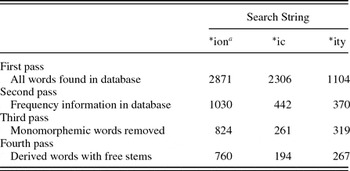
Three nonneutral, stress-shifting suffixes (-tion, -ity, and -ic) were used in the study. The suffixes varied in frequency: -tion was the most frequent, -ity the next frequent, and -ic the least frequent. This pattern of suffix frequency was observed in a small suffix corpus from children's literature (Jarmulowicz, Reference Jarmulowicz2002); however, because that sample was so small, a second method for estimating suffix frequency was used. Type frequency, or numerosity (Burani & Thornton, Reference Burani, Thornton, Baayen and Schreuder2003) of each of the three suffixes, was estimated with the MRC Psycholinguistic Database (http://www.psy.uwa.edu.au/mrcdatabase/uwa_mrc.htm). The number of different words in which each suffix occurred was calculated across four passes through the data (see Table 1http://www.psy.uwa.edu.au/mrcdatabase/uwa_mrc.htm). The number of different words in which each suffix occurred was calculated across four passes through the data (see Table 1). Each pass essentially filtered the data according to specific criteria.
Number of unique words occurring in the MRC Psycholinguistic Database with the suffixes -tion, -ic, and -ity

aFor the database search, the string *ion was used instead of -tion to capture different orthographic versions of this suffix (e.g., -ation, -tion, -sion, -xion). All orthographic variants include the same pronunciation, /ʃӘn/.
A separate search for each of the three suffixes was conducted. The search criteria, output fields, and selection criteria were identical for the three suffixes. Three frequency measures were selected as output fields in the MRC Database: Kucera–Francis written frequency, Thorndike–Lorge written frequency, and Brown verbal frequency. The first pass revealed all words meeting the orthographic sequence criterion *ion, *ity, or *ic.Footnote 2 In the second pass, only words with frequency information in any of the frequency output fields were retained. This eliminated very low-frequency words (e.g., natation, peregrination, perspicacity, sphericity, troglodytic, lapidific, etc.), including prefixed derivatives that usually appeared on the list in their unprefixed form (e.g., preadmission, retranslation, subclassification, unpopularity, inopportunity, antispastic, hydrokinetic, etc.). In the third pass, monomorphemic words were removed (e.g., attic, mansion, quality). On the fourth and final pass, words with bound stems were removed (e.g., curiosity was kept, but sanctity was not; cubic was kept, but cosmetic was not; location was kept, inquisition was not). Although -tion ranked higher than the other two suffixes on all passes, the rank order of -ic and -ity switched by the third pass. Many more monomorphemic words ended in -ic than in either -ity or -tion, and these monomorphemic words were not considered in the estimation of suffix frequency. The final suffix frequency order was -tion, -ity then -ic.
To ensure that the judgments made on the third and fourth passes were reliable, a second judge was recruited to evaluate the same lists of words. This judge was unaware of the purpose for these judgments. For individual words across all three lists, the two judges achieved a 91.43% agreement score by the fourth pass: 90.35% for *ion words, 94.59% for *ity words, and 89.34% for *ic words.
Stimuli: Stem words
Both real and nonsense stem words were used in this study. To ensure that a stress shift could be observed in the derived words, all stem words were two to four syllables in length. Primary stress never occurred on the final syllable of any stem. Three ranges of whole derived-word frequency were represented: high, low, and zero (i.e., nonsense words).
REAL WORDS
Twenty-three derived words with freestanding, monomorphemic stems were included in the study. The stems and derived forms exhibited a semantically transparent relationship (e.g., communicate-communication). A computerized survey using Nagy and Anderson's (Reference Nagy and Anderson1984) 6-point scale of semantic relatedness was administered to 30 adults (M age = 35 years, range = 19–60 years). These adults were different from the adults who participated in the derived word production task. In this scale, Level 0 signifies a transparent relationship between the stem and derived form (e.g., cheer/cheerful), and Level 1 represents a relationship where derived word meaning can be inferred with little help from context (e.g., drive/driver). Levels 2–5 indicate stem and derived word relationships that range from those requiring a reasonable amount of contextual information to be inferred (e.g., decide/decisive) to those where a relationship is barely discernible or nonexistent (e.g., depart/department). All the real stems and derived words used in the production study were semantically transparent (M semantic relatedness = 0.64, SD = 0.98).
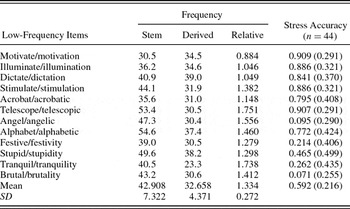
The standard frequency index (SFI) for the stems and derived words, which was obtained from Carroll, Davies, and Richman (Reference Carroll, Davies and Richman1971), provides frequency estimates based on texts written for elementary school-aged children. The SFI is a logarithmic scaling of the estimated frequency per million. For this study, the 11 high-frequency wordsFootnote 3 (M SFI = 50.97, range = 46.8–53.3) occurred approximately one in 102,000 tokens, and the 12 low-frequency words (M SFI = 32.66, range = 23.3–38.2) occurred approximately one in 10,887,000 tokens.
NONSENSE WORDS
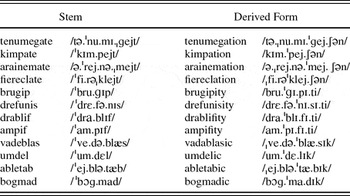
Twelve nonsense stems, which did not violate English phonotactics, were created. Nonsense words were matched to real words on number of phonemes, number of syllables, and stem stress patterns.
In addition to the target items with nonneutral suffixes, 24 real and 12 nonsense words derived with neutral suffixes (e.g., -ness, -ment) were used as filler words. The items in the real word and nonsense word lists of the derived word production task were pseudorandomized, such that no two words derived with the same suffix occurred consecutively. Presentation of the real and nonsense word lists was counterbalanced across participants: half the participants received the nonsense word list first and half received the real-word list first.
Derived word production task
Participants were verbally provided two parts of a derived word (i.e., a suffix and stem). Their task was to reverse the order of the morphemes and combine them to create a new word (e.g., “Put -ity on the end of active,” yielding activity). The stimuli were prerecorded, and repetitions of the suffix, stem, or both were allowed as needed. Repetition of the stimuli does not appear to bias or enhance stress production performance (Jarmulowicz, Reference Jarmulowicz2006; Jarmulowicz & Taran, in press). All derived word productions were digitally recorded for later transcription.
Six practice items were administered prior to the production task to ensure that children understood the task. The practice items included six English stem words (e.g., wonder, mystery) and four English suffixes (i.e., -ful, -er, -al, and -ious). The words and suffixes used in the practice test differed from those in the experimental task. The instructions for the practice items were the same as those for the experimental task. Half the practice items required a stress change in the newly derived word. If a practice item was answered incorrectly, the correct derived form was provided.
The data for this paper were gathered as part of a larger study, which included a more extensive testing protocol. Each child was tested individually over three sessions. For all children, the CELF-4 was administered in the first session, and the derived word production task in the last session.
Scoring and reliability
All productions were transcribed for primary stress placement by a graduate student trained in phonetic transcription at the School of Audiology and Speech–Language Pathology at The University of Memphis. Ten children (25% of the sample) were randomly selected for the purpose of obtaining reliable transcriptions. Agreement on stress accuracy between the first transcriber and two additional transcribers, who were also trained in phonetic transcription, was 94.03% for all words across the 10 children. Reliability between the first and second transcribers on five children was 92.50%. Reliability between the first and third transcribers on a different five children was 95.56%. We concluded that this level of agreement with two different transcribers was acceptable. The first transcriber's transcriptions were used in the analysis.
The syllable receiving primary stress was noted for each production. When a child made more than one attempt, the final production was used in the analysis. Productions were considered correct if (a) there were no syllable additions or deletions, (b) the correct suffix was used, and (c) primary stress occurred on the expected syllable. Phoneme additions, deletions, or substitutions were not counted against the child's stress production accuracy. Correct stress proportions were calculated across children and items. When a child had a missing cell, typically because of a lack of response, the average across all children for that particular item was included for the missing data point. This happened infrequently, as there were only 20 empty cells out of 1,540 total cells (1.30%).
RESULTS
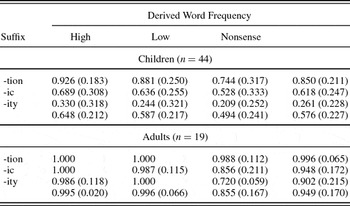
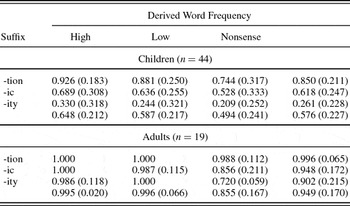
Data from one adult participant was omitted because average stress production accuracy was more than 2 standard deviations below the adult group mean. The child and adult group means and standard deviations for accurate stress production across the three derived word frequencies (high, low, and nonsense) and the three suffixes (-tion, -ic, and -ity) are presented in Table 2. The adults performed at ceiling levels on the real words; their data were not statistically analyzed further.
Means (standard errors) of primary stress accuracy by derived word frequency and suffix
Analysis 1
In the first analysis, a repeated-measures analysis of variance was conducted to evaluate the effect of word frequency (high, low, and nonsense) and individual suffix (-tion, -ic, and -ity) on stress production accuracy. The analysis revealed significant main effects for both derived word frequency, F (2, 86) = 16.153, p < .001, η2 = 0.273 and suffix, F (2, 86) = 201.445, p < .001, η2 = 0.824. There was no interaction between derived word frequency and suffix, F (4, 172) = 1.005, p = .392.
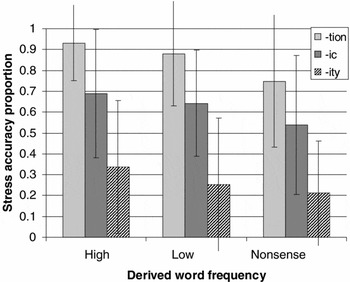
To explore the pairwise differences within the frequency and suffix variables, multiple dependent t tests with Bonferonni adjustment (%E = 0.017) were conducted. The children's performance is illustrated in Figure 1. With regard to frequency, performance on stress production was significantly better for high-frequency words than for low-frequency (t = 2.689, p < .01; ES = 0.406) and nonsense words (t = 4.825, p < .001; ES = 0.727). Stress production accuracy was significantly better for low-frequency words than for nonsense words (t = 3.454, p < .001; ES = 0.5206).
Stress accuracy performance across the three suffixes and three derived word types.

Significant differences were also found on stress production accuracy across the three suffixes. Children were significantly better at producing stress on words formed with the suffix -tion, than they were at producing stress on words formed with -ic (t = 11.451, p < .001, ES = 1.726) or -ity (t = 16.343, p < .001, ES = 2.464). Furthermore, stress production was more accurate for words ending in -ic than for words ending in -ity (t = 11.795, p < .001; ES = 1.778). The adults showed a similar suffix pattern on the nonsense derived words with performance on -tion words being significantly better than performance on -ity (t = 4.481, p < .001, ES = 1.002) and -ic words (t =3.584, p < .002, ES = 0.801). The difference between performance on -ity words and -ic words approximated, but did not reach, significance (t = −2.433, p = .025).
Analysis 2
Effects of stem, derived word, and relative frequency are documented in studies with adults (Bradley, Reference Bradley, Aronoff and Kean1979; Burani & Caramazza, Reference Burani and Caramazza1987; Burani & Thornton, Reference Burani, Thornton, Baayen and Schreuder2003; Colé et al., Reference Colé, Segui and Taft1997; Hay, Reference Hay2001). Using the same derived word production task with 7-, 8-, and 9-year-old children, Jarmulowicz (Reference Jarmulowicz2006) found a significant negative correlation only between stem frequency and stress accuracy in derived words. Higher stem frequency resulted in poorer stress accuracy performance. No relationship between stress accuracy and relative frequency or derived word frequency was found; this may have been because the stimuli were all midfrequency derived words. The current study used a different set of words representing a wider range of derived word frequency.
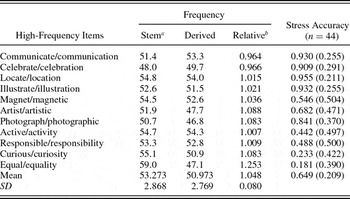
To explore the relationship between stress production accuracy and stem, derived word, and relative frequency in the current study, independent Spearman rank order correlations were conducted post hoc on the real-word items. Relative frequency was calculated by dividing stem frequency by derived word frequency. Thus, a relative frequency of >1 indicates that the stem had a higher surface frequency than the derived word; whereas a relative frequency of <1 indicates that the stem had a lower frequency than the derived word. Based on Hay's (Reference Hay2001, Reference Hay2002) work with adults, lower relative frequency would increase the likelihood of direct access of the derived form, whereas higher relative frequency would likely indicate composition.
Detailed information on stem, derived word, and relative frequency measures can be found in Tables 3 and 4, respectively. Although the two tables separate the stimuli by whole derived word frequency (i.e., high- and low-frequency items), all real words were grouped together when the correlations between stress accuracy and frequency were performed.
Stem frequency, derived word frequency, relative frequency, and stress accuracy proportions (standard deviation) for high-frequency derived words

aFrequency values are the logarithmic standard frequency index obtained from Carroll, Davies, and Richman (Reference Carroll, Davies and Richman1971).
bRelative frequency is calculated as the stem frequency divided by the derived word frequency. The lower the number, the more frequent the derived word is relative to the stem; higher relative frequency numbers represent higher stem frequencies relative to the derived word.
Stem frequency, derived word frequency, relative frequency, and stress accuracy proportions (standard deviation) for low-frequency derived words
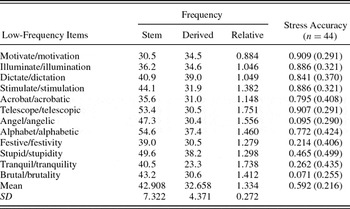
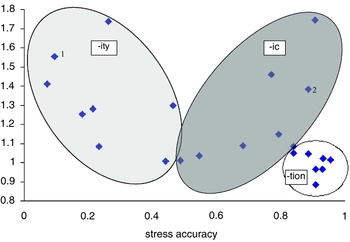
We found a significant negative correlation between stress accuracy and relative frequency (r s = −.505, p = .014). Children produced stress more accurately on derived words that were relatively closer in frequency to their stems (e.g., celebration, SFI = 49.7, from celebrate, SFI = 48.0) than on derived words that were much less frequent than their stems (e.g., tranquility, 23.3, from tranquil, SFI = 40.5). The relationship between stress accuracy and relative frequency is illustrated in Figure 2. Note that the distributions for the three suffixes fall in different areas of the scatterplot with very little overlap. This mirrors the main effect of suffix found in Analysis 1 above. The -tion items cluster in the lower right corner, whereas the -ity items are more widely distributed on the left side of the figure. The -ic items are perhaps the most interesting. They cluster between the -tion and -ity items, but their distribution seems opposite of the one predicted.
Scatterplot of individual real word items by stress accuracy (mean proportion) and relative frequency (stem frequency divided by derived word frequency). Note: Words ending in the three suffixes fall in different distributions with only two exceptions: 1is the word angelic and 2is the word stimulation.

Only two words fell out of the range exhibited by the individual suffix types. Performance on the item angelic was more similar to the -ity than the -ic words. However, it stayed in line with the general hypothesis that higher relative frequency scores would result in poorer stress accuracy performance. The item stimulation was an outlier from the other -tion words. In this case, stress remained accurate despite higher relative frequency.
In contrast to earlier work (Jarmulowicz, Reference Jarmulowicz2006), the correlation between stress accuracy and stem frequency was not significant (r s = −.052, p = .812). In addition, there was no significant relationship between stress accuracy and derived word frequency (rs = .323, p = 0.133). This result seems to contradict the main effect of derived word frequency found in the first analysis, until you consider the strength of the suffix effect. Children performed better on the low-frequency words derived with -tion than they did on high-frequency words suffixed with either -ic or -ity. Thus, in a correlation, stress accuracy and derived word frequency fail to reach significance.
There were two other significant correlations that relate to the distributional frequency of the stimuli. Relative frequency showed a negative relationship with derived word frequency (r s = −.762, p < .001), such that the lower the derived word frequency, the higher relative frequency. This is intuitively appealing because relative frequency is contingent upon variations in derived word frequency. In addition, derived word frequency was highly correlated with stem frequency (r s = .647, p = .001), a finding that has been noted elsewhere (Ford, Marslen-Wilson, & Davis, Reference Ford, Marslen-Wilson, Davis, Baayen and Schreuder2003).
DISCUSSION
The purpose of this study was to determine whether lexical frequency affects third-grade children's accurate production of primary stress in derived words with nonneutral suffixes. Frequency was explored in three different ways: whole derived word frequency, suffix frequency, and relative frequency of the derived word to the stem. Each layer of frequency adds another dimension to an interconnected lexical and production system.
Derived word frequency
The third-grade children in this study produced primary stress more accurately in the high-frequency derived words than the low-frequency derived words, and more accurately in the low-frequency derived words than the nonsense derived words. The frequency of whole words derived with nonneutral suffixes appears to affect children's stress production accuracy; however, the whole story is more complicated than this. The simple whole-word frequency finding is tempered by nonsense word performance, by performance with individual suffixes, and by the effects of relative frequency between the stem and derived word form on stress production accuracy.
Although stress production in the nonsense derived words was less accurate than in either high- or low-frequency derived words, performance was still fairly good. Even without a lexical representation of either the stem or the derived word, children exhibited a correct stress shift to the presuffixal syllable in 50% of their nonsense word productions. This is not a trivial accuracy rate. In the group of 12 stem words, 6 were two syllables in length whereas 6 were three and four syllables. Thus, with the addition of the suffix, children had up to five syllable candidates for primary stress placement. If derived word frequency was solely responsible for the differences in stress production, we should have seen much worse performance on the nonsense words than we actually observed.
The suffixes chosen for the study required primary stress to fall on the presuffixal syllable. Stress accuracy performance on nonsense words closely paralleled real words across the three suffixes. Nonsense words do not have the benefit of being stored as whole words in memory, which was reflected in the poorer performance on nonsense words relative to the real words. However, to the degree that children have a tacit association between a suffix and a stress pattern, they may generalize that stress pattern to a new stem. In fact, this may be why children performed as well as they did on the nonsense words: they were using information about the suffix and the stress pattern associated with the suffix. Adults showed a similar pattern of accuracy across the suffixes on the nonsense word productions, suggesting that they too can use suffix information when no lexical representation is available.
Suffix differences
Independent of the derived word frequency levels, there were remarkably strong differences among the three suffixes included in the study. A similar pattern was observed across the high-frequency, low-frequency, and nonsense words: performance on -tion forms was best, followed by -ic, then -ity. The fact that this pattern was obtained with the nonsense words suggests a robust influence of the suffixes. The same pattern of stress production accuracy across these three suffixes has been noted in other studies using this production task (Jarmulowicz, Reference Jarmulowicz2006; Jarmulowicz & Taran, in press). Better performance on -tion derivatives was also observed in a stress judgment task (Jarmulowicz, Reference Jarmulowicz2002). Nevertheless, the observation that the individual suffixes played a role in performance does not tell us why the suffixes maintained a consistent order across the three frequency types.
The differences in stress production accuracy among the three suffixes may be due in part to the frequencies of the individual suffixes. Burani and Thornton (Reference Burani, Thornton, Baayen and Schreuder2003) noted that suffix frequency affects lexical decision performance by adults. The suffix -tion, and its variants, is the most frequent of the three suffixes included in this study both in type (Jarmulowicz, Reference Jarmulowicz2002) and in token frequency (see Table 1). It is also a relatively productive suffix (Baayen & Lieber, Reference Baayen and Lieber1991). Children are sensitive to distributional characteristics of language (Behrens, Reference Behrens2006; MacWhinney, Reference MacWhinney, Burmeister, Piske and Rohde2002). Thus, the developmental advantage of -tion over the other two suffixes may be due in large measure to the multitude of opportunities that a child has to extract the suffix and associate it with a phonological pattern and meaning.
A frequency explanation for the other two suffixes is more complicated. Children's stress productions in words ending in -ic were more accurate than those ending in -ity. However, according to Table 1 and Jarmulowicz (Reference Jarmulowicz2002), -ity occurs more frequently than -ic as a clearly separable suffix in English. It may be that the frequency difference between these two suffixes is not large enough to produce a measurable effect in the stress production task. It is also possible that the frequency difference is not yet observable in third-grade children. Older children who have more experience with the language might exhibit a difference between these two suffixes. However, recall that adults also showed the same tendency to perform worse on nonsense words ending in -ity than those ending in -ic. Thus, there are likely other factors that come into play in the production task. Some of the phonological factors will be discussed below.
Another possibility is that we used the wrong frequency count as our estimate of suffix frequency. Many monomorphemic words and derived words with bound stems end in -ic and exhibit a penultimate syllable stress pattern (e.g., ceramic, mosaic, galactic, emphatic). As seen in Table 1, between the second and final passes of the lists from the MRC database, 56% of the words ending in *ic were lost, whereas only 26 and 28% of words ending in *ion and *ity were lost, respectively. Thus, for this production task, the frequency variable may not be a morphological one (as determined by morphological complexity) but rather a phonological one (as determined by phoneme sequences reliably co-occurring with specific prosodic patterns; cf. Burani & Arduino, Reference Burani and Arduino2004, for a similar proposal).
Relative frequency
For adults, derived words that are more frequent than their stems can be accessed and recognized without decomposition, whereas decomposition into morphemic units is more likely when the stem is more frequent than the whole derived form (Hay, Reference Hay2001, Reference Hay2002). Although our analysis of relative frequency was a post hoc exploration, there is some indication that children are sensitive to distributional characteristics of both the stem and derived forms. This supports Bybee (Reference Bybee2001), who suggests that morphophonological relationships between words emerge from the system, and these schemas can be generalized to other words. Third-grade children in the current study appeared to be able to generalize stress patterns associated with specific suffixes, to the extent that they had developed a schema for those suffixes.
Several caveats should be noted, all of which stem from the fact that this study cannot fully evaluate relative frequency independent of other mitigating factors. There were few items in which the derived word was more frequent than the stem (relative frequency = <1.0). However, there were many items in which the derived word and stem frequencies were similar (i.e., relative frequency = ∼1.0). Thus, the key indicator in this study was how much greater stem frequency was than derived word frequency. Further research should include a wider range of relative frequency across more suffix types.
The frequency categories for the real words (high and low) were based on derived word frequency, not stem frequency. The stem frequencies were systematically higher for the high-frequency derived words than the stem frequencies for the low-frequency derived words. This may have limited our ability to fully evaluate relative frequency effects, because the range of relative frequency values was restricted. Despite this limitation, the fact that we found an effect of relative frequency suggests that it is an important variable for future consideration.
One reason for the relative frequency result may be the task that children were asked to perform. Children were verbally given a suffix and then a stem, and then asked to produce a derived word. Thus, they heard the stem but not the derived form. Children may have been able to access higher frequency derived words from the stem and suffix information alone. In contrast, when children were given a much higher frequency stem than the derived target, either the stem blocked access to the derived form or children may not have known the derived form at all. If children did not or could not access the derived form, they had to rely on a compositional production strategy because they had no direct access the derived word representation with stored phonological and stress information.
This alternate production strategy may also be what adults used to produce the nonwords. Adults reached ceiling levels of performance on the derived words with real stems, regardless of frequency, suggesting that they had access to both high- and low-frequency derived forms. However, the pattern of performance on the nonsense words was similar to the pattern produced by children on all words. Without access to lexically stored stress patterns, the adults had to use another strategy, possibly a compositional or phonological generalization strategy that by default relied heavily on the suffixes and suffix characteristics in their accurate stress production. To children, many real words may have been nonsense words, resulting in a similar suffix-based strategy.
Figure 2 suggests that suffix type exerts pressure on the slope of the stress accuracy curve. Derived words with the suffix -tion were generally produced accurately. However, only on -tion words were there relative frequency relationships in which the derived word was greater than the suffix. Stress production accuracy was systematically low for the -ity items, despite some relative frequency values approximating 1.0. Furthermore, although there was a significant negative correlation between stress accuracy and relative frequency when all three suffixes were collapsed, the distributions of the three suffixes included in this study suggest that relative frequency may play a more prominent role for words with some suffixes (e.g., -tion and -ity), but not others (e.g., -ic). Thus, suffix numerosity (-ic was the least frequent of the three suffixes in Table 1) may also play a role. It appears that although relative frequency may be influential in our results, the suffix difference is equally, if not more, important. Ultimately, it may be difficult to balance both stem and derived word frequency across suffixes while maintaining semantic transparency between the stem and derived word and keeping the words child friendly.
Phonological considerations
In addition to the relative frequency of the stem and derived form, Hay (Reference Hay2002) suggests that a derived word's decompositionality also depends on the phonotactic probability of the sounds occurring at the morpheme boundary. Adults perceive stem and suffix junctures with sounds that are not usually contiguous in word-internal contexts as more decomposable than stem and suffix junctures with sounds that are commonly found word internally (Hay, Reference Hay2002). Thus, a sequence /pf/ in cupful would be more likely to indicate a morpheme boundary (or word boundary) than the sequence /ti/ at the morpheme boundary in acrobatic. Hay further states that this can be summarized as a generalization that vowel initial suffixes are more difficult to decompose than consonant initial suffixes because the latter result in more phonotactically improbable sequences.
From a production standpoint, vowel initial suffixes may be difficult for different reasons. In a task that forces composition, vowel initial suffixes must be merged with their stems through syllabification. Because children heard the stem and suffix independently in our task, the process would include resyllabification of a word stem already accessed as an independent unit with a suffix or phoneme sequence. For example, by adding -ic to acrobat / Èæ.krӘ.Çbæt/, the final consonant of the stem becomes the onset of the suffix syllable, resulting in /Çæ.krӘ.Èbæ.tIk/ (Selkirk, Reference Selkirk, van der Hulst and Smith1982). Thus, poorer performance on -ic and -ity, both vowel initial suffixes, than on -tion /ʃӘn/, would be expected.
In addition, the suffix -ity contains two syllables, whereas -ic and -tion are both a single syllable. This fact may have consequences in word production, particularly in designating the syllable receiving primary stress. The tendency for English to prefer trochaic feet (i.e., strong–weak [SW] syllable sequences) may have biased accuracy toward words ending in -tion and -ic and against those ending in -ity. English does not typically end in stressed syllables, so a one-syllable suffix may fit nicely into the second position of a default trochee (e.g., alphabetic has an SWSW pattern of two trochaic feet). In contrast, because -ity has two syllables, children may resist a word-final SWW pattern (e.g., curiosity has a SWSWW pattern); rather, they may default to a trochaic foot in which the suffix itself becomes SW. This may account for some of the -ity stress errors, but it raises another problem. If we assume a prosodic strategy, why did children (and adults) do as poorly on the -ic items as they did? Children showed no aversion to producing SWW sequences in their errors on -ic words (e.g., artistic or magnetic), when they should have switched to a WSW pattern.
Another phonological factor should be noted. There were three items (one high frequency, two low frequency) that were particularly difficult for children to produce accurately (<20% stress accuracy): equality, angelic, brutality. In addition to having vowel initial suffixes, these items exhibit vowel alternations with their stems: equal, angel, brutal. Two other qualities that these items share are that (a) the stem-final syllable contains an unstressed neutral vowel and (b) the stem ends in a sonorant consonant (i.e., /l/), which may function as a syllabic nucleus. Thus, there may not be a fully specified vowel in the stem-final syllable to associate with the full vowel that exists in the derived form. In fact, there were other items that exhibited vowel changes (e.g., curious/curiosity, telescope/telescopic), yet children did not err on these to the same degree. This suggests that it may not be the change in vowel quality that makes producing primary stress in these derived words difficult; rather, it may be the quality of the stem vowel.
Finally, all the stems that were appended with -tion ended in a similar sound sequence (e.g., celebrate, dictate, kimpate). It turns out that this pattern -ation is particularly prevalent in words ending in -tion. One of the reasons for children's good performance with -tion may be that there are few final syllable types that accept the suffix. Thus, the phonological consistency associated with -tion extends not only to the stress pattern, but also to the syllable segments of the stem as well. This systematicity across the stem–suffix boundary may make phonological patterns more easily discernible than patterns that show more variation. This is exactly the kind of paradigmatic analogy, or “gang effect” that other authors have noted (Alegre & Gordon, Reference Alegre and Gordon1999; Bybee, Reference Bybee2001; Hay & Baayen, Reference Hay and Baayen2005).
CONCLUSION
The results reported here are best supported by a dual-route model that emphasizes the availability of both a direct route to a whole word and a composition route of sublexical parts. What is not completely clear from the current data is whether these sublexical parts are morphological, phonological, or both. Nevertheless, children make use of whole word representation when they have one, as demonstrated by their performance on the high-frequency words. When they do not have direct access to a derived word, they must compose one, using whatever knowledge they have about a suffix, the phonological patterns associated with the suffix, or both.
Mastery of morphophonology, in particular stress shift, depends partly on suffix frequency. The suffix that exhibited the highest numerosity, by occurring on the most different words (i.e., -tion) had the developmental advantage. Acquiring morphemes after multiple exposures on different forms is a key characteristic of the emerging inflectional system in language development (Marchman & Bates, Reference Marchman and Bates1994). Frequency, however, loses some of its explanatory power for the other two suffixes in our study. Characteristics of the individual suffix (e.g., number of syllables, vowel initial) or stem (e.g., syllable length, initial stress pattern, internal changes to segmental phonology) also come into play.
Establishing suffix representations for -ic and -ity may be challenging because there is more variability in the input. Not only do words with these suffixes occur infrequently, but also when they do they may exhibit other phonological changes, not just stress shift. Many more exposures on different words may be required to extract a generalizable pattern. Although stress shift associated with these suffixes is still productive in English, the vowel and consonant alternations may not be. The addition of these segmental changes may complicate the emergence of these suffixes.
Whole derived word frequency, relative frequency, suffix frequency, suffix phonology, and stem phonology all seem to play a role in children's ability to accurately produce primary stress in nonneutral derived English words. The relationships between these factors are intertwined, perhaps intractably so. Pierrehumbert(Reference Pierrehumbert, Bod, Hay and Jannedy2003) suggests that every level of the system—from the phonetic to phonologic, morphologic to lexical—exhibits “statistical robustness,” (p. 4) which ultimately allows for generalization to new exemplars. In addition, every level of the system is developing simultaneously and affecting other levels of the system, a fact that has been noted in research emphasizing the relationship between lexical and phonological development in preschool children (Storkel, Reference Storkel2002; Storkel & Morrisette, Reference Storkel and Morrisette2002). How and when children learn the morphophonological patterns associated with suffixes, and perhaps the degree to which they can generalize these patterns, is undoubtedly influenced by lexical frequency.
The importance of derived words in the developing vocabularies of school-aged children should not be underemphasized. The rapid increase in vocabulary size between third and sixth grades is largely because of acquisition of derived forms and the ability to use morphological information both to compose and to decompose new words (Anglin, Reference Anglin1993; Carlisle, Reference Carlisle2000; Tyler & Nagy, Reference Tyler and Nagy1989; Wysocki & Jenkins, Reference Wysocki and Jenkins1987). Furthermore, the ability to perform well on derivational tasks is linked to good reading and spelling skills (Carlisle & Stone, Reference Carlisle and Stone2005; Casalis et al., Reference Casalis, Colé and Sopo2004; Jarmulowicz, Hay, Taran, & Ethington, in press; Singson et al., Reference Singson, Mahony and Mann2000; Tyler & Nagy, Reference Tyler and Nagy1990). The present study suggests that distributional characteristics—frequencies of derived words, suffixes, and phonological patterns—are critical variables in third-graders’ production of derived words; however, further study across a wider range of ages and suffixes will clarify the role of frequency in the development of English derivation.
APPENDIX A
Nonsense stimuli
ACKNOWLEDGMENTS
This work was supported in part by the American Speech–Language and Hearing Foundation 2004 New Investigator Grant (to L.J.) and by the Center for Research Initiatives and Strategies for the Communicatively Impaired at the University of Memphis. Many thanks to Kathleen Fulmer, Helen S. Cairns, D. Kimbrough Oller, the children who participated in this study, and the teachers and principals who cooperated with us.