Implications
The results of this study illustrate that dealing with the problem of dairy cow mortality requires a concerted effort that recognizes and appropriately manages numerous and diverse risks. Addressing suboptimal management practices that result in increased mortality levels requires the identification and prevention of infectious and non-infectious disease. Postmortem evaluations can help define the reasons that cows die and provide a means for evaluating the effectiveness of disease prevention and control measures.
Introduction
Summary studies of dairy cow removal have been in the literature for decades (Seath, Reference Seath1940; Asdell, Reference Asdell1951; O’Bleness and Van Vleck, Reference O’Bleness and Van Vleck1962), although information specifically related to US dairy cow mortality has been limited. A review covering the years 1965 to 2006, found 19 studies that focused on dairy cow death (Thomsen and Houe, Reference Thomsen and Houe2006). Of these studies, two included data since 2000, six were from the US, and 10 incorporated information related to causes of death. The average annual mortality was between 1% and 5%. National Dairy Herd Improvement Association (DHIA) data (15 025 035 lactations in 45 032 herds) from 1995 through 2005, demonstrated an overall death frequency of 3.1% on a lactation basis (5.7% on a cow basis) with observed lactational death frequencies increasing from 2.0% in 1995 to 4.6% in 2005 (Miller et al., Reference Miller, Kuhn, Norman and Wright2008). DHIA data from 2001 through 2006 representing 3 629 002 lactations in 2054 herds located in 38 states primarily east of the Mississippi river, demonstrated an annualized death rate of 6.6% (Pinedo et al., Reference Pinedo, De Vries and Webb2010). Similarly, USDA:APHIS:VS National Animal Health Monitoring System (NAHMS) Dairy surveys have reported steady increases in cow mortality, from 3.8% of the January 1996 inventory, to 4.8% of the January 2002 inventory, and 5.7% of the January 2007 dairy cow inventory (USDA, 2007a).
Past studies documenting dairy cow removal have highlighted the need to increase the productive lives of dairy cattle to improve the economic efficiency of herd operations (Asdell, Reference Asdell1951; Parker et al., Reference Parker, Bayley, Fohrman and Plowman1960). An emphasis was put on prevention, early recognition, and prompt treatment of injuries and diseases such as mastitis and infertility, while focusing on proper feeding and management. Some of the earliest research into removals specified the relative importance of dystocia, accidents, traumatic reticuloperitonitis, bloat, and hypocalcemia as underlying problems (O’Bleness and Van Vleck, Reference O’Bleness and Van Vleck1962; White and Nichols, Reference White and Nichols1965). Whereas traumatic reticuloperitonitis and hypocalcemia may be less of a problem with current management strategies, dystocia and accidents certainly remain problematic, and modern practices have given rise to a new set of concerns such as abomasal displacements, hemorrhagic bowel syndrome, lameness and multifactorial transition cow issues (McConnel et al., Reference McConnel, Garry, Hill, Lombard and Gould2010). In fact, literature based on Scandinavian data suggests that high on-farm mortality is associated with characteristics specifically related to the intensification of dairy production systems (Norgaard et al., Reference Norgaard, Lind and Agger1999; Alvåsen et al., Reference Alvåsen, Roth, Jansson Mork, Hallen Sandgren, Thomsen and Emanuelson2014).
The potential for underlying causes of dairy cow mortality to change over time provides a moving target for addressing management practices and herd characteristics influencing death loss. Differences lie in the details related to particular herd characteristics and practices, and specific manageable outcomes. The objective of the current paper was to evaluate associations between facilities, herd management practices, disease occurrence and death rates on US dairy operations through an analysis of the NAHMS Dairy 2007 survey. The Dairy 2007 survey data set provided a thorough and directed data set from which to describe and analyze a variety of herd characteristics and their association with dairy cow mortality in the United States.
Material and methods
Data collection
The NAHMS Dairy 2007 study included farms in 17 states that represented 79.5% of US dairy operations and 82.5% of the US dairy cow population. States included in the study were: California, Idaho, Indiana, Iowa, Kentucky, Michigan, Minnesota, Missouri, New Mexico, New York, Ohio, Pennsylvania, Texas, Vermont, Virginia, Washington and Wisconsin. The survey design was a stratified random sample with unequal selection probabilities between strata. Unequal selection probabilities were implemented to ensure that large operations were represented in the sample. To account for the selection probabilities and for nonresponse, weights were created for each operation. The analysis incorporated weights to allow inferences to the study population (i.e. 45 450 dairy operations with 30 or more cows in the 17 states) representing a target population of 59 640 US dairy operations with 7.356 million cows (Figure 1).
Flowchart for herd participation in the National Animal Health Monitoring System’s Dairy 2007 study. NASS=National Agricultural Statistics Service. VMO=Veterinary Medical Officer.

During the first phase of the study operations were randomly selected from a sampling list maintained by the National Agricultural Statistics Service (NASS). Completed face-to-face surveys were obtained from 2194 operations of the 3554 on the sampling list. Only farms that participated in phase I and also had 30 or more dairy cows were eligible to participate in phase II (Figure 1).
Questionnaires covered topics that included dairy herd information and management practices, milk quality and milking procedures, births, illness, deaths, disease confirmation, health management, housing and biosecurity. Dairy cow deaths referred to the total number of dead cows during calendar year 2006. Other descriptors referred to dairy practices and outcomes specific to calendar year 2006 or the 12 months previous to survey administration. Surveys were administered by NASS enumerators, veterinary medical officers, and animal health technicians between January and August 2007. Additional details of the study design and sample weighting are published elsewhere (USDA, 2007b).
Statistical analysis
The association between dairy cow deaths and 162 a priori identified operation-level management practices or characteristics was evaluated. Relevant parameters were identified based on biologically plausible influences on cow mortality. To evaluate linearity for inclusion in a negative binomial multivariable model (SAS version 9.3; SAS Institute, Cary, NC, USA), continuous predictor variables were plotted against the log of the percent deaths (an approximation of the mortality risk and rate based on the number of dead cows during 2006 relative to number of dairy cows present on 1 January 2007). Continuous variables that were not linearly related to death rate were converted to and evaluated as categorical variables based on quartiles (lower 25%, middle 50%, upper 25%), which resulted in 136 categorical and 26 continuous variables. Categorical and continuous variables were evaluated individually using a weighted, negative binomial model in STATA (StataCorp, College Station, TX, USA). The number of deaths was the outcome and the offset was the log of the number of dairy cows present on 1 January 2007. Variables that met univariable screening criteria (χ 2 P<0.05), including an assessment of correlations (<0.5) using Pearson’s product-moment correlation for categorical variables and Spearman’s rank-order correlation for continuous variables, were evaluated using a weighted, stepwise, forward selection, negative binomial regression model created in STATA. Entry into the final model required that variables have a P-value of ⩽0.049. Retention within the model required a P-value of ⩽0.05, and the Akaike information criterion (AIC) was used for final model selection. The final weighted model included only predictor variables with P-values <0.05.
Results
Univariable associations
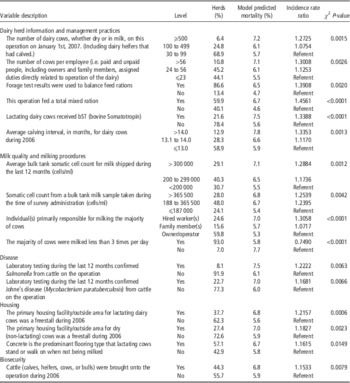
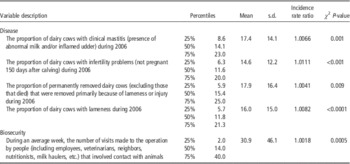
Of the 162 management factors explored in the univariate analysis, 47 categorical and 13 continuous variables met initial screening criteria for further evaluation of association with dairy cow mortality (Supplementary Table S1). Variables that did not meet initial screening criteria included descriptors for milk production, days dry, lactating cow rations, equipment use relative to handling feed and manure and guidelines for calving intervention. Examples of variables that were evaluated further are presented in Table 1 and Table 2, and included descriptors of the herd management such as herd size. Based on incidence rate ratios (ratio of the risk of death in an exposed group to the risk of death in an unexposed group), this analysis predicted a 7.5% increase in mortality for herds with 100 to 499 adult cows (6.1% mortality), and a 27.3% increase in mortality for herds with ⩾500 cows (7.2% mortality), relative to herds with 30 to 99 dairy cows (5.7% mortality). Cow mortality also increased as the number of cows per employee increased (P=0.0026). Increased mortality was associated with using forage tests to balance rations (P=0.0020), feeding a total mixed ration (TMR) (P<0.0001), and administering bST (P<0.0001). Other herd indices associated with mortality included the average bulk tank somatic cell count (P=0.0012) and the average calving interval (P=0.0013). A decrease in somatic cell counts in cells per ml was associated with decreased predicted mortality. As the calving interval in months decreased, mortality was predicted to decrease as well. Decreased mortality was observed if the majority of cows were milked by the owner/operator, as opposed to family members of the owner or non-family hired workers (P<0.0001). Milking less than three times per day was also associated with decreased mortality compared with three times per day milking (P<0.0001).
Selected categorical variables used in the univariable analysis of herd-level factors associated with dairy cow mortality using data from 459 operations in 17 states

A full list of variables can be found in Supplementary Table S1.
Selected continuous variables used in the univariable analysis of herd-level factors associated with dairy cow mortality using data from 459 operations in 17 states

A full list of variables can be found in Supplementary Table S1.
Several health management variables describing heifer and cow vaccinations and nutritional supplementation were significantly associated with mortality (Supplementary Table S1). Variables describing herd levels of disease and illness demonstrated increased mortality with increased levels of disease problems. Specifically, infertility problems, retained placentas and other reproductive problems (e.g. dystocia, metritis) were all associated with increased mortality. Similar increases in mortality were observed with increased respiratory problems, diarrhea, mastitis, displaced abomasums and lameness. As an example, for every 1% increase in the proportion of lame cows, mortality was predicted to increase 0.8% (Table 2). Increased mortality was also associated with operations from which laboratory testing confirmed cattle infected with Salmonella (P=0.0063) or Mycobacterium avium subspecies paratuberculosis (P=0.0066, Table 1).
Various parameters describing operation housing and biosecurity were associated with mortality (Supplementary Table S1) and examples are presented in Table 1 and Table 2. Overall mortality was increased on operations where lactating dairy cows were housed in freestalls (P=0.0006) and for operations where dry cows were primarily housed in freestalls (P=0.0023) Mortality increased when concrete was the predominant flooring type that lactating cows stood or walked on when not being milked as compared with other flooring types (P=0.0149). For variables related to biosecurity, increased mortality was associated with dairies that brought cattle onto the operation (P=0.0079), and with increased visits onto the operation by people who had contact with the animals (P=0.0005).
Multivariable model
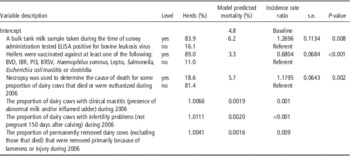
The final weighted, forward selection negative binomial regression model was chosen based on the stepwise selection parameters and had the lowest AIC. Of the 60 variables identified in the univariate analysis, six that were significantly associated with mortality remained (Table 3). Based on the incidence rate ratio, this model predicted 32.0% less mortality for operations that vaccinated heifers for at least one of the following: bovine viral diarrhea (BVD), infectious bovine rhinotracheitis (IBR), parainfluenza 3 (PI3), bovine respiratory syncytial virus (BRSV), Haemophilus somnus, leptospirosis, Salmonella, E. coli or clostridia. The final multivariable model also predicted a 27.0% increase in mortality for operations from which a bulk tank milk sample tested ELISA positive for bovine leukosis virus (BLV) at the time of the Dairy 2007 survey. Additionally, an 18.0% higher mortality was predicted for operations that used necropsies to determine the cause of death for some proportion of dairy cows that died or were euthanized. The final model also predicted that increased proportions of dairy cows with clinical mastitis (presence of abnormal milk and/or an inflamed udder) and infertility problems (not pregnant 150 days after calving) were associated with increased mortality. For every 1% increase in the proportion of cows with clinical mastitis, mortality was predicted to increase 0.7%. Likewise, for every 1% increase in the proportion of cows with infertility problems, mortality was predicted to increase 1.1%. Finally, every 1% increase in the proportion of permanently removed cows that were removed primarily because of lameness or injury, mortality was predicted to increase 0.4%.
Multivariable analysis of herd-level factors associated with dairy cow mortality using data from 459 operations in 17 states

BVD=bovine viral diarrhea; IBR=infectious bovine rhinotracheitis; PI3=parainfluenza 3; BRSV=bovine respiratory syncytial virus.
Discussion
The NAHMS dairy surveys provide an unparalleled vantage of the US dairy landscape. US dairy cow mortality was previously evaluated using data from the Dairy 2002 survey (McConnel et al., Reference McConnel, Lombard, Wagner and Garry2008). However, the current study was unique due to differences in the sampling, information gathered, and statistical methodology. The Dairy 2007 survey data set incorporated a number of distinct variables related to milk quality, milking procedures, and disease confirmation. Although causality cannot be determined purely through associations, ultimately this study provided a useful platform from which to consider aspects of current dairy practices that might underlie mortality rates.
Some of the variables associated with dairy cow mortality by univariable analysis were the same for this study as for the previous study that analyzed NAHMS Dairy 2002 survey data (McConnel et al., Reference McConnel, Lombard, Wagner and Garry2008). These variables included a number of operational practices and descriptors related to nutritional management such as feeding a TMR and using forage tests results to balance rations, and health management variables such as those describing heifer vaccinations and nutritional supplementation. Other similarities were found within several variables describing herd levels of disease and illness, operation facilities and biosecurity practices. These findings agree with previous studies outside of the United States that suggest that mortality may be associated with greater rates of common production diseases, as well as physiologic stress linked to intensive management practices such as animal crowding and feeding high levels of concentrate (Norgaard et al., Reference Norgaard, Lind and Agger1999; Thomsen et al., Reference Thomsen, Ostergaard, Sorensen and Houe2007; Alvåsen et al., Reference Alvåsen, Roth, Jansson Mork, Hallen Sandgren, Thomsen and Emanuelson2014).
While the Dairy 2002 and 2007 surveys had similarities, the Dairy 2007 survey data set expanded upon the findings from the Dairy 2002 survey data and resulted in a unique final model. Analysis of the Dairy 2002 survey found dairy cow mortality to be specifically associated with operational attributes such as the use and composition of a TMR, the calving interval, region of the country, and herd levels of respiratory disease, lameness, sick cow treatments and early postpartum culling (McConnel et al., Reference McConnel, Lombard, Wagner and Garry2008). The current study’s final model found dairy cow mortality to be associated with a herd’s BLV infection status, mastitis, lameness, infertility problems, heifer vaccinations and necropsy utilization.
A direct interpretation of the model’s findings fails to acknowledge the broader implications that the selected variables speak to. These included reproductive problems, non-infectious postpartum disease, infectious disease and infectious disease prevention, and the extensive information inherent within postmortem evaluations. The inclusion of BLV in the model underscored the capacity for a specific infectious agent to directly affect mortality rates (Erskine et al., Reference Erskine, Bartlett, Byrem, Render, Febvay and Houseman2012; Bartlett et al., Reference Bartlett, Norby, Byrem, Parmelee, Ledergerber and Erskine2013). More importantly, it illustrated an overarching concept regarding the influence of management on adverse impacts from infectious disease. It has been demonstrated that there are management factors positively associated with within-herd BLV prevalence and decreased cow longevity (Bartlett et al., Reference Bartlett, Sordillo, Byrem, Norby, Grooms, Swenson, Zalucha and Erskine2014). Although lymphosarcoma is the most obvious negative outcome of BLV infection and can certainly adversely influence mortality rates (Olson, Reference Olson1974), less than 5% of infected cattle typically show clinical signs of lymphosarcoma (Rhodes et al., Reference Rhodes, Pelzer and Johnson2003). In most cases it is expected that the longevity of BLV-infected animals is decreased due to compromised immune function and susceptibility of infected animals to multiple opportunistic pathogens (Bartlett et al., Reference Bartlett, Sordillo, Byrem, Norby, Grooms, Swenson, Zalucha and Erskine2014). The key may not be how much death is caused specifically by BLV infection, but rather to consider general operational differences that influence the infectious disease status for agents such as BLV and ultimately impact mortality levels (Alvåsen et al., Reference Alvåsen, Jansson Mork, Hallen Sandgren, Thomsen and Emanuelson2012).
This broad approach to disease evaluation is relevant as well to the variables describing the proportions of cows with mastitis, lameness or injury and infertility problems. In the model, higher within-herd prevalences of these variables were associated with increased mortality. Yet these associations do not imply cause and effect and are potentially based on relatively generic definitions of disease possibly influenced by suboptimal record keeping or other producer biases. The model does not necessarily suggest that an implicit outcome of mastitis, lameness and infertility problems is death. Rather, it highlights the continuum of health problems that can include these specific diseases and that indicate underlying management issues related to disease prevention. Although mastitis can predispose to other diseases such as metritis, displaced abomasums, ketosis and cystic ovaries (Gröhn et al., Reference Gröhn, Rajala-Schultz, Allore, DeLorenzo, Hertl and Galligan2003), and infertility problems often follow such diseases (Harman et al., Reference Harman, Gröhn, Erb and Casella1996; Gröhn and Rajala-Schultz, Reference Gröhn and Rajala-Schultz2000), the issue at hand remains one of defining those specific management practices that eventuate in these poor outcomes including death (Alvåsen et al., Reference Alvåsen, Roth, Jansson Mork, Hallen Sandgren, Thomsen and Emanuelson2014). Further, although culling lame and injured cows may preempt some individual cow deaths, a rise in such forced culling may be indicative of other underlying problems that eventuate in higher mortality levels. In fact, it is plausible that increases in lame and injured cattle align with increases in non-ambulatory cattle requiring euthanasia. Much like the BLV infection status of herds emphasizes underlying management issues related to infectious agents, increases in mortality associated with diseases and consequences of diseases such as mastitis, lameness and infertility problems highlight the importance of targeting disease prevention and control.
Achieving explicit infectious and non-infectious disease prevention and control requires making informed management decisions. Similarly, optimizing decision making to combat rising mortality requires clearly defining the reasons that cows die through the use of thorough necropsy evaluations (McConnel et al., Reference McConnel, Garry, Hill, Lombard and Gould2010; Thomsen et al., Reference Thomsen, Dahl-Pedersen and Jensen2012). The present model showed that there was an increase in mortalities on operations that utilized necropsies, suggesting that the motivation to perform necropsies may be rising mortality levels. Necropsies are certainly warranted when mortality exceeds historic or comfortable levels. Necropsies also provide relevant information when there is a perceived treatment failure, when clinical signs are dramatic or unusual, when samples are required for confirming a tentative clinical diagnosis, or for characterizing a disease process when no antemortem observation has been made (Mason and Madden, Reference Mason and Madden2007). Combining the information derived from a necropsy with background information related to clinical history and treatments helps expose those facets of management that influence poor outcomes (McConnel et al., Reference McConnel, Garry, Lombard, Kidd, Hill and Gould2009). Ultimately, a thorough postmortem evaluation incorporates the full gamut of information underlying a death and generally captures the essence of why a cow died, providing necessary insight into how best to prevent future occurrences (Thomsen et al., Reference Thomsen, Dahl-Pedersen and Jensen2012).
Efforts at reducing mortality require sound, informed management decisions. This requires the incorporation of practices aimed at preventing underlying issues related to problems such as disease, traumatic events, nutritional accidents, or multifactorial failures linked to transition cow or negative energy balance issues (McConnel et al., Reference McConnel, Garry, Hill, Lombard and Gould2010). Clearly, prevention of diseases that increase deaths is more desirable than cure. The importance of preventative practices was shown within the model in that operations that incorporated heifer vaccinations into their management had reduced mortality. The Dairy 2007 study reported that more than 60% of operations vaccinated heifers against BVD, IBR, PI3, BRSV and leptospirosis, and over 90% of operations vaccinated for at least one of the above infectious diseases or H. somnus, Salmonella, E. coli or clostridia (USDA, 2007b). Vaccination aims to help avoid the introduction of disease agents to a farm, and to prevent the spread of disease agents and the severity of clinical disease among groups of animals on a farm. Yet attempting to ensure better disease resistance through vaccination is only one principle of biosecurity and biocontainment.
Disease prevention is a multifaceted endeavor best addressed through the same principles as those of the Hazard Analysis and Critical Control Point system (Villarroel et al., Reference Villarroel, Dargatz, Lane, McCluskey and Salman2007). Similarly, the prevention of the multitude of poor choices and harmful practices that can negatively influence mortality levels is best served by such an approach. The present model illustrated these principles well. Hazards associated with mortality, such as infectious and non-infectious disease, must be appropriately defined by thorough postmortem evaluations. With this information in hand critical control points can be established and actions specified to reduce the risk of negative outcomes. This might include implementing measures such as enhanced worker training focused on improving udder health or minimizing calving trauma. Finally, a monitoring system should be used to evaluate the effectiveness of control methods, again highlighting the utility of thorough postmortem evaluations to document concrete and dynamic information related to deaths for future reference and analysis.
Acknowledgment
This research was funded in part by the Colorado State University Animal Population Health Institute.
Supplementary material
To view Supplementary materials for this article, please visit http://dx.doi.org/10.1017/S1751731115000385