Introduction
Using the definition of seed germination in flowering plants as the emergence of the radicle or shoot from the seed coat, germination speed is the time that event takes from the start of imbibition (Baskin and Baskin, Reference Baskin and Baskin1998). The questions of which species germinate most quickly and how fast they germinate are hardly touched on in the excellent review text on germination by Baskin and Baskin (Reference Baskin and Baskin1998). Here, I briefly review the widely scattered literature on these subjects.
For a temperate flora, Grime et al. (Reference Grime, Mason and Curtis1981) used the term ‘rapidly-germinating’ for species germinating in less than 4 d, while for desert annuals, Gutterman (Reference Gutterman2001) classified germination speed as (a) fast – less than 1 d; (b) intermediate – 1–2 d; (c) slow – more than 2 d. Because, in general, desert annuals germinate very quickly compared to other groups (see Grime et al., Reference Grime, Mason and Curtis1981), here I will use the phrase ‘very fast’ to refer to species germinating in less than 1 d.
From the cases studied in detail, it is clear that fast germination can be of profound ecological significance in minimizing seedling mortality in a range of stressful habitats. Examples include both desert annuals in areas where droughts are common (Gutterman, Reference Gutterman2003) and pioneer tree species of Populus and Salix from well-watered, temperate floodplains where the main causes of seedling mortality are seasonal desiccation and removal of seedlings by floods (Karrenberg et al., Reference Karrenberg, Edwards and Kollman2002). Here, my aim is to further clarify the role of fast germination by giving an overview of its incidence in flowering plants and its relationship to habitat factors.
Methods
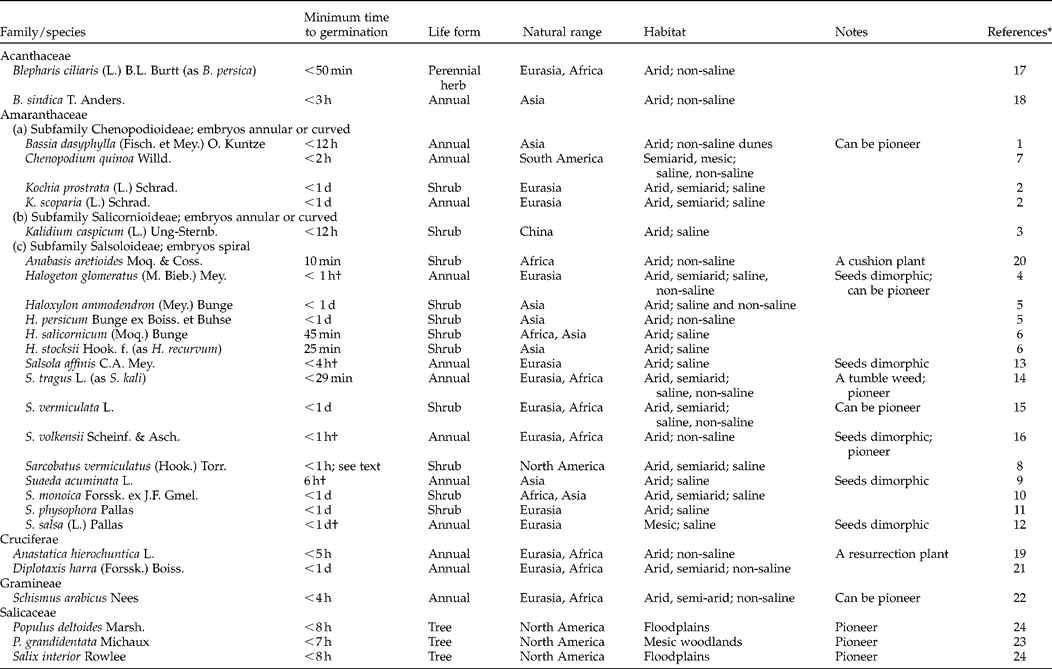
Because the first detailed account of very fast germination and its causes is that of Wallace et al. (Reference Wallace, Rhoads and Frolich1968), literature published from 1968 to the present was searched for records of flowering plant species for which the seeds germinate in less than 24 h. The papers by Faust (Reference Faust1936) and Williams (Reference Williams1960) are included for some minor points they make in passing. The databases searched were Biological Abstracts, Ingenta connect and ISI Web of Knowledge, using the search string: ((rapid or fast or ‘very fast’) and seed germination). I also used (time to germination). This was supplemented by using references from the author's personal database and papers cited therein. Values for minimum time to germination were often gleaned from tables and figures from diverse literature with a variety of main aims. The aim was not to provide an exhaustive list but to cover enough literature to indicate the main families and genera in which very fast germination is found. The data on grasses refer to germination of caryopses, while those on Amaranthaceae can include cases where the seed is covered by persistent fruit layers. For simplicity, such cases are treated as seeds here. Nomenclature for families and genera follows Mabberley (Reference Mabberley2008), while use of species names for Salsola follows Mosyakin (Reference Mosyakin2003). Authors for species names are given in Table 1; those for species extra to Table 1 are given in the text.
Minimum time to germination, life form, natural range and habitat for flowering plants that can germinate in less than 24 h from imbibition

* References: 1, Tobe et al. (Reference Tobe, Zhang and Omasa1999); 2, Orlovsky et al. (Reference Orlovsky, Japakova, Shulgina and Volis2011); 3, Qu et al. (Reference Qu, Baskin, Wang and Huang2008); 4, Williams (Reference Williams1960); 5, Tobe et al. (Reference Tobe, Li and Omasa2000); 6, Sharma and Sen (Reference Sharma and Sen1989); 7, Delatorre-Herrera and Pinto (Reference Delatorre-Herrera and Pinto2009); 8, Eddleman (Reference Eddelman1979); 9, Wang et al. (2012); 10, Waisel and Ovadia (Reference Waisel and Ovadia1972); 11, Song et al. (Reference Song, Feng, Tian and Zhang2005); 12, Song et al. (Reference Song, Fan, Zhao, Jia, Du and Wang2008); 13, Wei et al. (Reference Wei, Dong and Huang2007); 14, Wallace et al. (Reference Wallace, Rhoads and Frolich1968); 15, Creager (Reference Creager1988); 16, Negbi (Reference Negbi1968); 17, Gutterman (Reference Gutterman1972); 18, Narita and Wada (Reference Narita and Wada1998); 19, Gutterman and Shem-Tov (Reference Gutterman and Shem-Tov1997); 20, Grenot (Reference Grenot and Brown1974); 21, Tlig et al. (Reference Tlig, Gorai and Neffati2008); 22, Gutterman (Reference Gutterman2003); 23, Faust (Reference Faust1936); 24, Noble (Reference Noble1979).
† Seeds dimorphic; this figure applies to the very fast germinating type.
Results
For species showing very fast germination, the survey eventually recorded 20 species of Amaranthaceae (all formerly treated as Chenopodiaceae), three species of Salicaceae, two of both Acanthaceae and Cruciferae and one Gramineae (Table 1).
Amaranthaceae
The group of species that was formerly Family Chenopodiaceae is mostly made up of shrubs and herbs, especially from arid and semi-arid areas. Seed size for the species in Table 1 ranges from 0.9 mm to 2 mm, which is small to medium using the categories of Ellis et al. (Reference Ellis, Hong and Roberts1985). True endosperm is nearly or quite absent; when perisperm is absent too, the embryo entirely fills the seed coat (Wallace et al., Reference Wallace, Rhoads and Frolich1968; Cronquist, Reference Cronquist1981). Mucilaginous seeds are only known in Beta and Spinacia (Heydecker et al., Reference Heydecker, Chetram and Heydecker1971; Kuhn, Reference Kuhn and Kubitzki1993; Kreitschitz, Reference Kreitschitz and Gorb2009; Western, Reference Western2011).
Wallace et al. (Reference Wallace, Rhoads and Frolich1968) highlighted the fact that the pioneer annual weed Salsola tragus (Amaranthaceae; given as S. kali) can germinate in less than 29 min. This is a case where, before imbibition, the seeds contain fully differentiated embryos coiled in the form of a spiral. On water addition, germination consists merely of the uncoiling of the spiral embryo as the embryo cells elongate so that the embryo ruptures the seed coat (Wallace et al., Reference Wallace, Rhoads and Frolich1968). Salsola tragus is a member of subfamily Salsoloideae which is the only subfamily in the family characterized by possession of spiral embryos (Kuhn, Reference Kuhn and Kubitzki1993). The subfamily includes at least 15 species showing very fast germination, by far the largest such group (Table 1). For one of the group, the Sahara Desert species Anabasis aretioides, its early development is described: ‘Saturated with water after a rain shower, seeds of Anabasis aretioides unfold their embryos in ten minutes. Ten hours later, their roots are anchored in the soil and the spread green cotyledons are capable of photosynthesis.’ (Grenot, Reference Grenot and Brown1974). Ten minutes is the fastest time for germination I recorded (Table 1). Of the genera in Table 1, Salsola is the one for which most data are available; they are partly summarized here. An extremely short life cycle of within 3 months is known for S. tragus (as S. kali; Johnson, Reference Johnson1998). For the same species, it has been suggested that the unwinding of the embryo at germination is important in forcing the radicle into the soil (as S. kali; Wallace et al., Reference Wallace, Rhoads and Frolich1968). Finally, in a study of the germination of fresh seeds of species from a cold desert in China, of the eight species of annuals, only Salsola collina Pall. (the sole species of Salsoloideae studied) germinated at high percentages. The other annuals, including Chenopodium album L. and C. vulvaria L. from subfamily Chenopodioideae in the Amaranthaceae, required dormancy-breaking treatment (Wesche et al., Reference Wesche, Pietsch, Ronnenberg, Undrakh and Hensen2006). This striking difference in germination strategy requires elucidation in this context.
At least five of the species of Salsoloideae in Table 1 have dimorphic seeds. The best-understood case is that of Suaeda acuminata of central Asian deserts. It has both large, brown, soft-coated seeds and smaller, black, hard-coated (but water-permeable) seeds. Fresh brown seeds are non-dormant, imbibe water readily and most have germinated 6 h from imbibition. Fresh black seeds have physiological dormancy, imbibe water slowly and, even after 20 d, less than 7% have germinated. Both morphs have fully developed embryos before imbibition (Wang et al., Reference Wang, Wang, Tian and Huang2012). A closely analogous case is that of Suaeda salsa (Table 1; Song et al., Reference Song, Fan, Zhao, Jia, Du and Wang2008). The case of Halogeton glomeratus is also closely analogous (Williams, Reference Williams1960) except that, strangely, the seed coat colours are reversed, i.e. the black morph is the non-dormant, fast-germinating one. The similar cases in Salsola involve very fast germinating, large, non-dormant, green seeds and slow germinating, small yellow seeds which are dormant when fresh (Negbi and Evenari, Reference Negbi and Evenari1961; Negbi and Tamari, Reference Negbi and Tamari1963; Wei et al., Reference Wei, Dong and Huang2007). In S. affinis, the two behaviours are described as ‘opportunistic’ (green seed) and ‘cautious’ (yellow seed) (Wei et al., Reference Wei, Dong and Huang2007). Clearly, having two such complementary behaviours means that a single seed batch can provide seedlings over a longer period and a wider range of conditions than either behaviour alone can (Wei et al., Reference Wei, Dong and Huang2007). Very fast germination behaviour requires extreme embryo and seed coat specializations which may be incompatible with a longer-term, more cautious strategy, thus favouring the evolution of dimorphic seeds with contrasting behaviour.
A related aspect of Salsoloideae germination is that, at least in Salsola volkensii and Suaeda monoica, what protrudes first through the seed coat is the hypocotyl; radicle expansion and development are delayed. Hypocotyls are far better protected against dehydration than radicles by thick cuticular layers; this may be critical in allowing seedlings to survive the first few days after germination following light rain in desert areas (Negbi and Evenari, Reference Negbi and Evenari1961; Waisel and Ovadia, Reference Waisel and Ovadia1972). It is not known whether this behaviour is widespread in other species of Salsoloideae.
Despite the small sample size and varying methods of assessing minimum time to germination, from the data in Table 1 it is possible that, in general, species of Salsola are able to achieve faster germination than those of Suaeda. If so, this can be associated with the fact that, while both genera have seeds with membranous pericarps, in Salsola the seed coat itself is membranous while in Suaeda it is ‘shining black, crustaceous’ (Stanley and Ross, Reference Stanley and Ross1983) which may reduce imbibition rates compared to those in Salsola. An exception to the generalization above is Suaeda arbusculoides L.S. Smith, which has a transparent, membranous seed coat (Stanley and Ross, Reference Stanley and Ross1983); establishing its germination speed would be an excellent way to test the hypothesis above. Turning to the other Salsoloideae, further relevant details to those in Table 1 are only available for Sarcobatus vermiculatus (Eddleman, 1979). The embryo is enclosed in a single transparent membrane called either a seed coat by Hils et al. (Reference Hils, Thieret and Morefield2003), who I will follow here, or a pericarp (Eddleman, 1979). On imbibition, germination normally occurs rapidly through ruptured or weak areas in the seed coat. However, in some seedlots, despite rapid imbibition, the seed coat does not rupture and the embryo remains trapped inside for at least 30 d unless the coat is ruptured with a needle. At the other extreme, in one seedlot, on many seeds the radicles were already protruding before imbibition. In this seedlot, the seed coat ‘is not continuous around the embryo’ (Eddleman, 1979). I have ignored this behaviour in Table 1 and simply put that germination takes less than 1 h. Turning to the subfamilies with annular or curved rather than spiral embryos (Table 1), Kalidium at least is like the Salsoloideae in having fully developed embryos in the seed before imbibition (Qu et al., Reference Qu, Baskin, Wang and Huang2008).
Acanthaceae
Very fast germination is known in two desert species of Blepharis, both herbs (Table 1). Few other relevant data are known for these, except that germination is ‘more orthodox’ than the embryo-uncoiling type shown by Salsola (Gutterman, Reference Gutterman1972). The family itself has very thin seed coats, no endosperm (in the subfamily which includes Blepharis) and large embryos which are straight or curved but not spirally coiled (Cronquist, Reference Cronquist1981). For a mainly herbaceous family and in the context of the families in Table 1, seed size is large, e.g. 7.8 mg in B. sindica (Narita and Wada, Reference Narita and Wada1998) and 5–10 mg in B. linariifolia Pers. (Elberse and Breman, Reference Elberse and Breman1989). In B. ciliaris, mucilaginous trichomes on the seed anchor the seed and seedling to the soil (Gutterman and Shem-Tov, Reference Gutterman and Shem-Tov1997).
Cruciferae
Very fast germination is known in two annual desert species (Table 1). In this family, the embryo is strongly curved or variously folded. In some species, the cotyledons are spirally coiled (Appel and Al-Shehbaz, Reference Appel, Al-Shehbaz and Kubitzki2003), thus resembling those of the Salsola type. The behaviour of such spirally coiled embryos at germination has not been described. As in Salsola, the embryo is large, completely filling the seed (Rendle, Reference Rendle1938). In this family, the seeds are generally small; in Saharan species of Diplotaxis they can be dust-like (seed weight c. 0.05 mg) (Appel and Al-Shehbaz, Reference Appel, Al-Shehbaz and Kubitzki2003). Seed coats are thin and seed dormancy occurs in most species (Ellis et al., Reference Ellis, Hong and Roberts1985). Seed coats of some taxa become mucilaginous when wetted, including Anastatica and Diplotaxis harra (Gutterman, Reference Gutterman2002).
Gramineae
The desert species Schismus arabicus is the sole monocot in Table 1; it is often a pioneer, has dust-like seeds and is ‘one of the fastest maturing desert annuals’. It proceeds from imbibition to flowering in 4 weeks (Brooks, Reference Brooks and Bossard2000); even shorter life cycles, from 8 to 10 d, from germination to seed production are known in the Saharan Boerhavia repens L. (Cloudsley-Thompson and Chadwick, Reference Cloudsley-Thompson and Chadwick1964).
Salicaceae
Many papers document, in passing, the germination of species of Populus and Salix within 24 h (e.g. see the three cited in Karrenberg et al., Reference Karrenberg, Edwards and Kollman2002), but few provide any details. In Table 1, I have simply included only the species with the three fastest values I could find. Populus and Salix species are usually pioneer trees on active floodplains. They produce very small seeds with very thin seed coats; in Salix, these are transparent. The seeds lack endosperm; the seed coats are entirely filled up by the embryo (Rendle, Reference Rendle1938; Karrenberg et al., Reference Karrenberg, Edwards and Kollman2002). Unusually for temperate trees, seeds of most Populus and Salix species have no dormancy; this is associated with short seed longevity (Karrenberg et al., Reference Karrenberg, Edwards and Kollman2002). Rendle (Reference Rendle1938) believes that their rapid germination is associated with the development of mucilaginous hairs at the base of the hypocotyl (collet hairs involved in seedling anchorage; Noble, Reference Noble1979) while the embryo is still in the seed.
Cactaceae
This family does not qualify for Table 1, but shows some striking similarities with species of subfamily Salsoloideae in the Amaranthaceae. Species of Cactaceae usually have very small seeds (average 1–2 mm long) often with a thin seed coat (Barthlott and Hunt, Reference Barthlott, Hunt and Kubitzki1993; Maiti et al., Reference Maiti, Hernandez-Pinero and Valdez-Marroquin1994). The seeds are without true endosperm (Mabberley, Reference Mabberley2008) and, in many species, show a lack of dormancy (Ortega-Baes et al., Reference Ortega-Baes, Aparicio and Galindez2010). The embryo may be curved or spirally rolled (Rendle, Reference Rendle1938). Given these characteristics, it is not surprising that, in most subfamilies, germination is fast and usually occurs within a week (Bregman and Bouman, Reference Bregman and Bouman1983); this has been related to the thin seed coat by Maiti et al. (Reference Maiti, Hernandez-Pinero and Valdez-Marroquin1994). Further work is needed to establish just how quickly germination can occur in such Cactaceae. As in the Cruciferae, seeds of some species produce a mucilage sheath on wetting (Barthlott and Hunt, Reference Barthlott, Hunt and Kubitzki1993).
There are further species which fall just outside the ‘less than 24 h criterion’ used here for very fast germination. These are the two crucifers Carrichtera annua (L.) DC and Erucaria microcarpa Boiss. (as Reboudia pinnata) and Plantago coronopus L. (Plantaginaceae). These germinate in about 24 h or slightly longer (Gutterman and Shem-Tov, Reference Gutterman and Shem-Tov1997).
Finally, I checked a tabulation of ‘minimum days to germination’ for about 550 species of Australian native flowering plants sown on to a variety of substrates. This yields just seven species for which the minimum is as short as 2 d. Of these, two are from Casuarinaceae, two from Compositae and the other three are from three different families. The Casuarinaceae and Compositae show a clear tendency for faster germination than the other families (Fox et al., Reference Fox, Dixon, Monk and Langkamp1987). These possible family relationships need following up.
Discussion
Much remains to be discovered about the phenomenon of very fast germination. In the case of Salsola tragus, it is clear that it is mainly the result of water uptake leading to cell expansion. Cell division is not involved; the process is physical rather than physiological (Wallace et al., Reference Wallace, Rhoads and Frolich1968). However, this paper is the only one giving details of the process. Otherwise, all we know is that the other Salsoloideae have spirally coiled embryos like Salsola, with no details at all known for the other species listed.
Partly analogous behaviour is found in the germination of sporocarps of the arid-adapted fern Marsilea, where, on imbibition, hygroscopic mucilaginous tissue swells and within a few minutes a long wormlike structure splits the hard wall and emerges, when spores are released from it (Gifford and Foster, Reference Gifford and Foster1989).
In summary, all species in Table 1 (except Schismus arabicus) are from families in which the endosperm is absent or nearly so. Except for the Acanthaceae and Chenopodium quinoa, there are strong tendencies towards both small seed size (see also Grime et al., Reference Grime, Mason and Curtis1981) and soft, thin seed coats which are often membranous or transparent and which imbibe water readily. A qualification to the point about seed coats applies to the five species of Salsoloideae with dimorphic seeds (Table 1). In the cases studied in detail, the thin-coated morph is non-dormant and germinates with the first rain while the thick-coated morph is dormant and provides a seed bank for future rain events (as discussed above). Except for the Gramineae (Schismus) and the Amaranthaceae (but with two exceptions), the families in Table 1 can produce mucilage on wetting, either from collet hairs at the base of the hypocotyl (in the Salicaceae; Rendle, Reference Rendle1938) or from the seed coat (in the other families). As well as its role in adherence to the surface soil, in the case of the seed coat, the mucilage envelope, by keeping water around the seed, can be crucial in speeding up germination (Gutterman, Reference Gutterman2002; Kreitschitz, Reference Kreitschitz and Gorb2009).
Many species in Table 1 germinate over a very wide range of temperatures, leading Negbi and Evenari (Reference Negbi and Evenari1961) to state that, for some species, their germination is unusual in being ‘independent of … temperature’. Some actual temperature ranges for germination for Table 1 species are: Blepharis ciliaris, 8–40°C (Gutterman, Reference Gutterman2002); Diplotaxis harra, 5–30°C (Tlig et al., Reference Tlig, Gorai and Neffati2008); Salsola vermiculata, 3–33°C (Sankary and Barbour, Reference Sankary and Barbour1972); and Sarcobatus vermiculatus, 5–40°C (Romo and Eddleman, Reference Romo and Eddleman1985). Populus and Salix also have wide ranges (Karrenberg et al., Reference Karrenberg, Edwards and Kollman2002). Studies are needed to see if this is related to embryos being fully differentiated prior to germination, as is the case with Salsola tragus (Wallace et al., Reference Wallace, Rhoads and Frolich1968).
There is a clear relationship between very fast germination and high-stress habitats, with suites of Table 1 species variously adapted to arid, saline and active floodplain habitats. Allied to this is status as pioneer species (ten species in Table 1), including desert species like Schismus arabicus that become confined to disturbed areas as pioneers in the wettest parts of their range (Brooks, Reference Brooks and Bossard2000). Species like Halogeton glomeratus (Williams, Reference Williams1960), Salsola tragus (Wallace et al., Reference Wallace, Rhoads and Frolich1968) and Schismus arabicus (Brooks, Reference Brooks and Bossard2000) can behave as highly invasive weeds. The essential ecology underlying the evolution of very fast germination is that seedling establishment can depend on rapid exploitation of temporarily favourable conditions (Grime et al., Reference Grime, Mason and Curtis1981). For the desert species, after rain, fast germination can allow seedling roots to penetrate the surface soil before it dries out (Gutterman, Reference Gutterman2003); for Blepharis, root length can reach 50 mm within 24 h of wetting (Gutterman, Reference Gutterman2000).
There are two contrasting types of germination found in species with very fast germinating seeds. In one, all the seeds germinate within a very short time from wetting (e.g. Blepharis spp., Gutterman, Reference Gutterman2002; Populus spp. and Salix spp., Karrenberg et al., Reference Karrenberg, Edwards and Kollman2002; Suaeda physophora, Song et al., Reference Song, Feng, Tian and Zhang2005), while in the other, small amounts of rain cause germination of small fractions of seed from a long-living soil seed bank (e.g. Schismus arabicus, Gutterman, Reference Gutterman2002). Possession of dimorphic seeds gives a species the ability to utilize both behaviours, one for each morph (see, for example, Wei et al., Reference Wei, Dong and Huang2007; Wang et al., Reference Wang, Wang, Tian and Huang2012), letting the species cope with more conditions than one behaviour alone. The main workers in this field refer to the two behaviours as strategies. Gutterman (Reference Gutterman2002) calls the first of them ‘immediate germination’ and the second one ‘opportunistic strategy’, while Wei et al. (Reference Wei, Dong and Huang2007) and Wang et al. (Reference Wang, Wang, Tian and Huang2012) call the first ‘opportunistic strategy’ and the second ‘cautious strategy’. This confusion needs to be resolved. Brooks (Reference Brooks and Bossard2000) refers to the second strategy as ‘bet-hedging’ which, in my view, is a more apt term than opportunistic in such a context.
Further ramifications of very fast germination behaviour are: (1) that it may be crucial in conferring a competitive advantage, e.g. in the case of competition between Salsola tragus and other alien annuals in the Great Basin, USA (Young and Evans, Reference Young and Evans1972); and (2) that, because ants are said to collect seeds but not seedlings, rapid transition from seeds to seedlings allows escape from ant predation (Gutterman, Reference Gutterman2000). Clearly, there is scope for much more work on fast germination.
Acknowledgements
I thank M. Bartley, T. Edwards, J. Morgan, I. Price, N. Scarlett and K. Watson for helpful discussions.