What is of importance to us is the activity and behavior of the total organism or individual as opposed to the activity of single, detachable organs.
— Adolf Meyer (1915; quoted in Karl & Holland, Reference Karl and Holland2013)INTRODUCTION
The biopsychosocial model in cancer considers the holistic approach to a patient, and supports a patient's individual treatment. Each cancer patient has their own personal history, with their own social relationships and illness adjustment response within the cancer context (Grassi, Reference Grassi2013). The conceptual model of biopsychosocial processes can be reported in three main domains: (1) physical well-being, which refers to disease-specific symptoms or the side effects of treatment; (2) psychological well-being, referring to emotional and spiritual aspects, communication, cognition, coping style, subjective meaning of the cancer, and personal accomplishment; and (3) interpersonal well-being, which refers to perceived social support and social role functioning. Adjustment to cancer has been defined as the cognitive and adaptive behavioral mechanism that takes place over time, within their social setting (Brennan, Reference Brennan2001). One way of capturing patients' adjustment response to cancer is using health-related quality of life (HRQoL) measures. The HRQoL instruments have been shown to be adequate for measuring change over time in adjustment responses to cancer (Brennan, Reference Brennan2001). Traditionally, HRQoL was considered a multidimensional concept, including patients' subjective evaluation of their physical function, disease, and treatment-related symptoms, and psychological and social functioning (Ganz, Reference Ganz1994).
The relationship between HRQoL and social support is best understood using stress-buffering hypotheses, where social support improves HRQoL by facilitating an adaptive coping response (Helgeson, Reference Helgeson2003). Additionally, in the integrative research model on psychosocial oncology, social support and coping response were among some of the psychosocial variables considered for mediating adjustment to cancer, HRQoL being the outcome variable for an adaptive response to cancer (Holland, Reference Holland2002). Many studies have examined the predictive nature of social support by diminishing psychological comorbidity in cancer patients and survivors (Devine et al., Reference Devine, Parker and Fouladi2003; Helgeson & Cohen, Reference Helgeson and Cohen1996) and noted that a higher level of social integration was associated with better HRQoL (Michael et al., Reference Michael, Berkman and Colditzm2002; Lewis et al., Reference Lewis, Manne and DuHamel2001). The results showed that especially social support demonstrated its moderating effects on cognitive-processing variables, such as intrusive thoughts about cancer (Lewis et al., Reference Lewis, Manne and DuHamel2001). Social support enabled patients to garner additional coping resources that facilitated emotional processing of their cancer experience through verbal disclosure of thoughts and feelings (Devine et al., Reference Devine, Parker and Fouladi2003; Lepore & Helgeson, Reference Lepore and Helgeson1998; Zakowski et al., Reference Zakowski, Ramatim and Mortonm2004). While many studies substantiated that perceived social support has been considered a significant mediator of psychological outcomes in cancer patients (Holland, Reference Holland2002; Helgeson & Cohen, Reference Helgeson and Cohen1996), the odd study has suggested that social support has no mediating effect on psychological well-being and that other personal resources like optimism or self-transcendence should be included (Mathews & Cook, Reference Mathews and Cook2009). Moreover, specifically in the context of a cancer-screening setting, psychological well-being is influenced by social constraint and cognitive adaptation to a threatening event, rather than perceived social support or emotional processing (Andrykowski & Pavlik, Reference Andrykowski and Pavlik2011).
Helgeson et al. (Reference Helgeson, Snyder and Seltman2004) examined patterns of adjustment to breast cancer over a four-year period, where social support was distinguished from the different mental functions, illustrating that women who experienced decline in mental health also had fewer social resources. Regarding the functional aspects of social support relating to mental and physical well-being, it was suggested that patients' psychological resources affect their ability to utilize social support to improve personal physical well-being (Bloom et al., Reference Bloom, Stewart and Johston2001). Perceived social support, measured as an outcome variable, has been related to psychological processes of supportive relational schemas, coping responses, or personality factors (Uchino, Reference Uchino2009; den Oudsten et al., Reference den Oudsten, Van Heck and Van der Steeg2010).
An important line of inquiry in adjustment to cancer is defined by the combined effect of coping response, social support, and HRQoL. Considering three previous dimensions conceptualized in the biopsychosocial approach to cancer, our study was focused to highlight the contributions of underlying factors affecting perceived social support in cancer patients. Our objective was to assess the influence of the combined contribution of different types of coping responses and HRQoL domains in predicting perceived social support during cancer treatment. It was hypothesized that perceived social support was related to patients' coping responses, at the same time as it was influenced by their HRQoL, physical, and mental domains.
METHODS
Sample/Participants
Our study was conducted at a cancer center. The inclusion criteria were: confirmed diagnosis of cancer; outpatients undergoing chemotherapy and radiotherapy or other oncology treatment; and patients 18–80 years of age. Patients with a low performance status (Karnofsky Index <40%), psychotic illness, or significant cognitive impairment were excluded. The study was approved by an institutional research board and an ethics committee review.
Measurements
A demographic questionnaire collected data about patients' sociodemographic characteristics and medical status. To measure coping response, the Mental Adjustment to Cancer (MAC) Scale was utilized. This is a 40-item self-rating questionnaire that employs a 4-point Likert-type scale that includes five behavioral styles (Watson et al., Reference Watson, Greer and Young1988; Ferrero et al., Reference Ferrero, Barreto and Toledo1994), these being Fighting Spirit, Helpless–Hopelessness, Anxious Preoccupation, Fatalism, and Avoidance (Denial). In the Spanish version of the MAC, which contained 28 items, the appropriate factor solutions also constituted five factors that accounted for 36.69% of total variance. The resulting factors were then titled as follows: Hopeless (α = 0.78), Anxious (α = 0.74), Resignation/Fatalism (α = 0.62), Illness Acceptance (α = 0.44), and Self-Safety Behavior (α = 0.69), with acceptable internal consistency in the majority of dimensions (Costa-Requena & Gil, Reference Costa-Requena and Gil2009).
A general measure of HRQoL was provided by the Medical Outcomes Study, Short Form-36 (SF–36) (Ware & Sherbourne, Reference Ware and Sherbourne1992). This instrument measured two general health domains—physical health and mental health—divided by eight specific domains: physical functioning, limitations in performing roles because of physical health problems (physical roles), bodily pain, general health, vitality, social functioning, limitations in performing roles because of emotional health problems (emotional roles), and mental health. In each domain of the SF–36 scale, scores range from 0 (the worst possible measured health) to 100 (the best possible measured health). Hence, higher scores represented better functioning. The SF–36 health survey was translated and adapted into Spanish, and this version has shown satisfactory reliability, with a Cronbach's alpha ranging from 0.71 to 0.94 for all dimensions (Alonso et al., Reference Alonso, Prieto and Antó1995).
Social support was assessed with the Medical Outcomes Study Social Support Survey (MOS–SSS) (Sherbourne & Stewart, Reference Sherbourne and Stewart1991). This questionnaire measures five functional aspects of the perceived availability of social support (Emotional, Informational, Instrumental, and Affective Support, and Positive Interaction). For each item, the respondent was asked to indicate how often each support was available to them, if necessary. All but one item (number of close friends or relatives) were scored on a 5-point Likert-type scale ranging from 1 (none of the time) to 5 (all of the time). For each subscale, simple algebraic sums were computed, with a higher score indicating a better perception of social support. Adequate psychometric properties of the MOS–SSS have been established with Spanish validity and a Cronbach's alpha of 0.94 (Costa-Requena et al., Reference Costa-Requena, Salamero and Gil2007). By using a factor analysis in Spanish cancer patients, three subscales of functional social support were distinguished: emotional/informational support, affective support, and instrumental support. Additionally, the total index of functional items was used as an overall measure of support (Sherbourne & Stewart, Reference Sherbourne and Stewart1991; Costa-Requena et al., Reference Costa-Requena, Salamero and Gil2007).
Procedure
With consecutive sampling, the samples were gathered from patients who had undergone oncology treatment, mainly with chemotherapy or a combination of chemotherapy with radiotherapy. Participants were recruited in the outpatient clinic while waiting for medical examination or chemotherapy treatment. All patients approached were informed of the objective of this study when asked to fill out the sociodemographic data and before signing the consent form agreeing to participate in the study. Data collection was conducted in a private area adjacent to the hospital ward. Permission to conduct the study was received from the institutional review board of the hospital. Patients were first registered with a structured interview by a clinical psychologist to obtain sociodemographic data and a Karnofsky functional index; medical characteristics were available from the patient's clinical record. Following this sociodemographic interview, patients were asked to complete the MAC, SF–36, and MOS–SSS questionnaires. Participants were asked to fill them out by themselves, with an interviewer available for questions at all times. The assessment protocol lasted from 20 to 45 minutes.
Statistical Analysis
The demographic and clinical-related characteristics of the sample were examined using descriptive statistics. An analysis of variance was performed, which yielded Pearson's product–moment correlation coefficients to evaluate the association of different types of coping styles and two general HRQoL domains—physical health and mental health—with a global index of perceived social support. Then, to test the theoretical model of influence of coping response on perceived social support, two standard least-squares regression analyses were developed with significant correlations. In both cases, the global index of perceived social support was a dependent variable. Coping variables significantly correlated with perceived social support used in regression models. In the first model, only different types of coping response were utilized as predicting variables, while in the second the two general health domains were added as independent variables. Multicollinearity was calculated by a variation inflation factor (VIF) in the regression analyses. Inspection of residuals revealed whether the distribution could be considered fairly normal. Analyses were carried out using the Statistical Package for Social Sciences (SPSS, version 15.0).
RESULTS
Subjects
The interviewer originally approached 823 patients to participate in the study, and a total of 757 (91.9%) completed the sociodemographic interview. The main reasons for refusal were lack of time (n = 39), withdrawal without explanation (n = 12), disinterest in the study (n = 7), and not feeling well (n = s8).
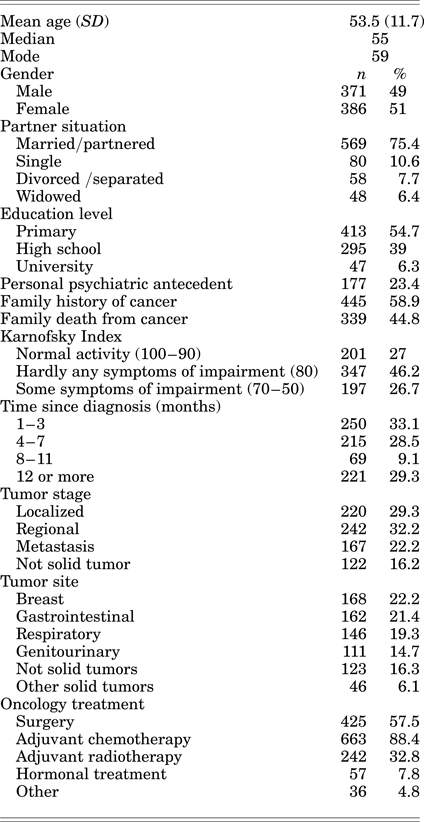
The median age of the sample population was 55 years; 371 were men (49%). Most of the patients (569, 75.4%) were married or had a partner. The sample represented many different types of cancer, the most prevalent being breast, colorectal, and respiratory tumors. At the time of the study, 665 patients (88,4%) were undergoing chemotherapy. Almost half the patients (347, 46.2%) showed almost no symptoms of impairment. A summary of the clinical and sociodemographic characteristics can be found in Table 1.
Clinical and demographic data (N = 757)

Perceived Social Support Correlations
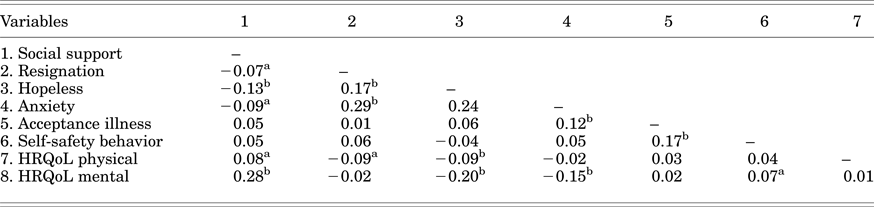
In bivariate correlation analyses, a higher level of perceived social support was significantly related to better the HRQoL physical component (r = 0.08, p ≤ 0.05) and the HRQoL mental component (r = 0.28, p ≤ 0.01). Moreover, there was a negative association between perceived social support and coping response to cancer, that is, perceived social support was related with less Resignation (r = −0.07, p ≤ 0.05), less Hopelessness (r = −0.13, p ≤ 0.01), and lower scores on Anxiety response to illness (r = −0.09, p ≤ 0.05). Coping response with Illness Acceptance and Self-Safety Behavior did not have a significant association with perceived social support. These correlations are presented in Table 2.
Correlations between perceived social support, coping style, and HRQoL domains

a p ≤ 0.05.
b p ≤ 0.01.
Influence of Type of Coping Response and HRQoL on Perceived Social Support
In the first model, a standard regression analysis was calculated with significant bivariate correlations to identify the coping responses that influenced patients' perceived social support. In the second model, HRQoL domains were added with coping responses to assess their contributions to perceived social support. In collinearity diagnostics, the VIF for predictors ranged from 1.01 to 1.14, indicating multicollinearity did not affect the estimated β parameter.
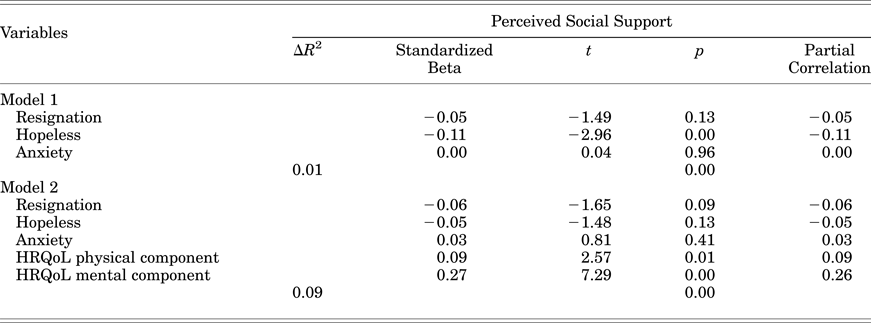
Three coping responses were added: Resignation, Hopelessness, and Anxiety. The previous model reported an acceptable statistical analysis (F = 4.50, p ≤ 0.01), and the total equation was significant, but only accounted for 1.5% of the variance. Hopelessness, with a negative coefficient, had a significant influence on perceived social support, as can be seen from Table 3. The second model in the regression analyses added the physical and mental components of HRQoL with coping response, and these variables improved the model's fitness to explain perceived social support (F = 14.88, p ≤ 0.01). The total equation accounted for 9% of the variance. More than coping response, HRQoL's domains were significant predictors of perceived social support, particularly the mental component. The Hopelessness response failed to be significant when HRQoL's domains were added. The contribution of each predictor on the global index of perceived social support was demonstrated by a partial correlation, as presented in Table 3.
Standardized regression analysis of overall global index of perceived social support

DISCUSSION
Considering the biopsychosocial dimensions in the approach to cancer, social support has a significant role to play regarding psychological adjustment to cancer (Helgeson et al., Reference Helgeson, Snyder and Seltman2004). In order to better understand the mechanisms affecting perceived social support in cancer patients, the current study examined the relative factors associated with it. Social support was not considered simply an aspect of HRQoL, but it has been shown to effectively improve HRQoL in cancer patients (Bloom et al., Reference Bloom, Stewart and Johston2001; Sherbourne & Stewart, Reference Sherbourne and Stewart1991). This could be a determining variable in a reciprocal relationship. Our results suggest that better HRQoL mental and physical domains indicate better perceived social support during cancer treatment. The mental component of HRQoL was especially relevant in influencing perceived social support. Moreover, in other studies, a higher level of perceived social support influenced better mental HRQoL by facilitating cognitive processing to reduce distress (Andrykowski & Pavlik, Reference Andrykowski and Pavlik2011).
The earliest studies showed a relationship between patient psychological response and adjustment to a diagnosis of cancer (Greer et al., Reference Greer, Morris and Pettingale1979). Coping responses measured after cancer diagnosis predicted adjustment over a three-year follow-up (Hack & Degenr, Reference Hack and Degenr2004). Particularly, the Hopelessness response was associated with poor psychological adjustment (Schnoll et al., Reference Schnoll, Mackinnon and Stolbach1995; Shimizu et al., Reference Shimizu, Nakaya and Saito-Nakaya2012); furthermore, at 10 years post-diagnosis, cancer patients' survival decreased after a high initial Hopelessness response (Hack & Degenr, Reference Hack and Degenr2004; Watson et al., Reference Watson, Homewood and Haviland2005). Also, it has been found that coping strategies and cognitive variables may influence perceived social support (den Oudsten et al., Reference den Oudsten, Van Heck and Van der Steeg2010; Uchino, Reference Uchino2009). Current findings showed that a Hopelessness coping response is a negative determinant of patients' perceived social support. This became clear when the Hopelessness response was considered a cognitive indicator with low positive effects (Beck et al., Reference Beck, Perkins and Holder2001). In turn, other studies have shown that perceived social support is not a predictor of a Hopelessness response in adjustment to cancer, but it does predict other positive coping responses, such as Fighting Spirit (Cicero et al., Reference Cicero, Lo Coco and Gullo2009).
Also noteworthy in our results is the fact that, when HRQoL domains were added to evaluate patients' perceived social support, coping response was not significant. These findings paralleled the results described in other studies, where HRQoL domains were stronger predictors rather than coping behavior for patients' perceived psychosocial support needs (Brix et al., Reference Brix, Schleussner and Füller2008). Positive health outcomes, with a reduction in treatment side effects, might gradually diminish physical deterioration related to cancer, thus ensuring recovery.
Our study had some limitations. First, the sample was taken from patients enrolled in only one hospital, reducing any ability to generalize. Second, the cross-sectional design did not clarify a causal interpretation of the association between coping style and HRQoL domains regarding perceived social support. In future studies, it would be interesting to explore longitudinally the effect of changes in coping responses and HRQoL domains on perceived social support over time. Third, patients' sociodemographic and clinical variables were not analyzed, including personality traits or personal resources such us optimism and self-esteem, and these could have an impact on psychological distress and perceived social support. Finally, contribution of coping response and HRQoL to different functional dimensions of perceived social support were also not analyzed. This would strengthen differential specific effects on outcomes.
The interest in perceived social support has been reported within the integrative research model of psychosocial oncology (Holland, Reference Holland2002) and following the early biopsychosocial principles in the approach to cancer. Both support the need for an individualized doctor–patient communication, attending to the patients' psychosocial aspects and interpersonal relations (Alonso, Reference Alonso2004; Grassi, Reference Grassi2013). The current findings emphasize the importance of HRQoL domains in predicting perceived social support during cancer treatment. In this way, improvements in cancer treatment to facilitate patients' HRQoL also provides psychological well-being. It is therefore essential to consider a holistic and multidisciplinary approach to facilitate adjustment to cancer. Along these lines, following cancer diagnosis and treatment, a higher level of perceived social support in cancer survivors has been associated with greater likelihood of change toward healthy behaviors (Harper et al., Reference Harper, Schmidt and Beacham2007). Undoubtedly, in the health practice areas there is a wide range of factors influencing healthcare and the healing process, including psychological and social factors, and not only biomedical management (Alonso, Reference Alonso2004; Grassi, Reference Grassi2013).
CONFLICTS OF INTEREST
The authors have no funding or conflicts of interest to disclose.