1. Introduction: the syntactic behaviour of English verbs of saying
Verbs of saying have followed their own distinct syntactic patterns throughout the history of English. Already in Old English (OE), two characteristic orders, represented by (1) and (2), are attested.
-
(1)

-
(2)


The parenthetic clause shown in (1) generally resembles the structure which is still used in Present-day English (PDE), i.e. the so-called quotative inversion, which is one of the few rare situations in which PDE shows subject–verb inversion with a lexical verb, as in (3).
-
(3) ‘That's the whole trouble,’ said Gwen, laughing slightly. (FICT) (Biber et al. Reference Biber, Johansson, Leech, Conrad and Finegan1999: 921)
In PDE, such clauses are usually placed in the final position (i.e. following the reported message), which makes them ambiguous between V-initial (V-1) and V-second (V-2): the reported clause functions as the object of the reporting clause and, as a result, reporting clauses ‘are on the borderline between independent and dependent clauses’ (Biber et al. Reference Biber, Johansson, Leech, Conrad and Finegan1999: 922). The origin of quotative inversion is not entirely clear but it was suggested that it ‘may derive from the verb-second construction’ (Los Reference Los2009: 110) which was attested in OE and was largely lost by the end of the Middle English (ME) period (Fischer et al. Reference Fischer, van Kemenade, Koopman and van der Wurff2000: 105).
What is most interesting from the point of view of the present study, S-V inversion sometimes takes place when the reporting clause is placed before the reported message, as in (2) for OE and (4) and (5) for PDE. Such a structure cannot be analysed as V-2; it is a clear and unambiguous example of the V-1 order. In PDE, the occurrence of this structure is said to be limited to news or ‘journalistic writing’ (Biber et al. Reference Biber, Johansson, Leech, Conrad and Finegan1999: 922; Quirk et al. Reference Quirk, Greenbaum, Leech and Svartvik1985: 1024; Sams Reference Sams, Corrigan, Moravcsik, Ouali and Wheatley2009: 168).Footnote 3
-
(4) Said a pollster: ‘Frenchmen still like to believe that they are the world's greatest lovers.’ (NEWS) (Biber et al. Reference Biber, Johansson, Leech, Conrad and Finegan1999: 922)
-
(5) Declared tall, nineteen-year-old Napier: ‘The show will go on.’ (Quirk et al. Reference Quirk, Greenbaum, Leech and Svartvik1985: 1024)
Sonoda (Reference Sonoda1997: 19), on the basis of OED2, claims that this structure is ‘old’ and can be traced back to ME, see (6).
-
(6) c.1250 Gen. & Exod. 1313 Quat Abraham, ‘god sal bi-sen [etc.]’ (after Sonoda Reference Sonoda1997: 19)
The author also observes that the structure in question was first used with quoth, and later also said and say began to follow this pattern; the earliest example with said discussed in Sonoda (Reference Sonoda1997: 18) comes from the end of the eighteenth century.
However, the structure seems to be older than Sonoda (Reference Sonoda1997) suggests because the York–Toronto–Helsinki Parsed Corpus of Old English Prose (YCOE) allows us to retrieve numerous OE examples, including both cweþan and secgan, as in (2) and (7).
-
(7)

The present article aims to analyse clauses such as (2) and (7) in order to discover the motivation for the use of V-1 with verbs of saying in OE in the context of the general tendencies observed for OE V-1 clauses, as described in the following section.
2. Functions of V-1 clauses in OE
V-initial main clauses are quite rare in OE (Allen Reference Allen1995: 34) since this group of clauses usually follows the V-2 order. The only context which is clearly associated with V-1 in OE is negation (Fischer et al. Reference Fischer, van Kemenade, Koopman and van der Wurff2000: 106; Hopper Reference Hopper1975: 52; van Kemenade Reference Kemenade1997; Mitchell Reference Mitchell1985: §3935). However, it has also been observed that OE affirmative V-1 clauses often contain verbs of saying.Footnote 4 Mitchell (Reference Mitchell1985: §3930) lists them among the factors promoting the use of V-1 in OE prose and Petrova (Reference Petrova, Ishihara, Schmitz and Schwarz2006) claims the same for OE poetry (her study is based on Beowulf). Ohkado (Reference Ohkado2005: 67) includes verbs of saying in the list of ‘verbs which can be used in V1 constructions’.
Nonetheless, unlike in PDE, where only verbs of saying appear in V-1 main declarative clauses, the OE V-1 pattern is also associated with other groups of verbs (mostly unaccusative verbs including motion verbs and auxiliaries) and it performs specific discourse functions. As stated by Allen (Reference Allen1995: 34), V-1 clauses in OE tend to introduce new and/or important subjects into the discourse.Footnote 5 V-1 clauses are often claimed to have some sort of dramatic or emphatic force (Smith Reference Smith1971: 96; Hopper Reference Hopper1975: 52; Mitchell Reference Mitchell1985: §3932) and it has been noted that they tend to mark a turning point in a narration (Mitchell Reference Mitchell1985: §3933; Traugott Reference Traugott and Hogg1992: 279; Petrova Reference Petrova, Ishihara, Schmitz and Schwarz2006), which seems natural for clauses that often introduce new subjects. It has been observed that these clauses are used relatively often at the beginning of a story (especially in poetry; many OE poems start with a V-1 clause, e.g. The Seafarer) and they make the narration more lively (Barret Reference Barret1953: 7). Ohkado (Reference Ohkado2004) produces a list of pragmatic functions of V-1 clauses from Ælfric's Catholic Homilies I: they mark transition from action to action, they summarise the discussion, they introduce a new character, they mark a type or sentence which is in contrast to the preceding one(s), and they open a new story/paragraph. Calle-Martín & Miranda-García (Reference Calle-Martín and Miranda-García2010) note that certain verb types (especially speaking and motion verbs) are particularly compatible with marking transition in discourse, and this is the reason why they co-occur with V-1 most often.
Mitchell (Reference Mitchell1985: §3932) observes (after Quirk & Wrenn Reference Quirk and Wrenn1955) that the V-1 order is especially frequent in some of the OE poetry and Bede's Historia ecclesiastica; Calle-Martín & Miranda-García (Reference Calle-Martín and Miranda-García2010) point to Bede, Orosius and Ælfric's Letters as the texts which follow this pattern most frequently. Ohkado (Reference Ohkado, Amano and Nakano2000: 272) states that in Bede the structure is not only exceptionally frequent but also used in contexts which rarely co-occur with V-1 in other OE texts (this conclusion is confirmed by Aastrup Reference Aastrup2015). What is more, in the context of verbs of saying, Mitchell (Reference Mitchell1985: §1949) reports after Ogura (Reference Ogura1979) that there are two competing patterns of parenthetic insertion in OE: cwæð he generally used in Bede and he cwæð used in the Homilies of Wulfstan, which suggests some intertextual variation in the use of quotation formulas.
Moreover, Ohkado (Reference Ohkado2000) suggests that Latin influence may be the reason for the uncommonly high frequency of V-1 in Bede; this conclusion is based on an analysis of a small sample of V-1 clauses (only 10, none of them containing a verb of saying). Since in Latin ‘verbs of saying, knowing, perceiving, etc. tend to occur in initial position’ (Bauer Reference Bauer, Baldi and Cuzzolin2009: 278), at least some of the V-1 clauses containing verbs of saying in OE translations may be calques of original Latin clauses.
Of course, we cannot assume that V-1 clauses with verbs of saying should behave in the same way in OE and PDE, but if the structure developed in a continuous way (which does not seem improbable considering its presence in all stages of English), some functional parallels might be identifiable. Sonoda (Reference Sonoda1997) observes that PDE clause-initial reporting verbs are used interchangeably with other reporting structures in order ‘not to bore the reader’ (Sonoda Reference Sonoda1997: 24), which suggests a stylistic motivation; a similar observation has also been made in the context of OE V-1 clauses in general. The other function identified by Sonoda (Reference Sonoda1997) for PDE is to summarise a paragraph, which is one of the pragmatic functions of V-1 clauses mentioned in Ohkado (Reference Ohkado2004) in the context of OE. Finally, information structure is also considered in the studies of PDE clause-initial reporting verbs (e.g. Konno Reference Konno2013); studies of OE go along the same path. Sonoda (Reference Sonoda1997) observes that the subjects in such inverted clauses are hardly ever pronominal, and since pronominal subjects are given information, this would confirm the hypothesis that V-1 clauses tend to introduce new subjects. However, Konno's (Reference Konno2013) study (based on phrasal verbs only) shows that the information status of the subjects does not seem to influence the use of the structure (40 per cent of the subjects in Konno's study were given), so the correlation is not clear, at least not in PDE.
In short, the main research problems formulated on the basis of existing research and investigated in the present article are:
-
(i) How often do verbs of saying co-occur with the V-1 order and what is the distribution of the pattern across texts?
-
(ii) Are the functions of V-1 clauses with verbs of saying the same as the functions defined for V-1 clauses in general?
-
(iii) What is the most probable reason for the exceptionally high frequency of V-1 in certain texts?
3. Methodology
In this study, the V-1 order is understood as a structure specific to main declarative clauses with an overt subject and without a coordinating conjunctionFootnote 6 in which the finite verb form takes the first position, as in (8). Negated clauses such as (9) are excluded from the study because it would be impossible to determine whether the V-1 order is used because of the presence of the negative particle or because of the fact that the verb belongs to the group of verbs of saying.
-
(8)
-
(9)


V-1 clauses preceded by a subordinate clause are also excluded. It is generally assumed that in OE subject–verb inversion related to the V-2 phenomenon cannot be caused by a preceding subordinate clause (Haeberli Reference Haeberli2007), but since in other Old Germanic languages clauses such as (10) would be analysed as V-2, they were not considered in the analysis to avoid structural ambiguity. Besides, it is logical to assume that the use of patterns shown in (8) and (10) was motivated by different factors and that the sentence-initial placement of the verb in (8) may have created a different effect compared to the sentence-medial positioning of the verb shown in (10).
-
(10)

Data used in the analysis have been retrieved from the York–Toronto–Helsinki Parsed Corpus of Old English Prose (YCOE) (Taylor et al. Reference Taylor, Warner, Pintzuk and Beths2003) and the York–Helsinki Parsed Corpus of Old English Poetry (Pintzuk & Plug Reference Pintzuk and Plug2002). The corpora include part of speech and syntactic annotation, which allowed for automatic extraction of the data by means of the CorpusSearch 2 application (Randall et al. Reference Randall, Kroch and Taylor2005–13).
In order to limit the data to declarative clauses, the finite verb was defined as unambiguously indicative and all cases of imperative and subjunctive forms were excluded from the search. Since ambiguous forms included cases of jussive subjunctive, declarative clauses were identified manually from within the sample of clauses containing ambiguous verbs. Since the study is focused on verbs of saying, only lexical verbs were included in the search (the query used to retrieve the data is included in the Appendix). The sample retrieved from the corpus and subjected to analysis contained 366 instances of the V-1 pattern in prose and 293 in poetry. Clauses containing verbs of saying were identified in the sample manually.
In the study, a verb is considered to belong to the group of verbs of saying if its basic meaning denotes verbal communication (cweþan, secgan, sprecan, tellan), or if it is one of the main verbs used to report a conversation (i.e. andswarian, frignan and ascian), though only in the first case is the communication unambiguously oral so verbs from this category are the most typical representatives of the group. If the action of communication is clearly not oral (as e.g. in writan), the verb is excluded from the category. Verbs used to report a command or request (biddan, hatan) were not included because the article aims to investigate the syntactic behaviour of verbs whose primary function is to report (oral) communication.
4. Results
4.1. General distribution of the pattern
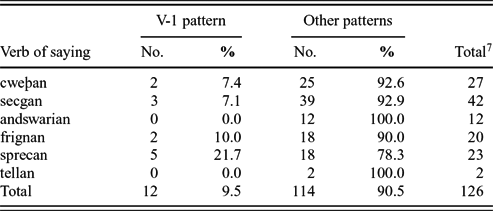
Table 1 shows the proportion of V-1 and other possible orders found in main clauses without a conjunction and with an overt subject for each of the investigated verbs of saying separately. The data were retrieved from the poetry corpus.
Distribution of patterns for individual verbs of saying in poetry

It is clear that in OE poetry V-1 is a minority pattern within main clauses containing verbs of saying, but the frequency of verbs of saying in poetry is generally quite low (only 126 clauses altogether), which makes V-1 a small but relatively well-represented pattern in the investigated group of clauses. Twelve instances of V-1 with verbs of saying were found in the entire corpus, as illustrated with (11), which contains sprecan, the only verb in which the frequency of V-1 reaches 20 per cent.
-
(11)

Despite the presence of V-1 in the data, over 90 per cent of main clauses containing verbs of saying in OE poetry follow alternative orderings, as in (12).
-
(12)

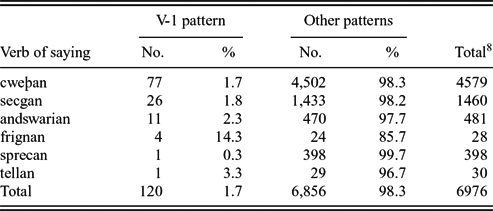
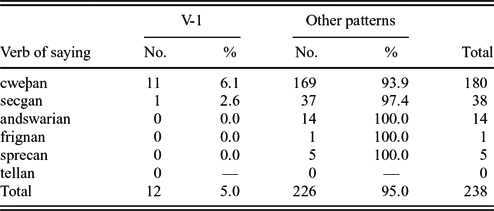
The data for prose are presented in table 2. Even though the absolute numbers of clauses with verbs of saying are much higher than in poetry, the proportion of V-1 is much lower, not reaching even 2 per cent. cweþan appears in 77 out of 120 V-1 clauses with verbs of saying; secgan holds the second position with 26 occurrences; see (13) and (14).
-
(13)
-
(14)


Distribution of patterns for individual verbs of saying in prose
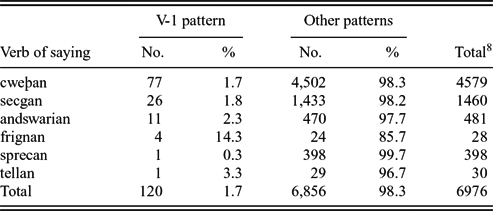
Nonetheless, verbs of saying may hardly be called a trigger for the use of the V-1 pattern in OE prose. Even for cweþan, the proportion of clauses following the V-1 order is less than 2 per cent; alternative orderings, as shown in (15) and (16), are much more frequent. Thus, it seems that the relatively good representation of cweþan in V-1 clauses is a by-product of its high frequency in the corpus rather than a sign of a strong association with the investigated structure, especially given that the proportion of V-1 is similar in the less frequent verbs of saying, i.e. secgan and andswarian.
-
(15)
-
(16)


A slightly higher proportion of V-1 is visible only in frignan, which has a generally low frequency in the investigated clause type. It is interesting to note that in prose texts, unlike in poetry, sprecan actually seems to disfavour the V-1 order because, despite the generally high frequency of this verb in the prose corpus, the V-1 pattern is followed by one clause only.
4.2. The distribution of the pattern across texts
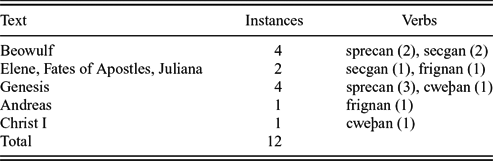
Table 3 shows the distribution of V-1 clauses containing verbs of saying across the poems. Only 12 clauses with verbs of saying were identified in the sample; these few examples are scattered around the corpus. All the verbs are used in at least two different poems. Therefore, it may be concluded that even though verbs of saying are used relatively rarely in V-1 clauses in OE poetry, their distribution is quite balanced and there is no single poem which dominates the use of the structure in question.
Distribution of V-1 clauses with verbs of saying in the poetry corpus

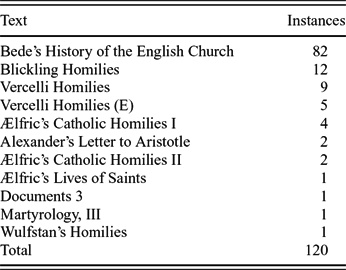
Table 4 shows that the situation in prose is different from the balanced picture of distribution found in poetry. The dominant source of the structure in prose texts is Bede (82 out of 120 V-1 clauses containing verbs of saying come from this text). Therefore, it seems that the correlation between the use of a verb of saying and the V-1 order is to a great extent shaped by one text in which the pattern is used more often than in all the texts from the remaining part of the YCOE corpus put together.
Distribution of V-1 clauses with verbs of saying across prose texts

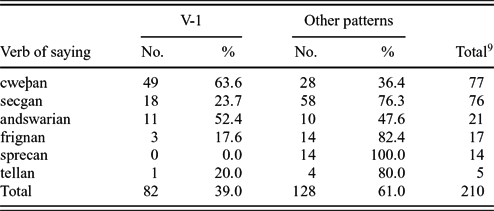
Moreover, when we compare the frequency of other patterns with individual verbs of saying for Bede (see table 5), it turns out that unlike in OE prose in general (see table 2), cweþan and andswarian clearly favour the use of V-1, though the same cannot be claimed for other verbs of saying; secgan, frignan and sprecan prefer other orderings. However, on the whole, the V-1 pattern in Bede is used in almost 40 per cent of main clauses with verbs of saying, while the same figure for OE prose in general is below 2 per cent (see table 2).
Distribution of patterns in clauses with verbs of saying for Bede

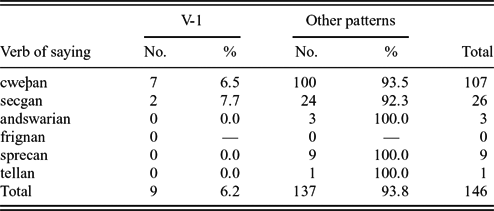
In the other two texts in which the structure was used more than 5 times, i.e. the Blickling Homilies and the Vercelli Homilies, the situation is similar to what has been established for OE prose in general: there are some relatively infrequent uses of V-1 with verbs of saying, but all of these verbs clearly favour other orderings, as shown in tables 6 and 7. In the other prose texts included in table 4 the situation is similar. Thus, Bede is clearly exceptional in his preference for V-1 with verbs of saying.
Distribution of patterns in clauses with verbs of saying for the Blickling Homilies

Distribution of patterns in clauses with verbs of saying for the Vercelli Homilies

In short, the analysis presented so far shows that the exceptionally high frequency of V-1 in Bede reported in other studies devoted to V-1 in general can also be identified for a specific lexical class, i.e. verbs of saying.
4.3. Discourse functions of V-1 clauses with verbs of saying in prose
In this section, the functions of the investigated structure are described and compared to the general functions of V-1 identified in other studies. Only prose texts are included in this part of the analysis because the low number of occurrences of the structure in poetry precludes any meaningful interpretation of the results.
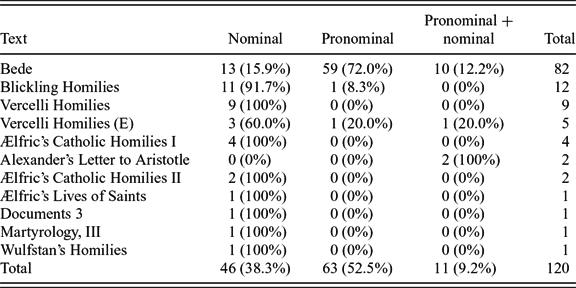
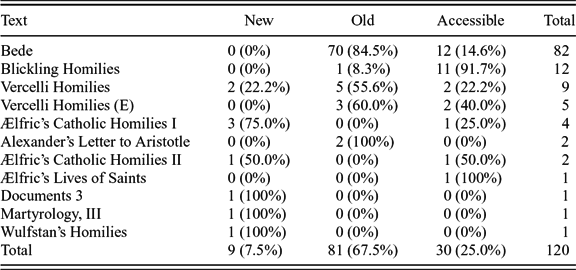
According to other studies (Allen Reference Allen1995; Ohkado Reference Ohkado2004; Petrova & Solf Reference Petrova, Solf, Fabricus-Hansen and Ramm2008), V-1 clauses show a tendency to introduce new subjects into the narration, suggesting that the subjects should mostly be nominal. As shown in table 8, this assumption is confirmed in all the texts except Bede, where most subjects used in V-1 clauses with verbs of saying are pronouns.
Subjects in V-1 clauses with verbs of saying in OE prose texts

While in all the other texts the majority of subjects are nominal, as in (17), the subjects in Bede are either personal pronouns, as in (18), or personal pronouns followed by an appositive noun phrase, as in (19).
-
(17)
-
(18)
-
(19)


There are only 2 V-1 clauses with verbs of saying and a subject pronoun which do not come from Bede. They are shown in (20) and (21).
-
(20)
-
(21)


When the information status of all the subjects is compared, as in table 9, it turns out that even when the subjects are nominal, they are hardly ever new; in Bede, the subjects are mostly old (i.e. directly repeated), while in the other texts, they are mostly old or accessible.
Information status of subjects in V-1 clauses with verbs of saying in OE prose texts

It seems that only Ælfric's texts show a tendency for the use of V-1 with verbs of saying to introduce new subjects into the narration, as in (22), though it is difficult to speak of tendencies with such a low number of examples.
-
(22)

It is noteworthy that all four new subjects used by Ælfric are strongly indefinite. Apart from sume gedwæsmen (‘some fools’) shown in (22), there are also gehwylce lareowas (‘some teachers’), sum man (‘some man’) and heora an (‘one of them’). However, in the other texts, and especially in Bede, where none of the subjects is indefinite or new, the primary function of V-1 clauses with verbs of saying is clearly different. In order to discover the functional motivation for the use of V-1 in the other texts, all the instances of the investigated structure were analysed in context.
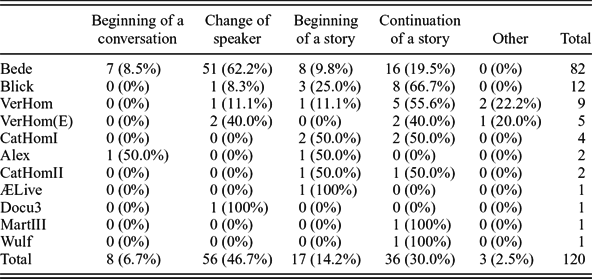
Table 10 shows the division of V-1 clauses with verbs of saying into four basic functions that were identified in the sample. The first and generally most frequent function fulfilled by V-1 clauses with verbs of saying in OE prose is to mark changes of speakers in a conversation. Consider the following example:
Discourse functions of V-1 clauses with verbs of saying in OE prose texts

-
(23)

At the beginning of each turn, a V-1 clause is used, and when a different speaker (Drihten) is introduced into the narration, a V-2 clause is used instead. The conversation is then continued for another three turns, and V-1 clauses are used consistently until the end. However, the pattern illustrated above is followed only when the speakers are clearly recognizable on the basis of subjects, as is the case with he and heo in (23) or he and ic in (24) below:
-
(24)

If two speakers are referred to by means of the same pronoun, as in (25), one of them is introduced by a V-1 clause, while the other one is introduced by a V-2 clause.
-
(25)

Thus, it seems that the alternation between V-1 and þa-V-S was a method of identification of speakers in a conversation (though the translator added se biscop to the last he in (25) to make this clear). There are more examples of this pattern, but all of them come from Bede, as in (26). The absence of the pattern from the other texts is quite natural considering the fact that subjects in V-1 clauses with verbs of saying are pronominal almost exclusively in Bede, and only pronominal subjects can lead to such ambiguity.
-
(26)

In the other texts, if V-1 is used for turn-taking, the speakers are clearly identifiable on the basis of the subject, but V-1 is used for only one of them, as in (27).
-
(27)

Example (27) also features one of the clauses that was classified as ‘other’ in table 10. The last use of the pattern Cwædon heo, Iudeas is a V-1 clause following a V-1 clause without a change of speaker (so it resembles (25) in that V-1 is used consistently for one speaker while V-2 is used for the other). All in all, in the Vercelli Homilies, V-1 does not clearly signal a change of speaker, while in Bede, there is no exception to the pattern described above: if V-1 is used in a conversation, it always indicates a new turn. This function could be interpreted as ‘introducing a type or sentence which is in contrast to the preceding one(s)’, as suggested by Ohkado (Reference Ohkado2004), since the change of speaker in a dialogue is clearly contrastive.
The next function fulfilled by verbs of saying is to begin a new story, as in (28), which appears almost at the beginning of the whole text (after a short introduction), or (29), which introduces a completely new story.
-
(28)
-
(29)


However, verbs of saying are used relatively more often to continue a story than to begin it (30 vs 14 per cent), and they either push the narration forward, marking transition to the next part, as in (30), or provide some additional information or a comment on the story, as in (31).
-
(30)
-
(31)


In short, it may be concluded that the functions of V-1 clauses with verbs of saying overlap with the general functions of V-1 clauses identified by Ohkado (Reference Ohkado2004), but some functions are represented better than others. Apart from beginning a new story or marking transition to the next part of it, the investigated structure functions as a marker of a new turn in conversation, and it is sometimes used interchangeably with V-2, which may have facilitated the identification of speakers.
4.4. Influence of the Latin source text on Bede
Ohkado (Reference Ohkado, Amano and Nakano2000: 275) suggests that the untypically high frequency of the V-1 pattern in Bede may be the result of the Latin source text influence. The aim of this section is to examine all the instances of the V-1 pattern with verbs of saying in Bede and assess the degree of foreign transfer in the case of the investigated structure. In order to achieve this goal, the sources of all 82 V-1 clauses with verbs of saying have been identified in the Latin text.Footnote 10
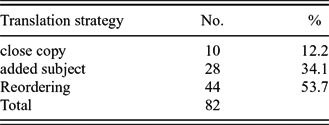
As shown in table 11, the number of closely copied clauses, as in (32), is relatively low. It should also be noted that in most clauses classified as copied some interventions of the translator are visible, as in (33), where the V-S order is followed but an appositive personal pronoun is added to the target clause.
-
(32)
-
(33)


Translation strategies for V-1 clauses with a verb of saying in Bede

In clauses with an added subject (34 per cent of all the clauses), Latin follows the V-1 order and the translator provides the subject in the post-verbal position, retaining the clause-initial position of the finite verb, as in (34). Thus, some sort of Latin influence may also be claimed here (the translator does not place the subject in the more natural preverbal position, possibly to retain the original V-1 order), though it is less direct than in (32) and (33). What is more, the relative position of the verb to the quoted message is changed in 12 out of 28 such clauses, as in (35), where the Latin clause is a parenthetic insertion.
-
(34)
-
(35)


Therefore, clauses with added subjects come across as quite independent. The most independent ones, though, still constitute more than 50 per cent of all the instances: the order is completely changed as in (36), and the most frequent pattern consists in avoiding parenthetic insertion and using the V-1 pattern instead, as in (37) (thus it makes clauses like (37) similar to (35) regardless of the presence of an overt subject in the Latin).
-
(36)
-
(37)


There are 25 source clauses containing parenthetic inquit / inquam / inquens; all of them are translated following the same V-1 pattern. It seems that the number of V-1 clauses with a verb of saying in Bede is increased because of the consistent strategy used by the Bede translatorFootnote 11 of rendering parenthetic insertions with Latin inquit as V-initial structures. Within 25 translated clauses illustrating this strategy, 23 start with cweþan followed by a personal pronoun (i.e. cwæð he / cwæð ic / cwædon heo); the two remaining ones contain the verbs frignan and secgan.
In short, direct source text influence is not the main reason for the high number of V-1 clauses in Bede since the structure is not directly modelled on the Latin in the majority of cases. What is more, an indirect influence is also rather improbable because V-1 clauses in the Latin version of Bede are relatively infrequent. In a sample of around 1,546 finite clauses only 159 (10 per cent) follow the V-1 order, while as many as 705 (46 per cent) are V-final (Cichosz et al. Reference Cichosz, Gaszewski and Pęzikforthcoming), which means that the translator would have been more likely to place the verb in the clause-final than in the clause-initial position. As defined by Taylor (Reference Taylor2008: 342), the indirect translation effect works like a priming mechanism, and the translator is inclined to use a structure which is particularly frequent in the source even in places without a direct model. This, however, is not the case in Bede, where the indirect influence would rather work in the opposite direction.
Therefore, it may be concluded that V-1 clauses with verbs of saying in Bede are mostly independent of the Latin and the frequency of the structure is increased by the consistent use of a V-1 quotation formula, which is a lexically fixed and recurrent word sequence, as explored in the next section of the present article.
4.5. Formulaicity
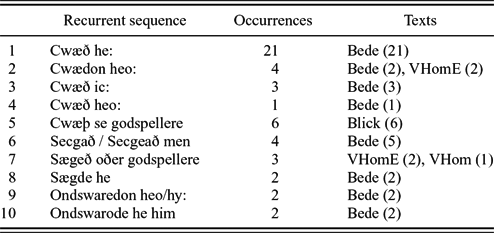
In corpus-based research of language it has been noted that there are some recurrent multiword combinations known as ‘formulaic sequences’ or ‘phraseological units’ which become established both in spoken and written language through constant reuse by members of a given linguistic community (Wray Reference Wray2002; Sinclair Reference Sinclair1991). The existence of such prefabricated chunks facilitates speech processing; the probability of discovering such units is high both in contemporary and historical texts. In this study, a formula is defined as a clause which is lexically recurrent, i.e. composed of exactly the same word sequences, as a whole or in part. The aim of this section is to check to what extent V-1 clauses containing verbs of saying are formulaic. A high degree of lexical fixedness would suggest that the structure was not (fully) productive from the syntactic point of view. In order to investigate this issue, lexical fixedness of all V-1 clauses with verbs of saying coming from the OE prose texts has been examined.Footnote 12 The analysis shows that there are many clauses which are completely or partially composed of recurrent patterns, as presented in table 12.
Recurrent word sequences in V-1 clauses with verbs of saying in OE prose

Sequences 1–4 are practically identical: the V-1 clause consists of two elements only, i.e. clause-initial cweþan and a subject pronoun. These short clauses account for 27 V-1 clauses with a verb of saying from Bede (around 33 per cent of all the analysed clauses); 16 of them are translations of the parenthetic inquit/inquam/inquens.Footnote 13 Thus, it seems that the translator generalised the formula cweþan + subject pronoun as a device for introducing direct speech, as in (38).
-
(38)

In other OE prose texts, a V-2 pattern with þa + cweþan is clearly preferred; among 4,579 instances of cweþan in non-conjunct main declarative clauses with an overt subject, there are 439 instances of the sequence þa cwæð he (9.6 per cent), as in (39), and only 8 of them, e.g. (40), come from Bede:
-
(39)
-
(40)


(39) shows how the þa cwæð he / þa cwæð ic formula is used in Boethius interchangeably to report a dialogue; they signal a new turn in a conversation, just like V-1 clauses do in Bede (see section 4.3). The V-2 formula with þa is clearly disfavoured in Bede and the V-1 pattern surfaces as the main (though not exclusive) reporting formula.
What is more, there is also a variant of the cwæð he formula in Bede with an appositive nominal element following the subject pronoun, in two cases also with a prepositional object: Cwæð he se ðe mid mec spræc: (cobede, Bede_4:26.354.10.3569), Cwæð he se biscop him to: (cobede, Bede_4:3.266.1.2700), Cwæð he se biscop: (cobede, Bede_5:6.402.26.4064), Cwæð he se cyng: (cobede, Bede_5:14.438.17.4396), Cwæð he se werga feond: (cobede, Bede_3:14.216.2.2199). Cwæð hio sio abbudisse to him: (cobede, Bede_4:26.354.27.3578). Yet another variant (with 2 occurrences) uses the adverb eft after the subject pronoun, as in (7) shown in the introductory section. All in all, if we consider all of the abovementioned examples as instances of the following pattern: cweþan + subject pronoun (+subject apposition) (+eft) (+prepositional object), we find 35 clauses following this formula in Bede.
Another recurrent sequence is secgeað men, as in (41): there are 5 clauses repeating this exact pattern in Bede's text. In the Latin original in (41), the verb of saying is placed in the clause-medial position, while the phrase secgað men is placed by the translator clause-initially (which resembles the strategy of translating the parenthetic inquit). In 2 out of 5 clauses following this formula, the Latin clause starts with ferunt autem (‘say-3PL also’), but the remaining ones are like (41).
-
(41)

Apart from the pattern shown in (41), there are also 3 variants of this formula: secgað men be hire (cobede, Bede_4:21.318.14.3196), sægdon men þæt (cobede, Bede_3:8.180.12.1785) and sægdon þætte þa menn, þa hit cuðon (cobede, Bede_3:10.188.7.1896); if we count these instances together with exact repetitions, and add them to all the instances of the formulas mentioned earlier, the number of lexically fixed V-1 clauses with verbs of saying amounts to 48, which is 58 per cent of all occurrences of this structure in Bede. It must also be noted that V-1 clauses containing the most frequent verb of saying, i.e. cweþan, are lexically fixed in 71 per cent of cases (35 out of 49 occurrences). In short, two main formulas were identified in Bede: one is used for turn-taking in a reported dialogue (cwæð he with variants) and the other is used to begin a story or a new stage of a story (secgað men with variants). Thus, the two formulas are used for the two distinct discourse functions identified in section 4.3.
Bede is not the only text in which recurrent V-1 sequences are used. In the Blickling Homilies, 6 out of 12 instances of a V-1 clause with a verb of saying have exactly the same form, as in (42):
-
(42)

Apart from the short cwæþ se godspellere formula, there are another 4 clauses consisting of only two constituents and following the formula cwæþ someone,Footnote 14 as e.g. (43):
-
(43)

This means that the level of lexical fixedness in the Blickling Homilies is even higher than in Bede (83 per cent), though the absolute numbers are of course much lower in the former text. The short formula identified in the Blickling Homilies (cwæþ someone:) is used for storytelling (beginning of a story or transition in a story), and it is also present in other texts, mostly homilies, as in (44).
-
(44)

All in all, it may be claimed that fixed reporting formulas exists in OE prose and the fact that they follow different constituent order accounts for the intertextual differences between the relative frequency of V-1 vs V-2 orders in non-conjunct main clauses containing verbs of saying.
5. Summary and conclusions
This study has revealed that V-1 is a minority pattern in main clauses with verbs of saying: its frequency is below 2 per cent in prose, while in poetry the proportion of V-1 is higher (around 9 per cent) but the number of occurrences is negligible because of the generally low frequency of verbs of saying in OE poetry. There is only one (prose) text, i.e. Bede's Historia ecclesiastica, in which a substantial part of clauses with verbs of saying (around 40 per cent) have the verb in the clause-initial position. The frequency of the structure in other texts is low; most main clauses with verbs of saying follow the V-2 or V-late order.
Furthermore, the study shows that V-1 clauses with verbs of saying are used for two main functions in OE prose: they signal new turns in reported conversations and they mark the beginning of a story or a transition to the next part of a story. Both functions are to a great degree performed by short, lexically recurrent V-1 clauses, with a set of close variants of the same formula used for each function. Moreover, there is an interesting variation in the use of the V-1 formula cwæð he and the V-2 formula þa cwæð he. In some texts, the V-1 formula is preferred in all contexts (e.g. in Bede), in others the V-2 formula is generally used (e.g. in Boethius), while elsewhere the two formulas are used interchangeably (e.g. in the Vercelli Homilies and sometimes also in Bede, probably to facilitate the identification of speakers). A consistent comparison of the use of these two patterns across OE prose texts, together with a diachronic analysis of their later developments, would be an interesting direction for further research which could reveal whether the variation between the two patterns was governed only by the writers’ individual preference or if some other factors may have played a role in the choice.
In addition, this study shows that direct Latin influence (suggested by Ohkado Reference Ohkado, Amano and Nakano2000) should not be considered as the main reason for the exceptionally high number of V-1 clauses with verbs of saying in Bede. Instead, it seems that the frequency of the pattern is increased as a result of a consistent translation strategy of the Latin parenthetic insertions with inquit, and that most V-1 clauses with verbs of saying follow the V-1 pattern independently of the original.
Finally, it should be noted that even though V-1 clauses with verbs of saying are a rare and (at least to some extent) lexically fixed structure in OE, the presence of similar patterns in later periods (observed in Sonoda Reference Sonoda1997) and some functional overlaps with the same structure found in PDE (see Sonoda Reference Sonoda1997; Konno Reference Konno2013) suggest that the development of the pattern could have been continuous, though a full-scale diachronic study is needed to test this hypothesis.
APPENDIX
Query 1:
The query used to extract V-1 clauses:
-
define: c:/corpus_stuff/verb.defFootnote 15
-
add_to_ignore: INTJ*
-
node: IP-MAT*
-
query: ((IP-MAT* iDomsNumber 1 finite_verb)
-
AND (IP-MAT* iDoms NP-NOM*)
-
AND (NP-NOM* iDoms ! \*con\*|\*pro\*|\*exp\*))
-
The initial elements that were ignored in the calculation of the finite verb position were interjections (INTJ*). Clauses without an overt subject (\*con\*|\*pro\*|\*exp\*) were not included in the search.
Query 2:
The query used to extract contexts for individual verbs of saying on the example of secgan:
-
node: IP-MAT*
-
query: ((IP-MAT* iDoms NP-NOM*)
-
AND (VBPI|VBDI iDoms secge|sei+t|sei+d|sege+d|sege+t|s+ag+d| s+ag+t|secga+d|secga+t|s+ade|s+agde|ges+ade|s+agdon|s+adan|s+adon| s+age+d|s+age+t|saga+d|s+age)
-
AND (NP-NOM* iDoms ! \*con\*|\*pro\*|\*exp\*)
-
AND (IP-MAT* iDoms ! CONJ))
-
Searched forms:
-
− cweþan: cwið, cwiþ, cwyð, cwyþ, cwiþst, cwiðst, cweþað, cweðað, cweðaþ, cweþaþ, cwæþ, cwæð, cweþ, cweð, gecwæþ, gecwæð, gecwæde, cwædon, cuædon, cwædan, gecwædon
-
− secgan: secge, seiþ, seið, segeð, segeþ, sægð, sægþ, secgað, secgaþ, sæde, sægde, gesæde, sægdon, sædan, sædon, sægeð, sægeþ, sagað
-
− andswarian: andswarode, andswarede, andswarade, ondswarode, ondswarede, ondswarade, onswarode, onswarede, andswarast, ondswarast, onswarast, andswearedon, ondswearedon, onswearedon, andswaredon, ondswaredon, onswaredon
-
− frignan: frineð, frineþ, gefrægn, gefrægen, frægn, gefrunon, frugnon
-
− sprecan: sprece, spriceð, spriceþ, sprecað, sprecaþ, specað, specaþ, spræce, spræc, gespræc, spræcon, gespræcon, gespræconn, spæcan
-
− tellan: telge, getelge, telest, getelest, tealde, getealde, tealdon, getealdon