Introduction
The genus Vicia L. is a member of the legume tribe Fabeae of the subfamily Papilionoideae (Fabaceae) (Frediani et al., Reference Frediani, Maggini, Gelati and Cremonini2004). This temperate herbaceous genus comprises 210 annual or perennial species that are widely distributed throughout the temperate regions (Maxted, Reference Maxted1993; Jaaska, Reference Jaaska2005). Archaeological evidence suggests that the Mediterranean region is the principal centre of diversification (Naranjo et al., Reference Naranjo, Ferrari, Palermo and Poggio1998), although secondary centres with high genetic variability have been found in southern Siberia, Europe, and North and South America, including Argentina (Maxted, Reference Maxted1995). Knowledge of the natural distribution, taxonomy and production potential of the Vicia genus has not been fully exploited. Knowledge of genetic diversity is a useful tool in genebank management and breeding programmes to tag germplasm, identify and/or eliminate duplicates in the genebank stock, and establish core collections (Ma et al., Reference Ma, Kim, Lee, Lee, Lee, Yi, Park, Kim, Gwag and Kwon2009).
Identification of Vicia species using a method based on morphological characteristics has its limitations, as it is difficult to describe the genetic variation present in the Vicia species (Haider et al., Reference Haider, Nabulsi and MirAli2012). Hosseinzadeh et al. (Reference Hosseinzadeh, Pakravan and Tavassoli2008) identified several Vicia species with intermediate morphological characters, which make it difficult to distinguish species. Large-scale structural changes have been observed in Vicia chromosomes, and cytological and karyological studies have been performed for taxonomical discrimination (Maxted et al., Reference Maxted, Callimassia and Bennett1991; Navratilova et al., Reference Navratilova, Neumann and Macas2003). However, earlier studies had limited success in discriminating Vicia species. Therefore, a robust and reliable method is needed to discriminate Vicia species in order to secure their diversity.
DNA barcoding has recently been proposed as a taxonomic tool that allows taxonomists to revise, describe, reorder and even identify species (Gregory, Reference Gregory2005). The barcoding method has been used to identify a specific region in the plant genome that can be sequenced routinely in a diverse set of samples, resulting in easily comparable data that enable species to be distinguished (Chen et al., Reference Chen, Yao, Han, Liu, Song, Shi, Zhu, Ma, Gao, Pang, Luo, Li, Li, Jia, Lin and Leon2010). Many recent papers have reviewed the applications of DNA barcoding (Vijayan and Tsou, Reference Vijayan and Tsou2010; Hollingsworth et al., Reference Hollingsworth, Graham and Little2011). Numerous single and combined loci have been proposed as barcode sequences (Chase et al., Reference Chase, Cowan, Hollingsworth, van den Berg, Madrinan, Petersen, Seberg, Jorgsensen, Cameron, Carine, Pedersen, Hedderson, Conrad, Salazar, Richardson, Hollingsworth, Barraclough, Kelly and Wilkinson2007; Kress and Erickson, Reference Kress and Erickson2007), but no consensus has emerged yet on the use of a standard genomic region.
An ideal barcode sequence must allow efficient discrimination of closely related species in a set of diverse samples. Several researchers have already demonstrated the potential of internal transcribed spacer (ITS) for taxonomic classification and phylogenetic reconstruction of Vicia L. species (Endo et al., Reference Endo, Choi, Ohashi and Delgado-Salinas2008; Ruffini Castiglione et al., Reference Ruffini Castiglione, Frediani, Gelati, Ravalli, Venora, Caputo and Cremonini2011; Haider et al., Reference Haider, Nabulsi and MirAli2012; Ruffini Castiglione et al., Reference Ruffini Castiglione, Frediani, Gelati, Venora, Giorgetti, Caputo and Cremonini2012; Schaefer et al., Reference Schaefer, Hechenleitner, Santos-Guerra, de Sequeira, Pennington, Kenicer and Carine2012; Caputo et al., Reference Caputo, Frediani, Gelati, Venora, Cremonini and Ruffini Castiglione2013; Shiran et al., Reference Shiran, Kiani, Sehgal, Hafizi, ul-Hassan, Chaudhary and Raina2014). In a previous study, we tested the use of ITS2 and matK for taxonomic classification of Vicia L. species (Raveendar et al., Reference Raveendar, Lee, Park, Lee, Jeon, Lee, Cho, Ma, Lee and Chung2015). Here, we evaluated the most widely used DNA barcodes (ITS2, matK, psbA-trnH and rbcL) in discriminating Vicia species, the earliest domesticated plant genus.
Materials and methods
Plant material and DNA extraction
A total of 110 genebank accessions representing 34 Vicia species were provided by the Genetic Resource Center of the National Academy of Agricultural Science, Rural Development Administration, Republic of Korea (Supplementary Table S1, available online). To identify the subset of the proposed barcoding loci required to distinguish Vicia species, we sampled one to five individual accessions. Seeds were germinated and leaf tissues were harvested from 3-week-old seedlings grown under controlled conditions in the greenhouse. Total DNA was extracted using the DNeasy® Plant Mini-kit (Qiagen, Valencia, CA, USA), according to the manufacturer's instructions. Fresh leaf tissue from each accession was used for each extraction and pulverized in liquid nitrogen. DNA was resuspended in 100 μl of water, and dilutions were made to 10 ng/μl followed by storage at − 20 or − 80°C. Genomic DNA was quantified using a Nanodrop/UVS-99 instrument (ACTGene, Piscataway, NJ, USA), and the A260/A280 nm ratio was established. DNA quality was confirmed on a 0.8% agarose gel.
PCR amplification and sequencing
Sequences of the universal primers for four barcoding regions (ITS2, matK, psbA-trnH and rbcL) and thermocycling reaction conditions were obtained from Chen et al. (Reference Chen, Yao, Han, Liu, Song, Shi, Zhu, Ma, Gao, Pang, Luo, Li, Li, Jia, Lin and Leon2010). Amplification reactions were performed in a total volume of 20 μl containing 1 × PCR buffer, 0.1 mM primers, 0.2 mM each dNTP, 1 U Taq DNA polymerase and 200 ng of template DNA. Sequencing of PCR amplicons was performed by Macrogen Company, South Korea. Forward and reverse sequences were assembled and aligned for consensus sequences using the Sequence Scanner (Version 1.0). All sequences were submitted to the NCBI GenBank (Supplementary Table S1, available online).
Phylogenetic analysis
Consensus sequences of each region (ITS2, matK, psbA-trnH and rbcL) were manually edited with MEGA6 (Tamura et al., Reference Tamura, Stecher, Peterson, Filipski and Kumar2013) and aligned using the ClustalW program. Manual adjustments in the alignment of the nucleotide sequences for the barcoding region were made to improve alignment. All variable sites were rechecked with the original trace files. To assess the barcoding gap, the relative distribution of pairwise genetic distances was calculated using TAXONDNA (Meier et al., Reference Meier, Shiyang, Vaidya and Ng2006) based on the Kimura-2 parameter (K2P)-corrected pairwise distance model. For efficient species discrimination, aligned barcodes (ITS2, matK, psbA-trnH and rbcL) were evaluated by bootstrap analysis (5000 replicates) with pairwise deletion (Felsenstein, Reference Felsenstein1985). K2P distances (Kimura, Reference Kimura1980) were calculated to construct an unrooted neighbour-joining (NJ) dendrogram using MEGA6 (Tamura et al., Reference Tamura, Stecher, Peterson, Filipski and Kumar2013). Species discrimination was considered successful only when all the conspecific individuals formed a single clade. Species identification was assessed with bootstrap values, as described by Liu et al. (Reference Liu, Moller, Gao, Zhang and Li2011). Additionally, the functions of the ‘best match’ and the ‘best close match’ based on the presence or absence of a ‘barcode gap’ were used to test the individual-level discrimination rates for each single marker and all possible combinations using TAXONDNA based on the K2P-corrected distance model (Meyer and Paulay, Reference Meyer and Paulay2005). Using the barcode gap criterion, a species was distinct from its nearest neighbour (NN) if its maximum intra-specific distance was less than the distance to its NN sequence. Finally, the publicly available National Center for Biotechnology Information (NCBI) database for reported DNA sequences, the nucleotide BLAST (blastn) application, was searched for barcode sequences.
Results
Sequence character of the four loci
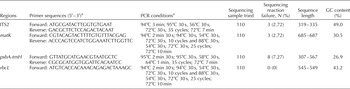
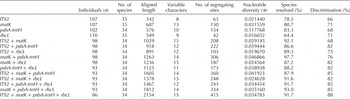
When the universal primers were evaluated separately, all the four loci showed very high success rates (93–100%) for PCR amplification and sequencing (Table 1). All individual loci had length variation, with ranges of 319–335 bp for ITS2, 685–687 bp for matK, 307–567 bp for psbA-trnH and 545–549 bp for rbcL. The GC content ranged from 27 to 49% (Table 1). Efforts to align all barcode sequences using ClustalW were successful across all species. However, the ClustalW-aligned sequences showed considerable size variation among the four targeted loci. The aligned length was 342 bp for ITS2, 687 bp for matK, 567 bp for psbA-trnH and 549 bp for rbcL (Table 2). A total of 426 sequences for 110 individuals were available from the 34 Vicia species. Sequence analysis of the multiple alignment revealed that nucleotide diversity (π) was similar among the four loci, with psbA-trnH exhibiting the highest π value (0.11). Sequence characteristics of the four barcoding regions are summarized in Table 2.
Primer sequences, PCR conditions and sequencing successes for the samples used in this study

Genetic diversity of marker combinations among the four markers used in this study

Genetic distance and barcoding gap assessment
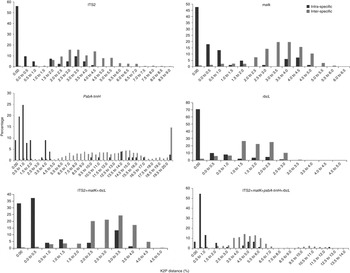
The relative distribution of K2P distances based on single barcodes and combinations ITS2+matK+rbcL and ITS2+matK+psbA-trnH+rbcL demonstrated significant overlap and no barcoding gap (Fig. 1). Among the single barcodes, psbA-trnH had the highest variation in inter-specific divergence, followed by ITS2, when compared with the range of intra-specific distances (Fig. 1). Similarly, among the barcode combinations, ITS2+matK+psbA-trnH+rbcL showed the highest variation in inter-specific divergence compared with the range of intra-specific distances (Fig. 1).
Relative distribution of K2P distances across all the sequence pairs of Vicia datasets for different markers.

Utility of barcodes for resolving species
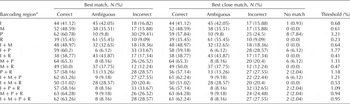
The utility of loci and their sequences for barcoding alone and in multigene combinations is presented in Table 2. The results indicated that psbA-trnH resolved a much higher percentage of species (83%) than did other loci. However, multigene combinations marginally resolved a greater percentage of taxa and provided greater support compared with psbA-trnH alone (Table 2); matK+psbA-trnH provided considerably higher resolution (98%). When comparing the results of the ‘best match’ and ‘best close match’ analyses, the former always showed higher or equal individual identification rates compared with the latter (Table 3). In the ‘best match’ analysis, each query found the closest barcode match. If both sequences were from the same species, the identification was considered a success, whereas mismatched names were counted as failures. Several equally good best matches from different species were considered ambiguous. The ‘best close match’ analysis determined that all queries without barcode matches below the threshold value were unidentified, and their identity was compared with the species identity of their closest barcode. If the names were identical, the query was considered an identification success. The identification was considered a failure if the names were mismatched, and it was considered ambiguous when several equally good best matches were found that belonged to a minimum of two species. Identification efficiency at the individual level was higher than at the species level for each barcode and all combinations (Fig. 1; Table 3).
Number (rates) of sample identification based on the analysis of the ‘best match’ and ‘best close match’ functions using TAXONDNA software for each DNA barcoding marker and combinations from 110 individuals

a For the abbreviations, see Table 2.
Discrimination efficiency in Vicia
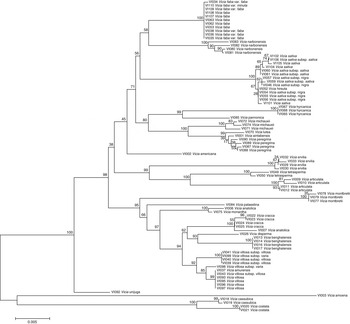
The NJ tree was used to assess identification efficiency within the genus Vicia. Phylogenetic trees based on unrooted NJ analysis and K2P (Kimura, Reference Kimura1980) distances of the nucleotide sequences of the four loci were topologically similar (Fig. 2). However, trees of each locus and multigene combinations generated by NJ tree analyses differed in their branch length values (Supplementary Figs S1–S14, available online). Phylogenetic analyses based on the nucleotide sequences of the four loci were generally successful in discriminating the Vicia species (Fig. 2). If individuals within a species or subspecies formed a distinct clade, it was considered a successful identification at the species level. Also, species with a single or fewer than three samples were only considered successful when they formed a distinct clade themselves. The species and subspecies of V. articulata, V. benghalensis, V. cassubica, V. costata, V. cracca, V. ervilia, V. faba, V. hyrcanica, V. michauxii, V. montbretii, V. narbonensis, V. sativa and V. villosa were identified successfully using the four DNA barcodes, singly or in multigene combinations (Supplementary Figs S1–S14, available online). Individual and multigene combinations, through NJ tree analyses, separated most of the species and subspecies in the genus Vicia, although some species could not be discriminated.
Phylogenetic analysis of Vicia species based on the combinations of barcode loci. The NJ tree was developed by applying the K2P method to the nucleotide sequences of the ITS2+matK+psbA-trnH+rbcL region. Numbers next to the branches are the bootstrap test values.

Phylogenetic analysis of the four loci also demonstrated that, for several species, accessions were located in distant clades. For example, an accession of V. villosa subsp. villosa was located in a clade with the accessions of V. sativa (Supplementary Figs S1–S4, available online). Similarly, accessions of V. anatolica, V. amoena, V. articulata, V. benghalensis and V. villosa were placed in the same clade, with no clear differences. The species V. amurensis, V. anatolica and V. hirsuta were not identified by the loci used, neither singly nor in combination (Supplementary Figs S1–S14, available online).
The NJ tree of the 34 species based on the combinations of the four DNA barcoding regions is shown in Fig. 2. All 86 individuals fell into distinct clades, with high bootstrap support values corresponding to the 34 species. The clustering relationships among the species were similar to those found by Liu et al. (Reference Liu, Moller, Gao, Zhang and Li2011), who used smaller sample sizes for each species. Topologies of the phylogenetic trees based on sequence concatenation were similar, but some Vicia species were placed in different clades when analysed individually. Moreover, phylogenetic trees based on concatenated sequences of the four loci improved the topologies of the phylogenetic tree and successfully discriminated all the 34 Vicia species (Fig. 2).
Of the four single barcodes, matK and rbcL showed the highest discriminatory power, with 71% of all the species discriminated, followed by psbA-trnH (68%) and ITS2 (66%). The combination of the four barcodes led to higher discrimination rates (Table 2). Three-marker combinations significantly increased the species discrimination ability when they included psbA-trnH. Any combination of three barcodes that included psbA-trnH showed the best (85%) species discrimination. The four-way combination, ITS2+matK+psbA-trnH+rbcL, had higher species discrimination (88%), but some closely related species could not be discriminated with bootstrap support values. Accessions of V. villosa, V. benghalensis, V. cracca and V. montbretii were placed with closely related species in the same monophyletic clade. Across all locus combinations and the single loci, 17 of the 34 species received >90% branch support on average, with the highest average for V. faba, followed by V. sativa (Supplementary Figs S1–S14, available online), indicating a clear genetic distinction of the species.
Discussion
Taxonomy of the Vicia L. genus has been problematic, as the taxonomic history of the genus is extensive and contentious (Maxted, Reference Maxted1993). The high economic importance of this genus has led to numerous studies on the molecular characterization and investigation of phylogenetic relationships among Vicia species. Various studies have investigated phylogenetic relationships among species based on rDNA (Raina and Ogihara, Reference Raina and Ogihara1995), in situ hybridization with repetitive sequences (Navratilova et al., Reference Navratilova, Neumann and Macas2003), RAPD analysis (Haider et al., Reference Haider, Hassanin, Mahmoud and Madkour2000; Sakowicz and Cieslikowski, Reference Sakowicz and Cieslikowski2006), repetitive DNA sequences as probes (Frediani et al., Reference Frediani, Maggini, Gelati and Cremonini2004), capillary electrophoresis (Piergiovanni and Taranto, Reference Piergiovanni and Taranto2005) and SDS–PAGE on seed storage proteins (MirAli et al., Reference MirAli, El-Khouri and Rizq2007). However, none of these studies could resolve the taxonomic problems of the genus Vicia. Our research study aimed to validate DNA barcodes that could distinguish Vicia species.
DNA barcode evaluation
The universality of the PCR primers and sequencing success are important criteria for DNA barcoding (Chase et al., Reference Chase, Cowan, Hollingsworth, van den Berg, Madrinan, Petersen, Seberg, Jorgsensen, Cameron, Carine, Pedersen, Hedderson, Conrad, Salazar, Richardson, Hollingsworth, Barraclough, Kelly and Wilkinson2007; Kress and Erickson, Reference Kress and Erickson2007). If the loci fail to amplify well, no sequencing data can be generated. Therefore, a valid DNA barcode must be evaluated for PCR amplification success (CBOL Plant Working Group: Hollingsworth et al., Reference Forrest, Spouge, Hajibabaei, Ratnasingham, van der Bank, Chase, Cowan, Erickson, Fazekas, Graham, James, Kim, Kress, Schneider, van AlphenStahl, Barrett, van den Berg, Bogarin, Burgess, Cameron, Carine, Chacón, Clark, Clarkson, Conrad, Devey, Ford, Hedderson, Hollingsworth, Husband, Kelly, Kesanakurti, Kim, Kim, Lahaye, Lee, Long, Madriñn, Maurin, Meusnier, Newmaster, Park, Percy, Petersen, Richardson, Salazar, Savolainen, Seberg, Wilkinson, Yi and Little2009). In previous studies, the ITS2 region was suggested for phylogenetic analysis of plant species (Chen et al., Reference Chen, Yao, Han, Liu, Song, Shi, Zhu, Ma, Gao, Pang, Luo, Li, Li, Jia, Lin and Leon2010; Gao et al., Reference Gao, Yao, Song, Liu, Zhu, Ma, Pang, Xu and Chen2010). Recently, nucleotide sequences of some regions of the chloroplast DNA (matK, rpoC1 rpoB, trnH-PsbA rbcL, atpF-atpH and psbK-psbI) and their combinations were tested for barcoding of plant species (e.g. Starr et al., Reference Starr, Naczi and Chouinard2009). Among these DNA regions, matK and rbcL were accepted as a two-locus DNA barcode by the CBOL (CBOL Plant Working Group: Hollingsworth et al., Reference Forrest, Spouge, Hajibabaei, Ratnasingham, van der Bank, Chase, Cowan, Erickson, Fazekas, Graham, James, Kim, Kress, Schneider, van AlphenStahl, Barrett, van den Berg, Bogarin, Burgess, Cameron, Carine, Chacón, Clark, Clarkson, Conrad, Devey, Ford, Hedderson, Hollingsworth, Husband, Kelly, Kesanakurti, Kim, Kim, Lahaye, Lee, Long, Madriñn, Maurin, Meusnier, Newmaster, Park, Percy, Petersen, Richardson, Salazar, Savolainen, Seberg, Wilkinson, Yi and Little2009). In the present study, three chloroplast (matK, psbA-trnH and rbcL) and one nuclear-specific (ITS2) barcoding marker were tested. All regions were successfully amplified, except for the psbA-trnH, ITS2 and matK regions for a small percentage of individuals (Table 1).
Sequence quality and coverage are important criteria for DNA barcoding. High-quality sequences were routinely obtained for most of the four loci evaluated in this study (Table 1). However, a few ambiguous bases occurred with psbA-trnH sequences, which were previously considered a limitation for a barcode due to the potential for alignment ambiguities (CBOL Plant Working Group: Hollingsworth et al., Reference Forrest, Spouge, Hajibabaei, Ratnasingham, van der Bank, Chase, Cowan, Erickson, Fazekas, Graham, James, Kim, Kress, Schneider, van AlphenStahl, Barrett, van den Berg, Bogarin, Burgess, Cameron, Carine, Chacón, Clark, Clarkson, Conrad, Devey, Ford, Hedderson, Hollingsworth, Husband, Kelly, Kesanakurti, Kim, Kim, Lahaye, Lee, Long, Madriñn, Maurin, Meusnier, Newmaster, Park, Percy, Petersen, Richardson, Salazar, Savolainen, Seberg, Wilkinson, Yi and Little2009). In this study, we discovered that the psbA-trnH region had the highest sequence length variation due to their highest sequence divergence (Table 2). In this study, PCR amplification success using universal primers showed that they are vital for screening DNA barcodes in the Vicia genus.
DNA barcode species resolution
As a single-region barcode, psbA-trnH resolved the greatest number of species (Table 2). Multigene combinations improved species resolution when other barcodes were combined with psbA-trnH (Table 2). Only marginal gains in taxon resolution (83.3% vs. 97.7%) could be achieved when psbA-trnH was included in a two- (matK+psbA-trnH) or three-locus barcode (matK+psbA-trnH + rbcL). Even though we found few ambiguous bases when sequencing the psbA-trnH region, it is unlikely that psbA-trnH would significantly increase species resolution. In other words, it would most probably provide the same level of species resolution as observed in matK, but it would require more sequencing effort (Chase et al., Reference Chase, Salamin, Wilkinson, Dunwell, Kesanakurthi, Haidar and Savolainen2005; Kress and Erickson, Reference Kress and Erickson2007).
Among the four barcodes, psbA-trnH provided the highest species resolution. Due to the high level of sequence divergence and species discrimination, psbA-trnH has been considered the best candidate plant barcode in many studies (Hollingsworth et al., Reference Hollingsworth, Graham and Little2011). Similarly, in the present study, the psbA-trnH region had the highest sequence length variation and genetic divergence. Therefore, as a single barcode, psbA-trnH is the best candidate to distinguish Vicia species.
Barcoding discriminates Vicia species
We barcoded Vicia species that were difficult for taxonomists to differentiate using morphological characters. One of the most difficult tasks in reviving genebanks is the proper maintenance of genetic variation in the form of accessions. There are two risks during revival of accessions: loss of diversity, which requires critical attention to minimum population size, and loss of identity due to migration among accessions (Vencovsky and Crossa, Reference Vencovsky and Crossa1999). We found that the misidentified genebank specimens were those that only had vegetative characters, underscoring the difficulty of identifying species. Given the important economic value of Vicia, it would be very useful to have a reliable identification tool that can differentiate Vicia species by sampling only the leaves for DNA barcoding, which are easily accessible.
The success of molecular identification using DNA barcoding lies in the cohesiveness and distinctness of the clusters in the analysis (Steinke et al., Reference Steinke, Zemlak, Boutillier and Hebert2009). In the present study, conspecific samples formed monophyletic clusters, supported by a high bootstrap value, which provided reliability of barcoding sequences to identify Vicia species. Species discrimination with single DNA barcoding regions was similar, as the topologies of trees were similar (Supplementary Figs S1–S4, available online). DNA barcoding regions generally created separated clusters in the Vicia genus. However, several species could not be discriminated and are incorrectly grouped in the NJ tree of Fig. 2, suggesting that there might be misidentification of these accessions. Sample sizes of five to ten specimens per species have been suggested in the DNA barcoding database (www.barcodinglife.org), but optimal representation of intra-specific variation remains unclear (Zhang et al., Reference Zhang, He, Crozier, Muster and Zhu2010). It has been reported that the nuclear ITS2 region requires cloning before sequencing because of the allelic polymorphisms, pseudogenes and paralogous copies of the ITS2 region in a plant species (Bailey et al., Reference Bailey, Carr, Harris and Hughes2003; King and Roalson, Reference King and Roalson2008). In contrast, there are no allelic polymorphisms or insertions/deletions in the chloroplast region within the plastid genome. Therefore, we were able to efficiently amplify and sequence-characterize the chloroplast region without cloning.
Sequence data for ITS2, matK, psbA-trnH and rbcL were used to discriminate the Vicia species. The ITS region was proposed by others as a suitable barcode (Kress et al., Reference Kress, Wurdack, Zimmer, Weigt and Janzen2005). Genetic relationships among 49 Vicia species have recently been analysed using polymorphisms within the region of nrDNA, which includes the internally transcribed spacers ITS1 and ITS2 (Shiran et al., Reference Shiran, Kiani, Sehgal, Hafizi, ul-Hassan, Chaudhary and Raina2014). When only ITS2 was used, it discriminated only 66% of the species, which might be explained by allelic polymorphisms, pseudogenes and paralogous copies of the ITS2 region (Bailey et al., Reference Bailey, Carr, Harris and Hughes2003; King and Roalson, Reference King and Roalson2008).
Gao and Chen (Reference Gao and Chen2009) tested the potential of four coding chloroplast regions (rpoB, rpoC1, rbcL and matK) and two non-coding nuclear regions (ITS, ITS2) as barcodes for medicinal plants. Similarly, in the present study, species discrimination with barcode combinations (88%) was significantly higher than that with a single barcode (71%). When we searched the NCBI database for barcoding sequences generated in this study for ITS2, matK, psbA-trnH and rbcL, we retrieved accessions containing the highest hits (Supplementary Table S2, available online). We failed to obtain identical sequences for some species (e.g. V. faba var. faba, V. faba var. minuta and V. costata) as the sequences in the database had not been annotated or the sequences of the specific species were absent from the database.
In conclusion, a total of 110 individuals of 34 species in the Vicia genus were used to evaluate the discriminatory power of barcoding with four DNA barcodes. Based on the results from our study, psbA-trnH and matK are recommended as single DNA barcodes for Vicia. The combination of ITS2+matK+psbA-trnH+rbcL provided the most accurate (100% species ID) and efficient multi-locus DNA barcoding tool to identify Vicia species. Single-locus barcoding did not differentiate the 34 Vicia species, which was also the conclusion from multiple studies focusing on species other than the Vicia. Although the combination of psbA-trnH and any two of the other tested markers increased the percentage of species discrimination, further confirmation is required after a more complete sampling of the genus. The K2P-corrected pairwise distance analysis revealed considerable sequence variation that might easily differentiate all Vicia species. Giving consideration to universal amplification and divergence as needed, psbA-trnH and matK could serve as potential markers to discriminate Vicia species. It is unlikely that more than two samples, but a minimum of two, would be needed for DNA barcoding of any specific group of plant species.
Supplementary material
To view supplementary material for this article, please visit http://dx.doi.org/10.1017/S1479262115000623
Acknowledgements
This study was carried out with the support of the ‘Research Program for Agricultural Science & Technology Development (Project No. PJ008623)’ and was supported by the 2014 Postdoctoral Fellowship Program of National Academy of Agricultural Science, Rural Development Administration, Korea.