


Introduction
Definitions of treatment resistance vary widely (Thase and Rush, Reference Thase and Rush1997; Souery et al., Reference Souery, Amsterdam, de Montigny, Lecrubier, Montgomery, Lipp, Racagni, Zohar and Mendlewicz1999; Fava, Reference Fava2005) but about one-third of patients do not respond to antidepressants. One of the earliest definitions of resistance was “an absence of clinical response to treatment with a tricyclic antidepressant at a minimum dose of 150 mg/day of imipramine (or equivalent drug) for 4 to 6 weeks” (World Psychiatric Association, 1974). Recent guidelines by the National Institute for Clinical Excellence (NICE) are more stringent, with treatment resistant depression (TRD) defined as “that which fails to respond to two or more antidepressants given sequentially at an adequate dose for an adequate time” (National Institute for Clinical Excellence, 2004).
NICE guidelines suggest that “the combination of antidepressant medication with [face-to-face] cognitive behavioural therapy (CBT) should be considered” for patients with TRD, whereas guided self-help and computerized CBT are recommended for mild depression (National Institute for Clinical Excellence, 2004). However, a recent systematic review (Stimpson, Agrawal and Lewis, Reference Stimpson, Agrawal and Lewis2002) did not identify any randomized controlled trials (RCTs) of a psychological treatment for patients with TRD, which contrasts with current practice, whereby CBT is usually reserved for those who have not responded to pharmacotherapy.
There is evidence to suggest that CBT may be beneficial in this group. CBT has been shown to be effective in patients who have experienced only a partial remission of symptoms (residual depression) (Paykel et al., Reference Paykel, Scott, Teasdale, Johnson, Garland, Moore, Jenaway, Cornwall, Hayhurst, Abbott and Pope1999) and, amongst patients with chronic depression (at least 2 years duration), the combination of nefazodone and psychotherapy was more effective than either component alone (Keller et al., Reference Keller, McCullough, Klein, Arnow, Dunner, Gelenberg, Markowitz, Nemeroff, Russell, Thase, Trivedi and Zajecka2000). Whilst most research to date has examined the effectiveness of CBT for previously untreated depressive episodes, there is an increasing literature on the use of combination therapy for depression (Pampallona, Bollini, Tibaldi, Kupelnick and Munizza, Reference Pampallona, Bollini, Tibaldi, Kupelnick and Munizza2004), although the evidence base for CBT in treatment resistant depression remains sparse.
We therefore conducted a pilot study for a pragmatic RCT of the clinical effectiveness of CBT as an adjunct to pharmacotherapy in primary care based patients with TRD. The objectives of the pilot were: (i) to investigate the feasibility of recruitment; (ii) to investigate the quality of the CBT; and (iii) to pilot the method of economic data collection that would be part of a full-scale RCT.
Method
Setting
Three general practices in Bristol (total list size: 29,854; range: 7,597 to 13,278) that represented both urban and deprived areas were invited to participate. Ethical approval was given by the Central and South Bristol Research Ethics Committee (E5804).
Participants
Eligible patients were aged 18–65 years and were currently taking antidepressant medication and had received this medication for at least 6 weeks at recommended (British National Formulary) doses. Patients had to score at least 15 on the Beck Depression Inventory II (Beck, Ward, Mendelson, Mock and Erbaugh, Reference Beck, Ward, Mendelson, Mock and Erbaugh1961; Beck, Steer and Brown, Reference Beck, Steer and Brown1996), have complied with their antidepressant medication (Morisky, Green and Levine, Reference Morisky, Green and Levine1986), and met ICD-10 criteria (World Health Organization, 1992) for depression. Excluded were patients with bipolar disorder, psychosis, personality disorder or major alcohol or substance abuse problems; those who had been continually depressed for more than 5 years; those unable to complete the study questionnaires; those who had previously or were currently receiving CBT therapy; and those currently receiving other psychotherapy or secondary care for their depression.
Recruitment of trial participants
Stage 1
GP computerized records were searched by practice staff to identify those individuals receiving antidepressants based on the above criteria. Potential participants were mailed an invitation letter (and information leaflet) by the practice, and their consent sought for contact by the research team. Anonymized data (age and gender) were collected on non-respondents.
Following the initial practice record search, additional record searches were conducted to enhance recruitment (in total five further searches were conducted). GPs also had the option of recruiting patients during the consultation, although none did.
Stage 2
Patients who consented to contact were mailed a questionnaire that collected information on their socio-demographic characteristics, history of depression, current symptoms (BDI-II) (Beck et al., Reference Beck, Steer and Brown1996), quality of life, compliance with medication (Morisky et al., Reference Morisky, Green and Levine1986), and current medication.
Compliance was based on the 4-item self-report Morisky scale (Morisky et al., Reference Morisky, Green and Levine1986).When validated against electronic monitoring bottles, a score of zero (range: 0–4) indicates at least 80% compliance (George, Peveler, Heiliger and Thompson, Reference George, Peveler, Heiliger and Thompson2000). If the patient responded positively to the first question (“Do you ever forget to take your antidepressant medication?”) but gave negative responses to the other three questions, providing they complied with their medication based on a GP prescription record check, they were regarded as eligible to participate. The latter modification, prior to the start of recruitment, ensured that patients who, on occasion, forgot to take one or two tablets were not excluded.
Stage 3
Patients with a BDI score ≥15 and who had complied with their medication were invited to an appointment with a researcher. At this appointment, patients completed the computerized version of the revised clinical interview schedule (CIS-R) (Lewis, Pelosi, Araya and Dunn, Reference Lewis, Pelosi, Araya and Dunn1992; Lewis, Reference Lewis1994). Data on life events (Singleton, Meltzer, Gatward, Coid and Deasy, Reference Singleton, Meltzer, Gatward, Coid and Deasy1998) and social support (Brugha et al., Reference Brugha, Sturt, MacCarthy, Potter, Wykes and Bebbington1987; Brugha, Wing, Brewin, MacCarthy and Lesage, Reference Brugha, Wing, Brewin, MacCarthy and Lesage1993) were also gathered by computer interview. Those who met ICD-10 criteria for depression based on the CIS-R were asked to give written informed consent to be randomized. Prior to randomization, patient preference for treatment allocation was elicited as in previous trials (Klaber-Moffett et al., Reference Klaber-Moffett, Torgerson, Bell-Syer, Jackson, Llewlyn-Phillips, Farrin and Barber1999).
Randomization
Eligible patients were randomized to either CBT or usual care by means of a computer generated code implemented by an individual independent of the recruitment process. Minimization, with a probability weighting of 0.8, to reduce predictability (Brown, Thorpe, Hawkins and Brown, Reference Brown, Thorpe, Hawkins and Brown2005), was used to ensure balance in gender and BDI score (<30 vs. ≥30) between trial groups. Patients were informed of their treatment allocation by telephone within 48 hours.
Interventions
Both groups continued to take their antidepressant medication under the direction of their GP.
CBT
CBT was delivered by two therapists using the model described by Beck (Beck, Reference Beck1996). Patients could receive between 12 and 20 sessions. One therapist (MM) had a doctorate in clinical psychology with 14-months post-qualification experience in adult mental health and the other therapist (VB) was a Specialist Registrar in Psychiatry with 2 years experience of delivering CBT. Both therapists had weekly supervision sessions with a consultant psychiatrist (GL) experienced in the use of CBT.
Usual care
There were no restrictions on the treatment that patients in the usual care group could receive.
Patients gave informed consent for audio recording of the 3rd and 10th sessions. The quality of the CBT delivered was independently evaluated (based on 5 recordings per therapist: a random sample of recordings for therapist 1 and all recordings for therapist 2) using a validated CBT rating scale (Blackburn et al., Reference Blackburn, James, Milne, Baker, Standart, Garland and Reichelt2001). For the first two recordings, two independent raters rated the quality of the CBT and agreed upon a consensus rating. The remaining recordings were evaluated by a single rater.
Outcomes
Follow-up data were collected by postal questionnaire. The primary outcome was the BDI score at 4-months post-randomization. Secondary outcomes included quality of life and use of antidepressant medication. Data were also gathered on health service utilization and patient out-of-pocket expenses. Health service utilization data were also gathered from medical records in order to evaluate the differences in resource use between these two methods. A self-complete questionnaire would be our preferred method of data collection for a large trial as record searches may have substantial resource implications.
Statistical analysis
Differences in BDI scores from baseline to 4 months between those randomized to CBT and those receiving usual care were analysed using a multiple linear regression model adjusting for baseline BDI score and gender. This model was further adjusted to account for imbalances in baseline characteristics between treatment groups. Data were analysed on an intention-to-treat (ITT) basis, thereby retaining the patients in the groups as randomized. Missing data at follow-up were handled using last observation carried forward (LOCF). Data on secondary outcomes were analysed on the same basis.
The economic analysis was carried out in two stages. Firstly, resource use data were analysed on a per patient basis from the perspective of the health care provider and the patients separately. Information on health care contacts was valued using recognized sources: primary care and community services (http://www.pssru.ac.uk/uc/uc2004.htm); secondary care: (http://www.dh.gov.uk/assetRoot/04/09/15/32/04091532.xls); and prescribed medication (http://www.bnf.org/bnf). All unit costs were adjusted to 2005 prices using the Retail Prices Index (http://www.statistics.gov.uk/STATBASE). CBT sessions were costed on the basis of a therapist seeing five patients a day.
Patient costs were either reported directly in the questionnaire or costed appropriately. The AA schedule (http://www.theaa.com) was used for the cost of travel by car, the cost of private therapy was based on similar treatment at a local clinic, and we used prevailing prices at a local pharmacy for over-the-counter medication.
The second stage of the analysis involved scrutiny of the data collected from GP records. This provided information on all visits to the GP surgery, prescriptions issued, and use of secondary care. We made a patient-by-patient comparison of resource use to form a “best” estimate for each patient by enhancing the questionnaire data with information from notes. Valuation was completed using the costs as above.
Results
Recruitment
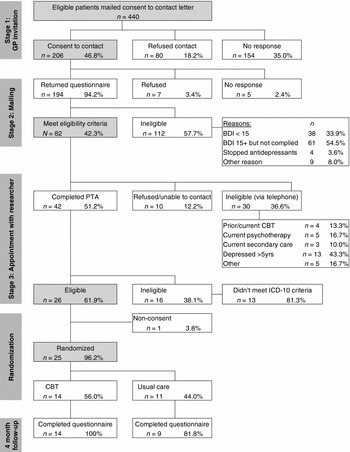
An invitation to participate was mailed to 440 potentially eligible patients (see Figure 1). The majority of these (n = 348 or 79%) were identified in the first record search for each of the three practices. Additional searches for potentially eligible patients yielded a much smaller return. Of those mailed, 65% responded, with most consenting to contact. Younger individuals and men were less likely to respond.
Flow of participants into and through the trial

Of those completing the screening questionnaire, 82 (42%) had a BDI ≥ 15 and had complied with their medication. Of the 30 subsequently identified as ineligible, almost half had been depressed for >5 years (Figure 1: Stage 3). Ten patients could not be contacted or declined further participation. Of the 42 patients who met with a researcher, 26 (62%) met ICD-10 criteria for depression, and all but one agreed to being randomized. Amongst the 25 patients who agreed to take part in the trial, 14 (56%) expressed a preference for CBT, one individual expressed a preference for usual care, and 10 expressed no treatment preference. Fourteen patients were randomized to receive CBT and 11 to usual care.
Baseline characteristics
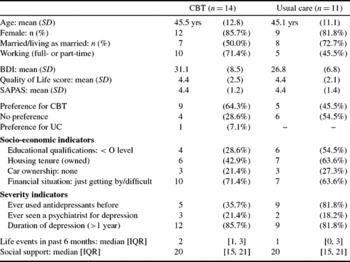
The two groups were similar in age and gender but, not unexpectedly for a small sample, imbalances were evident (Table 1). For example, those in the CBT group had higher BDI scores (mean: 31.1 vs. 26.8). At baseline, most patients were taking ≥ 20 mg fluoxetine, citalopram or paroxetine (CBT: n = 10 (71.4%); UC: n = 10 (90.9%)).
Comparison of baseline characteristics of trial participants

Outcome at 4 months
Twenty-three patients (92%) were followed up at 4 months post-randomization: 9 out of the 11 patients randomized to usual care and all those randomized to CBT (Figure 1). After adjustment for baseline BDI score and gender, the mean BDI score for those who received CBT was 9 points lower than those in the usual care group (Table 2). Further adjustment for baseline characteristics slightly attenuated the effect. The wide confidence intervals reflect the small number of patients. Adjustments for missing data gave similar results (Table 2). Eight out of 14 patients in the CBT arm had at least a 50% reduction in BDI score (4 months compared to baseline), but none in the usual care group experienced such a reduction. There was no difference in quality of life at 4 months post-randomization for those in the CBT arm compared to usual care (data not shown).
Primary outcome: BDI scores at 4 months post-randomization

Note: Regression coefficient represents the difference in BDI scores at 4 months post-randomization for CBT compared to usual care (reference).
Adjustment 1 – baseline BDI score and gender.
Adjustment 2 – baseline BDI score, gender, age, married (y/n), past history of psychiatrist care, duration of depression (>1 year), number of life events in past 6 months, social support score, socio-economic markers (educated to O-level, living in rented accommodation, car available for use, in paid employment, financial difficulty).
CBT attendance and quality of CBT delivered
By the 4-month follow-up, those randomized to CBT had received a median of 9.5 sessions [IQR: 2, 12]. Five patients (35.7%) had attended less than 5 sessions; 2 patients (14.3%) had attended between 5 and 9 sessions; and 7 patients (50.0%) had attended ≥10 sessions.
Whilst one therapist delivered the majority of the therapy (10 out of 14 patients), both scored above the threshold for “competence” based on the independent rater's assessment of the recorded CBT sessions.
Antidepressant use at the 4-month follow-up
Nineteen patients (82.6%) were still taking antidepressants at follow-up: CBT: n = 11; UC: n = 8. Half of those who stopped their medication did so because they “felt better”. Similar to baseline, most patients were taking SSRIs: CBT: n = 8; UC: n = 6 and complying with their antidepressant medication: CBT: 91%; UC: 88%.
Economic data
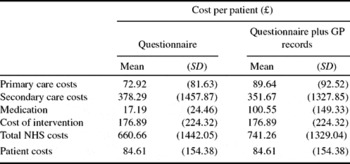
We piloted the method of data collection in this small study rather than compare costs. Questionnaire data alone gave a mean cost per patient across both groups of £661 to the NHS and £85 to the patient (Table 3). Over half were secondary care costs (57%), with primary care accounting for 11%, medication 3%, and the intervention 27%.
Cost per patient based on self-report questionnaire data alone or when supplemented with information from GP records

Over 80% of primary care contacts were GP or practice nurse consultations. These were under-reported in the questionnaire by nearly 30% (1.46 versus 1.86 consultations per patient). More complete data on prescribed medication were available in the GP records, from which the mean cost of prescribed medication per patient was £101 (SD £149).
Extra information on some secondary care was given in the GP notes. Using this extra information slightly reduced the mean cost per patient (Table 3).
Discussion
Summary of main findings
This pilot RCT demonstrates that a full-scale RCT to examine the effectiveness of CBT as an adjunct to pharmacotherapy in primary care based patients with TRD would be feasible. Patients responded positively to an invitation to participate in the study from their GP. Randomizing between a psychological intervention and usual care was not problematic. Whilst half expressed a preference for CBT, only one patient did not consent to be randomized. A full-scale RCT would need to be multi-centre in order to recruit sufficient patients.
Feasibility of recruitment
Only 6% of patients identified from practice records were randomized. There was substantial attrition during recruitment. At first glance this may appear overwhelming, but it is important to remember that a rigorous screening process was used to identify those with treatment resistant depression, hence those with only minimal depressive symptoms or who had not taken their prescribed antidepressants were excluded. This accounted for over 100 patients. Amongst those who met with the researcher, 62% were eligible to participate in the trial and all but one agreed, which was encouraging.
In the initial stage, 35% of patients failed to respond to the mailed invitation. This may reflect concerns about taking part in research, recognition that CBT may raise difficult issues that have to be challenged, or low levels of motivation.
The response to the mailed screening questionnaire was high (94%), and this may be attributed to the fact that those who consented to contact were expecting to receive a questionnaire, thus enhancing the response rate. However, as previously discussed, amongst respondents, a large number of individuals who had not complied with their medication were excluded at this stage. We also excluded a number of patients who had been depressed for more than 5 years on the basis that this group would be extremely difficult to treat and may be more likely to include individuals with personality disorder (an exclusion criterion). However, given the not insignificant number excluded on this basis, we would consider relaxing this in a full-scale RCT. Stratifying any randomization procedure on the duration of depression would be difficult given the problem in accurately establishing this timeframe.
Recruitment into RCTs, particularly in the field of mental health, is notoriously difficult. In the face of this, the finding that such a RCT appears feasible is greatly encouraging. The GPs played a vital role as “gate-keeper” (Ewing et al., Reference Ewing, Rogers, Barclay, McCabe, Martin and Todd2004) given current concerns around data protection, and thus facilitated the initial approach to patients. However, by minimizing subsequent workload, we streamlined a recruitment process that was acceptable to both patients and GPs. Whilst only a small number of patients were recruited into the pilot RCT, this did not reflect a lack of interest on behalf of the GPs. GPs were positive about the aims of the study and the primary mode of recruitment (through the record search) minimized their workload. In a full-scale RCT, we would also ask GPs to recruit during the consultation, as this mode of recruitment has been successful in other trials where CBT has formed part of the intervention.
Additional record searches were conducted to boost recruitment. However, the yield from these searches was much lower, reflecting the fact that these searches captured individuals with depression whose symptoms had not responded to at least 6 weeks of antidepressant medication in the period following the previous search. Whilst the yield from the additional searches was low, it was conducted with minimal effort as the computerized record searches were already established.
Quality of the CBT
When planning a full-scale pragmatic trial, it is important that the therapists who deliver the intervention have experience comparable to those working within the NHS in order to ensure that, if a positive result is obtained, the results will be widely generalizable. Many trials of CBT have used highly trained therapists and thus treatment effect sizes may not equate to the effects obtained in standard clinical settings. However, concerns are sometimes expressed about the quality of the CBT delivered by non-specialists. In this pilot study, we found that, with expert supervision, relatively inexperienced therapists were “competent”, based on an independent evaluation.
Economic data collection
Given the small sample, we did not compare cost between the two groups, but piloted two methods of data collection in order to provide some guidance as to the optimal method for a full-scale RCT. Previous studies have compared self-reports of GP visits (Patel et al., Reference Patel, Rendu, Moran, Leese, Mann and Knapp2005) or hospital admissions (Clark, Ricketts and McHugo, Reference Clark, Ricketts and McHugo1996) with data from medical records but, whilst there has been considerable work around calculating unit costs, there is comparatively little empirical data to inform the method of economic data collection.
Gathering data as part of a self-complete questionnaire was feasible, but searching the GP records provided some benefit. Although there is no definitive evidence that GP records provide better quality data than self-report, it is reasonable to assume that, in estimating the number of primary care consultations, notes will be more accurate. Patients under-estimated such consultations. More reliable information about prescribed medication could be obtained from patient notes.
With all economic evaluations it is good practice to identify all areas of resource use that might be affected by the intervention being evaluated and include each according to relevance to the study and analysis. We collected data on all health care contacts and medication, irrespective of reason for encounter, for two reasons. First, it is not always easy to identify whether a consultation or a prescription is attributable to the patient's mental health, albeit indirectly. Second, as this was a pilot, we collected a broad spread of data so that results could be examined and conclusions for a future trial drawn. As primary care consultations are mainly with a non-specialist and it is difficult to identify a precise reason for the encounter, we would recommend that all such consultations should be included in any future study. In contrast, secondary care outpatient consultations and inpatient stays are usually with a specialist and it would be easier to separate out resource use directly related to mental health problems and thus avoid disproportionate influences of, for example, orthopaedic interventions, which would be unlikely to be related to depression. It is more difficult to separate out depression-related prescriptions. Clearly, prescribed psychotropics would be relevant, but so too, for example, might gastro-intestinal drugs. Here we suggest collecting data on all prescribed medication and using sensitivity analyses to investigate the effect of including only psychotropics.
Other methodological issues
Compliance is difficult to measure but in order to operationalize our definition of treatment resistance, we relied upon a self-reported measure of compliance (Morisky et al., Reference Morisky, Green and Levine1986) that has previously been validated against electronic monitoring bottles (George et al., Reference George, Peveler, Heiliger and Thompson2000). For this trial, we defined treatment resistance as a failure to respond to at least 6 weeks of antidepressant medication. This was considered to be a low threshold directly relevant to primary care. As such, the trial results would be more widely generalizable. Furthermore, we demonstrated that, with the collaboration of practice staff, it is possible to identify this patient group from records, and to elicit their active participation in a RCT.
Our definition of treatment resistance is broader than the recent NICE definition that requires non-response to at least two antidepressants given sequentially (published after the start of this work). The NICE definition of TRD does not exclude the possibility that an individual could have failed to respond to two different SSRIs, which have the same pharmacological action. NICE guidelines suggest increasing the dose or switching to a different antidepressant if there is no response after 4–6 weeks (National Institute for Clinical Excellence, 2004) but there is little RCT evidence to support either strategy (Stimpson et al., Reference Stimpson, Agrawal and Lewis2002). Therefore, we propose retaining our definition of resistance as non-response to antidepressant medication given at an adequate dose for at least 6 weeks for a full-scale RCT, given the uncertainty about what GPs should recommend to patients who have not got better after 6 weeks of antidepressant medication. This early intervention with CBT would be in line with the recent announcement to widen access to talking therapies (Department of Health, 2006).
CBT is becoming an increasingly popular treatment option for depression but there are concerns about the capacity of the health service to deal with the potential demand, given the shortage of trained therapists. However, this was not our experience. Taking into account the various stages of attrition, only a relative small percentage of patients with TRD may be suitable for, and take up the option of, face-to-face CBT. Furthermore, other modes of delivery of CBT such as guided self-help or computerized CBT may be cheaper, although these are currently only recommended for mild depression (National Institute for Clinical Excellence, 2004). Nonetheless, we acknowledge that some of those who did not respond or refused to participate may have been deterred by the prospect of involvement in a research project and would have sought treatment if it formed part of routine care.
Implications for future research
This pilot study shows that recruiting subjects with treatment resistant depression for a RCT is challenging. The initial screening process has to be rigorous and excludes a large group who are not adherent to medication or who have minimal depressive symptoms. Subsequent recruitment rates are reasonable. It therefore appears feasible to conduct a large multi-centre RCT to investigate the effectiveness of CBT as an adjunct to pharmacotherapy in primary care based patients with treatment-resistant depression. The argument for such an RCT is all the more strong because, in practice in the United Kingdom, CBT is largely reserved for this difficult-to-treat group.
Acknowledgements
We would like to thank the GPs and practice staff at the three general practices (Gaywood House Surgery, Horfield Health Centre, and Lodgeside Surgery) for their assistance with the conduct of this study. We would also like to thank the patients who took part. Funding was provided by Avon and Wiltshire Mental Health Partnership NHS Trust (AWP257). Trial Registration Number: ISRCTN81845520. Declaration of interest: None.




Comments
No Comments have been published for this article.