Although the notion that adolescence is plagued by “storm and stress” has been largely refuted (Arnett, Reference Arnett1999), substantial biological, social, and psychological changes are inherent in this transitional life stage (Steinberg & Morris, Reference Steinberg and Morris2001). Compared to children, adolescents report elevated levels of negative life events and internalizing problems (Costello, Mustillo, Erkanli, Keeler, & Angold, Reference Costello, Mustillo, Erkanli, Keeler and Angold2003; Hankin & Abramson, Reference Hankin and Abramson2001; Rutter, Reference Rutter2007; Wagner & Compas, Reference Wagner and Compas1990). Further, there is evidence that negative life events and internalizing problems are mutually reinforcing over time (Cole, Nolen-Hoeksema, Girgus, & Paul, Reference Cole, Nolen-Hoeksema, Girgus and Paul2006; Ge, Lorenz, Conger, Elder, & Simons, Reference Ge, Lorenz, Conger, Elder and Simons1994; Wichers et al., Reference Wichers, Maes, Jacobs, Derom, Thiery and Kendler2012) and that the strength of this association varies across individuals (Cole et al., Reference Cole, Nolen-Hoeksema, Girgus and Paul2006; Ge et al., Reference Ge, Lorenz, Conger, Elder and Simons1994; Wagner & Compas, Reference Wagner and Compas1990). However, few studies have focused on understanding the origins of these individual differences. Such an understanding could provide important information for identifying who is at risk for internalizing problems in the presence, and absence, of negative life events.
Extensive developmental changes and milestones occur during adolescence. In addition to the substantial physical and physiological changes, adolescents experience rapid identity development, advancements in cognitive development and reasoning abilities, and the emergence of complex romantic and social relationships (Steinberg & Morris, Reference Steinberg and Morris2001). Amid these transformations, substantial increases in negative life events are also observed from childhood to adolescence (Low et al., Reference Low, Dugas, O'Loughlin, Rodriguez, Contreras and Chaiton2012). Concomitant increases in the rates of certain internalizing problems have been observed as well. Specifically, clinical depression and depression symptoms demonstrate a dramatic increase from age 15–18 (Hankin, Reference Hankin2009; Hankin & Abramson, Reference Hankin and Abramson1999); in contrast, anxiety symptoms have shown slight increases in some reports (Van Oort, Greaves-Lord, Verhulst, Ormel, & Huizink, Reference Van Oort, Greaves-Lord, Verhulst, Ormel and Huizink2009) and slight decreases in others (Hale, Raaijmakers, Muris, van Hoof, & Meeus, Reference Hale, Raaijmakers, Muris, van Hoof and Meeus2008). Further, many of these adolescent experiences are marked by sex differences, with girls experiencing more symptoms of depression and anxiety (Hale et al., Reference Hale, Raaijmakers, Muris, van Hoof and Meeus2008; Hankin, Reference Hankin2009; Hankin & Abramson, Reference Hankin and Abramson1999, Reference Hankin and Abramson2001; Hankin et al., Reference Hankin, Abramson, Moffitt, Silva, McGee and Angell1998) as well as more negative life events (Compas, Grant, & Ey, Reference Compas, Grant, Ey, Reynolds and Johnston1994).
Researchers have studied temporal sequencing of negative life events and internalizing problems. While the majority of studies suggest that adverse life events predict internalizing symptoms and disorders (Cicchetti & Rogosch, Reference Cicchetti and Rogosch2001; Deardorff, Gonzales, & Sandler, Reference Deardorff, Gonzales and Sandler2003; Espejo, Hammen, & Brennan, Reference Espejo, Hammen and Brennan2012; Kendler, Hettema, Butera, Gardner, & Prescott, Reference Kendler, Hettema, Butera, Gardner and Prescott2003; Kendler, Kuhn, & Prescott, Reference Kendler, Kuhn and Prescott2004), others have shown that internalizing problems precede negative life events (Brown, Harris, & Hepworth, Reference Brown, Harris and Hepworth1995; Farmer & McGuffin, Reference Farmer and McGuffin2003). However, theories (Hankin & Abramson, Reference Hankin and Abramson2001) and more recent studies employing cross-lagged and latent growth models (Brown & Rosellini, Reference Brown and Rosellini2011; Wichers et al., Reference Wichers, Maes, Jacobs, Derom, Thiery and Kendler2012) support the presence of bidirectional connections between negative life events and internalizing problems, emphasizing the importance of examining each variable in light of the other, rather than attempting to infer unidirectional effects. Further, there are substantial individual differences in the degree to which negative life events and internalizing problems are associated (Cole et al., Reference Cole, Nolen-Hoeksema, Girgus and Paul2006; Ge et al., Reference Ge, Lorenz, Conger, Elder and Simons1994; Wagner & Compas, Reference Wagner and Compas1990). Nevertheless, very little longitudinal empirical research has focused on the origins of such individual differences during adolescence.
Diathesis–stress models that conceptualize early adversity as a vulnerability suggest that individuals exposed to early life stress (ELS) may be particularly vulnerable to later internalizing problems due to increased sensitivity to stressors (Hammen, Henry, & Daley, Reference Hammen, Henry and Daley2000; Harkness, Bruce, & Lumley, Reference Harkness, Bruce and Lumley2006; Rudolph & Flynn, Reference Rudolph and Flynn2007). Most previous research has focused on the main effects of ELS exposure as a risk factor for the development of later internalizing problems in adolescents (Essex et al., Reference Essex, Kraemer, Armstrong, Boyce, Goldsmith and Klein2006, Reference Essex, Shirtcliff, Burk, Ruttle, Klein and Slattery2011; Halligan, Herbert, Goodyer, & Murray, Reference Halligan, Herbert, Goodyer and Murray2007; Kim, Cicchetti, Rogosch, & Manly, Reference Kim, Cicchetti, Rogosch and Manly2009; Trickett, Negriff, Ji, & Peckins, Reference Trickett, Negriff, Ji and Peckins2011). This body of literature has also shown that the negative effects of ELS may be particularly pervasive if multiple stressors are present (McLaughlin, Conron, Koenen, & Gilman, Reference McLaughlin, Conron, Koenen and Gilman2010) and/or if ELS occurs during critical periods, such as infancy (Essex et al., Reference Essex, Boyce, Hertzman, Lam, Armstrong and Neumann2013). ELS has been shown to sensitize individuals to later life stress; compared with nonexposed individuals, those exposed to ELS demonstrate higher levels of internalizing problems when faced with lower (Hammen et al., Reference Hammen, Henry and Daley2000; Harkness et al., Reference Harkness, Bruce and Lumley2006; Rudolph & Flynn, Reference Rudolph and Flynn2007) or higher levels of recent life stress (Espejo et al., Reference Espejo, Hammen, Connolly, Brennan, Najman and Bor2006; Kendler et al., Reference Kendler, Kuhn and Prescott2004; McLaughlin et al., Reference McLaughlin, Conron, Koenen and Gilman2010; Rudolph & Flynn, Reference Rudolph and Flynn2007). Previous studies examining the sensitizing effects of ELS have not taken into consideration the reciprocity between negative life events and internalizing symptoms.
The sensitizing effects of ELS may operate in part through underlying mechanisms, such as ELS-induced neurobiological changes encoded in the hypothalamic–pituitary–adrenal (HPA) axis (Hammen et al., Reference Hammen, Henry and Daley2000). Although studies examining the effect of altered adrenocortical functioning on later stress sensitivity are limited (for exceptions, see Badanes, Watamura, & Hankin, Reference Badanes, Watamura and Hankin2011; and Rudolph, Troop-Gordon, & Granger, Reference Rudolph, Troop-Gordon and Granger2011), cortisol has been repeatedly linked to greater internalizing problems. While many studies have found higher levels of cortisol to predict greater later internalizing (Essex, Klein, Cho, & Kalin, Reference Essex, Klein, Cho and Kalin2002; Goodyer, Herbert, Tamplin, & Altham, Reference Goodyer, Herbert, Tamplin and Altham2000; Goodyer, Park, & Herbert, Reference Goodyer, Park and Herbert2001; Halligan, Herbert, et al., Reference Halligan, Herbert, Goodyer and Murray2007; Smider et al., Reference Smider, Essex, Kalin, Buss, Klein and Davidson2002), some have found that lower levels of cortisol predict greater later internalizing problems (Granger et al., Reference Granger, Serbin, Schwartzman, Lehoux, Cooperman and Ikeda1998), suggesting that adrenocortical dysregulation at both ends of the spectrum may convey risk. Other studies have not found an association between cortisol and internalizing problems, possibly due to sampling of cortisol at a single time point that may capture temporary fluctuations in HPA functioning rather than more persistent alterations best identified by diurnal cortisol sampling over a prolonged period of time (see Gunnar, Reference Gunnar, Vasey and Dadds2001; Li, Chiou, & Shen, Reference Li, Chiou and Shen2007; Shirtcliff et al., Reference Shirtcliff, Allison, Armstrong, Slattery, Kalin and Essex2012). Although a variety of dysregulated diurnal cortisol measures have been linked to internalizing problems, including morning (Ruttle et al., Reference Ruttle, Shirtcliff, Serbin, Ben-Dat Fisher, Stack and Schwartzman2011), afternoon (Burghy et al., Reference Burghy, Stodola, Ruttle, Molloy, Armstrong and Oler2012; Essex, Klein, et al., Reference Essex, Klein, Cho and Kalin2002) and evening (Van den Bergh & Van Calster, Reference Van den Bergh and Van Calster2009) levels as well as atypical diurnal slopes (Cicchetti, Rogosch, Gunnar, & Toth, Reference Cicchetti, Rogosch, Gunnar and Toth2010), midafternoon levels have been most closely linked to internalizing problems compared to cortisol sampled earlier or later in the day (Li et al., Reference Li, Chiou and Shen2007). This may be because midafternoon cortisol samples reflect genetic and environmental influences (Bartels, de Geus, Kirschbaum, Sluyter, & Boomsma, Reference Bartels, de Geus, Kirschbaum, Sluyter and Boomsma2003; Kupper et al., Reference Kupper, de Geus, van den Berg, Kirschbaum, Boomsma and Willemsen2005; Schreiber et al., Reference Schreiber, Shirtcliff, Van Hulle, Lemery-Chalfant, Klein and Kalin2006; Wust, Federenko, Hellhammer, & Kirschbaum, Reference Wust, Federenko, Hellhammer and Kirschbaum2000), both of which are involved in the development of internalizing problems (Kendler, Gardner, & Lichtenstein, Reference Kendler, Gardner and Lichtenstein2008; O'Connor, McGuire, Reiss, Hetherington, & Plomin, Reference O'Connor, McGuire, Reiss, Hetherington and Plomin1998). Moreover, afternoon cortisol levels have been implicated in ELS–internalizing associations in our prior work (Burghy et al., Reference Burghy, Stodola, Ruttle, Molloy, Armstrong and Oler2012; Essex, Klein, et al., Reference Essex, Klein, Cho and Kalin2002). For example, although ELS and preschool-age afternoon cortisol were correlated, each made unique contributions to subsequent childhood symptoms (Essex, Klein, et al., Reference Essex, Klein, Cho and Kalin2002). These previous findings suggest ELS and cortisol may impact mental health symptoms at least in part through different pathways and prompt questions of whether similar patterns of association may be observed later in development. Further, research has yet to examine simultaneously the effects of ELS and altered adrenocortical functioning on sensitization processes as later evident in adolescence, including the co-occurrence of negative life events and internalizing symptoms.
Present Study
The overall aim of the present study was to investigate developmental origins of individual differences in stress sensitivity, as indexed by the covariation of internalizing symptoms and negative life events. To be specific, we examined how stress exposure and HPA-axis stress physiology earlier in life influenced the later covariation of internalizing symptoms and negative life events in a community sample of adolescents followed since birth. To address the major question, analyses focused on the effects of two earlier factors, which were a composite measure of multiple maternal-report stressors across the infancy period (ages 1, 4, and 12 months) and a measure of average early-adolescent (ages 11, 13, and 15 years) afternoon cortisol levels, on the later covariation between negative life events and internalizing symptoms across the high school years (Grades 9, 11, and 12; ages 15, 17, and 18). We hypothesized that there would be individual differences in the covariation of negative life events and internalizing symptoms according to adolescents' earlier stress exposure and afternoon cortisol levels. Although it has been postulated that cortisol may mediate the effect of ELS on stress sensitization processes (Hammen et al., Reference Hammen, Henry and Daley2000), given that unique effects of both variables on mental health symptoms were observed in our prior research, we took an exploratory approach to identifying the specific nature of the associations of earlier stress exposure and cortisol with the later covariation of negative life events and internalizing symptoms. Furthermore, given the sex differences in the prevalence rates of adolescent internalizing problems and reports of negative life events in previous studies (Compas et al., Reference Compas, Grant, Ey, Reynolds and Johnston1994; Hankin & Abramson, Reference Hankin and Abramson2001; Hankin et al., Reference Hankin, Abramson, Moffitt, Silva, McGee and Angell1998) and sex-specific effects of ELS on neuroendocrine functioning (Ruttle, Shirtcliff, Armstrong, Klein, & Essex, Reference Ruttle, Shirtcliff, Armstrong, Klein and Essex2013) and mental health (Burghy et al., Reference Burghy, Stodola, Ruttle, Molloy, Armstrong and Oler2012; Essex, Klein, et al., Reference Essex, Klein, Cho and Kalin2002), adolescent sex and its interactions with ELS and cortisol were considered in all analyses.
As a precursor to addressing the study's main question, initial analyses considered whether levels of internalizing symptoms changed over time (i.e., showed developmental growth across high school) and whether change was observed in the covariation of internalizing and negative life events across the high school years. Initial analyses also considered ELS and early-adolescent cortisol as predictors of later internalizing symptoms. In addition, given the potential differences in the developmental progression across adolescence of the two components of internalizing symptoms (depression and generalized anxiety), it was of interest to consider the two types of symptoms separately. However, because of the known high correlation between anxiety and depression symptoms (Kovacs & Devlin, Reference Kovacs and Devlin1998) and resulting multicollinearity, this distinction was addressed in secondary, exploratory analyses.
Method
Participants
Participants were drawn from the Wisconsin Study of Families and Work, a longitudinal study originally designed to assess the impact of parental employment leave, family stress, and women's health outcomes during the first postnatal year. A total of 570 women and their husbands/partners were initially recruited during the second trimester of pregnancy through obstetric/gynecology and low-income clinics in the Milwaukee (80%) and Madison (20%), Wisconsin, geographical areas (for additional details, see Hyde, Klein, Essex, & Clark, Reference Hyde, Klein, Essex and Clark1995). Of the original sample, 560 (98.3%) had eligible live births. Families living within geographic proximity to the project offices were asked to participate in the saliva collection protocols across adolescence. Three hundred and forty-six participants provided saliva samples for cortisol assaying from at least one assessment (ages 11, 13, and 15) and, of these individuals, 330 participants provided mental health and life events information during at least one of the high school assessments (ages 15, 17, and 18). There were no significant differences between the 330 participants and the remainder in terms of parental education, marital or ethnic status, or annual family income; however, parents in the participating subsample were slightly older at recruitment: mother M = 29.7 (SD = 4.2) versus 28.9 (SD = 4.5), t (546) = 0.93, p < .05; father M = 31.7 (SD = 5.2) versus 30.7 (SD = 4.8), t (529) = 0.61, p < .05. Most participating parents identified as non-Hispanic White (91%), were married (96%), and were well educated (mothers and fathers: 2% had less than a high school degree). Annual family income at recruitment was approximately $48,000 (range = $10,000–$200,000). Parents gave informed consent at each time point; child assent was obtained beginning at age 11. All procedures were reviewed and approved by the University of Wisconsin Institutional Review Board.
Measures
ELS
As in our prior work (e.g., Ellis, Essex, & Boyce, Reference Ellis, Essex and Boyce2005; Essex, Klein, Slattery, Goldsmith, & Kalin, Reference Essex, Klein, Slattery, Goldsmith and Kalin2010), the maternal-report stress measure was constructed from scores in five domains: (a) depression symptoms (Radloff, Reference Radloff1977); (b) family-expressed anger, including marital conflict (Barnett & Marshall, Reference Barnett and Marshall1989) and general anger expression (Halberstadt, Reference Halberstadt1986; Spielberger, Krasner, Solomon, & Janisse, Reference Spielberger, Krasner, Solomon and Janisse1988); (c) parenting stress (Abidin, Reference Abidin1986; Block, Reference Block1965); (d) role overload (Abidin, Reference Abidin1986; Barnett & Marshall, Reference Barnett and Marshall1989); and (e) financial stress (Essex, Klein, et al., Reference Essex, Klein, Cho and Kalin2002). We chose a composite stress measure during the infancy period (ages 1, 4, and 12 months), as the negative effects of ELS may be particularly detrimental if multiple stressors are present (McLaughlin et al., Reference McLaughlin, Conron, Koenen and Gilman2010) and when stress occurs during a critical period (Essex, Klein, et al., Reference Essex, Klein, Cho and Kalin2002). Each of the stress domains was averaged across the three infancy time periods, and the resulting five domains were combined using principal components analysis.
Early-adolescent longitudinal afternoon cortisol
Children's hormone levels were assessed in the summers following Grade 5 (N = 279; M age = 11.51, SD = 0.32, range = 10.7–12.5), Grade 7 (N = 321; M age = 13.52, SD = 0.32, range = 12.7–14.6), and Grade 9 (N = 315; M age = 15.27, SD = 0.34, range = 14.5–16.3). Within each of the three assessments from early adolescence to midadolescence, participants were asked to collect saliva for three consecutive days, including a participant-set target between 3:00 and 7:00 p.m. (prior to dinner). Samples were frozen immediately after collection and, once all samples within a particular wave of data were collected, research staff retrieved the samples and transported them to the laboratory where they were stored at –80 °C until assaying. Cortisol was assessed in duplicate using well-established, salivary enzyme immunoassay kits (Salimetrics, State College, PA). Raw cortisol scores were log-transformed and extreme values were Winsorized to normalize distributions. Previous analyses revealed that medication usage did not systematically impact salivary cortisol levels in the present sample (Shirtcliff et al., Reference Shirtcliff, Allison, Armstrong, Slattery, Kalin and Essex2012); however, given the likely effect of oral steroids on cortisol levels (Masharani et al., Reference Masharani, Shiboski, Eisner, Katz, Janson and Granger2005), data for one child taking prednisone at one assessment were omitted. Mean intra-assay and interassay coefficients of variation (CVs) were 4.0% and 6.1%, respectively, with a lower limit of sensitivity of 0.02 µg/dl.
Hierarchical linear modeling (HLM; for more information, see Bryk & Raudenbush, Reference Bryk and Raudenbush1992) utilized the multiple cortisol samples collected across early adolescence within an individual to produce an average measure of predicted longitudinal cortisol. Afternoon cortisol was modeled as a function of an intercept and time variables that were centered on time since waking. Given that we were interested in extracting a measure of average level of cortisol over early adolescence to midadolescence, we fit a two-level HLM that included within-individual variations in the intercept and slope (Level 1) and random effects representing between-individual differences (Level 2), not distinguishing between days or assessments. By doing so, we collapsed across multiple days within an assessment and across the three assessments in adolescence, allowing us to extract a single empirical Bayes estimate for each individual representing their average level of afternoon cortisol from age 11 to 15.
Adolescent life events across high school
The amount of recent negative life events was indexed using an inventory modeled on the Adolescent Perceived Events Scale (Compas, Reference Compas1987) and the Life Events Survey (Sarason, Johnson, & Siegel, Reference Sarason, Johnson and Siegel1978). Life events were assessed in the spring of Grade 9 (M age = 15.27, SD = 0.34, range = 14.5–16.3), Grade 11 (M age = 17.2, SD = 0.30, range = 16.5–18.4), and Grade 12 (M age = 18.1, SD = 0.33, range = 17.4–19.2). Forty-three events covered age-appropriate life domains, including relationships with family and friends; changes in parental marital status, household composition, and finances; and serious illnesses and deaths of close friends and family members. For each event, adolescents indicated whether it occurred in the preceding year and in the preceding 6 months, and they rated the valence (mostly positive, mostly negative, or very mixed). Because we were primarily interested in the covariation of concurrent negative life events and internalizing symptoms over time, the current analyses examined for each time point the summed count of negative events occurring in the preceding 6 months. To account for unmeasured influences that may affect changes in adolescent reports of negative life events, as well as changes in mental health symptoms, each individual's negative life events score was centered on her or his own mean score across the three assessments. Thus, the effect of each negative life event score is relative to that individual's average report of negative life events across the high school years.
Adolescent internalizing symptoms across high school
Internalizing symptoms were assessed using self-report from an adolescent version of the MacArthur Health and Behavior Questionnaire—Child (Boyce et al., Reference Boyce, Essex, Goldstein, Armstrong, Kraemer and Kupfer2002; Essex, Boyce, et al., Reference Essex, Boyce, Goldstein, Armstrong, Kraemer and Kupfer2002) during the same assessments in which the life events measure was administered. Adolescents rated symptoms of depression (15 items, e.g., “I feel like crying most days/I don't feel like crying most days”) and generalized anxiety (15 items, e.g., “I worry a lot/I don't worry a lot”). For each item, adolescents chose the one statement from each pair that was most like them and marked how much that statement was like them. Responses were coded on a 6-point scale based on which statement was selected (positive or negative) and whether the response option marked was really like me (6 if positive, 1 if negative), mostly like me (5 if positive, 2 if negative), or sort of like me (4 if positive, 3 if negative). Depression and generalized anxiety scores were computed as means. Coefficient αs ranged from 0.70 to 0.96 across assessments. A composite measure of internalizing symptoms was created at each assessment by averaging the depression and generalized anxiety scores. Although depression and generalized anxiety scores display a high intercorrelation within an assessment (rs = .78–.80), they were examined separately in secondary analyses because of possible differences in symptom trajectories over time.
Data preparation and preliminary analyses
Because of the longitudinal nature of this study, some participants were missing data at certain time points. Little's missing completely at random test was performed to ensure the data were missing at random, and then missing data was imputed using Amelia (Honaker, King, & Blackwell, Reference Honaker, King and Blackwell2009). Correlations between ELS and early-adolescent afternoon cortisol were examined as the first step in determining whether to test empirically for mediation.
Major analytic strategy
HLM was selected as the major analytic tool because of its abilities to model multiple observations without the need for aggregation and to measure simultaneously the covariation between the outcome variable and repeatedly measured predictor variables (i.e., predictors of within-individual variation of the outcome). For each symptom outcome variable, the research questions were addressed using a two-level HLM model that separated within-individual (N = 990 samples, i.e., 330 participants observed across three waves of data collection over the high school years) and between-individual (N = 330 participants) sources of variability, as described and shown in the general model below.
Level 1: Within-individual covariation of symptoms with negative life events and change in symptoms and covariation over the high school years
Level 1 analyses were a precursor to addressing the main research questions regarding predictors of covariation in Level 2. HLM requires users to select an outcome variable before modeling the covariation between two variables. Therefore, internalizing was entered as the outcome, as it has most frequently been predicted by stress-related variables; secondary analyses focused separately on depression and anxiety symptoms as the outcome variables. For each symptom outcome (i.e., internalizing in primary analyses, depression and anxiety separately in secondary post hoc analyses), simultaneously assessed negative life events were entered as a Level 1 predictor, thereby capturing the degree to which symptoms and negative life events covaried within an individual at each assessment. Because hierarchical models separate within- from between-individual sources of variability (Hruschka, Kohrt, & Worthman, Reference Hruschka, Kohrt and Worthman2005), the observed covariation is not merely a correlation between symptoms and negative life events but rather provides the opportunity to examine coupled intraindividual processes beyond correlated change scores (Sliwinski, Smyth, Hofer, & Stawski, Reference Sliwinski, Smyth, Hofer and Stawski2006). To examine whether patterns of symptoms changed across the high school years, time (i.e., time in years since entry to high school) was included in the models as a Level 1 predictor. To examine whether patterns of covariation changed across high school, the interaction term Time × Negative Life Events was also included as a Level 1 predictor. Once Level 1 predictors are entered into the model, Level 2 predictors can then be used to examine between-individual sources of variability for each of the Level 1 components (e.g., covariation between negative life events and symptoms; change in symptoms over time, etc.).
Level 2: Between-individual predictors of covariation of symptoms with negative life events and change in symptoms and covariation over the high school years
Level 2 captures between-individual variability in symptoms, the covariation of symptoms and negative life events across the three high school assessments, and change in symptoms and covariation across the high school years. To address the major research question, child sex, ELS, early-adolescent longitudinal afternoon cortisol level, and corresponding two-way (Sex × ELS, Sex × Cortisol, ELS × Cortisol) and three-way (Sex × ELS × Cortisol) interactions were included as fixed predictors of the covariation between negative life events and symptoms across the high school years as well as change in covariation. These between-individual predictors were also used to predict symptoms and change in symptoms across the high school years. To improve parsimony, all nonsignificant Level 1 predictors and nonsignificant Level 2 interaction terms were removed.
The general HLM equation is as follows for Level 1 (within-individual predictors):
 $$\eqalign{{\rm symptoms} & = {\rm \pi}_{0} + {\rm \pi}_{\rm 1NegLifeEvents} + {\rm \pi}_{2{\rm Time}} \cr & \quad + {\rm \pi}_{3{\rm Time} \times {\rm NegLifeEvents}} + e\comma \; }$$
and for Level 2 (between-individual predictors):
 $$\eqalign{{\rm \pi}_{0} & = {\rm \beta}_{00} + {\rm \beta}_{01{\rm Sex}} + {\rm \beta}_{02{\rm ELS}} + {\rm \beta}_{03\rm Cort} \cr & \quad + {\rm \beta}_{04{\rm Sex} \times {\rm ELS}} + {\rm \beta}_{05{\rm Sex} \times {\rm Cort}} \cr & \quad + {\rm \beta}_{06{\rm ELS} \times {\rm Cort}} + {\rm \beta}_{07{\rm Sex} \times {\rm ELS} \times {\rm Cort}} + R_{0}}$$
 $$\eqalign{{\rm \pi}_{1{\rm NegLifeEvents}} & = {\rm \beta}_{10} + {\rm \beta}_{11{\rm Sex}} + {\rm \beta}_{12{\rm ELS}} + {\rm \beta}_{13{\rm Cort}} \cr & \quad + {\rm \beta}_{14{\rm Sex} \times {\rm ELS}} + {\rm \beta}_{15{\rm Sex} \times {\rm Cort}} \cr & \quad + {\rm \beta}_{16{\rm ELS} \times {\rm Cort}} + {\rm \beta}_{17{\rm Sex} \times {\rm ELS} \times {\rm Cort}}+R_1\comma}$$
 $$\eqalign {{\rm \pi}_{2{\rm Time}} & = {\rm \beta}_{20} + {\rm \beta}_{21{\rm Sex}} + {\rm \beta}_{22{\rm ELS}} + {\rm \beta}_{23{\rm Cort}} \cr & \quad + {\rm \beta}_{24{\rm Sex} \times {\rm ELS}} + {\rm \beta}_{25{\rm Sex} \times {\rm Cort}} \cr & \quad+ {\rm \beta}_{26{\rm ELS} \times {\rm Cort}} + {\rm \beta}_{27{\rm Sex} \times {\rm ELS} \times {\rm Cort}}\comma}$$
 $$\eqalign {{\rm \pi}_{3{\rm Time} \times {\rm NegLifeEvents}} & = {\rm \beta}_{30} + {\rm \beta}_{31{\rm Sex}} + {\rm \beta}_{32{\rm ELS}} \cr & \quad + {\rm \beta}_{33{\rm Cort}} + {\rm \beta}_{34{\rm Sex} \times {\rm ELS}} \cr & \quad + {\rm \beta}_{35{\rm Sex} \times {\rm Cort}} + {\rm \beta}_{36{\rm ELS} \times {\rm Cort}} \cr & \quad + {\rm \beta}_{37{\rm Sex} \times {\rm ELS} \times {\rm Cort}}\comma \; }$$
where NegLifeEvents is negative life events and Cort is early-adolescent afternoon cortisol.
Results
Preliminary correlation analyses revealed a nonsignificant association between ELS and early-adolescent afternoon cortisol (r = 0.08, ns); therefore, further tests were not conducted regarding the possible mediating effect of cortisol on the association between ELS and the covariation of later internalizing and negative life events. Preliminary HLM analyses revealed that there was significant variability within adolescents' overall internalizing symptoms, χ2 (329) = 3221.87, p < .001, as well as specific symptoms of depression, χ2 (329) = 2508.18, p < .001, and anxiety, χ2 (329) = 3054.72, p < .001, allowing us to examine Level 1 predictors of this variance.
Within- and between-individual predictors of internalizing symptoms and covariation with negative life events
Prior to investigating the major research question, initial Level 1 analyses revealed that when negative life events was entered as a predictor of internalizing symptoms, they were concurrently associated within each individual across high school (B = 0.027, t = 3.57, p < .01); when individuals reported increased amounts of negative life events, they tended to report increased internalizing symptoms and vice versa. When time and Time × Negative Life Events were included in the model, results indicated that there was no significant within-individual change in internalizing symptoms (time: B = 0.010, t = 0.95, ns) or change in covariation across high school (Time × Negative Life Events B = –0.010, t = –1.19, ns); therefore time-related variables were removed from the model. With time-related variables dropped from the model, the intercept of symptoms reflects the average level of symptoms across the high school years and the covariation coefficient reflects average level of covariation across the high school years.
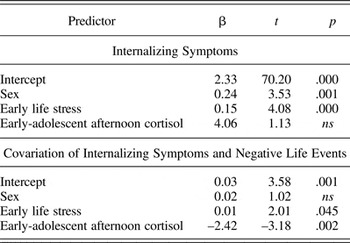
Adolescent sex, ELS, early-adolescent longitudinal afternoon cortisol, and all corresponding two- and three-way interactions were entered into the model at Level 2 to predict effects on later internalizing symptoms across the high school years and their covariation with negative life events. Main effects of sex and ELS were found for internalizing symptoms; girls and individuals exposed to higher levels of ELS demonstrated increased levels of internalizing symptoms across high school (see Table 1).
Predictors of internalizing symptoms and their covariation with negative life events

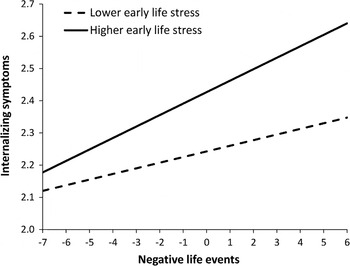
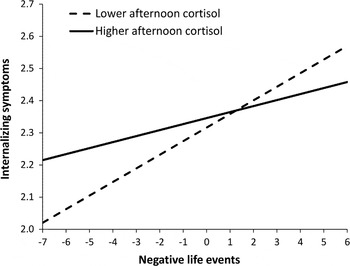
Concerning our major research question, both ELS exposure and early-adolescent afternoon cortisol levels were significant predictors of between-individual differences in the covariation of internalizing symptoms and negative life events (see Table 1). This covariation was tighter for individuals exposed to higher levels of ELS than for those exposed to lower levels. As shown in Figure 1, although lower negative life events was associated with lower levels of internalizing symptoms regardless of ELS exposure, adolescents exposed to higher levels of ELS displayed higher levels of internalizing symptoms when reporting more negative life events and vice versa. Furthermore, early-adolescent longitudinal afternoon cortisol levels negatively predicted covariation. To be more specific, negative life events and internalizing symptoms across high school were more tightly linked for individuals with lower early-adolescent afternoon cortisol levels than for those with higher levels. As shown in Figure 2, individuals with lower early-adolescent cortisol levels displayed higher levels of internalizing symptoms when reporting more negative life events and vice versa. In contrast, individuals with higher early-adolescent cortisol levels displayed higher levels of internalizing symptoms even when reporting fewer negative life events, and less of a concomitant increase in internalizing symptoms with an increase in negative life events and vice versa. None of the interaction terms were significant predictors of internalizing symptoms or its covariation with negative life events; therefore, the interactions were removed from the model.
Moderating effect of early life stress on the covariation between negative life events and internalizing symptoms across high school.

Moderating effect of longitudinal afternoon cortisol on the covariation between negative life events and internalizing symptoms across high school.

Potential differences between symptoms of depression and anxiety
Two additional secondary HLM analyses explored potential differences in the components of internalizing symptoms (depression and anxiety) and the covariation of each with negative life events across the high school years, as well as possible differences in earlier predictors.
The results of initial Level 1 analyses revealed that both symptoms of depression and anxiety covaried with negative life events (B = 0.054, t = 3.16, p < .01; B = 0.021, t = 2.37, p < .05, respectively). Similar to the findings for overall internalizing symptoms, when time and Time × Negative Life Events were included in the model for anxiety symptoms, there was no significant change in anxiety symptoms (time: B = –0.018, t = –1.39, ns) or change in covariation (Time × Negative Life Events: B = –0.004, t = –0.38, ns); therefore, time-related variables were removed from the anxiety model. In contrast, in the model for depression symptoms, results indicated that depression symptoms increased (time: B = 0.037, t = 3.40, p < .01) and the covariation with negative life events became less tight over time (Time × Negative Life Events: B = –0.02, t = –1.99, p < .05). Given that time-related variables were retained in the model examining depression symptoms, the coefficients reflect values related to age 15, the first assessment of the Level 1 variables: The intercept reflects depression symptoms at age 15 and the covariation coefficient reflects the covariation between negative life events and depression symptoms at age 15, and the time-related variables reflect change in depression symptoms (i.e., time) and covariation from age 15 (i.e., Time × Negative Life Events).
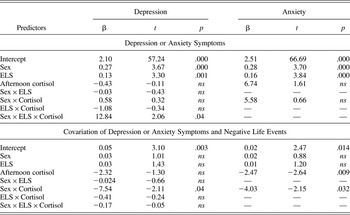
Level 2 analyses allowed us to explore whether the predictors of depression and anxiety differed and to address whether there were differences by symptom type for our major research question, that is, early predictors of the covariation of internalizing symptoms and negative life events. Regarding the former, similar to the findings for overall internalizing symptoms, main effects of sex and ELS exposure were found for both depression and anxiety symptoms; girls and individuals exposed to higher levels of ELS demonstrated higher levels of both types of mental health problems (see Table 2). In addition, for depression, a three-way Sex × ELS × Afternoon Cortisol effect was found; however, when considering girls and boys separately, neither sex showed a significant interaction of ELS × Afternoon Cortisol (girls: p = .22; boys: p = .16).
Predictors of depression or anxiety symptoms and their covariation with negative life events
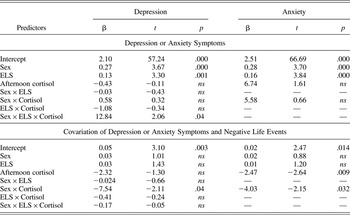
Note: (—) Interactions not included in a specific model. ELS, Early life stress.
Regarding our main question of predictors of covariation (see Table 2), although there was no significant main effect of ELS on the covariation of negative life events with either depression or anxiety, the effect in both models was in the same direction as the effect in the internalizing model. Similar to the findings for internalizing symptoms, there was a main effect of early-adolescent afternoon cortisol only on the covariation of negative life events and anxiety. Further, a Sex × Afternoon Cortisol interaction predicted the covariation between negative life events and both depression and anxiety. Examining these associations separately for boys and girls revealed that girls with lower cortisol displayed tighter covariation between anxiety and negative life events (B = –4.50, t = –3.44, p < .01) as well as tighter covariation between negative life events and depression (B = –5.79, t = –2.29, p < .05). No effect of boys' cortisol was found for either covariation between negative life events and anxiety (B = –0.70, t = –0.46, ns) or covariation between negative life events and depression (B = 1.22, t = 0.48, ns).
Because Level 1 analyses revealed that depression symptoms demonstrated significant change over the high school years, we also explored predictors of developmental change in depression symptoms and their covariation with negative life events. Sex was the only predictor of change in depression symptoms over time (B = –0.05, t = –2.26, p < .05): boys increased more over time. Sex × Afternoon Cortisol predicted progression in covariation over time (B = 3.57, t = 2.05, p < .05); however, upon examining this effect separately for boys and girls, the effect of afternoon cortisol was nonsignificant for both sexes (girls: p = .18; boys: p = .22).
Discussion
The major goal of this study was to investigate the developmental origins of differential stress sensitivity, as indexed by the covariation of internalizing symptoms and negative life events. We did so by examining how stress exposure in infancy and afternoon cortisol levels in early adolescence modulate the later association between internalizing symptoms and negative life events across the high school years. Findings support and expand upon models of the sensitizing effects of early stress; a history of ELS exposure or altered early-adolescent afternoon cortisol levels influenced the degree of covariation between later internalizing symptoms and negative life events.
Before considering our primary question, we first examined the patterns of covariation over time between negative life events and internalizing symptoms. Consistent with prior studies finding a bidirectional association between negative life events and internalizing symptoms (Brown & Rosellini, Reference Brown and Rosellini2011; Wichers et al., Reference Wichers, Maes, Jacobs, Derom, Thiery and Kendler2012), we found tight positive covariation between negative life events and internalizing symptoms. We also found that this covariation did not vary in strength across the high school years. We extended previous work on sensitization by focusing on predictors of this covariation.
Previous studies examining sensitization have shown that early stress exposure may increase an individual's sensitivity to subsequent adverse events, resulting in increased levels of internalizing problems (Espejo et al., Reference Espejo, Hammen, Connolly, Brennan, Najman and Bor2006; Hammen et al., Reference Hammen, Henry and Daley2000; Harkness et al., Reference Harkness, Bruce and Lumley2006; Kendler et al., Reference Kendler, Kuhn and Prescott2004; McLaughlin et al., Reference McLaughlin, Conron, Koenen and Gilman2010; Rudolph & Flynn, Reference Rudolph and Flynn2007). We found that individuals exposed to high levels of ELS demonstrated tighter covariation between negative life events and internalizing symptoms over the high school years. While there was no difference between lower and higher ELS groups at lower levels of negative life events and internalizing symptoms, individuals exposed to higher ELS demonstrated much tighter covariation under higher levels of negative life events and internalizing symptoms than their lower-exposure counterparts. Early models of stress sensitization (Hammen et al., Reference Hammen, Henry and Daley2000) suggested a generalized sensitization effect: Individuals exposed to ELS will require less subsequent life stress to elicit internalizing symptoms compared to their nonexposed counterparts. That is, even when experiencing low levels of later negative life events, ELS-exposed individuals would be expected to show higher levels of internalizing. More recent models (Rudolph & Flynn, Reference Rudolph and Flynn2007) modified the original stress sensitization hypothesis to suggest that, rather than a generalized sensitization effect, there is an amplification effect of later life stress. In other words, for both ELS-exposed and nonexposed individuals, low levels of internalizing are likely when concurrent stress is low; however, when the individual is faced with severe life stress (i.e., increased number of negative life events), those exposed to ELS would be expected to show higher levels of internalizing. Thus, our finding for the effect of ELS on the covariation of negative life events and internalizing in adolescence lends support to models of stress amplification. Furthermore, our findings extend previous research that has relied on retrospective reports of ELS, which may be biased by current emotions or psychological state (e.g., Brett, Brief, Burke, George, & Webster, Reference Brett, Brief, Burke, George and Webster1990). Examining prospectively the effect of mother-reported ELS exposure measured in infancy on adolescent self-reported negative life events and internalizing symptoms eliminated the possibility of potentially inaccurate recall and other biases and underscored the enduring effects of early stress exposure on susceptibility to later stressful life events. Our findings suggest that individuals exposed to greater ELS display a vulnerability that amplifies the effects of later adversity. Exposure to increased negative life events or elevations in internalizing symptoms may elicit a self-perpetuating cycle of susceptibility in individuals exposed to higher levels of ELS.
It has been proposed that altered adrenocortical functioning may influence stress sensitization processes (Hammen et al., Reference Hammen, Henry and Daley2000), but this rarely has been tested empirically. In line with models of stress amplification, the only studies that have examined cortisol as a predictor of later sensitization have found that both lower reactive cortisol (Badanes et al., Reference Badanes, Watamura and Hankin2011) and higher anticipatory cortisol (Rudolph et al., Reference Rudolph, Troop-Gordon and Granger2011) predicted increased internalizing problems when youth were faced with higher levels of stress or victimization. In the present study, we also found some support for stress amplification: Individuals with lower early-adolescent afternoon cortisol were more likely later in adolescence to demonstrate tighter positive covariation (i.e., lower or higher levels of both) between negative life events and internalizing problems. This is also in line with research finding that individuals with blunted or lower levels of cortisol demonstrate increased levels of internalizing problems following exposure to high levels of maltreatment or other stressful circumstances (Cicchetti et al., Reference Cicchetti, Rogosch, Gunnar and Toth2010; De Bellis et al., Reference De Bellis, Dahl, Perel, Birmaher, Al-Shabbout and Williamson1996; Ruttle et al., Reference Ruttle, Shirtcliff, Serbin, Ben-Dat Fisher, Stack and Schwartzman2011; Shirtcliff & Essex, Reference Shirtcliff and Essex2008), suggesting that lower levels of basal cortisol may be a risk factor for internalizing symptoms in individuals exposed to prolonged or extremely stressful circumstances. However, we also found that individuals with higher longitudinal afternoon cortisol levels demonstrated a weaker covariation between negative life events and internalizing symptoms among individuals that was partially attributable to increased levels of internalizing symptoms at lower levels of negative life events. This is consistent with the original study of stress sensitization (Hammen et al., Reference Hammen, Henry and Daley2000), which found that individuals exposed to childhood adversity displayed increased internalizing problems in response to lower levels of stress. It has been suggested that individuals with higher levels of cortisol have a generalized biological sensitivity to context (Boyce & Ellis, Reference Boyce and Ellis2005; Ellis et al., Reference Ellis, Essex and Boyce2005), possibly rendering them susceptible to more minor, as well as more severe, negative circumstances. However, our finding may also be due to an unmeasured variable such as more chronic everyday stresses that, especially for those individuals with higher levels of cortisol, would result in higher internalizing symptoms even at low levels of negative life events.
Although prior studies have considered ELS or cortisol as a predictor of stress sensitization in adolescence, this is the first study to simultaneously examine their joint effects. Both ELS and early-adolescent afternoon cortisol independently predicted the later covariation between negative life events and internalizing problems. Although it has been suggested that the effects of ELS on stress sensitization operate through HPA-axis functioning (Hammen et al., Reference Hammen, Henry and Daley2000; Harkness et al., Reference Harkness, Bruce and Lumley2006; Rudolph et al., Reference Rudolph, Troop-Gordon and Granger2011), previous research from the current sample examining more proximal measures in an earlier developmental period found that although ELS and preschool cortisol were correlated each independently predicted higher levels of later mental health symptoms at first grade (Essex, Klein, et al., Reference Essex, Klein, Cho and Kalin2002). In the present study, ELS and early-adolescent afternoon cortisol were uncorrelated, eliminating the possibility of mediation. One possibility for the independent effects of these measures on covariation and their lack of association is the extended period of time between the assessment of ELS (i.e., infancy) and the subsequent measurements of cortisol (i.e., early adolescence to midadolescence). However, it may also be indicative of each measure exerting its influence on sensitization via a separate pathway. For example, compared to their nonexposed counterparts, ELS-exposed individuals demonstrate a wide range of cognitive deficits, including impaired problem-solving ability, cognitive flexibility, and decision-making skills, which may hinder their ability to adequately deal with negative life events and increase their risk for internalizing problems (Fishbein et al., Reference Fishbein, Warner, Krebs, Trevarthen, Flannery and Hammond2009; Spratt et al., Reference Spratt, Friedenberg, LaRosa, Bellis, Macias and Summer2012). Moreover, although ELS has been shown to influence later HPA-axis functioning in both preclinical (Bakshi & Kalin, Reference Bakshi and Kalin2000; Sanchez, Ladd, & Plotsky, Reference Sanchez, Ladd and Plotsky2001) and human populations (Essex, Klein, et al., Reference Essex, Klein, Cho and Kalin2002; Essex et al., Reference Essex, Shirtcliff, Burk, Ruttle, Klein and Slattery2011), other factors, such as genetics and experiences later in childhood (Young, Aggen, Prescott, & Kendler, Reference Young, Aggen, Prescott and Kendler2000), are also likely to exert lasting effects on HPA-axis functioning.
In addition to the major analyses, secondary analyses examined anxiety and depression separately rather than in a combined internalizing score. Previous studies suggest there might be differences in the developmental progression of anxiety and depression symptoms across adolescence (Hale et al., Reference Hale, Raaijmakers, Muris, van Hoof and Meeus2008; Hankin, Reference Hankin2009). However, research has yet to consider differences in the covariation of negative life events with each of these components of internalizing symptoms. Covariation of anxiety symptoms and negative life events mirrored those of overall internalizing, revealing tight positive covariation across the high school years; whereas, depression and negative life events were initially tightly positively associated but became less tightly linked over time. The effect of ELS on covariation of both symptom types was in the same direction as that of internalizing-negative life events covariation (i.e., higher ELS predicted tighter positive covariation) but dropped below significance. Furthermore, similar to internalizing covariation, lower afternoon cortisol predicted tighter positive covariation between negative life events and anxiety symptoms; this was particularly strong in girls. Lower afternoon cortisol also predicted tighter positive covariation between depression and negative life events but only in girls. Given the lack of previous literature examining the sensitizing effect of afternoon cortisol, it is unclear why girls were particularly likely to display such associations when examining covariation separately for anxiety and depression. Overall, although these findings suggest there may be different developmental patterns of covariation between negative life events and anxiety and depression symptoms, predictors of both patterns of covariation were largely similar to predictors of internalizing covariation.
As a precursor to our primary analyses, we considered developmental patterns of internalizing symptoms and examined longitudinal predictors of these patterns. Consistent with some previous research (Leve, Kim, & Pears, Reference Leve, Kim and Pears2005), we found that the level of internalizing symptoms experienced across high school did not significantly change over time; however, similar to previous findings (Hale et al., Reference Hale, Raaijmakers, Muris, van Hoof and Meeus2008; Hankin, Reference Hankin2009), secondary analyses revealed that this was driven by differences in the developmental progression of anxiety and depression symptoms over adolescence: while depression symptoms increased across high school, anxiety symptoms remained stable, resulting in little change in the combined internalizing measure over time. Upon including predictors of internalizing symptoms in the model, we found that girls (Hankin & Abramson, Reference Hankin and Abramson1999; Hankin et al., Reference Hankin, Abramson, Moffitt, Silva, McGee and Angell1998; Petersen et al.) and individuals exposed to higher levels of ELS (Halligan, Herbert, et al., Reference Halligan, Herbert, Goodyer and Murray2007; Halligan, Murray, Martins, & Cooper, Reference Halligan, Murray, Martins and Cooper2007; Trickett et al., Reference Trickett, Negriff, Ji and Peckins2011) demonstrated elevated levels of internalizing symptoms across high school, and these findings persisted when examining anxiety and depression separately. However, while girls displayed the highest levels of depression symptoms across high school, boys' symptom levels increased more over time. Although previous research suggests that girls' depression symptoms increase more than boys' during this developmental period (Hankin, Reference Hankin2009), differences in findings may be due to differences in the covariates included in the models, the measures of depression symptoms employed, and duration of the study.
Although the present study affords the unique opportunity to examine the developmental origins of differential stress sensitization in a longitudinal sample followed from birth, it is not without its limitations. The participants were drawn from a Midwestern community sample comprising mostly middle-income, non-Hispanic White families and therefore may not be representative of the larger US population. Future studies should attempt to replicate these findings in more diverse samples and in populations that include sizeable numbers of maltreated and/or neglected children. Although longitudinal measurement of negative life events and internalizing symptoms across high school provides important information on a developmental epoch in which internalizing (particularly depression) problems increase, examining how these factors work together earlier in the transition to adolescence may provide critical information concerning the onset and initial development of such mental health problems. Finally, while preliminary studies have begun identifying the neural circuitry (e.g., amygdala, hippocampus, and prefrontal cortex) through which ELS exposure (Cisler et al., Reference Cisler, James, Tripathi, Mletzko, Heim and Hu2013) and cortisol levels (Burghy et al., Reference Burghy, Stodola, Ruttle, Molloy, Armstrong and Oler2012) operate to influence an individual's susceptibility to later internalizing problems, only animal studies have begun looking at the neural correlates of processes that more closely reflect a stress sensitization paradigm. For example, Eiland & McEwen (Reference Eiland and McEwen2012) found that ELS-exposed mice subjected to chronic stress in adulthood demonstrated increased corticosterone levels, elevated levels of anxiety, and altered hippocampal neuron morphology (Eiland & McEwen, Reference Eiland and McEwen2012). While these findings suggest that the effect of ELS and/or stress physiology may be encoded in brain structure and functioning, sensitizing individuals to later stress and resulting in increased levels of internalizing problems, additional research is required to extend findings from preclinical to human studies and to disentangle the sequencing of effects.
Our findings highlight when individuals with different stress profiles may be most susceptible to the harmful effects of negative life events and internalizing problems. Moreover, whereas individuals exposed to ELS and those with lower afternoon cortisol levels seem to be particularly likely to develop internalizing symptoms when experiencing increased negative life events, and vice versa, individuals with higher afternoon cortisol levels seem to demonstrate higher levels of internalizing problems even at lower levels of negative life events. These results suggest that while the majority of individuals may benefit from learning adaptive coping techniques to employ during times of increased emotional and life stress, individuals with higher afternoon cortisol may benefit from additional coping strategies as well as techniques shown to reduce cortisol levels (Brand, Holsboer-Trachsler, Naranjo, & Schmidt, Reference Brand, Holsboer-Trachsler, Naranjo and Schmidt2012; Jacobs et al., Reference Jacobs, Shaver, Epel, Zanesco, Aichele and Bridwell2013). Taking a multilevel approach to understanding internalizing problems by incorporating earlier measures of environmental stress and stress physiology as well as concurrent negative life events provides researchers with a more nuanced understanding of how such mental health problems develop and may inform intervention and prevention programs to help improve adolescent quality of life.