On January 4th 1971, Christian Astrup, a Professor of Psychiatry from Norway, addressed a letter to the Nominating Committee for The Nobel Prizes supporting William Horsley Gantt’s candidacy for the Nobel Prize of Physiology/Medicine for his contributions to the understanding of higher nervous activity of man and animals under normal as well as pathological conditions. In Astrup’s words:
(…) Gantt’s work covers a vast field from the anatomy of conditional reflexes, cardiac conditioning and interoceptive conditioning to experimental neuroses in animals, studies of psychiatric patients, psychopharmacology and principles of psychotherapy… His concepts of organ-responsibility, schizokinesis and autokinesis… offer new ways of understanding the mechanisms of psychosomatic and psychiatric diseases and treatment procedures. Furthermore they open perspectives for prophylactic psychiatry Footnote 1 .
Besides explaining the reasons why Gantt deserved the Prize, Astrup reminded the Committee of the importance of one of the Gantt ‘patients’: “Gantt’s dog, Nick, is as important for conditional reflex psychopathology as Anna O. was for the development of psychoanalytic theory”. Footnote 2 This neurotic mutt thus became part of the exclusive group of distinguished patients in the history of Psychopathology.
Why was Nick’s case so significant? Gantt did not discover the phenomenon of “experimental neurosis”, which had long been well known. Departing from the pioneering studies of Maria Erofeeva and Nadezhda Shenger-Krestovnikova in I. P. Pavlov’s Laboratory at Leningrad (Pavlov, Reference Pavlov1941, p. 341–342; see also Todes, Reference Todes2014, especially chapter 36), many American psychologists and psychiatrists had published about this topic before the story of Gantt’s dog was widely known and valued (Bijou, Reference Bijou1943; Cook, Reference Cook1939; Dimmick, Ludlow, & Whiteman, Reference Dimmick, Ludlow and Whiteman1939; Dworkin, Reference Dworkin1939; Jacobson, Wolfe, & Jackson, Reference Jacobson, Wolfe and Jackson1935; Karn, Reference Karn1940; Liddell, Reference Liddell1938; Maier, Reference Maier1939; Masserman, Reference Masserman1946).
To understand the importance of Nick’s case, we must take into account several factors concerning Gantt’s scientific approach and the social context in which he worked: 1) Gantt’s methodological innovations–his novel combination of the Pavlov’s physiological technique of conditional reflexes with Adolf Meyer’s psychiatric method of writing the “life-chart” of an individual; 2) Gantt’s concentration upon a single individual, which made his book recognizable and interesting to physicians, psychologists, and psychiatrists who also worked on individuals; and 3) Gantt’s attempts to persuade scientific and lay audiences about the possibility of detecting which individuals are vulnerable before a nervous breakdown occurs (Gantt, Reference Gantt1943).
We must also consider that during the 1940s there was a widespread concern with social instability produced by industrialization, the two World Wars, the Depression, and the rise of European fascism (Cross & Albury, Reference Cross and Albury1987; Kunitz, Reference Kunitz2002; Viner, Reference Viner1999). In this context, studies dealing with the problem of emotional instability and its treatment or prevention attracted special attention. Gantt’s Nick case fully reflected these contextual factors.
Nick’s story was meticulously narrated by Gantt in his book Experimental Basis for Neurotic Behavior. Origin and Development of Artificially Produced Disturbances in Dogs (1944). Footnote 3 In 1946, Gantt was awarded the Lasker Prize in Mental Hygiene “For Experimental Investigation into Behavior Deviation”. As the citation noted, Gantt’s book was “timely when psychiatric education is shifting its focus toward neurosis, when general medicine is beginning to develop a responsibility for the vast neurotic patient population whose ills do not come within the framework of traditional medical science, and when the pressures of a war have forced a higher public consciousness of neurotic disability”. Footnote 4
In this paper, we have used archival materials to explore Gantt’s experiences with Nick, the reception of the book in scientific and lay circles, and its significance for Gantt’s proposal of an objective psychopathology.
“Gantt, Meyer, Nick, and the Pavlovian Laboratory at Phipps Clinic”
William Horsley Gantt founded and directed the Pavlovian Laboratory at Phipps Clinic from 1930 to 1964. Although he only took one psychology course during his medical studies, Gantt stated in his unpublished autobiography that he “felt the fascination of psychiatry and neurology, and the promise of Freud to explain psychopathology, [but he] saw in these subjects a maze of words rather than principles”. Footnote 5 So, after receiving his M.D. at the University of Virginia in 1920, Gantt’s professional career began at the University of Maryland Hospital in Baltimore studying a more scientific field: liver pathology (Harvey, Reference Harvey1976). This earlier interest in gastroenterology definitely shifted to psychiatry after visiting the Union of Soviet Socialists Republics (USSR) in 1922.
During this visit, Gantt met Pavlov for the first time while he was a medical member of the American Relief Administration (ARA) sent to the USSR under Herbert Hoover for famine work. Despite of the fact that Gantt was an unknown to Pavlov, the Russian physiologist demonstrated his experiment on conditional reflexes to him. This experience had such a deep influence on Gantt that many years later he referred to it as “an event occurred from which I can date my whole subsequent professional life”. On October 29, 1922, Gantt wrote in his diary:
My interpreter, Dr. Zellheim, said to me I should go to see Pavlov´s laboratory. During my medical course I knew of Pavlov as the great physiologist of digestion, a name so prominent in this subject that I thought he must have been dead for years. Indeed so little news came from Russia after the 1917 Revolution that Pavlov’s obituary was published in the Encyclopaedia Britannica in 1916. Even though I had taken a graduate course in psychology, the conditional reflex was a concept and a term unknown to me, although a few articles had been published in English and Watson gave his 1916 presidential address on the subject. But it was possible to be a graduate in psychology without a knowledge of the conditional reflex…
Pavlov who spoke no English demonstrated his experiment on the conditional reflex (…) The clarity of his explanations and the ability to reduce the complex ‘psychical function’ to drops of saliva, to a quantitative measure, stirred me emotionally, immediately made to believe that there he was the method of studying mentality and its disorders. I wrote in my diary: this is the happiest day of my professional life in Europe Footnote 6
.
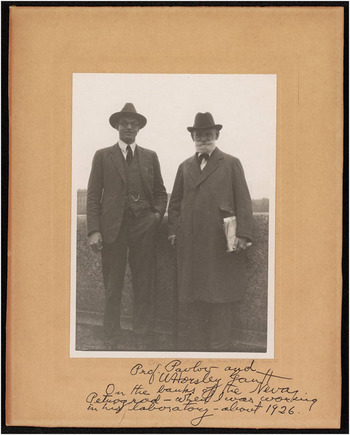
After finishing his work for the ARA and spent one year doing clinical research at the University College Medical School in London, the Bolshevik government renewed his visa and Gantt came back to the USSR for a second long stay at Ivan Petrovich Pavlov’s laboratory in Leningrad from 1925 to 1929 Footnote 7 . (See Figure 1).
Pavlov and Gantt on the Banks of the Neva River –ca. 1926- (Image courtesy of the Alan Mason Chesney Medical Archives of the Johns Hopkins Medical Institutions. Reproduced with permission).

Gantt arrived to Pavlov’s laboratory a few months after the Leningrad flood, a timely moment for somebody with psychiatric interests as him. This natural disaster happened on September 23, 1924, and gave Pavlov the opportunity of studying the pathological consequences of this event on his dogs. The incident was vividly described by Pavlov:
The building for animals which stood on the ground a quarter of a kilometer away from laboratory building began to be flooded. In the dreadful storm with large incoming waves striking against the buildings, the roar and rumble of broken and falling trees, we have to move out animals hastily by swimming in groups to the second floor. All this, apparently, extraordinarily inhibited all animals without exception, because during that time we did not observe any of the usual fights between them. After this event some of the dogs, returned to their former place, remained the same as they had been before; others, especially those of the inhibited type, developed nervous diseases (and for a very long time at that) of which we convinced ourselves in our experiments with their conditioned reflexes. (Pavlov, Reference Pavlov and Pavlov1994, pp. 179–180).
Once Gantt joined Pavlov’s laboratory, he was assigned to carry out research about the effect of the different conditional stimuli on the magnitude of the conditional reflexes. The problem consisted in determine whether the effect of various stimuli, e.g., a light or a tone, on the salivary conditional reflex depended on the differences in the kind of stimulation – visual versus auditory -, or, on the contrary, depended on the different intensities or strengths of the two stimuli. In his experiments, Gantt founded that these differences were dependent on the intensity or strength of the stimuli used (Kupalov & Gantt, Reference Kupalov and Gantt1927). Besides of that, Gantt also participated in studies about the physiology of digestion “one of these had to do with the difference in the effect of black and white bread on gastric secretion, another on the influence on the mechanical division of the food on the ease of digestion, a third work on the effect of coffee and tea on gastric secretion”. Footnote 8
In the course of all these research experiences Gantt became well acquainted with the Pavlovian physiological methodology, and Adolf Meyer, who had heard of Gantt works through John Dewey and Alan Gregg, Footnote 9 sent him an invitation at the beginning of 1929 to make “your training available in our research and practical work at the Henry Phipps Psychiatric Clinic”. Footnote 10 From its creation in 1913, the Phipps Clinic, under Meyer’s direction, functioned as part of the University’s Medical School, and by the time of Gantt’s arrival it was, as Meyer had envisioned, “an institute representing a true clinic, i.e., a hospital for practical work, research and teaching” (Meyer, Reference Meyer and Lief1913, p. 346). Having left Russia in the summer of 1929, Footnote 11 Gantt was appointed Research Fellow on the Psychiatry Research Fund of the Phipps Clinic on September 1929. Footnote 12
As an institution, Phipps Clinic embodied Adolf Meyer’s view of the psychobiology as a science that deals with the person as a whole. Footnote 13 For Meyer, Psychiatry must move away from simple analysis –description of symptoms, classification and brain pathology- to become the study of the behavior of each person in his/her social and physical environment (Lamb, Reference Lamb2014). In Meyer’s words “what is of importance to us is the activity and behavior of the total organism or individual as opposed to the activity of single, detachable organs” (Meyer, Reference Meyer and Lief1915, p. 398). The data of interest for the psychiatrist were those related with the mental integrations of the individual, “his attitudes and activities, including the respiratory and vasomotor and circulatory and cerebral activity involved, and also the situation in which the reaction takes place as a process of adjustment. The ‘integrations of the nervous system’ would thus form an essential link in the broader ‘integration of personality’” (Meyer, Reference Meyer and Lief1912, p. 382).
One of the main components of Meyer’s psychobiological approach was the importance attributed to the historical dimension of each case–to the life story of the person. Meyer’s Psychiatry has a narrative or biographical component: all the reactions of a person occur in a sequence forming a biography, and clinical examination is the moment of reconstructing this sequence of events just as they have happened. To this end, Meyer suggested using the “life-chart,” a device that permitted representation of the temporal dimension of each case. Footnote 14 This chart sought to link the history and conditions of the personality with the history and conditions of the principal organs and functions (Meyer, Reference Meyer and Lief1919).
The chart begins with the birth date of the patient, and information about diseases and important life events were included to the left and right side respectively of the weight curve of the different organs. The basic aim of the chart was portray visually a chronological summary of each case as a chain of events such that “if the same conditions were reproduced, we should be forced to expect the same results, whether they be normal or abnormal” (Meyer, Reference Meyer and Lief1912, pp. 382–383).
All work at Phipps Clinic–whether clinical, teaching or research- was organized according to Meyer’s psychobiological ideas (Lamb, Reference Lamb2014; Meyer, Reference Meyer and Lief1934). So, for example, medical students were introduced to the study of psychobiology through the writing of their own biographies as a framework to understanding themselves and others, Footnote 15 and the staff was encouraged to use in its research “all the resources of contemporary sciences in dealing with conditions and facts about patients and the community, with due consideration for different possibilities of interpreting them”. Footnote 16
Gantt’s Pavlovian Laboratory was one of four research facilities at the Phipps Clinic. Footnote 17 Although a part of Phipps Clinic, it was physically located in the Department of Physiology of the Johns Hopkins School of Medicine. A patient of Adolf Meyer at that time donated all expenses for the first years and paid by “the construction of the sound-proof camera”. Footnote 18 From 1932 until 1948, the laboratory was continuously and exclusively funded by the Rockefeller Foundation. Footnote 19
In this laboratory Gantt and a group of collaborators Footnote 20 launched a complex, Pavlovian research program that included two lines of inquiry: the study of the anatomical structures essential to the conditional reflex and the investigation of nervous disturbances in dogs. Footnote 21 These two lines were soon complemented with clinical researches on psychiatric patients (Gantt, Reference Gantt1938a, Reference Gantt1938b; Gantt & Muncie, Reference Gantt and Muncie1942).
Gantt’ style of research was deeply influenced by the psychobiological spirit of Phipps Clinic. As Gantt himself recognized “the University character of the Phipps Clinic, in the bringing together of people of widely varying experiences and the range of ideas presented, makes a strong appeal to me. In summarizing my present outlook, I should say that I find the schools of thoughts represented by Pavlov and Adolf Meyer my chief stimuli and guides for the study of psychical phenomena”. Footnote 22 Gantt’s style of research, thus, could be described as combining a physiological method (the conditional reflexes approach), with a psychiatric problem (nervous disorders) in the context of a particular framework, Meyer’s psychobiology, that established the person or individual as unit of analysis. To make this possible, Gantt supplemented the Pavlovian methodology of conditional reflexes with attention to the activity of different organs –the heart and lungs Footnote 23 - and their relationships with the salivary and motor conditional reflexes. Footnote 24 He also, as Meyer had recommended, observed and recorded every event in the life of experimental individuals –composing a “life chart” of his neurotic dogs.
Gantt’s approach to the study of nervous disturbances considered laboratory and clinical observations as complementary: “by the piecing together of many controlled observations from the laboratory and from life we may step by step arrive on firm ground in the field of psychopathology” (Gantt, Reference Gantt1944, p. ix). Gantt extended these clinical observations to the entire life of his dogs and invoked Meyer’s authority about this question: “The thorough study of the individual is preferable to fitting cases into clear-cut diagnoses and well made theories; ‘nothing in psychobiology is absolute’ (Adolf Meyer)”, he wrote (Gantt, Reference Gantt1944, p. 29); and “the function of the individual is the final criterion. Adolf Meyer has been one of the chief exponents of the study of the function of the individual (ergasia), lying emphasis on the behavior of the individual in his life experiences. This behavior is an essential element in both the personality and the psychopathology of the individual, and the importance of other systems is only for the light they may throw on this central question” (Gantt, Reference Gantt1944, p. 169).
One example of this interaction between the laboratory and the clinical setting is provided by Gantt’s presentations of his studies to several of the weekly Staff Conferences at Phipps Clinic. During these conferences, Gantt had the opportunity to interact and receive feedback from different specialists, including but not limited to psychiatrists. Interestingly, Gantt approached this diverse audience by presenting his studies with dogs at the same time as he showed the usefulness of the conditional reflex in testing real human patients. For instance, after a conference completely devoted to summarizing his experiments with dogs (February 2, 1939), Footnote 25 Gantt dedicated the following one (February 9, 1939) to a demonstration of a conditional reflex motor with a patient. Footnote 26 Gantt’s continual rhetorical conflation of the laboratory and clinical setting may well have helped to blur the boundary between them transforming his animal studies in clinical cases, and making his experiments with dogs understandable and interesting for clinicians. As one of his colleagues recognized:
I had not realized what an excellent approach to the theory of conditioned disorders of behavior would be provided by such a detailed case history. One can talk about conditioned and unconditioned reflexes, clashing of excitation and inhibition until he is black in the face without rousing the interest which a good concrete chronology of symptoms can arouse. Footnote 27
The influence of Meyer’s psychobiology on Gantt’s style of research is not only discernible on a methodological and clinical level; its precept of respect toward the different possibilities of interpretation also influenced his theoretical approach. So, Gantt abstained from providing a systematic explanation of the psychopathological mechanism underlying Nick’s neurosis (as was Pavlov’s practice). Rather he gave Nick’s story to different specialists and contrasted their approaches. A representative of the Pavlovian reflexology, Naum E. Ischlondsky, a psychoanalyst, Leon J. Saul, and an anthropologist and pupil of Adolf Meyer, Alexander H. Leighton, were all invited to see Nick in different moments, and to offer explanations of his disturbances. As expected, each proposed a different explanation based on his own point of view. Ischlondsky appealed to the laws of irradiation and induction to explain Nick’s symptoms and its spread through different physiological systems; Saul emphasized the powerful influence of the social factors (master-dog relation) and the emotions; and Leighton, focused his explanations on how people after forming attitudes in the course of growth and development in which they invest his sense of security, are not able of giving them up even in situations in which they are inappropriate. Interestingly, Gantt did not endorse any explanation –whether Pavlovian or not. For example, he considered the explanations offered by the reflexologist and the psychoanalyst as possibly representing “a different aspect of the same mechanism”, and invoked pragmatic reasons to decide between them: “the significance of the concept for the field in which we are working” (Gantt, Reference Gantt1944, both quotes on p. 186).
The product of these converging influences is fully evident in Gantt’s most famous clinical case –that of Nick. Gantt’s canine Anna O, was a male mongrel dog that became a star at Phipps Clinic between 1931 and 1943. Footnote 28 Described by Gantt as “lively and playful” (Gantt, Reference Gantt1944, p. 51), Nick “presented after two and a half years of experiments that were physically painless but psychically frustrating, as perfect a picture of a patient with a complete nervous breakdown as any psychiatrist ever found in his consulting room”. Footnote 29 Throughout his life, Gantt made clear the special importance of this case, referring to Nick with expressions such as “hero” Footnote 30 and “one of my best teachers”. Footnote 31 Eventually, Gantt even included Nick as a character -“Ghost of the dog Nick, a Neurotic”- in his unpublished comedy entitled “Erotica, Neurotica and Dr. Beach”. Footnote 32
Nick’s life experiences: “My neurotic animal” Footnote 33
The story of Nick is as extraordinary as it is complicated. Gantt’s narrative presents this case as a carefully planned effort to elucidate the origin, development, and treatment of neurotic disturbances. In this biography, all of Nick’s key experiences are included–his conditional reflexes, his relations with the experimenters and with other dogs, his symptoms, his improvements, his relapses, his death. Nick emerges in different roles –experimental subject, patient, soldier, pet- in a story full of intensity and drama. Footnote 34 As Gantt wrote to John Caldwell, photograph editor of Newsweek, his book was:
A biography of Nick from his puppyhood through his love life, his conflicts, his breakdowns, his pet hates, his accidents, his partial recoveries, his life on the farm, his work in the laboratory, with nearly 20.000 measured scientific observations. During this period Dr. Gantt and the other collaborators at the Pavlovian Laboratory of the Phipps… lived with him, studied him in the laboratory, took him to his summer home on vacation and never lost sight of his loves, hates and conflicts…Besides this detailed life story of Nick on the pattern of a medical case history, the author outlines an objective basis for the study of susceptibility to nervous breakdown in the animal and the human and applies it to the various individual types Footnote 35 .
The experiments began in February 1932. Three dogs, were studied –Fritz, Peter and Nick. From this moment until 1935, Roger Brown Loucks, Gantt’s former research associate, and Harry Schmidt, the laboratory technician, were the two persons most involved with Nick. During these years, Gantt always played a discrete “supporting role” (Gantt, Reference Gantt1944, p. xvi).
After establishing a simple salivary reflex and a differentiation between two tones (T1 and T2) different in pitch, the procedure was gradually changed in such a way that T1 and T2 became increasingly similar in pitch. In October 1932, T1 and T2 were so close in pitch that Nick could not differentiate between them anymore, and his reactions markedly changed: all his conditional salivary responses dropped to zero, and at the same time Nick became noticeably restless in the experimental room, rejecting the food (Spratt Ovals) that was offered after T1 –indeed, for the next nine years Nick refused these Ovals inside or outside the experimental chamber.
On October 12th 1932, the first symptoms of the nervous breakdown were recorded by Loucks in the laboratory logbook: “Dog whimpering and cry. Wouldn’t eat. Loud whimpering”. Footnote 36 In the following days, Nick nervous behavior was so obvious that he was demonstrated to the Phipps Staff several times. Footnote 37
Gantt thought that this first group of symptoms showed Nick’s “constitutional instability”–since the other two dogs, Fritz and Peter, didn’t display such a serious disturbance after the same experiments. Footnote 38 Importantly, these signs of imbalance were revealed only in the laboratory and under stressful situations. According Gantt’s observations before experimentation begun, Nick appeared normal (Gantt, Reference Gantt1944, p. 51).
Nick was also exposed to one stressful situation that soldiers suffered during war –explosions. Nick’s nervous strain was increased when Harry Schmidt fired blank cartridges (July 20, 1933) and firecrackers (October 19, 1933 and November 2, 1933) while the dog was suspended in a hammock that swung freely on the table in the experimental room “to make the tension in this dog as great as possible” (Gantt, Reference Gantt1944, p. 73). Nick was so terrified that he jumped off the hammock and had to be strapped in. One notation in the laboratory book recorded: “Jumped down from swing. 3 firecrackers, terrific howling”. Footnote 39 Occasionally during this period, blood was removed from Nick to determine his blood level. This level corresponded “to patients who developed mounting tension, anxiety, fear” (Gantt, Reference Gantt1944, p. 110).
Gantt tried different therapeutic measures, to treat the disturbance: 1) Making the experimental room more pleasant by giving him his favorite food, meat; 2) Treating his over activity by injecting Nick with Cortin, an adrenal cortex extract containing a mixture of hormones including cortisone; 3) Giving Nick short rest periods in the laboratory paddock. None of these alleviated the symptoms. A typical description of Nick’s disturbed behavior was the one of January 26, 1934: “ran in corner, tail tucked, whined and very fearful behavior, would run to slightest sound”. Footnote 40
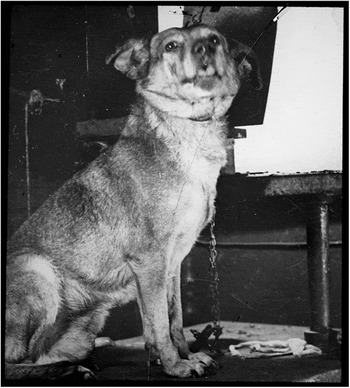
From July 1934 to July 1936 Nick was rested, and the experimentation ceased. The dog remained in his paddock and was brought to the experimental room only occasionally for observation. Gantt observed that Nick nevertheless developed new symptoms including: asthmatic-like breathing Footnote 41 (1935), frequent urination (1936), and marked and persistent sexual erections (1937). (See Figure 2). In his book of 1944, Gantt used the term “spread of disturbance” to refer this process of extension of the symptoms through different physiological systems in absence of the conflict situation (Gantt, Reference Gantt1944, p. 51).
Nick’s constellation of symptoms during the conditional stimulus (tone) in the conflict situation, as described in Gantt’s book (1944, p. 133): “Nick during tone. Note the anxiety-like facies, with labored breathing, tugging on leash, sexual erection” (Image courtesy of the Alan Mason Chesney Medical Archives of the Johns Hopkins Medical Institutions. Reproduced with permission).

Like the other symptoms, the sexual erections appeared not only when the dog was taken into the experimental camera and exposed to the stimuli used there, but also outside when the dog was exposed to familiar laboratory stimuli. While on the farm in 1939, Nick was offered the same kind of food used in the laboratory –and this resulted more than once in immediate urination on the food, and sometimes in erection with ejaculations.
Gantt’s main observations about Nick’s sexual symptoms were: 1) the experimental chamber, and some elements of the situation –food, as well as the people involved- provoked abnormal sexual erections; 2) the experimental chamber inhibited normal sexual function produced either by artificial (masturbation during 1 min. and peripheral –faradic- stimulation applied to the external genitalia) or by natural stimuli (presence of a female in estrus in the experimental room or in the paddock); 3) both artificial and natural sexual excitation temporarily inhibited the neurotic symptoms produced by the tone (Gantt, Reference Gantt1944, especially pp. 132–144; for a detailed analysis of sexuality from Gantt’s perspective see also Levens, Reference Levens2005).
Gantt always considered that his observations about Nick’s abnormal sexual behavior were one of the principal contributions of this book. Apparently, Meyer didn’t like very much these studies, so Gantt published the book once Meyer was retired. The incident is related in Gantt’s unpublished autobiography in the following terms:
Since the Johns Hopkins Medical School was founded mainly by those who had their training in Germany, the heads of the Departments exercised an absolute control in both salaries and publications of those under them. For this reason, my book ‘Experimental Basis for Neurotic Behavior’ was prohibited publication by the head of the Department, Adolf Meyer, because of his dislike for some of my discussions of the sexual responses in dogs. This, however, did not prevent my doing the scientific work, and I was able to publish the book only after his retirement. Although this incident certainly annoyed me, I recognized the right of the head of the Department to control the publications from that Department Footnote 42 .
The year 1938 marked a turning point in Nick’s life. Gantt then began to study what he called the “human social factor”. What he observed was the paradoxical effects of the presence of a person on Nick’s reactions, either being a trigger of the anxiety reaction or having a quieting effect during the presentation of the conflict tone –an effect never observed while other dogs were in the experimental chamber with Nick (Gantt, Reference Gantt1944, especially pp. 145–150). So, for example the approach of Harry Schmidt, the laboratory technician, produced in Nick many of the pathological symptoms, but these symptoms disappeared when Schmidt stood close to the dog or petted him. Indeed, any person who petted the dog dispelled Nick’s anxiety reactions to the tone.
Why Harry Schmidt gave rise to Nick anxiety is not a mystery, for it was Schmidt who usually punished the dog for trying to scratch off the glass tube attached to the salivary fistula or for shaking himself during experiments and so disrupting the record system. Footnote 43
From 1938 on, in order to alleviate Nick’s symptoms new therapeutics measures were tested. Gantt assessed the efficacy of alcohol, and of associating the tone that had earlier give rise to Nick’s disturbance with a new defensive reflex (flexion of the paw after receiving an electric shock). None of these treatments were effective in dispelling Nick’s symptoms. Footnote 44
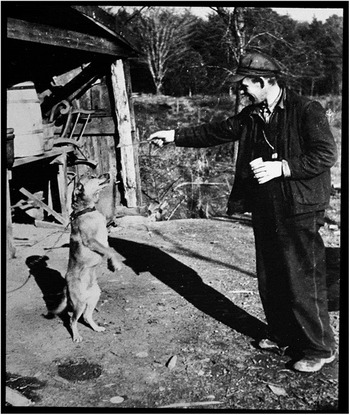
The most effective therapy for Nick was a combination of resting (outside the laboratory) and social factors. Nick was transferred to Gantt’s farm in Virginia for two periods –a short time in 1937 (August 1-October 3), and a longer period from August 1939 until January 1941 (See Figure 3). During both periods, Nick progressively changed his negative reactions toward Gantt, although he maintained his reserve toward Harry Schmidt; when the technician visited Nick at the farm, the dog showed “a marked negativism toward him, running away, crouching at his feet and turning on his back” (Gantt, Reference Gantt1944, pp. 93–94).
“Nick accepting food from attendant on farm, 1940” (Gantt, Reference Gantt1944, p. 150). (Image courtesy of the Alan Mason Chesney Medical Archives of the Johns Hopkins Medical Institutions. Reproduced with permission).

Many of Nick’s symptoms did improve during his stay in the farm, e.g., his heart rate was significantly lower than in the experimental room; others however did not –when Gantt approached Nick the loud breathing appeared. Only during the summer of 1940, did the relationship between Gantt and Nick definitely change when Gantt began to feed and walk the dog. After that Nick became friendlier with Gantt (Gantt, Reference Gantt1944, p. 165).
These resting periods produced a marked improvement in Nick’s condition. The improvement was proportional to the length of the period. Unfortunately, the old symptoms progressively started again, showing that Nick “was by no means cured” (Gantt, Reference Gantt1944, p. 166).
According to Gantt’s book “Nick came to an end… perhaps appropriate to his life –he was killed accidentally in a fight with another dog” (Gantt, Reference Gantt1944, p. 166). The fact is that the elderly Nick, the hefty mutt once the star of Phipps Clinic, “was reported to have died on 22 Dec. The attendant had thrown the body into the garbage can… The dog obviously died in a violent fight from rupture of trachea”. Footnote 45
The book: “It will remain as one of the standard work on experimental neuroses” Footnote 46
Gantt’s Experimental Basis for Neurotic Behavior is a monograph about the studies on “behavior disorders” in dogs carried in the Pavlovian Laboratory of Phipps Clinic from 1931 to 1943. It is completely focused on what Pavlov had termed “experimental neuroses”.
Gantt addressed his book to an audience of clinicians –psychiatrists, psychologists, and physicians. Footnote 47 Being aware of the difficulties of Pavlovian theories for an audience lacking highly specialized knowledge of them, Gantt used a descriptive style, focused his message in the importance of this methodology, and selected his material according to its relevance for clinical settings. For example, he included several clinical measures of the development of disorder as changes in the blood sugar, effect of adrenalin, acetylcholine, and gastric acidity. Overall, the book conveyed the impression of close contact with the clinical setting. As Liddell wrote in a letter to Gantt:
I think you have done more in your Monograph to bring our work into direct working relations with clinical medicine than anything that has been done in our field, not excluding Pavlov’s work. It seems to me that Nick will become overnight a famous patient whose case history will be referred to in the literature for many years to come Footnote 48 .
The chronological presentation of the life of the dogs and his rhetorical strategy of give the voice of the Pavlovian theories to other person, Ischlondsky, gave the impression that Gantt’s studies arose from the clinical observation of dogs rather than from his conviction about the feasibility of Pavlovian physiological theories about the brain.
From the beginning of the book, Gantt introduces the reader to the influential Pavlovian metaphor of “balance-imbalance”: Footnote 49 For Pavlov, when excitatory and inhibitory brain waves collide severely, the system of positive and negative conditional reflexes responsible for maintaining the balance between the environment and the organism is disrupted, and the result may be a constellation of symptoms as previously described in Nick. The regular and balanced reactions observed in the conditional reflexes of a normal dog give way to the imbalance, chaos and variability of a neurotic dog: As Gantt put it “the pronounced variability of Nick in many functions give a picture of an animal under constant bombardment of extreme fluctuations in every measured function” (Gantt, Reference Gantt1944, p. 173).
Rhetorically, this Pavlovian metaphor also permitted Gantt to connect his research with the social concerns of American society during the World War II. Gantt thought that individuals and societies work in the same way: integrating their activities in adapting to the environment. Under certain circumstances, however, “the living unit or a part may react in such a way as to defeat all these goals. The resulting chaos may end either in mass disorganization, such as is represented by war, or in individual disorganization leading to the neurosis and psychoses” (Gantt, Reference Gantt1944, p. 195). Just as the balance and integration were signs of healthy individuals and societies, so were the imbalance and disorganization symptoms of pathological individuals and societies. In this way, Gantt, as had Pavlov, assumed the existence of an analogy between individual and society:
In such a periodically recurring chaotic world state of affairs any approach to the question of emotional imbalance is important. Though this monograph may have only a remote and at present indirect relation to international problems of upheaval, a study of the emotional reactions in the laboratory offers some knowledge, and may open one door for the control of the destructive tendencies that make adjustments difficult, both individually and internationally (Gantt, Reference Gantt1944, p. viii).
References to the effect of war, violence and chaos permeate Gantt’s book. Many of the dog’s disturbances originated in some experience of violence. Some of these experiences were accidental –as when 15 dogs who lived together in two paddocks were roaming during a weekend barking and fighting among them. Others were provoked experimentally in the laboratory in an attempt to produce artificial neurosis –as when Gantt subjected two dogs to attacks by fierce bull-dogs, or reproduced in the laboratory some such elements of war and battle as rough treatment, explosions, and physical pain (Gantt, Reference Gantt1994, especially pp. 19–31).
Just like the experiences of violence produced neurotic symptoms in dogs, so did war cause nervous upheavals in soldiers. This similarity was suggested to Gantt by Dr. Victor Rosen, a military psychiatrist. Footnote 50 In a letter sent to Gantt, Rosen explicitly mentioned the correspondence between Nick’s symptoms and the symptoms observed in some soldiers after a battle: “I have a few boys on my ward from Guadalcanal who remind me of Nick with his tachycardia, panting and pollakiuria”. This resemblance, Rosen wrote, was not simply a mere equivalence of symptoms, the life of these soldiers, as of Nick’s, was full of “unresolved conflicts and difficult differentiations”, and the symptoms were not noticeable “until there was an overwhelming threat to their personal integrity”. Footnote 51
So, Gantt’s book is the expression of the converging influences of Pavlov and Meyer on a scientist interested in showing the significance of a methodology, the conditional reflexes, for the clinical setting, and in a moment, the World War II, of marked social instability and deep concerns about how to face the neurotic disturbances.
Persuading audiences: “And in spite of the canine variations we see much in Nick that is basic for the human being” Footnote 52
Gantt’s stories about his neurotic dogs –and Nick’s was no exception- were aimed both at an audience of specialists through publications in journals and scientific books, and at the broader public through a series of newspaper articles during the 1930s and 1940s.
Scientists in various specialties responded favorably to Gantt’s book, reviewing to it positively in their journals; Stanley Cobb, a well-know neurologist at Harvard, wrote the reviews for American Journal of Psychiatry (Cobb, Reference Cobb1945a) and Archives of Internal Medicine (Cobb, Reference Cobb1945b), and emphasized in both cases Gantt’s demonstration of the importance of the individual differences: “Of special interest is the agreement of Pavlov, Liddell, and Gantt on the importance of the ‘premorbid personality’ of the animal, his lability or stability, which accorded to Gantt can be tested only by special methods” (Cobb, Reference Cobb1945b, p. 69). The question of types was also highlighted in other medical journals including Journal of the American Medical Association (Carlson, Reference Carlson1944), British Medical Journal (Anonymous, 1944), and such clinically oriented journals as the Bulletin of the Johns Hopkins Hospital (F. W., 1945), Psychosomatic Medicine (Mirsky, Reference Mirsky1945), American Journal of Orthopsychiatry (Levy, Reference Levy and Horsley Gantt1945), and Archives of Neurology and Psychiatry (Anonymous, 1946).
In The Psychoanalytic Quarterly, the reviewer praised Gantt for presenting “in such an unbiased, open-minded way” his experiments and also for abstaining “from devising a premature theoretical system of his own, confining himself to cautious explanations of directly observed mechanism” (Herold, Reference Herold and Horsley Gantt1946, pp. 107–109).
The most critical review was written by Donald B. Lindsley for the Journal of Consulting of Psychology. After recognizing that Gantt’s book included “extremely interesting observations of the production of behavior disturbances in dogs,” and describing Gantt’s approach as “essentially clinical” and “based principally upon the life stories of three dogs”, Lindsley however regretted that the “application of the method, the measurements and the resulting data do not always appear to be too precise nor systematic and are seldom subject to statistical analysis” (Lindsley, Reference Lindsley and Horsley Gantt1946, p. 63).
For the lay public, Gantt was portrayed in the newspapers as a scientist involved in the study of the ailments of the mankind, and his experiments as a way to obtain scientific responses to the illness of those times. These articles included descriptions of experiments with dogs and Gantt’s answers to different questions. In his responses, Gantt indulged himself in generalizations never used in his publications for scientific audiences. For example, one newspaper proclaimed in 1934 “Neurotic Mongrels, Some Bordering on Insanity, Used in Check of Mental Disorder of Nation”. Footnote 53 In the article, Gantt claimed that the disturbed reaction of a dog to a difficult differentiation “was similar to that of many persons who committed suicide”, Footnote 54 and after explaining the differences between the easiness of extinction of two consecutive conditional reflexes, Gantt told the journalist:
The extinction of the second conditional reflex we have found is much easier than the first. Also, when a reflex has been extinguished and restored it is never so stable as it was before an extinction. Don’t you see what an enormous significance has in the destruction of the moral codes? Gantt asked. It explains why a person untrustworthy in one thing is usually so in another. It explains the chaos produced by revolution and war. It explains the difficulty in bringing about permanent cures in drunkards and convicts Footnote 55
.
The spread of the symptoms that Nick experienced “may explain how adults, with apparently no physical disorders, find themselves unable to do certain things –and even suffer from neurosis- because of problems which they as children had been unable to solve”. Footnote 56
The connections between dogs’ disturbances and soldiers’ breakdowns in battle, -so-called shell shock or war neurosis- were repeatedly mentioned. So, just as Nick’s heart rate jumped in the presence of one element of the conflict while other motor responses had disappeared, a soldier:
After a particularly grueling experience, bombing, mutilation of friends in a battle… breaks down both internally and externally –perhaps he weeps, wrings his hands or even run away. Two years later, long after he is out of the Army, he sees a recruiting poster or read a headline about another conscription. Immediately, he reacts organically, although he is consciously under control and does not react externally. He does not weep or run away, or change the expression. But his heart and his respiration speed up Footnote 57 .
The most important message transmitted to both specialists and lay people was that experiments upon dogs were useful in finding a possible solution. In the dogs, the return to nature –Gantt’s farm at Virginia-, and the friendly contact with man had greater beneficial effects than drugs: “The presence of a human being in the room with the dog reassures him so that he does not show the anxiety symptoms as long as the person is with him… Prolonged rest on the farm has had a beneficial effect”. Footnote 58 Therefore, in the case of humans therapeutic measures should include resting “in a complete change of scene including persons”, Footnote 59 and a psychotherapeutic treatment in which the ‘rule of abstinence” defended by Psychoanalysis was not observed: “what an important role interpersonal relationship must play in psychiatric treatment”. Footnote 60
Nevertheless, “greater beneficial effect” wasn’t exactly equivalent to a complete recovery. At the farm, rest and social factors ceased his symptoms but did not cure them. The symptoms recurred again and again in the conflict environment –once the neurosis aroused, it seemed “very obstinate and resistant to treatment”. Footnote 61 What Gantt envisioned, then, was a preventive approach based on the sensitivity of conditional reflexes as a measure of imbalance. This approach transcended the individual level, setting up a social program aimed to detect those individuals vulnerable to this kind of disturbance. This prophylactic message was directed simultaneously to both scientific and lay audiences. So, for instance in a psychiatric journal Gantt claimed “The most important therapeutic indication is the detection of susceptible animals by measuring the reactions under strain, and preventing the progress to that point at which a permanent breakdown occurs. Once the disturbance is thoroughly established, therapy is difficult” (Gantt, Reference Gantt1942, p. 481). This preventive strategy was described in a newspaper as a “far-reaching mental-hygiene program” which would:
-
a. Establish mass, routinely administered tests in schools and other organizations to determine relative susceptibility to nervous disorders.
-
b. Remove the more susceptible persons from especially disturbed environments –calculated to accelerate their neuroses- and place them in surroundings and occupations best suited to their innate tendencies and capabilities, considering especially emotional stability Footnote 62 .
Conclusion
Nick’s story is a scientific product in which come together the different traditions that shaped Gantt’s approach to the study of nervous disorders –the Pavlovian and the Meyerian. From a literary point of view, the result of this combination is a biographical composition, a life story that make possible to trace back the origin of every observed symptom to certain life experiences. Each concrete experience –whether the effect of a metronome on the salivary reactions or the effect of petting- makes sense, as in any other biography, in the whole context of the life of the individual starring the tale. So, Gantt’s rhetorical strategy of focus his book on the complete story of an individual made it easily recognizable to diverse audiences -psychiatrists, psychologists, physicians and general public. Particularly, Gantt’s presentation of Nick’s case in his book is a “patho-biography”. It pretends to be a Pavlovian “patho-biography”, that is, an objective description of the dog’s reactions –and in some sense it is. But at the same time it is also full of the subjectivity involved in the narrative of a clinical case. So, at the beginning of the story Nick was “more friendly toward strangers” Footnote 63 than to those who worked with him, but at the end Nick “after my close association with him he became a most devoted companion, following me everywhere, even into the river at about age of 10, though he has never learned to swim before. He exhibited toward me loyalty and affection than pet dogs which I had there at the same time” (Gantt, Reference Gantt1944, p. 165).
It was precisely the biographical nature of Nick’s story that enabled Gantt to present his main results in a manner understandable for those who were unfamiliar with the specialized language of Pavlovian physiology. Gantt’s style of physiology Footnote 64 emphasized, on the one hand, the usefulness of the conditional reflexes as a tool that would help the clinicians in the diagnosis, investigation and prevention of the nervous disorder –at the expense of the more theoretical aspects of Pavlovian physiology, and, on the other hand, focused on the individual as a way of studying the uniqueness of each clinical case, a feature overshadowed in the statistical approach used by experimental psychologists at that times. As Heinrich Klüver wrote to Gantt after receiving a copy of his book:
Congratulations on your 1944 monograph! I feel you should not be apologetic about the few cases. The detailed story as you present it is infinitely more important than “averages” derived from hundred of cases and it will survive thousand of theories Footnote 65 .
At last, the biographical nature of Nick’s case permitted Gantt to enhance one of the Pavlovian themes par excellence –the types. Just as Pavlov had attributed great importance to the types, so did Gantt as well, considering the question of individual variability as essential, and proposing a functional classification of types in two categories: “stable and labile”. The key to making this typology was compare the reactions of the different individuals to a same light load of stress –the most satisfactory artificial stress is the conflict between excitation and inhibition, such as is provided by the difficult differentiation of two similar conditional stimuli-, and measure his reactions in as many physiological systems as possible. His results with Nick, Fritz, and Peter, indicated that “the stable animal remains stable and the labile animal who cracks under one kind of stress shows the same pattern of abnormality under other stresses” (Gantt, Reference Gantt1944, p. 177). Here, Gantt thought, was the basis to develop a test for the early detection of the more susceptible individuals.
Both Nick’s case and Gantt’s style of research were the products of Pavlov’s introduction of the chronic experiment in physiology and Meyer’s vision for Phipps Clinic, the “three horse team”: care of patients, research, and teaching. A research conceived in terms of “letting the problems arise from clinical issues encountered, rather than any tendency merely to use the patients to try out methods for method’s sake or to test foreign suggestion from literature and polemics”. Footnote 66 One of the Meyer’s dictum still echoes in Gantt’s Nick case (Lief, Reference Lief1948, p. x): “I put my emphasis on specificity. It is ‘the story’ that counts in a person”.