


Introduction
Perfectionism is argued to be a ‘transdiagnostic’ process that is an important risk and maintaining factor across a number of disorders (Egan et al., Reference Egan, Wade and Shafran2011). In particular, perfectionism is associated with obsessive compulsive disorder (OCD). The Obsessive Compulsive Cognitions Working Group argued that perfectionism is one of six core cognitive feature of OCD (see Egan et al., Reference Egan, Wade and Shafran2011). Theorists have argued that perfectionism triggers the development of OCD, particularly a sense of having never performed actions in ‘just’ the right way (see Frost et al., Reference Frost, Di Bartolo, Flett and Hewitt2002). Within the cognitive-behavioural model, OCD manifests from three cognitive distortions including perfectionism, the belief in the existence of perfect solutions, and a need for certainty (see Frost et al., Reference Frost, Di Bartolo, Flett and Hewitt2002). Further, cognitions aligned with perfectionism can lead to misguided threat appraisal, which is at the core of OCD. For example, the belief that one must be perfectly competent or that failure to achieve perfect standards should result in punishment, perpetuates the repetition of compulsive behaviours in order to avoid feared consequences (see Frost et al., Reference Frost, Di Bartolo, Flett and Hewitt2002).
Perfectionism has been found to predict poorer treatment response in OCD (see Egan et al., Reference Egan, Wade and Shafran2011). Kyrios et al. (Reference Kyrios, Hordern and Fassnacht2015) found that pre-treatment perfectionism and intolerance of uncertainty were the only significant and unique predictors of treatment outcome in OCD. Kyrios et al. (Reference Kyrios, Hordern and Fassnacht2015) concluded that future OCD treatment may need to focus on changing perfectionism earlier in treatment to enhance outcomes. These findings suggest that it may be useful to directly target perfectionism in the treatment of OCD.
Given that perfectionism has been found to predict poorer treatment outcomes, it has been argued that this transdiagnostic construct should be directly targeted in treatment (Egan et al., Reference Egan, Wade and Shafran2011). A recent meta-analysis of eight trials found that CBT for perfectionism (Egan et al., Reference Egan, Wade, Shafran and Antony2014) is associated with large reductions in perfectionism and medium reductions in anxiety and depression (Lloyd et al., Reference Lloyd, Schmidt, Khondoker and Tchanturia2015). However, to date, studies have included insufficient participants with OCD (e.g. n = 2) to enable a comprehensive examination of the efficacy of CBT for perfectionism (CBT-P) for OCD.
The aim of this study was to compare group CBT-P to waitlist in a sample of participants with OCD. The mode of delivery of CBT-P in trials has been mixed. A number of studies have delivered CBT-P individually; however, larger trials have adopted group delivery to optimize time and cost efficiency (see Lloyd et al., Reference Lloyd, Schmidt, Khondoker and Tchanturia2015). To date, individual and group CBT-P have not been compared. As this is the first trial of CBT-P for OCD, group CBT-P was employed to maximize resource efficiency and the opportunity to deliver the intervention to more participants. It was predicted that CBT-P would be superior to waitlist in reducing clinical perfectionism and OCD severity at post-treatment and that these reductions would be maintained at 3-month follow-up.
Method
Design
The study employed a randomized waitlist-control design. Tabulated, block randomization was used to allocate participants into an 8-week group intervention or 8-week waitlist, which was carried out by an independent clinician to minimize selection bias. At the conclusion of the waitlist, participants were non-randomized to the intervention group (see supplementary material for further details regarding study design).
Inclusion and exclusion criteria
Inclusion criteria were: (i) age 18 years and above, (ii) a primary diagnosis of OCD, and (iii) elevated perfectionism indicated by a score of ≥ 22 on the concern over mistakes subscale of the Frost Multidimensional Perfectionism Scale (FMPS; Frost et al., Reference Frost, Marten, Lahart and Rosenblate1990), which has been used as a cut-off in previous perfectionism treatment studies. Exclusion criteria included self-harm, moderate or severe suicidal ideation, psychosis, an organic mental disorder, substance abuse or dependence, or a principal diagnosis other than OCD. Participants were requested to not engage in other psychological intervention from baseline until 3-month follow-up, and to maintain a stable dose of psychotropic medication throughout the trial.
Procedure
Individuals who expressed interest were first screened over the telephone, which involved administering diagnostic screening instruments to determine suicide risk and the presence of OCD and perfectionism symptoms. Eligible individuals based on this screening were then assessed face-to-face using a clinician-administered structured diagnostic interview and the outcome measures outlined below (see supplementary material for further details).
Measures
Outcome measures were administered to the waitlist group at pre-test and post-waitlist. The intervention group completed outcome measures at pre-treatment, post-treatment and 3-month follow-up. Outcome measures consisted of the Yale-Brown Obsessive Compulsive Scale (YBOCS); FMPS; concern over mistakes (CM) and personal standards (PS) subscales; and the Clinical Perfectionism Questionnaire (CPQ). See supplementary material for further details.
Participants
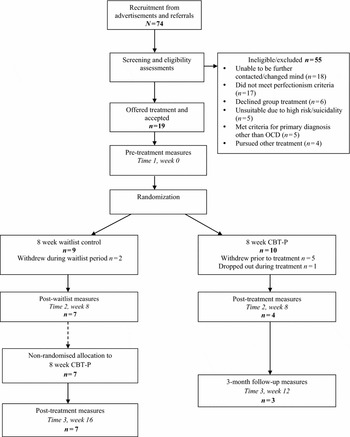
There were 74 individuals who expressed interest and were screened. A consort diagram is presented in Fig. 1. A total of 19 individuals (26%) were eligible and accepted into the study (69% female). There were 11 participants (age range 26‒61 years, mean = 40.00, SD = 10.39) who completed treatment (42% drop-out), four who received treatment immediately and seven who received treatment following the waitlist period. A summary of OCD symptom presentations for the sample is presented in the supplementary material (Table S1).
CONSORT diagram of participant recruitment and allocation through the study

Intervention protocol
CBT-P was delivered in groups, with 2-hour sessions held once weekly over an 8-week period (Egan et al., Reference Egan, Wade, Shafran and Antony2014). CBT-P has previously been found to be effective in reducing symptoms of anxiety, depression and eating disorders (Lloyd et al., Reference Lloyd, Schmidt, Khondoker and Tchanturia2015). Sessions were delivered by trainee postgraduate-level clinical psychologists, under the supervision of registered clinical psychologists.
Results
A within-subjects (paired-samples) analysis of effect sizes, together with an examination of statistically reliable and clinically significant change, was used to examine the efficacy of CBT-P versus waitlist.
Descriptive clinical means and effect sizes
Tabulated demographic data for the full sample is reported in the supplementary material (Tables S2 and S3). Descriptive clinical data for the waitlist and intervention group on each outcome variable was as follows: waitlist (n = 7); CM: pre-treatment mean = 33.28, SD = 8.56, post-waitlist mean = 33.14, SD = 8.55; PS: pre-treatment mean = 28.57, SD = 4.47, post-waitlist mean = 29.42, SD = 3.36; CPQ: pre-treatment mean = 32.0, SD = 4.43, post-waitlist mean = 33.14, SD = 6.25; YBOCS: pre-treatment mean = 26.57, SD = 2.87, post-waitlist mean = 27.57, SD = 2.07; intervention (n = 11); CM: pre-treatment mean = 33.00, SD = 2.08, post-treatment mean = 26.67, SD = 4.81, follow-up mean = 30.67, SD = 3.48; PS pre-treatment mean = 28.63, SD = 4.13, post-treatment mean = 26.45, SD = 3.61, follow-up mean = 27.67, SD = 2.60; CPQ: pre-treatment mean = 30.5, SD = 3.81, post-treatment mean = 27.33, SD = 5.17, follow-up mean = 24.33, SD = 2.73; YBOCS pre-treatment mean = 27.45, SD = 3.56; post-treatment mean = 16.45, SD = 5.22, follow-up mean = 15.67, SD = 2.96.
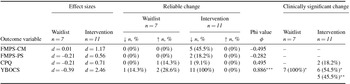
Effect sizes on each outcome variable are reported in Table 1 for the waitlist and intervention group. The intervention group demonstrated an improvement in perfectionism, which according to conventions (Cohen, Reference Cohen1992) indicated a large effect on CM; and a medium effect on PS and the CPQ. The waitlist group had a small effect on these variables. The largest improvement was for OCD symptoms, in which the intervention group demonstrated a considerable reduction in YBOCS symptoms as indicated by a mean reduction in severity of 11 points from ‘severe’ to ‘moderate’ at post-treatment.
Comparison of effect sizes and proportion of participants in the waitlist and intervention conditions demonstrating reliable and clinically significant change on outcome variables from pre to post treatment

The intervention group includes data from immediate intervention and waitlist participants; n, % = ↓ number and percentage of participants who experienced a reliable decrease (improvement) on the outcome variable; ↑ n, % = number and percentage of participants who experienced a reliable increase (deterioration) on the outcome variable; FMPS, Frost Multidimensional Perfectionism Scale; CM, concern over mistakes; PS, personal standards; CPQ, Clinical Perfectionism Questionnaire; YBOCS, Yale-Brown Obsessive Compulsive Personality Scale; *unchanged; **recovered, improved; d = Cohen's magnitude of effect; Phi value = magnitude of effect (0.10 = small, 0.30 = moderate, +0.50 = large); ***strong positive association.
Reliable change
A reliable change index (RCI) score was computed for each participant according to established criteria (see supplementary material). Results for statistically reliable change at post-test are reported in Table 1. Consistent with our predictions, the waitlist group indicated no reliable improvement on any perfectionism measure over the waitlist period, whereas five (45.5%, CM), two (18.2%, PS) and one (9.1%, CPQ) participant in the intervention group achieved a reliable reduction on the perfectionism measures. One waitlist participant indicated a decrease in the CPQ. The most pronounced improvement was for OCD severity, with all 11 participants in the intervention group displaying a reliable reduction in YBOCS symptoms at post-treatment. Two waitlist participants experienced a reliable deterioration in OCD severity. For each outcome measure, the strength of the association between group (intervention, waitlist) and reliable change (yes, no) was measured by the Phi statistic. The Phi coefficient indicated moderate associations for CM and CPQ, and a small-to-moderate association for PS. The strength of the association for YBOCS was large, strong and positive (Phi ϕ = 0.886) indicating that, compared with the perfectionism outcomes, CBT-P had its strongest impact on OCD symptoms.
Tabulated reliable change index scores for intervention participants available at 3-month follow-up (n = 3) are reported in the supplementary material (Table S4). Two participants reported further improvement from post-test to follow-up in perfectionism on CM (Frost et al., Reference Frost, Marten, Lahart and Rosenblate1990), and one participant indicated reliable deterioration in perfectionism. One participant reported a reliable improvement in perfectionism according to the CPQ, whilst two participants reported a reliable deterioration. Each participant demonstrated reliable improvement in OCD symptoms at follow-up.
Clinically significant change
Clinically significant change indicates whether a participant's post-treatment score on an outcome measure is more likely to represent the functional or the dysfunctional population. In the absence of normative reference data for the CPQ, previous research has used a post-treatment score that is two standard deviations below the samples’ pre-treatment mean to define clinically significant improvement (see supplementary material for sources). According to this criterion, two intervention participants in our sample who indicated reliable change in their CPQ score also achieved clinically significant improvement.
As there is currently no normative reference data for the YBOCS, Fisher and Wells (Reference Fisher and Wells2005) have argued that when measuring OCD severity, a shift from a pre-test score of above 14 to a post-intervention score of 14 or below represents a clinically significant change. Three participants from the intervention group (n = 11), and none from the waitlist satisfied the Fisher and Wells (Reference Fisher and Wells2005) criterion for clinically significant change on the YBOCS.
In addition to RCI scores used to establish pre-post treatment changes, Fisher and Wells (Reference Fisher and Wells2005) established that a 10-point change criterion on the YBOCS is required to show that a statistically reliable change has taken place, such that individuals who meet criteria for reliable and clinically significant change are classified as recovered; a 10 or more point decrease is classified as improved; a 10 or more point increase is deteriorated; and a variation in score by less than 9 points is considered unchanged. According to these criteria, 45.5% of the intervention group were recovered, with the remainder unchanged. In comparison, all waitlist participants were unchanged.
Discussion
This is the first study to examine CBT-P in an OCD sample. Consistent with predictions, CBT-P was associated with improvements in perfectionism and OCD severity, as indicated by a reduction in primary outcome means and medium to large effect sizes. However, the prediction that reliable changes would be accompanied by clinically significant improvement was not supported, as only 18.2% of participants experienced a clinically significant improvement in perfectionism and 45.5% of participants experienced a clinically significant improvement in OCD severity. Reliable improvements were maintained in a small sub-set of participants (YBOCS, n = 3; FMPS-CM, n = 2; see supplementary material for details).
These results make a novel contribution as the first examination of the CBT-P intervention in an OCD sample. However, the lower than expected rates of clinically significant change and high rates of drop-out are less encouraging, which may have been influenced by a number of limitations to the study.
In addition to the small sample size and high drop-out rate, one limitation was the standardized selection of participants on their ≥ 22 point CM subscale (perfectionism) score of the FMPS (Frost et al., Reference Frost, Marten, Lahart and Rosenblate1990). A total of 17 individuals were ineligible in our study because they did not meet this criterion, resulting in a relatively large proportion (31%) of potential participants being precluded. Future OCD studies could consider removing the perfectionism inclusion criterion. Given the association between perfectionism and obsessive-compulsive pathology (Egan et al., Reference Egan, Wade and Shafran2011), implementation of the CBT-P intervention could be effective in participants’ learning relevant useful therapeutic content and principles that generalize to OCD symptoms.
Whilst the Fisher and Wells (Reference Fisher and Wells2005) criterion of an OCD cut-off score of 14 or below and a 10-point change (decrease) on the YBOCS for clinically significant change sets a robust benchmark, in practice the criteria are somewhat stringent, requiring a substantial categorical downwards shift in severity, for example from moderate to mild. This can be difficult to achieve in the context of a relatively brief eight-session group treatment programme and given that it is acknowledged that OCD tends to persist at moderate levels in many people following treatment (Kyrios et al., Reference Kyrios, Hordern and Fassnacht2015). Future studies may seek to increase therapy duration (e.g. 12 weeks) or frequency (e.g. bi-weekly sessions) in order to observe whether clinically significant change outcomes improve with treatment intensity.
Of the total sample that was offered and accepted into the study, 42% dropped out on the day prior to starting treatment or during the initial stages of programme commencement. In addition, only three participants were available at 3-month follow-up, which limited our ability to evaluate the longevity of the intervention. The drop-out rate is relatively high compared with the drop-out observed in recent OCD treatment studies (e.g. 25%; Kyrios et al., Reference Kyrios, Hordern and Fassnacht2015). Further, the manner of drop-out in the current investigation, which predominantly occurred prior to commencement of the intervention, was unique relative to previous OCD trials in which drop-out occurred during the course of treatment. The focus on perfectionism in the current study is a point of distinction compared with previous OCD studies. As such, it is conceivable that elevated perfectionism may have played a role in the significant drop-out, given its association with rigidity and ambivalence about change (Egan et al., Reference Egan, Wade and Shafran2011). Further, a number of participants declined treatment because it was group-based. It would be useful for future research to investigate reasons for drop-out and declining therapy to inform understanding of the feasibility of treatment and further clinical trials for perfectionism in OCD. One way to improve retention may be to engage individuals with OCD and perfectionism in treatment individually first, in order to mitigate concerns regarding performance in a group setting.
Given the small sample, it would also have been useful to have measured symptoms across the treatment programme (e.g. weekly) as this may have provided richer data from which to evaluate the sample and efficacy of the intervention. Given that some studies have found perfectionism interferes with treatment response in OCD (e.g. Kyrios et al., Reference Kyrios, Hordern and Fassnacht2015) it would be useful to further investigate how to address perfectionism in OCD to improve treatment outcomes. Conceivably, by increasing flexibility in thinking and increasing capacity for more realistic standards (i.e. addressing perfectionism at pre-treatment or as a simultaneous adjunctive component), individuals may then be more amenable to engaging in necessary exposure-based exercises with increased self-awareness and more realistic expectations for performance.
In summary, further research is required to determine whether effects for perfectionism treatment for OCD are more robust when implemented with a larger sample over a longer time period, or whether drop-out is still a significant problem. Preliminary outcomes from this study suggest that CBT for perfectionism would be useful to investigate in future studies with larger samples to evaluate the effectiveness of this intervention.
Acknowledgements
Financial support: This research received no specific grant from any funding agency, commercial or not-for-profit sectors.
Conflicts of interest: Shalane K. Sadri, Rebecca A. Anderson, Peter M. McEvoy, Robert T. Kane and Sarah J. Egan have no conflicts of interest with respect to this publication.
Ethics: This study has been approved by the Curtin University Human Research Ethics Committee (approval no. HR38/2014). The authors assert that all procedures contributing to this work comply with the ethical standards of the relevant national and institutional committees on human experimentation and with the Helsinki Declaration of 1975, and its most recent revision.
Supplementary material
To view supplementary material for this brief clinical report, please visit https://dx.doi.org/10.1017/S1352465816000618.




Comments
No Comments have been published for this article.