Introduction
Weeds remain one of the major obstacles to successful crop production in organic farming, even though producers invest considerable resources to control weedsReference Gianessi and Reigner1. New implements, methods and organic herbicides are being developed for weed controlReference Bond and Grundy2, Reference Evans and Bellinder3; yet, even with these additional options, yield losses due to weeds are still prominent.
BarberiReference Barberi4, considering recent advances in methodology, questioned whether emphasis on specific control tactics was the most effective approach to manage weeds in organic systems. He speculated that the control tactic approach may neglect the systemic (‘holistic’) nature of organic agriculture, and encouraged researchers to consider system design in addition to control tactics. A similar suggestion was made by Bastiaans et al.Reference Bastiaans, Kropff, Goudriaan and van Laar5 for conventional farming: a systems approach could be a key to successful weed management.
Our interest in system design is stimulated by a weed management approach used in the semi-arid Great Plains. Historically, producers in this region followed a winter wheat (Triticum aestivum L.)–fallow rotation and they tilled to control weeds during fallow. No-till practices, however, enabled producers to crop more frequently before needing fallow again. Crops such as corn (Zea mays L.), proso millet (Panicum miliaceum L.) and sunflower (Helianthus annuus L.) are now grown in rotations with winter wheat and fallow. With this diversity of crops, producers were able to design cropping systems that disrupted weed population dynamics, subsequently reducing herbicide inputs by 50% compared with conventional practicesReference Anderson6. Less herbicide is needed because weed density in croplands declines across time.
To stimulate more consideration of the systems approach, BarberiReference Barberi4 suggested that examples of system designs for weed management in organic farming be described in the scientific literature. In a similar perspective, Hill and McRaeReference Hill and McRae7, analyzing various approaches to sustainable agriculture systems, found that a vital aspect of successful transitions to sustainable agriculture was designing cropping systems based on ecological principles rather than modifying existing systems in response to a specific issue.
Producers in the Great Plains improved weed management by designing cropping systems to disrupt population growth of weedsReference Anderson8. We speculate that weed management in organic rotations may also respond to rotation design, especially if the design is guided by principles of population ecology. Therefore, the purpose of this paper was to explain the systems approach used successfully by producers in the Great Plains, and then to suggest a rotation design for organic farming based on these principles. Our suggested rotation involves cropping practices prevalent in the western edge of the Corn Belt, but we believe these principles will also apply to other regions where different crops are grown.
A Population-Based Approach to Weed Management
Population-based weed management in the Great Plains involves cultural tactics that reduce weed seed survival in the soil seed-bank, suppress weed seedling emergence and minimize seed production of weeds that escape control. A pivotal factor in this approach is rotation designReference Anderson9. Rotations are arranged to include crops with different life cycles, such as winter wheat and corn. Weeds common in winter wheat, such as downy brome (Bromus tectorum L.), are easily controlled during the growing season of warm-season crops such as corn, thus eliminating seed production of downy brome in that yearReference Anderson9. The lack of seed production along with the natural death of seeds across time reduces density of weed seeds in soil and, subsequently, number of weed seedlings in following years. A similar benefit occurs with warm-season weeds and cool-season crops.
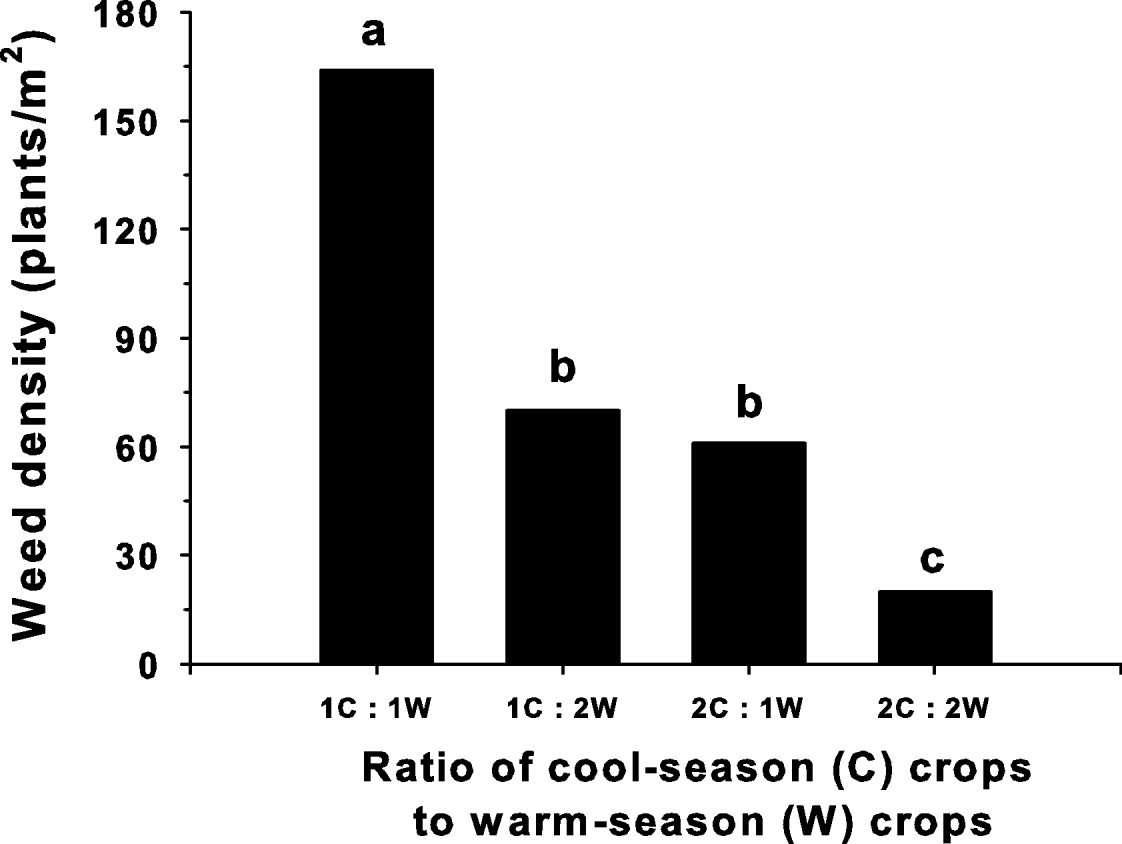
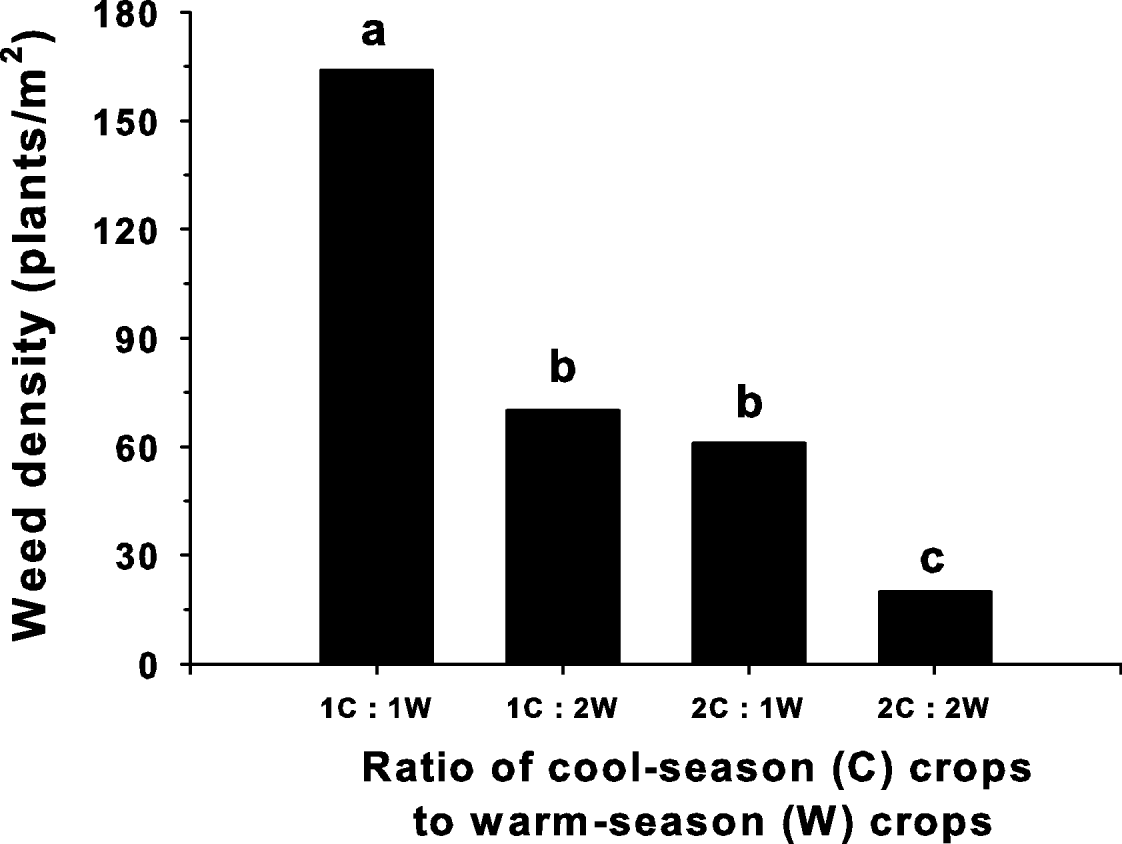
However, the arrangement of cool- and warm-season crops in rotation is critical for weed population managementReference Anderson9. This factor was demonstrated with three long-term rotation studies in the Great Plains. Rotations were comprised of various combinations of cool- and warm-season crops. Weed management was based on best management practices, yet weed community density varied eightfold among rotations after 10 years (Fig. 1). In all studies, the lowest weed density occurred in rotations comprised of two cool-season crops followed by two warm-season crops, whereas rotations comprised of one cool- and one warm-season crop had the highest weed densityReference Anderson6. The 2-year intervals of crops with similar life cycles balance two factors of weed population dynamics: natural decline of weed seed density in soil across time and population growth rate of weeds during the cropping seasonReference Anderson9. The impact of balance between crop seasonal types was also noted with three-crop rotations, where weed density was threefold higher than with four-crop rotations (Fig. 1). Warm-season weeds proliferated with rotations comprised of two warm-season crops and one cool-season crop. Similarly, cool-season weeds were predominant in three-crop rotations that included two cool-season crops.
Weed community density among various rotation designs in the Great Plains. Abbreviations are: C, cool-season crop; W, warm-season crop. Cool-season crops were winter wheat, spring wheat or dry pea; warm-season crops were corn, soybean, sunflower, proso millet or chickpea (Cicer arietinum L.). Data averaged across three studies. Bars with the same letter are not significantly different as determined by Fishers' Protected LSD (0.05). (Adapted from AndersonReference Anderson6.)
A further aspect of rotation design is crop diversity within a life-cycle category. For example, density of downy brome was 40 times higher in a four-crop rotation that included two winter wheat crops compared with the same rotation but where dry pea (Pisum sativum L.) replaced one winter wheat cropReference Anderson8. Planting dry pea in April provided an opportunity to eliminate downy brome seedlings in that year. A similar trend occurs with summer annual weeds; weed density is lower when summer annual crops with different planting dates are grown compared with growing the same crop 2 years in a rowReference Anderson8.
No-till practices also help weed management. This benefit was initially attributed to crop residues on the soil surface suppressing weed germination and seedling establishment, as weed seedling density is reduced approximately 15% for each 1000 kg/ha of residuesReference Anderson8. But, no-till also increases mortality of weed seeds in the soil. Tillage buries weed seeds in soil, thus seeds are protected from environmental extremes and predation. In contrast, leaving weed seed on the soil surface with no-till leads to extensive loss of seed viabilityReference Froud-Williams, Altieri and Liebman10.
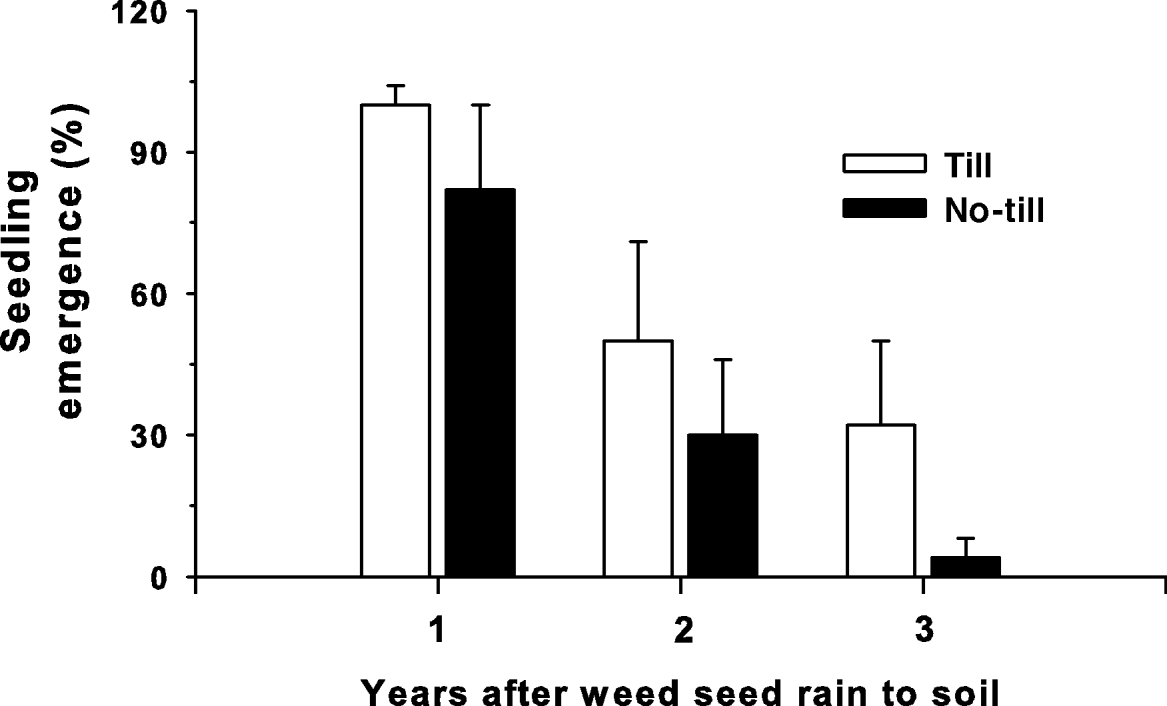
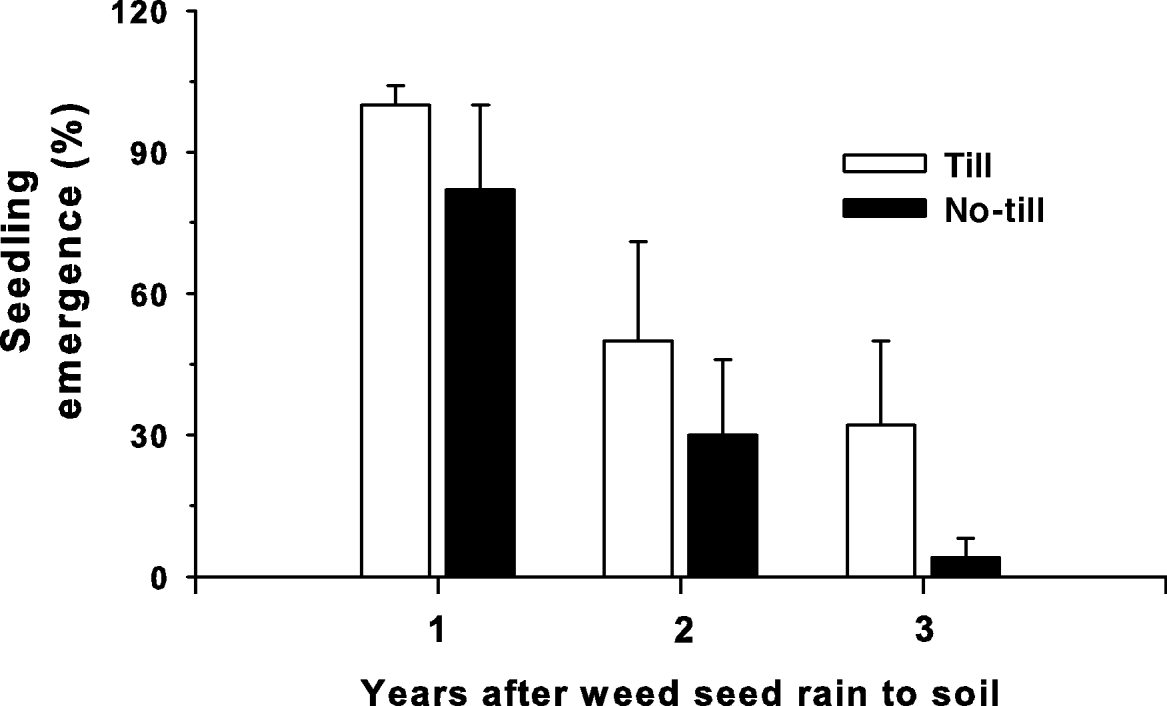
The impact of no-till on weed seed survival was shown in a series of studies that compared weed seedling emergence for 3 years in no-till and tilled treatmentsReference Anderson8. The sites were naturally infested with weeds, but after initiation of each study, further weed seed rain was prevented. Seedling emergence declined 70–95% by the third year compared with the first year (Fig. 2). But differences between no-till and tillage increased with time. In the first year, weed seedling emergence was similar between tilled and no-till, whereas in the second year the difference between tillage treatments was about twofold. In the third year, however, seedling emergence was eightfold greater with tillage. Because of this eightfold difference in the third year, no-till accentuates the effect of 2-year intervals of cool- and warm-season crops on weed dynamics.
Impact of tillage on seedling emergence across time, averaged across four studies. Weed seeds were not added to the soil after initiation of the study; tillage occurred in the tilled treatment each year. Data expressed as a percentage of the treatment with the highest number of weed seedlings in each study. Standard error bars were derived from yearly means among studies. (Adapted from AndersonReference Anderson8.)
The synergistic interaction between no-till and rotation design was demonstrated in the long-term cropping systems studies described aboveReference Anderson6. One site was no-till for the duration of the study whereas a second site was minimum-till, with one tillage operation by non-inversion implements occurring each year. First, weed density was fivefold higher at the tilled site compared with the no-till site, averaged across all rotations in each study. Second, the difference in weed density between four-crop rotations and two-crop rotations was greater in no-till. Weed density was 13-fold higher in two-crop rotations compared with four-crop rotations at the no-till site, but at the minimum-till site, the difference between rotation designs was only fivefold.
An additional factor of weed population ecology is productivity of weeds that establish in crops. Producers can reduce seed production of these plants by improving crop competitiveness with cultural tactics. Several tactics are available, such as increasing the seeding rate or choosing a taller cultivar, but effectiveness is enhanced by combining tactics togetherReference Anderson8. For example, a single cultural tactic with sunflower, such as narrower row spacing, higher plant population, or delayed planting, reduces seed production of redroot pigweed (Amaranthus retroflexus L.) 5–10% compared with the conventional system used by producers. When two tactics are combined, seed production is reduced 15–25%. However, seed production is reduced almost 90% when three tactics are integrated together. Similar trends occur with winter wheat, proso millet and corn; effective suppression of weed seed production requires that several cultural practices be used togetherReference Anderson8.
Producer Experiences with Population-Based Weed Management
Producers are managing weeds with 50% less inputs with no-till rotations such as spring wheat–winter wheat–corn–sunflower or dry pea–winter wheat–corn–proso milletReference Anderson6. Herbicides are not needed in some crops because the low weed density does not affect crop yield. However, weed density has not declined in no-till rotations comprised of only one or two crops; herbicide use remains high with these rotationsReference Anderson6. Successful population management of weeds in the Great Plains requires the synergistic interaction of rotation design, crop diversity, no-till and competitive crop canopiesReference Anderson8.
A Population-Based Approach for Organic Rotations
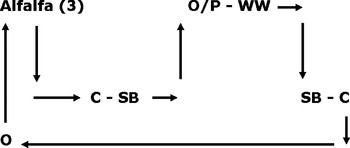
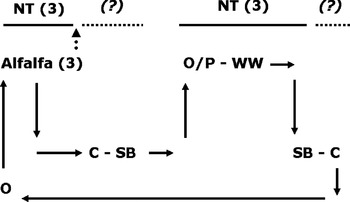
We believe that organic producers can also reduce weed density and management inputs with a population-based approach, especially if rotations are extended to include perennial forages. As an example, we suggest a 9-year rotation consisting of 3 years of alfalfa, followed by a warm-season sequence of corn and soybean, a cool-season sequence of an oat (Avena sativa L.)/pea mixture for forage and winter wheat, a second warm-season interval of soybean–corn, and alfalfa re-established with oat as a companion crop (Fig. 3). Note that the rotation includes 2-year intervals of cool- and warm-season annual crops, and that crops within a life-cycle interval (i.e., cool- or warm-season crops) have different planting dates to provide an additional opportunity to control weed seedlings. Further weed management options are discussed within suggested sequences.
A rotation design that may suppress weed density in organic systems. The figure visually aligns cool-season crops in the upper part of the figure and places warm-season crops below. Abbreviations are: C, corn; SB, soybean; O/P, oat–pea mixture for forage; WW, winter wheat; and O, oat (grown as a companion crop for establishing alfalfa). The (3) refers to 3 years of alfalfa production.

Interval of alfalfa
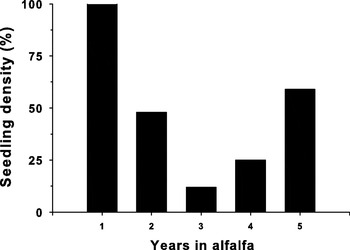
Population dynamics of weeds are disrupted in alfalfa due to both mowing for forage harvest and competitiveness of alfalfa; it is difficult for weeds to establish and produce seeds. Also, weed seeds remain on the soil surface during the alfalfa interval because the field is not tilled; consequently, weed seed survival declines rapidly across time, as noted in Figure 2. Three years of alfalfa is the most detrimental to weed population dynamics, with weed seedling density being only 10% in the third year compared with the first year (Fig. 4). Density of cool-season weeds adapted to alfalfa management, such as field pennycress (Thlaspi arvense L.), dandelion (Taraxacum officinale Weber in Wiggers) and downy brome, increase in the fourth and fifth year of alfalfa. Alfalfa competitiveness with weeds decreases in the later years because stand density of alfalfa declines across timeReference Cummings, Berberet, Stritzke and Caddel14, Reference Mesbah and Miller15.
Seedling emergence of the weed community in alfalfa across time. Data are expressed as a percentage of highest emergence in the first year, and averaged across several studies. (Adapted from Harvey and McNevinReference Harvey and McNevin11, Entz et al.Reference Entz, Bullied and Kapeta-Mupondwa12 and Ominski et al.Reference Ominski, Entz and Kenkel13.)

Corn–soybean sequence
We suggest growing corn first in this warm-season sequence because of high N levels in soil following alfalfa. Also, producers may be able to control weeds in corn without tillage. First, to suppress establishment and growth of cool-season weeds following tillage to control alfalfa, oat or spring triticales (×Triticosecale) could be planted in August. These crops will die over winter, but the remaining crop residue will favor the use of a stale seedbed in corn the next year to reduce early season weed emergenceReference Shaw16, Reference Boyd, Brennan and Fennimore17.
Second, implements have been developed to control weeds in corn without tillage. DonaldReference Donald, Singh, Batish and Kohli18 designed a between-row mower that controls weeds with two operations as effectively as herbicides in corn. Weeds in the row can be controlled by implements such as the finger weeder or rotary-tine weeder, if weed density is low and the crop is larger in sizeReference Bond and Grundy2. Density of warm-season weeds likely will be low after 3 years of alfalfa, whereas the stale seedbed will suppress early growth of weed seedlings present in corn.
Oat/pea–winter wheat sequence
A cool-season sequence of oat/pea mixture harvested for forage followed by winter wheat will suppress warm-season weeds during the 2-year interval. Weeds common in corn and soybean are not able to establish in winter wheat because of its competitive canopy. Some weed seedlings can establish in spring wheat or oat, but few weed seeds are produced. For example, green foxtail [Setaria viridis (L.) Beauv.] produces only 65 seeds/plant in spring wheat, whereas a plant growing in soybean can produce more than 1700 seedsReference Anderson19. The oat/pea mixture will further suppress establishment of warm-season weeds because pea supplements oat canopy development. An additional benefit of this sequence is that winter wheat yields 20% more following oat/pea compared with spring wheat or soybean as a preceding cropReference Anderson20.
Soybean–corn sequence
We suggest planting soybean first in this sequence because N supply in the soil likely will be low after winter wheat, and would reduce yield of corn. Also, this sequence provides an opportunity for producers to replace tillage with a rye (Secale cereale L.) cover crop to control weeds in soybean. This suggestion is based on a recent study that quantified impact of an oat–winter wheat sequence on weed dynamics in soybeanReference Anderson21. The study was established in a conventionally tilled field where the rotation had been corn–soybean, but oat and winter wheat were grown with no-till. After winter wheat harvest, treatments of no-till and tillage were established, with soybean planted the next growing season. Tillage consisted of chisel plowing in August and cultivating to prepare a seedbed in early May.
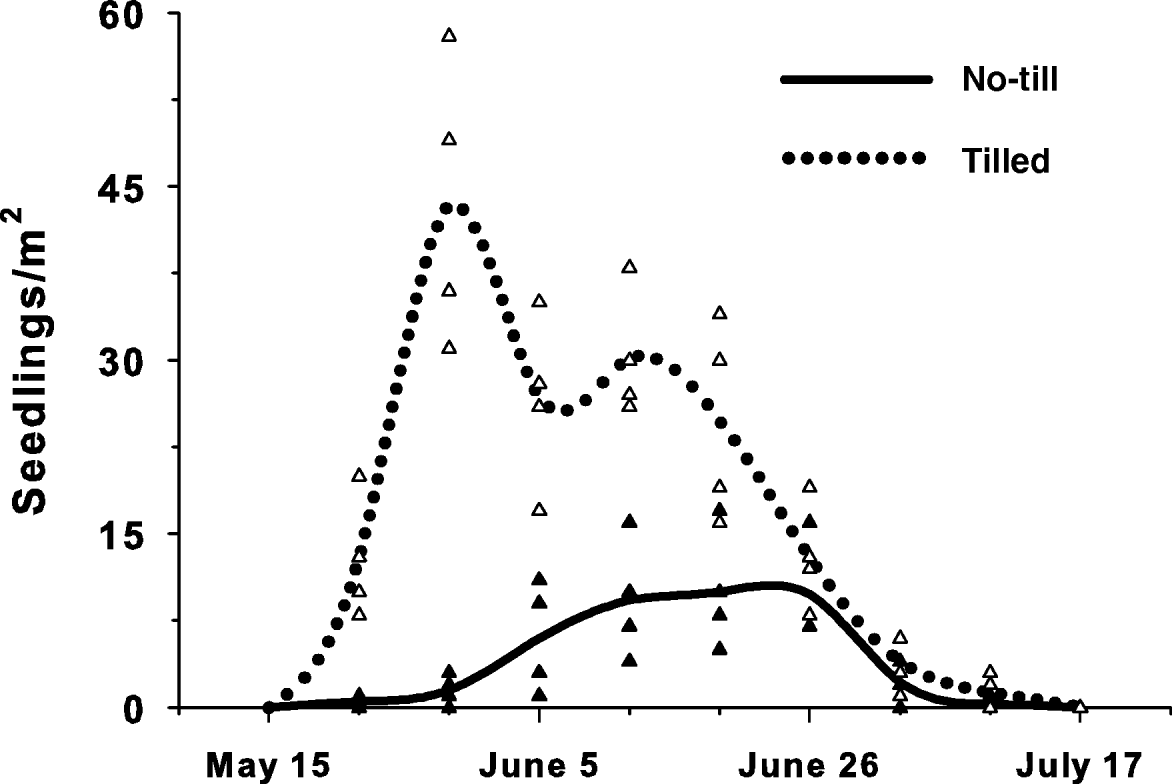
The number of weed seedlings emerging in no-till or tilled plots was determined weekly for the first 7 weeks of the growing season. Seedling density was fivefold higher after tillage compared with no-till (Fig. 5). Furthermore, seedling emergence was delayed in no-till; the initial germination flush was 2–3 weeks later. Consequently, soybean yield was not affected by weeds in no-till, whereas weeds reduced yield 25% in tilled soybean. Soybean tolerated weeds more in no-till because of lower density and delayed emergence of weeds.
Seedling emergence of the weed community in no-till and tilled soybean, following a 2-year no-till sequence of oat and winter wheat. Statistical analysis indicated that weed density and time of emergence differed between no-till and tilled treatments at the 0.05 level of probability. The emergence curves were developed by cubic spline interpolation to show the emergence patterns for treatments averaged across years. Data points represented weekly means for soybean averaged across six replications in four site-years. (Adapted from AndersonReference Anderson21.)
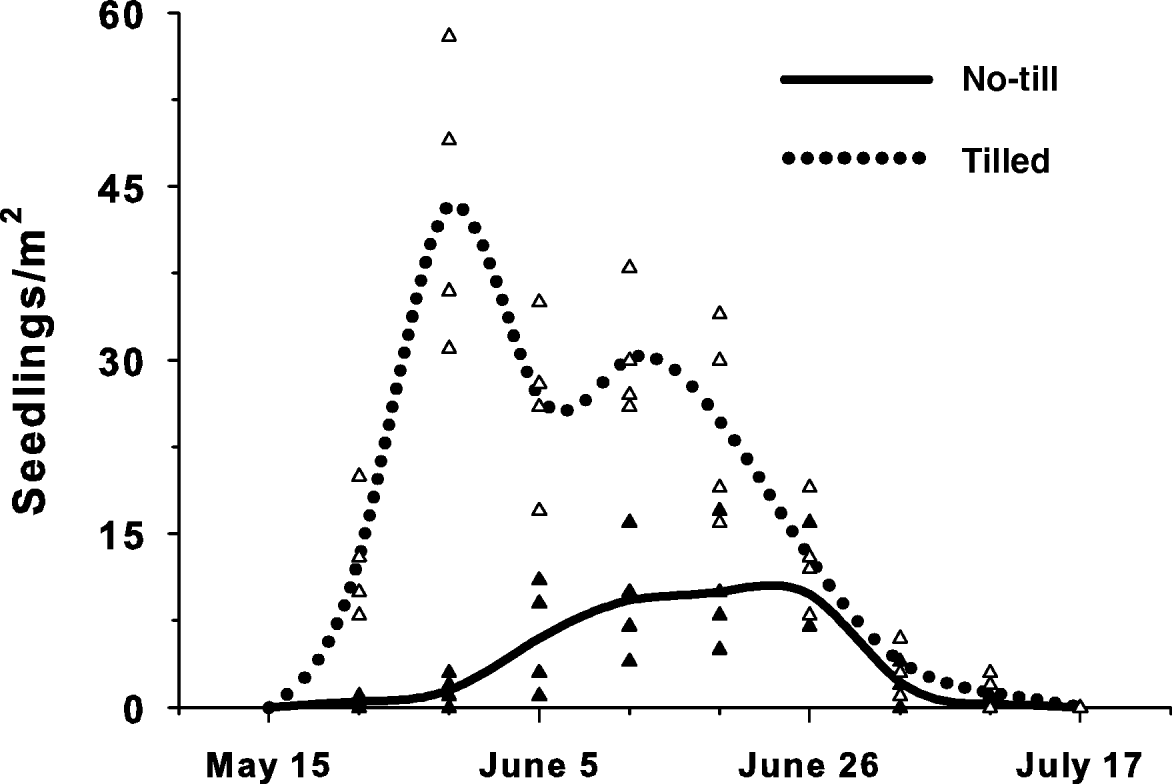
Herbicides were used to control volunteer winter wheat after harvest in the no-till system, but other weeds were not present after harvesting oat or winter wheat because the weed community consisted primarily of warm-season weeds due to the previous corn–soybean rotation. These weeds were not able to establish in oat or winter wheat.
Organic producers could gain this advantage with no-till by growing a rye cover crop between winter wheat and soybean to replace herbicides. Rye can be effectively controlled with mowing or a roller when plants are flowering, thus eliminating the need for tillageReference Ashford and Reeves22. Rye normally flowers in early June, which results in soybean being planted late and yielding less. However, if rye is planted in mid-August after winter wheat harvest, flowering would occur in MayReference Anderson21. Control with mowing or rolling at this time will avoid soybean yield loss due to late planting. Also, weeds that emerged in soybean could be controlled by between-row mowingReference Donald, Singh, Batish and Kohli18 and within-row implementsReference Bond and Grundy2. The low density and delayed emergence with no-till (Fig. 5) would increase the probability of effective weed management in soybean without tillage. This approach eliminates the need for tillage during the soybean season, and results in a 3-year interval of no-till with the oat/pea–winter wheat–soybean sequence. This 3-year interval of no-till will further help weed management by its impact on weed survival across time (Fig. 2).
We suggest establishing alfalfa with oat grown as a companion crop (Fig. 3). This practice will reduce the establishment of weeds in the first year of alfalfa.
Ancillary Benefits of This Rotational Framework
Additional options for weed management
Producers may be able to further suppress weed dynamics by using chaff collectors during harvesting of winter wheat and soybean to remove weed seeds from the fieldReference Shirtliffe and Entz23. With some weeds, more than 70% of seeds produced can be collected during harvest. Effectiveness of other control tactics used by organic producers, such as steaming, flaming and cover crops, will improve with lower weed densityReference Bond and Grundy2, Reference Zasada, Linker and Coble24, Reference Hoffman, Regnier, Singh, Batish and Kohli25. Also, organic herbicides are being developed that may further reduce the need for tillage, such as controlling weeds present at planting timeReference Evans and Bellinder3.
N management
Alfalfa will help organic producers with N management, as alfalfa can fix more than 100 kg N/ha by the second year of its establishmentReference Kelner, Vessey and Entz26. Peterson and RusselleReference Peterson and Russelle27 found that 3 years of alfalfa can supply more than 250 kg N/ha with biological fixation. HoytReference Hoyt28 showed that soil N produced by alfalfa was adequate for small grain production, even 4 years after alfalfa was eliminated by tillage. A further benefit of alfalfa is that its deep rooting patterns will access nitrates that may have leached downward in the soil profile and recycle this N for following cropsReference Dinnes, Karlen, Jaynes, Kaspar, Hatfield, Colvin and Cambardella29.
Yield benefit
This rotational framework should improve crop yield, as crops yield more when grown less frequently in a rotationReference Anderson and Lichthouse30. For example, corn yielded 24% more when grown once every 4 years compared with once every 2 yearsReference Anderson31. Similarly, a 35-year rotation study in Wisconsin showed that corn yielded more in a rotation including 3 years of alfalfa compared with either continuous corn or a corn–soybean rotationReference Stanger and Lauer32. This yield gain could not be accrued by adding additional fertilizer to the short rotations; the yield benefit of alfalfa was attributed to improved soil functioning.
Soil health
A concern with any cropping system that relies on tillage is its impact on soil health and structureReference Lal33. Organic producers would like to reduce the intensity of tillage in their systemsReference Sooby, Landeck and Lipson34. Our suggested rotation includes intervals of no-till, i.e., alfalfa and the oat/pea–winter wheat–soybean sequence, which may help producers repair the damage to soil accrued during years of intensive tillage (Fig. 6). An intriguing possibility is if weeds in corn can be controlled without tillage during the ninth year, a 7-year interval of no-till could occur before alfalfa is tilled in its third year. Long intervals of no-till will improve both weed management and soil health.
Possible 3-year intervals of no-till within the 9-year organic crop rotation. Abbreviations are: NT, no-till; C, corn; SB, soybean; O/P, oat–pea mixture for forage; WW, winter wheat; and O, oat (grown as a companion crop for establishing alfalfa). The (3) refers to 3 years of either alfalfa production or no-till. The question mark signifies that no-till may be possible with low weed density, whereas the dotted line with an arrow signifies tillage to convert alfalfa to cropland.

A recent study in the central Corn Belt evaluated the effect of alfalfa on soil health, as defined by nine bio-indicatorsReference Karlen, Hurley, Andrews, Cambardella, Meek, Duffy and Mallarino35. Soil health improved when rotations include at least 3 years of perennial forages; in contrast, soil health declined with continuous corn or corn–soybean rotations. All rotations included tillage to prepare seedbeds for crops.
Summary
Our goal with this paper was to provide a conceptual framework to help organic producers design rotations to reduce weed density in their croplands. With fewer weeds, cultural tactics to control weeds in crops will be more effective. Also, this approach may provide other opportunities for weed management, such as that shown in Figure 5, where a sequence of small grains followed by soybean may be grown without tillage. This rotation has not been field tested, but we believe organic producers can reduce weed density by designing rotations to include crops with a diversity of life cycles and planting dates, perennial forages and intervals of no-till. In addition, this rotational approach will likely accrue a multitude of other benefits in addition to improved weed management.