Introduction
The increased frequency and severity of both natural and man-made disasters underscores the importance of preparedness for mass-fatality incidents (MFIs). One of the fundamental principles guiding disaster readiness in the United States (US) is the engagement and cooperation of what is referred to as the whole community. 1 This includes members of the general public, local communities, the private sector, non-governmental (voluntary) organizations, and governmental agencies at all levels. As articulated in both the US National Response Framework and National Response Plan (NRP), 2 , 3 the ability to effectively respond and quickly recover from all types of disaster events is dependent upon a high degree of integrated coordination of response capabilities across the whole community.Reference Horney, Nguyen, Salvesen, Tomasco and Berke 4 In particular, assistance provided by members of voluntary organizations is critical, as they are often the first on the scene and most familiar with the needs of the affected community. Local voluntary organizations can provide immediate assistance with food and shelter and can supplement and strengthen the ability of the response agencies to manage the disaster. Voluntary faith-based organizations (FBOs) are among the voluntary entities that help communities recover from the immediate effects of the disaster and often play an important role in long-term recovery efforts.
As participants in whole community response, voluntary FBOs have a particularly important role to play in the effective management of MFIs, defined as any disaster that results in “more human bodies to be recovered and examined than can be handled by the usual local resources.” 1 There are four main objectives of MFI management; they include: decedent recovery, victim identification, reunification of remains with family members for final disposition, and the provision of counseling and spiritual care to the bereaved. Effective management of these key objectives is a high priority in the US; even under the extremely challenging conditions that MFIs present, deeply held core values of respect for the deceased and compassion for surviving family, friends, and community members are maintained to the fullest extent possible. The US also considers timely and appropriate management of MFIs critical for community resiliency and recovery. The FBOs are uniquely qualified to help support an effective response to MFIs. For example, they are well-suited to provide grief counselling to those who are bereaved; psychological first aid care to survivors and first responders; spiritual and pastoral counseling; notification of next-of-kin; and facilitation of family needs for lodging, food, transportation, and assistance with burial plans.Reference McCabe, Semon and Thompson 5 - Reference Kilmer and Gil-Rivas 7
Because of their special expertise, FBOs are considered a key sector in the US mass-fatality infrastructure, which is led by the medico-legal system of the Offices of Medical Examiners/Coroners (ME/C), and is further comprised of the death care industry (DCI; including funeral homes, cemeteries, crematories, and funeral industry suppliers), Departments of Health (DOHs), Offices of Emergency Management (OEMs), the Disaster Mortuary Operational Response Teams, and other voluntary organizations (eg, American Red Cross; Washington, DC USA).
The objective of FBOs active in disaster work is to reduce human suffering and to promote and support community resilience and recovery. To provide the type of specialized emotional and spiritual care needed by communities affected by disasters, including disasters with MFIs, national associations have formed that offer organizational structure and training to their affiliated members, most typically local or national FBOs.Reference McCabe, Semon and Thompson 5 Their goal is to unite and train local FBOs interested and capable of providing spiritual care and counseling in the aftermath of disasters, including MFIs. These national associations serve as a national disaster-relief resource under the NRP. Two associations in particular, the National Voluntary Organizations Active in Disaster (NVOAD; Alexandria, Virginia USA) 8 and the National Disaster Interfaiths Network (NDIN; New York, New York USA), 9 founded in 1970 and 2005, respectfully, play important roles in this regard. However, despite the significance of FBOs, their level of preparedness for MFI disasters has not been well-characterized. As part of a larger study of the entire mass-fatality infrastructure in the US,Reference Merrill, Orr, Chen, Zhi and Gershon 10 the preparedness of FBOs for their role in MFI response was recently assessed. The overarching goal of this research was to identify gaps in preparedness to allow for targeted strategies for improvement.
Methods
Study Design and Recruitment
Using a cross-sectional design, an anonymous, web-based survey was distributed nationwide with the assistance of two major associations that represent local and national FBOs that respond to disasters: NDIN and NVOAD. With the assistance of leadership from NDIN and NOVAD, potential study participants were recruited using direct membership emails and membership newsletters. Recruitment also occurred through social media (eg, LinkedIn; LinkedIn Corporation; Mountain View, California USA) announcements. This recruitment approach was taken because membership in national FBOs active in disasters is complex for several reasons: (1) membership rolls are incomplete, and many clergy who are unaffiliated with any national organizations self-deploy to disasters; (2) FBO responders may have overlapping membership and sponsorship across organizations, both nationally and locally; and (3) membership in FBOs active in disasters is extremely fluid. These complexities made the identification of an accurate sample frame infeasible for this study, and therefore, an internet-based strategy for recruitment was chosen. Study participants included respondents who identified themselves as professionals representing FBOs that respond to disaster events. No incentive was utilized. All study procedures had prior review and approval of the University of California, San Francisco Committee on Human Research (San Francisco, California USA; protocol 12-09425) and Columbia University Human Research Protection Office Institutional Review Boards (New York, New York USA; protocol AAAL0206). Electronically signed informed consent was obtained from each participant enrolled in this study.
Metrics and Questionnaire Development
With the assistance of key stakeholders and national experts in the fields of MFI and disaster management and response, “MFI preparedness of FBOs” was first defined by identifying three domains: (1) organizational capabilities; (2) operational capabilities; and (3) resource sharing partnerships. Next, a 4-part process was followed to develop the questionnaire items that addressed each of these domains, as follows: (1) review of federal MFI response documents and relevant FBO documents; (2) an environmental scan of the peer-reviewed and “grey” literature (eg, state annexes, mass-fatality plans, and other documents) to obtain any possible existing preparedness measures; (3) drafting of survey items based on document review; and (4) iterative review by the research team and external experts. The questionnaire underwent extensive validation testing, including construct validity (both face and content validity) and criterion validity. Pilot testing with field experts and stakeholders assessed convergent validity and also served to refine the internet-based format for content clarity, ease of navigation, and to determine the average time for completion. The final survey consisted of 28 items and took approximately 15 minutes to complete.
In 2014, the survey was hosted for a 6-week period using an SSL-secured platform (SurveyMonkey Inc.; Palo Alto, California USA). The final questionnaire included items that addressed organizational capabilities, operational capabilities, resources sharing partnerships, planning activities and trainings, ability and willingness of FBO staff to respond to MFIs (with and without chemical, biological, radiological, nuclear, and explosive [CBRNE] contamination), self-rated organizational and jurisdictional preparedness for MFI response, and resources needed for improvement. All study materials may be obtained by contacting the corresponding author and the survey is available as Appendix 1 (available online only).
Measures
Various response formats were used, including Likert-scale, checklist, multiple-response, “yes/no/don’t know,” and open-ended for “other” options. Respondents were asked to respond based on their knowledge and experience of their FBO and were requested to forward the survey on to the most knowledgeable person in their organization if they did not have personal knowledge of the organization’s MFI preparedness.
Participant and Organizational Characteristics
Information on the professional role (ie, Chaplain, Disaster Program Manager, or Spiritual Care Provider) that the study respondent held within their FBO was collected. Descriptive information also was collected on the participant’s FBO, including location (State); number of clergy, staff, and volunteers; national organization they are affiliated with; frequency of updates and compliance of their continuity of operations plan (COOP) with national guidance; ability to maintain religious duties while providing response to MFIs; if staff had received training as temporary mortuary (T-MORT) operational team Chaplains; training provided by FBO on disaster spiritual care that complies with consensus standards; resources their FBO needed for improved preparedness; and self-reported perceptions of FBO’s level of preparedness and the level of preparedness of their local jurisdiction.
Organizational Capabilities Measure
This new measure consisted of 18 items to access the organizational capabilities to respond to MFIs. Specific items were as follows: (1) whether their FBO had responded to MFIs in the past five years; (2) whether their FBO would respond to MFIs within their state and out-of-state; (3) if their FBO had an assigned support function in their local MFI plan or family assistance center plan; (4) if their FBO had a written disaster COOP; (5) whether their FBO had “on call” key personal: (a) Board Certified Chaplain, (b) Senior Disaster Chaplain, and (c) First Responder Chaplain; (6) whether their FBO participated in drills with local partners; and (7) if their FBO provided training to staff on: (a) religious literacy and competency, (b) personal protective equipment (PPE), (c) COOP, and (d) CBRNE. Four items addressed the perceived ability (ie, availability) and willingness of FBO clergy to respond to MFIs, with or without CBRNE contaminants. Respondents also were asked to estimate the proportion of FBO staff that had pre-event planning in place that would allow them to be available to respond to MFIs.
Operational Capabilities Measure
To access the operational capabilities of FBOs in terms of the types of services they were able to provide when responding to an MFI, a new measure was developed as a 7-item checklist. The services that FBO would be able to provide included basic emotional care, grief counseling, psychological first aid, Disaster Chaplain/spiritual care, licensed pastoral counseling, notification of death to next-of-kin, and facilitation of family needs (ie, food, lodging, transportation, and burial expenses).
Resource Sharing Partnerships
A 15-item checklist was used to identify the partners that FBOs would expect to provide services to in response to MFIs. The potential partners included State OEM; Local OEM/Civil Defense; ME/C, Sheriff’s Office, Justice of the Peace; local first response organizations; local/state DOHs; local Health Care Organizations; local DCI (funeral homes, cemeteries, and crematories); voluntary organizations; other nearby FBOs; federal assets; local communities in need; and the National Guard.
Data Analysis
Descriptive statistics, bivariate logic regression, bivariate correlation, and response mapping of survey data were performed in order to: (1) characterize sample attributes and preparedness capabilities; (2) determine the association among the three domains of preparedness; (3) identify significant correlations between specific factors and each of the domains; and (4) provide visual examination of respondent distribution. All statistical analyses were performed using statistical software (SPSS Statistics Desktop, V22.0; IBM Inc.; Armonk, New York USA) and response distribution mapping was performed using spatial analysis software (ArcGIS Desktop 10.2.2; Environmental Systems Research Institute (ESRI); Redlands, California USA).
The main outcomes were the three measures of MFI preparedness. Total scores for each measure were first calculated by summarizing scores (0 or 1) of each individual item. For bivariate analyses, the final measure was then dichotomized into two categories (scores below group median=0; equal or above group median=1). The data met the criteria required by the intended statistical testing procedures and the level of significance was set at an alpha level of .05, two-tailed.
Results
Participants and Organizational Characteristics
Participant and Organizational Characteristics
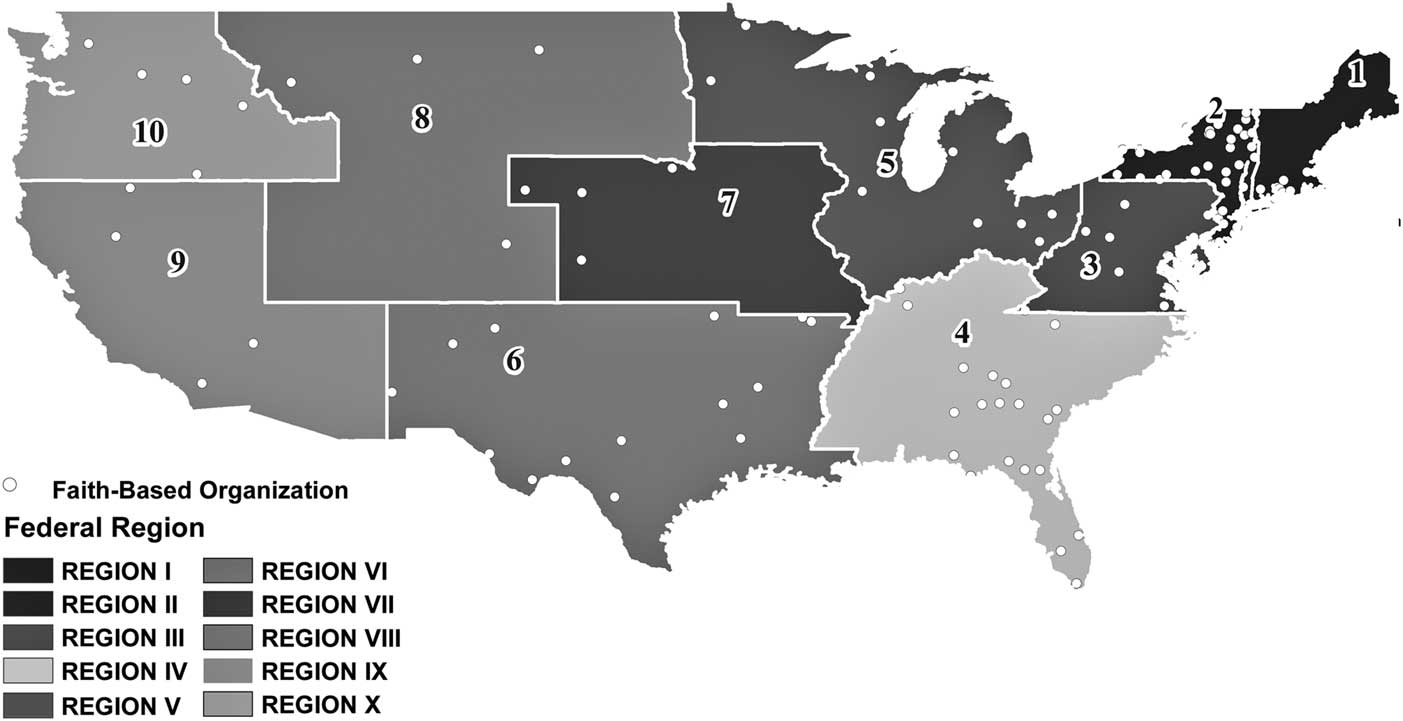
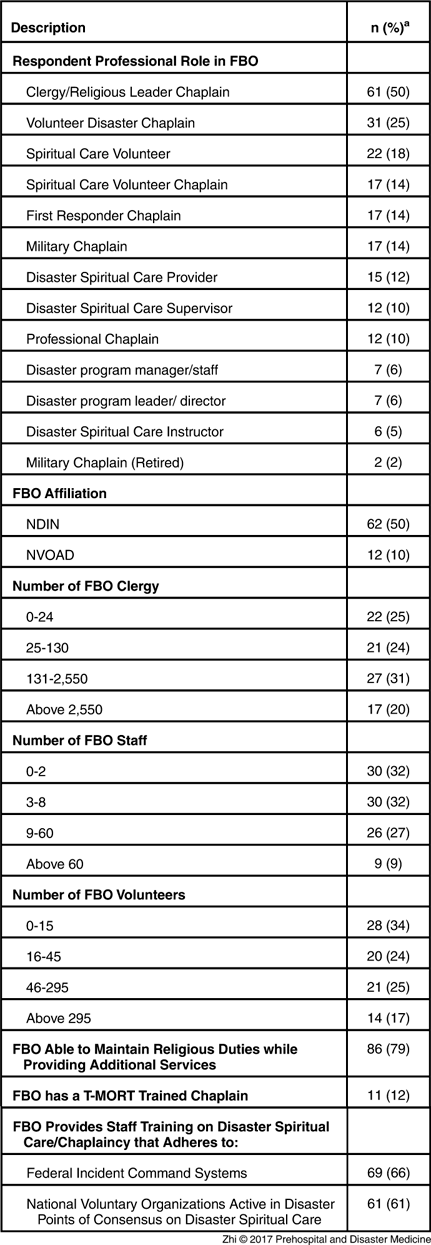
Data were collected from 124 participants. Most respondents represented small-sized FBOs (with less than 10 personnel). One-half of the sample was affiliated with NDIN, 10% with NOVAD, and the rest were affiliated with a variety of other FBOs active in disaster relief, including Fire and Police Chief Chaplaincies, National Association of Jewish Chaplains, National Guard Chaplains, and other spiritual care organizations/networks. In general, respondents were located on the east coast, especially New York State, as depicted in Figure 1. Among those who reported that their organization had an MFI plan, 42% indicated that their plan was updated annually. Most plans were reportedly compliant with national guidance. The majority (79%) stated that their FBO would be able to maintain their regular professional duties while providing additional services during MFIs. Only 12% reported that their FBO had T-MORT-trained Chaplains on staff. Over 60% reported that their organizations provided training to staff on Disaster Spiritual Care that adhered to the Federal Incident Command System (66%) or adhered to the NVOAD Disaster Spiritual Care standards (61%). Detailed characteristics frequencies are included in Table 1.
Faith-Based Organizations by Region.

Description of Respondent and Faith-Based Organization (N=124)

Abbreviations: FBO, faith-based organization; NDIN, National Disaster Interfaiths Network; NVOAD, National Voluntary Organizations Active in Disaster; T-MORT, temporary mortuary.
a Data shown represent individuals who endorsed each item on the checklist.
Self-Rated Workplace and Jurisdiction Preparedness
On a scale of one to five (five being completely prepared), the mean was 3.0; only nine percent thought that their organization was completely prepared to respond to MFIs. The mean score on the question related to jurisdictional preparedness was somewhat higher (3.3).
Resources Needed to be Better Prepared
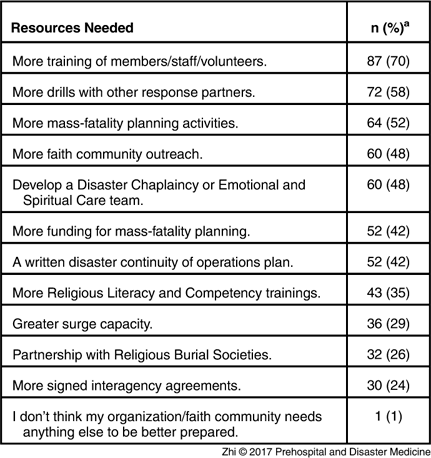
Among the 124 respondents, additional staff training (70%) and more drills (58%) with response partners were needed. Respondents also felt that more MFI planning activities (52%) and more community outreach (48%) would improve response. Nearly one-half (48%) reported that their FBO needed a designated Disaster Chaplaincy or Emotional and Spiritual Care team. Frequencies for each item are listed in Table 2.
Resources Needed to Be Better Prepared (N=124)

a Data shown represent individuals who endorsed each item on the checklist.
Organizational Capabilities Measure
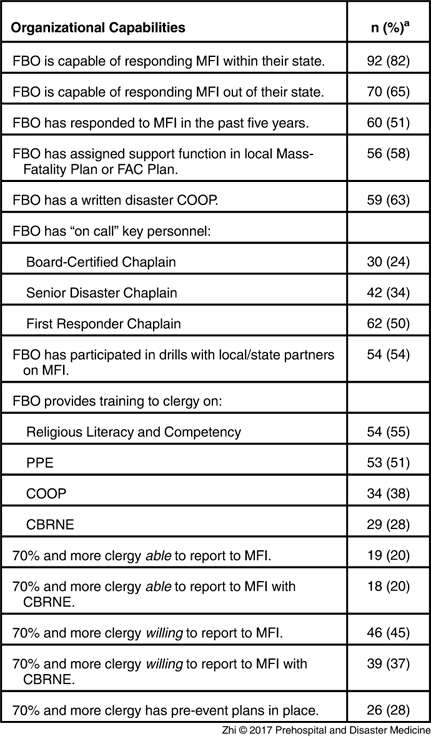
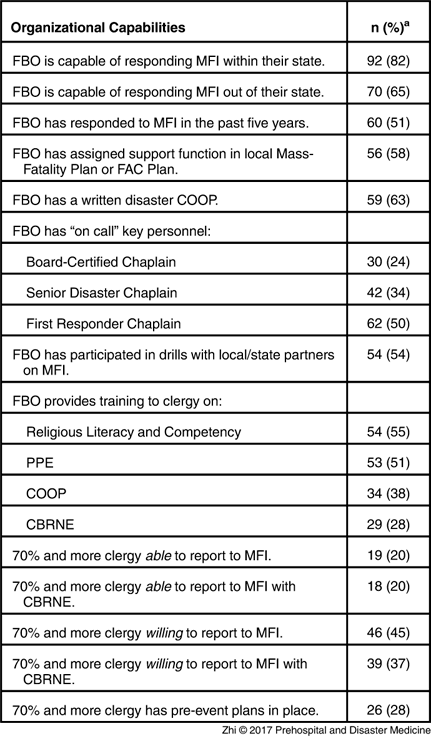
The frequencies for the items measuring organizational capabilities are shown in Table 3. Only one participant reported all 18 items in place. The mean scale score was 6.8 (median 6.5; minimum 0; range 18). Only slightly more than one-half of the respondents reported that their FBO had participated in drills with their local partners. Training on the COOP, religious literacy, PPE, and CBRNE was sub-optimal. Pre-event personal staff planning was also sub-par; only 28% of respondents reported that 70% or more of clergy had such planning in place.
Organizational Capabilities (N=124)
Abbreviations: CBRNE, chemical, biological, radioactive, nuclear, and explosives; COOP, continuity of operations plan; FAC, Family Assistance Center; MFI, mass-fatality incident; PPE, personal protective equipment.
a Data shown represent individuals who endorsed each item on the checklist.
Using a cut-off point of 70%, which was based on previous staff surge capacity modeling for other types of disaster events,Reference Merrill, Orr, Chen, Zhi and Gershon 10 , Reference Gershon, Orr and Zhi 11 only 20% of respondents thought that 70% or more of their FBO staff would be able to respond to MFIs, with or without CBRNE. A larger proportion (45%) thought that 70% or more of the FBO’s would be willing to respond to MFIs, although that proportion decreased to 37% if CBRNE agents were involved.
Operational Capabilities Measure
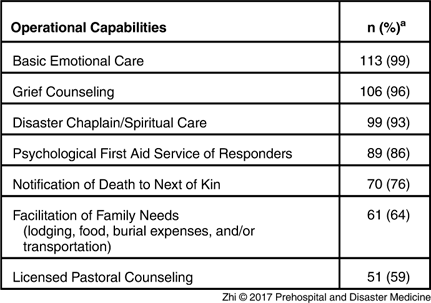
The frequencies for the operational capabilities measure are shown in Table 4. The mean scale score on this measure was 4.8 (median 5; minimum 0; range 7). Almost all (90%) respondents reported that their FBO would be able to provide basic emotional care, grief counseling, and Disaster Chaplain/spiritual care during MFIs.
Operational Capabilities (N=124)

a Data shown represent individuals who endorsed each item on the checklist.
Resources Sharing Partnerships
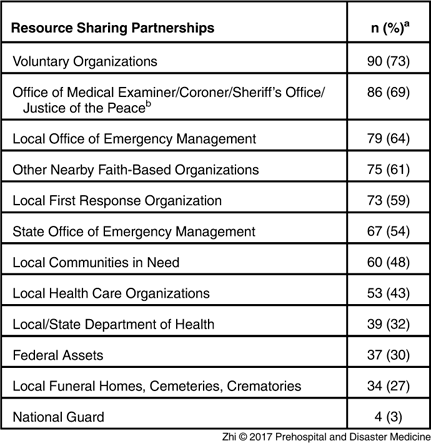
The frequencies for items on the resource partners are shown in Table 5. The mean scale score was 5.6 (median 5; minimum 0; range 15). None of the respondents had a pre-existing relationship with all 15 possible local/state partners. The most frequently reported relationships were with other voluntary organizations; local ME/C or agencies with equivalent function; local OEM; and other near-by FBOs. The FBOs were least likely to have relationships with the National Guard, local DCI, federal assets, and local/state DOHs.
Resource Sharing Partnerships (N=124)

a Data shown represent individuals who endorsed each item on the checklist.
b Options combined as serve the same function.
Bivariate Logistic Regression
Bivariate logistic regression was performed to assess relationships between organizational capabilities measure and the other two measures created in this study. The results indicated that the organizational capabilities measure was significantly associated with both the operational capabilities measure (OR 2.65; 95% CI, 1.21-5.76) and resource sharing partnerships measure (OR 2.15; 95% CI, 1.02-4.51).
Bivariate Correlation
As noted below, several factors were significantly associated with ability and willingness: (1) Perception of FBO Preparedness: (a) ability (r .466; P <.001) and willingness (r .426; P <.001) to respond to MFI, and (b) ability (r .406; P <.001) and willingness (r .476; P <.001) to respond to CBRNE-involved MFI; (2) Perception of Jurisdictional Preparedness: (a) ability (r .328; P <.001) and willingness (r .403; P <.001) to respond to MFI, and (b) ability (r .250; P <.010) and willingness (r .319; P <.001) to respond to CBRNE-involved MFI.
Additionally, both perception of FBO and jurisdictional preparedness were significantly correlated with the organizational capabilities measure (r .314; P <.001 and r .248; P <.010), respectively.
Finally, the organizational capabilities measure was found to be significantly associated with certain items in the resources needed to be better prepared checklist, including: more funding (r .245; P <.010), planning (r .371; P <.001), drills (r .419; P <.001), trained members (r .315; P <.001), and faith-based community outreach (r .285; P <.001).
Discussion
Assessment of MFI capabilities of the FBO sector has been lacking, largely due to a lack of appropriate preparedness measures. The three domains of preparedness (organizational capabilities, operational capabilities, and resources sharing partnerships) that were developed here to define and measure preparedness provide a broad perspective of the FBO role in MFIs. These measures can be used to assess organizational planning (through written plans, training, and certification of clergy); the capacity of FBOs to provide specialized spiritual care to bereaved families and communities; and to identify the response partners that FBOs can provide resources to. These measures help define what it means for FBOs active in disasters to be prepared for MFI response. Individual FBOs can utilize these measures as part of their self-assessment and quality improvement efforts. The measures also can be useful to other entities that are responsible for management of MFIs. A clear understanding of the intra- and inter-organizational capabilities of all sectors responsible for the US mass-fatality infrastructure is key to ensuring an effective and timely response to MFIs. In order to affect a coordinated MFI response, all sectors need to be aware of each other’s roles, responsibilities, and capabilities. These new measures can help the other sectors and other FBO members better understand each other’s capabilities.
Using these measures, gaps in FBO organizational capabilities were identified. In particular, additional targeted training of clergy seems indicated, as does the participation in drills with local and state partners. These data also suggest that clergy willing to respond to MFIs may not always be able to do so because pre-event planning and “on-call” scheduling was not in place. In general, ability and willingness rates noted here were lower than the rates reported by other key MFI infrastructure sectors, suggesting, and supported by the data, that planning improvements and additional training are needed.
Results from the operational capabilities measure indicate a high-level of capacity with respect to the provision of basic emotional spiritual care, grief counseling, and psychological first aid to first responders. These are critical services and are foundational to the understanding of individual community resiliency and recovery. While almost all FBOs in the sample reported that they could provide emotional care to survivors, only slightly more than one-half could provide Licensed Pastoral Counseling, indicating that some additional training is needed. Leading national FBOs active in disasters now offer a wide range of specialized training programs to their members at low or no cost. Participation in these accessible, on-line programs should be encouraged. Since FBOs vary greatly in size and capacity, coordinated sharing of training and planning materials may maximize the effectiveness of the sector as a whole. In particular, FBOs might benefit from targeted guidance from the federal government and funding to support intra- and inter-sector engagement for MFI response. These strategies are supported by study data and literature on the role of FBOs in general emergency preparedness and response efforts.Reference Joshi 12 Similar to results from MFI infrastructure studies,Reference Merrill, Orr, Chen, Zhi and Gershon 10 - Reference Joshi 12 it was found that participation in drills was associated with operational capabilities as well as with resource sharing partnerships. Improved clarity of role function and enhanced integration of FBOs in the overall MFI mission can be achieved through coordinated drills and training with their partners in the private and public sectors. In whole community responses, it is critical that all entities cooperate to ensure that the infrastructure can effectively manage MFIs in the US. Although community-wide drills for MFIs are infrequent, these data suggest that FBOs should be included.
The need for such drills was highlighted by the finding that willingness of FBO clergy to respond was dramatically reduced if CBRNE contaminants are involved. Since most FBOs are not capable of providing specialized CBRNE training, it creates an opportunity for engagement with local response agencies, such as fire, police, and Emergency Medical Services, as they are already required to provide this training to their own staff. Specialized trainings also provide an opportunity for relationship building, the cornerstone of interagency cooperation.
The results from the resource sharing partnership measure align with previous findings that FBOs are mostly connected with voluntary organizations (eg, American Red Cross or NVOAD).Reference Joshi 12 These findings indicate that FBOs are well-connected to medical examiners or equivalent agencies (the lead local agency in MFIs), but poorly connected to health departments. This latter finding is troubling since local DOHs also are tasked with psychological first aid to communities and first responders in the event of MFIs. Clearly, better coordination between FBOs and health departments is warranted.
Only moderate scores were found on perceptions of FBO preparedness, suggesting lack of confidence in the FBO’s capabilities. This, in turn, might influence clergy ability and willingness to respond to MFIs, with or without CBRNE, although a report by SwainReference Swain 13 indicated that, at least in response to the World Trade Center disaster (2001; New York USA), there was no shortage of FBO representatives. In that same report, however, there was a clear indication of a lack of coordination. In some cases, the authors found that FBO representatives were poorly trained for their role, overworked, and unclear of their responsibilities. At the same time, there was an indication that many FBO representatives were under-utilized. This type of disorganized response by FBOs also was noted in Hurricane Katrina (2005; Gulf Coast USA). At least one study on response to Katrina found that, in general, FBO participation was mainly “ad-hoc…and developed to meet immediate needs and to fill service gaps.”Reference Joshi 12 The FBOs must be better integrated into formal MFI planning to take advantage of both the high degree of personal motivation as well as the ability to provide much needed services that members of FBOs active in disasters can provide.
The bivariate logistic regression and correlational analyses point out the importance of planning, training, drills, and community outreach. These are worth greater investment, especially as respondents identified a need for these activities in order for them to be better prepared for MFIs. In particular, community outreach could help FBOs build additional trust with those from diverse cultural and religious backgrounds - a national priority in disaster response in general.
Limitations
The study limitations are as follows. First, as a cross-sectional study, causality cannot be inferred; bivariate logistic regression and correlation analysis only reflect associations between variables and cannot provide an indication of direction. Second, self-reported response and social desirability bias could lead to over- or under-estimation of actual level of MFI preparedness. However, the questionnaires were completely anonymous and targeted the respondent’s FBO and not their own personal preparedness. Third, the relatively small sample and distribution via national organizations and social media could result in lack of generalizability of findings. Nonetheless, these results are similar to previous research on general FBO preparedness and response to emergencies.Reference Joshi 12 These potential study limitations notwithstanding, this was the first national study on this topic, and as such, it provides a foundation for additional studies that utilize more robust designs and larger sample sizes. In the future, it would be beneficial to launch a national questionnaire through national and local voluntary organizations, as well as national MFI government agencies, in order to account for potential confounding variables.
Conclusion
Faith-based organizations play a critical role in helping communities recover from disaster events. Members of FBOs are usually the first on the scene of MFIs and the last to leave, all the while fulfilling their role in MFI management by providing counseling and spiritual care to those who are bereaved. The FBOs also provide comfort and support to members of the affected community and to first responders. Their efforts can best be maximized through judicious and targeted coordination and training with other MFI response sectors. With the full cooperation and coordination of all the key sectors of the mass-fatality infrastructure, including FBOs, a well-managed and effective response can be assured, which in turn will assure that the most deeply held values of respect for those that are deceased and compassion for those that are bereaved are upheld, even in the most challenging of circumstances.
Acknowledgement
The authors are grateful to Mr. Peter B. Gudaitis for his important contribution on questionnaire development and distribution, and to the following individuals who graciously provided their input on questionnaire development: Ms. Tara McAlexander and Ms. Halley Riley. The authors also are deeply appreciative of leadership from the National Disaster Interfaiths Network (NDIN) and the National Voluntary Organizations Active in Disaster (NVOAD) for their assistance in questionnaire development, as well as distribution and participant recruitment. A special note of thanks to the study respondents for their enthusiastic participation in the various aspects of this study.
Supplementary Material
To view supplementary material for this article, please visit https://doi.org/10.1017/S1049023X17006665