Introduction
With the rapid development of a new generation of information technology, communication technology, and Internet of Things technology, the manufacturing industry is leaping into the direction of digitalization, networking, and intelligence. The traditional large-scale manufacturing mode has been gradually eliminated, the new products are updated more and more frequently, the original market demand faces severe tests of diversification, personalization, small batch, multi-species, short-cycle, quick response, etc. (Research, 2018; Zheng et al., Reference Zheng, Wang, Sang, Zhong R, Liu and Liu2018). In the whole lifecycle of products, process planning severs as the transition from the design stage to manufacture stage, realizes the conversion of product design information to manufacture information, and is the bridge connecting product design and manufacturing. The quality of the process planning scheme directly affects the allocation and optimization of manufacturing resources, production organizational efficiency, product quality, production cycle, environmental benefits, etc. (Shin et al., Reference Shin, Woo and Rachuri2017; Zoran and Milica, Reference Zoran and Milica2017). Therefore, how to realize the rapid evaluation and selection of multiple feasible alternatives is part of the technical difficulties faced by process planning.
Traditional process planning evaluation mainly focuses on production cost, product quality, and processing efficiency (Jin et al., Reference Jin, Du and He2017). However, consideration of resource consumption and environmental impact in the manufacturing process is relatively less, resulting in the manufacturing situation of high energy consumption, heavy pollution, and low efficiency. With the increasing global greenhouse effect and the implementation of the carbon tax policy, the manufacturing industry faces dual pressure of environment and cost. The low-carbon manufacturing mode characterized by minimal pollution, low emission, and low energy consumption has become an inevitable trend for the sustainable development of manufacturing industry, and various manufacturing enterprises pay more and more attention to the environmental impact issues such as carbon emissions during processing. The comprehensive evaluation of the process planning scheme considering the carbon emissions, production cost, and efficiency of the manufacturing process is an urgent basic scientific problem in the context of low-carbon manufacturing.
Process planning is not just restricted by the selection of machining equipment, tool, and fixture, but also influenced by the process design principle and the process concentration or dispersion (Liu et al., Reference Liu, Liu, Xie and Ma2014; Li et al., Reference Li, Rong, Chang, Zhang and Ying2015). In actual production, multiple feasible process planning schemes may exist simultaneously for machining the same part. Therefore, this is a multi-constraint, nonlinear, and multi-objective combinatorial optimization decision-making problem (Zheng and Wang, Reference Zheng and Wang2012). In the past, the evaluation of process planning was mainly performed by process planners relying on their own professional knowledge and experience, leading to subjectivity and applicability limitations of evaluation results, as well as the following defects: (1) insufficient universality of process planning; (2) insufficient flexibility and adaptability of process planning scheme; (3) low intelligence of process planning; and (4) insufficient information sharing in process planning. To reduce the dependence of process planning evaluation on process planner's ability, various comprehensive evaluation methods have been proposed, such as multivariate regression analysis (MRA), artificial neural network (ANN), grey clustering analysis, genetic algorithm, ant colony algorithm, decision tree, and analytic hierarchy process (AHP) (Rafiei et al., Reference Rafiei, Manzari and Bostanian2011; Pakkar, Reference Pakkar2016, Reference Pakkar2017). Usually, these methods are used alone to evaluate process planning schemes and have achieved good results. However, with the increasingly complex structure of mechanical products, diverse production modes, numerous influencing factors of evaluation indexes, and many evaluation indexes with empirical, fuzzy, and uncertainty, resulting in the above methods have their own limitations in practical application. For example, MRA cannot solve the highly nonlinear intricate relationship among influential factors (Das, Reference Das2020). It is difficult to determine the initial threshold of ANN, and the sample size to be trained is large and it is easy to fall into the local optimal solution in the fitting process, resulting in insufficient generalization ability of the model (Saravanan et al., Reference Saravanan, Jerald and Rani2020). Grey clustering method has low resolution, which is often inconsistent with the actual situation (Mv et al., Reference Mv, Sm, Bg, Pv and Bp2019). The decision tree model will become complex as the increase in planning cases, leading to inefficient decision-making (Sungsu et al., Reference Sungsu, Lkhagvadorj and Aziz2017). When there are too many indicators in AHP, the data statistics are large and the weights are difficult to ascertain, while experts give different index score causing multiple evaluation results, which even increases the difficulty of actual decision-making (Vidal et al., Reference Vidal, Marle and Bocquet2011).
In order to adapt to the diverse evaluation index factors and dynamic change of data in the evaluation process, it is necessary to enhance the sharing and integration between process design information and manufacturing resource information. As a new path to promote the interactive integration of the physical world and information world in manufacturing, digital twin can help process planners to rapidly evaluate and optimize process planning schemes through interactive virtual-real feedback, data fusion analysis, and iterative optimization for decision-making (Zhang et al., Reference Zhang, Liu, Chen, Zhang and Leng2017; Pei and Ming, Reference Pei and Ming2021).
Based on the above motivation, a comprehensive evaluation method of low-carbon process planning for digital twin is proposed in this paper. Firstly, a multi-level evaluation index system for low-carbon process planning is constructed. Then, a comprehensive evaluation method is presented to carry out low-carbon evaluation and prediction of process planning scheme based on the digital twin data formed by production real-time data and process planning data, so as to realize multi-resource and multi-dimensional dynamic evaluation and decision-making. Finally, an alternative process planning scheme of an automobile part is implemented to verify this method.
The rest of this paper is organized as follows. Section “Literature review” briefly reviews related work of low-carbon manufacturing and process planning. Section “Diversity analysis of process planning schemes” analyses the main factors affecting process planning diversity. Section “Multi-level evaluation index system” introduces a multi-level evaluation index system of process planning based on digital twin. Section “Comprehensive evaluation method” illustrates in detail the comprehensive evaluation method and solution process of planning scheme based on digital twin. Section “Case study and discussion” offers a case study and discusses the experimental results. Finally, section “Conclusions” draws the conclusion and future work.
Literature review
Low-carbon manufacturing
With the global shortage of resources and energy, as well as the increasing greenhouse effect, the traditional manufacturing industry is gradually transforming to low-carbon manufacturing. Low-carbon manufacturing refers to reduce resource consumption and CO2 emissions by saving resources and improving production efficiency during the whole lifecycle of product design, production, operation, and scrap, which have obvious economic, social, and ecological benefits (Zheng et al., Reference Zheng, Yang, Lou, Gao and Feng2021). As a new sustainable development model, low-carbon manufacturing has been greatly valued and widely studied at home and abroad.
Regarding the carbon emissions measurement of the product's entire lifecycle, Mayyas et al. (Reference Mayyas, Qattawi, Mayyas and Omar2012) adopted a lifecycle assessment method to make a detailed study of carbon emissions generated in the stages of vehicle production, using and maintenance. Scipioni et al. (Reference Scipioni, Manzardo, Mazzi and Mastrobuono2012) proposed a useful lifecycle approach of carbon dioxide identification to manage carbon emissions during the manufacturing process. Zhang et al. (Reference Zhang, Zhang and Hu2012) used the recursive method to reduce carbon emissions of component connection unit based on the analysis of product lifecycle carbon emissions. Narita et al. (Reference Narita, Kawamura, Norihisa, Chen, Fujimoto and Hasebe2006) used a lifecycle assessment method to predict the environmental impact of the machining process, and analyze the carbon emissions in cutting process by calculating the electrical energy consumed by each component of the machine tool during the machining process. Due to the complexity of the manufacturing process and the different specific research objects, the lifecycle method is not universal enough to calculate carbon emissions in the manufacturing process, and the calculated results deviate greatly from the experimental data.
In terms of quantitative calculation of carbon emissions in the manufacturing process, Sun and Zhang (Reference Sun and Zhang2011) used a hierarchical stepwise control method to estimate carbon emissions to improve resources utilization and reduce carbon emissions. Li et al. (Reference Li, Cui, Liu and Li2013) proposed the five major parts of carbon emissions in the machining process, and each part is calculated. This method has certain adaptability in machining. Meier and Shi (Reference Meier and Shi2011) proposed a new method for calculating carbon emissions from manufacturing stages based on hybrid analysis to help enterprises determine the potential for reducing carbon emissions.
In terms of energy conversion in the low-carbon manufacturing process, Ball et al. (Reference Ball, Evans, Levers and Ellison2009) proposed the possibility of realizing zero carbon manufacturing by analyzing the interaction among energy flow, material flow, and waste flow in the integrated manufacturing process. Gutowski (Reference Gutowski2007) analyzed the manufacturing process from the perspective of thermodynamics, the calculation method of specific energy consumption is proposed, and the strategies of reducing carbon emissions is given. Munoz and Sheng (Reference Munoz and Sheng1995) quantified the environmental impact of the manufacturing process through energy utilization rate, raw material flow of workpiece and secondary material flow, and provided decision support for low-carbon manufacturing, including part process planning, process parameters selection, etc.
Low-carbon-oriented process planning evaluation
Process planning directly affects the quality and performance of the parts after machining, and it has a significant effect on the carbon emissions of the manufacturing process. Selecting a reasonable process planning scheme is helpful to increase productivity, reduce resource consumption, and product cost. Generally, the evaluation methods for process planning are classified into three categories: model-based approach, knowledge-based approach, and data-based approach (Gao et al., Reference Gao, Mou and Peng2016; Zhu and Li, Reference Zhu and Li2018; Kumar, Reference Kumar2019; Schnoes and Zaeh, Reference Schnoes and Zaeh2019). The traditional process planning evaluation is mainly built on existing process regulations and experience, which cannot adapt to the variable evaluation indexes and data dynamic changes during the manufacturing process.
To meet the new demands of process planning evaluation under the background of low-carbon manufacturing, various comprehensive evaluation methods for low-carbon manufacturing have emerged. Based on topologic theory and entropy weight method, Yan et al. (Reference Yan, Feng and Li2014) introduced a set of sustainable evaluation methods that meet environmental, economic, and social criteria. Considering the carbon emissions, benefits, and completion time of the manufacturing process, Cheng et al. (Reference Cheng, Cao, Li and Luo2013) proposed a comprehensive evaluation method based on carbon benefits, which facilitates manufacturing enterprises to determine the best process planning according to production demand. Yi et al. (Reference Yi, Li, Zhang, Liu and Tang2015) established an optimization model with carbon emissions and maximum completion time, by optimizing parameters to reduce carbon emissions and improve system efficiency. Lian et al. (Reference Lian, Zhang, Shao and Liang2012) classified process planning problems with production cost as the optimization objective and proposed flexible optimization measures. Yazdani et al. (Reference Yazdani, Benyoucef, Khezri and Siadat2020) established an ecological impact analysis model for machining process, and quantitatively evaluated the environment impact of energy consumption, material flow consumption and resources consumption in process solutions. Yin et al. (Reference Yin, Cao and Li2014) evaluated and optimized process planning with the goals of minimum carbon emissions and energy consumption.
Although these methods above have achieved good results in many evaluation, the static evaluation without interactive feedback between the physical space and information space of the production process cannot achieve the expected results due to the dynamic changes of actual machining process, and the disturbance in machining process will affect the implementation of process planning. Since the concept of digital twin is proposed, it paves the way for the interaction of information and physical space, providing a new way for process planning evaluation.
Digital twin and its application in manufacturing
The concept of digital twin can be traced back to the “mirror space model” that was proposed by Professor Michael Grieves in the product lifecycle management course in 2003, which was equivalent to the virtual digital representation of physical products (Grieves, Reference Grieves2005), including physical space, virtual space, and information connection between the two, shown in Figure 1. In 2011, it was officially named Digital Twin by Grieves and Vickers in “Almost Perfect: Driving Innovation and Lean Products through PLM” (Grieves, Reference Grieves2011). In the early days, digital twin was mainly used to solve the maintenance problem of fighter airframes. Subsequently, in addition to the aerospace field (Kholopov et al., Reference Kholopov, Antonov, Kurnasov and Kashirskaya2019), digital twin gradually expanded to various fields such as smart city, railway transportation, health care, environmental protection, and engineering construction, but the hottest research is in the field of smart manufacturing, which has now grown up become an important technical tool for smart manufacturing. The key technologies for the rapid development and wide application of digital twin mainly include modeling and simulation technology, data acquisition, transmission and processing technology, virtual-real interaction technology and data security technology, etc. In the process of digital twin data interactive feedback, the communication protocol based on industrial PLC is used to facilitate the access and management of various third-party industrial devices, and the user datagram protocol (UDP) is used to sense the data collected by various sensors, embedded systems, and data acquisition cards in real time. These dada are transmitted through fieldbus/5G/WiFi/Ethernet/RS-485/M-BUS/RF network to realize bidirectional flow and real-time interaction in real-virtual space. To facilitate the mapping between process data and collected multi-source heterogeneous data, the eXtensible mark-up language (XML) is used for organization and management.
Conceptual ideal model for digital twin.

As an enabling technology to practice advanced concepts such as intelligent manufacturing, Industry 4.0 and industrial Internet, digital twin has been widely explored and practiced in several stages of the manufacturing field. In the product development and design stage, digital twin is introduced into the product R&D process to establish a digital twin model of the product, so the product design knowledge database can be obtained through real-time interaction between the virtual model and physical model of the product to provide assistance for product design (Wagner et al., Reference Wagner, Schleich, Haefner, Kuhnle and Lanza2019). Meanwhile, the complex physical model can be resolved by analyzing the digital twin data, so as to reduce the design difficulty. By comparing the differences between virtual model and physical model, the design defect can be detected and corrected in time to rapidly verify the product prototype design (Pai and Kendrik, Reference Pai and Kendrik2020). Thus, it can quickly meet the customization needs of diverse customers, and manage the product whole lifecycle to bring it to market with less cost and shorter time. In the manufacturing stage, digital twin can be used to simulate the production equipment, manufacturing technology, and machining process, so as to improve process flow, increase production efficiency, and provide support for product-oriented whole-lifecycle management. Digital twin-driven process planning makes product resource and full-factor process interactive feedback to form a symbiotic iterative collaborative optimization, predicts the form of processed products and product performance assessment in real-time, and proposes modification and improvement measures based on actual production results and assembly effects for adaptive or self-organized dynamic response (Debroy et al., Reference Debroy, Zhang, Turner and Babu2016). Therefore, it can realize predictable process planning oriented to the production site and the process knowledge modeling optimization based on big data analysis. In the product assembly stage, digital twin is combined with assembly process, and the digital twin assembly model is constructed by means of “virtual-real fusion, virtual control of reality” (Kholopov et al., Reference Kholopov, Antonov, Kurnasov and Kashirskaya2019). Through the intelligent software service platform and tools, the precise control and unified management of the components assembly process can be achieved.
Diversity analysis of process planning schemes
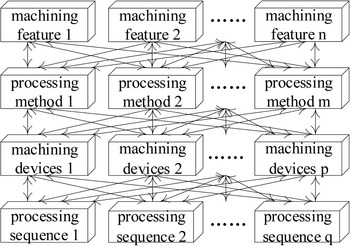
A machined part usually has several machining features, and different divisions of machining feature will correspondingly result in separate processing methods, and each processing method may have various machining devices and fixtures. At the same time, the processing sequence of different machining equipment is also constrained by product type and scale, process standards and technician's experience, thus forming a complex mapping relationship. The network structure of process planning schemes is shown in Figure 2.
Network structure of process planning schemes.

Diversity of machining features and complexity of process design principles
The machining features of parts include the shape features, such as plane, cylindrical surface, conical surface, spherical surface, hole, groove, spline, and screw; include material features, such as material type, material hardness, and material heat processing requirements; also include precision features, such as shape and position accuracy, surface quality; and process features, such as part clamping and positioning, cutting amount. The process design principle mainly includes from coarse to precise, from plane to hole, from primary to secondary, design basis first, process concentration or decentralization, etc. Different part types and product quality requirements have great difference in the division of machining features and the selection of procedures.
Diversity of processing methods and dynamics of machining devices
The processing methods of parts usually include turning, milling, drilling, grinding, laser processing, forging, welding, riveting, etc. The same processing feature may correspond to various processing methods, for instance plane processing, according to the production scale, material properties and surface quality requirements of parts, can be processed by planning, milling, broaching, grinding, etc. Different processing methods correspond to different processing equipment and productivity.
Processing equipment mainly includes numerous machine tools and auxiliary tools such as cutting tools, fixtures. Its dynamic performance is that the machine tool needs to be equipped with different types of tools and fixtures during the machining process; moreover, the processing sequence of machine tool and its operating state change with the dynamic variations of process route or production resources. The selection of different processing methods and equipment directly affects the production efficiency, machining quality, and carbon emissions of parts.
Multi-level evaluation index system
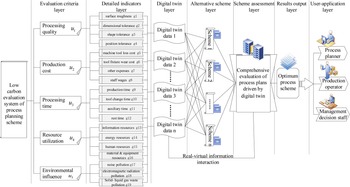
Due to the diversity of process planning schemes, in the actual production process, the energy consumption, carbon emissions, production cost and benefit generated by using different process planning solutions for the same parts vary greatly. Therefore, resource consumption and environmental impact should be considered in the low-carbon decision-making analysis of process planning, so as to quickly and effectively select the economical and reasonable process scheme. In this paper, “classifying-simplifying-synthesis” strategy combined with digital twin technology is adopted to establish a set of feasible comprehensive evaluation index system, as shown in Figure 3.
Evaluation system of machining process planning scheme.

The system mainly includes five evaluation criteria: processing time, processing quality, production cost, resource utilization, and environmental impact. Processing time includes production time, tool change time, auxiliary time, and rest time; processing quality includes surface roughness, dimensional tolerance, shape tolerance, and position tolerance; production cost contains machine tool loss cost, tool fixture wear cost, staff wages, and other expenses; resource utilization includes information resources, energy resources, human resources, material and equipment resources; environmental impact contains noise pollution, electromagnetic radiation pollution, and solid–liquid–gas waste pollution. The formula can be expressed as follows:
 $$\eqalign{F& = f( u_1, \;u_2, \;u_3, \;u_4, \;u_5) , \;u_1 = f( g_1, \;g_2, \;g_3, \;g_4) , \;u_2 \cr & \quad = f( g_5, \;g_6, \;g_7, \;g_8) , \;u_3 = f( g_9, \;g_{10}, \;g_{11}, \;g_{12}) , \;u_4 \cr & \quad= f( g_{13}, \;g_{14}, \;g_{15}, \;g_{16}) , \;u_5 = f( g_{17}, \;g_{18}, \;g_{19}).}$$
In this evaluation system, Solidworks, Mworks.Sysplorer and other software are used to build physical models involved in process planning, such as machine tools, fixtures, and parts. These models are then imported into plant simulation software to form a digital twin planning model. Also, the process constraints, technical requirements, material properties of the parts, etc., are used to construct the corresponding digital twin constraint model and rule models. Various sensing devices are used to collect process data, machining data, and historical data of the parts. These data are sent to the digital twin model through data transmission network such as fieldbus, industrial Ethernet, WIFI, and 5G network to realize timely update and virtual-real mapping of the digital twin model. After data fusion and data cleaning operations, the digital twin data are combined with the process characteristics of the parts to form various process schemes, and then integrated analysis and simulation verification are carried out in the scheme evaluation link. Through this link, the feasibility of different process planning schemes can be evaluated, the potential problems in the production process can be predicted and the corresponding improvement measures can be given. Finally, the process flow and process documents that comply with the low-carbon manufacturing requirements can be obtained. These information can be feedback to the production site to dynamically display the whole process of parts manufacturing, which is convenient for offline operation training and online production guidance.
Comprehensive evaluation method
Firstly, the evaluation index set U and evaluation level V of the process planning scheme is established, and the fuzzy relationship matrix between the evaluation index and the evaluation level is built by using the reduced half trapezoidal distribution function. Then, digital twin data of each evaluation index value is normalized by the polarization method to eliminate the influence of dimension. The combined weight coefficients of each evaluation index value are determined by the hierarchical entropy weight method, and the improved fuzzy operation rules are used to comprehensively evaluate the low-carbon process planning schemes, and the pros and cons of each scheme are obtained, which provides guidance for the production decision-making.
Construction of the fuzzy relationship matrix
Firstly, according to the five evaluation criteria given in the evaluation system described above, the evaluation index set is established: U = {u 1, u 2, u 3, u 4, u 5}; and the feasibility of the process planning scheme is divided into five levels: {excellent, good, general, bad, inferior} to establish the evaluation level: V = {v 1, v 2, v 3, v 4, v 5}.
Then, according to the fuzzy degree of each evaluation index belonging to different evaluation levels, the fuzzy relationship matrix R = {r ij}n×m is established. For qualitative indexes, expert consulting method is adopted to determine its membership function, namely:
 $$r_{ij} = \displaystyle{{\sum\nolimits_{i = 1}^n {h_i\cdot k_i} } \over {\sum\nolimits_{i = 1}^n {k_i} }},$$
where n is the evaluation indexes number, m is the evaluation objects number, h i is the value given by expert i, and k i is the weight of expert i. In order to eliminate the influence of different dimensions among index values on the calculation results, the polarization processing method of formula (2) is adopted to normalize the collected digital twin data, and convert each data to the interval [0,1]. For quantitative indicators, the benefit-type index that refer to the larger the index value, the better result, using formula (3) to determine its membership function:
 $${x}_{ij} = \displaystyle{{x_{\,j\max }-x_{ij}} \over {x_{\,j\max }-x_{\,j \min}}},$$
 $$r_{ij} = \displaystyle{{x_{ij}} \over {\sum\nolimits_{i = 1}^n {x_{ij}} }}.$$
And, for the cost-type index that refer to the smaller the index value, the better result, using formula (4) to determine its membership function:
 $$r_{ij} = \displaystyle{1 \over {\left({{x}_{ij}\cdot \sum\nolimits_{i = 1}^n {{x}_{_{ij} }^{{-}1} } } \right)}},$$
where  $x_{j\max } = \mathop {\max }\limits_i x_{ij}, \;x_{j\min } = \mathop {\min }\limits_i x_{ij}$, x ij is the measured value of index i from the jth scheme; r ij is the membership of index i from the jth scheme. And the fuzzy relationship matrix can be built by the calculated membership values above.
Determine the combined weight A = {a 1, a 2, … , a n}
Firstly, the judgment matrix Y = {y ij}m×n is constructed by AHP, and the relative importance of indexes is determined by the nine-level scale method. After that, the maximum eigenvalue of matrix Y and its corresponding eigenvector are calculated, the weight vector P = {p 1, p 2, ⋅ ⋅ ⋅ , p n} is obtained by normalizing the eigenvector; and the formula (5) as follows is used to test the consistency of judgment matrix Y:
 $${\rm CR} = \displaystyle{{\rm CI} \over {\rm RI}}\quad {\rm and} \quad {\rm CI} = \displaystyle{{( {\lambda_{\max }-n} ) } \over {( {n-1} ) }},$$
where RI is the average random consistency ratio of judgment matrix Y, its assignment is shown in Table 1.
The valve of RI

If CR < 0.10, the consistency of the judgment matrix Y is good; otherwise, the element values of matrix Y need to be adjusted to meet the consistency requirement.
Secondly, the weight coefficient q i is calculated by the entropy weight method (EW). The original data matrix X = {x ij}m×n is standardized according to formula (6) to obtain the judgment matrix Y = {y ij}m×n, and the entropy weight of ith evaluation index is calculated by formula (7) and (8).
 $$y_{ij} = \displaystyle{{a_{ij}} \over {\sqrt {\sum\nolimits_{i = 1}^n {a_{ij}^2 } } }},$$
 $$H_i = {-}\displaystyle{{\sum\nolimits_{\,j = 1}^n {\,f_{ij}\ln f_{ij}} } \over {\ln n}} \;{\rm and} \; f_{ij} = \displaystyle{{( 1 + y_{ij}) } \over {\sum\nolimits_{\,j = 1}^n {( {1 + y_{ij}} ) } }},$$
 $$q_i = \displaystyle{{( 1-H_i) } \over {( m-\sum\nolimits_{i = 1}^m {H_i} ) }}.$$
After that, the weight p i determined by AHP are fitted with those q i obtained by EW to get the combined weight coefficients a i, namely:
 $$a_i = \displaystyle{{\sqrt {\,p_iq_i} } \over {\sum\nolimits_{i = 1}^n {\sqrt {\,p_iq_i} } }}.$$
Improved fuzzy operations to solve the problem
The conventional fuzzy operation method is improved by combining M(∧,∨) operator and M(⋅,⊕) operator to consider the effect of each evaluation index and effectively avoid data loss. Then, we can get a new fuzzy operator  $\lambda M( {\wedge} , \;\vee ) + ( 1-\lambda ) M( {\cdot} , \;\oplus )$, and the fuzzy calculation is performed by the combined weight set A and the membership fuzzy relationship matrix R to obtain the comprehensive evaluation vector, that is:
 $$\eqalign{B & = A\cdot R = [ {a_1, \;a_2, \;\cdots , \;a_n} ] \cdot \left[{\matrix{ {r_{11}} & {r_{12}} & \cdots & {r_{1m}} \cr {r_{21}} & {r_{22}} & \cdots & {r_{2m}} \cr \vdots & \vdots & \ddots & \vdots \cr {r_{n1}} & {r_{n2}} & \cdots & {r_{nm}} \cr } } \right] \cr & = [ {b_1, \;b_2, \;\cdots , \;b_m} ],}$$
 $${b_j = \alpha \displaystyle{{\vee a_ir_{ij}} \over {\sum\nolimits_{i = 1}^n {\vee a_ir_{ij}} }} + ( 1-\alpha ) \displaystyle{{\sum\nolimits_{i = 1}^n {a_ir_{ij}} } \over {\sum\nolimits_{\,j = 1}^m {\left({\sum\nolimits_{i = 1}^n {a_ir_{ij}} } \right)} }}{\rm , \;\ }\alpha \in [ {0, \;1} ]}. $$
In order to further utilize the information provided by vector B so as to reflect the actual situation comprehensively and objectively, formula (12) is adopted for weighted-means calculation to obtain the final comprehensive evaluation results:
 $${B}^{\prime} = \displaystyle{{\sum\nolimits_{\,j = 1}^m {\,jb_j^s } } \over {\sum\nolimits_{\,j = 1}^m {b_j^s } }}, \;$$
where s = 1,2.
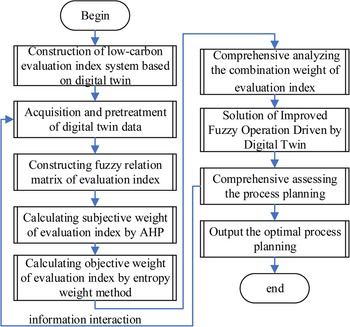
To sum up, the comprehensive evaluation process of low-carbon process planning based on the digital twin is shown in Figure 4.
Flowchart of the comprehensive evaluation process.

Case study and discussion
In this paper, the machining process optimization of adapter parts produced by an automobile plant is taken as an example to verify the feasibility and effectiveness of this method.
Acquire relevant process information
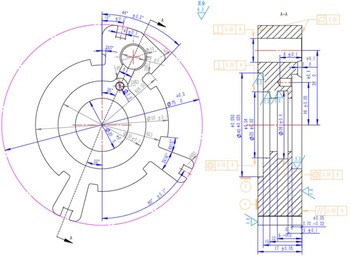
The main view and A–A rotating section of the adapter part are shown in Figure 5.
Schematic diagram of the adapter part.

As can be seen from Figure 4, the machining process features of this part mainly include cutting cylindrical surface, dual-end-face machining, through-hole, and inner groove machining. The surface roughness requirement of the dual-end-face is high, reaching Ra1.6, and it has parallelism and flatness requirements of 0.02. During the processing of through-hole and inner groove, verticality and concentricity requirements shall be reached to 0.02, and the dimensional accuracy requirement is also high. According to the process features and machining requirements of this part, different machining method and equipment can be utilized to achieve this. Now, three kinds of machining process planning schemes to be evaluated are given, as shown in Table 2.
Process planning schemes

Synthetically estimating and analysis
According to the machine tools and equipment used in processing schemes and the consultation with processing staff, the evaluation index values of each process planning scheme can be obtained, wherein the quantitative indexes (processing quality, production cost and processing time) can be obtained directly, qualitative indexes (resource utilization and environmental impact) are graded by five experts according to the proportional scale method (excellent: 0.9, good: 0.7, general: 0.5, bad: 0.3, inferior: 0.1), and the relative weight of experts is (0.5,0.3,0.2,0.4,0.1), as shown in Table 3.
Index measurements of each process planning scheme

The data in Table 3 can be calculated according to formula (1)–(4) to get the membership matrix of each type of indexes as follows:
 $$\displaylines{R_{19 \times 3}{\rm} = \left[{\matrix{ {0.3333} & {0.3719} & {0.4215} & {0.3609} & {0.2975} & {0.3226} & {0.4255} & {0.3648} & {0.3546} \cr {0.3333} & {0.2975} & {0.3044} & {0.3383} & {0.3719} & {0.1935} & {0.2553} & {0.2964} & {0.3129} \cr {0.3333} & {0.3306} & {0.2740} & {0.3008} & {0.3306} & {0.4839} & {0.3191} & {0.3388} & {0.3325} \cr } } \right. \cr \left. {\matrix{ {0.4000} & {0.4200} & {0.4255} & {0.4467} & {0.6867} & {0.6867} & {0.6200} & {0.3547} & {0.6733} & {0.5267} \cr {0.2667} & {0.3000} & {0.2553} & {0.2467} & {0.5400} & {0.4467} & {0.6333} & {0.3159} & {0.5667} & {0.4467} \cr {0.3333} & {0.2800} & {0.3191} & {0.2733} & {0.3667} & {0.3800} & {0.6467} & {0.3294} & {0.5133} & {0.4067} \cr } } \right]^T.}$$
The judgment matrix of the first layer is constructed with index U = (u 1, u 2, u 3, u 4, u 5) as follows,
 $$U = \left[{\matrix{ 1 & 2 & 3 & 3 & {{1 / 2}} \cr {{1 / 2}} & 1 & 3 & 2 & 2 \cr {{1 / 3}} & {{1 / 3}} & 1 & {{1 / 2}} & {{1 / 3}} \cr {{1 / 3}} & {{1 / 2}} & 2 & 1 & {{1 / 2}} \cr 2 & {{1 / 2}} & 3 & 2 & 1 \cr } } \right].$$
The maximum eigenvalue λ max, the weight vectors of first layer P I and CR can be obtained from the previous steps of AHP:
λ max = 5.3499,  $P_I = \left[{\matrix{ {0.2825} & {0.2601} & {0.0753} & {0.1167} & {0.2654} \cr } } \right]$, CR = 0.0781 < 0.1. It passes consistency verification.
Similarly, the judgment matrix of each index in u 1 ~ u 5 is constructed to obtain the weight vector of the second layer P II and test its consistency, and the results are shown in Table 4.
Index weight coefficients

Thus, the total weight coefficients of AHP can be obtained by multiplying the above two weight coefficients, as follows:
 $$\displaylines{P = &[{\matrix{ {0.1293} & {0.0734} & {0.0505} & {0.0293} & {0.0363} & {0.0728} & {0.1209} } } \\ & \times {\matrix{ {0.0301} & {0.0446} &{0.0152} & {0.0090} & {0.0065} & {0.0163} & {0.0329} } } \\ & \times {\matrix{ {0.0547} & {0.0129} & {0.1659} & {0.0362} & {0.0633}] & & &&&&& } } }$$
The data in Table 3 are normalized according to formula (6) to obtain the judgment matrix Y:
 $$\displaylines{Y{\rm} = \left[{\matrix{ {0.5774} & {0.5112} & {0.4351} & {0.5287} & {0.6389} & {0.4867} & {0.4243} & {0.5200} & {0.5406} \cr {0.5774} & {0.6390} & {0.6024} & {0.5640} & {0.5111} & {0.8111} & {0.7071} & {0.6400} & {0.6126} \cr {0.5774} & {0.5751} & {0.6693} & {0.6345} & {0.5750} & {0.3244} & {0.5657} & {0.5600} & {0.5766} \cr } } \right. \cr \left. {\matrix{ {0.4616} & {0.4472} & {0.7071} & {0.7268} & {0.7245} & {0.7433} & {0.5773} & {0.5407} & {0.6677} & {0.6260} \cr {0.6594} & {0.7155} & {0.4243} & {0.4499} & {0.5488} & {0.4730} & {0.5773} & {0.6072} & {0.5463} & {0.5759} \cr {0.5934} & {0.5367} & {0.5657} & {0.5191} & {0.4171} & {0.4730} & {0.5773} & {0.5822} & {0.5058} & {0.5259} \cr } } \right]^T.}$$
According to formula (7) and (8), the entropy weight Q can be obtained as follows:
 $$\displaylines{Q = \left[{\matrix{ {0.0401} & {0.0402} & {0.0405} & {0.0402} & {0.0402} & {0.0416} & \cr {0.0406} & {0.0402} & {0.0401} &{0.1956} & {0.1174} & {0.0406} & {0.0405} \cr {0.0407} & {0.0406} & {0.0401} & {0.0402} & {0.0403} & {0.0402} }} \right].}$$
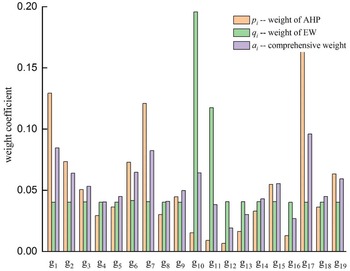
The above two weight coefficients are fitted according to formula (9) to get the combined weight coefficient A, as shown in Figure 6.
 $$\eqalign{& A = \left[{\matrix{ {0.0475} & {0.1191} & {0.0345} & {0.0819} & {0.0325} & {0.0721} & {0.0264} & \cr } } \right. \cr & \left. {\matrix{ {0.1317} & {0.0447} {0.0153} & {0.0089} & {0.0066} & {0.0280} & {0.0191} & {0.0551} & \cr } } \right. \cr & \left. {\matrix{ {0.0117} & {0.1663} & {0.035} & {0.0635} } } \right].}$$
Weight coefficient of each indicator.

According to formula (11) and (12), the final comprehensive evaluation results are as follows:  $B = [ \matrix{ {0.3648} & {0.3104} & {0.3247} \cr } ] .$
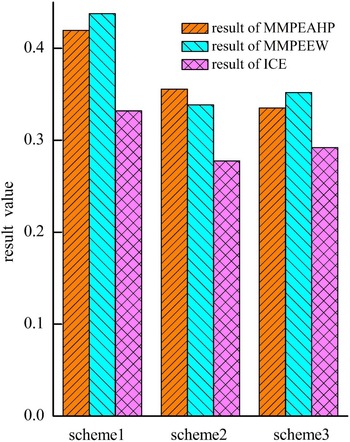
In order to compare with the results of traditional evaluation methods, the analysis results of three evaluation methods, that is, the maximum membership principal evaluation with analytic hierarchy process (MMPEAHP), the maximum membership principal evaluation with entropy weight (MMPEEW), and the improved comprehensive evaluation (ICE) proposed in this paper, are summarized in Figure 7.
Results of different evaluation methods.

From Figure 6, among the subjective weight coefficient obtained by AHP, the weights of g 1, g 6, g 7, g 17 are relatively large, while the weights of g 11, g 12, g 16 are relatively smaller than others. Among the objective weight coefficient obtained by EW, the weights of g 10, g 11 are larger than others, and the rest tends to be consistent. This is determined by the characteristics of the two methods themselves, which lead to the difference in evaluation results. The combined weight coefficients obtained by weight correction effectively improve the larger or smaller weight coefficient calculated separately by AHP and EW method, so that the combined weight coefficients are basically between the weights determined by AHP and EW methods. The combined weight calculation method fully combines the advantages of these two methods and can avoid the result deviation caused by insufficient or inaccurate original data.
In Figure 7, it can be seen that scheme 1 is the best among the three methods, indicating that this scheme is feasible. The MMPEAHP highlights the role of the maximum influential index, and its evaluation results tend to be conservative; the MMPEEW balances the effects of each evaluation index and makes the evaluation results more reasonable. From the comprehensive evaluation results, the feasibility of scheme 3 is the second, and that of scheme 2 is the worst. Therefore, under the conditions of meeting the machining equipment and production capacity, the scheme 1 should be preferred for machining this product, which can give full play to the advantages of centralized processing of computer numerical control equipment to ensure machining accuracy and improve production efficiency, while saving resources consumption and reducing carbon emissions. Thereby, it can reduce environmental pollution and promote the development of traditional manufacturing in the green and low-carbon direction. Through practical verification, the evaluation method adopted in this paper is consistent with the actual production situation and has certain application and promotion value.
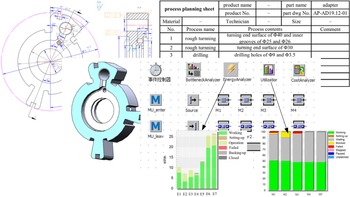
At the same time, the relevant parameters of optimal solution obtained from process planning evaluation are brought into the plant software for simulation, which can observe the feasibility and availability of manufacturing resources in real time, as shown in Figure 8. This process helps planners visually understand and predict manufacturing capability, production cost, processing time, and production bottlenecks of the selected solution; it also facilitates planners to visualize the decision-making to better understand the optimal results and promote continuous optimization of the production process.
Example of process planning evaluation interfaces.

Conclusion
The comprehensive evaluation of machining process planning is important to reduce resource consumption, environmental pollution in the manufacturing process, and promote low-carbon manufacturing. When facing unpredictable disturbing events in process planning, digital twin severs as a tool to effectively fuse physical space and virtual space, providing a new way for the dynamic assessment of process planning. Therefore, in this work, we present a comprehensive evaluation method for multi-process planning schemes oriented to digital twin technology. The main contributions of this paper are concluded as follows.
1) Based on the diversity of process planning schemes, a multi-level process planning evaluation system is established with 19 evaluation indicators from five aspects, and a comprehensive evaluation method for low-carbon process planning scheme oriented to digital twin is constructed.
2) After the index data are normalized by the polarized data processing method, combination weight of each index is determined through the hierarchical entropy weight method, and the evaluation and analysis of multi-process schemes are carried out according to the improved fuzzy operation rules.
3) Three alternative process planning schemes of an automobile part are employed as an example to verify the feasibility of this approach. The results demonstrate that it can obtain an optimal scheme of economical and environmental benefits, which meets the long-term development needs of enterprises.
In future work, several following issues are worth to be further considered to improve the practicability of this method:
1) To construct a more comprehensive digital model for dynamic evaluation of process planning schemes. This model can continuously accumulate design and manufacturing process information, which is easy to be improved and reused.
2) Real-time acquisition of machining status data (such as machining parameter information, machine tool information, and real-time data), which is the basis of dynamic evaluation and decision-making, and is also beneficial to the virtual-real interaction of physical data and virtual data in the production process.
3) To optimize and improve the process parameters according to the real-time evaluation results, which could reduce carbon emissions in the manufacturing process. As well as to optimize the proposed method to enhance its adaptability for delicate parts. In addition, the proposed method could be extend to other domains, for example, assembly process planning evaluation, casting process planning evaluation, etc.
Acknowledgments
The authors would like to thank the anonymous reviewers for their valuable comments and constructive suggestions.
Financial support
This work is supported by the Scientific Research Foundation of Chongqing University of Technology (0103191147), the National Natural Science Foundation of China (61605205), and the project of Zhongke advanced manufacturing and innovation in Deyang, China (YC-2016QY-07).
Conflict of interest
The authors declare none.
Zhaoming Chen received the BS degree in Mechanical Engineering from Northwestern Polytechnical University, Xi'an, China, in 2007, and the master's degree in Academy of Aerospace Solid Propulsion Technology, Xi'an, China, in 2010. He is currently a senior engineer in Chongqing Institute of Green and Intelligent Technology, Chinese Academy of Sciences, and is also a PhD student in Chongqing school, University of Chinese Academy of Sciences. His research interests include smart manufacturing systems, digital twin technology, computer-aided design, and systems engineering.
Jinsong Zou received the BS degree from Shenyang University of Technology, Shenyang, China, in 1995. He is currently an engineer in Chongqing Institute of Green and Intelligent Technology, Chinese Academy of Sciences. His research interests include conceptual design, computer-aided design, and modeling and simulation of advanced manufacturing systems.
Wei Wang received the BS degree in Computer Engineering from Chongqing University of Posts and Telecommunications, Chongqing, China, in 2001, and the PhD degree in Computer Engineering from the University of Chinese Academy of Sciences, Beijing, China, in 2019. He is currently an Associate Professor with the College of Computer Science and Engineering, Chongqing University of Technology, Chongqing, China. His current research focuses on service-oriented manufacturing (SOM) and computer-aided design.