

In the USSR, the Bar was set apart by its unique organization, both within the justice system and the Soviet structure more generally. Self-organized into “colleges” (kollegii, here translated as bar associations) and working outside the bureaucracy, lawyers (advokaty)—who were initially known as “defenders” (zashchitniki)—were never civil servants, though they were controlled by the ruling bodies of the Communist Party of the Soviet Union (CPSU) and the Ministry of Justice. Their clients’ fees were more or less regulated depending on the period and were paid directly to the presidency of the bar association, which was charged with redistributing them in proportion to the number of cases handled by each lawyer. Admission to the bar associations was subject to election. Lawyers’ official activities consisted of the counsel's speech in both criminal and civil courts, the provision of legal advice to the public, businesses, and organizations, and the drafting of appeals. Until 1960, they were excluded from all investigative procedures, including those of the sledovatel’ or preliminary investigator, and their influence in court was limited. Their presence was required in criminal courts whenever the prosecutor was in session—that is to say, in half of all cases between 1945 and 1953—but it was rare in military tribunals and the other special courts that nonetheless handled a great many cases.
A symbol of class-based justice, the Bar had been vehemently called into doubt by the Bolsheviks from November 1917, with Lenin expressing his distrust of a profession that he had himself practiced for a few brief months in Samara in 1891–1892.Footnote 1 In broad terms, the relationship between lawyers as a group and the Soviet authorities shifted over time from one of mutual hostility to gradual rapprochement. The lawyers who had trained under the empire were often liberals who were critical of autocracy and close to the Constitutional Democratic Party (Konstitutsionnaia demokraticheskaia partiia, KD)—which had made clear its hostility to the new authority as early as the October Revolution of 1917—and the powerful Petrograd bar association had unanimously condemned the Bolshevik coup d’état. The Bar ceased to exist officially from 1917 to 1922, when it was reestablished following the publication of the Criminal Procedure Code of the Russian Soviet Federated Socialist Republic (RSFSR). On several occasions the Commissariat for Justice nevertheless continued to support plans to make lawyers civil servants, which were periodically discussed and implemented for a few months at a time, further destabilizing a profession whose members were moreover subject to widespread surveillance and police repression. However, from the mid-1930s onwards, under the influence of the prosecutor Andrei Ianuarievich Vyshinskii and the patronage of Stalin, the traditional justice system was rehabilitated in political discourse. The right to defense became a constitutional right in 1936, and the Bar was provided with a new set of regulations in 1939. The notion that a trial should involve the hearing of both parties (audi alteram partem), that is to say, an adversarial trial, was no longer challenged and “revolutionary justice” was gradually replaced by “socialist legality.”Footnote 2
Drawing on the sociology of law and of the professions,Footnote 3 the study of the legal profession in the USSR makes it possible to evaluate how far the exercise of defense and the handling of the law in the service of the private interests of individuals could work as a barrier against state repression.Footnote 4 Described in other contexts as the bearers and vectors of political liberalism,Footnote 5 lawyers effectively played an important political role during the imperial period, the 1920s, and—to a more modest extent—the 1970s and 1980s. The memoirs published by émigré lawyers or after perestroika paint a picture of a highly competent, close-knit professional body that was attached to its history and which shared a professional (legalisticFootnote 6 ) ethos and liberal, humanist political tendencies that were naturally opposed to Soviet authoritarianism.Footnote 7
Establishing how lawyers could—and did—defend their clients against the repression of the Stalin era is complex: the lack of first-hand testimonies from the 1930s to 1950s, coupled with limited access to the archives of trials held after the war, does not allow for a fine-grained description of the presence and use of the law in Soviet courtrooms. With the exception of one work on the 1920s and 1930s,Footnote 8 there exists no study of lawyers for the remainder of the Soviet period; the testimonies and memoirs, as well as the monographs on particular regions, are essentially concerned with the same two decades preceding the Second World War and the periods that succeeded Stalin's death (notably the emergence of a “defenders of the law” movement within dissident circles and the specialization of a limited number of lawyers in the defense of political prisoners).
Based on a corpus of (extremely rare) testimonies and (abundant) administrative and police archives, this article endeavors to describe the professional lives of lawyers on a daily basis. It focuses less on their practices in the courtroom than on their social and political networks, homing in on the social fabric in which they were embedded and reevaluating their ability to act, notably in cases brought to appeal. The highly particular way in which the legal profession was practiced in the USSR—which cannot be reduced to the defense speeches lawyers delivered during trials—in turn illuminates how ordinary justice operated on the ground, through legal procedures, to be sure, but also through the exchange of information, or even material goods or money. These exchanges were the mainstay of defense proceedings in the face of the very aggressive campaign to clamp down on ordinary criminality that struck Soviet society following the end of the Second World War. At the time of Stalin's death, over five million individuals were imprisoned in the Gulag, the camps, and special villages, representing 3 percent of the Soviet population. Around 40 percent of ordinary prisoners had been sentenced for theft by the standard courts, with the theft of state and private property alike being punished with particular severity following the decree of June 1947: the petty theft of socialist property was punishable by a minimum of seven to ten years in the Gulag, and aggravated theft by ten to twenty-five years. “Counterrevolutionary crimes” accounted for almost 22 percent of the Gulag population on January 1, 1953.Footnote 9
Based on the meticulous reconstruction of the social context and political climate of the 1930s and, above all, the 1940s, the study of the networks and sociabilities of jurists makes it possible to grasp the different aspects of their activity and to situate these in a broader history of the USSR that is attentive to everyday practices and social structurations as they are revealed in the archives. Such a study sheds new light on how the Soviet state exercised power and how people understood the decisions made by Stalin—as well as how they reinterpreted them, deviated from them, circumvented them, and made possible their very existence. The lawyers of the 1940s knew how to affect a (formal) allegiance to the state; indeed, some had been trained in the regime's most repressive institutions (the police, the political police, and the Prokuratura or Procuracy). Above all, in the years that followed the war they learned to handle new tools of protection, patronage, and even corruption, which they put to the service of their clients or their own protection.Footnote 10 Occasionally demanding the payment of what were viewed as exorbitant fees compared to the standards set by the regime, in direct contact with victims and their families, and revealing themselves to be subtle connoisseurs of a congested justice apparatus, lawyers fully participated in the development of new political rules of play in the USSR.
In the pages that follow, I describe the generational shift that occurred between the lawyers issued from the Old Regime—who took risks to alleviate the harshest repressions of the 1930s—and the postwar Bar. Subjected to rigorous surveillance and controls, the latter was composed partly of standard legal specialists and partly of personnel hailing from the repressive institutions of the regime, the Procuracy and the political police, which saw the scope of their activities expand in the context of a repression of criminality that was principally administered by ordinary courts. The lawyers of the 1940s and 1950s grappled directly with various social dynamics of patronage and clientelism. To help their clients, they had to be able to navigate their way through the party-state system, as well as to understand its political culture and exploit these new rules of exchange.
Lawyers, the Tumult of the Revolution, and Stalin-Era Repression
In The State and Revolution, written during the summer of 1917, Lenin recognized the need for the law to be maintained in a transitional period, though he considered it an instrument of the dominant classes that was fated to disappear in Communist society. With the Revolution came the organization of revolutionary courts, adding to the routine work of the ordinary courts inherited from the Old Regime, which continued to function. Within these revolutionary courts, the professions of prosecutor and professional defender did not exist: anyone could be appointed by the Supreme Soviet to exercise one or the other of these functions and thereby administer justice founded on “revolutionary conscience.” After 1922, with the publication of the first Criminal Procedure Code, the traditional justice institutions, including the Bar, were reestablished.Footnote 11
The figure of the lawyer was decried throughout the 1920s. In 1926, for example, the CPSU Central Control Commission had plans to prohibit Communists from becoming lawyers, judging that this still privatized profession defended only wealthy people, and that to practice it might corrupt party members, especially given that the maximum income they could earn was lower than lawyers’ salaries.Footnote 12 In Communist literature and pamphlets, the bar associations were not only described as dens of bourgeois depravity, but also as beacons for the déclassés of the new regime.Footnote 13 Covetous and deviant, pursuing a decadent way of life and defending the old elites or businessmen (nepmen), lawyers represented the dominant, intellectual, and affluent classes of old and were thus bearers of class inequality in the face of criminal repression. There was no end of speculation over their high fees. In Moscow, some members of the Commissariat for Justice came out in favor of abandoning the adversarial procedure for trials, and plans to turn the bar associations into state organizations were regularly discussed. Criminal proceedings were focused on the prosecution—an inquisitorial bias that remained a constant within the Soviet penal system. Although the presence of lawyers in the proceedings of ordinary justice was no longer questioned from the mid-1930s onwards, their scope for action in court was highly limited and strictly supervised.
Demanding an acquittal, criticizing the preliminary investigation, or taking an overly direct stance against the prosecution by invoking noncompliance with criminal procedures all carried a risk for lawyers, particularly when it came to the hundreds of cases fabricated during the great waves of repression. During the 1930s, statements of principle in favor of rehabilitating the trial and the position of lawyers came up against the preponderant role of the preliminary investigators. Vyshinskii, the architect of the Soviet justice system, was the main advocate for rehabilitating the adversarial procedure when it was attacked. He wrote on the right to defense, and this right was recognized in the Stalin Constitution of 1936. But his position on the role of Soviet lawyers was ambiguous, as evidenced in his use of a famous Moscow lawyer, Il'ia Braude, as an example.Footnote 14 During the great trial against the Industrial Party in 1930, Braude had stressed the high quality of preliminary investigators' work and had strictly confined himself to requesting that his “sincerely” repentant clients be spared the death penalty, thereby delimiting the range of possibilities left open to the defense in political trials.Footnote 15 Throughout the wave of show trials aimed at industrial elites following the Shakhty Trial of 1928, the political police and the Central Committee had appointed lawyers who did not question the “evidence” produced by the preliminary investigators in fabricated cases. Vyshinskii, then the RSFSR prosecutor, praised their position and thereby defined the specificity of the Soviet lawyer, who ought to be less concerned with the individual interests of a client than with putting himself or herself at the service of the court and the socialist state in order to establish the truth.
Lawyers’ accounts of their work in the criminal courts during the Stalin era are rare, though a few do exist for the 1930s, particularly as some lawyers took the opportunity to emigrate to the United States when war broke out.Footnote 16 Boris Georgievich Men'shagin, who spent the postwar years as a prisoner in the USSR, left a gripping testimony of his experience as a lawyer during the two major campaigns of repression in the 1930s: collectivization (dekulakization) and the Great Purge.Footnote 17 His memoirs, published in Paris during perestroika, provide detailed descriptions of his work. He notes not only what he did but also the position of his colleagues, and recounts various trial scenes. His narrative is a fruitful point of departure for evaluating the destructured justice apparatus that emerged from the civil war and the early years of the Bolshevik regime, as well as the forms assumed by the court-administered criminal repression of the Stalin era.
Born in 1902 in Smolensk in western Russia, on the border with Belorussia, Men'shagin received secondary-level legal training before serving in the Red Army from 1919 to 1927. After being demobilized, he completed his studies by correspondence and from 1928 to 1931 served as a lawyer at the regional court of southwestern Russia (Tsentral'no- Chernozemnyi okrug). After a spell of employment at a Moscow factory, he once again became a lawyer in his native region from 1937 to July 1941. Under the German occupation, he became the burgomaster, or mayor, of Smolensk and collaborated with the Nazis. As such he participated alongside the German forces in the excavation of the mass graves at Katyn, where the bodies of thousands of Polish officers assassinated by the Soviet political police were discovered (the Soviet authorities accused the Nazis of committing the massacre). At the end of the war, Men'shagin returned to the USSR in the hope of finding his family. Arrested as a collaborator privy to state secrets of the utmost importance, he spent twenty-five years in Vladimir Prison, held in solitary confinement.
Men'shagin's testimony describes in considerable detail the hazardous and chaotic ways in which lawyers could have their clients freed or spared the death penalty in the distinctive political context associated with the end of the Great Purge. It thus gives a sense of the possibilities furnished by the law whenever a decision was made to restore political calm. Men'shagin describes how, between 1936 and 1937, he was appointed by the president of the bar association of the Smolensk region to sit in on political trials entrusted to the “special” sections of the courts.Footnote 18 In this capacity he took part in several cases that were effectively trials against the regional economic elites. Amid the terrible hardships of rationing during the 1930s, senior officials from industry and agriculture, including the director of the bread-making corporation, were accused of counterrevolutionary sabotage. The cases were investigated by the political police but ultimately went to court, where the defendants were sentenced to death. Describing his actions as well as his failures, Men'shagin above all explains how he attempted to overturn verdicts that had been appealed to the Supreme Court or the General Procuracy of the USSR. Implicit in his narrative is a new dimension of the Soviet justice system, namely the hasty construction of a poor, shabbily quartered, and under-resourced justice apparatus that was lacking in authority. It faced not only the obstacles posed by the political climate, but also practical difficulties arising from the incomplete construction of a traditional state and the instability of its justice institutions.
To appeal death sentences, Men'shagin made the three-day train journey to Moscow, his expenses paid by his clients’ families.Footnote 19 After hours spent waiting in packed and noisy anterooms or making his way from one secretariat to another long after his fellow Smolensk lawyers had preferred to retire to the taverns, he succeeded in having several trials reviewed and his clients saved from execution. In reality, these cases benefited from the political lull that marked the end of the Great Purge from June and particularly November 1938 onwards,Footnote 20 and which saw cases handled by the lower courts being reviewed by the high courts of the USSR and the Procuracy.Footnote 21
On another occasion, a trial was brought against eight managers and technicians from the agricultural and livestock-rearing sector in the Smolensk region. Emboldened by his successes in previous appeals, Men'shagin had the courage to take a stand against the preliminary investigation as soon as the trail began and demanded an adjournment on the grounds that further examination was required, thereby putting himself at some risk. His request was refused, and the defendants were sentenced to death. Nonetheless, pressed by the wives of the men, he presented himself at the Prokuratura of the USSR in Moscow. In what seems to have been a fortunate coincidence, he was eventually received by Vyshinskii himself, who in the intervening period had become prosecutor general of the USSR. Men'shagin was made to take a procedural test and Vyshinskii, gratified to see that a lawyer from the distant and provincial Smolensk was possessed of the kind of Soviet legal professionalism he had been calling for since the early 1930s, and given that the frenzy of the Great Purge had subsided, opened a review. Two months after the eight defendants had been sentenced to death, the lawyer was able to have the verdict overturned by the Procuracy and the case returned to the preliminary investigators for reexamination. Finally, after two years of proceedings, the defendants were released.
The examples taken from Men'shagin's testimony—his failures in court, his long and costly trips to Moscow, the pressure from (and relief of) wives and families, the influx of new cases after an initial success, the admiration-laced anxiety of his colleagues when serious criminal cases turned out well—all point to the subtle game or space in which Soviet lawyers could exercise their skill in appeal cases, and later in the courtroom once again. Men'shagin presents himself as an exception, and the story he relates can only be understood against the backdrop of relative appeasement that accompanied the end of the Great Purge. Nonetheless, he also bears witness to the possibility of handling the law in certain ways, and the importance, in this very specific context, of handling it correctly. It is difficult to assess how many risks of this kind were taken, and even harder to determine the extent to which they met with success. It was a dangerous game. Men'shagin relates that when he was questioned after his arrest in 1945, he was accused not only of collaborating with the Nazis but also of inciting defendants to systematically refute the statements they had made during investigations: his practice as a lawyer had been placed under surveillance. The historian Sergei Krasil'nikov has shown that in the region of Novosibirsk in the 1930s, lawyers who had questioned the preliminary investigation in trials targeting counterrevolutionaries were identified by the political police and disbarred.Footnote 22 Indeed, bar associations were constantly monitored by their supervisory authorities, their elected presidium, the party, the Ministry of Justice, the courts, the Procuracy, and the political police.Footnote 23
The bar associations had already undergone incessant purges during the 1920s and the turn of the 1930s. As early as 1934 Vyshinskii boasted of having established a Bar made up of young specialists drawn from those milieus particularly prized by the regime: proletarians or peasants who had trained and rapidly climbed the social ranks in the context of mobility that characterized the first period of Stalinism. Nevertheless, during the Great Purge three hundred lawyers were repressed (deported or executed) and over four hundred were disbarred.Footnote 24 On July 1, 1938, there remained only 7,163 lawyers (compared to 13,000 at the end of the empire), 10.5 percent of whom belonged to the party or the Komsomol. By June 1939 their numbers had already risen to 8,875, with 24.3 percent belonging to the party or the Komsomol. In January 1940, there were 10,931 lawyers and trainee lawyers within a total Soviet population of around 195 million inhabitants. Between 1940 and 1945, 55 percent of lawyers disappeared or left the profession. With the gradual disappearance of the jurists who had been trained under the Old Regime, the Soviet state had an almost complete grip on the profession by the end of the war.Footnote 25
“Sovietized” Lawyers and the Place of the Law in the Postwar Period
As table 1, based on the archives of the Ministry of Justice of the USSR, shows, in the years that followed the number of Soviet lawyers remained stable and relatively low compared to the total population, the number of cases handled, and the size of the country.
The number of lawyers in the USSR (1947–1952)
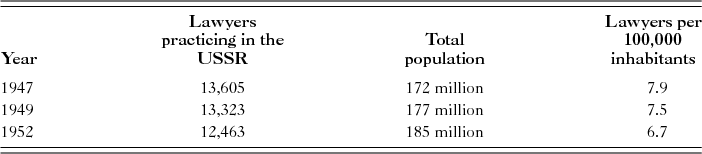
Sources: GARF, f. 9492, op. 1, d. 1232, l. 15. The statistics for the Soviet population were established by Evgenii M. Andreev, Leonid E. Darskii, and Tat'iana L. Kharkova, Naselenie Sovetskogo Soiuza, 1922–1991 (Moscow: Nauka, 1993), 118–19. As a comparison, in New York in 1930 there were 264 lawyers for every 100,000 inhabitants: see Abbott, The System of Professions, 252.
Nevertheless, in the postwar period a series of criminal laws targeting social practices that were considered deviant but which were extremely widespread in a context of famine and general shortage (pilfering, theft, misappropriation, lateness or absenteeism from work, abuse of social goods, etc.), led to a vertiginous rise in the number of trials and, ultimately, in the Gulag inmate population. From 1945 to 1953, around 16 million people were judged guilty, and over half received custodial sentences.Footnote 26 The Special Conference (Osoboe Soveshchanie)—the organ of extrajudicial repression of the political police (now the Ministerstvo gosudarstvennoi bezopasnosti, MGB)—continued to sentence thousands of citizens for “political” reasons without their lawyers being present, but the Soviet Union's ordinary courts were working even harder, operating at full tilt.Footnote 27
The Ministry of Justice statistics give a sense of the spectrum of the courts’ activity, whether criminal defense, civil defense, or legal aid—the scope of which widened at the end of the war. Lawyers were widely solicited despite their weak influence, and their limited numbers, distribution across the country, and finite capacity for action inside the courtroom did not prevent them from consolidating their social position. In 1948, a lawyer handled an average of seventy criminal cases and seventeen civil cases each year.Footnote 28 Given the social difficulties faced by the population, lawyers also helped people to claim their disability and veterans’ pensions, or other forms of maintenance. According to the statistics that the bar associations regularly submitted to the Ministry of Justice, lawyers had thus provided 400,000 free advisory consultations in the first quarter of 1949 and were participating in over a million criminal cases.Footnote 29 In 1954, they had defended citizens in 606,394 criminal cases, represented the interests of citizens and organizations in 292,522 civil cases, established 1,136,176 statements and complaints, and provided 843,259 legal consultations.Footnote 30 In accordance with article 55 of the Soviet Criminal Procedure Code, court-appointed lawyers risked not being paid if the client did not have the necessary financial means (any trial in which the prosecutor was in session was supposed to take place in the presence of a lawyer, but the latter could be refused by the defendant). Although there were debates in the 1940s over whether the courts or the bar associations should reimburse their services, the refusal to compensate lawyers for their work poisoned the working atmosphere of the bar associations, and it was common knowledge that unpaid lawyers played only a token role in court. Despite the increase in pro bono services (in 1953, 43 percent of all cases for the defense were delivered by court-appointed lawyers, whose payment was therefore not guaranteedFootnote 31 ), lawyers were still wrongly believed to be better paid than other justice personnel. In 1954, their monthly salary averaged 985 rubles.Footnote 32
The Statute on the Soviet Bar, adopted in 1939, formed the basis of the Bar's organization until the fall of the USSR. The services of lawyers were delivered through the bar associations, and, at the district level, through legal consultation bureaus (konsultatsiia), the aim being to guarantee legal assistance to the Soviet population as a whole and to promote the spread of a “legal culture” across the USSR.Footnote 33 These bureaus were placed under the authority of an elected presidium that was entitled to specify the location and composition of the consultations, and to appoint their directors. The latter were accountable to the presidium, not to their colleagues. Salaries were calculated on the basis of the number of cases handled, with a deduction in the range of 30 percent to cover the bar association's operating costs. The presidium was elected at meetings of the electoral colleges representing the consultation bureaus; according to some testimonies these meetings, orchestrated by the party cell, provided certain room for maneuver thanks to political techniques developed to ensure that the presidium was composed exclusively of Communists, but also honorable people.Footnote 34 In February 1950, the Council of Ministers of the USSR decided that the Ministry of Justice should set a maximum number of lawyers per city, region, and republic.Footnote 35
At the local level, this number was negotiated with the presidiums of the different bar associations. These, like the consultation bureaus, were not at all evenly distributed across the country, because lawyers, still few in number, often refused to be posted to rural or isolated areas. The presidiums and/or the ministry would order the lawyer to move to such and such a town, and the local administration would provide him or her with accommodation—but the lawyer would simply not go. The minister observed that there was a high turnover, particularly at the end of the war, and a constant shortage of legal specialists in country towns.Footnote 36 For instance, of fifty people posted to the provinces in the region of Kiev, thirty had refused to go and had asked that the presidium's decision be reviewed. Preferring to remain in the city, where their services were in much higher demand and far more lucrative, the lawyers registered complaints with the Ukrainian Ministry of Justice to have the postings overturned.Footnote 37
The desire to have lawyers posted across the country could be explained not only by the rise in the number of cases, but also by the new importance conferred on the law in Soviet propaganda after the war. A ruling pronounced by the Central Committee in October 1946, for example, demanded that all legal practitioners in the USSR, most of whom were party members and state functionaries confronted with the issue of how to practically handle criminal law within the Soviet institutions of justice and repression, should receive proper legal training. In the context of the normalization of the USSR’s image abroad and the country's participation in the Nuremberg trials, Soviet law—or “socialist legality”—acquired a new statusFootnote 38 : jurists seemed to enjoy new authority in a country where their role had largely been discredited prior to the war.Footnote 39 Prominent figures within the judicial apparatus made high-profile appearances on the benches of university law courses. Across the board, the legal professions received the same orders to rapidly professionalize, particularly by means of correspondence courses.Footnote 40 Within the Procuracy and the political police alike, many of the prosecutors and preliminary investigators had no formal legal training, and the same was true of the judges. This difference in levels of legal training, evident in the 1930s but less pronounced in the postwar period, had effects on the confrontations between prosecutors, judges, and lawyers in the courtroom.
In 1937, 6.1% of the members of the Soviet Bar were Communists and 4.4% were Komsomols, while 35% of lawyers had no legal training.Footnote 41 By January 1947, 34.4% were party members.Footnote 42 In 1938, the head of the branch of lawyers within the Ministry of Justice called for a guild of “qualified and trained” (gramotnye i kul'turnye) lawyers, but observed that 38% (i.e., 5,000) still had no legal training: these lawyers had practiced a profession associated with the institutions of repression or justice, and had merely completed a practical internship lasting a few months. In July 1952, half of all lawyers were signed up to the party or the Komsomol and 55% could boast a post-secondary qualification in law.Footnote 43 By 1954, 64% had completed post-secondary legal training, 46% were members of the party, and 10% were members of the Komsomol (only 3% of Soviets were party members in the early 1950s).Footnote 44 These statistics indicate that lawyers were gradually becoming part of the Soviet establishment, with a profile increasingly resembling that of other justice personnel: prosecutors were more frequently party members and trained in law.Footnote 45 More generally, one third of state functionaries employed in the justice system had completed post-secondary legal training as of 1953, while half had done so by 1956, and the recruitment of people without legal training became rare by 1960.Footnote 46
In addition, a series of measures was taken to regulate the concrete practices of the profession. The late 1940s saw the development of the first attempts to standardize what remained very heterogeneous approaches. In December 1949, the Ministry of Justice decreed rules to make criminal proceedings more robust. Lawyers were now required to keep a file containing all the documents relating to a case, a procedure that was essential to the trial proceedings.Footnote 47 With the exception of Vyshinskii's articles, literature on the practice of the legal profession remained limited. Yet within the Ministry of Justice and the Supreme Soviet, jurists had embarked on the massive task of reviewing and rewriting the Criminal Code and the Criminal Procedure Code (both of which dated from the 1920s). The triumphant USSR’s greater openness toward the outside world led renowned jurists to propose reinstating a role for lawyers that more closely resembled the Western tradition, with the lawyer representing the point of view of the defendant alone. But the dawn of the Cold War and its characteristic denunciation of scientific or intellectual transfers had immediate effects.Footnote 48 Published in 1948, the sole work on defense in the criminal trial, Zashchita po ugolovnym delam, had a print run of 15,000 copies and was presented as a reference manual, yet by the following year it was the object of an intense campaign of denigration. The bar associations were instructed to organize meetings criticizing its content. Among the essays by eminent jurists, an article by Moisei L'vovich Shifman entitled “A few questions on the summation for the defense” was particularly singled out: the author had been too explicit in his references to the great tradition of eloquence among the lawyers of the Old Regime. The volume was also denounced in Socialist Legality (Sotsialisticheskaia zakonnost’), the law journal published by the Procuracy, and its principal editor, Ivan Goliakov, the president of the Supreme Court of the USSR, was vehemently criticized.Footnote 49
New Margins for Maneuver
While repression had largely operated outside the justice system prior to the war, this was no longer the case in a postwar context that saw the rehabilitation of the law and legal institutions.Footnote 50 As a consequence, the justice apparatus had to confront a steep rise in the number of criminal cases. The courts were overwhelmed, and although lawyers were excluded from military trials and the Special Conference, or even from any ordinary trial in which the prosecutor was absent, their services were increasingly solicited.Footnote 51 The number of appeals was constantly on the increase, and very often this required the intervention of lawyers, at least while the appeals were being drawn up. Judges in the supreme courts of the Soviet republics complained of having to handle between 650 and 700 appeals every month.Footnote 52 Against the harsh, repressive backdrop of the late 1940s, lawyers thus spent much of their time drawing up a vast number of appeals, reflecting a general expansion of legal activity that overwhelmed the justice apparatus as a whole.
The declarations of intent concerning the need to consolidate lawyers’ authority were not acted upon. Lawyers were now better embedded within Soviet society because their numbers were greater; they were also more integrated by dint of their party membership and their social action as “propagandists” of the law. Moreover, they were engaged in various aspects of legal counsel and, of course, they made increasingly frequent appearances in the tribunals and appellate courts due to sweeping criminal repression. And yet they did not acquire a more solid foothold within the justice system, where they continued to come up against the apparatus of the preliminary investigators and the judges. Lawyers did not have the same prerogatives as the representatives of the Procuracy, such as the right to obtain a complete copy of the case file.Footnote 53 The courts did not send out the file in time for the lawyers to read it thoroughly; they familiarized themselves with cases in a matter of hours, sitting ten to a table in the corridors and recesses of the court.Footnote 54 A year after Stalin's death, in June 1954, the justice minister had to reiterate in his internal memoranda that lawyers were entitled to apply to different institutions and organizations to request documents and information that could serve as evidence in civil or criminal cases.Footnote 55 Mistreated in the courtroom, lawyers considered their substandard material working conditions a symbol of their weak authority. At the Moscow Province Court and in most provincial cities, there was no room assigned to lawyers where they could review their files. Instead they had to seek out an empty courtroom and meet their clients in the corridors, on the street, or, from time to time, in an apartment, a practice that was forbidden.
In the memoirs that she wrote once in the United States, Dina Kaminskaya depicts the Supreme Court of the RSFSR: the lack of windows or ventilation, the squalor, the rudeness of the clerks, and the difficulty of copying out the huge case file without any assistance, huddled in groups of five around small tables that were so close together they were almost touching.Footnote 56 She also describes the lawyers’ chambers in the Leningradskii district in Moscow: a small one-story wooden house containing a single room and four tables for twelve lawyers. In the reception rooms at the Supreme Court, lawyers could spend twelve hours waiting for a question to be examined and, at 11 o'clock at night, find out that the examination had been postponed to the following day. They had difficulty obtaining copies of legal documents, and occasionally they were not given any at all.Footnote 57
In their administrative correspondence with the ministry or the party, some lawyers continued to complain of prosecutors threatening them in court. In Chernivsty Court, for instance, the prosecutor Poliarush announced that the lawyer who was present would be arrested because he had been to the packaging factory in which the crime of embezzlement under trial had occurred: he had taken documentation on the fishing industry from a future witness, raising suspicions of attempted subornation.Footnote 58 In January 1952, a trial took place at the Supreme Court of the USSR in which a group of twenty-seven criminals were accused of embezzlement and stealing “socialist (public) property” to the tune of over one million rubles at a shoe manufacturer in the region of Zhytomyr. The defendants were represented by five lawyers, who were accused by the Ukrainian justice minister of conduct that did “not correspond to that befitting a Soviet lawyer” after they announced that their clients disavowed the confessions made during the initial investigation. The defendants eventually admitted that their lawyers had encouraged them to question the preliminary investigation, and the ministry firmly criticized these “longstanding practitioners, [who], knowing the trial's rules of conduct, had abused their position.”Footnote 59 Although the status of the confession as the ultimate proof of guilt retained its central place in Soviet investigative procedures, thereby encouraging intimidation and torture, if lawyers suggested that the defendants ought to retract what they had said during the preliminary investigator's interrogation (from which lawyers were excluded), they would be reprimanded or even disbarred.Footnote 60 In this context, they continued to restrict their defense to a request for a lighter sentence, without questioning the preliminary investigation or the classification of the crime.Footnote 61
In cases involving the misappropriation of large sums of money—part of the fight against the theft of socialist property—defending serious offenders led to suspicions of venality. And even during the trial itself, lawyers saw their intervention undermined by the court. Some explained that they would refuse to visit their clients in prison for fear of arousing suspicions of having spoken to the defendants or asking them to change their testimony.Footnote 62
The “Soviet” Composition of the Bar Associations
Faced with these difficulties, it seems that lawyers sought to gain acceptance through the law itself, and, above all, that they had learned to make concessions to the justice system and the apparatus of repression. Using the archives of the Ministry of Justice, it is possible to establish a brief prosopography of the bar associations and retrace the career paths of some of their members. This puts the justice apparatus's discourse of normalization and professionalization into perspective and takes us to the heart of the Soviet justice system, contradicting a priori the vision of a well-structured, united, and more legally cultivated professional body during the 1940s. There were certainly some lawyers who spent their entire career at the Bar after completing their studies. A number of “stars” had “distinguished” themselves during the great trials of the 1930s or the trials of collaborators held during and after the war. Yet in a context where qualified legal labor was generally in short supply, some jurists’ career paths were less linear. Recruits to the Bar were thus drawn from the apparatus of repression, the Ministry of the Interior, or even the political police, and indeed some were transferred to the advokatura for negative reasons, such as the sidelining or retirement of personnel who had spent their career working for other bodies (the Procuracy, the courts, etc.), or on the grounds of physical incapacity, offenses, the disclosure of a compromising past, or poor conduct.
A study of the composition of the senior levels of the bar associations in the 1950s is revealing. In 1949, the presidium of the powerful Moscow bar association was made up of individuals whose professional experience was far removed from the career of a typical jurist. Born in 1908, the lawyer Aleksandr Ivanovich Or'ev had only been a party member since 1944. He had begun his career as a typesetter at the printing office of the political police (then known as the Ob'edinennoe gosudarstvennoe politicheskoe upravlenie, OGPU) in 1930–1933, and continued as an “operational worker” until 1937, the year of the Great Purge.Footnote 63 In 1941, while pursuing his career at what had by then become the MGB, he was criminally prosecuted and sentenced for murder, though he was eventually released in February 1942 on the request of the Commissariat of the Interior. He continued to work for the political police until he was dismissed for health reasons, and ended his career at the presidium of the Moscow bar association in 1950.Footnote 64 Mikhail Vasil'evich Stepanov, born in 1892, had served in the Russian Army in Romania; a Bolshevik since 1918, he had forged his career in the Red Army. He became a preliminary investigator for the military in Ukraine before becoming prosecutor for Leningrad, and afterwards Moscow, in the 1930s. From 1939 to 1941 he was head of the legal consultation bureau for the city of Moscow. After resuming his role as prosecutor during the war (he was the military prosecutor for a special Gulag camp), and later in the army in Moscow, he returned to work at the city's bar association in 1948.Footnote 65 Grigorii Semenovich Rausov, a Bolshevik since 1918, was also head of the operational branch of the political police (then known as the Cheka) in Petrozavodsk in 1919. A preliminary investigator and prosecutor, he arrived at the Moscow bar association in 1939. During the war, he was a political worker for the “destruction battalions” (istrebitel'nyi) of the NKVD, which were charged with combating the intrusion of parachutists, saboteurs, and Nazi spies at specific locations on the front, as well as suppressing the spread of rumors and breaches of public order. As a military prosecutor, he eventually returned to the Bar in 1946.Footnote 66 Lastly, Vladimir Naumovich Zlotnikov, a party member since 1920, was also a member of the Cheka in 1921–1922 and worked for the operational cell of the political police (OGPU, then NKVD) from October 1930 to July 1937. He then became a member of the presidium of the Central Committee of the Firefighters’ Unions, and a lawyer from 1939 onwards.Footnote 67 He was elected to the presidium of the Moscow bar association after his career as a prosecutor working on special (i.e., political) cases was marred by his brother's arrest in 1936.Footnote 68 The composition of the senior political levels of the Moscow bar association was far from exceptional. To take another example, in Alma-Ata, the protocol of the presidium of the city's college of lawyers clearly stated that a former NKVD preliminary investigator, Truskov, had been dismissed for breaching socialist legality. He was subsequently admitted to the Bar, despite having carried out torture (primenenie pytok pri vedenii sledtsviia) as part of his investigations for the political police.Footnote 69
The profiles of these lawyers can be interpreted in various ways. Whether they had done the regime's dirty work before being shunted into the network of lawyers, or had escaped from the network of the political police and discovered economic advantages within the bar associations, these individuals had connections that could prove useful. Even as late as the early 1950s, the political police, with its cohort of enforcement officers and preliminary investigators, was still conducting the pretrial examinations of many cases that ended up in court. However, it is hard to analyze these career paths in greater detail given the closure of staff files in the archives of the political police and the difficulty of getting a handle on the protagonists of the Stalinist Terror, about whom regrettably few studies exist.Footnote 70
Several comments can be made about the composition of the presidium of the Moscow bar association. On the one hand, it can be read as an all-too-obvious sign of the weakness of the bar associations, called to take on compromised staff from other parts of the justice system, or as a symbol of the dubious proximity that existed between the bar associations and the political police. It may also reflect self-preservation techniques. The presidencies of the bar associations had been adroit enough to attract, or accept and appoint, senior personnel who were likely to have contacts in the branches of the political police. This aptitude for constructing relationships—not only within those branches, but also when it came to the grandees of the state or party apparatus, or even economic actors—was apparent not only in Moscow and Leningrad, but also on the peripheries, in provincial towns and the republics. The study of lawyers takes us to the very heart of postwar Soviet society, a society based on relations of patronage and clientelism that are not easy for the historian to discern: the Soviet regime of secrecy and propaganda was so effective during these years that it is still difficult to move beyond an atomized, passive vision. The archives, however, tell an entirely different story involving interpersonal relations and rapid, largely deviant social structurings vis-à-vis the regime—a gray area where legal, police-related, and economic influence intermingled.
The Constant Surveillance of the Bar Associations
The state and party archives offer a means for the historian to grasp both the functioning of the bar associations and the constant surveillance to which they were subject. Admittedly, the collective dossiers held in the archives of the bar associations—individuals’ files cannot be accessed—outline technical discussions about cases and the minutes of formal meetings. But the documents issued by the Procuracy, the Supreme Court of the USSR, and the administrative commission of the Central Committee in particular reveal a series of cases demonstrating the broad mistrust of the justice apparatus in general, and of lawyers in particular.
Throughout the entirety of the Stalin era, the supervisory bodies charged with overseeing the advokatura complained of politically untrustworthy personnel and dubious moral and professional conduct. After the war, the purges were constant, with almost annual accreditation procedures in some regions. Although many disbarred lawyers were eventually reinstated in a period of serious labor shortages, particularly after the intervention of the Ministries of Justice in the republics, the postwar climate was tense. A few figures make this very clear. In 1948, 10.4 percent of lawyers were excluded from their bar association.Footnote 71 From 1948 to July 1952, 3,242 were dismissed, that is to say, over a quarter of the Bar as a whole.Footnote 72 On a regional level, the purges were even more drastic.
In Ukraine, which went through a period of particularly severe repression under Nikita Khrushchev, accreditation operations were organized on a more or less annual basis, with investigations targeting all members of the Bar. In April 1947, the Central Committee of Ukraine issued a ruling in which it observed that the advokatura included countless scoundrels (prokhodimtsy), louts, and prevaricators (rvachi). There were painstaking MGB investigations into the activities of jurists who had remained in occupied territory and their closeness to the German administration, and region-by-region lists of collaborators were drawn up.Footnote 73 In 1947, of a total of 2,577 lawyers practicing in Ukraine, over 1,000 had been disbarred (including 120 for having worked with the Nazis and 705 for having remained in occupied territory). In 1948, in the same republic, twenty-one of the twenty-five presidents of the oblast bar associations were replaced, and all lawyers were subject to personal verification by the Ministry of Justice, assisted by the administrative branches of the party's regional committees (obkom).Footnote 74 From 1947 to 1952, 1,581 lawyers were dismissed (that is to say, 61.3 percent of all lawyers practicing in the republic as of January 1, 1947).Footnote 75 In 1947 and the first half of 1948, one hundred lawyers were criminally prosecuted, and eighty-seven were judged guilty.Footnote 76 Even before the campaign against “cosmopolitanism” began to rage, Jewish lawyers, who still made up a significant proportion of the Ukrainian Bar, were dismissed on the grounds that it was necessary to bolster the presence of lawyers of Ukrainian nationality.
This climate of suspicion did not affect lawyers alone. Justice personnel in general were subject to sweeping inspection operations at the end of the war. From 1948 to 1951, the Central Committee and the General Procuracy of the USSR amassed “facts,” accusations, and the conclusions of MGB investigations, proving the existence of widespread corruption at the highest levels of the justice apparatus. The investigations, which were kept secret, eventually led to closed-door trials and to the dismissal and arrest of dozens of justice system staff. These cases, which compromised high-ranking figures across the country, received no publicity. They led to a far-reaching purge of the high courts of the USSR, Ukraine, the RSFSR, and Georgia, as well as the Moscow City Court.Footnote 77 The justice minister, the president of the Supreme Court of the USSR, and his deputy were the objects of a campaign of defamation led from the very top of the Central Committee, which culminated in their being removed from their posts, and in even the suicide of the vice-president of the Supreme Court. The latter had been accused of accepting bribes, and the archives have preserved the testimony of one Velichko, relating in detail how she had become acquainted with the defendant and arranged with him to have criminals freed in return for large sums of money. This testimony also proved compromising for another member of the Supreme Court, who was charged with acting as the go-between in a larger number of minor affairs.Footnote 78
Accusations of corruption, base morals, and, later on, “Zionism” were leveled against justice system staff at various levels.Footnote 79 A series of scandals, which were kept secret from the public but discussed within the bar associations, shook the judiciary in the late 1940s and early 1950s.Footnote 80 These disciplinary and criminal cases involving the higher echelons of the lawcourts compounded the disarray of the depleted justice apparatus. Lawyers were accused of playing a specific role in these scandals. Since they were independent, with access to money and on the side of defendants, their influence on a judge or prosecutor signaled the latter's guilt. In this vast system of corruption, they were seen as intermediaries: passing on defendants’ requests and money, lawyers enabled the corrupting transaction to take place. The justice minister and the prosecutor general of the USSR spoke of the justice apparatus—and judges in particular—as being influenced by “fiddling lawyers” (lovkie advokaty). In attendance in prisons and to a lesser extent the Gulag camps, pacing the courts, the Procuracy buildings, and the supreme courts, not to mention receiving defendants’ families, lawyers were accused of illegally assisting thousands of Soviet citizens, especially the wealthiest. It was said that they facilitated the illegal circulation of information, money, and goods. According to the police reports, families offered substantial sums of money to have their loved ones freed or at least given a lighter sentence, or to avoid having their assets confiscated. Lawyers also took it upon themselves to circulate information, packages, and small gifts among defendants and prisoners.
Money, Corruption, and the Everyday Life of the Soviet Lawyer
In 1947, the General Procuracy of the USSR wrote a classified letter to the Central Committee informing it of the presence of “immoral and criminal elements” within the bar association of the city of Moscow. The letter cited the example of Tsvylev, a lawyer who over the course of several years had hired jurists with a murky past—he and his colleagues had run a vast racket, and at his home police had found a slush fund to the tune of over 60,000 rubles. A sizable share of lawyers’ clientele did not turn to them for legal assistance within the frameworks set out by the law, but rather as intermediaries to pay bribes (posrednik v dache vziatok) to judges and thereby have the prosecution abandoned.Footnote 81 These practices caused serious damage to the justice system, with some sections of the public convinced of the widespread corruption of judges, the Procuracy, and even the Special Conference. This belief in endemic corruption raised fears that it would only become more pervasive, and indeed the rumors that spread among the public discredited and compromised the Soviet justice institutions as a whole by making people believe it was possible to escape punishment if one had money and the right connections (blat).
The origins of these rumors, the Procuracy observed, were the excessively high fees lawyers asked of their clients. Even in criminal or civil cases where the defendant had received a favorable decision made on purely legal grounds, the defendant nevertheless believed it to have been obtained thanks to the sums of money paid to his or her lawyer. For example—and, again, according to the prosecutor general of the USSR—in 1946 a certain Kozlov had been sentenced to execution by the Moscow Oblast Court, but “the application of the most severe sentence did not seem indispensable, and it appeared evident that, on appeal, the conviction would be made more lenient by the higher judicial authority.” The parents of the convicted man had turned to a lawyer by the name of Astvatsaturov, who had promised to save Kozlov's life for the “modest” sum of 10,000 rubles. The lawyer passed on some of this money to his colleague Katsaf, who lobbied one of his contacts, the president of the Supreme Court of the RSFSR. The latter overturned the verdict and delivered a ten-year custodial sentence. But, to the Procuracy's despair, Kozlov's parents were subsequently convinced that the decision was the direct result of their paying the 10,000 rubles.Footnote 82 The descriptions that punctuate the correspondence between the Procuracy, the Central Committee, the Council of Ministers, the Ministry of Justice, and the supreme courts detail the role of lawyers and other court staff. Lawyers established close relations with the court secretaries and typists in order to receive a copy of court material. The practice of secretaries and technical court staff touting for clients (verbovka) was condemned: junior justice staff advised defendants or their relatives on their choice of lawyer in exchange for remuneration. Placed under surveillance and shadowed, prominent Muscovite lawyers had been spotted in the expensive restaurant Aurore, in the company of staff from the court of the central Moscow neighborhood of Taganka, dining at the bar association's expense.Footnote 83
A few months later, the vice-prosecutor general of the USSR, Gregorii Safonov, sent a letter to the secretary of the Central Committee denouncing extensive corruption among preliminary investigators and within the courts and bar associations.Footnote 84 In his report, he described an endemic system of corruption, with lawyers charging fees well above the statutory rates (taksy). These inflated fees, well-attested in the 1960s, were already known as “miksty.”Footnote 85 In some cases, they far exceeded the payment ceiling per judicial document set by the Ministry of Justice. The fees for criminal cases were supposed to range between 100 and 500 rubles and could be increased by decision of the presidium. Yet in the cases cited, lawyers demanded fees to the tune of thousands, if not tens of thousands, of rubles, even though the average monthly salary in 1947—before the devaluation of the ruble in December—was 550 rubles.Footnote 86 In Moscow in 1948, a people's judge received a monthly salary of 960 rubles, and a court secretary 400 to 600 rubles.Footnote 87
According to Safonov, most lawyers were notorious among the public for being reluctant to take on a case or provide legal assistance if they did not receive an additional salary. The prosecutor described these practices as the “pillage of citizens” (ograblenie grazhdan), and demanded that the overcharging of fees, whether in money or in kind, should go from being a disciplinary breach, as denounced in the regulation governing the advokatura, to a criminal offense.Footnote 88 Safonov stressed that these requests for money were justified by the need to redistribute the proceeds among justice personnel, whom lawyers took it upon themselves to buy off. But this corruption did not simply concern technical staff. Judges and lawyers met over dinner in expensive restaurants, paid for by the latter and in full public view. Some lawyers even boasted of being able to influence cases judged by the Special Conference of the political police, in which lawyers had no role (with the exception of drafting complaints, though they could not examine the case file). Cases of corruption within the justice apparatus, denounced in letters addressed to the Central Committee from 1948 onwards, sullied the reputation of the highest-ranking officials: Goliakov at the Supreme Court, Nikolai Ryzhkov at the Ministry of Justice, and Konstantin Gorshenin at the General Procuracy of the USSR.Footnote 89
Inflated fees had always been decried, but they were now judged as dangerous because they sustained the flow of liquid cash that was needed to corrupt poorly paid justice staff. According to the testimonies of certain lawyers, corruption primarily served to achieve a fair judgment and ensure that a case was attentively examined and judged: in a system that was dysfunctional, arbitrary, and impoverished, it was simply a way of ensuring an honest verdict.Footnote 90 The historian James Heinzen concludes that corruption was an everyday practice in postwar Soviet society, and considers it a natural reaction to judges’ workload and poor pay. Corruption, he maintains, also reflected a conflict of norms in that the justice apparatus, although forced to implement the Stalinist repression, did not subscribe to it.Footnote 91
These pecuniary affairs reflected the relationship between the client and the lawyer he or she had chosen. Lawyers in Moscow, for example, were solicited by defendants under formal investigation from across the USSR; they traveled from place to place to follow their trials, or, in cases that went to appeal, to acquaint themselves with the defendant's file.Footnote 92 Fees were ultimately fixed by a parallel market that distinguished lawyers, whose living standards varied, according to their legal aptitude, eloquence, and networks. The state's attitude toward this system remained ambiguous. Unlike corruption, the inflation of fees was never prosecuted—despite the discussions that envisioned rewording the Criminal Code to introduce a harsh custodial sentence of six months to three years for illegally accepting fees, or even three to ten years if the sum had been obtained by blackmail or extortion.Footnote 93
In August 1948, the General Procuracy offered an initial insight into its investigations of instances of corruption (vziatochnichestvo) and abuse (zloupotreblenie) of connections with criminal elements (rvachestvo) that had led to verdicts and appeals retrospectively judged illegal in Moscow, Kiev, Krasnodar, and Ufa. These “criminal elements” acted with the help of lawyers serving as intermediaries. The letters list a series of cases that depict networks of family relations, friendships, or intimate relationships between economic criminals, lawyers, and justice staff. Illegal transactions, in kind or in cash, intermingled with sex scandals and family solidarities.Footnote 94 For each case, the Procuracy obtained dozens of arrests.Footnote 95 A lawyer by the name of Zelenskii was thus arrested after he was accused by the mother of a certain Kogan and a prisoner's wife of demanding 10,000 rubles to have their son's and husband's cases reviewed. Kogan's mother had hoped to ensure that the sums of money found at her son's home would not be confiscated, while the prisoner's wife had been told by her husband not to fear the confiscation of their assets but to pay Zelenskii so that he would be released from custody.Footnote 96 Another lawyer is said to have received 200,000 rubles for a case, a proportion of which had been given to staff at the Ministry of Justice and the Moscow Procuracy. A third lawyer had received 100,000 rubles to secure the release of Abram Grintsvaig, who had traveled from the city of Dubno to buy gold and currency in Moscow with the aim of selling them in Ukraine.Footnote 97
This information was gathered by the MGB, which put lawyers about whom it had received “compromising” information under surveillance (v agenturnuiu razrabotku). The reports attest to the use of shadowing, scouts, and informants as well as the interrogation of family members in the cells of the militia, in line with the investigative methods widely practiced by the police in the years after the war. In the Ukrainian oblast of Kirovohrad, the MGB investigated various cases, including that of the lawyer Ivan Stepanovich Zamch, who was to be arrested for fraud. He had entered into contact with the vice-president of the Supreme Court of Ukraine, Suslo, and the Ukrainian vice-minister of Justice, Tatarenko, thereby obtaining the release of some of his clients. Zamch had become a close associate of Suslo through the intermediary of one Golovashchenko, a notorious crook. Although untrained, Golovashchenko had worked at the Ukrainian Supreme Court before becoming a court bailiff. According to the MGB, he settled his cases “po blatu,” that is, on the basis of various kinds of connections and support, and specialized in putting court bailiffs in contact with thieves and embezzlers. The latter, once sentenced, usually had their assets confiscated, or at least had to pay a certain amount to make amends for the theft. But some court bailiffs charged with seizing their assets would come to an agreement with them and confiscate very little. Zamch had also demanded sums of 2,000 rubles to lodge appeals for pardons with the Supreme Soviet, when the standard rate was 150 rubles. He had received his clients, who came laden with foodstuffs and other objects that he could potentially redistribute, directly in his apartment. In the same region of Kirovohrad, another lawyer, Isakovich, was arrested by the MGB on account of his connections with the judge Golovenko. Though he acknowledged that he often played chess with Golovenko, he refuted any illegal activity—including the accusation that he had obtained the release of one of his clients through the intermediary of the judge. The defendant, named Platonov, was being prosecuted for the major theft of socialist property. Prior to the trial which led to his release, his lawyer had been seen breakfasting in the company of the public assessor and the prosecutor in the president of the court's apartment.Footnote 98
Some cases were covered in compromising press articles (fel'eton), such as the one denouncing the practices of a couple of jurists—the husband a lawyer, the wife a judge—in a caustic and ironic tone.Footnote 99 These snippets from the press circulated within the party. The external checks on the profession also took the form of requests from the ministry or the presidiums requiring the political police to carry out inspections.
The number of cases involving justice personnel accused of embezzlement or scandalous behavior also multiplied over this period. Here again, Ukraine provides a case in point. In this republic, police uncovered a series of high-profile cases involving misappropriation of funds, theft, and resale in businesses and shops, as well as private production. Lawyers were in attendance during these trials, often in groups, and some were accused of receiving and passing on bribes. In one such case, two Ukrainian lawyers were accused of attempting to exonerate seven speculators who had illegally imported industrial merchandize to Kiev from Moscow, Tashkent, and other cities in the USSR. Sentenced to terms of five and ten years in the camps, their appeals to the higher courts were to no effect. In the end, however, they made contact with the “right” lawyers, who traveled to the Supreme Court of the USSR in Moscow and obtained their acquittal and release.Footnote 100
The relations between judges, lawyers, and defendants were thus the object of police surveillance or the interrogations of preliminary investigators. At the local level the complicity of these relations was no secret: the scenes described attest to the connections forged between the various branches of the justice apparatus and the defendants and their families. Enjoying little protection, lawyers were both the weak link in this system and the driving force behind these forms of arrangement, which they conducted in full view of the police, with scant concern for secrecy and even to the contrary flaunting their good connections. As a show of force demonstrating the solidity of the networks that existed in the cities and provinces, these ostentatious behaviors also reveal a sentiment of impunity that is surprising given the political climate, but which was linked to the power that certain protections exerted within a neighborhood or town, or to the certainty that receiving gifts or close associates in one's home did not constitute an offense.Footnote 101
In the city of Storozhynents’ in the region of Chernivsty, an article in the Medical Worker entitled “Crime and Punishment” harshly criticized the attitude of the prosecutor, Reznik. The investigation initiated by the General Procuracy nevertheless demonstrated that Reznik had been right to place Dr. Levchenko, the city's chief physician, under investigation for corruption. The doctor was in the habit of demanding that his hospital patients pay donations in cash or in kind on top of the legally set rates. On the day of his trial, the president of the court, Judge Vereshanin, decided to acquit him against the opinion of the two assessors, and some witnesses retracted statements that had been made during the preliminary investigator's interrogations. The General Procuracy's investigation revealed that throughout the entire trial the judge had lived with the nephew of the defendant, an alcohol factory manager named Potravskii, and that Levchenko's mother had regularly brought him supplies. Once the verdict had been delivered, Vereshanin and Levchenko's lawyer, Butyrskii, had gone back to Potravskii's apartment to celebrate the detained man's acquittal in his company. Shortly after this meal, the lawyer and his client had left together for the neighboring town and, after making an appointment at the Procuracy, had submitted a request for Reznik to be criminally prosecuted for alcoholism. The medical newspaper had quickly echoed this accusation, attracting the attention of the Prokuratura.Footnote 102 At the regional level, this powerful doctor, judge, and lawyer, along with the local press, had mutually supported one another against the investigations and accusations of the prosecutor. Only after the intervention of the General Procuracy in Moscow did Reznik win the case and succeed in having the doctor sentenced.
Both the letters from the Procuracy and the letters of denunciation contained in the archives of the Central Committee should be treated with caution. Certain accusations rely heavily on stereotyped narrative elements, suggesting that a number of these cases were fabricated and even libelous. Nevertheless, the MGB investigations were usually coupled with more technical verifications: the supreme courts were entitled to reexamine any judicial decisions pronounced by the tribunals, with the supervisory power (nadzor) of the Supreme Court of the USSR extending across the entire Soviet territory.Footnote 103 If there were doubts about a judge, these courts would ask for the criminal files he or she had handled to be reexamined; dismissed cases and acquittals in particular were attentively scrutinized. In cases of doubt, the Procuracy itself asked to review the files. The fixing of cases by the Central Committee and the MGB, combined with the climate of widespread distrust of behaviors that attracted police surveillance (such as receiving defendants or organizing private meetings) means that these accounts must be analyzed with prudence, particularly when they involve excessively large networks, especially prominent figures, or persons whose ethnic (Jewish) background cast suspicion on the justice apparatus.
This call for prudence does not contradict the existence of practices involving the exchange of money or services that eluded the control of the Central Committee and which it considered to be illegal. For the historian, the cases of bribery uncovered by the political police and the Procuracy, even if exaggerated, open a window onto certain little-studied social structurations that are nonetheless present in memorial narratives, and which cannot be completely disqualified under the pretext that some of the files may well have been fabricated. Networks, sites of sociability, family relations, and exchanges of goods connected lawyers, their clients, and their clients’ families to the essential actors of the Soviet system of repression: the justice institutions, the police, the party, and the local administration. The “corrupt” lawyer as described in the archives appears as an intermediary and an informed connoisseur of local power relations and persons of influence, an enterprising personality who set his or her rates and knew who to turn to.
Despite the accusations of the Procuracy, which form part of a long tradition of denigrating lawyers, these figures ultimately played only a limited role and their dishonorable conduct, based on testimony or confession, was often difficult to prove. In essence, the implication of lawyers in corruption cases signified merely that they were well integrated into Soviet society and that they participated—in a way that was significant but by no means unusual—in a system of exchange of goods and services that evidently did not disappear with the end of the war.Footnote 104
From the 1930s onwards, once the turbulence of the Great Purge's main campaigns of repression had subsided, certain audacious lawyers obtained results and succeeded in exonerating their clients. The study of their activities during the 1940s shows that they mobilized channels other than those the justice system itself had made available to them: in order to protect their clients, they maneuvered within a complex social system that was both highly controlled and to a large extent “deviant.” In their own testimonies, lawyers have generally portrayed their confrontations with the political system and a largely incompetent judiciary. While some have highlighted the importance of correctly handling the law to obtain results, few describe the networks of social protection and information that were necessary to the success of their cases. Situated at the interface between society—or at least its most affluent strata—and the party-state, they influenced the strategies of individuals grappling with a repressive system that hit the Soviet people particularly hard at the end of the Second World War. Describing their social practices enables us to understand the workings of the USSR in a new light and to define this period as one in which the elites “acclimatized” to the regime in place under Stalin in ways that meant direct confrontation was no longer permitted. Acclimatization does not signify support, but rather the understanding of a specific political system and the slow and gradual unearthing of a power to act in a context that progressively stabilized. Avoidance, circumvention, and diversion within the very apparatus of the party-state became increasingly widespread during this period, and along with networks of protection began to call into question the economic and political foundations of the regime itself.
The study of this profession during the postwar years reveals not only the degree of control and surveillance to which lawyers were subject, but also their implementation of strategies to obtain information or assist clients, notably by paying justice personnel or judges. Lawyers were full-fledged members of a society in which open resistance had become impossible, but where a continual subversion of institutions and social practices can be observed even among the elites. These phenomena can be likened to the use of micro-strategies, which are more generally associated with the most impoverished strata of a population.Footnote 105 In this instance, they concern a profession that was both peripheral—because it was situated outside the state apparatus and desired independence—and at the same time installed at the very heart of Soviet high society, whose networks and information channels it mastered, and whose money and goods it handled. This history indicates the capacity of organized, connected, and educated individuals to maintain a form of “professional” coherence and autonomy, less by dint of their legal expertise—or at least, to a lesser degree—than on account of their social skills. These skills enabled them to obtain the right information from both junior and senior staff at the courts and within the organs of repression in order to exert a favorable influence on the outcome of cases.
At the end of the 1950s, eloquence became the site of production of a legal discourse, with the bar associations collecting counsels’ speeches, discussing and recording them, and attempting to perfect the way lawyers handled the law and their place in the courtroom. The new Criminal Procedure Code adopted in 1960 enabled lawyers to intervene in the proceedings of the preliminary investigation and in certain cases to shed light on the principles of the crime. In the 1970s, the engagement of a select number of criminal lawyers in the defense of dissidents and common rights manifested itself in a direct and head-on challenge to the prosecution. Despite the renewed value attached to the law, interpersonal and informal skills also extended their reach, as the explosion of corrupt practices and fee inflation (miksty) demonstrates. It would seem that these lawyers’ ability to get by in a corrupt and corruptible society, and to act in the service of their clients within this framework, was already developing during the Stalin era.



