Introduction
Successful fertilization and embryo development are critical for implantation and live births. The main focus of assisted reproductive technology (ART) treatments is to improve implantation and pregnancy rates. Gametogenesis is the first step along the way to successful pregnancy. Male and female gametes are derived from primordial germ cells (PGCs), which have unique properties of gene expression, epigenetics, morphology and behaviour. The formation of mature spermatozoa and oocyte follows distinct pathways. In spermatogenesis, spermatogonia undergo mitosis starting at puberty until death and each primary spermatocyte produces four spermatids at the end of meiosis. In oogenesis, PGCs differentiate into oogonia, they enter meiosis and arrest until puberty. Unlike meiosis II in spermatogenesis, the secondary oocyte and first polar body do not complete meiosis II until fertilization. After fertilization, meiosis II starts and each oogonia produce a single viable oocyte (Tulay et al., Reference Tulay, Naja, Cascales-Roman, Doshi, Serhal and Sengupta2015).
Embryo development is affected by many factors. It has been long known that abnormal sperm morphology has been associated with implantation failure (Kruger et al., Reference Kruger, Menkveld, Stander, Lombard, Van Der Merwe, Van Zyl and Smith1986). Since then, only a limited number of studies have been performed to test whether the same holds true for oocyte morphology and to date there has not been a clear-cut conclusion. In in vitro fertilization (IVF) applications, assessment of oocyte morphology is more difficult due to the surrounding cumulus and corona cells. However, with the use of intracytoplasmic sperm injection (ICSI), not only can spermatozoa with good morphology be selected, but oocyte morphology can also be assessed. While some studies have shown that the morphology of the oocyte does not have any association with successful fertilization rates (De Sutter et al., Reference De Sutter, Dozortsev, Qian and Dhont1996), or with pregnancy rates (Balaban et al., Reference Balaban, Urman, Sertac, Alatas, Aksoy and Mercan1998), others have suggested that oocytes with abnormal morphology result in fertilization, developmental potential (Bedford and Kim, Reference Bedford and Kim1993) and lower pregnancy rates (Serhal et al., Reference Serhal, Ranieri, Kinis, Marchant, Davies and Khadum1997). Therefore, in this study, we aimed to investigate the fertilization, embryo development, aneuploidy in embryos and pregnancy outcomes obtained from oocytes with abnormal morphology, especially granular cytoplasm.
Materials and methods
Study design
This study was performed between December 2014 and December 2017. Only patients with normal semen parameters and no female infertility factors, such as polycystic ovaries or endometriosis, were included in this study. All the patients were stimulated under a gonadotrophin-releasing hormone (GnRH) analogue regimen. A short antagonist ovulation stimulation protocol was applied to each patient. Briefly, starting from the second day of the menstrual cycle, 375 IU human menopausal gonadotropin (hMG, Monogon, Ferring Pharmaceuticals) was administrated to the patients for 6 days. The ultrasonography was performed on the seventh day to analyse the follicle sizes. When the largest follicle reached 14 mm, 375 IU hMG administration was continued for another 3 days. To prevent ovulation, 250 μg was also administrated to the patients. The follicles were retrieved 36 h after 10,000 IU human chorionic gonadotrophin injection (hCG, Ovidrelle, Merck Serono, UK) when at least two follicles had reached 18 mm in diameter. Cumulus−oocyte complexes (COCs) were incubated in modified human tubal medium (mHTF; Irvine Scientific, USA) with 10% synthetic serum substitute (SSS; Irvine Scientific, USA) for 2 h at 37°C, in a 6% CO2 and 5% O2 in air incubator. COCs were denuded using 40 IU/ml hyaluronidase (Irvine Scientific, CA, USA). The oocyte morphologies were assessed using an inverted microscope at ×400 magnification (Olympus IX70 with Hoffman modulation contrast). The oocytes were incubated for 1 h in mHTF before microinjection.
Oocyte classification
The oocytes were classified according to the Istanbul consensus workshop (Alpha Scientists in Reproductive Medicine and ESHRE Special Interest Group of Embryology, 2011) as having a clear cytoplasm with uniform texture and homogeneous fine granularity (control group) and granular and dark cytoplasm (sample group).
Sperm analysis and ICSI
The semen analysis was performed according to WHO (2010) and assessed by Kruger’s strict criteria assessing the volume, motility, viscosity, pH and the morphology (Diff Quick, Reagena, Finland). The sperm was prepared for the ICSI procedure by discontinuous colloidal silica gel gradient (PureSperm, Nidacon, Sweden) using sperm wash medium (Life Global, USA). ICSI was performed in HEPES with mHTF medium at ×400 magnification (Olympus IX70 with Hoffman modulation contrast). Injected oocytes were cultured individually in pre-equilibrated complete continuous medium culture (Irvine Scientific, USA) at 37°C, 6% CO2 and 5% O2.
Embryo grading
Successful fertilization was recorded 16–18 h post insemination by observing the presence of two polar bodies and the formation of two pronuclei. Embryos were graded following European Society of Human Reproduction and Embryology (Alpha Scientists in Reproductive Medicine and ESHRE Special Interest Group of Embryology, 2011) guidelines, as follows: grade 1 embryos included blastomeres of equal size with no fragmentation; grade 2 embryos included blastomeres of equal size with minor fragmentation; grade 3 embryos included blastomeres of equal size with moderate fragmentation; and grade 4 embryos included blastomeres of equal or unequal size with heavy fragmentation and embryonic arrested cells.
The morphologically best quality embryos were transferred either on day 3 or day 5 after fertilization. The embryos were morphologically assessed according to the Istanbul consensus workshop (Alpha Scientists in Reproductive Medicine and ESHRE Special Interest Group of Embryology, 2011).
Preimplantation genetic diagnosis
Preimplantation genetic diagnosis (PGD) was performed for 386 embryos obtained from granular oocytes and 334 embryos obtained from morphologically normal oocytes. The biopsy was performed on day three post fertilization and the single blastomeres were spread on poly-l-lysine-coated slides (Thermo Scientific, Germany). MultiVysion PB (Abbott Molecular Inc., USA) was used to investigate chromosome abnormalities for chromosomes 13, 16, 17, 18, 21, 22, X and Y. An Olympus fluorescence microscope was used by two experts for evaluation.
Good quality and euploid embryos were transferred under transabdominal ultrasound guidance.
Statistical analysis
The fertilization, morphology assessment of the embryos, euploidy status of the embryos and clinical pregnancy rates were assessed in association with oocyte morphology. Student’s t-test and the chi-squared test were performed for statistical analysis. A P-value<0.05 was considered to be statistically significant.
Results
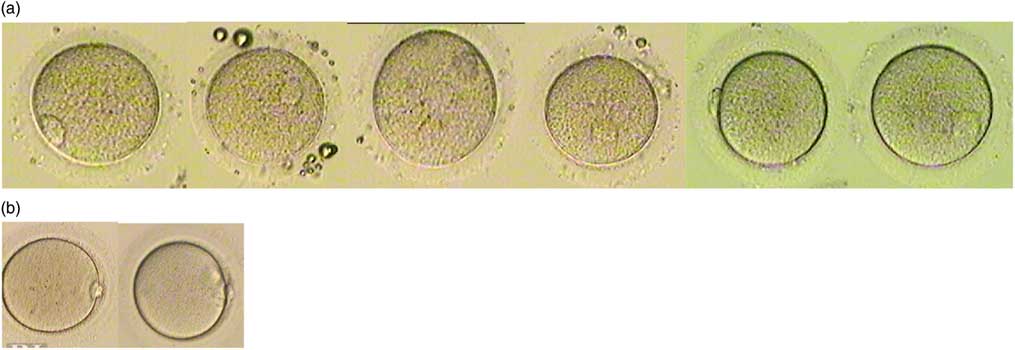
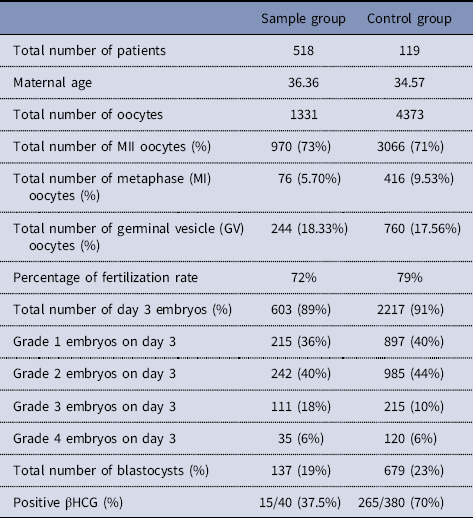
In total, 496 patients undergoing ICSI treatment were involved in this study. Of these patients, 376 had oocytes with normal morphology and 120 had granular cytoplasm (Fig. 1). In total, 637 ICSI cycles were performed and 5704 oocytes were collected. Of these oocytes, 4036 were metaphase II (MII) oocytes and 970 were observed to have granular cytoplasm. The mean female age, duration of infertility, ovarian stimulation protocol and the mean number of oocytes retrieved were similar in the two groups of oocytes with normal and granular cytoplasm. Overall, 72% of the oocytes with granular cytoplasm were successfully fertilized and 89% were cleaved successfully. These results were comparable with the control group (Table 1). Seventy nine per cent of the oocytes with normal cytoplasm were fertilized and of these 91% were cleaved successfully. Although, the aneuploid embryos obtained from the granular oocytes were more, compared with embryos obtained from morphologically normal oocytes, there was no statistical significance (63%, 243/386 vs. 54%, 179/334; respectively). Nineteen percent of the embryos with granular oocytes and 23% of the morphologically normal oocytes developed to the blastocyst stage (Table 1). The mean number of embryos transferred was the same in both groups (P > 0.05). Embryo transfers were performed for 63 patients using embryos obtained from granular oocytes. The pregnancy rate was 37.5% (15/40), whereas the pregnancy rate was significantly higher in the control group (70%, 265/380, P<0.05).
Oocytes from patients undergoing ICSI treatment. (a) Images of the oocytes with granular cytoplasm. (b) Images of the oocytes with normal cytoplasm.
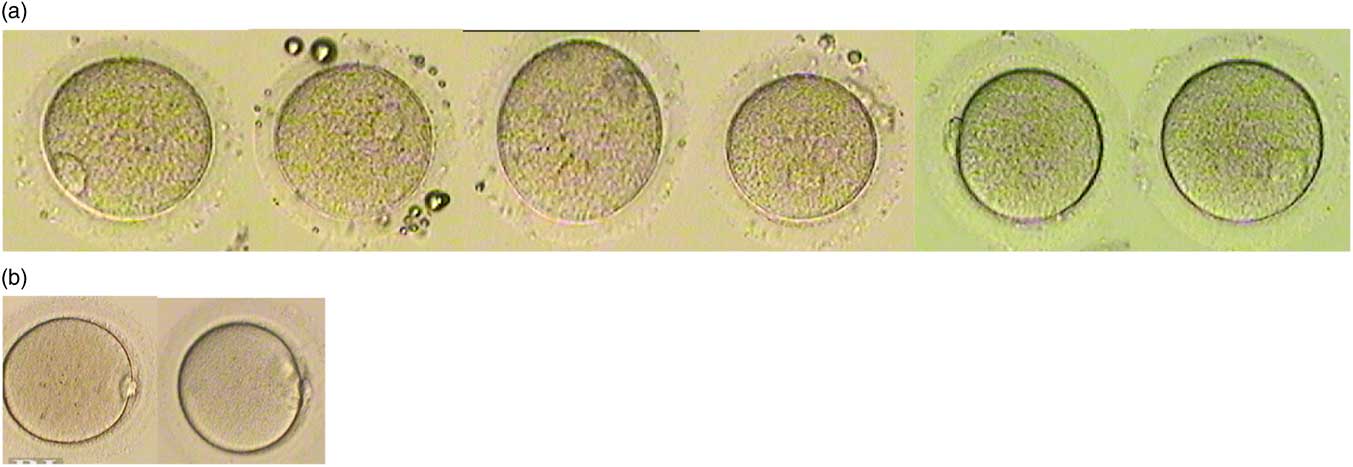
Details of the patients undergoing ICSI treatment

Discussion
One of the main reasons for IVF failure is anomalies in sperm that may include motility or penetration problems. Although these parameters become more complicated in cases of ICSI failures, it can still be due to sperm associated problems, such as aberrations with oocyte activating factors (Dozortsev et al., Reference Dozortsev, Rybouchkin, De Sutter, Qian and Dhont1995). However, there has always been ongoing research about the intrinsic oocyte problems causing fertilization failure. Furthermore, oocyte morphology assessment has long been discussed as a possible indicator for embryo development and implantation. However, there has not been a clear-cut conclusion with contradictory results. Therefore, in this study, we investigated the fertilization, cleavage and blastocyst development rates and aneuploidy in embryos obtained from oocytes with granular cytoplasm.
In this study, controlled ovarian hyperstimulation was standardized within the GnRH analogue and gonadotrophin protocol. The mean female age was also similar between the two groups. Our results indicated that the oocytes with granular cytoplasm had the same capacity for fertilization, cleavage and blastocyst development. However, pregnancy rates were shown to be compromised. Similar results with clinical pregnancy rates have been reported previously, and significantly lower pregnancies were obtained in this group of oocytes (Serhal et al., Reference Serhal, Ranieri, Kinis, Marchant, Davies and Khadum1997). Some researchers have proposed that IVF cycles using oocytes with dark and granular oocytes result in poor fertilization rates (Veeck, Reference Veeck1991). Oocytes with smooth endoplasmic reticulum (SER) were shown to lead to lower fertilization and implantation rates compared with oocytes with no SER aggregates (Hattori et al., 2014; Setti et al., 2016). However, there have been contradictory studies as well, as oocytes with SER aggregates have been shown to produce blastocysts, resulting in adequate ongoing pregnancies (Itoi et al., 2017). Furthermore, these kinds of oocytes with SER aggregates were reported to be fertilized, and developed to the good qualities on day 3 and day 5 post fertilization, plus led to live birth rates at a similar level compared with the oocytes without SER aggregates (Mateizel et al., 2013).
Anomalies of oocyte morphology are most likely to be multifactorial, such as ovarian stimulation protocols, culture conditions and genetic complement of the gametes. Stimulation protocols induce maturation of oocytes that would result in atresia if ovulation induction was not applied. However, as similar stimulation protocols had been applied to all patients, the morphology of the oocytes, as well as fertilization and blastocyst development. should not be associated with the stimulation protocols. Previous studies have shown that the oocytes with aberrant morphology may have higher rates of aneuploidy (Van Blerkom et al., Reference Van Blerkom, Davis, Merriman and Sinclair1995). However, to date, there has not been any studies conducted to investigate specific oocyte morphologies with the incidence of aneuploidy. Our study has shown that, although the number of aneuploid embryos was high in the oocyte with abnormal morphology group, statistical difference was not significant.
Our study showed that the quality of the oocytes affects the outcomes of ICSI treatment. Even though normal fertilization and embryo development were attained using oocytes with granular cytoplasm, as also supported previously (De Sutter et al., 1996; Serhal et al., Reference Serhal, Ranieri, Kinis, Marchant, Davies and Khadum1997), and embryo implantation was compromised significantly. The results of this study led us to conduct a wider investigation on the underlying causes of aberrant oocyte morphologies and, furthermore, selection criteria should be revised accordingly. This action may improve the quality and rates of embryo development and successful implantation rates.
Financial support
This research received no specific grant from any funding agency, commercial or not-for-profit sectors.
Conflicts of interest
None
Ethical standards
Not applicable.