Introduction
Human spiritual processes and needs in palliative care have received increasing research attention over the past decade (Breitbart, Reference Breitbart2007; Amoah, Reference Amoah2011; Pargament, Reference Pargament2011; Lopez-Sierra and Rodriguez-Sanchez, Reference Lopez-Sierra and Rodriguez-Sanchez2015; Shields et al., Reference Shields, Kestenbaum and Dunn2015; Breitbart et al., Reference Breitbart, Pessin and Rosenfeld2018). One reason for this is the growing evidence that suggests that spiritual suffering may exacerbate other debilitating symptoms in dying patients, particularly pain (Rippentrop et al., Reference Rippentrop, Altmaier and Chen2005; Boston et al., Reference Boston, Bruce and Schreiber2011). Another is practitioner awareness that patients’ spiritual and psychological journeys through a terminal illness can be as important as their physical and social experiences (Knight and Emanuel, Reference Knight and Emanuel2007; Steinhauser et al., Reference Steinhauser, Alexander and Byock2009; Best et al., Reference Best, Butow and Olver2016; Rego et al., Reference Rego, Pereira and Rego2018). A primary aim for current research on spirituality in the fields of psychotherapy, healthcare and pastoral care is to articulate the different ways in which practitioners can facilitate patient engagement with existential issues in order to manage suffering and distress (Klemens, Reference Klemens2004; Pargament, Reference Pargament2011). Significant outcomes for palliative care that have emerged from this increased inter-professional and disciplinary alignment have included: quality indicators that measure and document what matters (O'Reilly et al., Reference O'Reilly, Larkin and Conroy2016; Aslakson et al., Reference Aslakson, Kweku and Kinnison2017; Snowden and Telfer, Reference Snowden and Telfer2017; Flannelly et al., Reference Flannelly, Flannelly and Jankowski2018; Fitchett et al., Reference Fitchett, Pierson and Hoffmeyer2020); clinical practice guidelines for psychosocial distress and spiritual care practice (Murillo and Holland, Reference Murillo and Holland2004; Bernard, 2017); as well as a number of manualized psychotherapeutic interventions (LeMay and Wilson, Reference LeMay and Wilson2008; Marchand, Reference Marchand2012; Breitbart et al., Reference Breitbart, Pessin and Rosenfeld2018; Rodin et al., Reference Rodin, Lo and Rydall2018). Relatedly, many research projects have described endeavors to help patients through letters, diaries, legacy documents, and other narrative approaches (Cooper, Reference Cooper2011; Emery, Reference Emery2013; Sumathy, Reference Sumathy2019) and attended to the impact that cultural and contextual diversity can have on spirituality and religiosity in supportive and palliative care (Delgado-Guay, 2014; Lopez-Sierra and Rodriguez-Sanchez, Reference Lopez-Sierra and Rodriguez-Sanchez2015; Ahluwalia et al., Reference Ahluwalia, Johnson and Reddy2020).
While growth in spiritual care research continues (Damen et al., Reference Damen, Delaney and Fitchett2018), healthcare chaplaincy research has felt the need for a common model in which clinical and chaplaincy researchers could locate their hypotheses. In 2015, the Chaplaincy Research Consortium (CRC) published a consensus model for spheres of spiritual experience aligned with domains outlined in models of palliative care and human suffering (Emanuel et al., Reference Emanuel, Handzo and Grant2015a). The model built on existing work (Sulmasy, Reference Sulmasy2002; Puchalski et al., Reference Puchalski, Ferrell and Virani2009) and defined spirituality as “the aspect of individuals that seeks and perceives significance and experiences connectedness to the sacred.” It is notable for its assertions that patients experience spirituality across social, physical, psychological, and spiritual domains and that all of these can interact with the sacred and divine. It draws on a growing body of the literature about processes of adjustment (Knight and Emanuel, Reference Knight and Emanuel2007; Ching et al., Reference Ching, Martinson and Wong2009; Kenne Sarenmalm et al., Reference Kenne Sarenmalm, Thoren-Jonsson and Gaston-Johansson2009; Ahluwalia et al., Reference Ahluwalia, Johnson and Reddy2020). The model posits that individuals are motivated to connect with “what's out there” [external to their selves] and/or “what's in there” [within their selves] in order to achieve peace or well-being, and that they experience 4 stages of adjustment (Discovery, Dialogue, Struggle, and Arrival/Disconnect) as they engage in that process. Another distinguishing feature of this CRC model is its acknowledgment of the multiple paths a patient may take through these 4 stages in their spiritual experience as they adjust to illness.
Accepting the fundamental importance of spirituality at the end of life (Williams, Reference Williams2006) and the validity of the idea that existential/spiritual states exist in human psychology, the CRC proposed a definition of spirituality with the explicit aim of facilitating researcher engagement. This definition is “the aspect of individuals that sees and perceives significance and experiences connectedness to the sacred,” where the sacred is “feeling connected to or aware of the unknowable, the infinite, immanent or transcendent in a way that creates awe, and seems to be precious, and connected to that which enlivens” (Emanuel et al., Reference Emanuel, Handzo and Grant2015a). Although the CRC model aims to facilitate chaplaincy research, this definition does not focus on the work of chaplains alone. Refining all healthcare professionals’ understanding of the ways in which patients process spiritual experiences is vital to creating a holistic conceptual framework for research and enhanced inter-professional understanding of patient connectedness at the end of life.
Our study objectives were twofold. The first was to test the responsiveness of various healthcare professionals to the CRC model's definition of spirituality. The second was to test inter-professional assessment of the utility of the CRC model's adjustment process categories (Discovery, Dialogue, Struggle, and Arrival/Disconnect) as effective descriptors of stages in the patient spiritual experience.
Methods
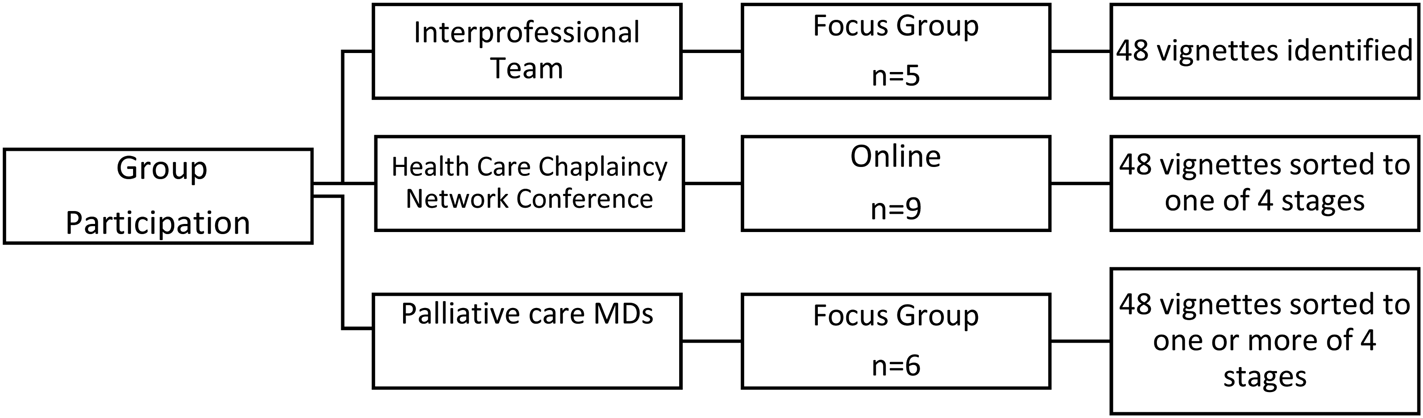
Contextual and pilot data were collected through a review of the literature followed by an iterative mixed methods process. The latter is shown in Figure 1. Focus group discussions with inter-professional team members familiar with the patients’ spirituality in palliative care settings resulted in vignettes to identify experiences in patient's spiritual journeys. The authors identified a coding approach and a conference call with an advisory group refined the approach. This coding of vignettes was used in an online card sort involving attendees at the annual 2017 Healthcare Chaplaincy Network Conference who were invited to participate. A second card sort was conducted with a focus group of palliative care physicians.
Flowchart of participant engagement with mixed methods.

Review of the literature
A literature review using the keywords “spirituality” “supportive” and “palliative care” was undertaken in MEDLINE Web of Science (2001–2019). Excluding articles not written in English, this yielded 59 articles. Content analysis of article keywords showed some recurring themes. These include spirituality defined as a construct that “involves concepts of ‘faith’ where faith is a belief in a higher transcendent power, but not necessarily identified as God (Breitbart, Reference Breitbart2002; Breitbart et al., Reference Breitbart, Rosenfeld and Gibson2010, Reference Breitbart, Pessin and Rosenfeld2018; Young et al., Reference Young, Nadarajah and Skeath2015).” Patient spirituality as a component of supportive care is frequently understood to be predominantly intrapersonal and conceptualized as a central and internal motivating force that provides a sense of direction in life and/or protection (i.e., providing a sense of meaning/purpose/what matters) (Barnard et al., Reference Barnard, Strasser and Gamondi2017; D'Souza and Astrow, Reference D'Souza and Astrow2020). Evident in the literature is the conceptualization of spirituality as coping and hopefulness that may be either intrapersonal or interpersonal based on the presence of connection with the sacred (and/or sacred components in life), and the direction that is perceived from the connection (Delgado-Guay, Reference Delgado-Guay2018; Prizer et al., Reference Prizer, Kluger and Sillau2020). Also important are activities such as music, mind diversion and the creation of healing environments (Delgado-Guay, Reference Delgado-Guay2018). In line with this research, spirituality in the context of supportive and palliative care was conceptualized as a motivational process entailing a search for, and connection with, the sacred.
Focus groups
To explore the concept of patient spirituality in supportive and palliative care, we held two focus groups with five participants. Focus group participants included a psychologist, social worker, a palliative care chaplain, and survivor support group volunteers, one of whom was also a chaplain. All focus group participants were invited to share reactions to the study definition of spirituality and to provide their own observed vignettes of sacred phenomena. Using a deductive approach to content analysis (Elo and Kyngas, Reference Elo and Kyngas2008), transcripts from the focus were analyzed for consistent themes and phenomena. Process categories and domains were identified using published works (Emanuel et al., Reference Emanuel, Powell, Handzo, Cherney, Fallon, Stein, Portenoy and Currow2015b) and our code book incorporated the exemplars of behavioral, emotional, and goal-bound activities modeled in the original published article (Emanuel et al., Reference Emanuel, Handzo and Grant2015a). The authors R.J. and L.E. thematically identified and culled 48 vignettes shared during the focus groups as behaviors, feelings, and activities characteristic of patients’ spiritual journeys. Coders then assigned these sample vignettes to the 4 stages proposed by the CRC model. To authenticate coding attribution, coders shared initial coding with a single meeting of a mixed stakeholder group, several of whom had authored the original CRC model article.
An early discrepancy discussed and resolved by team members concerned the functionality of two of the 4 stages. Coders found Struggle and Dialogue to be contested stages with vignette designations to them being difficult. The research team proposed there would be better understanding and consensus if these categories were renamed as Exploration and Working Through, respectively.
Online card sort
The authors then used OptimalSort to create an online card sorting program. This method has been used specifically in palliative care (Vyjeyanthi et al., Reference Vyjeyanthi, Periyakoil and Noda2010) and was chosen to facilitate observation of health professional attribution of vignettes to the CRC's 4 stages. The 48 vignettes were edited by the authors R.J. and L.E. and then presented to participants from the focus groups; the participants assigned each vignette to one of the 4 stages. The card sort was also used following the presentation of the project at the HealthCare Chaplaincy Network 2017 conference in Chicago. A total of nine people attempted this online card sort. Participants included four chaplains, a physician, two researchers, and two others. The results of this activity were further discussed by the participants on a conference call with the research team. Members recommended one final iteration of the card sort with participants being given the option of selecting more than one process category for each card and being allowed to converse about selections. With this addendum, six physicians completed the code sort using the refined categories in pairs.
Results
Our findings are organized to highlight topics that arose during focus group discussion or were flagged by card sort participants in the online comment box. The focus groups and card sorts yielded data about the following themes which we describe below: Spirituality, Connectedness, and the 4 Stages of Recursive Adjustment (Discovery, Exploration, Working Through, and Arrival/Disconnect).
Spirituality
The CRC model (Emanuel et al., Reference Emanuel, Handzo and Grant2015a) asserts that spirituality can be experienced as something in and of itself or as part of the physical, social, and psychological domains. Coders noted that focus group participants concurred with the model's presumption that these domains overlap. As one focus group participant commented: “as a psychologist I struggle to define what is psychological and what is spiritual … a lot of these conversations dovetail.” Another commented: “spiritual care … it's going in and whatever they present, whatever they give us, that's the framework and the bedrock — that's the only thing we can work with.”
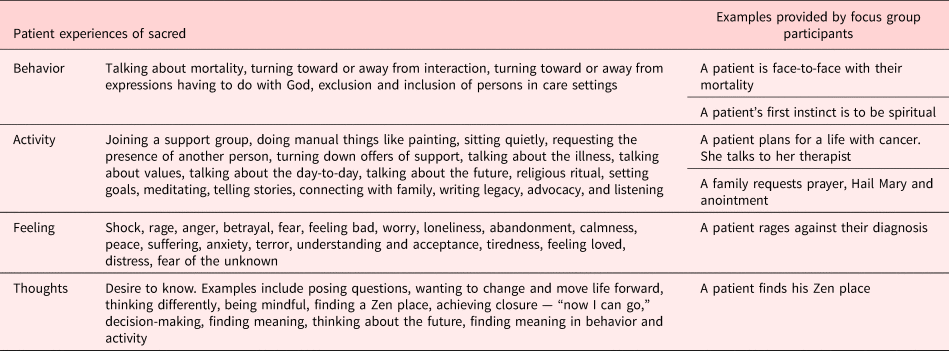
As illustrated in Table 1, content analysis of focus group participants showed the range of behaviors, activities, feelings, and thoughts generated by discussion of the CRC model's definition of spirituality.
Patient experiences of the sacred

Connectedness
Focus group participants were invited to consider the CRC model's precept that it is through the processing of spiritual experience that patients feel “connected to or aware of the unknowable, the infinite, immanent or transcendent in a way that creates awe, and seems to be precious, and connected to that which enlivens.” While the CRC model “does not specify what it is that connects us all,” coders observed that spiritual caregivers who are skilled in observing for phenomena that signify connectedness or disconnectedness have no hesitation in identifying connectedness or providing examples of the phenomena they look for. Content analysis of focus group transcripts showed “feelings, values, and relationships” are the phenomena frequently cited by participating health professionals to characterize their observation of connectedness, with “feeling” being the most frequently cited, and most desired focus for further exploration with patients.
As one participant stated, “I think when a person's first diagnosed, they're vulnerable and they're shaken to their core, because they don't … we never think it's going to happen to us and so everything comes from that — existentially, psychologically, spiritually … Whatever dream they had for themselves or plan that they had envisioned for their life has now been interrupted, so there comes a, just a disconnect and how to reconnect with their story in light of their illness. And what things are valuable to them now … ”
Consensus about the 4 stages recursive adjustment
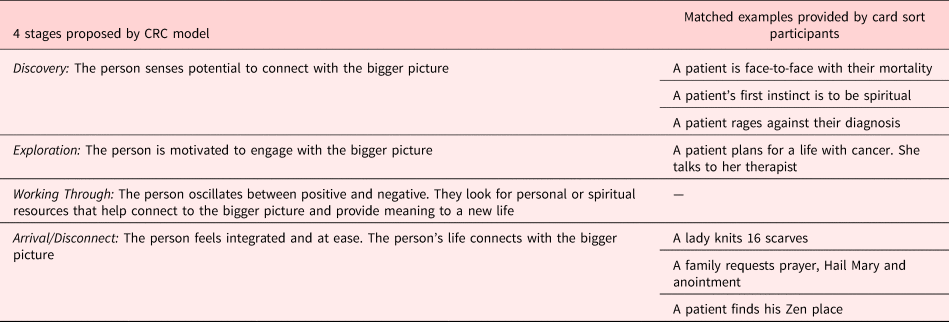
Analysis of the online card sort of 48 vignettes to the 4 revised stages (Discovery, Exploration, Working Through, and Arrival/Disconnect) showed some level of consensus. Table 2 presents the vignettes that were assigned to one of the 4 stages with an 80% or 100% agreement among participants. Of note are the 2 cards that had a 4 out of 4 match with the stage of Arrival (“A patient finds his Zen place” and “A lady knits 16 scarves”). Also of note are the 2 stages with least agreement among card sort participants: Exploration and Working Through.
Matching vignettes to the model's 4 stages in recursive processing of spiritual experience

On completion of the exercise, participants commented that they felt disadvantaged by not knowing the “contextual nature of ongoing meaning making” or the steps which preceded or followed the example given. One participant wrote: “A lot of spirituality around severe illness and dying is in the moment, so I feel cautious about reading too much into a single sentence synopsis until it shows some relative movement between 2 points (and not that there wouldn't be a return to state A as time goes forward). It's not a simple dance.” Another commented: “Spirituality is not discrete. [Need] more context (e.g. progression from A to B vs. a snapshot in time).” In discussion with the broader team, coders observed that this reflected the difficulty they too had experienced when trying to assign vignettes to categories of Dialogue and Struggle. Despite renaming both stages as Exploration and Working Through it appeared these were still a challenge for participants.
In keeping with the literature that shows professional training is a key factor in providing an interpretative framework for spiritual states and outcomes (Ledbetter, Reference Ledbetter2001; Hall et al., Reference Hall, Goddard and Opio2012, Reference Hall, Goddard and Martin2013; Shields et al., Reference Shields, Kestenbaum and Dunn2015), participants mentioned their familiarity and professional comfort with states that were similarly theorized by the model's stages. One clinical psychologist commented that the definitions given for the 4 distinct stages overlapped with those they used to facilitate Acceptance Commitment Therapy (Low et al., Reference Low, Serfaty and Davis2016).
To address the emerging hypothesis that the Exploration and Working Through stages were rarely seen as isolated stages but more as precursors to other stages, we offered an additional group of professions, two palliative care physician pairs, the option of selecting two placements for any of the cards they struggled to assign to a single adjustment stage. Physician participants took the option for 25% of the 48 cards, commenting that they had observed patients to be in more than one place at a time. Cards placed under the header Exploration or Working Through were paired six times with each other and cards placed under Working Through and Arrival were placed five times with each other. Discovery and Arrival, on the other hand, were only paired once. One possible explanation for this is that Exploration and Working Through are states of mind more frequently characterized by extra activity, moving between states, than Arrival or Discovery.
Discussion
A long-term goal of the CRC model is to help researchers in patient spirituality in supportive and palliative care situate their hypotheses in a flexible and multidisciplinary model of the human spiritual experience. The goal of this exploratory study was to shed light on the clinical utility of key aspects of the model. Our study contributes to the literature by showing consensus among health professionals providing supportive and palliative care (including a psychologist, social worker, palliative care chaplain, and palliative care physicians) that an experience of “connectedness” characterizes palliative care patients’ diverse experiences of spirituality despite the fact that, as one participant commented: “specifics are different.” Participants in our study also affirmed that spiritual experiences exist within physical, psychological, and social occurrences and not only in purely spiritual occurrences. Participants could readily identify the stages from the CRC model of Discovery and Arrival but were less able to identify stages of Exploration and Working Through until able to pair those stages with other stages. This suggests that there may be multiple paths through these stages and that some of these stages may be experienced simultaneously.
The limitations to our study are ones that are shared with other studies of spirituality in palliative care (e.g., Bonsignore et al., Reference Bonsignore, Barkow and Jessen2001; Bech, Reference Bech2004) and include the use of category-based approached and the use of “single item experiences.” Category-based approaches are necessarily limited in their capacity to discover novel and unexpected relations between the individual and their states of being because the categories used to summarize experience are typically developed rationally and are, thus, constrained by prior theory and researchers’ intuitions (Shields et al., Reference Shields, Kestenbaum and Dunn2015). As we have described, 2 of our 4 stage descriptors needed further exploration. In addition, our multi-method qualitative approach utilized single experience vignettes as proxies for processes, an increasingly common practice in healthcare contexts (Johnson et al., Reference Johnson, Wirpsa and Boyken2016) but one which downplays contextual nuance.
Despite these limitations, we believe that this study provides evidence which advances the capacity of healthcare professional to utilize research to advance spiritual and palliative care. Recommendations to continue to improve the CRC model's utility include further development of methods to capture the necessarily subjective and unique, yet fundamental and potentially generalizable spiritual processes of patients. Statistical modeling of processes identified in multiple patient stories, for example, could facilitate understanding of how individuals typically move from stage to stage and identify the care skills that are more or less effective at each stage. Methods developed by narrative identity researchers to ensure research is inclusive of narrative and personal storytelling may also prove fruitful (Adler, Reference Adler2010, Reference Adler2012) by allowing for more diverse descriptions of these stages and their relationship to each other. Further work will help to elucidate how these stages can be elicited from patients, how they can be discussed with colleagues and whether there are therapeutic implications that vary by stage.
Acknowledgments
We acknowledge the SMART family foundation who sponsored this study (Study # STU00203047 IRB exempt) and the HealthCare Chaplaincy Network who helped manage it. Also, our multi-disciplinary advisory panel of Ken Pargament, Holly Prigerson, George Handzo, William Breitbart, Tracy Balboni, and Tammie Quest who provided expert consultancy on the project design and initial findings. We would also like to acknowledge the help of Lara Boyken at the Northwestern University Feinberg School of Medicine in the final preparation and submission of the manuscript.
Conflict of interest
The authors have no conflicts of interest.