Introduction
Producers in the Great Plains are evaluating cover crops to enhance sustainability of their farming systems. Cover crops increase biological diversity, nutrient cycling, organic matter levels (Snapp et al., Reference Snapp, Swinton, Labarta, Mutch, Black, Leep, Nyiraneza and O'Neil2005) and pest suppression (Phatak and Diaz-Perez, Reference Phatak, Diaz-Perez and Clark2007; Brainard et al., Reference Brainard, Bellinder and Kumar2011).
Producers may be able to increase cover crop growth by planting mixtures of species, as mixtures often yield more than sole species (Tilman, Reference Tilman1999). This gain in biomass, referred to as overyielding, occurs because mixtures use resources more effectively (Szumgalksi and Van Acker, Reference Szumigalski and Van Acker2006). For example, species with different leaf canopies can increase community light interception (Szumgalksi and Van Acker, Reference Szumigalski and Van Acker2008).
However, research has shown that some mixtures of cover crops can yield considerably less than sole crops. For example, biomass of a four-species mixture that included oat was 25–40% lower than oat grown alone in 3 yr out of 4 (Hansen et al., Reference Hansen, Owens, Beck and Sexton2013). In another study, Smith et al. (Reference Smith, Atwood and Warren2014) found that a five-species mixture yielded 25–45% less than the highest yielding sole cover crop. Also, Wortman et al. (Reference Wortman, Francis and Lindquist2012) observed that some cover crops, especially tall species, were antagonistic to growth of other species in mixtures.
Producers are concerned that production of cover crop mixtures may be less than desired, and are asking for guidelines in planning mixtures. We recently conducted a field study with cover crops that may provide insight for planning.
Materials and Methods
The study was established on a Barnes clay loam near Brookings, South Dakota, where yearly precipitation averages 590 mm. Four cover crop treatments were established following spring wheat (Triticum aestivum L.) harvest: (1) oat (Avena sativa L.) alone; (2) oat + dry pea (Pisum sativum L.) + oilseed radish (Raphanus sativus L.); (3) the three species in treatment 2, plus lentil (Lens culinaris Medikus), flax (Linum usitatissimum L.) and common vetch (Vicia sativa L.); and (4) the six species in treatment 3, plus buckwheat (Fagopyrum esculentum Moench), cowpea (Vigna unguiculata L.) and hairy vetch (Vicia villosa Roth). Seeding rates followed Natural Resources Conservation Service (NRCS) recommendations (NRCS, 2015), and were adjusted for mixtures; i.e., planting a one-sixth rate for each species in a six-species mixture. Species were planted at 4 cm depth and in rows spaced 19 cm apart on August 16, 2014, and August 5, 2015. Plot size was 7 × 20 m2; treatments were arranged as a randomized complete block design with four replications.
Two weeks after emergence, density of each species in 1 m of row was recorded at eight random sites per plot. Biomass of individual species and mixtures was measured 9 weeks after planting by collecting above-ground plant material in four 0.5 m−2 quadrats randomly located in each plot, and drying at 65°C until a constant weight. Sampling occurred on October 14, 2014 and October 7, 2015. After statistical analysis, treatment means were separated with Fisher's Protected LSD (0.05).
Results and Discussion
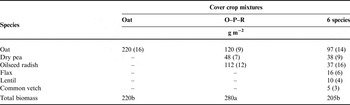
The oat–dry pea–oilseed radish (O–P–R) mixture was more productive than oat, yielding 280 g m−2 or 27% more biomass than oat alone (Table 1). Mixtures with more species, however, were less productive than the O–P–R mixture; biomass was only 205 g m−2 for the six-species mixture (Table 1) and 220 g m−2 for the nine-species mixture (data not shown), approximately 24% less than O–P–R.
Biomass (dry weight) of individual cover crops in various mixtures, averaged across two experiments, 2014 and 2015. The abbreviation, O–P–R, refers to oat, dry pea and oilseed radish. SD of the mean (±) is presented in parentheses. Treatment means in the total biomass row followed by the same letter are not significantly different based on Fisher's LSD (0.05).

Comparing oat, dry pea and oilseed radish growth among mixtures, these species produced 182 g m−2 in the six-species mixture, or 65% of biomass in the three-species mixture (Table 1). Less production of these species in the six-species mixture was expected, as seeding rate for these species was reduced 50%. However, community density of seedlings (330 ± 32 plants m−2) was similar among treatments because of seedlings from other species in the mixture. Adding flax, lentil and common vetch to O–P–R, however, did not compensate for less biomass of oat, dry pea and oilseed radish; these species produced only 31 g m−2.
Another reason for lower production, however, may be that species respond differently to mixtures. Oat and dry pea biomass in the six-species mixture was 80% of corresponding biomasses in the three-species mixture (Table 1). In contrast, biomass of oilseed radish in the six-species mixture was only 33% of its biomass in the three-species mixture (37 compared with 112 g m−2). Seedling density for each of these species in the six-species mixture was approximately one half of their density in the three-species mixture (data not shown), yet oilseed radish did not compensate for the lower seeding rate like oat and dry pea.
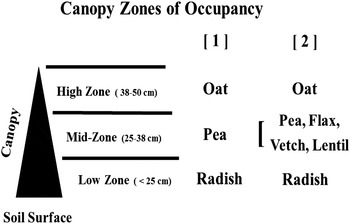
We speculate that canopy architecture affected oilseed radish production. Biomass may be higher in the three-species mix because each species occupied a different zone in the canopy (Fig. 1). At biomass sampling, most of oat leaves occupied a layer 38–50 cm in height (high zone), dry pea leaves grew in the mid-zone (25–38 cm in height) and oilseed radish leaves grew in the low zone (less than 25 cm high). This differentiation into zones was noticeable even 4 weeks after emergence. With the six-species mixture, dry pea, lentil, flax and common vetch occupied the mid-zone (Fig. 1). We believe these four species along with oat suppressed growth of oilseed radish, whose leaves remain close to the soil surface, by intercepting most of the sunlight. An even greater reduction in oilseed radish biomass occurred with the nine-species mixture, where eight of the nine species grew in the high and mid-zones (oilseed radish biomass was 7 g m−2, 3% of the mixture biomass).
Canopy structure of the three-species and six-species mixtures observed between 4 and 8 weeks after seedling emergence, based on zones of occupancy. The triangle represents the cover crop canopy. Example [1] shows the O–P–R mixture and example [2] is the six-species mixture.

Interspecies competition may have been minimized by growing one species in each of the three zones. Tremmel and Bazzaz (Reference Tremmel and Bazzaz1993) reported a similar trend, where production of lower leaves was suppressed by high leaf density in the canopy above. It is possible that other cover crop species may respond differently to canopy architecture, but this approach was favorable for oat, dry pea and oilseed radish productivity. Arranging other species to occupy these three zones equally may also minimize interspecies competition and improve productivity. Considering canopy architecture may be especially helpful when low-growing species such as oilseed radish or turnip (Brassica rapa L.) are included in the mixture.