Thomas Adès's Brahms, op. 21, a five-and-a-half-minute setting for baritone and orchestra of Alfred Brendel's 1998 poem ‘Brahms II’,Footnote 1 was composed for Brendel's seventieth-birthday celebrations and premièred in London in June 2001. The poem describes the nightly visits of Johannes Brahms's ghost to the music room of a house.Footnote 2 In doing so, it recalls a number of tropes from nineteenth-century ghost fiction, albeit laden heavily with irony and even a hint of the uncanny, for the familiar figure of Brahms is made alien in this new guise.Footnote 3 Its supernatural elements are of humorous rather than frightening intent, as Brahms's nocturnal piano-playing is viewed solely as a nuisance that wakes the children and sends the unfortunate instrument out of tune. Brahms's spectre departs sorrowfully; all that is left behind is the smell of cigar smoke.
Adès's setting closely follows Brendel's lead, tongue apparently planted firmly in cheek in his irreverent invocation of a string of Brahms's compositions which lends to the musical surface a fractured, fragmentary quality. As with Brendel's poetic skirting around the uncanny, Adès's allusions to particular works render them strange in their new context. Furthermore, words and music alike are laden with an irony that would not be altogether unfamiliar to Brahms himself. In his analysis of ironic narratives in the music of Chopin and Brahms, Michael Klein observes the generative role played by the subversion of narrative archetypes as well as ‘topoi, genres, affects, musical codes, and so forth’.Footnote 4 Brendel's toying with nineteenth-century supernatural conventions has already been mentioned; the similarly ludic quality of Brahms will be explored below. Yet the uncanny and humorous elements of the poem and Adès's setting are unable to mask deeper tensions and ambivalences. For Klein, ‘the deeply ironic narrative […] denies the logic of cultural values’, and that irony ‘reaches beyond simple lying to the idea that what we hold to be self-evident, clear, conventional, and beyond dispute is less apparent than we think’.Footnote 5 In the case of Brahms, the satiric-ironic quality of the music questions and critiques the cultural values bound up in narratives of musical tradition in which the figure of Brahms the composer plays a substantial role.
Specifically, Brahms situates itself within and against traditions that might be understood as emanating from Brahms. It is against this background that one can understand the significance of the fact that Adès's reworking of Brahms's music sounds closer to the music of the Second Viennese School than to the original.Footnote 6 By such means, ‘Adès traces the development of German music over several decades, since Schoenberg claimed the Brahmsian inheritance.’Footnote 7 But, as I shall argue, the Brahmsian inheritance is neither culturally and political neutral, nor bound to musical representation alone. In particular, Brahms can be considered as a response to the Schoenberg-influenced musical and discursive traditions that revolve around the figure of Brahms, and in particular their appropriation into Anglo-American musical discourse, all of which come together in the third of Brahms's op. 121 Vier ernste Gesänge, ‘O Tod, O Tod, wie bitter bist du’.
Neither Schoenberg nor ‘O Tod’ is mentioned in Tom Service's programme note for Brahms. Rather, he claims that the two sources of ‘inspiration for this “anti-homage”’ are thus:
The first is from Tchaikovsky's diaries: ‘I played through the music of that scoundrel Brahms. What a giftless bastard. His music is made up of fragments of some indefinable something welded together.’ The next comes from Jan Swafford's biography of Brahms: ‘The middle classes loved the beauty and warmth of his music, not the logic. Surely Brahms understood that.’Footnote 8
Many of the quotations in this programme note originated in a 2001 interview between Adès and Service. Here, we find Adès discussing in greater depth the difficulties he has with Brahms's music, stating that ‘Brahms is unable to allow his ideas and material to breathe within his structures: as if he deliberately disables his instinct’; more pointedly, Adès stated that ‘the thing I can't forgive Brahms for is his self-pity’.Footnote 9 Over a decade on, the relationship between form and content in Brahms's music once again came under scrutiny in conversations between Adès and Service: Brahms, Adès claims, seeks ‘to bring wider harmonic circles back to heel within the symphonic argument’; and ‘the moment he forces himself to put on a black tie and write a concert symphony, to me it just stinks of fake, phoniness’.Footnote 10
Service's defence of (among other works) Brahms's Fourth Symphony, the finale of which Adès finds to be ‘a terrible waste of space’, suggests that he was unwilling to take Adès's provocative stance entirely at face value.Footnote 11 There seems to be a correlation between Adès's comments and the ‘cartoon-like phantasmagorical atmosphere’ that David Hart attributes to Brahms.Footnote 12 The boisterous, occasional nature of Brahms is perhaps one reason why it does not merit a mention in the later set of Adès–Service interviews. Yet the ‘minor’ status of the work implied by this omission belies its depth, which emerges by virtue of its intersection with broader cultural discourses, and the critical distance from these that it presumes to adopt.
Specifically, Adès's comments are representative of long-standing and enduring topics in the reception of Brahms that damn the composer on the grounds either of intellectualism or of his debased quality of expression: for instance, John Daverio cites Eduard Hanslick's critique of the ‘display of prodigious compositional technique at the expense of expressive immediacy’ in Brahms's Concerto for Violin, Cello and Orchestra, op. 102.Footnote 13 Some critics even have it both ways, as demonstrated by the cultural historian Peter Gay in his characterization of Brahms as the ‘cerebral sentimentalist’.Footnote 14 Adès's descriptions of, on the one hand, symphonic structures that suffocate and stymie the inner world of feeling and, on the other, a cloying self-absorbed maudlin mode of expression firmly position Brahms in the midst of this discourse.
Gay considers Schoenberg's essay ‘Brahms the Progressive’ to be one of the few positive critical responses to Brahms that recognize him as a ‘traditionalist and an innovator’, as an ‘emotional intellectual, without crippling conflicts, without paradox’.Footnote 15 One might read the slightly defensive tone that arises occasionally in Schoenberg's account of ‘O Tod’ in this essay as a response to Brahms's general reception. By stressing that ‘the sense of logic and economy and the power of inventiveness which build melodies of so much natural fluency deserve the admiration of every music lover who expects more than sweetness and beauty from music’, Schoenberg celebrates some of those qualities of Brahms's music that his critics decry.Footnote 16 Like Gay, Margaret Notley has noted that Schoenberg's emphasis in his writings ‘on “musical logic” and “composing after models” […] surely derives from the Liberal tradition (invoked now by a “progressive” composer)’ – a Liberal tradition Schoenberg shares with Brahms, and which provides a common thread linking both Schoenberg's and Gay's essays.Footnote 17
Schoenberg's account, however, is animated by other critical traditions, which ultimately serve to distance ‘the progressive’ Brahms from the ‘cerebral sentimentalist’. John Covach has discussed the ways in which the work of the spiritualist Emanuel Swedenborg manifests itself in a range of Schoenberg's musico-philosophical writings;Footnote 18 this is also true of ‘Brahms the Progressive’. Mediated by Swedenborgian thinking, Schoenberg's shackling of a historicized figure to eschatological notions of progress performs the double trick of rendering Brahms neither of his own time (for he points to the future, not his present) nor of our own (as he lived and died in the past). Most tellingly, Schoenberg aligns (and elides) the figure of Brahms with that of musical tradition (or rather, the version of musical tradition with which Schoenberg seeks to identify himself). Schoenberg's depiction of Brahms resonates in the writings of those composers and musicologists that followed in his wake over the course of the twentieth century, and that thereby served to reinforce Brahms's centrality to this tradition.
In this context, there is little surprise that further echoes of Schoenberg's essay can be heard in Adès's Brahms, in which the music of the past, rendered strange in its new context, informs the music of its future and our present. That Adès should choose to do so in a manner that is more playful than Schoenberg's says much about their respective attitudes to tradition; witness, too, Adès's sometimes irreverent, sometimes affectionate evocations of the past in works such as Darknesse Visible (1992; Dowland), Sonata da caccia, op. 11 (1993; Couperin),Footnote 19 Asyla, op. 17 (1997; among others, Mahler and Bartók),Footnote 20 the Piano Quintet, op. 20 (2000; Beethoven,Footnote 21 Brahms),Footnote 22 and the Mazurkas, op. 27 (2009; Chopin).Footnote 23
The distance between Schoenberg's and Adès's depictions of Brahms opens up a critical perspective on the ostensible similarities that they also possess. Adès summons certain Brahms-like characteristics in Brahms in order to make corporeal the ghost described in Brendel's poem; Schoenberg leavens his discussion of the properties of Brahms's music (and its precedents) with musings of a spiritual nature, although later readings have largely exorcized the latter in order to privilege the ‘flesh’ of Schoenberg's argument (that is, Brahms's technique). Such a move does little to quieten the ghostly injunctions underpinning Schoenberg's stance, however. We might ask of both composers, therefore, the questions Jacques Derrida asked in Specters of Marx: ‘How did [Marx] himself treat the ghost, the concept of the ghost, the specter or revenant? How did he determine it? How did he bind it, finally, after so many hesitations, through so many tensions and contradictions, to an ontology?’Footnote 24 I will demonstrate later that the ontology to which Schoenberg binds Brahms is that of music tradition; a hauntological rereading of Schoenberg and the texts, musical and otherwise, that followed in his wake will demonstrate the prevalence (and precariousness) of this binding and serve also as the basis for a subsequent rereading of the spectres to be found in Adès's Brahms.
The plural title of Derrida's Specters of Marx puns on the repeated mention of ghosts in Marx's writing, but also on the way in which ‘the spirit of [Marx's] injunction’ has been taken up by various authors over the last 150 years or so.Footnote 25 Each reading of Marx puts flesh on this spirit in different ways: the result is the multiple returns of Marx as a spectre. To identify spectres, to speak to them, is part of the critical enterprise of interpretation, for it is by understanding the way that spirit is made flesh that we can deconstruct its apparent ontology.Footnote 26 In the present study, I suggest that we can understand Brahms in part as a continuation of the constructions of Brahms as ‘cerebral sentimentalist’ on the surface and, more significantly, ‘Brahms the Progressive’ as a critical background. Running in parallel with this argument is the identification of the ‘spectres of Brahms’ that haunt and destabilize these constructions. The significance of Brahms thus lies in its capacity simultaneously to evoke and to critique the dominant discourses surrounding both Brahms the composer and musical tradition considered more broadly; in this respect, Brahms's ‘teasing mixture of sly reminiscence and allusion’ emerges, as noted perceptively by Andrew Clements, as ‘more subversive than its modest dimensions might suggest’.Footnote 27
Schon wieder Brahms!
Si le texte de Brahms amuse, sa musique est souvent menaçante, voire effrayante. Qui ne craint les histoires de revenants dont il rit? Que ne croit tout de même un peu à l'existence des fantômes?Footnote 28
How did Adès bind Brahms's ghost to an ontology? Service's programme note to Brahms offers one explanation:
Adès explains his approach to the composition of Brahms: ‘I wondered what would happen if I wrote a piece just about the logic of Brahms’ music and not about the beauty and warmth.’ Brahms is a playful, but serious, investigation of the limits of Brahms’ musical material. Adès takes Brahms’ melodic and harmonic tics – such as sequences based on descending thirds, and densely contrapuntal textures – to ‘logical’ extremes. As a result of this process, there are allusions to many Brahms pieces. The opening notes for piccolo, clarinet and violins outline the same series of thirds that appears at the start of Brahms’ Fourth Symphony: B–G–E–C. But where the pitches are the basis of a long-breathed argument in the symphony, they are mechanical, even sinister, in Adès’ reworking, as the music descends via this obsessive chain of intervals from the highest orchestral register to the low rumbles of contrabassoon and double basses.Footnote 29
Service makes no specific programmatic links between words and music, though a certain ghostly thread in his lexicon – ‘sinister’, ‘obsessive’, ‘rumbles’ – suggests that conventional word–music relationships adhere in Brahms. At the same time, the figure of Brahms is established musically by means of quotation and allusion. In this section I shall attend both to word–music relationships and to intertextual resonances in order to demonstrate that the apparition of Brahms that these devices summon is that of the ‘cerebral sentimentalist’.
Brahms consists of a series of short sections, primarily delineated by the text, texture and orchestration, and linked by the ever-present chains of descending thirds. Following closely the content of the poem, there is no obvious overarching formal scheme (see Table 1); rather, Brahms presents itself as an evocative scena in which the shifting dramatic contexts determine the musical material. Nevertheless, a climax at bars 71–2 creates the most significant point of articulation in the work, after which the music tends to be texturally more consistent, in contrast to the relatively rapid changes that dominate prior to the climax.
| Bar nos. | English translation |
|---|---|
| 1–8 | [orchestral introduction] |
| 9–27 | When at dead of night the ghost appearsand starts prowling round the pianothen we knowBrahms has arrived |
| 28–35 | It wouldn't be quite so badif his cigar smell |
| 36–44 | didn't stink out the music room for days on end |
| 45–52 | Even worse thoughis his piano-playingThis wading |
| 53–7 | through chords and double octaveswakes even the children from their |
| 58–702 | deep sleep |
| 703–75 | Not Brahms againthey wailand stop their ears |
| 76–862 | Out of tune and smokingthe piano stands therewhen Brahms gets up |
| 863–1062 | Brahmshe says several timesin a plaintive tenor |
| 1063–114 | before leaving through the kitchen door |
Note: The English translation of ‘Brahms II’, taken from Alfred Brendel, One Finger Too Many, trans. Richard Stokes (London, 1998), is reproduced with kind permission of Faber and Faber Ltd.
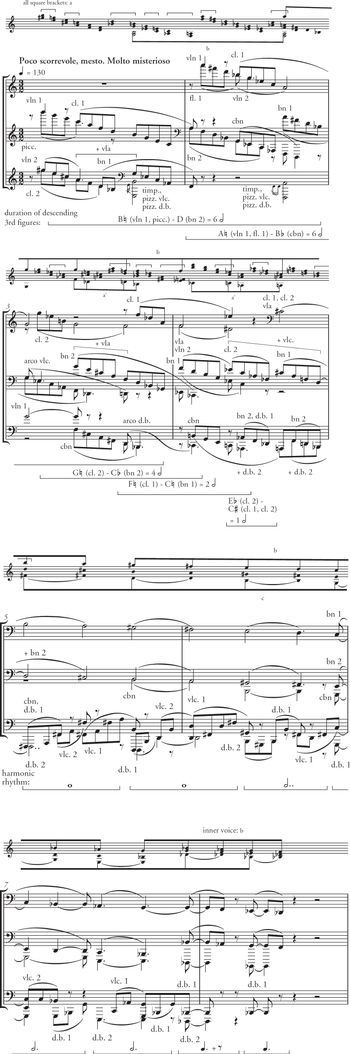
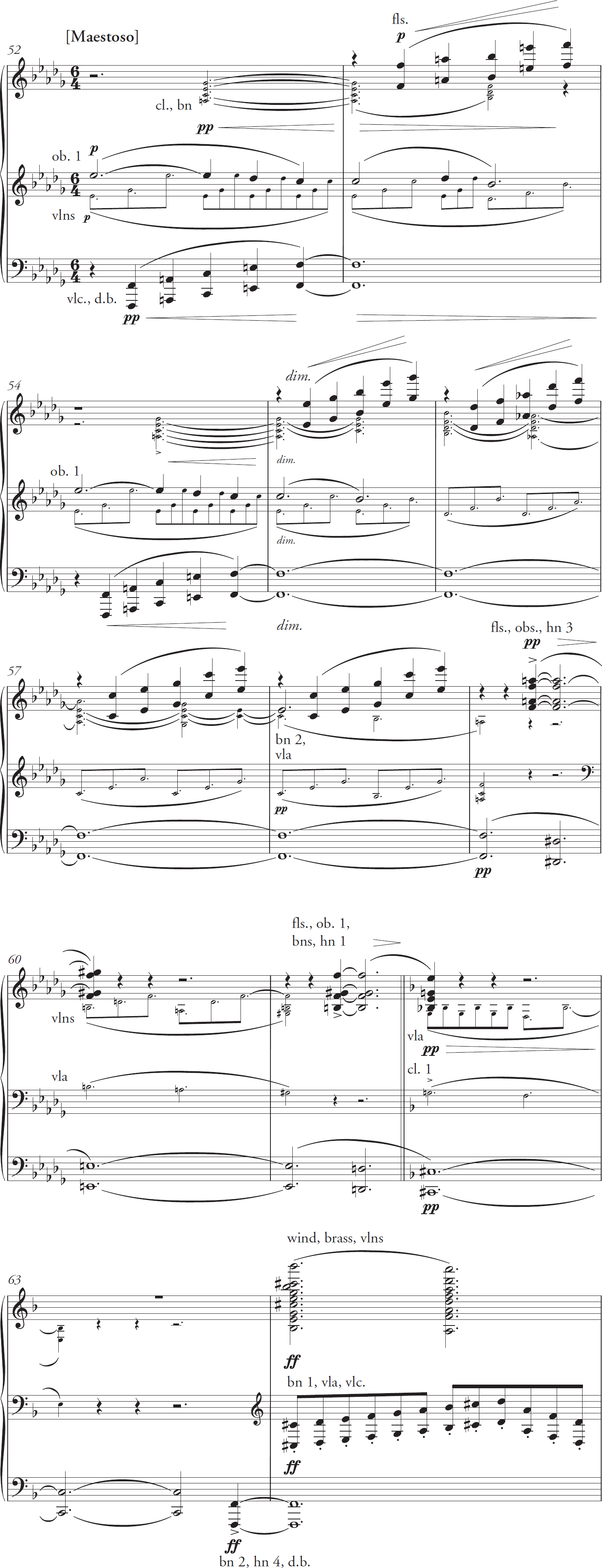
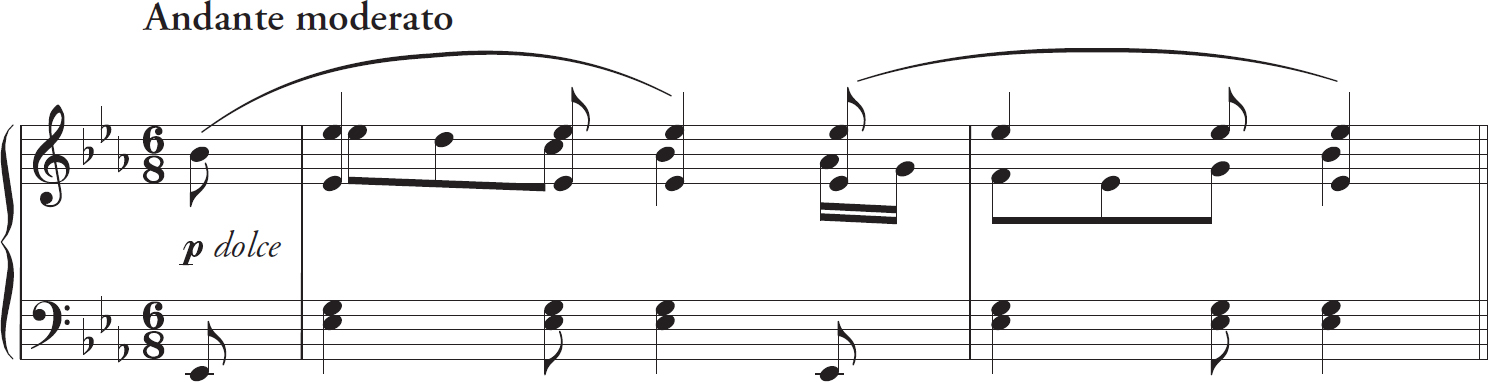
The work opens in a state of apprehension, waiting for the arrival of the ghost. Derrida makes much of the same state of affairs in Hamlet, noting that ‘everything begins in the imminence of a re-apparition, but the reapparition of the spectre as apparition for the first time in the play’.Footnote 30 Thus, although the material of the opening eight bars of Brahms, for orchestra alone, occurs for the one and only time at the start of the work, it is nevertheless a re-presentation of Brahms by virtue of the allusions generated by its descending thirds: Brahms the historical figure reappears to us once again (see Example 1).

These opening bars contain the seeds of Brahms in its entirety and can thus stand metonymically for the whole. If the background thirds are analogous to the ‘spirit’ of Brahms (however problematic this is, as will be discussed below), then the foreground allusions to specific works create anachronistic ‘spectres’. Adès notes that ‘much of the piece is built on the cliché of Brahms's descending thirds, and just by exploring that technique a little, ten or 11 pieces of Brahms fell immediately into one's lap. It's interesting that by using a few little tics you end up with all of Brahms's musical language.’Footnote 31 The tone is negative, but the content is subtly misleading, for the descending thirds very soon cease to be Brahmsian in Adès's setting.
Thus, at first, as Service notes, the material of Brahms emerges from the series of descending thirds that opens Brahms's Fourth Symphony, extended ad absurdum. From this premiss, however, Adès extrapolates a variety of material that has more to do with his own musical language than with that of Brahms. In Example 1 a second strand of descending thirds joins those taken from the Fourth Symphony; from this arises a series of mild false relations (labelled a). Reordered melodically, this cell implies an octatonic background (a′) at odds with the tonal implications of the Brahmsian foreground.Footnote 32 Through the emphasis and later the sustaining of certain pitches, descending whole-tone lines emerge with increasing clarity from the tumbling thirds (b). As these whole-tone lines move into the foreground in bars 5–8, they are underpinned in the bass with a further line descending by thirds (c). Finally, the entire passage is characterized by decreasing phrase lengths that have the quality in the final three bars of the phrase of a written-out accelerando (see the annotations beneath Example 1).
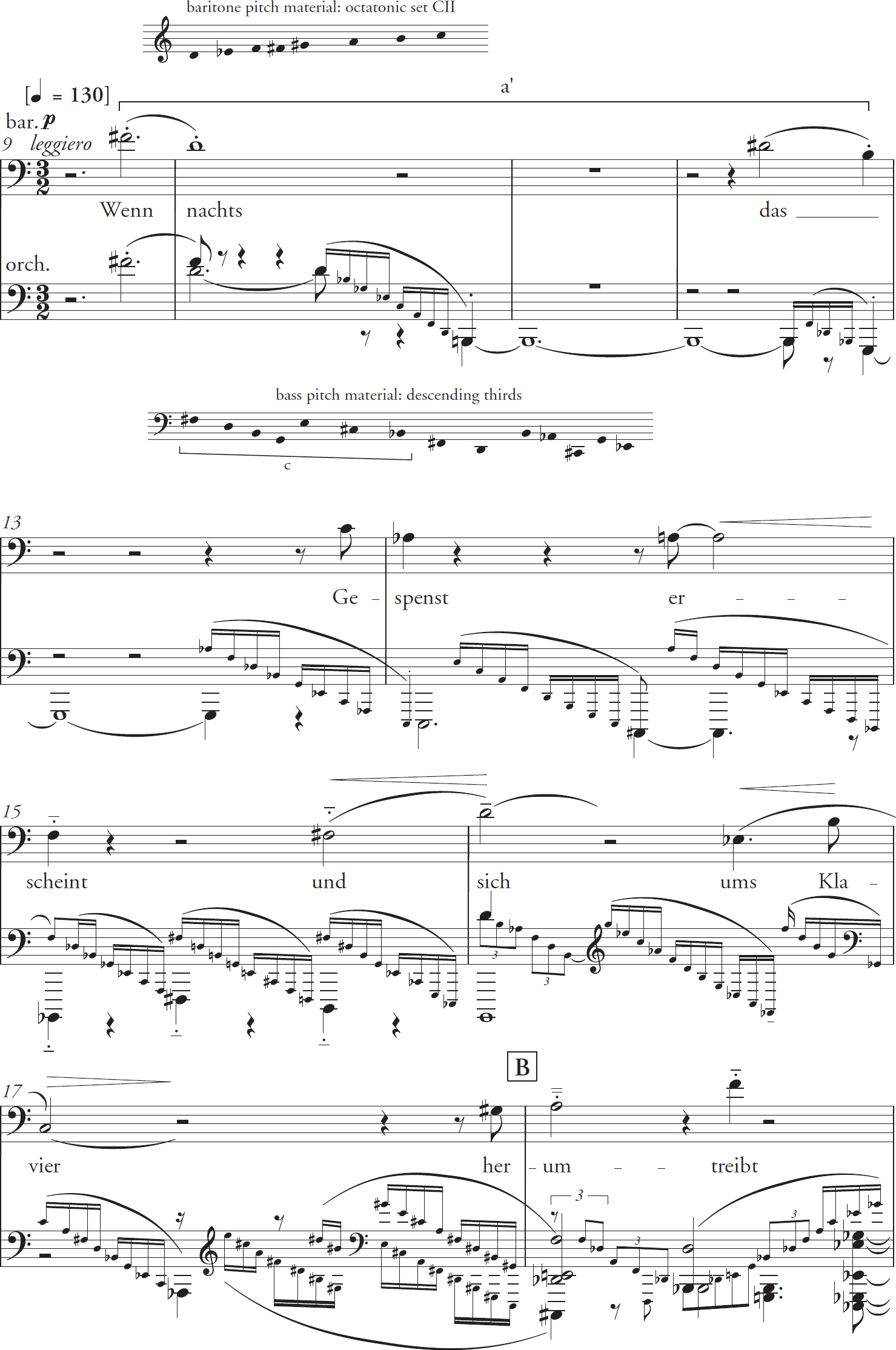
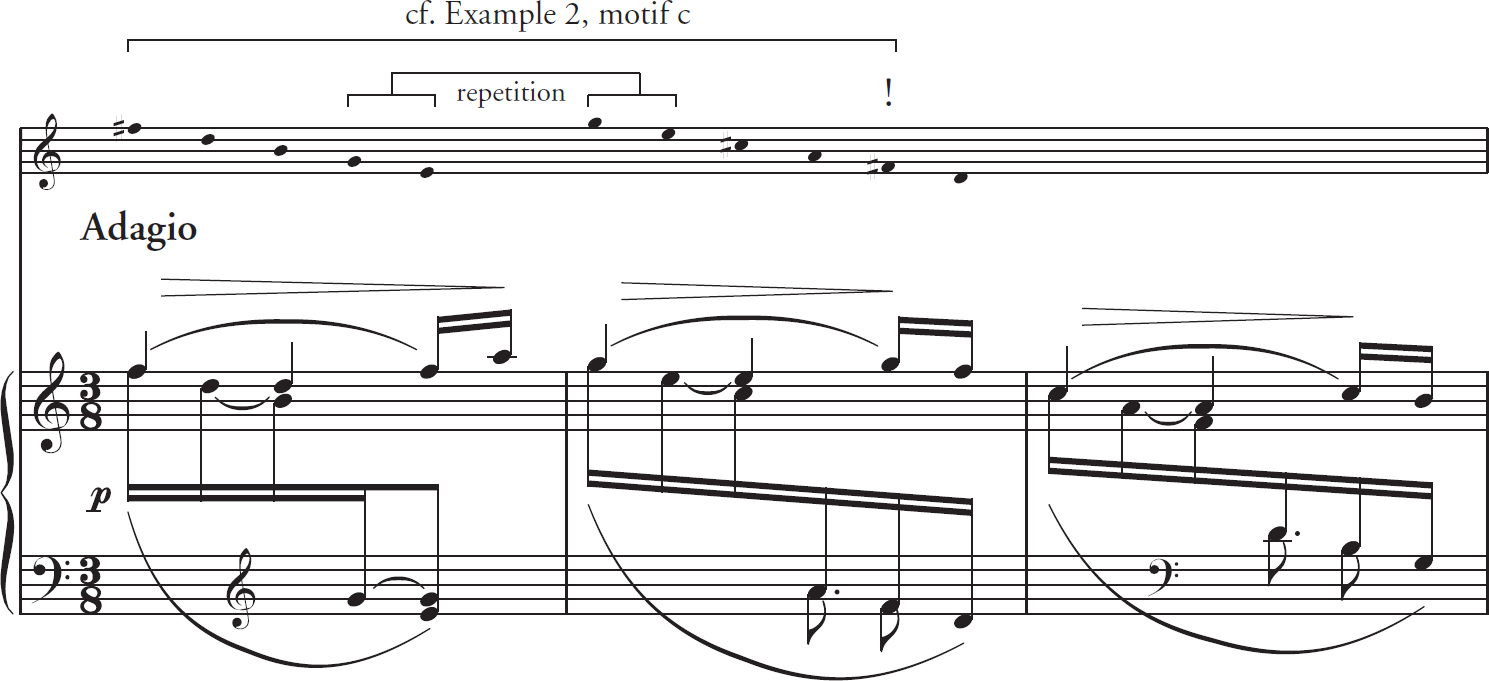
At this point (bar 9), the baritone, in the role of narrator, sets the scene: it is dead of night, and ‘das Gespenst […] sich ums Klavier herumtreibt’ (see Example 2). Allusions abound: the falling thirds continue to cue Brahms's Fourth Symphony, but the specific pitches closely follow those of the opening of the Intermezzo op. 119 no. 1, perhaps the closest that Brahms's own rigorous working of this pattern has come to challenging diatonic function (motif c; see Example 3); even more pertinently, the opening of ‘O Tod’ is evoked (more of which below). Nevertheless, the organizational principles of the music are far removed from those of common-practice tonality. Were the thin texture, bass rumbles and fugitive figuration not enough to capture musically the atmosphere of the text, the tension between foreground and background creates a pervasive, if comic, unease. More specifically, the voice moves through two complete statements of an octatonic set, at first making use of the contours of motif a′, and then the same pitch series in which the falling thirds are inverted into sixths. There is an inexact written-out accelerando through the first three pairs of thirds, which broadens in the fourth. Meanwhile, in the bass, motif c is repeated, almost in the manner of a passacaglia, with its own internal durational patterns that move in and out of phase with the voice. Embellishing the bass are further decorative falling thirds. Patterns such as these, sometimes interlocking and sometimes pursuing their own logic, have been identified by John Roeder as characteristic of Adès's style; there emerges therefore at best only a superficial relationship with Brahmsian rhetoric.Footnote 33


The musical processes initiated in these first two paragraphs are developed over the course of the work, at times independently of each other, providing a background against which further suggestions of Brahms's music can be suspended. Both familiar, in its invocation of Brahmsian thirds, and unfamiliar, in the musical consequences it derives from this premiss, the background renders the foreground allusions strange, as they are able neither to be assimilated into the discursive logic nor to be rejected from it entirely. There are resonances here, perhaps, of Derrida's distinction between the spirit (that which seems to exist in the abstract, such as in the tumbling thirds) and the spectre, the revenant (that which comes back; from the verb revenir) that is summoned and made flesh: ‘Once ideas or thoughts are detached from their substratum, one engenders some ghost by giving them a body.’Footnote 34
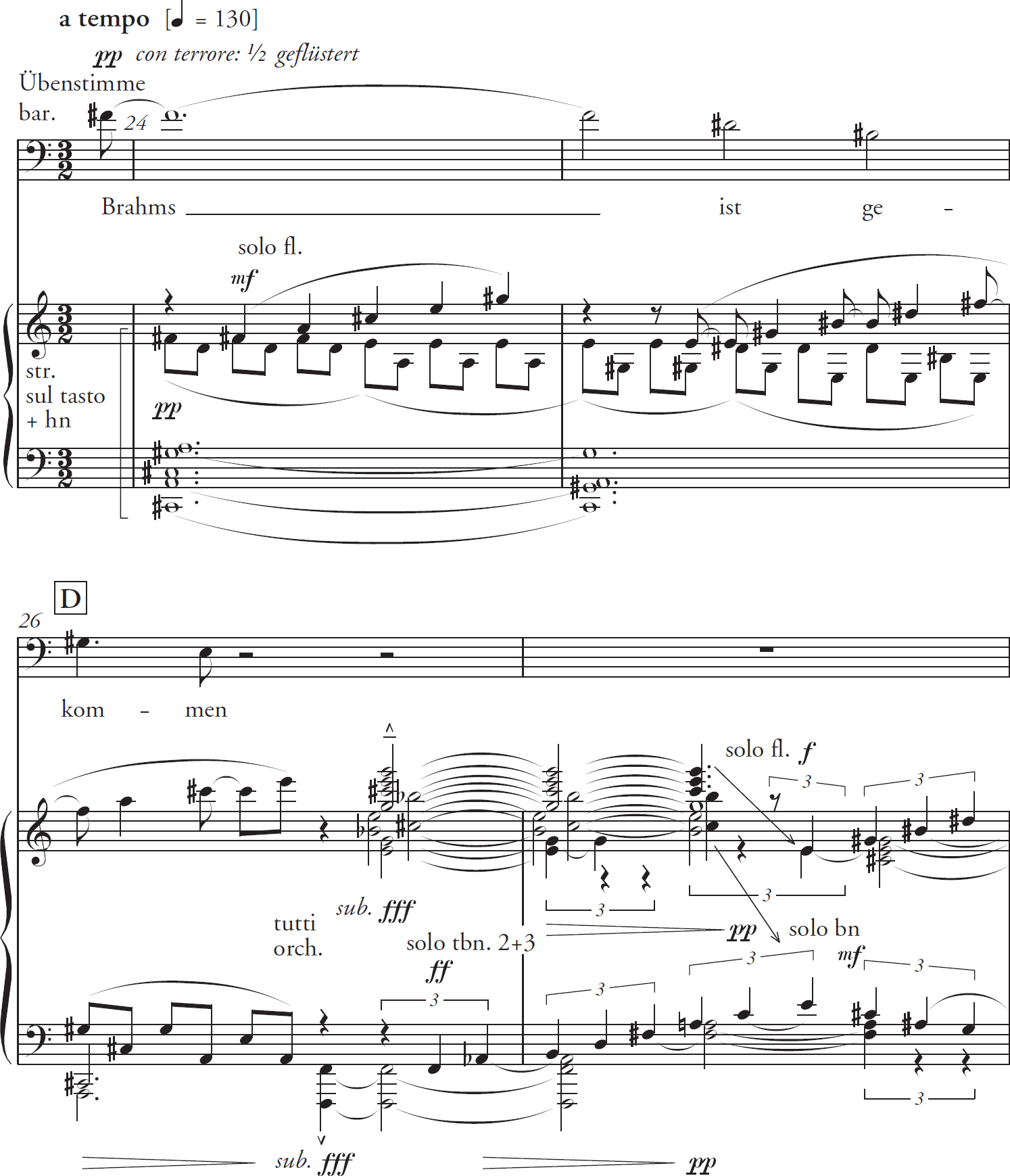
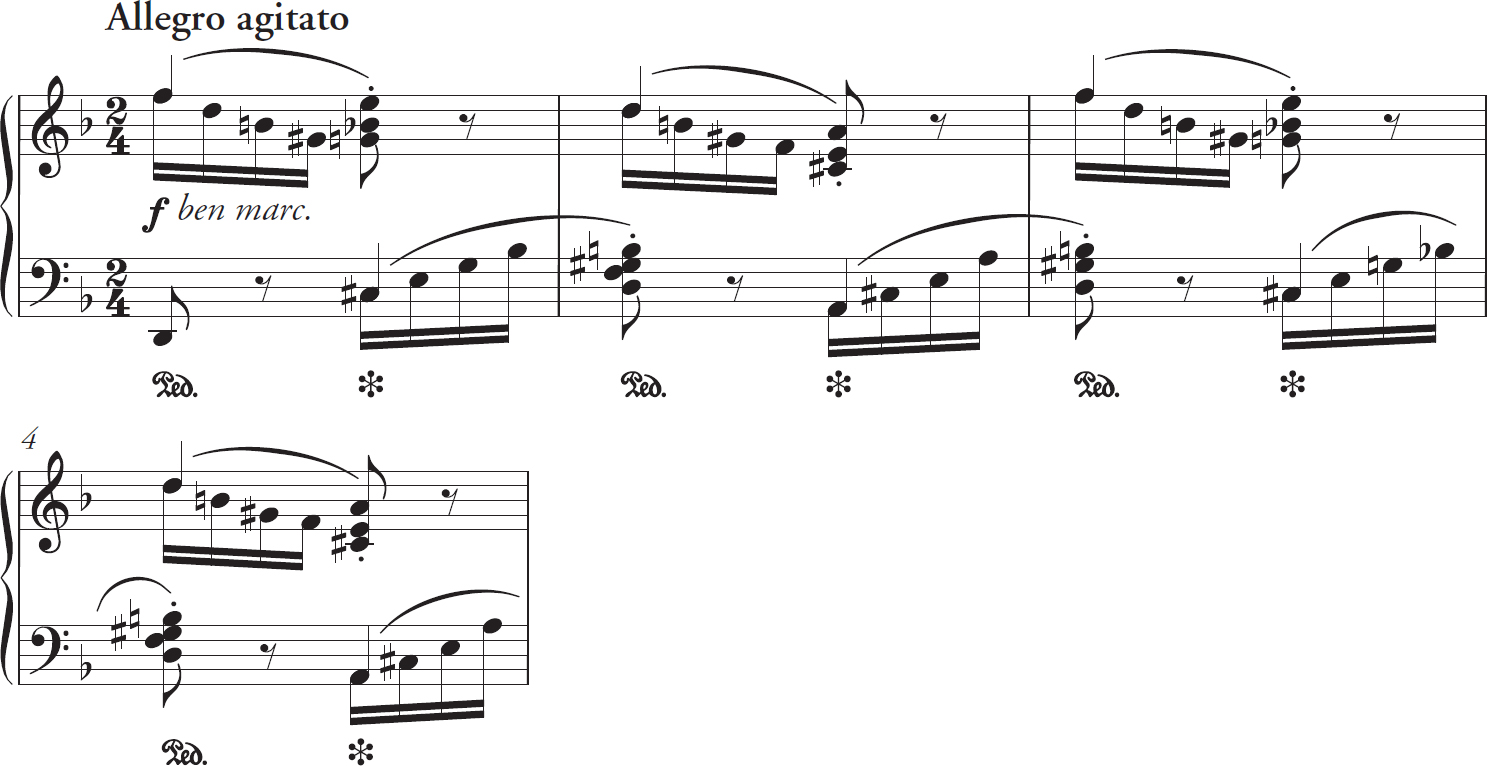
The ‘bodies’ to which Adès alludes are more than just mechanical invocations of works by Brahms. Rather, I would contend that these have been carefully chosen in part because they map neatly onto the background thirds (and thus have a symbolic function), but also because they are illustrative. Thus, the allusions in the first 18 bars primarily set the scene, but those that follow are programmatic in nature. This process begins after the words ‘Brahms ist gekommen’, which are followed by a chord (bar 26) that has been borrowed from bar 64 of Brahms's First Piano Concerto, op. 15 (see Examples 4a and b). There are similarities in the material preceding this chord – the rising thirds in the flute, for instance – which strengthen the intertextual reference. In the concerto, the piano soloist begins to play soon after this chord, and so, too, does the ghostly pianist Brahms in Brendel's text (‘Dieses Gewühl durch Akkorde und Doppeloktaven’).Footnote 35 From this point in the narrative, the ghost of Brahms begins to work his way through some of the composer's greatest hits, each offering figuration or topical references that support ideas in the poem. These are interspersed with further references to the Fourth Symphony, which forms a continual point of reference (perhaps as progenitor of the constant thirds). Read hauntologically, the ‘spirit’ gives rise to a multitude of ‘revenants’ that clamour for our attention (and, as it transpires, the attention of the residents of the house, too, though at this point in the poem we are unaware of this fact).


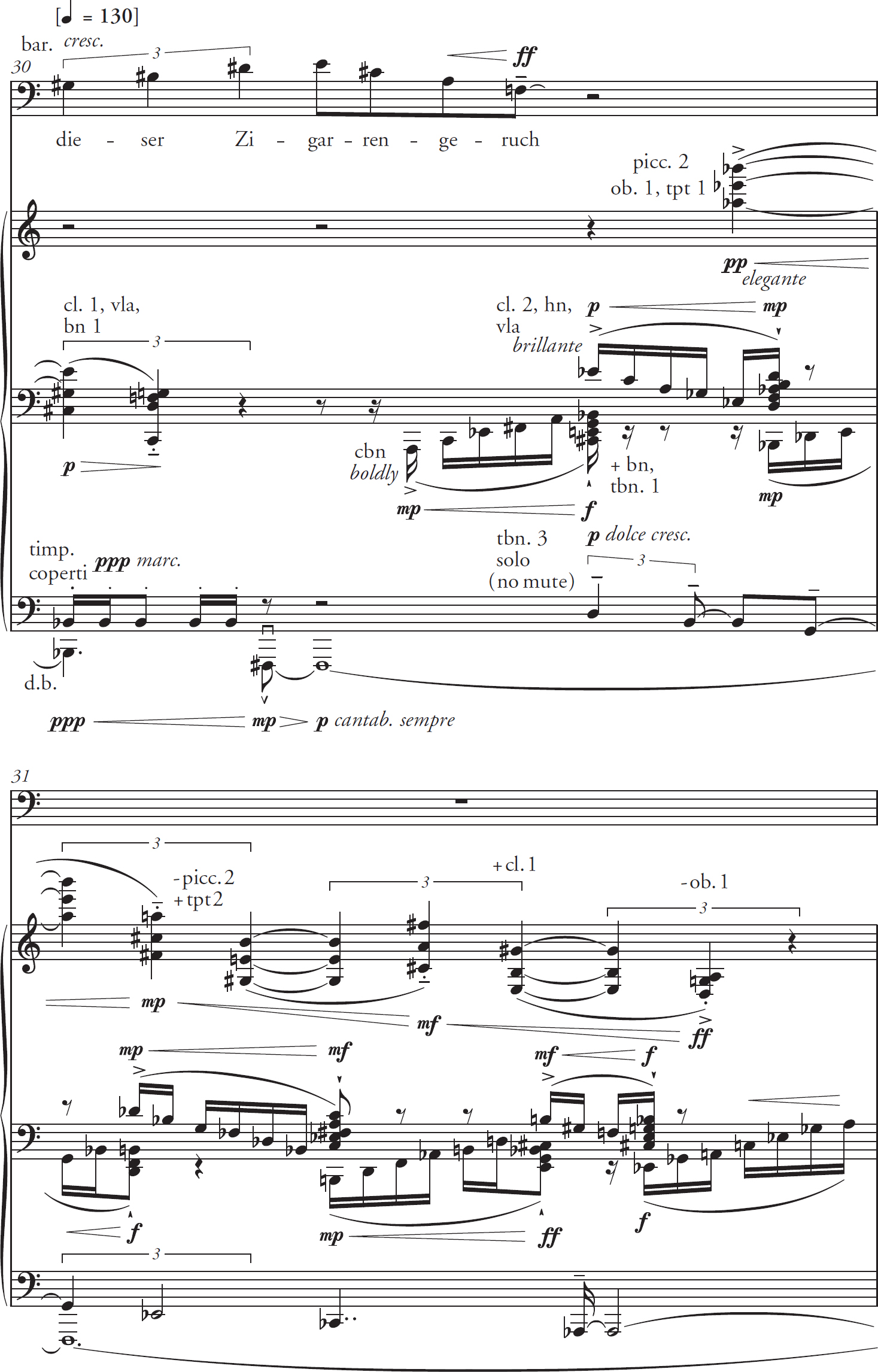
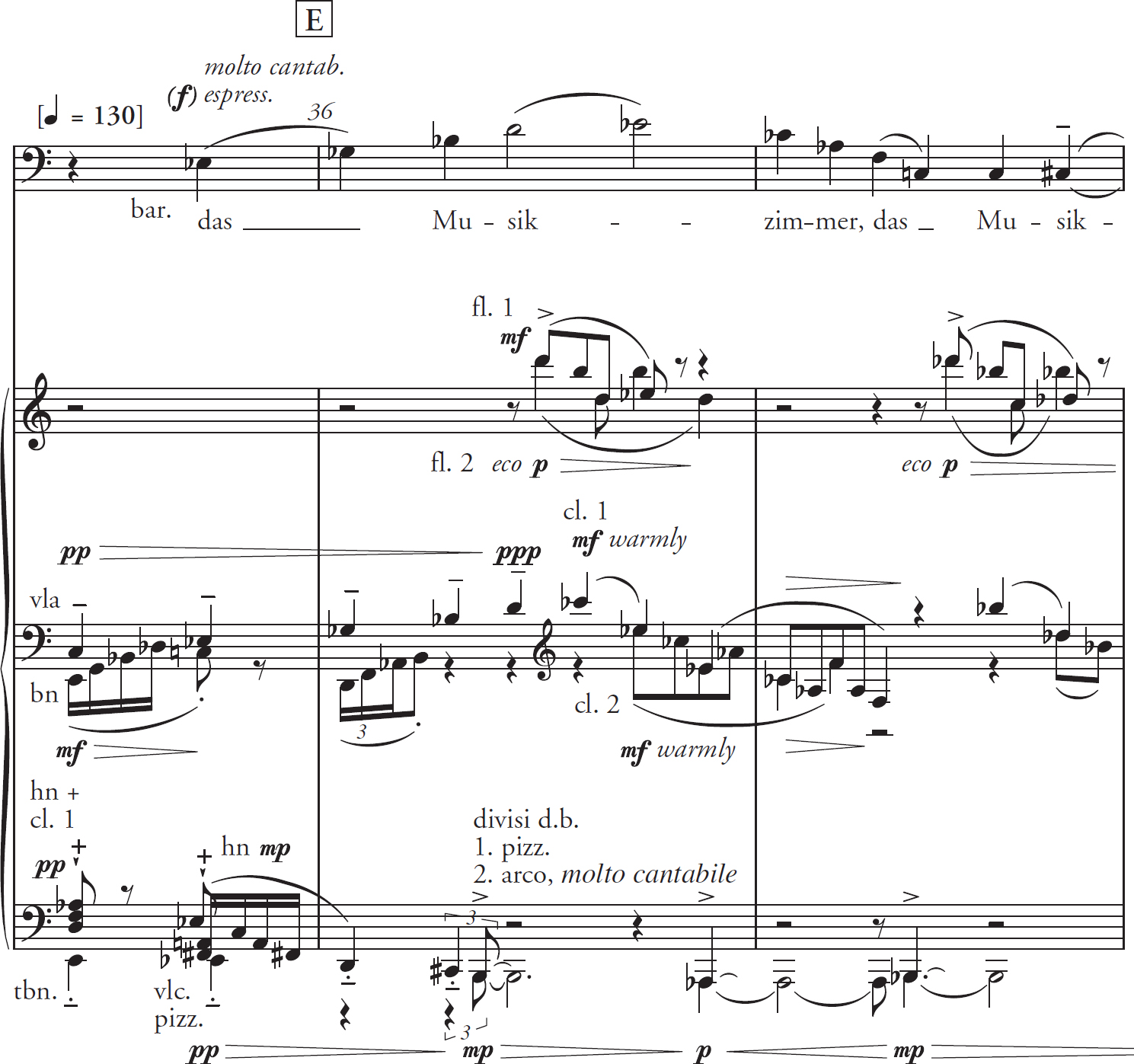
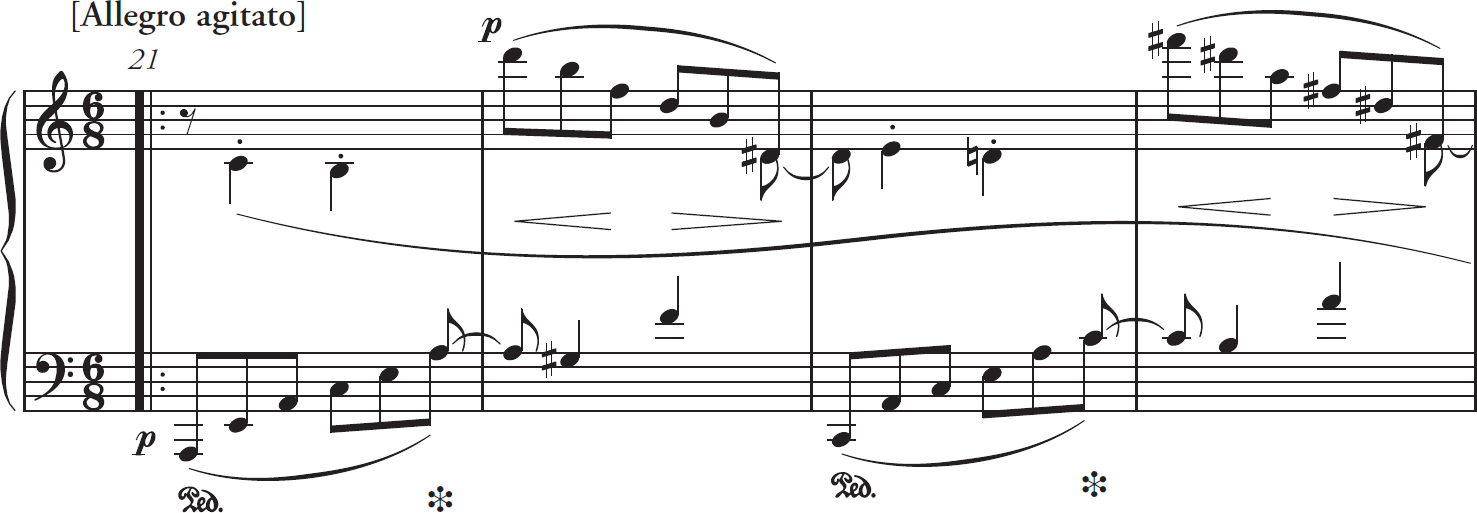
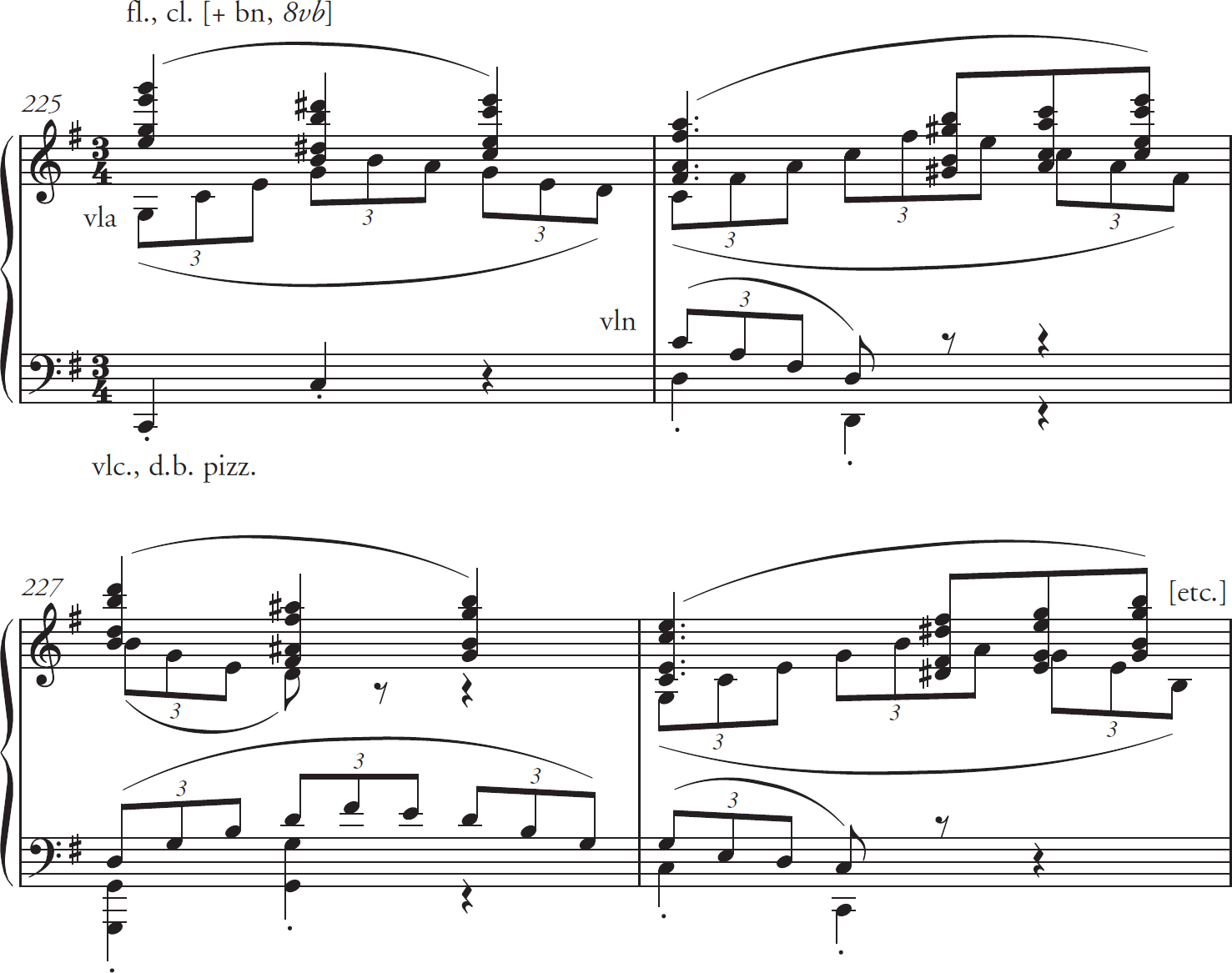
As the fallout from the climactic chord in bar 26 subsides, textual and textural matters alike turn to the cigar smoke that stinks out the music room for days.Footnote 36 Suitably smoky figuration in the orchestra at bars 30–5 relates to that in the Capriccio op. 116 no. 7 (see Examples 5a and b). A sudden shift to a suave melodic figure in the voice, still in rising thirds, with an elegant accompaniment, introduces the music room (Example 6a);Footnote 37 the change in mood and the contours of the accompaniment vaguely recall bars 21–8 of op. 116 no. 7 as if filtered through the gentle dance of bars 225–32 of the finale of Brahms's Fourth Symphony (see Examples 6b and c).


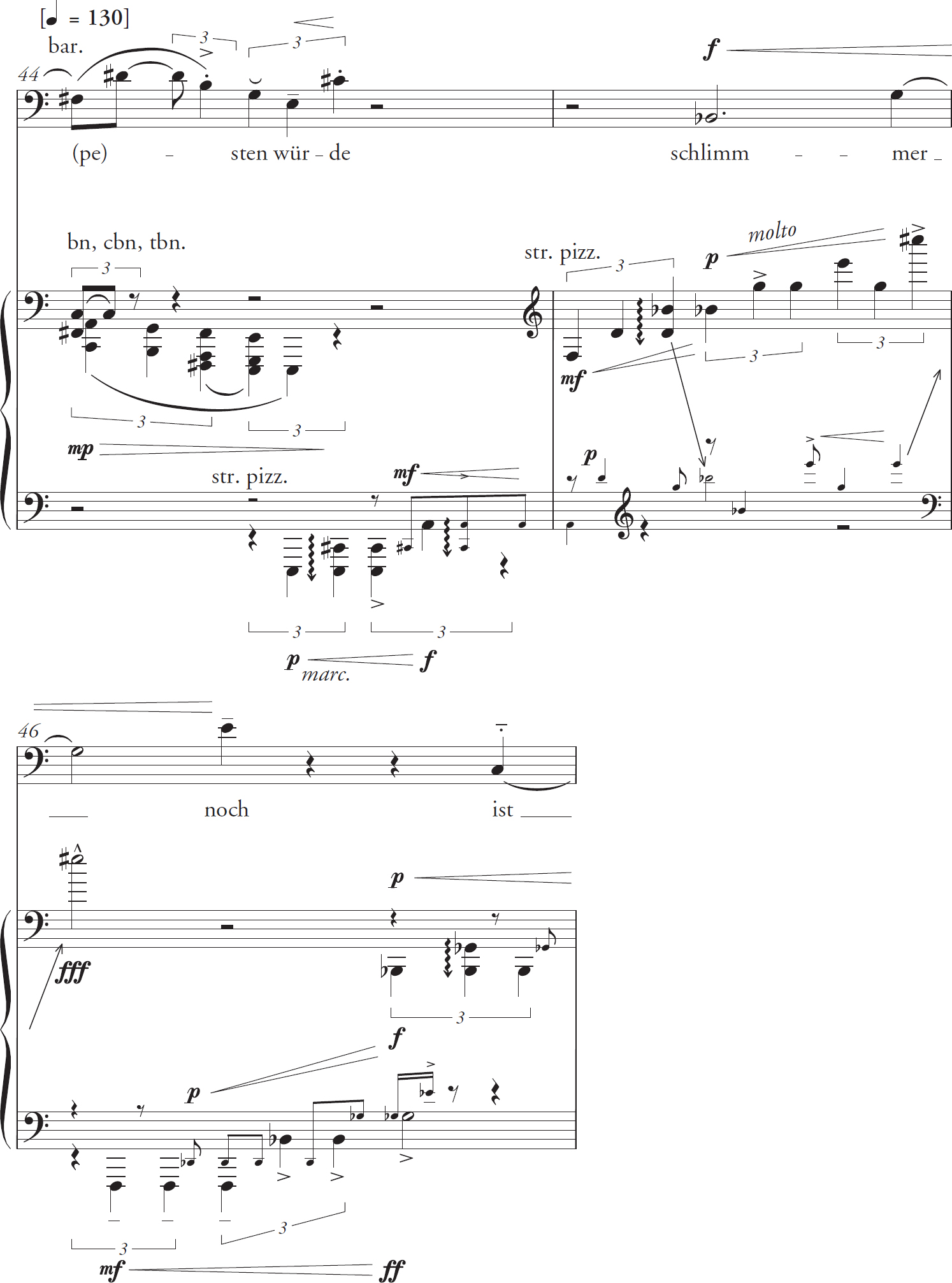
Rising pizzicato figures in the strings (beginning in bar 44) introduce a new mood for the words ‘schlimmer noch ist allerdings sein Klavierspiel’; the allusion seems to be to the textures and harmonies of Brahms's op. 116 no. 1 Capriccio, perhaps as the ghost is limbering up on the keyboard (see Examples 7a and b). If the late piano pieces are being evoked here, then the intention must surely be satirical: Adès has spoken of how those works are ‘so floral and symbolic. I mean I don't like all of them, there's some of them that are a little bit industrial. You can hear the pistons going in them. They often use exactly the same material at different speeds, but it behaves in the same way. […] They're largely just the same thing in different moods, those pieces.’Footnote 38


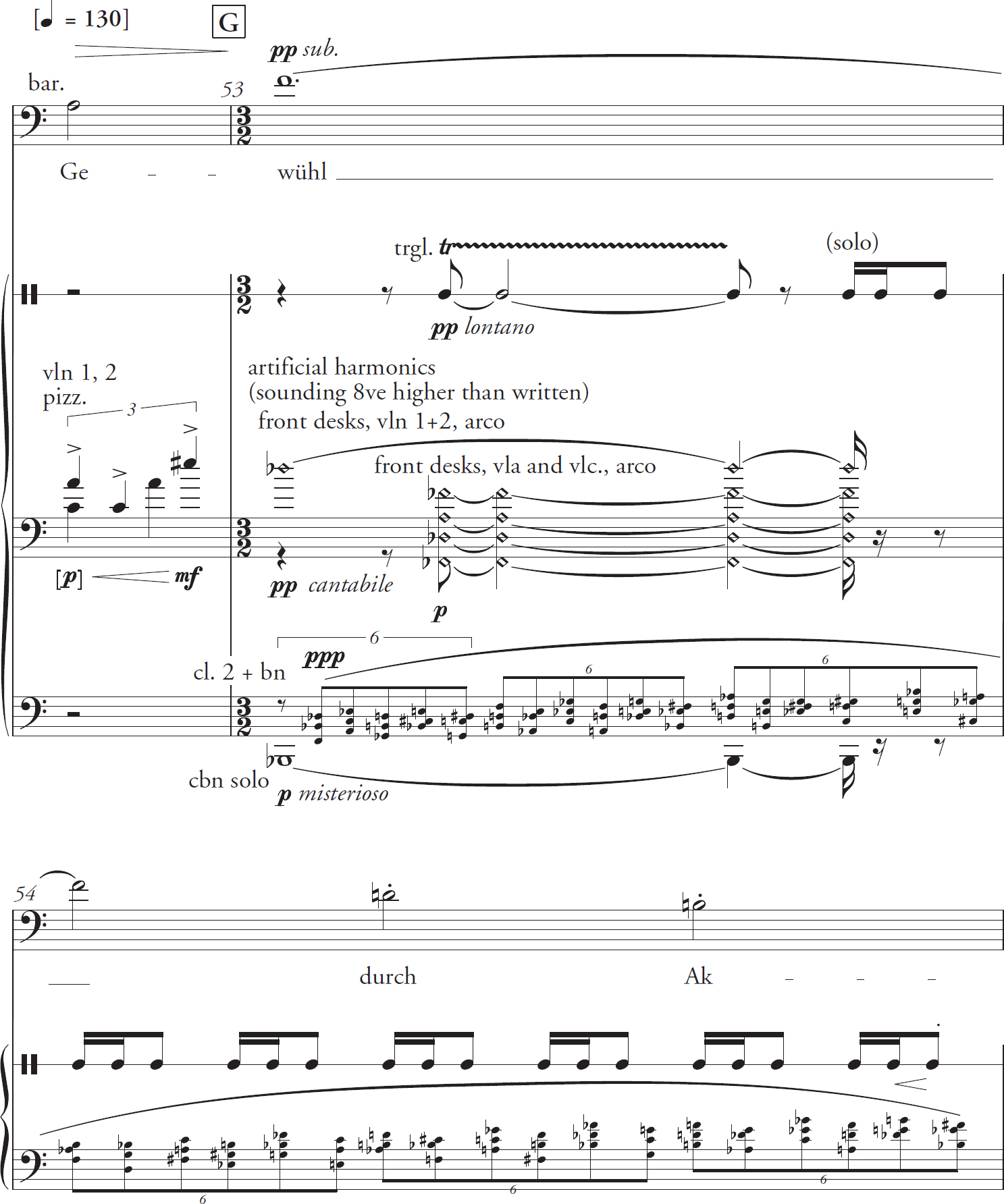
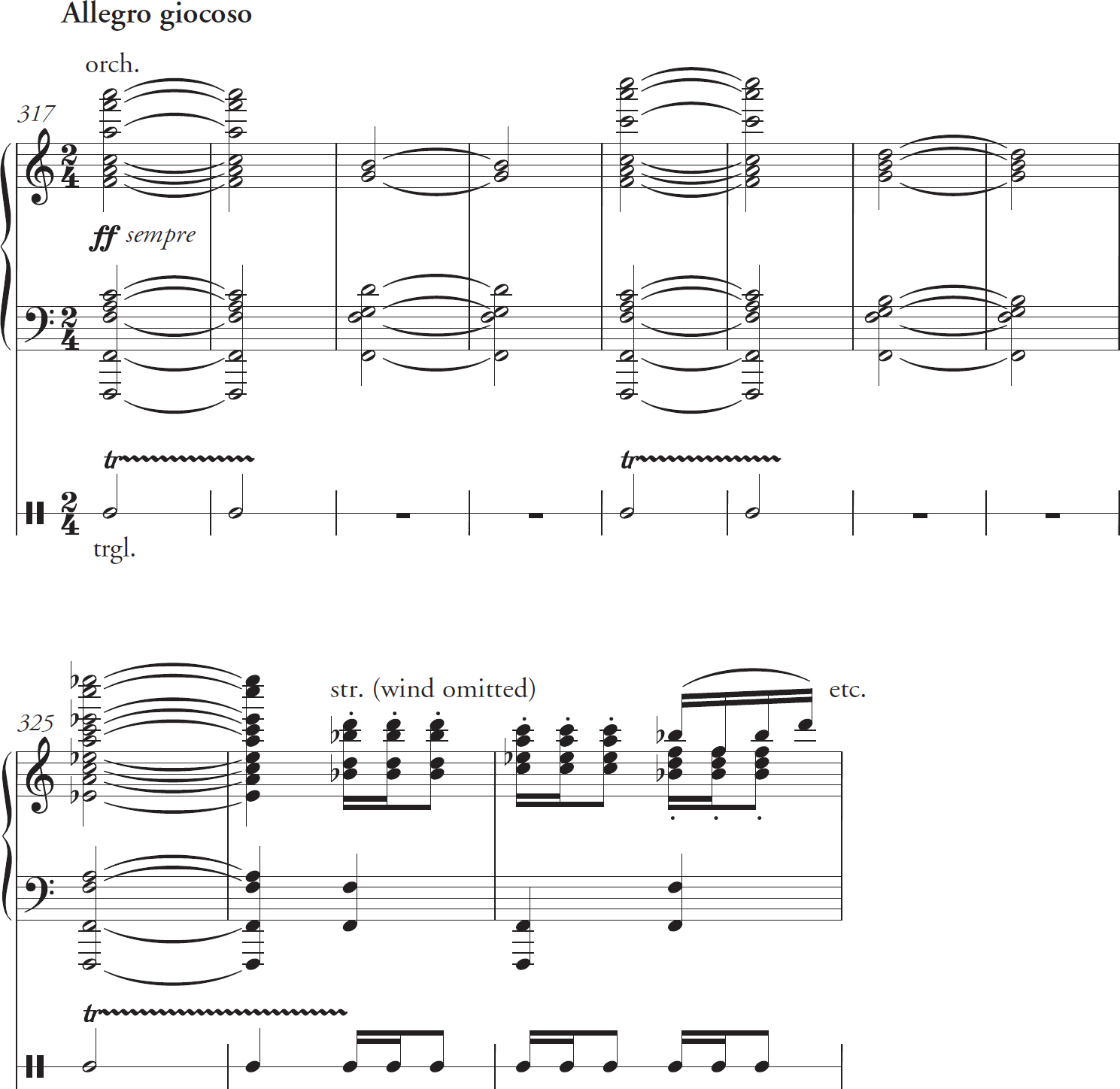
Further shades of Brahms return in a mysterious passage (ppp, from bar 53 in Adès's setting) in which the wind figuration recalls and extends the equivalent string writing found in, for example, bars 107–9 and 249–52 of the first movement of Brahms's Fourth Symphony. In Adès's setting, however, the pointed rhythms of Brahms's trumpet (first movement, bars 107–9) are replaced by a triangle culled from the third movement of the same work (see, for instance, Example 10b, bars 326–7, and compare Examples 8a and b).


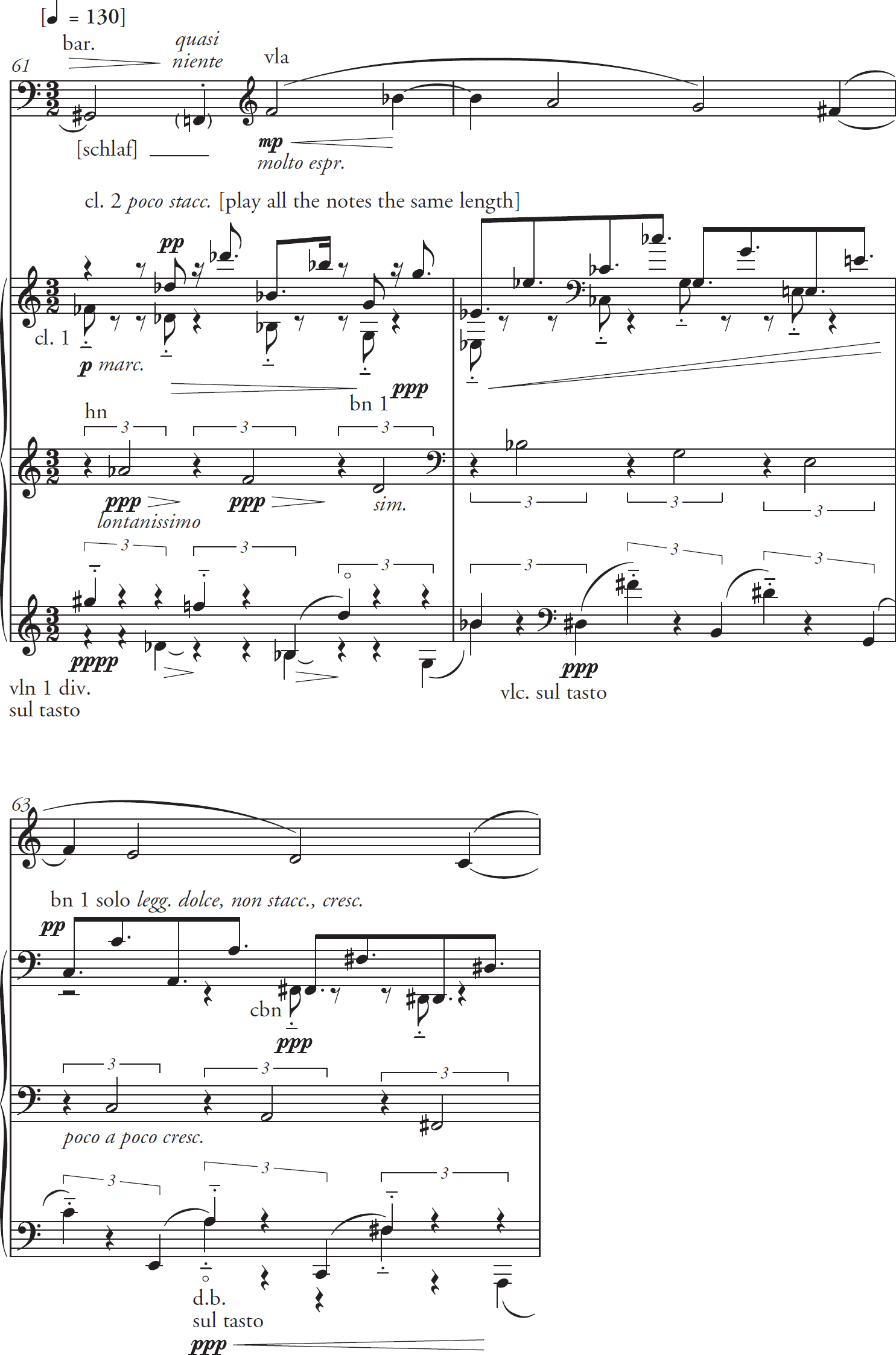
As the clouds of the wind figuration lift, a light Wiegenlied begins (bar 58), depicting the ‘Tiefschlaf’ from which the children are woken. An accompaniment passes from ethereal heights down into the depths, whilst violas and then cellos carry the melody (see Example 9a). The melody recalls that of the Intermezzo in A minor, op. 76 no. 7 (see Example 9b); the opening ascending fourth followed by a scalic descent distantly evokes, too, the closing cadential figure of Brahms's celebrated Wiegenlied op. 49 no. 4. There is also a familial resemblance to the melody of Brahms's Intermezzo op. 117 no. 1, to which Brahms added the opening lines of a Scottish folksong, indicating that it, too, is a cradle song: ‘Schlaf sanft, mein Kind, schlaf sanft und schön! Mich dauert's sehr, dich weinen sehn’ (see Example 9c).Footnote 39 In comparison with these possible antecedents, Adès's melody is extended – as with the chains of thirds that permeate Brahms – far beyond the limits provided by Brahms the composer.
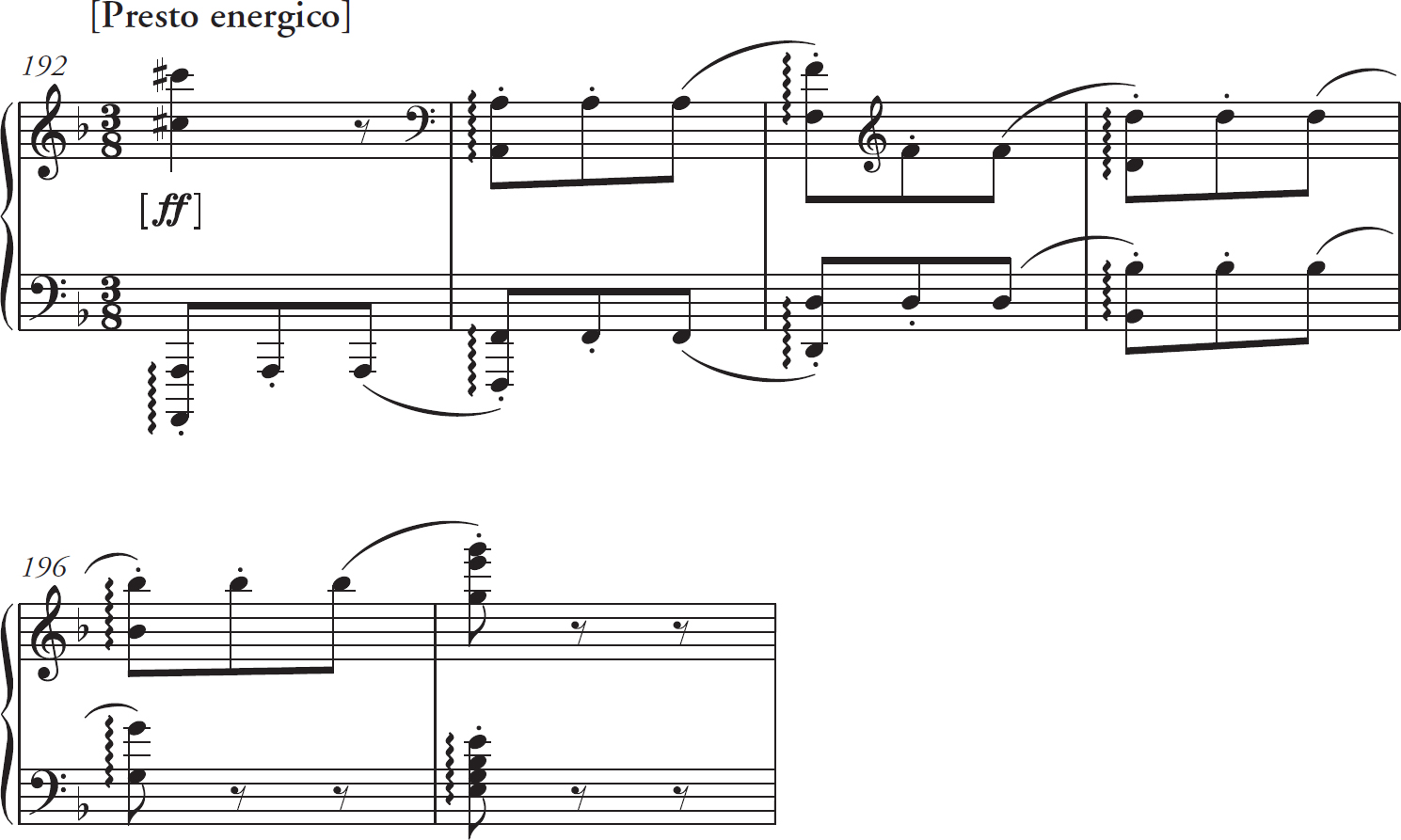
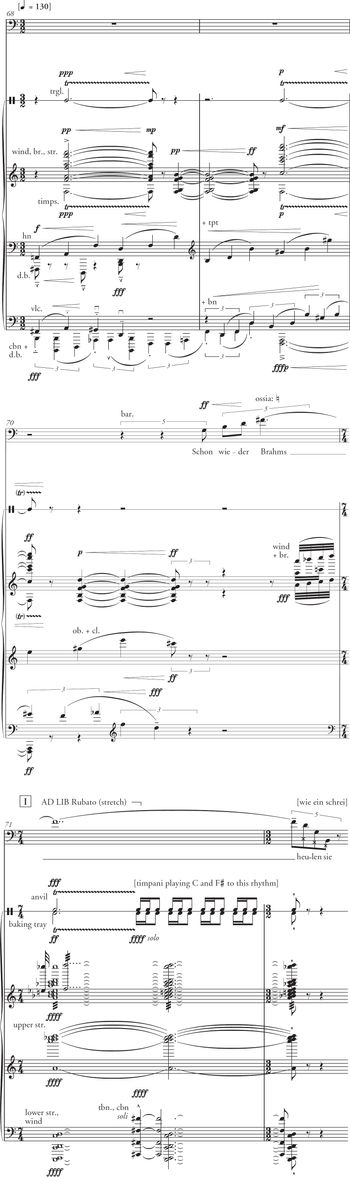
The raucous climax (bars 68–75), modelled on the orchestration of the Scherzo of the Fourth Symphony, albeit with a baking tray replacing Brahms's triangle, wakes the children up, and they cry ‘Schon wieder Brahms’ (‘Not Brahms again’; see Examples 10a and b). The use of the baking tray may have been for parodic purposes, but it also reinforces the domesticity of the unfolding scena (recall that the nineteenth-century ghost tended to lurk in the household rather than the crypt).
Bars 1–75, then, offer up the spectres of Brahms that haunt both the work and our culture: wisps of melodies, chords or timbres that tease the ear and then disperse. Their insubstantiality along with their ambiguous connection to the ‘spirit’ – the distended logic of the background thirds – call into question their existence:
One would have to say: it haunts, it ghosts, it specters, there is some phantom there, it has the feel of the living dead – manor house, spiritualism, occult science, gothic novel, obscurantism, atmosphere of anonymous threat or imminence. The subject that haunts is not identifiable, one cannot see, localize, fix any form, one cannot decide between hallucination and perception, there are only displacements; one feels oneself looked at by what one cannot see.Footnote 40
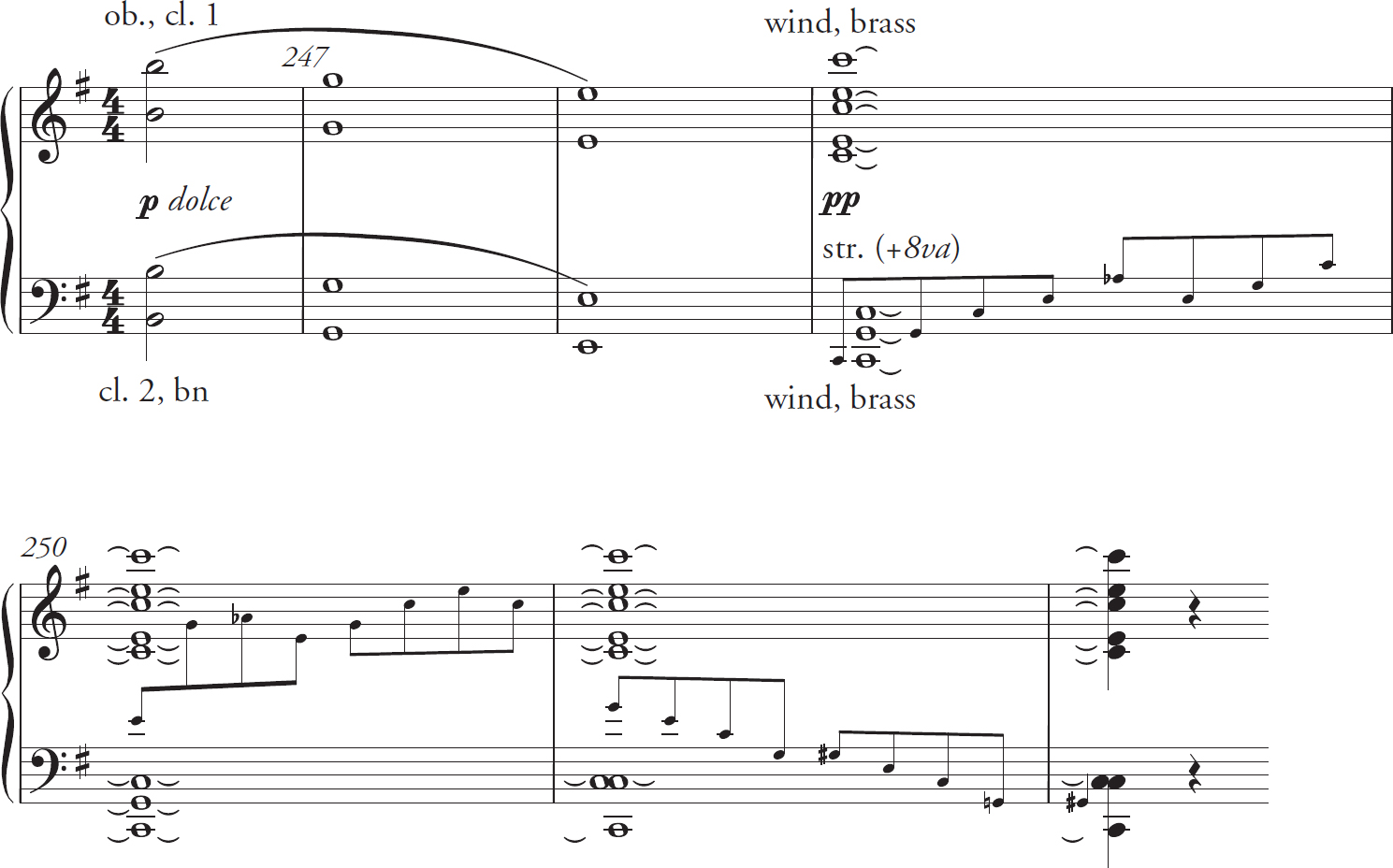
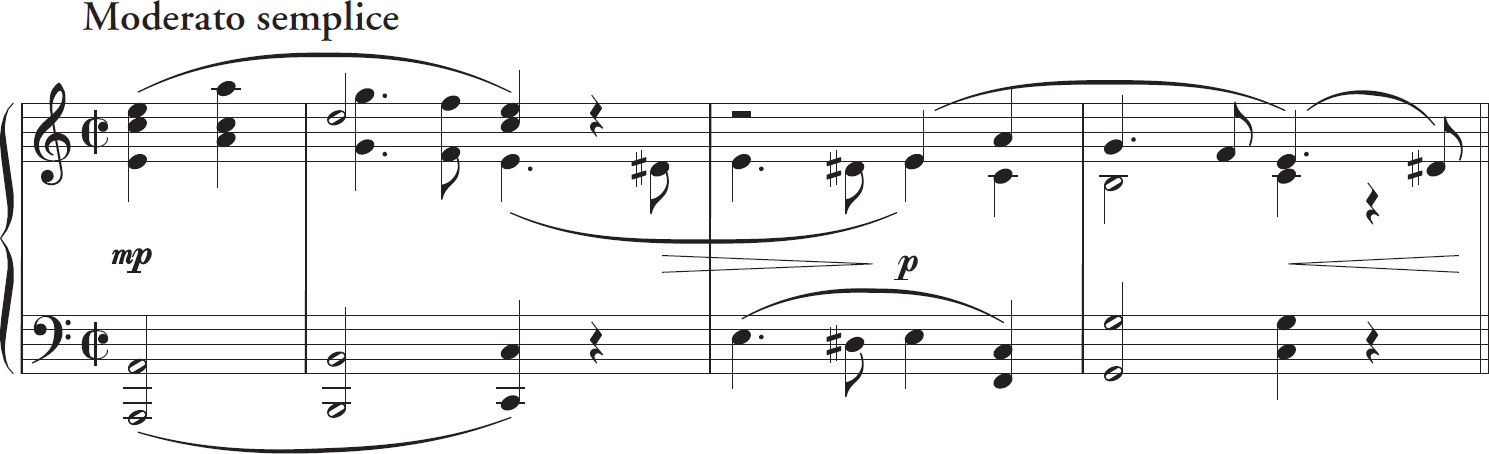
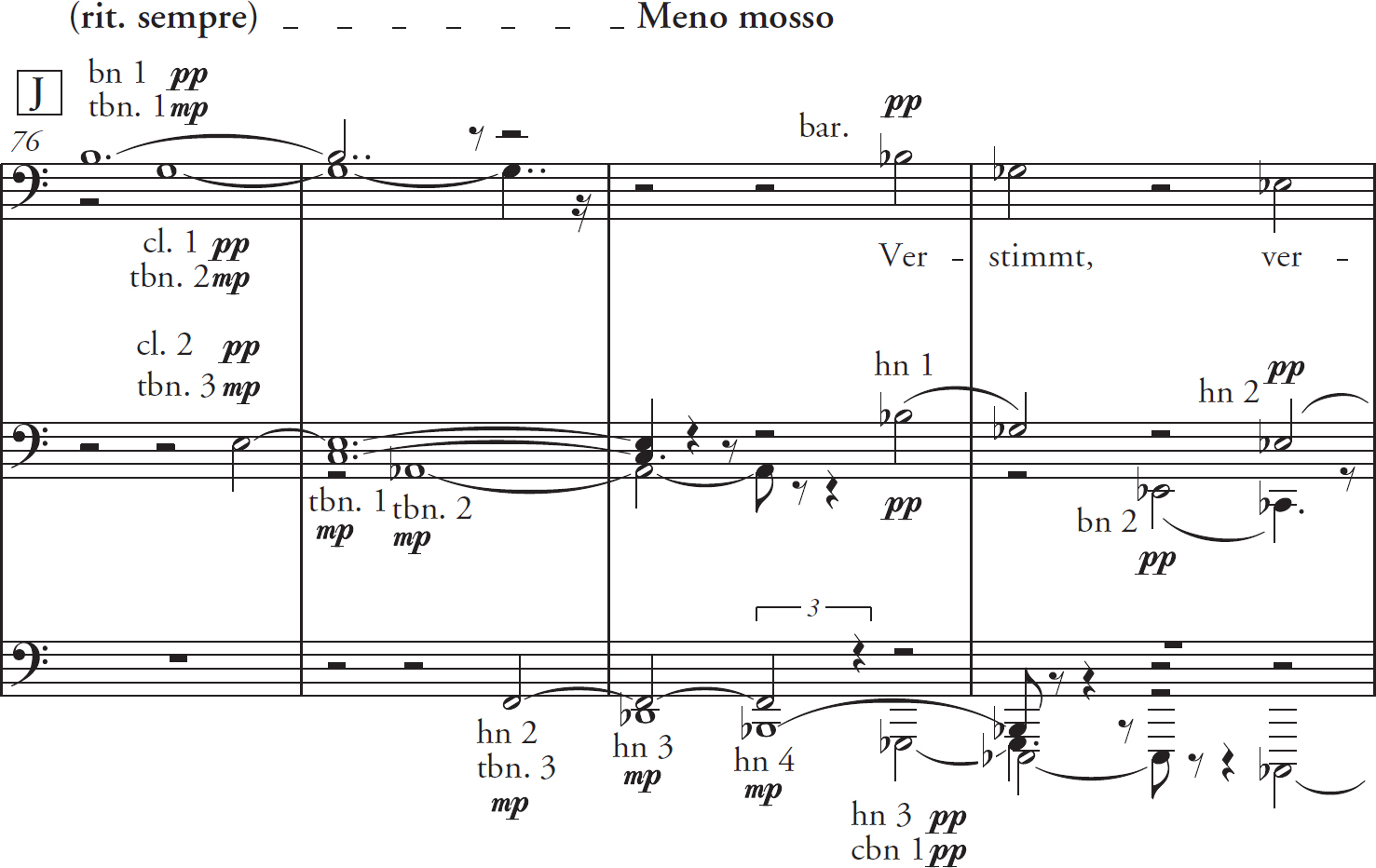
The narrated response in Brahms is to ignore the sensation of being observed: the final minutes of the song (bars 76–114) see the unappreciated and forlorn spirit of Brahms depart to increasingly complex versions of the omnipresent descending thirds. With no observers willing to give the spectre flesh, the spirit is all that remains. Thus, in contrast to the density of allusions during the piano-playing sequence (bars 24–75), there are few obvious reminiscences of specific works. The opening thirds (see Example 11), sombrely coloured by wind and brass, recall once again ‘O Tod’, and might also be a distorted echo of the beginning of the recapitulation of Brahms's op. 98/i (bars 246–58);Footnote 41 there is perhaps a further reference to the First Piano Concerto in bars 84–6 (alluding to op. 15/i, bars 306–9). Nevertheless, such connections lack the pictorial and topical motivations of bars 24–75. It is almost as if, upon the children's recognition of Brahms, ‘symphonic logic’ rises up to consume the content.
In speaking of Adès's use of allusion, Arnold Whittall has noted that the composer does so ‘without any hang-ups, because he finds it pleasurable to do so; and he hopes that listeners will share that pleasure’.Footnote 42 Nevertheless, one does not need to know of specific Brahmsian allusions in Brahms in order to perceive the topical references (such as cradle song) and thus the expressive affect.Footnote 43 So well ingrained are the allusions into the dominant musical language of the work (albeit a language characterized by a tension between allusion and background), and so fitting are they with the text, that such insertions do not necessarily disturb the experience of the whole: they add an extra layer of detail to the unfolding narrative for those able to ‘share that pleasure’. The suggestiveness of such allusions helps to imbue the poetic and musical narrative with authority, both programmatically and in its meta-narrative depiction of Brahms as a canonic composer, albeit one limited by virtue of his compulsion to repeat his ideas. The sequence of allusions and topical references thus serves to reinforce and reinscribe the tradition of Brahms as a ‘cerebral sentimentalist’; the conventionality of this image is reflected in the high level of correspondence between music and text. This is the most obvious – and ultimately least fulfilling – layer of meaning in the work, however, no matter how sparklingly it is achieved.
Yet the lack of disturbance to the whole created by the allusions – the smoothness by which they can be playfully introduced and then discarded – simultaneously displaces the authority that they evoke. If ultimately we can choose to ignore the specific echoes of Brahms, as do the children in the house, or not hear them at all, we might question not just the importance of the allusions within Brahms's musical discourse, but also Brahms's importance within the musical tradition. Greater depth thus emerges in Brahms through the ways in which its hauntological trappings – the way in which past, present and future collide to invoke and revoke both spirit and spectre – function within the piece. In order to elaborate upon this notion, and how Brahms comes to be elided with notions of tradition, we must turn to the spectres of ‘Brahms the Progressive’.
The hauntology of ‘Brahms the Progressive’
By constructing Brahms's inheritance in terms of ‘progressiveness’, Schoenberg's account is profoundly hauntological. Its own influence upon the interpretative stance towards Brahms of successive generations of scholars also yields to hauntological interpretation, in part owing to the excising (or exorcism) of its Swedenborgian, transcendental content. In what follows, I will trace some of the multiple refractions – spectres – of the Brahms–Schoenberg ‘progressive’ legacy which may plausibly have been passed down to Adès and manifested in Brahms.Footnote 44
For Swedenborgians, the spirit is a supernatural affair: ‘The world of spirits […] is intermediate between heaven and hell, and is the first receptacle of souls after death. It was chiefly in this intermediate world (in which a man's spirit even whilst living in the body really exists), that [Swedenborg] experienced what he heard and saw.’Footnote 45 The Swedenborgian spirit, neither truly of the body nor of heaven and hell, thus has close parallels with the Derridean spectre, for which ‘the very essence […] is to be found in this undecidability between flesh and spirit: it is not purely body – for in that case there would be no spectrality at all; but it is not pure spirit either – for the passage through the flesh is crucial’.Footnote 46
Such matters arise in Schoenberg's discussion of Brahms:
If a man who knows that he will die soon makes his account with earth and with heaven, prepares his soul for the departure, and balances what he leaves with what he will receive, he might desire to incorporate a word – a part of the wisdom he has acquired – into the knowledge of mankind, if he is one of the Great. […] Or is one entitled to assume that a message from a man who is already half on the other side progresses to the uttermost limit of the still-expressible? Is one not entitled to expect therefrom perfection of an extraordinary degree, because mastership, a heavenly gift, which cannot be acquired by the most painstaking assiduity and exercise, manifests itself only once, only one single time in its full entirety, when a message of such importance has to be formulated?Footnote 47
Schoenberg suggests that Brahms's ‘protective wall of dryness’ would have caused him discomfort when faced with ‘poetry’ or ‘sentimental fuss’ of this nature (though Schoenberg's characterization of his Swedenborgian exhortations as merely poetic is something of a misdirection).Footnote 48 Indeed, Schoenberg appears to be assuming the role of a medium in his summoning of Brahms's spirit, ‘half on the other side’. To achieve this, he must give it a body. The physical manifestation of Brahms's spirit as conjured by Schoenberg takes the form of motivic and metrical-rhythmical working, neither corporeal (in its existence as sound) nor wholly absent.
That the spectre we encounter in ‘Brahms the Progressive’ is of this nature is of little surprise, given the symbiotic relationship between expression, spirituality and technique in Schoenberg's thinking. And if the first two of these have already perhaps progressed beyond the ‘uttermost limit of the expressible’, it is natural that Schoenberg should turn to technical matters in order to find traces of ‘perfection’, which is to say the ‘heavenly gift’ – the inheritance – he had just described. So conceived, Brahms's technique transcended the laws of music as they were understood at that time: either the laws needed to be re-evaluated, or one must accept that there are ‘more things in heaven and earth […] than are dreamt of in our philosophy’.Footnote 49
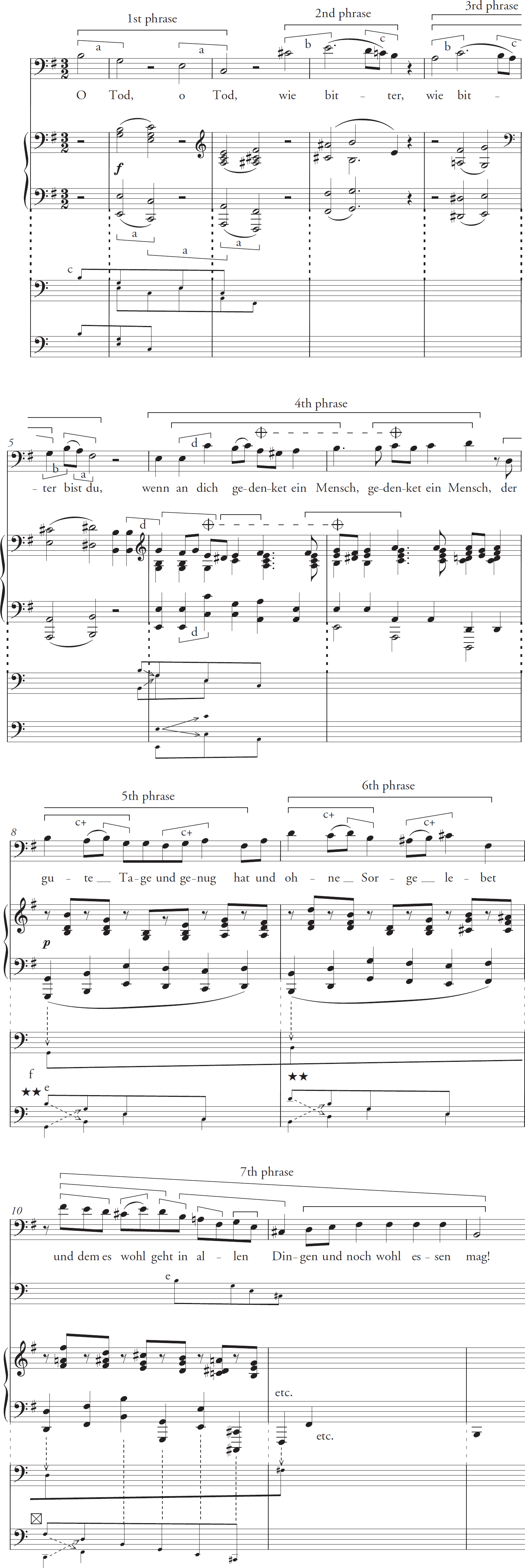
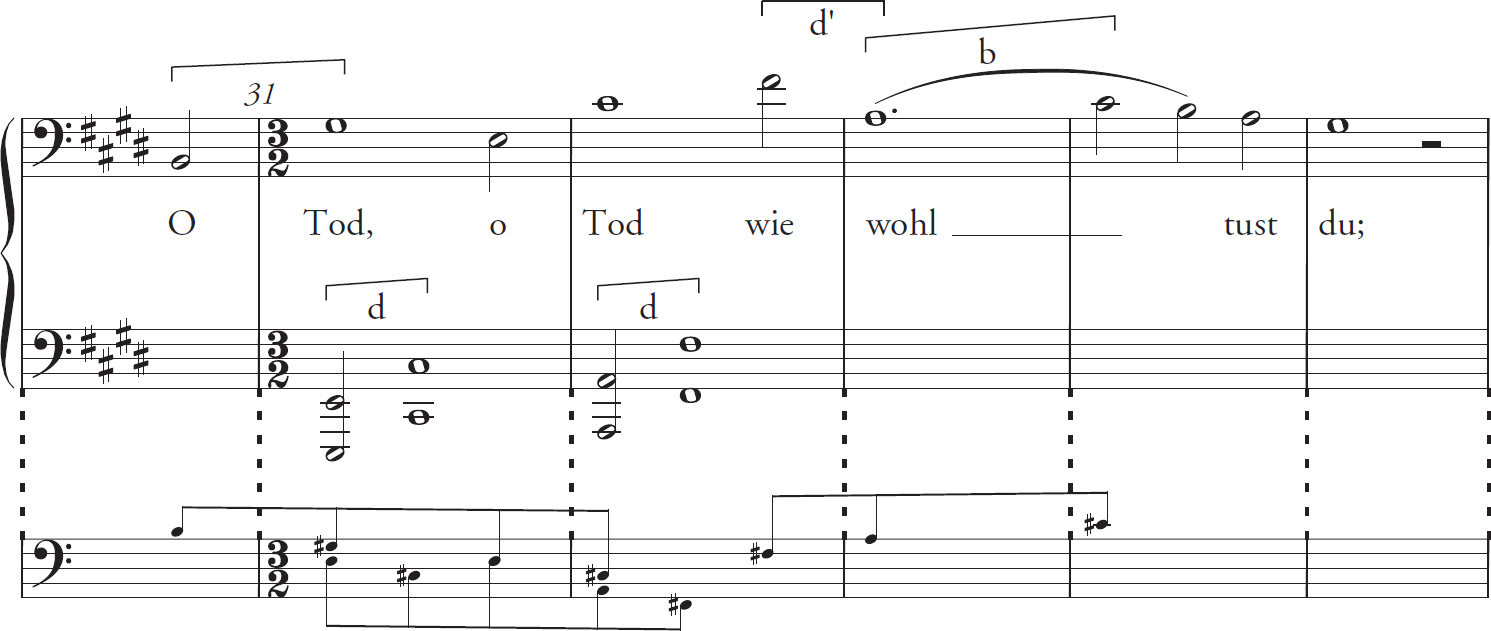
Such perfection is to be found, according to Schoenberg, in ‘O Tod’; it is telling that the bulk of Schoenberg's analytical account is devoted to a work that brings apprehensions of death to the fore. The opening of his analytical diagram (see Example 12) demonstrates the density of Brahms's thought, made manifest in the canonic writing in bars 1–2 and 6–7 and the prevalent motivic development of chains of thirds, descending (a), ascending (b), filled in (c) and inverted (d). The irregularity of phrase lengths and the displacement of the third phrase also come in for special mention. Later on in the work, the entirety of the opening line is inverted, now in the major, and imitated in the bass (see Example 13).
In contrast to the purple prose cited above, Schoenberg's account of the music is comparatively dispassionate – rational, even; but it is perhaps not as far removed as one might think from an explanation of the intermediate world in which Brahms's spirit purportedly resides. In a truly hauntological move, Schoenberg describes the spectre in systematic and quasi-scientific (fleshly) prose whilst simultaneously using this supposedly rational argument to confirm its spiritual, incorporeal (and thus untraceable) ‘existence’. Kicking over his traces, Schoenberg ascribes to this incarnation of Brahms an ontology that foregrounds eschatological concepts, rather than celebrating it as partial or uncanny. Viewing Brahms in this light, Schoenberg repurposes him as a prophet, unspeaking but nevertheless able to deliver his message of what might (or rather, should) be.
Thus, in Schoenberg's account, time becomes most decidedly ‘out of joint’.Footnote 50 In true ghostly fashion, Brahms is no longer of his own time, but belongs simultaneously to past, present and future. Communicating by way of musical example, he is enjoined to point to the musical future – a future which uncannily predicts the direction that Schoenberg's music was to take. ‘The most important capacity of a composer’, Schoenberg wrote, ‘is to glance into the most remote future of his themes or motives.’Footnote 51 In works such as ‘O Tod’, Brahms was able to go even further than that, glancing towards the future development of music, thereby (in the subtext to Schoenberg's argument) legitimizing that development itself.
Such legitimization depends on canonic support: Schoenberg demonstrates the indebtedness Brahms had to his musical past, which in turn validated Brahms's innovations. Moreover, this authority is vouchsafed by belonging to another sphere of influence altogether: this is a ‘heavenly gift’ which we can only partially comprehend, and which we therefore have to accept unquestioningly as if witnesses at a seance. This move serves, in other words, to relocate the authority of Schoenbergian modernism into the world of the spectral, at once unable to be proved but at the same time unquestionable. In short, Schoenberg's vision of the musical future is irrevocably hauntological rather than ontological, invoking a spectre of Brahms, and a particular inheritance from that spectre, in order to legitimize his own musical development, and by extension that of Western art music.
Schoenberg's hauntological reading of the Brahmsian legacy is reflected in the subsequent appropriation of the idea of ‘Brahms the progressive’ by other scholars and composers; even though overtly spiritualist elements tend to be excised from discussions, their remnants stubbornly linger on (much like the ghost in Brendel's poem). Alexander Goehr's critique of ‘Brahms the Progressive’ is instructive in this respect, not least because it provides an indirect bridge between Schoenberg (with whom Goehr's father studied) and Adès (who studied with Goehr).
Goehr highlights the insubstantiality of Schoenberg's technical argument, directing us to its spectral quality. Questioning the freedom of phrase structure that Schoenberg so admires in ‘O Tod’, Goehr notes that it ‘is only achieved within a very particular overall conception of the form’.Footnote 52 Continuing, he states: ‘When you look in detail, you tend to find that the effect of these apparent innovations relies on symmetrical forms and regular phrase-structures. If so, and it is so, it is false to see here a “progressive” attitude, a tendency towards “unrestricted” and prose-like construction.’Footnote 53 Schoenberg's ghosts, it seems, are constructed from smoke and mirrors. Goehr points out the apparatus by which Brahms's spectre is summoned in ‘Brahms the Progressive’, and shows that every time it is made to speak, it does so with a Schoenbergian accent.
Yet Goehr's own reading is no more or less a (mis)appropriation of Schoenberg than Schoenberg's is of Brahms. Goehr's excision of the transcendental aspects of Schoenberg's argument fails to silence the spectres of Brahms: an attempted exorcism of this nature is, according to Derrida, ‘a performative that seeks to reassure but first of all to reassure itself by assuring itself, for nothing is less sure, that what one would like to see dead is indeed dead’.Footnote 54 As Nicholas Royle notes, ‘to exorcize is not to escape from phantom-effects, rather the reverse’.Footnote 55 Thus spectres lurk behind the title of Goehr's critique, ‘Brahms's Aktualität’, a title chosen to question Brahms's relevance to our society – to interrogate whether an exorcism is in fact necessary – and which thereby draws attention to our continued reworking of his inheritance.
It also draws our attention to Goehr's specific, ongoing musical response to the Brahms–Schoenberg tradition, and the personal relevance which Brahms (thus conceived) holds for him. Goehr's critique of ‘Brahms the Progressive’ echoes in his music, in which he challenges the authority of the tradition that Schoenberg has Brahms represent by combining it dialectically with alternative, competing traditions.Footnote 56 A selective survey of Goehr's output highlights the dialectical tensions that arise. Although Bayan Northcott's description of the opening of Goehr's String Quartet no. 3, op. 37 (1975–6) as ‘Messiaenic Brahms’ (distinct from Schoenberg's depiction of a messianic Brahms!) captures two of Goehr's central influences, it is quite clear from his subsequent survey that Goehr's music re-examines, ‘in a new context, a variety of traditional and historical procedures for defining and handling musical ideas’, not least those of Stravinsky.Footnote 57
Nevertheless, this has not prevented authors from exploring the Viennese influence on Goehr's music. Northcott himself frames Goehr's Chaconne (1974) in terms of both Schoenberg's Variations op. 31 and Brahms's Fourth Symphony, the latter, significantly, in the guise of ‘Brahms the progressive’.Footnote 58 Robin Holloway, too, singles out the Chaconne as an extreme (and negative) example of ‘Goehr-the-Progressive’, having shortly before brought together this Schoenbergian (traditionalist) vision of progressiveness with ideas of cerebral sentimentality (Holloway refers to ‘the aspects of Brahms that called forth [Hugo] Wolf's fury and Nietzsche's contemptuous “He is unable to exult”’).Footnote 59 Indeed, Holloway expresses Goehr's ‘value’ in familiar Schoenbergian terms: his ‘sense of this heritage, and his endeavour to add to it’ are central in this respect.Footnote 60
Nearly a quarter of a century later, Holloway mollifies his view of Goehr. He observes that ‘the prevailing image in about 1980 was monolithic and Germanic – “Goehr the Progressive” – the selfconscious and ambitious heir to a mainly instrumental mainstream stretching back via Schoenberg to Brahms, thence to the Viennese Classics’.Footnote 61 The works that embodied this view include the Little Symphony (1963), the Symphony in One Movement (1970) and the concertos for violin (1962) and piano (1972). The music post-1980 ploughs a wider furrow, drawing Baroque and Renaissance influences into the melting pot. Still, not all recent commentators have allowed Goehr to escape his roots. Geoffrey Poole argues that ‘Goehr must have a major task in upholding the ethic of a Beethoven–Brahms–Schoenberg heritage in the twenty-first century, and in practice his preference for traditional resources and his aversion to outward show represent a particularly purist attitude even to that heritage’.Footnote 62 Milton Babbitt drew a comparison between Goehr and Brahms in particularly Schoenbergian terms, noting that music such as the Piano Sonata, the Violin Concerto and The Death of Moses ‘always appear[s] profoundly and delightedly mindful of what music has been and – therefore – can be, looking forward as did the music of that composer whom he (and I) so admire: Brahms’.Footnote 63
The critical, problematic response to the Brahms–Schoenberg ‘progressive’ tradition to be found in Goehr's music is encapsulated in his observation of Brahms's ‘particularly modern sensibility’ and the ‘paradox’ that ‘we can so easily empathise and even identify with Brahms, his feelings and his ideas […]. But the tendencies and deliberate limitations of his compositions are not generally reflected in the preoccupations of present-day composers; most would, if asked, consider him irrelevant to their own intentions.’Footnote 64 The tensions that animate this paradox – of identification and simultaneous dismissal – are typically hauntological, and are played out in Goehr's music and writings. Whether Adès inherited a heightened version of these tensions from his teacher, or whether they arose from a rejection of Goehr as a late twentieth-century embodiment of the Brahms–Schoenberg tradition, they nevertheless inform Brahms, as I shall demonstrate below.
Goehr's former colleague at Cambridge the composer Hugh Wood approaches the paradox more positively, drawing attention first to the
great gulf […] between us and Brahms […]. This must not imply that he was cosily ensconced in his Victorian garden. He was a stranger there too: if not afraid, then certainly in a world he never had made – and had (as we have seen) great difficulties in coming to terms with. If he is remote from us, then he was equally remote from his contemporaries.Footnote 65
Yet Wood tempers this assessment by demonstrating the ways in which ‘for some of us he has never gone away’.Footnote 66 Wood's appropriation of ‘Brahms the progressive’ thus differs from Goehr's, focusing instead upon Schoenberg's particular canonic formulation of Brahms in order to argue that Brahms was the last composer to be able to bear the burden of the past and of tradition, ‘the last person to see the whole predicament, and to be able to cope with it. That is his importance to the darkened world of today.’Footnote 67 But it is more than that: the authority invested in Brahms legitimizes the music that follows in his wake – music such as Schoenberg's and Wood's.Footnote 68 Once again, the collapsing of temporality – the past, Brahms's Vienna and the ‘world of today’ – into the figure of Brahms as Tradition is classically hauntological.
Indeed, the trend presented in Schoenberg's ‘Brahms the Progressive’ – whereby Brahms's innovations are made to look simultaneously back to the Classical canon and forward to the twentieth century, thus rendering time ‘out of joint’ – has become axiomatic in Brahms's reception.Footnote 69 Daniel Beller-McKenna has drawn attention to this practice: ‘Brahms scholars have focused on aspects of his musical style that separate him from, rather than relate him to, the culture in which he lived.’Footnote 70 Beller-McKenna's aim to re-place Brahms within his cultural milieu has the paradoxical effect of reinforcing the sense of separation between us and the ‘ahistorical’ Brahms. Similarly, Notley's work has sought to understand Brahms's music ‘in the context of late nineteenth-century Vienna by exploring both what [she conjectures] to be his position and what [she interprets] as prevailing “climates of opinion”’.Footnote 71 Her argument traces ‘lateness’ as both a cultural and a musical trope, and reads Brahms's music against ‘the twilight years of Viennese liberalism’ – a political position that (note the phraseology) Brahms ‘embodied’.Footnote 72 Another feature of the late style is the use of archaisms, ‘which Adorno connects to the alienation, the sense of estrangement from one's time’.Footnote 73 Notley concludes:
The ostensible futility of Brahms's complete technical command did not determine the quality of expression. Rather, through his command of musical logic, his ability to find meaning in aging conventions, Brahms was able to write music that often sounds both of its time and at odds with it. Beyond the pleasures afforded by its compositional sophistication and its sheer sonorous beauty, the music may be said to express the melancholy of someone who was part of a culture that could not last much longer, a middle-aged person aware of lateness.Footnote 74
Brahms and his music ‘embody’ the twilight years of Viennese liberalism whilst simultaneously being distant from it: framed thus, they were as spectral then as they are now. Brahms was divorced from his own culture and distant from ours, so it is little wonder that Goehr opines that ‘Brahms's thinking has little (which is not to say it has nothing) to do with us’.Footnote 75 Nevertheless, Brahms refuses to go away, and whether the centrality of the tradition he embodies is questioned (as with Goehr) or accepted as a symbol of authority (as with Wood), his spectres continue to haunt both his own time and our own.
Thus, although the overtly spiritualist and eschatological tenor of Schoenberg's argument has been downplayed over the intervening decades, his construction of Brahms and his shackling of Brahms's spirit to a particular vision of musical tradition and authority in the form of ‘Brahms the progressive’ nevertheless lingers on problematically in the form of multiple spectres. Brahms and his music belong neither to his own time nor to ours, and yet despite this insubstantiality, his continuing presence represents some sort of terrible and often unwelcome authority in an era in which such a position is suspect. It is not surprising, then, that responses to Brahms and his music, both positive and negative, so often find expression in terms of ghosts and revenants which collapse both time and space.
Brahms the uncanny
The spectral reveals hints of deep-seated underlying concerns – of a malaise. ‘Something in the present is not going well, it is not going as it ought to go,’ wrote Derrida. ‘The coming of the other, the absolute and unpredictable singularity of the arrivant as justice. We believe that this messianic remains an ineffable mark – a mark one neither can nor should efface – of [a] legacy, and doubtless, of inheriting, of the experience of inheritance in general.’Footnote 76 Such concerns underpin the texts surveyed in the previous section, in which fears about the legitimacy of modern music (and modernity) intermingle with the problematic legacy of tradition. In the case of Adès's Brahms, I suggest that the spectral serves a double purpose. On the one hand, the spectres of Brahms to be found in the work leave the ‘ineffable mark’ of inheritance and tradition; I shall return to this point in my conclusion. On the other hand, the spectral functions in order to critique the specific inheritances of the discourses of ‘Brahms the cerebral sentimentalist’ and ‘Brahms the progressive’. In doing so, it challenges the ontological security of these positions and brings to the fore concerns with the authority of such claims. In this section I demonstrate how this is achieved, with reference to the uncanny.
Derrida's injunction that we must speak with ghosts is motivated less by the desire to ascribe to them ontological status (a move that he finds ethically suspect) than by that to attend to those uncanny elements that cause the ghost to be displaced in the first place. The importance of the uncanny is confirmed by Derrida's suggestion that ‘the subtitle of [Specters of Marx] could […] have been: “Marx – das Unheimliche”’.Footnote 77 The Unheimliche, according to Friedrich Schilling (cited by Freud), is something that is visible that ought, however, to be hidden and secret.Footnote 78 In its peculiarly hauntological guise, the uncanny causes us to question certainties of the present;Footnote 79 the secret that emerges is not the secret of the ghost, but the secret of the present and ‘the experience of secrecy as such’.Footnote 80
There have been numerous applications to music of Freud's notions of the uncanny over the last 20 years; within these, the definition of the uncanny as ‘something familiar and old established in the mind that has been estranged’Footnote 81 is frequently repeated.Footnote 82 Taken en masse, such endeavours have begun a preliminary mapping out of the uncanny in music, and it is with the aid of such maps that we can turn once more to Schoenberg's and Adès's visions of Brahms.
In his brief discussion of Schubert's late E♭ major Piano Trio (D.929), Lawrence Kramer observes the manner in which transformations of a Swedish folksong eventually become timeless, so that the revenant returns to live on – differently. ‘The stake’, Kramer suggests, ‘is cultural memory.’Footnote 83 The same stake underpins Schoenberg's ‘Brahms the Progressive’ (and Wood's version of Brahms, too): cultural memory suffuses his argument by means of his invocation of the canon and its transformations. Yet his account estranges Brahms's music from his own time as well as ours through the suggestions of timelessness – or the degree to which time is perceived as out of joint – discussed above. By demonstrating how both memory and technique live on in his own music, Schoenberg allows Brahms's revenant to exert its influence long after Brahms's musical style lost favour; the revenant finds different forms through which to express itself. I would argue, however, that this is more than just a simple case of influence (as if any influence can be described as simple!), for Schoenberg claims to have discovered a ‘secret’ in Brahms's music.Footnote 84 By making this secret visible, Schoenberg has strayed into the uncanny.
The reappropriation in Schoenberg's own music of Brahmsian motivic techniques outside their tonal context renders the material strange: Michael Cherlin has characterized the ‘wisps of tonality’ that haunt Schoenberg's post-tonal music as emerging ‘distant voices from his past’.Footnote 85 The resurfacing of something once familiar in an alien context is, of course, typical of the uncanny, but it is the notion of ‘distant voices’ that I wish to address here. Kramer has suggested that Freud ‘disperses himself into a trio of alter-egos’ in order to master the uncanny;Footnote 86 nevertheless, ‘Freud invites – or cannot prevent – the return of the irrational (subjective, unconscious, natural) materials upon a discourse, a technique, that is meant to demystify them.’Footnote 87 Freud provides, therefore, a classic instance of a Derridean exorcism in which the attempt to dispel a ghost serves only to reinforce its power. And Schoenberg, by means of his particular dispersal of his own self into the methods and techniques of his predecessors, might be said to be addressing the uncanny – the distant voices, the ghosts – in his own music. Yet, as with Freud, Schoenberg peppers his discourse with the irrational – such as the quasi-spiritualist interjections discussed above – at the very moment of heightened rationalism (as represented by his detailed motivic analyses). To put this another way, Schoenberg's efforts to master the uncanny in both his music and his writings can be read as his attempt at mastering the burden of tradition, given symbolic form in ‘Brahms the Progressive’ in the shape of Brahms the composer. The uncanny, spectral traces that result serve to challenge the ontological security of this depiction of Brahms; it indicates that ‘something in the present is not going well’.
I would argue that Adès's Brahms all but thematizes this malaise, this loss of certainty in the constructions of tradition that characterize ‘Brahms the Progressive’. It can be heard both as a reworking of the compositional methods discerned by Schoenberg and as a response to this tradition as inherited from Goehr (and Wood). The analysis of the work presented above has already demonstrated the extent to which Adès collapses together heightened rationality and irrationality in his own depiction of the composer (and, by implication, tradition): it is there in the use (and overuse) of the falling thirds, and in the dislocation of time engendered by the multiple quotations from works by Brahms. Some of the spectral qualities of the music have already been noted: some of its secrets have already been made visible. ‘Since such a conjuration today insists, in such a deafening consensus, that what is, it says, indeed dead, remain dead indeed, it arouses a suspicion,’ writes Derrida. And, like the children of Brendel's poem, ‘it awakens us where it would like to put us to sleep’.Footnote 88
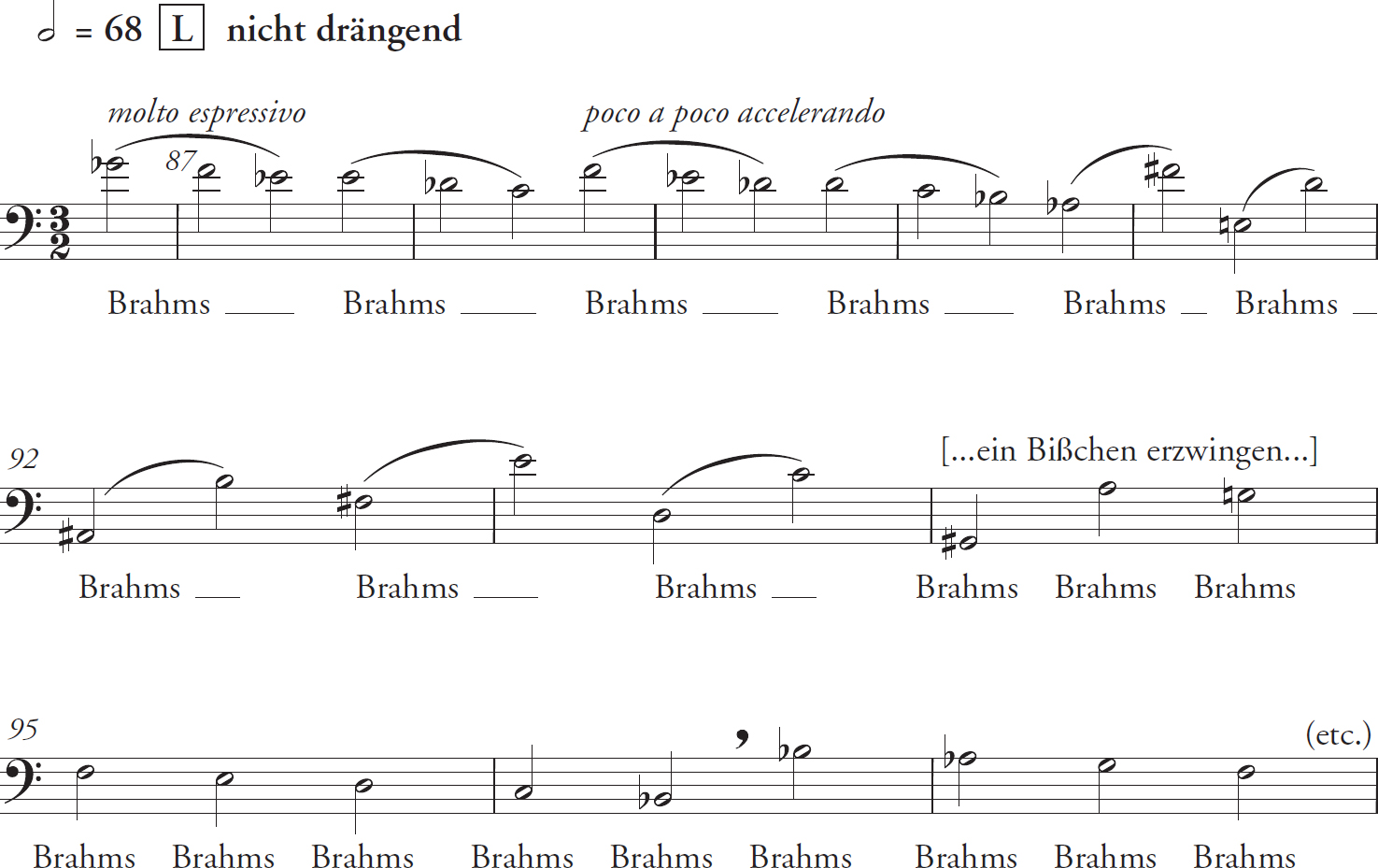
Suspicions that we are dealing in Brahms with such a conjuration are aroused initially through the presentation of many of the musical devices that might be taken as signs of the uncanny. Klein has suggested that ‘the musical signs surrounding the uncanny’ include ‘the ombra topic (tremolos, diminished-seventh chords, Neopolitans) […] enharmonicism, strange uses of chromaticism, odd voice-leading, and mechanical repetitions of musical material’.Footnote 89 Most of these features occur in Brahms, and though many of them can be attributed to conventional depictions of the supernatural, certain uncanny traces remain. Although the multiple repetition of the falling thirds is the most obvious signifier of the uncanny in this context,Footnote 90 the false relations and octatonic implications of Adès's material, when set against the tonal logic of Brahms's music, also evoke the uncanny. In his presentation of fragments from, and allusions to, works by Brahms, Adès makes them strange, transforming the Heimliche into the Unheimliche.Footnote 91 That the allusions are drawn primarily from Brahms's later music gains greater significance in this context, for in Notley's assessment there is already a hint of the uncanny in the source material (‘Brahms was able to write music that often sounds both of its time and at odds with it’): it is as if Adès is turning the uncanny screw just a little further.Footnote 92 Yet in addition to the shock of hearing that ‘what ought to have remained in the past has recurred’ (a revenant, in both Derrida's and Kramer's terms), Adès's material has been ‘emptied of meaning’ by virtue of the logical distance between Brahms's music and Adès's, and in the incessant and never-ending pattern of thirds.Footnote 93 The multiple repetitions of the name ‘Brahms’ in bars 86–99 offer a heightened example of that which is ‘often read as a degradation of language, as the sign of a flattened self, as something to be feared, struggled against: as uncanny’ (see Example 14).Footnote 94
Such uncanny elements raise suspicions that Adès's apparently straightforward depiction of Brahms as ‘cerebral sentimentalist’ – an interpretation that is promoted by the programme note to Brahms – might mask more complex responses to Brahms's legacy. It is here that Schoenberg's appropriation of Brahmsian motivic working and his filtering of the Brahmsian inheritance come into play, along with Goehr's subsequent ambivalence towards the relevance of this tradition, for they provide conceptual and musical backgrounds against which the genuinely critical dimension of Brahms can be assessed.
Specifically, the presence of descending thirds on a variety of levels and the manipulation of phrase lengths in the opening paragraph of Brahms parallel exactly those devices highlighted by Schoenberg in his analysis of ‘O Tod’; the twist is that Adès jettisons the underlying formal regularity and phrase structures identified by Goehr in his critique of ‘Brahms the Progressive’. Nevertheless, ‘O Tod’ remains an important background for Brahms, audible in the use of the 3/2 metre and the series of end-accented pairs of notes and thin texture at the vocal entry (see Example 2 above). Tracing the connections further, in ‘O Tod’, as Schoenberg observes, Brahms inverts the descending thirds into sixths, whereas in the Fourth Symphony he reverses direction mid-theme to ascend in thirds. From bar 15 of Adès's setting, the same process of inverting interval rather than series direction can be found.
All told, it seems unlikely that these are fortuitous resemblances, given the associations with death to be found in both ‘O Tod’ and Brendel's poem. At the very least, Service's programme note encourages the audience (and analyst) to perceive – or to imagine that they perceive – such allusions. That is to say, although the Fourth Symphony (which serves as the touchstone for Service's note) provides a certain salient point of reference throughout Brahms, our apprehension of it is coloured by musical processes and extramusical connections that derive from ‘O Tod’. Pursuing the resemblance between the vocal entries of these two works further, it can be observed that Adès's setting is placed high in the baritone's register, its piano dynamic marking in stark contrast to the forceful forte opening of ‘O Tod’ in a more comfortable register. It is as if Brahms offers a distorted and shadowy reflection of ‘O Tod’ and, by extension, of the Schoenbergian vision of Brahms ‘the progressive’ that has dominated discourse on the composer for nearly a century. By rendering it uncanny, Adès invites us to question anew the stability of this vision.
Yet, as we have seen, no matter how much one strives to master the uncanny (and here Adès's attempted mastery is played out in every bar), the irrational nevertheless finds a way in. Kramer has drawn attention to Freud's detached third-person descriptions of his own encounter with the uncanny, and one can find a similar degree of deliberate, mannered distancing both in Adès's commentary on the work and in its musical techniques – in its emphasis on logical procedures, for example.Footnote 95 For Freud, this distance serves to reunite him with the uncanny: Kramer argues that he ‘returns to the uncanny in order to master it, to appropriate its power to go on living’.Footnote 96 Similarly, Adès's studied distance reunites him with the Brahms – or the tradition which Schoenberg and Wood would have Brahms represent – that is haunting him. As Schoenberg did before him, Adès is confronting the authority of Brahms in order to ‘master it, to appropriate its power to go on composing’.
Ghostliness is bound up in ‘the process of letting go of the past, of the dead’.Footnote 97 Yet this letting go is in practice not so easy. The humour that underpins Brahms – Emma Gallon has described the work as Gothic ‘with a comic turn’Footnote 98 – perhaps masks a deeper ambivalence. As Derrida has noted:
This hostility toward ghosts, a terrified hostility that sometimes fends off terror with a burst of laughter, is perhaps what Marx will always have had in common with his adversaries. He too will have tried to conjure (away) the ghosts […] he will have tried to conjure (away) the ghosts like the conspirators [conjurés] of old Europe on whom the Manifesto declares war.Footnote 99
Adès, like Marx and Goehr before him, conjures ghosts in order to send them away: Brahms invokes the spectres of Brahms as both ‘cerebral sentimentalist’ and ‘the progressive’. The humour of his setting, coupled with the use of the uncanny in order to defamiliarize the discourses within which the work is positioned, would appear to be an attempt to exorcise them, to decouple the spectre of Brahms from the apparent ontologies that bind it. Yet in doing so Adès brings unbidden an excess that cannot be spirited away: the fragments of the past, the persistence of tradition – and their Aktualität.
Schon wieder die Vergangenheit!
Although in the nineteenth century the supernatural was thought about in ways that seem distant and distinctly odd in hindsight, there are connections to be made between Victorian conceptions and the uses of the supernatural in twentieth-century thought. The metaphor of haunting, of revenants from another place or time, is one such connection, for this idea has been unexpectedly pervasive in recent literary-critical theory and cultural history.Footnote 100
The collapsing of time and distance between nineteenth-century and contemporary perspectives has been a persistent theme in this article, motivated by the heady, spectral mixture of ghost stories, reception histories and tradition as revenant which inform Adès's Brahms. Just as ghosts prove to be a means of providing a psychological insight into protagonists of a tale (A Christmas Carol; The Turn of the Screw) or into the unconscious (as in Freud's ‘Das Unheimliche’), so, too, I have argued, can they tell us something about music. Writing about A Christmas Carol and a later work by Dickens, The Chimes, Louise Henson has argued that
the apparitions in these stories are bound up with the identity of the protagonists, with memory playing a crucial role, supplying the ‘ideas or recollected images of the mind’ from which the specters take their form. Sensations from the present are interwoven with ideas from a remembered past which temporarily become dominant, and are closely related to apprehensions about the future. A drama of the self, triggered by the psychological tensions with the individual, is played out.Footnote 101
The same is true for Brahms, though when such interpretative analyses are applied to the work, as here, we are just as likely to be analysing ourselves, our musical culture.
Derrida begins Specters of Marx by ruminating on the phrase ‘I would like to learn to live finally.’Footnote 102 His conclusion is that ‘it can happen only between life and death […] can only maintain itself with some ghost […] this being-with specters would also be, not only but also, a politics of memory, of inheritance, and of generations’.Footnote 103 The tracing in this article of the issues governing the representation of Brahms in the works of Schoenberg, Goehr, Wood, Adès and others is in part an attempt to grapple with matters of cultural memory, making visible the play of invocations and exorcisms that underpin the dynamics of dealing with the inheritance of Brahms in particular and tradition in general. Thus both Schoenberg and Adès attempt to render aspects of Brahms abstract, formalized – a typical ‘conjuring trick’, according to Derrida;Footnote 104 though, as Samuel A. Chambers has noted, the logic of the spectre always disrupts formalism and undermines ontological claims.Footnote 105
In arguing that the opening of Adès's Brahms is a spectral reflection of ‘O Tod’, we are able to see keenly the distance between the ontologies that underpin Schoenberg's and Adès's visions of Brahms. Both composers offer portrayals of Brahms that reflect their own artistic interests (and by extension those of their respective, historically situated musical cultures); both attempt to persuade their audiences of the authority of these portrayals by basing them on selective musical evidence. Where they differ is that whereas Adès's audience is partially complicit in the production of Brahms's ghost, Schoenberg's listeners are required to be believers.
For Schoenberg, ‘O Tod’ borders on being a vision from the beyond that reveals the ways in which musical language can progress ‘to the uttermost limit of the still-expressible’.Footnote 106 In doing so, it provides historical and spiritual(ist) justification for Schoenberg's own artistic exploration of the limits of the expressible in his own music. For Adès, writing some 60 years later, it is no longer possible to write with any conviction about notions of musical progress. His ironic reworking of those very symbols of musical authority – the motivic rigour and flexible phrase length – that Schoenberg found in Brahms suggests that the very notion of limits (be they expressive or logical) is spurious and contestable. In Klein's terms, Adès provides an intertextual trope on Schoenberg's ‘Brahms the Progressive’, made additionally strange – if not uncanny – through its translation from essay (and annotated score) to concert piece.Footnote 107 Cunningly, this is made to wear the guise of ‘Brahms the cerebral sentimentalist’, thereby collapsing together and problematizing two dominant discursive traditions in a single gesture. Thus Brahms emerges as more than just a witty occasional work or a caustic response to Brahms's music, and something of its subversive nature comes to the fore. Despite its relative brevity, it manages to distil a century of commentary on the composer and (perhaps unwittingly) bring to the surface the tensions and contradictions that animate these historiographical, creative and critical discourses.
This, then, is the moral that can be drawn from Adès's ghost story. The spectres of Brahms – those ghosts of authority and limitations past – linger on, flickering insubstantially in the bright lights of our culture. Schoenberg and Wood would have us attend to these ghosts with care and respect, in order that we might yet find creative use for them before they drift mournfully out of our reach. Adès's response is by contrast more ambivalent, less reverential, and altogether more confrontational. Like the children of Brendel's poem, we might cover our ears in an attempt to block out the authoritarian subtext that clings to the ghostly whispers of what has been, what is, and what might be. Or worse: we might have lost the capacity to hear these allusions altogether. Schon wieder die Vergangenheit! But if Brahms acknowledges these as possibilities, it also offers an alternative. Tradition, packaged up in the figure of Brahms, proves impossible to accept or reject uncritically. Instead, we are forced continually to reaffirm and reproduce the significance it holds for us as individuals and as a culture. By divesting it of an apparently essentialized authority in favour of a negotiated, contextual inheritance, we can finally learn – in Derridean terms – to maintain it, and to live with it.
Examples 1, 2, 4a, 5a, 6a, 7a, 8a, 9a, 10a, 11 and 14 are reproduced by kind permission of Faber Music Ltd.
BRAHMS
Music by Thomas Adès © 2009 by Faber Music Ltd
Text by Alfred Brendel © 1996 by the author
Reproduced by permission of the publishers
All Rights Reserved.