





The UK psychiatry curriculum is regulated by the General Medical Council (GMC) and delivered through the Royal College of Psychiatrists (RCPsych), with the most recent comprehensive revision introduced in 2022.1 This curriculum structures postgraduate psychiatric education into two sequential phases: Core Psychiatry Training (years CT1–CT3) and Higher Specialty Training (years ST4–ST6+) (Supplementary information 1, available at https://doi.org/10.1192/bjb.2026.10321).1,2
Core training spans 3 years of whole-time equivalent working and provides broad exposure to major psychiatric subspecialties.1 These include psychiatric training in general adult, old age, child and adolescent mental health services (CAMHS), liaison psychiatry, intellectual disability, and addiction and forensic settings. During this stage, resident doctors in training (for conciseness, we refer to them here as resident doctors or trainees) are required to demonstrate progression across nine High Level (Learning) Outcomes (High Level Outcomes, HLOs), which encompass clinical assessment, person-centred care, therapeutic interventions, multidisciplinary collaboration, leadership, safeguarding, professionalism, quality improvement and teaching. These outcomes are articulated through 69 key capabilities that define the expected standard of practice for a core trainee.
Assessment is constant and portfolio based, incorporating workplace-based assessments (WPBAs), structured supervisor reports, reflective practice and formal examinations. Completion of the MRCPsych examinations, i.e. Paper A, Paper B and the Clinical Assessment of Skills and Competencies (CASC), is mandatory before progression to higher training.1
Higher specialty training builds on these foundations by enabling trainees to develop advanced expertise within a chosen psychiatric subspecialty.2 The GMC approves several psychiatric specialties, including general adult psychiatry, child and adolescent psychiatry, old age (also called ‘older adults’) psychiatry, forensic psychiatry, medical psychotherapy, psychiatry of intellectual disability and endorsements in addiction psychiatry, liaison psychiatry and rehabilitation psychiatry. Although each specialty has its own curriculum, all follow the same overarching HLO framework, ensuring consistency in professional standards while allowing for specialty-specific clinical, therapeutic and research competencies. Training at this stage emphasises increasing autonomy, complex case management, multidisciplinary leadership and the ability to integrate psychological, biological and social perspectives in clinical decision-making. Progression is monitored annually through the Annual Review of Competency Progression (ARCP) process, and successful completion leads to the award of a Certificate of Completion of Training (CCT), granting eligibility for entry onto the GMC Specialist Register.3
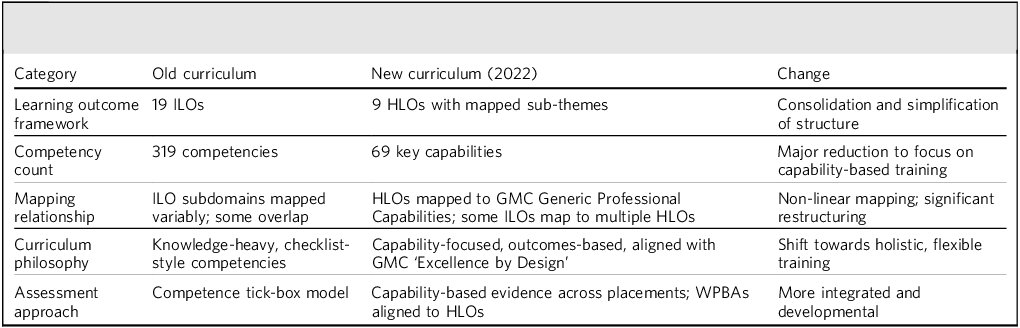
The 2022 curriculum reflects a broader shift within psychiatry training towards outcome-based training.1 It replaces the previous list of more than 300 competencies with a streamlined and flexible structure centred on high level professional capabilities (GMC).3 This reform aims to support personalised training pathways, enhance the quality of supervision and ensure that psychiatric education remains aligned with contemporary service needs, patient-centred care principles and evolving models of mental health delivery. The curriculum also places strong emphasis on reflective practice, quality improvement and the integration of neuroscientific, psychological and social frameworks, reinforcing psychiatry’s identity as a holistic and multidisciplinary medical specialty (Table 1).2
Intended Learning Outcomes (ILOs) versus High Level (Learning) Outcomes (HLOs) and key capability changes in the UK psychiatry curriculum

Table 1 Long description
A table comparing the old and new curriculum for psychiatry training. The table has 5 rows and 4 columns. The columns are labeled ‘Category’, ‘Old curriculum’, ‘New curriculum (2022)’, and ‘Change’. The rows are labeled ‘Learning outcome framework’, ‘Competency count”, ‘Mapping relationship’, ‘Curriculum philosophy’, and ‘Assessment approach’. Row 1: Learning outcome framework, Old curriculum: 19 ILOs, New curriculum (2022): 9 HLOs with mapped sub-themes, Change: Consolidation and simplification of structure. Row 2: Competency count, Old curriculum: 319 competencies, New curriculum (2022): 69 key capabilities, Change: Major reduction to focus on capability-based training. Row 3: Mapping relationship, Old curriculum: ILO subdomains mapped variably; some overlap, New curriculum (2022): HLOs mapped to GMC Generic Professional Capabilities; some ILOs map to multiple HLOs, Change: Non-linear mapping; significant restructuring. Row 4: Curriculum philosophy, Old curriculum: Knowledge-heavy, checklist-style competencies, New curriculum (2022): Capability-focused, outcomes-based, aligned with GMC ‘Excellence by Design’, Change: Shift towards holistic, flexible training. Row 5: Assessment approach, Old curriculum: Competence tick-box model, New curriculum (2022): Capability-based evidence across placements; WPBAs aligned to HLOs, Change: More integrated and developmental.
GMC, General Medical Council; WPBAs, workplace-based assessments.
The Assessment Strategy Review
The RCPsych undertook a major Assessment Strategy Review (ASR) in 2022, aiming to modernise, streamline and improve the validity, reliability and educational value of assessments used across psychiatric training. The review produced a formal report and a set of recommendations affecting the high-stakes examinations such as the CASC and WPBAs.4
The ASR was initiated to ensure that psychiatric assessment remains aligned with contemporary educational standards, GMC requirements and evolving models of clinical practice. The College emphasised raising standards in psychiatric education, improving fairness and ensuring that assessments meaningfully reflect the skills required for safe and effective psychiatric practice.
A key component of the ASR involved psychometric analysis, particularly of the CASC exam, to benchmark its reliability and evaluate differences between face-to-face and online delivery formats. This analysis examined reliability coefficients, standard error of measurement and score distributions to ensure that the CASC meets accepted reliability thresholds for Objective Structured Clinical Examination (OSCE)-type postgraduate medical assessments (typically 0.8–0.9).5
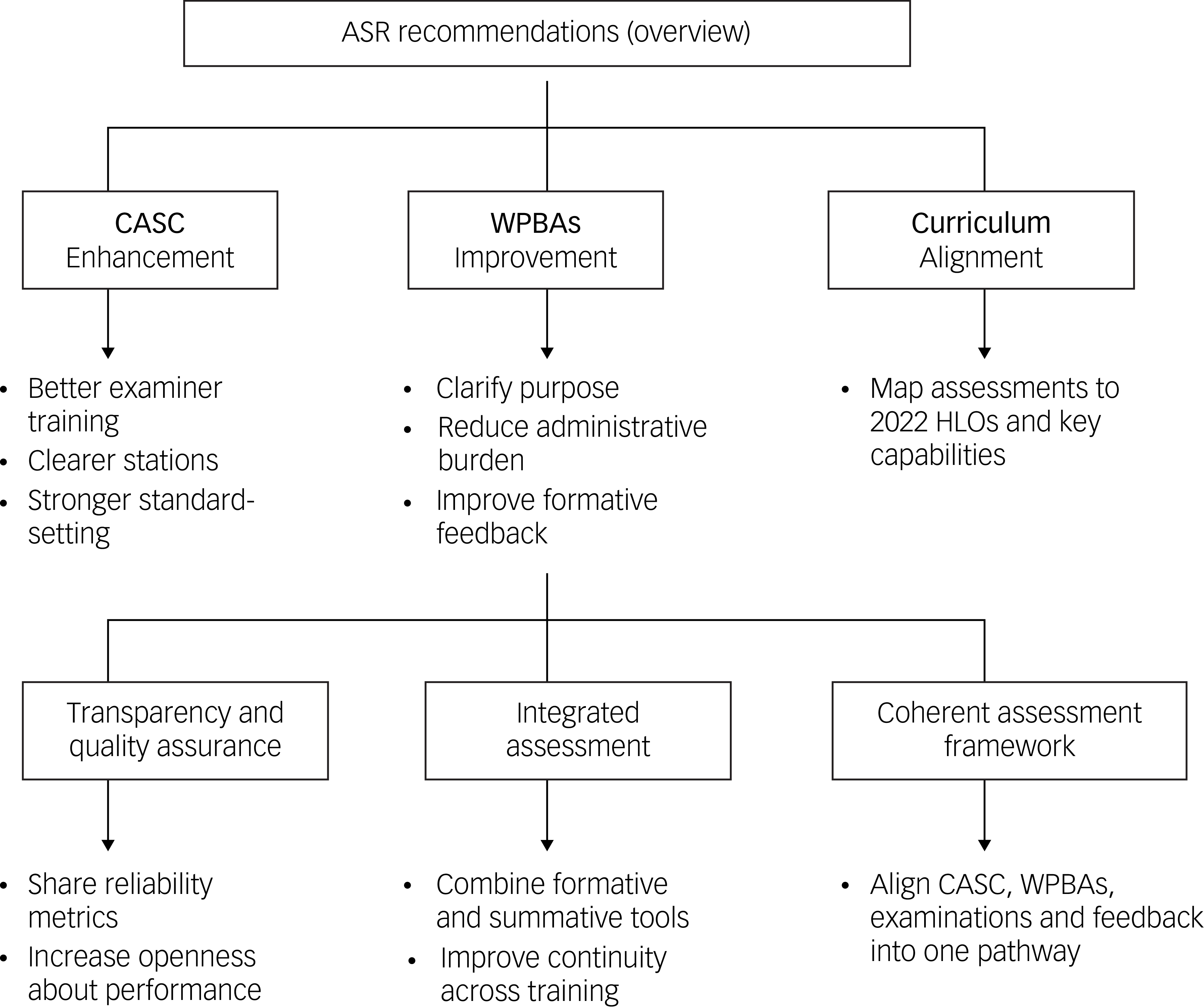
These recommendations were published alongside the ASR report and are now being implemented across training programmes (Fig. 1).
Recommendations of the Assessment Strategy Review (ASR). CASC, Clinical Assessment of Skills and Competencies; WPBAs, workplace-based assessments; HLO, High Level (Learning) Outcome.

For WPBAs, the ASR identified variability in implementation, educational value and feedback quality. This prompted the creation of the Formative Assessment Working Group in 2023 to examine how formative assessments including WPBAs could be improved to better support the development of trainees. The rating scales used a multi-button Likert format that was overly granular and contributed to rater inconsistency, halo effects (the influence of an assessor’s overall impression on specific assessment judgements) and grade inflation issues widely reported in the assessment literature.Reference Govaerts and van der Vleuten6,Reference Duddu7 This article reports on the Formative Assessment Working Group’s review of the RCPsych’s formative assessment process.
Aims
The objectives were:
-
(a) to shift WPBA away from a procedural, ‘tick-box’ model towards a system that promotes meaningful learning through high-quality, actionable feedback;
-
(b) to improve the consistency and educational value of assessment, reduce unnecessary administrative burden and enhance supervisor capability through clearer guidance and training.1,8
Method
Governance and timeline
The RCPsych Curricula and Assessment Committee oversaw the work. Final recommendations were endorsed by the Education and Training Committee in February 2024, progressed through Council approval, and were subsequently submitted to the GMC in 2025 and approved. Implementation is aligned with the new ePortfolio launch in August 2025.
Stakeholder representation and development process
Following recommendations arising from the ASR, the RCPsych established a Formative Assessment Working Group to review and enhance formative assessment within psychiatric training. Membership included representatives from all four UK nations and comprised Heads of School, Directors of Medical Education, Training Programme Directors, specialty and subspecialty advisory committees, resident doctors in training doctors from the Psychiatry Resident Doctors Committee (including less-than-full-time doctors), specialty doctors, educators, patients and carers, and other College representatives.
Four Task and Finish Groups were convened to address priority areas identified by the Formative Assessment Working Group. Membership was selected to ensure representation from both assessors and those undergoing assessment, alongside individuals with relevant expertise in each workstream.
Equality, diversity and inclusion principles were embedded throughout the process. Recommendations were developed through consideration of educational literature, stakeholder consultation, review of psychometric evidence from the ASR, benchmarking against assessment approaches used in other medical specialties, and iterative discussion within the groups. Recommendations were subsequently reviewed by the Formative Assessment Working Group before progressing through College governance structures.
Priority areas
Four priority areas for development were identified:
-
(a) entrustability scales and workplace-based assessment ratings
-
(b) assessment of formulation skills
-
(c) patient and carer feedback
-
(d) assessment of non-clinical competencies.
Results
Entrustability ratings and workplace-based assessments
A five-point entrustability scale was introduced into clinical supervisor and educational supervisor end-of-placement reports to support developmental judgements regarding trainees’ autonomy and supervisory requirements (Supplementary Information 2).
A simplified five-point analytic rubric replaced the previous WPBA rating scale (Supplementary Information 3). Psychotherapy-specific WPBAs will retain their existing specialty-specific rating frameworks because of their reliance on discipline-specific developmental models and process-focused competencies.
Formulation
Formulation skills were embedded explicitly within case presentations, reflecting their importance in psychiatric clinical reasoning and the integration of biopsychosocial perspectives in practice.
Patient and carer feedback
Structured patient and carer feedback was incorporated into portfolio requirements to support reflective learning and professional development (Supplementary Information 4).
Non-clinical competencies
Direct observation of non-clinical skills (DONCS) was expanded to enable assessment of leadership, governance, public mental health, advocacy, quality improvement, education, research and other system-level competencies aligned with the High Level Outcomes (Supplementary Information 5).
Discussion
Educational and clinical implications: a narrative synthesis
The following sections outline the educational rationale underpinning the recommendations and their anticipated implications for psychiatric training and clinical practice. This n arrative synthesis enabled exploration of complex issues while ensuring that proposed improvements are practical, evidence based and responsive to resident doctors in training and trainer needs.1,8
Entrustability ratings in end-of-placement reports
The introduction of entrustability ratings sought to formalise supervisory judgements regarding trainees’ autonomy while maintaining the formative purpose of WPBA. Entrustable professional activities (EPAs) were considered during development but were judged to require more extensive structural change and trainer development than was feasible within the current training framework.Reference Duddu7,Reference ten Cate10
Consultation with other medical specialties (emergency medicine, and obstetrics and gynaecology) highlighted both the educational value of entrustment-based approaches and the potential risks of applying entrustability ratings across all WPBAs. Consequently, entrustability ratings were incorporated into end-of-placement reports rather than individual WPBAs. This approach aims to support clearer judgements of autonomy while minimising additional administrative burden and preserving the value of narrative feedback.
Assessment of formulation
Although some stakeholders argued that formulation is already inherent to psychiatric practice and sampled in the written papers and the CASC, the Working Group recognised the educational gap created by the loss of the long case examination, a traditional assessment in which candidates undertook an extended patient assessment and presented an integrated diagnostic and management formulation. In this format, formulation had previously served as the anchor for diagnostic reasoning and management planning.
Embedding formulation within existing WPBAs such as the Assessment of Clinical Expertise (ACE), mini-ACE or case-based discussion (CbD) was considered but risked increasing administrative burden and diluting the formative purpose of these tools. To explore a feasible alternative, a local academic programme piloted mandatory assessment of formulation within case presentations. This approach was positively received by trainees, supervisors and multidisciplinary team (MDT) colleagues, and it informed regional and national practice through dissemination at professional meetings and a poster presentation.Reference Vinjamuri, Abulais, Khalid and Bickerton11 Feedback confirmed that the integration of a formulation-based approach in case presentation better conceptualised a patient’s mental health problems using the biopsychosocial model (usually the ‘5 P’ model – presenting, predisposing, precipitating, perpetuating and protective factors), guiding their management plan. It facilitated psychologically minded discussions, making a practical, observable, measurable difference to learning for psychiatry trainees, which in the long term leads to improved patient and carer experience through more therapeutic psychiatric care.Reference Vinjamuri, Abulais, Khalid and Bickerton11
Supported by guidance from the Faculty of Medical Psychotherapy, the proposal is therefore to assess formulation explicitly within case presentations. For those in core training (years CT1–CT3), this aligns with the existing requirement of one case presentation per year under the Silver Guide (www.rcpsych.ac.uk/training/curricula-and-guidance/curricula-implementation/curricula-documents-and-resources). For those in higher specialty training (years ST4–ST6+), one case presentation per year will replace a single CbD, maintaining the overall number of WPBAs and avoiding additional administrative load. Higher trainees will be encouraged to present to peers and MDT members, with WPBA sign off permitted by consultants or senior MDT professionals (e.g. Band 8 advanced practitioners, psychologists), consistent with Silver Guide provisions. This approach emphasises collaborative discussion rather than supervision, prioritising the applicability of formulation to real-world patient care while ensuring developmental continuity across training levels.1,2,Reference Duddu7,Reference Johnstone and Dallos12
Patient and carer feedback
Patient feedback is widely acknowledged to enhance communication skills, empathy and reflective practice, and it is a core expectation in consultant appraisal and revalidation.1,Reference Sargeant, Mann, Sinclair, van der Vleuten and Metsemakers9 Patient and carer feedback enhances learning by grounding reflection in lived experience.
Although concerns about administrative burden were noted, the new ePortfolio already hosts functionality for collecting patient feedback, enabling a streamlined approach through digital methods (e.g. apps, text messages) or paper responses where appropriate.
The proposal is for patient and carer feedback to be collected at least once during core training (CT1–CT3) and once during higher training (ST4–ST6+), with flexibility for trainees to select a suitable placement. A minimum of eight responses is considered sufficient for formative purposes, and pictorial or simplified formats will be available to ensure accessibility for CAMHS, intellectual disability services, dementia services, etc. For those in higher training, feedback may be gathered from patients seen in clinics, wards or community settings, and can be reviewed by supervisors as part of routine educational meetings.
The feedback will be used formatively, with aggregated results discussed with the clinical or educational supervisor to identify strengths, areas for development and targeted actions. Although this represents a small addition to the overall number of assessments, the disruption is minimal and the inclusion of patient and carer perspectives is expected to strengthen ARCP evidence and support development towards consultant-level practice.1,8
Public mental health and non-clinical competencies
A final working group explored how to strengthen assessment of public mental health and broader non-clinical competencies within the curriculum. Caseload-based discussion was identified as a valuable concept for assessing population- and service-level skills such as understanding readmission patterns, crisis presentations, equity of access, and patient outcomes, reflecting the curriculum’s emphasis on public mental health and systems-level thinking.
Rather than introducing a new assessment tool, the group incorporated the intended functions into an expanded DONCS, recognising that this scale is already established in the RCPsych’s assessment framework and has the flexibility to capture a wider range of competencies than currently utilised. This approach aligns the scale more closely with the full breadth of the curriculum, future proofs the assessment system and avoids adding administrative burden. The strengthened DONCS remains explicitly formative and must not be used as a proxy for performance management. Anticipated benefits include richer portfolio evidence, improved documentation of non-clinical competencies that are otherwise difficult to capture, and a flexible framework enabling individuals to demonstrate diverse skills across placements. Support materials will be developed by the Psychiatric Resident Doctors’ Committee and the College to guide supervisors in the expanded use of DONCS, and a non-exhaustive list of relevant competencies has been created with the intention that it will evolve as training needs change.1,8,Reference Norcini and Burch13
Clinical implications
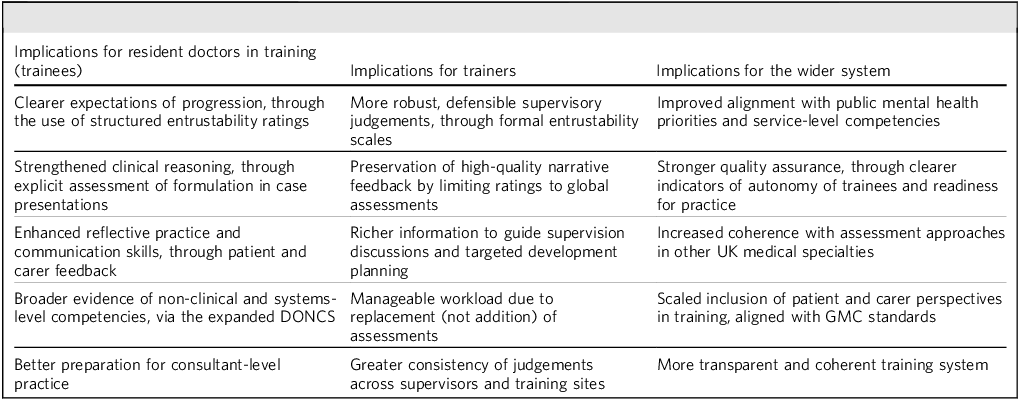
The assessment reforms clarify the expectations of resident doctors in training, strengthen clinical reasoning and feedback, enhance consistency of supervision and align training with public health priorities, quality assurance standards and patient-centred practice (Table 2).
Clinical implications of reforms to trainee assessment in the UK psychiatry curriculum

Table 2 Long description
A table with three columns and five rows detailing the implications of reforms to trainee assessment in UK psychiatry. The columns are labeled ‘Implications for resident doctors in training (trainees)’, ‘Implications for trainers’, and ‘Implications for the wider system’. Row 1: Clearer expectations of progression, through the use of structured entrustability ratings, More robust, defensible supervisory judgements, through formal entrustability scales, Improved alignment with public mental health priorities and service-level competencies. Row 2: Strengthened clinical reasoning, through explicit assessment of AQ1ulation in case presentations, Preservation of high-quality narrative feedback by limiting ratings to global assessments, Stronger quality assurance, through clearer indicators of autonomy of trainees and readiness for practice. Row 3: Enhanced reflective practice and communication skills, through patient and carer feedback, Richer information to guide supervision discussions and targeted development planning, Increased coherence with assessment approaches in other UK medical specialties. Row 4: Broader evidence of non-clinical and systems-level competencies, via the expanded DONCS, Manageable workload due to replacement (not addition) of assessments, Scaled inclusion of patient and carer perspectives in training, aligned with GMC standards. Row 5: Better preparation for consultant-level practice, Greater consistency of judgements across supervisors and training sites, More transparent and coherent training system.
DONCS, direct observation of non-clinical skills; GMC, General Medical Council.
Cross-cutting challenges
Implementing these assessment developments brings several cross-cutting challenges that require careful management to ensure their success. Clear, consistent communication between trainees, supervisors and training bodies is essential, particularly as changes to WPBAs, entrustability scales, formulation assessment, patient feedback and expanded DONCS represent a cultural as well as procedural shift. Concurrent introduction of a new portfolio platform has added implementation complexity.
Supervisor variability remains a recognised risk, especially in the use of entrustability scales, where unconscious bias, differing thresholds for autonomy and variable confidence in making global judgements may affect reliability.Reference Govaerts and van der Vleuten6 Supervisor variability can be assessed through feedback and outcomes, and mitigated through training.
Ensuring good engagement from trainees is equally important, including creating psychologically safe spaces for them to raise concerns, seek clarification and discuss the developmental purpose of these tools.
Although each group has worked to minimise administrative burden, perceived workload increases may still generate anxiety among trainers and trainees. To support implementation, annual audits or surveys could help identify emerging issues, monitor consistency and provide reassurance that the reforms are functioning as intended. Ongoing trainer development, supervisor guidance and transparent feedback loops will be crucial to embedding these changes sustainably and ensuring that they enhance learning rather than becoming mechanistic or punitive.1,Reference Norcini and Burch13
Strengths and limitations
A strength of this work is the breadth of stakeholder engagement, including representation from resident doctors in training, trainers, educational leaders, patients and carers across all four UK nations. The recommendations were informed by educational literature, psychometric evidence, cross-specialty benchmarking and iterative consensus-building. Limitations include the developmental nature of the work, which was not designed as a formal research study, and the absence of prospective outcome data regarding educational impact. A formal thematic analysis was not undertaken. Ongoing evaluation will therefore be important in determining the effectiveness, acceptability and unintended consequences of these reforms in practice. Although standardised training may improve consistency, decisions regarding whether such training should be mandatory fall beyond the scope of this paper and will require consideration during implementation and evaluation of the reforms.
About the authors
Indira Vinjamuri, FRCPsych, is a consultant psychiatrist in the Liverpool Crisis Resolution Home Treatment Team (Mersey Care NHS Foundation Trust), Director of Medical Education at Mersey Care NHS Foundation Trust, Liverpool, and Associate Dean for Curricula and Assessment at the Royal College of Psychiatrists, London, UK. Rohit Shankar, MBE, FRCPsych, is Professor of Neuropsychiatry at the University of Plymouth’s Peninsula Medical School, Director of its Cornwall Intellectual Disability Equitable Research (CIDER) unit and a consultant neuropsychiatrist with Cornwall Partnership NHS Foundation Trust, Truro, and Associate Dean for Academic Training at the Royal College of Psychiatrists, London, UK.
Supplementary material
The supplementary material is available online at https://doi.org/10.1192/bjb.2026.10321
Data availability
None.
Acknowledgements
We thank members of Royal College of Psychiatrists Task and Finish Groups, the Education and Training Committee and the staff who were involved in helping shape this project. Artificial Intelligence use: No artificial intelligence tools have been used in the research or writing process for this manuscript.
Author contributions
I.V.: conceptualisation, methodology, investigation, data curation, formal analysis, visualisation, writing – original draft, writing – review and editing. R.S.: supervision, resources, validation, visualisation, writing – review and editing. All authors satisfy the ICMJE guidance by substantially contributing to the design, analysis and interpretation of the work, drafting of the manuscript, final approval of the manuscript and all agree to be accountable for all aspects of the work in ensuring that questions related to the accuracy or integrity of any part of the work is appropriately investigated and resolved.
Funding
This research received no specific grant from any funding agency, commercial or not-for-profit sectors.
Declaration of interest
I.V. is Associate Dean for Curricula and Assessment at the Royal College of Psychiatrists (RCPsych). R.S. is the Associate Dean for Academic Training for the RCPsych. R.S. has received institutional research, travel support and/or honorarium for talks and expert advisory boards from LivaNova, UCB, Eisai, Veriton Pharma, Bial, Angelini, UnEEG and Jazz/GW Pharma outside the submitted work. He holds or has held competitive grants from various national grant bodies including Innovate, Economic and Social Research Council (ESRC), Engineering and Physical Sciences Research Council (ESPRC), National Institute of Health Research (NIHR), NHS Small Business Research Initiative (SBRI) and other funding bodies including charities all outside this work. The views/opinions expressed by the authors are their own personal ones and do not necessarily reflect views of employer/s.


 Open access


eLetters
No eLetters have been published for this article.