Introduction
Rice production in Mississippi is limited to the Mississippi and Yazoo river basin, commonly known as the Mississippi Delta (Miller and Street Reference Miller and Street2008). Bolivar, Quitman, Sunflower, Tunica, and Washington counties have traditionally been the leading rice-producing counties in Mississippi, with 85,700 ha of rice harvested in 2019, accounting for 4% of Mississippi’s row crop hectarage (USDA-NASS 2019). The clay soils that dominate these counties, along with large and flat fields, quantity of available water, and climate, are optimum for rice growth (Miller and Street Reference Miller and Street2008).
Weeds are the primary pest in Mississippi rice production (Buehring and Bond Reference Buehring and Bond2008). Weeds compete with rice for sunlight, water, nutrients, and other growth requirements (Smith Reference Smith1988). The top three most troublesome weeds of Mississippi rice are barnyardgrass, Palmer amaranth (Amaranthus palmeri S. Watson), and hemp sesbania [Sesbania herbacea (Mill.) McVaugh] (Webster Reference Webster2012).
For many years, weed control programs for rice in the midsouthern United States centered on propanil for control of grass and broadleaf weed species (Carey et al. Reference Carey, Hoagland and Talbert1995). However, repeated applications of propanil (Weed Science Society of America [WSSA] mechanism of action [MOA] Group 7) led to the evolution of propanil-resistant (PR) barnyardgrass. In rice fields with PR barnyardgrass, quinclorac (WSSA MOA Group 4) was used extensively for barnyardgrass control, and repeated quinclorac applications resulted in barnyardgrass resistant to both propanil and quinclorac (Malik et al. Reference Malik, Burgos and Talber2010). After selection for propanil and quinclorac resistance in barnyardgrass, rice with resistance to acetolactate synthase (ALS)-inhibiting herbicides (WSSA MOA Group 2) was developed (Riar et al. Reference Riar, Norsworthy, Bond, Barapour, Wilson and Scott2012; Sudianto et al. Reference Sudianto, Beng-Kah, Ting-Xiang, Saldain, Scott and Burgos2014). Imazethapyr and imazamox are the primary herbicides in imidazolinone-resistant (IR) rice, but repeated use eventually resulted in selection for barnyardgrass resistance to imidazolinone herbicides.
In IR rice, multiple applications of imazethapyr were used to control grass weeds including barnyardgrass and red rice (Oryza punctata Kotzchy ex Steud) (Buehring and Bond Reference Buehring and Bond2008; Norsworthy et al. Reference Norsworthy, Burgos, Scott and Smith2007). However, multiple seasons of rice monocropping resulted in outcrosses between IR rice and red rice in commercial fields (Burgos et al. Reference Burgos, Norsworthy, Scott and Smith2008, Reference Burgos, Singh, Tseng, Black, Young, Huang and Caicedo2014; Rustom et al. Reference Rustom, Webster, Blouin and McKnight2018; Zhang et al. Reference Zhang, Linscombe, Webster, Tan and Oard2006) and resulted in imazethapyr-resistant red rice (Scott et al. Reference Scott, Norsworthy, Barber, Hardke and Hardke2013).
Rice with enhanced resistance to herbicides that inhibit acetyl coenzyme A carboxylase (ACCase; WSSA MOA Group 1), marketed as ProvisiaTM, was developed to mitigate the spread of herbicide-resistant weeds across the midsouthern United States (Lancaster et al. Reference Lancaster, Norsworthy and Scott2018a). This ACCase-resistant rice is resistant to quizalofop-P-ethyl (Rustom et al. Reference Rustom, Webster, Blouin and McKnight2018), which was commonly used for control of annual and perennial grass weed species in cotton (Gossypium hirsutum L.), potato (Solanum tuberosum L.), soybean [Glycine max (L.) Merr.], other vegetables, and noncrop areas (Lancaster et al. Reference Lancaster, Norsworthy and Scott2018a; Shaner Reference Shaner2014). Quizalofop-P-ethyl only exhibits activity against grass weed species with broadleaf weed species exhibiting natural tolerance (Konishi and Sasaki Reference Konishi and Sasaki1994). The use rate for quizalofop-P-ethyl in ACCase-resistant rice ranges from 100 to 138 g ai ha−1 for a single application and 240 g ha−1 as a maximum total yearly application and is restricted to POST-only applications (Anonymous 2017).
Florpyrauxifen-benzyl is a POST herbicide developed by Corteva Agrisciences for control of grass and broadleaf weed species (Anonymous 2018). A member of the synthetic auxin herbicide family, the arylpicolinates, florpyrauxifen-benzyl provides an alternate mode of action in rice production and controls photosystem II-, synthetic auxin- (quinclorac), DOXP synthase-, and ALS-resistant barnyardgrass in rice production (Epp et al. Reference Epp, Alexander, Balko, Buysse, Brewster, Bryan, Daeuble, Fields, Gast, Green, Irvine, Lo, Lowe, Renga, Richburg, Ruiz, Satchivi, Schmitzer, Siddall, Webster, Weimer, Whitaker and Yerkes2016). Furthermore, research suggests florpyrauxifen-benzyl can safely be applied POST to rice cultivars grown in Mississippi (Sanders et al. Reference Sanders, Bond, Lawrence, Golden, Allen and Bararpour2020b).
Herbicide rate and application timing are important for maximizing weed control and minimizing injury to crops (Abit et al. Reference Abit, Al-Khatib, Stahlman and Geier2012). Previous research in soybean indicated that single applications of quizalofop-P-ethyl at 140 g ha−1 controlled red rice and suppressed seed heads when applied at tillering, whereas early-season applications were ineffective (Salzman et al. Reference Salzman, Smith and Talbert1989). However, in research by Khodayari et al. (Reference Khodayari, Smith and Black1987), quizalofop-P-ethyl controlled red rice most consistently when applied at the 2- to 4-leaf growth stage. Barrentine et al. (Reference Barrentine, Street and Kurtz1984) reported that red rice control was greater when quizalofop-P-ethyl was applied at the 5- to 6-leaf compared with the 2- to 3-leaf growth stage. More recently, barnyardgrass control with sequential treatments of quizalofop-P-ethyl applied alone and in mixtures with labeled rates of auxinic herbicides to rice at the 2- to 3-leaf growth stage or 4-leaf to 1-tiller was similar at 96% to 98% (Sanders et al. Reference Sanders, Bond, Lawrence, Golden, Allen and Bararpour2020a)
Although information is available on the effect of quizalofop-P-ethyl application rates and timings on weed control (Abit et al. Reference Abit, Al-Khatib, Stahlman and Geier2012; Lancaster et al. Reference Lancaster, Norsworthy and Scott2018a, b), information on the performance of sequential treatments of quizalofop-P-ethyl with florpyrauxifen-benzyl is lacking. Therefore, we conducted research to evaluate sequential applications at different rates of quizalofop-P-ethyl with florpyrauxifen-benzyl included in treatments applied immediately before flooding.
Materials and Methods
Field studies were conducted at the Mississippi State University Delta Research and Extension Center in Stoneville, MS, in 2017 (33.44°N 90.90°W) and 2018 (33.44°N, 90.54°W) to evaluate weed control with sequential treatments of quizalofop-P-ethyl that included florpyrauxifen-benzyl in applications before flooding. The soil was a Sharkey clay (very-fine, smectitic, thermic Chromic Eqiaquerts) with a pH of 8.2 and an organic matter content of 2.1%. The experimental site included a rice-fallow rotation where rice was seeded every other year. During the fallow year, weeds were allowed to grow and produce seed to maintain the soil seed bank. Glyphosate (Roundup PowerMax 4.5 L, 1,120 g ae ha−1; Monsanto Co., 800 N. Lindburgh Blvd., St. Louis, MO 63167), paraquat (Gramoxone 2.0 SL, 560 g ai ha−1; Syngenta Crop Protection, P.O. Box 18300 Greensboro, NC 27409), or 2,4-D (2,4-D Amine 3.8 SL, 560 g ae ha−1; Agri Star, 1525 NE 36th St., Ankeny, IA 50021) were applied in late March to early April each year to control emerged vegetation. Saflufenacil (Sharpen 2.85 SC, 49 g ai ha−1; BASF Crop Protection, 26 Davis Dr., Research Triangle Park, NC 27709) was applied PRE for residual control of broadleaf weeds, and bentazon plus acifluorfen (Storm 2 EC, 420 g ai ha−1; UPI, 630 Freedom Business Center, Suite 402, King of Prussia, PA 19406) was applied POST as needed to maintain the experimental sites free of dicot weeds. Barnyardgrass with no known herbicide resistance was surface seeded before rice seeding to ensure uniform infestation.
Rice was drill seeded on May 9, 2017, and May 2, 2018, to a depth of 2 cm using a small-plot grain drill (Great Plains 1520; Great Plains Manufacturing, Inc., 1525 East North St., Salina, KS 67401) at 356 seed m−2. Plots consisted of 8 rows of rice spaced 20 cm apart and 4.6 m long that were flooded to an approximate depth of 6 to 10 cm when rice reached the 1- to 2-tiller stage. Rows 3, 4, 5, and 6 in each plot were seeded with the ACCase-resistant rice cultivar ‘Provisia PVL01’ (Horizon Ag, LLC, 8275 Tournament Dr., Memphis, TN 38125). Rows 1 and 8 were seeded with ‘CL151’ (Horizon Ag, LLC) and rows 2 and 7 were seeded with ‘Rex’ (Reg. No. CV-136, PI 661111). CL151 and Rex were included to simulate an infestation of volunteer rice. Treated plots were bordered on either end by a 1.5-m fallow alley. Nitrogen fertilizer was applied at 168 kg ha−1 as urea (46-0-0) immediately before flooding (Norman et al. Reference Norman, Slanton, Roberts and Hardke2013). Rice was managed throughout the growing season following local Extension guidelines to optimize yield (Buehring Reference Buehring2008).
Treatments were arranged as a two-factor factorial within a randomized complete block design and four replications. Factor A was quizalofop-P-ethyl (Provisia 0.88 EC herbicide; BASF Crop Protection) treatment and consisted of no quizalofop-P-ethyl and sequential applications of quizalofop-P-ethyl at 120 g ha−1 followed by (fb) 120 g ha−1 applied to rice in the 2- to 3-leaf (EPOST) fb the 4-leaf to 1-tiller (LPOST) growth stages before flooding or LPOST fb 10 d after flooding (PTFLD); quizalofop-P-ethyl at 100 g ha−1 fb 139 g ha−1 EPOST fb LPOST or LPOST fb PTFLD; quizalofop-P-ethyl at 139 g ha−1 fb 100 g ha−1 EPOST fb LPOST and LPOST fb PTFLD; and quizalofop-P-ethyl at 85 g ha−1 fb 77 fb 77 g ha−1 EPOST fb LPOST fb PTFLD. Factor B was florpyrauxifen-benzyl (Loyant herbicide; Corteva AgriSciences, LLC, 9330 Zionsville Rd., Indianapolis, IN 46268) at rates of 0 and 29 g ha−1 included in the LPOST quizalofop-P-ethyl treatment, for a total of 16 treatments. All treatments contained a crop oil concentrate (Herbimax, 83% petroleum oil; Loveland Products, P.O. Box 1286, Greeley, CO 80632) at 1% (vol/vol) and were applied using a CO2-pressurized backpack sprayer equipped with flat-fan nozzles (Airmix 11002 nozzle; Greenleaf Technologies, 230 E. Gibson St., Covington, LA 70433) set to deliver 140 L ha−1 at 206 kPa using water as a carrier.
Visible estimates of aboveground ACCase-resistant rice injury and control of barnyardgrass, CL151, and Rex were recorded 7, 14, 28, 42, and 56 d after PTFLD (DA-PTFLD) on a scale of 0% to 100%, where 0% indicated no effect of herbicides and 100% indicated complete plant death or weed control. Plant heights for ACCase-resistant rice were determined 14 DA-PTFLD by measuring from the soil surface to the uppermost extended leaf and calculating the mean height of five randomly selected plants in each plot. Plots were drained approximately 2 wk before harvest maturity. Rice was harvested with a small-plot combine (Wintersteiger Delta; Wintersteiger, Inc., 4705 W. Amelia Earhart Dr., Salt Lake City, UT 84116) at a moisture content of approximately 20% on September 7, 2017, and October 8, 2018. Final rough rice grain yields were adjusted to 12% moisture content.
Arcsine transformations of the square roots of visible injury and control estimates were performed to improve homogeneity of variances. The transformation did not improve homogeneity of variance based on visual inspection of plotted residuals; therefore, nontransformed data were used in analyses. Nontransformed data were subjected to the Mixed Procedure (SAS, version 9.3; SAS Institute Inc., 100 SAS Campus Dr., Cary, NC 27513) with year and replication (nested within year) as random effect parameters (Blouin et al. Reference Blouin, Webster and Bond2011). Type III statistics were used to test the fixed effect of quizalofop-P-ethyl treatment and florpyrauxifen-benzyl rate and the interaction between these variables. Least square means were calculated and mean separation (P ≤ 0.05) was produced using PDMIX800 in SAS, which is a macro for converting mean separation output to letter groupings (Saxton Reference Saxton1998).
Results and Discussion
There was no significant interaction between the quizalofop-P-ethyl and florpyrauxifen-benzyl main effects on rice injury and height, or on CL151, Rex, and barnyardgrass control at 7, 28, 42, and 56 DA-PTFLD; nor was the florpyrauxifen-benzyl main effect significant (Table 1). A main effect of quizalofop-P-ethyl treatment was detected for ACCase-resistant rice injury 14 DA-PTFLD, CL151 and Rex control 7 DA-PTFLD, and barnyardgrass control 7, 28, 42, and 56 DA-PTFLD (Table 1). Pooled across florpyrauxifen-benzyl rates, ACCase-resistant rice injury was 3% or less 14 DA-PTFLD for all quizalofop-P-ethyl treatments (data not shown). Control of CL151 and Rex was 95% or greater 7 DA-PTFLD with all quizalofop-P-ethyl treatments (data not shown).
Significance of the main effects of quizalofop-P-ethyl treatment and florpyrauxifen-benzyl rate and interaction among the main effects for rice injury and control of ‘CL151’, ‘Rex’, and barnyardgrass 7, 14, 28, 42, and 56 d after last application (DA-PTFLD), rice height 14 DA-PTFLD, and rough rice yield in a study evaluating sequential treatments of quizalofop-P-ethyl with florpyrauxifen-benzyl included in applications before flooding at Stoneville, MS, in 2017 and 2018.

a No rice injury was observed at 28, 42, and 56 d after treatment.
b Complete control of CL151and Rex was achieved 14, 28, 42, and 56 d after treatment.
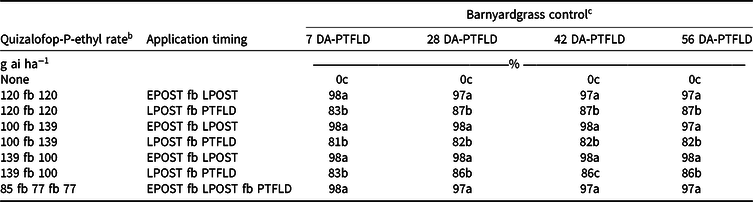
Pooled across florpyrauxifen-benzyl rates, banyardgrass control 7, 28, 42, and 56 DA-PTFLD was similar and at least 97% for all quizalofop-P-ethyl treatments that included EPOST fb LPOST timings (Table 2). Across the same evaluations, control from all quizalofop-P-ethyl treatments EPOST fb LPOST or EPOST fb LPOST fb PTFLD was at least 10 percentage points greater than treatments with LPOST fb PTFLD timings, which demonstrates the importance of treating barnyardgrass early to achieve the greatest control. Quizalofop-P-ethyl rate did not influence control across all evaluations for treatments applied at the same application timings. Ottis et al. (Reference Ottis, Chandler and McCauley2003) reported that sequential applications of imazethapyr in IR rice controlled barnyardgrass at least 96% regardless of PPI, PRE, or EPOST rate.
Influence of quizalofop-P-ethyl treatment on barnyardgrass control 7, 28, 42, and 56 DA-PTFLD at Stoneville, MS, in 2017 and 2018. a

a Data were pooled across two florpyrauxifen-benzyl rates and two experiments.
b Abbreviations: DA-PTFLD, days after final application; EPOST, rice in the 2- to 3-leaf growth stage; fb, followed by; LPOST, rice in the 4-leaf to 1-tiller growth stage; PTFLD, rice 10 d postflood.
c Means within a column fb the same letter are not different at P ≤ 0.05.
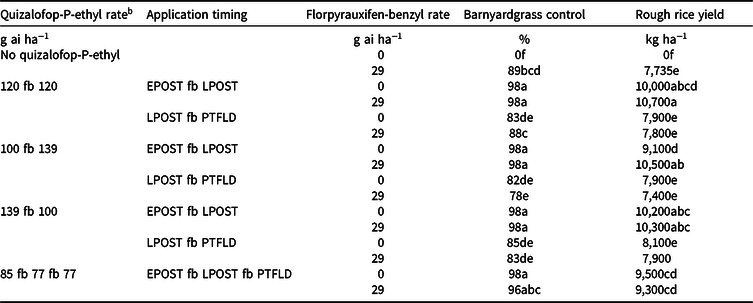
An interaction between quizalofop-P-ethyl treatment and florpyrauxifen-benzyl rate was significant for barnyardgrass control 14 DA-PTFLD and rough rice yield (Table 1). Barnyardgrass control 14 DA-PTFLD was similar and at least 96% for all quizalofop-P-ethyl treatments including EPOST fb LPOST timings alone and in mixture with florpyrauxifen-benzyl (Table 3). Barnyardgrass control with quizalofop-P-ethyl at 120 fb 120 g ha−1 LPOST fb PTFLD was greater in mixture with florpyrauxifen-benzyl than when the same quizalofop-P-ethyl treatment was applied with no florpyrauxifen-benzyl, although the difference was small (5%). Similar to barnyardgrass control at other evaluations, quizalofop-P-ethyl rate did not influence barnyardgrass control 14 DA-PTFLD for treatments applied at the same application timings. Even though barnyardgrass control was reduced by delaying the first application until LPOST, compared with initial applications at EPOST, the presence of florpyrauxifen-benzyl in LPOST treatments did not affect control when quizalofop-P-ethyl rates were 100 fb 139 g ha−1 or 139 fb 100 g ha−1.
Influence of quizalofop-P-ethyl treatment and florpyrauxifen-benzyl rate on barnyardgrass control 14 d after final application and rough rice yield in a study evaluating sequential treatments of quizalofop-P-ethyl with florpyrauxifen-benzyl included in applications before flooding at Stoneville, MS, in 2017 and 2018. a

a Data were pooled over two experiments.
b Abbreviations: EPOST, rice in the 2- to 3-leaf growth stage; fb, followed by; LPOST, rice in the 4-leaf to 1-tiller growth stage; PTFLD, rice 10 d postflood.
c Means within a column fb the same letter are not different at P ≤ 0.05.
The addition of florpyrauxifen-benzyl to quizalofop treatments only influenced rough rice yield when quizalofop-P-ethyl was applied at 100 g ha−1 fb 139 g ha−1 EPOST fb LPOST (Table 3). However, no explanation for this difference was evident. When florpyrauxifen-benzyl was included, rough rice yield was greater with quizalofop-P-ethyl EPOST fb LPOST, compared with when florpyrauxifen-benzyl was not included. In treatments without florpyrauxifen-benzyl, this was only true with quizalofop-P-ethyl applied at 139 g ha−1 fb 100 g ha−1 and 120 g ha−1 fb 120 g ha−1. Rough rice yield after quizalofop-P-ethyl application at 85 g ha−1 fb 77 fb 77 g ha−1 EPOST fb LPOST fb PTFLD was not influenced by the addition of florpyrauxifen-benzyl.
In IR rice, imazethapyr applied at rice emergence followed by a second application 2 wk later resulted in 90% barnyardgrass control. However, delaying initial applications of imazethapyr to 1 to 4 wk after emergence reduced barnyardgrass control to less than 60% (Carlson et al. Reference Carlson, Webster, Salassi, Bond, Hensley and Blouin2012). Lancaster et al. (Reference Lancaster, Norsworthy and Scott2018a) reported that optimum control with quizalofop-P-ethyl was achieved with sequential applications whereby the first treatment targeted rice before the 3-leaf growth stage, using the full seasonal rate of 240 g ha−1. For the grass weeds (barnyardgrass and volunteer rice) evaluated in this study, sequential applications of quizalofop-P-ethyl at 120 g ha−1 fb 120 g ha−1 EPOST fb LPOST, 100 g ha−1 fb 139 g ha−1 EPOST fb LPOST, and 139 g ha−1 fb 100 g ha−1 EPOST fb LPOST performed best, providing at least 97% barnyardgrass control at each evaluation.
These results suggest that quizalofop-P-ethyl rate may not be as important as application timing in controlling grass weeds, particularly barnyardgrass. Carlson et al. (Reference Carlson, Webster, Salassi, Bond, Hensley and Blouin2012) reported that barnyardgrass control was not affected by imazethapyr rate averaged across application timings. Similar results were reported by Lancaster et al. (Reference Lancaster, Norsworthy and Scott2018a): sequential applications of quizalofop-P-ethyl at 120 g ha−1 fb 120 g ha−1 controlled barnyardgrass 98% but was not different from quizalofop-P-ethyl at 80 g ha−1 fb 80 g ha−1, which provided 94% control. Quizalofop-P-ethyl applications applied EPOST in that study resulted in 98% control of barnyardgrass; however, control declined to 87% when applications were delayed until LPOST (Lancaster et al. Reference Lancaster, Norsworthy and Scott2018a).
In the present study, we evaluated volunteer rice and barnyardgrass control with different quizalofop-P-ethyl treatments applied with and without florpyrauxifen-benzyl included in applications before flooding. Sequential applications of quizalofop-P-ethyl at 120 g ha−1 fb 120 g ha−1 EPOST fb LPOST, 100 g ha−1 fb 139 g ha−1 EPOST fb LPOST, or 139 g ha−1 fb 100 g ha−1 EPOST fb LPOST can be used for control of barnyardgrass and volunteer rice. Similar results were reported by Pellerin et al. (Reference Pellerin, Webster, Zhang and Blouin2004). In their study, 92% barnyardgrass control was achieved with sequential treatments of imazethapyr at 87 g ai ha−1 fb 53 g ai ha−1 PRE fb POST with no further enhancement of control with the addition of a broadleaf herbicide POST. The addition of florpyrauxifen-benzyl is not needed to achieve this level of control; however, given that quizalofop-P-ethyl has no activity on broadleaf and sedge weed species, the addition of florpyrauxifen-benzyl could provide broad-spectrum weed control in ACCase-resistant rice and add an additional site of action for barnyardgrass control.
Because data suggested that quizalofop-P-ethyl application timing was more important than rate for barnyardgrass control, additional research should be done to evaluate barnyardgrass control using lower rates of quizalofop-P-ethyl than those suggested on the herbicide label. Although multiple applications of quizalofop-P-ethyl are currently effective in controlling grass weed species (Lancaster et al. Reference Lancaster, Norsworthy and Scott2018a), long-term sequential applications of quizalofop-P-ethyl can lead to herbicide resistance. Therefore, diversifying herbicide modes of action is the best approach when considering herbicide resistance management.
Acknowledgments
This publication is a contribution of the Mississippi Agricultural and Forestry Experiment Station. Material is based on work supported by the National Institute of Food and Agriculture, U.S. Department of Agriculture, Hatch project under accession number 199080. The authors thank the Mississippi Rice Promotion Board for partially funding this research. We thank personnel at the Mississippi State University Delta Research and Extension Center for their assistance. No conflicts of interest have been declared.