Introduction
Head and neck cancers (HNCs) are a significant cause of the global burden of cancer with nearly 900,000 new cases and 500,000 deaths annually with the highest incidence recorded in South Asia. Reference Fitzmaurice and Abate1–Reference Aupérin3 In India, HNCs are among the most common cancers and contribute to 30% of the entire cancer burden. Reference Sharma, Baishya, Kataki, Kalita, Das and Rahman2–Reference Mudur5 More than 70% of these patients in India present in an advanced stage, many of whom are deemed incurable either due to unresectable locally advanced or metastatic disease. These incurable patients are either not suitable candidates for aggressive concurrent chemoradiotherapy, accelerated fractionation radiotherapy (RT) or even conventional definitive RT, because of poor performance status, medical co-morbidities, expected poor tolerance to or compliance with treatment, presence of unresectable disease or distant metastases, or a combination of these factors. The 5-year survival of such patients even with an aggressive multimodal approach has been reported to be <20% in India. The median survival in such cases ranges between 3 and 5 months for patients on supportive care, 10 and 15 months for those receiving systemic therapy and 3 and 17 months for those receiving palliative radiotherapy (PRT). Reference Mathur, Sathishkumar and Chaturvedi6–Reference Grewal, Jones and Lin8
Deciding on optimal treatment for these compromised patients poses a challenge to all oncologists. While RT is often used with palliative intent for symptom reduction, there are no consensus guidelines or level 1 evidence to direct treatment decisions on dosing schedules. Several retrospective studies and prospective single-arm trials have evaluated various regimens of PRT for compromised patients with HNC, including several studies evaluating split-course regimens. Reference Agarwal, Nemade and Murthy9–Reference Corry, Peters and Costa11 However, there is significant variability in opinions on the best therapeutic option for these patients with no universal consensus. This study examines one such split-course hypofractionated PRT (SPORT) regimen used for HNC patients, exploring its efficacy and tolerability in such clinical settings, and compares it to other regimens reported in the literature.
Material and Methods
The study included all patients with HNC treated with a SPORT regimen between 2015 and 2019 at two tertiary-level cancer hospitals in India. A total of 100 HNC patients were treated with this regimen during the study period, and their treatment and follow-up records were collected and analysed. Data for the first 50 patients were collected retrospectively, while for the next 50 patients it was collected prospectively. The inclusion criteria were pathologically proven malignancies of any sub-site of HNC who were treated with the SPORT regimen. All patients were discussed in a multimodality tumour board before being selected for PRT. The indications for selection of palliative intent of treatment were either due to surgically unresectable or metastatic disease, poor performance status, poor general conditions, presence of multiple co-morbidities or a combination of these factors. Patients with prior radiation to the head and neck region and patients who had received chemotherapy in the previous 12 weeks were also excluded from the study.
All the patients were treated on Theratron Elite 100 or 780E Cobalt-60 teletherapy units. Treatment planning was done using 2D X-ray simulators, and the gross tumour volume (including the primary tumour and involved nodes) with a 2 cm margin was irradiated. Bilateral opposing fields covering both the primary and nodal regions were used in all the cases. Wedges were used as appropriate. In the first phase of treatment, all patients were treated with a RT dose of 30 Gy in 10 fractions of 300 cGy each, delivered once a day over 2 weeks. After completion of the first phase, the patients were given a break of 4 weeks after which they were treated with the second phase of PRT where they received a dose of 20 Gy in 5 fractions over 5 days. During the second phase of RT, the spinal cord was excluded from the field. Shielding with lead blocks was used to protect other critical organs at risk like eyes, midbrain and temporal lobes. All patients were monitored by the treating radiation oncologists on a weekly basis for any treatment-related toxicities.
Four weeks after completion of the second phase, patients were assessed for symptom relief and tumour response. Any reduction or relief from symptoms was recorded as the patients’ subjective graded response. The patients’ responses were in the form of answers to a single question asked by the treating doctors to describe their relief from symptoms on a four-point scale as none (0%), poor (<50%), partial but persisting (>50% but persisting) and complete (100%). The scale is used widely in our practice and is easy for patients of the Indian subcontinent to understand and to use to express their symptom relief. The tumour response to RT was assessed by clinical evaluation based on inspection and palpation as well as endoscopy when required and was reported according to the World Health Organization criteria. Reference Corry, Peters and Costa11 It was classified as complete response or CR (100% regression of tumour), partial response or PR (>50% regression), stable disease or SD (<50% regression) and progressive disease or PD (>25% increase in size of tumour or appearance of new lesions). The RTOG toxicity grading scheme was used for grading dermal and mucosal toxicities. Reference Cox, Stetz and Pajak12 Follow-up records were obtained to assess overall survival (OS) at 12 months of study patients.
Patient demographics, tumour and treatment parameters, and treatment toxicity were presented using descriptive statistics. For statistical analysis, the study variables used were age groups (<50, 50–59, 60–69, 70 or more years), sex, presence of co-morbidity (diabetes mellitus, hypertension or coronary heart disease), performance status as per ECOG score (Eastern Cooperative Oncology Group), stage (American Joint Committee on Cancer staging system 7th edition, 2010) and site (oral cavity, oropharynx, hypopharynx, larynx, nasopharynx and others). Outcome measures studied were classified into tumour response (CR or PR) or lack of it (SD or PD), and symptom relief (complete or partial) or lack of it (poor or none). Pearson’s chi-square tests were used to study any association between various study parameters and treatment outcomes. All tests were two-tailed with a p-value <0·05 considered as statistically significant. The Kaplan–Meier method was used to estimate mean OS, where OS was measured from commencement of RT until the date of death from any cause. The survival difference between patients who showed significant tumour response (CR or PR) and patients who did not (SD or PD) was tested through the log-rank test. All statistical analysis was carried out using Statistical Package for social sciences (SPSS) version 21 (International Business Machines Corporation (IBM), Armonk, New York, USA)).
Results
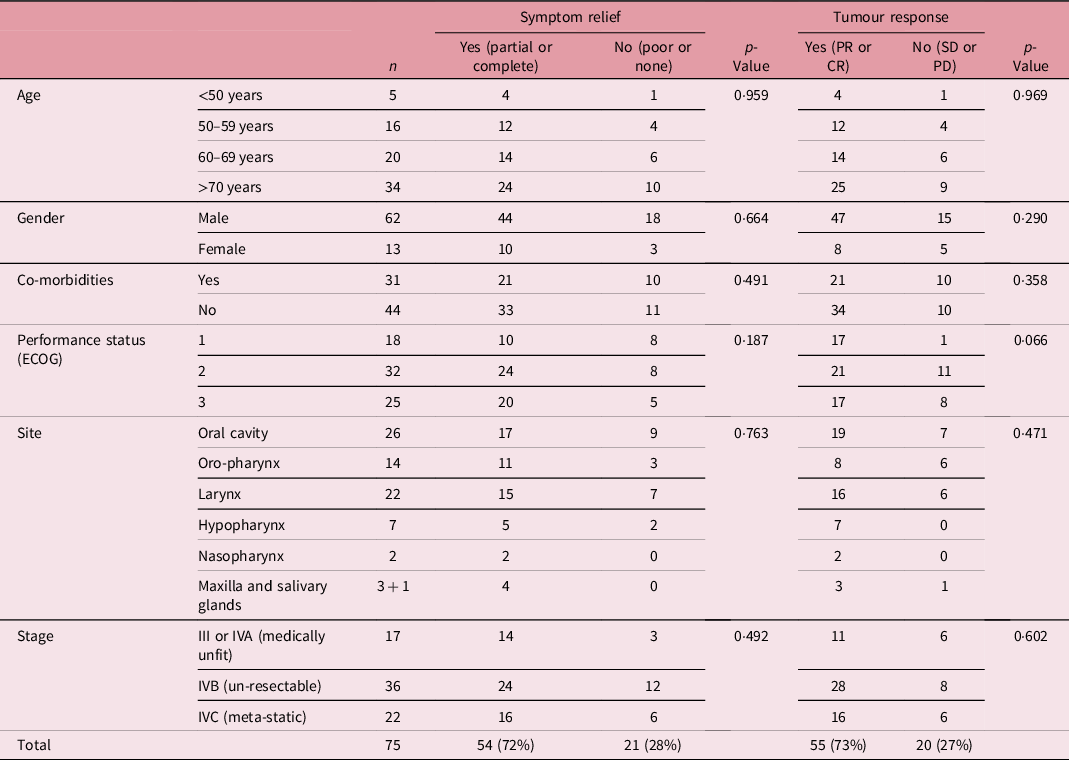
A total of 100 patients were treated with the PRT regimen during the study period. Fourteen were unable to complete the treatment schedule, and 11 were lost to follow-up after completion of therapy. Only 75 patients met the study criteria and were included in the study. Males made up the majority of the patients with a ratio of 4·8:1 compared to females. Patients’ ages ranged from 37 to 92 years with the mean age being 67. Only five patients were below the age of 50 years while a significant proportion (n = 34, 45%) were above the age of 70. Table 1 shows the distribution of various study parameters cross-tabulated with the recorded symptomatic relief and tumour response.
Distribution of study variables cross-tabulated against tumour response rates and symptom relief rates

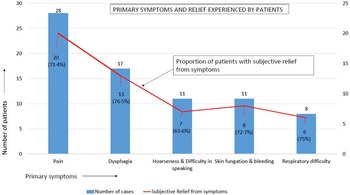
Pain (n = 28, 37%) was the commonest primary distressing symptom for which palliation was offered followed by dysphagia (n = 17, 23%). Fifty-four of 75 (72%) patients had partial or complete relief from their distressing symptoms. Twenty of 28 (71%) patients suffering from pain and 77% (13 of 17) patients suffering from dysphagia experienced relief after PRT (Figure 1). The chi-square test revealed no statistically significant association between the occurrence of symptom relief (partial or complete) and the study variables which included age group (p = 0·959), gender (p = 0·664), presence of co-morbidity (p = 0·491), performance status of patient (p = 0·187), site (p = 0·763) or stage of disease (p = 0·492) (see Table 1).
Graphical representation of the frequencies of primary distressing symptoms of the study population. The figure also shows the number and percentage of patients who experienced symptom relief (complete or partial) after PRT.

A significant reduction in tumour size in the form of complete or PR was seen in 55 (73%) patients. Twelve had a CR (16%) while 43 had a PR (57%). No statistically significant association was found between age group (p = 0·969), gender (p = 0·290), presence of co-morbidity (p = 0·358), performance status of patient (p = 0·066), site (p = 0·471) or stage of disease (p = 0·602) and the occurrence of tumour response (complete or partial) (see Table 1).
At 12 months of follow-up, 32 patients were dead, 17 were lost to follow-up while 26 (35%) were still alive. Forty-three patients were alive at their last follow-up including the 17 who did not complete 12 months of follow-up giving an OS at 12 months of 57%.
There was no statistically significant association of age group (p = 0·723), gender (p = 0·602), presence of co-morbidity (p = 0·383), performance status (p = 0·957), site (p = 0·541) or stage (p = 0·655) of disease with survival at 12 months. The occurrence of symptom relief was also not found to be statistically associated with survival at 12 months (p = 0·398); however, a statistically significant association was seen with the occurrence of significant tumour response (complete or partial) and survival at 12 months (p = 0·017).
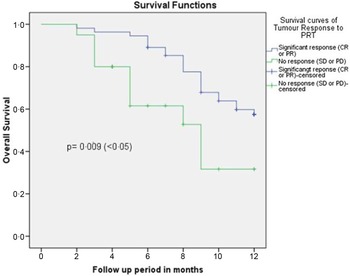
On survival analysis using Kaplan–Meier plots, the mean OS for the study group was 9·72 months. For patients who had a significant tumour response, the mean OS at 12 months was 10·29 months (9·59–10·99, 95% CI) while it was only 7·87 months (6·17–9·59, 95% CI) for those who did not. The difference is clearly seen in the survival plots (Figure 2) and was statistically significant as measured by the log-rank test (p = 0·009).
Kaplan–Meier plots comparing OS at 12 months between patients who had a significant tumour response (CR or PR) and those who did not (SD or PD). A statistically significant difference in survival was seen between the two groups (p = 0·009) when compared using the log-rank test (Mantel–Cox).

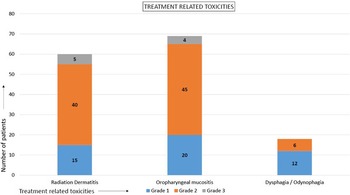
Radiation-induced skin reactions were seen in 60 (80%) patients, though only 5 (8%) of these were grade 3. Sixty-nine (92%) patients developed oropharyngeal mucositis during treatment of which only four (6%) were grade 3. Grades 1 and 2 treatment-induced dysphagia and odynophagia also affected 18 (24%) patients who did not have it before PRT. No grade 4 toxicity was seen in any of the patients in our study (Figure 3).
The treatment-related toxicities and their grades recorded in the study population.

Discussion
In India, a significant proportion of HNC cases present with locally advanced or metastatic disease and do not merit receiving radical therapy. Reference Mathur, Sathishkumar and Chaturvedi6 Although these patients are not suited for receiving prolonged and definitive therapy, they often require PRT as uncontrolled tumour growth in the head and neck region can negatively affect an individual’s nutrition, respiration and social interaction. In most RT centres, palliative therapy comprises between 40 and 50% of the workload. Reference Lutz, Chow, Hartsell and Konski13
HNCs can invade the aerodigestive tract giving rise to symptoms like pain, dysphagia, change in voice, bleeding, etc. The basic goal of treatment in such cases becomes palliation of symptoms by control of the local disease. The principles of effective palliation entail the use of therapeutic modalities that relieve a patient’s symptoms with minimal side effects and with minimal time spent in the hospital, to facilitate both the patients’ and their caregivers’ early return to their residence.
Short-course hypofractionated RT has been extensively and effectively used for palliation of HNCs over the years by institutions all over the world. The radiobiological principle that supports PRT is as follows. By using a large dose per fraction, a moderately high biologically effective dose (BED) can be built up within the tumour in a few treatment fractions. This dose will be sufficient to cause enough tumour cell kill to reduce the bulk of the tumour mass and relive the symptoms being caused by it. The acute toxicity associated is usually minimal and easily manageable. Reference Velarasan and Ramasundaram7–Reference Corry, Peters and Costa11,Reference Miller, Hoogstraten, Staquet and Winkler14 The risks of increased late toxicity due to larger doses per fraction and of increased chances of recurrence due to insufficient total dose can be neglected due to limited life expectancy in this patient group.
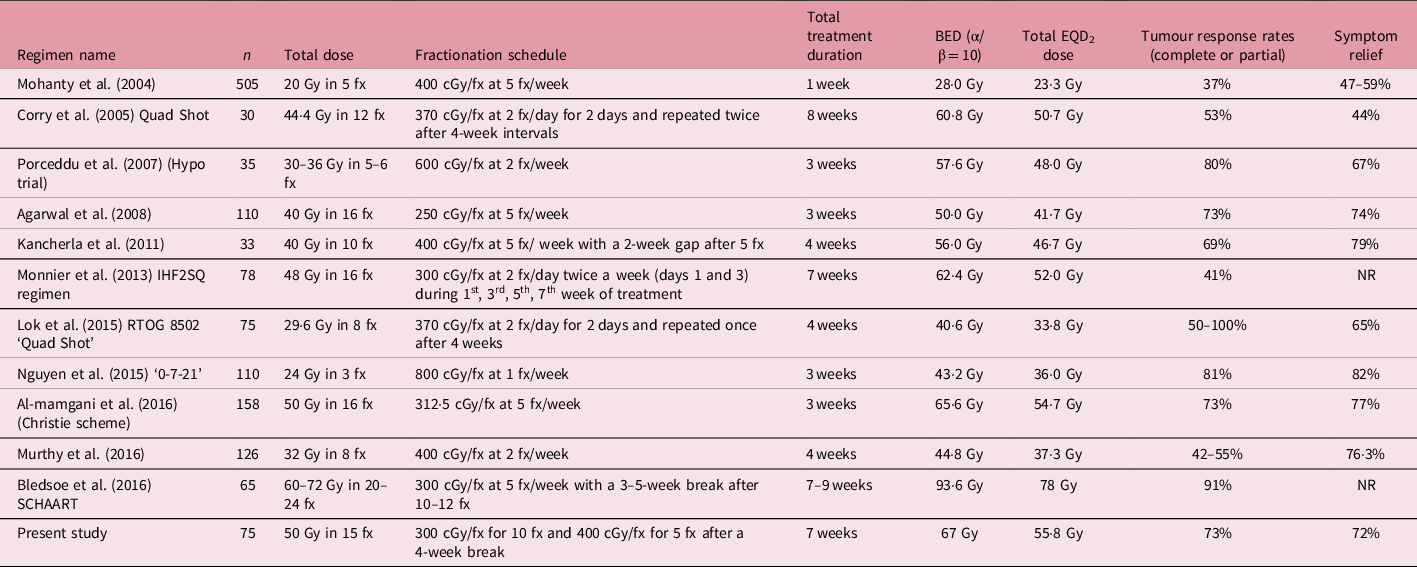
As far back as 1983, Weissberg et al. reported on a randomised controlled trial comparing a schedule of 70 Gy delivered in 35 fractions over 7 weeks versus another of 80 Gy in 12 fractions over 3 weeks in patients of stage III and IV HNCs. The study reported that both schedules had equal palliative benefit and toxicity. Reference Weissberg, Pillsbury, Sasaki, Son and Fischer15 In India, a large study of more than 500 HNC patients, conducted at AIIMS, New Delhi, showed that even a dose of 20 Gy delivered in 5 fractions over 1 week achieved a tumour response rate of 37% and relief from symptoms in 47–59% of patients. Reference Mohanti, Umapathy, Bahadur, Thakar and Pathy16 Over the last few decades, a myriad variety of dose fractionation schemes have been tried and reported in the literature, with tumour response rates ranging from 53% to 83%. Reference Velarasan and Ramasundaram7–Reference Corry, Peters and Costa11,Reference Kancherla, Oksuz and Prestwich17–Reference Stevens, Huang and Fung29 Table 2 compares some of these PRT schedules with the present study’s results. With a tumour response rate of 73% and symptomatic relief in 72% cases, the results are comparable to those that have been reported in previous trials.
Chart showing relative radiobiological doses, treatment durations and results of various PRT regimens in HNCs

However, the optimal regimen of hypofractionated RT for palliation of HNCs is yet to be agreed upon, and there are no available guidelines for preferring one regimen over the other. This is primarily because of the heterogeneity of clinical characteristics of patients and treatment environments in the various studies leading to a situation where it would be difficult to compare the regimens used in two different clinical trials. This is combined with the lack of any randomised controlled trials comparing two or more treatment schedules. Nevertheless, as is clear from Table 2, most of the regimens achieve gratifying results with symptom relief of patients ranging from 44% to 82% in various studies. The dose–outcome relationship, at least in terms of symptom relief, is not automatically evident, even if it exists. The situation is also confused by the concurrent use of painkillers and other medications that most trials allow. Symptom relief in our study, at 72%, is comparable to what has been described in the literature.
It has been previously suggested that the total dose delivered in a RT schedule may have a significant impact on the treatment response rates as well as OS rates. Reference Monnier, Touboul, Durdux, Lang, St Guily and Huguet28 The study also attempted to compare the BEDs of the major trials involving hypofractionated RT. The underlying hypothesis was that a higher BED may achieve a greater tumour cell kill leading to a more durable response, thus delaying disease recurrence and potentially improving OS. This would imply that regimens with a higher BED should show a greater tumour response rate and should be preferred where clinically and logistically feasible. BED and EQD2 (Equivalent Dose at 2Gy per fraction) were calculated for all the studies using the formulas based on the linear-quadratic model and compared with the study regimen (Table 2). No corrections were used for the time duration over which the dose was delivered.
Though no statistical test was carried out, a visual comparison of BEDs of various regimens and the tumour response rates reported suggests that a simple BED calculation may not help choose one PRT regimen over another. The regimen used in the present study had the second-highest BED and EQD2, but higher response rates and symptom relief rates have been reported by at least four studies with lower values of these parameters.
The mean OS calculated in this study population is 9·72 months, which was as expected for the patient demographic as per available literature. Reference Sharma, Baishya, Kataki, Kalita, Das and Rahman2–Reference Chen, Vaughan, Narayan and Vijayakumar10 It was interesting to see that among patients with significant tumour response (CR or PR), the mean OS was higher than those with no tumour response (SD or PD). This supports the theory that a higher tumour cell kill may potentially improve OS. It may be prudent to further research in this direction.
The skin, mucosal toxicities and treatment-induced dysphagia reported were similar to those described in other studies from India and were easily managed. Reference Grewal, Jones and Lin8,Reference Agarwal, Nemade and Murthy9,Reference Paliwal, Kumar-Patidar, Walke, Hirapara, Jain and Raj-Bardia26,Reference Shishodia, Divakar and Al Kheraif27 Higher number of grade 3 toxicities have been described when chemotherapy has been delivered concurrently with hypofractionated RT. Reference Minatel, Gigante and Franchin30
The question of preference for one PRT regimen over another remains unanswered. Shorter regimens may be preferable when logistic and economic issues of daily travel to the RT centre and overnight stay in a new city for treatment are considered. This is especially relevant in countries like ours where the majority of patients receiving RT are outstation residents. One- or 2-day schedules are also the better choices for patients with extremely poor performance status or general condition. On the other hand, longer schedules with higher total BED may potentially be superior in giving longer recurrence-free survival and OS in patients who have a life expectancy greater than a year. Thus, the decision should be taken by the treating radiation oncologist after considering all clinical, radiobiological and logistic factors. The available RT technology should also be considered in the selection of the treatment schedule.
In a recent French study by Benhmida et al., intensity-modulated radiotherapy (IMRT) was used to deliver hypofractionated PRT in two phases of 30 Gy in 10 fractions each separated by 2–4 weeks to a study population similar to ours. Reference Benhmida, Sun and Gherga31 Thus, an overall higher dose compared to our schedule could be delivered by using the conformal IMRT technique. The OS at 12 and 24 months was 60% and 41%, and a median OS of 19·3 months was reported. Acute skin toxicity (grades 1 and 2) was seen in 31% of patients, acute mucosal toxicity (grades 1, 2 and 3) in 35% of patients, while acute dysphagia (grades 1, 2 and 3) was seen in 36% of patients. Only three patients showed grade 3 reactions. Though the OS at 12 months of the French study (60%) was similar to what was seen in the present study (57%) which used 2D RT delivery, the incidence of acute toxicity is evidently lower. Use of modern conformal RT techniques, when available, can certainly reduce treatment toxicities and improve quality of life of patients undergoing PRT. Conformal techniques may also allow use of even shorter and more hypofractionated schedules which can deliver a substantially high dose of radiation to a relatively small target. This may also contribute to greater treatment compliance with higher radiation doses delivered and improvement in survival rates.
Finally, the management of incurable HNCs patients should always be multimodality. While PRT has a vital role, the importance of nutritional support, airway management, pain and infection control, psychological counselling and social support should not be neglected. Similarly, the use of chemotherapy, immunotherapy or targeted therapy where indicated and feasible is acceptable in management of such patients.
The limitations of this and similar trials reported in literature are that they are single-armed studies with a relatively short follow-up period, which preclude any analysis or comparison among each other for long-term outcomes and toxicities.
Conclusion
Short-course hypofractionated RT has the potential to improve the quality of life of incurable HNC patients by providing symptom relief and tumour size reduction. The authors conclude that the SPORT regimen was well-tolerated and achieved adequate palliation with local control in the study patients with a potential to improve patient survival. The efficacy of the palliative regimen was evident by the high rates of relief in symptoms of dysphagia, pain and reduction in tumour mass without any significant toxicity. No significant clinical benefit of one PRT regimen over another is discernible. The selection of a PRT regimen for a case of incurable HNC should be based not only on clinical and radiobiological factors but on logistic and socio-economic variables as well. Future and current research directions could be in the use of conformal techniques for even shorter and more hypofractionated PRT schedules and in the use of targeted systemic agents along with PRT.