Introduction
Grape is one of the most economically important crops in Chile, with vineyards covering over 180,000 hectares in 2007, and about a third of production dedicated to table grapes (ODEPA, 2010). This crop is the principal fruit exported from Chile, accounting for about 42% of all fruit exports. Mealybugs (Hemiptera: Pseudococcidae) are the main phytosanitary problem confronting international sales of Chilean table grapes, because their presence in the produce requires quarantine restrictions in many markets (SAG, 2009–2010). For example, during the 2008–2009 season, mealybugs were responsible for 71.5% of all table grape rejections during inspections before export (SAG, 2009–2010). In addition, mealybugs may damage the vines directly and indirectly. Large populations may lower the vigor of the plant by feeding on phloem and may affect fruit quality by depositing honeydew on the fruit, on which sooty mold subsequently develops (Artigas, Reference Artigas1994; Geiger & Daane, Reference Geiger and Daane2001; Bentley et al., Reference Bentley, Varela, Zalom, Smith, Purcell, Phillips, Haviland, Daane and Battany2008; Daane et al., Reference Daane, Cooper, Triapitsyn, Andrews and Ripa2008a). Mealybugs also can cause long-term damage by transmitting viruses (Golino et al., Reference Golino, Sim, Rill and Rowhani1999; Millar et al., Reference Millar, Daane, McElfresh, Moreira, Malakar-Kuenen, Guillen and Bentley2002; Douglas & Krüger, Reference Douglas and Krüger2008). The principal, recurrent problem in the management of mealybugs is the cryptic ecology of these species. They are small, feed in concealed areas and can be transported on plant material, workers and machinery, making them particularly successful invaders (Miller et al., Reference Miller, Miller, Hodges and Davidson2005). Mealybug biology, damage, current control techniques and the main pest species around the world have recently been reviewed (Daane et al., Reference Daane, Almeida, Bell, Botton, Fallahzadeh, Mani, Miano, Sforza, Walton, Zaviezo, Bostanian, Isaacs and Vincentin press).
Mealybugs constitute a very diverse group, with 2291 species belonging to 274 genera described worldwide (Ben-Dov et al., Reference Ben-Dov, Miller and Gibson2010). The species are hard to tell apart because they are very similar morphologically and their taxonomic identification is based on keys dealing with various cuticular structures on adult females, viewed on slide-mounted specimens under a microscope. Furthermore, in some species, there may exist phenotypic variations between individuals, depending on the climatic conditions or the substrate on which they are growing. This can make identification impossible without considerable expertise (Cox, Reference Cox1983; Gullan & Kosztarab, Reference Gullan and Kosztarab1997; Charles et al., Reference Charles, Froud and Henderson2000; Millar, Reference Millar2002; Zaviezo et al., Reference Zaviezo, Cadena, Flores and Bergmann2010). These problems have led to the development and use of molecular tools for the correct identification of Pseudococcidae species (Beuning et al., Reference Beuning, Murphy, Wu, Batchelor and Morris1999; Downie & Gullan, Reference Downie and Gullan2004; Rung et al., Reference Rung, Scheffer, Evans and Miller2007; Demontis et al., Reference Demontis, Ortu, Cocco, Lentini and Migheli2007; Cavalieri et al., Reference Cavalieri, Mazzeo, Garzia, Buonocore and Russo2008; Saccaggi et al., Reference Saccaggi, Krüger and Pietersen2008; Hardy et al., Reference Hardy, Gullan and Hodgson2008; Malausa et al., Reference Malausa, Fenis, Warot, Germain, Ris, Prado, Botton, Vanlerberghe-Masutti, Sforza, Cruaud, Couloux and Kreiter2011; Correa et al., Reference Correa, Aguirre, Germain, Hinrichsen, Zaviezo, Malausa and Prado2011; Park et al., Reference Park, Suh, Hebert, Oh and Hong2011).
Despite the difficulties involved in differentiating between mealybug species, correct identification is essential when dealing with species considered as pests. It is important to know which species are present in the field to optimize the timing of insecticide applications, because different species living on the same host may have different biological characteristics (Geiger & Daane, Reference Geiger and Daane2001; Varela, Reference Varela2006). Furthermore, the natural enemies of mealybugs tend to specialize on particular species; identification of the mealybugs present is, therefore, essential to the success of biological control programs (Chong & Oetting, Reference Chong and Oetting2007; Daane et al., Reference Daane, Cooper, Triapitsyn, Walton, Yokota, Haviland, Bentley, Godfrey and Wunderlich2008b). In international trade, different markets identify different mealybug species as quarantine pests (Beuning et al., Reference Beuning, Murphy, Wu, Batchelor and Morris1999; González & Volosky, Reference González and Volosky2004; SAG, 2009–2010).
The available data, based on morphological identification, suggest that Pseudococcus viburni (Signoret) is the most abundant and widely distributed species in Chilean vineyards (Zaviezo, Reference Zaviezo2002; González & Volosky, Reference González and Volosky2004; Sazo et al., Reference Sazo, Araya and de la Cerda2008; Ripa & Luppichini, Reference Ripa and Luppichini2010; Daane et al., Reference Daane, Almeida, Bell, Botton, Fallahzadeh, Mani, Miano, Sforza, Walton, Zaviezo, Bostanian, Isaacs and Vincentin press). Other species also have been reported sporadically: Pseudococcus longispinus (Targioni & Tozzetti) and other new Pseudococcus species (Correa et al., Reference Correa, Aguirre, Germain, Hinrichsen, Zaviezo, Malausa and Prado2011; González, Reference González2011). In addition, it has been suggested that Planococcus ficus Signoret may be present in Chilean vineyards, but this remains a matter of debate (González, Reference González2011).
Here, we took profit from the recent development of molecular markers for mealybugs to characterize the taxa infesting Chilean vineyards, by coupling DNA and morphological analyses. We collected mealybugs from 26 vineyards in the main grape-producing areas of central Chile, DNA sequenced them at two loci (Cytochrome oxydase I and ITS2) and examined morphologically. As a secondary objective, we used the produced DNA data to test the hypothesis that P. viburni is native to South America (Daane et al., Reference Daane, Cooper, Triapitsyn, Andrews and Ripa2008a; Charles, Reference Charles2010). Indeed, this hypothesis has implications for pest management (e.g. choice of biocontrol agents) and the level of genetic diversity observed among individual DNA sequences is an indication of the native regions of taxa.
Materials and methods
Sample collection
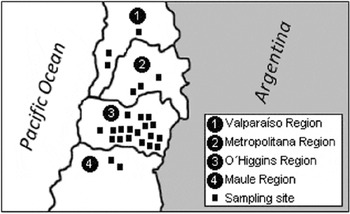
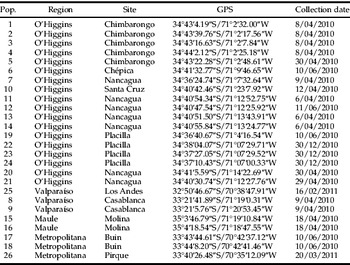
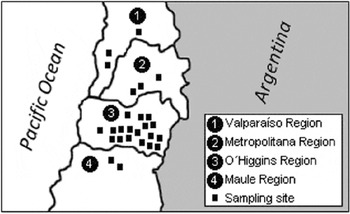
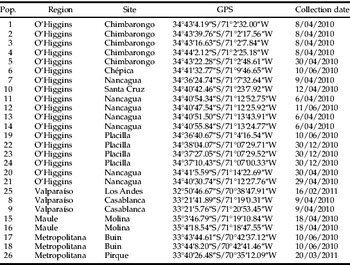
We sampled mealybugs from 26 Chilean vineyards during the 2009–2010 and 2010–2011 seasons (table 1 and fig. 1). In each vineyard, we examined a large number of grapevine individuals, checking all parts of the plants, and collecting mealybugs at different stages of development, to ensure that we did not miss species with different phenological features and habitat preferences. Adult females and nymphs were stored at –20°C in 95% ethanol until laboratory analysis.
Location of sampling sites in Chile.
Mealybug populations sampled.
DNA extraction and PCR amplification
Genomic DNA was extracted with the DNeasy Tissue Kit (QIAGEN, Hilden, Germany), with the non-destructive protocol described by Malausa et al. (Reference Malausa, Fenis, Warot, Germain, Ris, Prado, Botton, Vanlerberghe-Masutti, Sforza, Cruaud, Couloux and Kreiter2011), to ensure that the specimen remained available for morphological examination. Polymerase chain reaction (PCR) was performed with the reagents and concentrations used by Malausa et al. (Reference Malausa, Fenis, Warot, Germain, Ris, Prado, Botton, Vanlerberghe-Masutti, Sforza, Cruaud, Couloux and Kreiter2011). The primers used for COI were COI-J-2183-F CAACATTTATTTTGATTTTTTGG and COI-N-2568-R GCWACWACRTAATAKGTATCATG from Gullan et al. (Reference Gullan, Downie and Steffan2003). For ITS2, the primers were: ITS2-M-F CTCGTGACCAAAGAGTCCTG and ITS2-M-R TGCTTAAGTTCAGCGGGTAG, as described by Malausa et al. (Reference Malausa, Fenis, Warot, Germain, Ris, Prado, Botton, Vanlerberghe-Masutti, Sforza, Cruaud, Couloux and Kreiter2011).
PCR conditions were as follows: initial denaturation for 30 s at 98°C, followed by 35 cycles of denaturation for 10 s at 98°C, annealing for 15 s at temperatures of 48–60°C, elongation at 72°C for 15 s, and a final extension period for 5 min at 72°C. The quality of the PCR products was checked by electrophoresis in 2% agarose gels.
PCR products were sent to Genoscreen (Lille, France) for bidirectional sequencing. Consensus sequences were generated and checked with Seqscape v2.7 (Applied Biosystems, Foster City, CA, USA). Alignments were edited with Bioedit 7.01 (Hall, Reference Hall1999). Sequences differing from the consensus sequences were considered to belong to a different haplotype. A median-joining haplotype network was built with the software NETWORK (Bandelt et al., Reference Bandelt, Forster and Röhl1999) using our COI sequences and those available in GenBank for P. viburni. The sequences were from Europe (GU134686, found at >20 sites all over France and JF714166 found at one site in Spain), Brazil (GU134685, four sites from the region of Rio Grande do Sul), South Africa (FJ786966, number and location of sites unknown), USA (EU267207 and EU267206, number and location of sites unknown) and Iran (JF905460, number and location of sites unknown). The alignment used can be consulted in fig. S1 in the supplementary material.
Morphological examination
For each observed multilocus genotype (i.e. each combination of haplotypes for the two genetic markers), we morphologically examined at least one specimen (and up to 31). Specimens were prepared for slide-mounting as described by Malausa et al. (Reference Malausa, Fenis, Warot, Germain, Ris, Prado, Botton, Vanlerberghe-Masutti, Sforza, Cruaud, Couloux and Kreiter2011): (i) after making a small incision, they were heated in 10% KOH for 20 min; (ii) they remaining body contents were expelled, tapering the body with a micro spatula; (iii) the specimens were stained by incubation for 1 h in a saturated solution of fuchsine in a 1:1:1 mixture of distilled water, lactic acid and glycerol; (iv) then, the specimens were washed in glacial acetic acid for 1 h to stabilize the staining; (v) finally, the specimens were transferred to lavender oil for at least 1 h, placed in a drop of Canada balsam on a slide and covered with a coverslip.
The slide was then labeled and observed immediately under a microscope. Identification was based on the taxonomic keys of Williams & Granara de Willink (Reference Williams and Granara de Willink1992), Gimpel & Miller (Reference Gimpel and Miller1996) and Williams (Reference Williams2004). The voucher specimens are deposited in the Laboratoire de la Santé des Végétaux, ANSES, Campus International de Baillarguet, Montferrier-sur-Lez, France.
Results
Molecular characterization
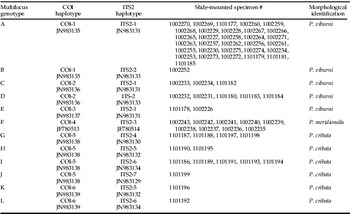
We obtained 164 individual sequences for each marker. Six haplotypes were identified for COI, and seven for ITS2, resulting in 12 multilocus genotypes (table 2). The sequences obtained in this work are available from GenBank under accession numbers JN983129-JN983139. Multilocus genotypes #A–E consisted of sequences similar or very similar to sequences already available for P. viburni (Malausa et al., Reference Malausa, Fenis, Warot, Germain, Ris, Prado, Botton, Vanlerberghe-Masutti, Sforza, Cruaud, Couloux and Kreiter2011; Beltrà et al., Reference Beltrà, Soto and Malausa2012). Multilocus genotype F consisted of COI and ITS2 sequences absolutely identical to those in the description of the species Pseudococcus meridionalis Prado: JF780513 for COI and JF780514 for ITS2 (Correa et al., Reference Correa, Aguirre, Germain, Hinrichsen, Zaviezo, Malausa and Prado2011). Multilocus genotypes #G–L did not correspond to any sequences deposited in international databases.
Multilocus genotypes for the various species found: P. viburni (COI: 1–3; ITS2: 1, 2), P. meridionalis (COI: 4; ITS2: 3) and P. cribata (COI: 5, 6; ITS2: 4–7), with the identification code of the slide-mounted specimens.
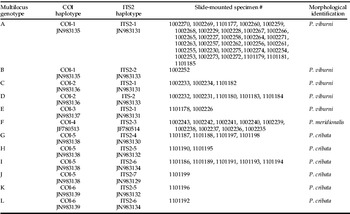
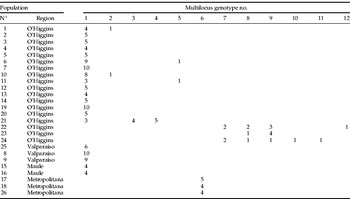
Considering that all the haplotypes were very similar to the published sequences assigned to P. viburni, we found that the most common and widely distributed were haplotype #1 for COI and haplotype #1 for ITS2 (multilocus genotype #A). Only multilocus genotype #A was found in the Valparaiso region, whereas four other multilocus genotypes in addition to multilocus genotype #A were observed in the O'Higgins region (table 3).
Geographic distribution and abundance of multilocus genotypes for the different species found: P. viburni (1–5), P. meridionalis (6) and P. cribata (7–12).
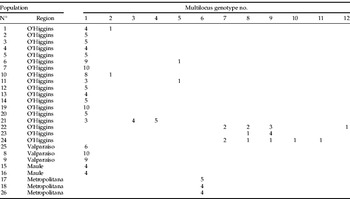
The multilocus genotype corresponding to the recently described species P. meridionalis was found only in the Metropolitana region, whereas multilocus genotypes #G–L, which could not be assigned to any species on the basis of molecular data, were found at three sampling sites in the O'Higgins region.
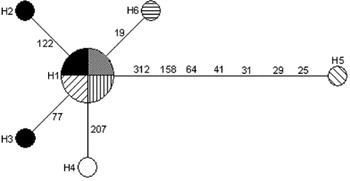
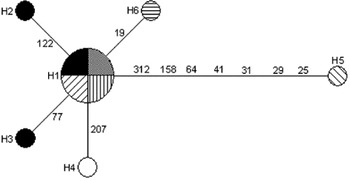
When we compared the Chilean COI haplotypes with other available haplotypes (fig. 2), the Chilean P. viburni haplotype #1 (H1) was also found in France, Spain and South Africa, whereas Chilean haplotypes #2 and #3 (H2 and H3) were present only in Chile. Several haplotypes absent from Chile were found in other countries: Brazil, U.S and Iran, (H4, H5 and H6, respectively, in fig. 2).
Median-Joining COI haplotype network for P. viburni. Numbers indicate the location of the mutation within the sequence. For more details of the alignment, refer to fig. S1 in the supplementary material ( , Spain;
 , Chile;
 , South Africa;
 , France;
 , Brazil;
 , California, USA;
 , Iran).
Morphological characterization
The molecular results were confirmed by the examination of slide-mounted specimens. Multilocus genotypes #A–E were assigned to Pseudococcus viburni. All the character states useful for the diagnosis of P. viburni (Gimpel & Miller, Reference Gimpel and Miller1996) were present in the specimens of this species: oral-rim tubular ducts (OR), usually absent in the submedial row from segment III–VII; with a medial row and a lateral row of OR on each side, 13 (10–18) OR on the dorsum of segments I–VIII; dorsal OR absent on the submargin between cerarii 15 and 16; 2 (1–3) discoid pores close to each eye; numerous translucent pores on hind tibia and femur; 10 (8–16) oral collar tubular ducts (OC) in clusters on the mesad of cerarius 12 and 1 (0–2) OC associated with cerarii 10 and 11.
Multilocus genotype #F corresponded to the morphological description of Pseudococcus meridionalis Prado. This species has several features in common with P. viburni: dorsal OR absent on the submargin between cerarii 15 and 16; 2 (1–3) discoid pores close to each eye; 9 (7–13) OC in clusters on the mesad of cerarius 12 and numerous translucent pores on hind tibia and femur. However, this species was characterized by three morphological characteristics not associated with any species of the ‘Pseudococcus maritimus complex’ (Gimpel & Miller, Reference Gimpel and Miller1996). The most obvious of these character states was the many OR on the abdomen, in transverse rows, with up to 9 OR per row, and 38 (34–43) OR on dorsum segments I–VIII. There were also 19 (13–23) OR on dorsal cephalo-thoracic segments, with a transverse row at the cerarius 12 level. Finally, there were 9 (6–13) OC clustered between cerarii 10 and 11.
The specimens displaying multilocus genotypes #G–L (which did not contain previously documented DNA sequences) were morphologically similar to Pseudococcus cribata González. These specimens had the following features: a dorsal OR between cerarii 15 and 16; presence of 1 to 2 OR close to the frontal cerarii and cerarii 8 and 10, which were not very marked or absent; a mean of 38 OR on the abdomen. On the venter, no discoid pores were found close to the eyes, and multilocular pores were present around the vulva.
The species most closely related to P. cribata, based on morphologically characterization, is Pseudococcus calceolariae (Maskell). Pseudococcus cribata differed from P. calceolariae by the slight or even absent cerarii 8 and 10; the presence of 1 to 2 dorsal OR close to cerarius 17; the higher density of trilocular pores on anal cerarii than in P. calceolariae and the presence of at least 10 OR between the anterior spiracle and cerarius 12.
Discussion
Pseudococcus viburni was the most common mealybug found in this survey of Chilean vineyards, consistent with previous reports based on morphological taxonomy (Zaviezo, Reference Zaviezo2002; González, Reference González2003a,b; Ripa & Luppichini, Reference Ripa and Luppichini2010). The second species found was P. meridionalis Prado (Correa et al., Reference Correa, Aguirre, Germain, Hinrichsen, Zaviezo, Malausa and Prado2011). This species had also been called Pseudococcus sp.1 (González, Reference González2003a) and recently described as Pseudococcus rubigena González (González, Reference González2011). Nevertheless, to our knowledge, Pseudococcus meridionalis is the valid name for this species. In our study, P. meridionalis was much less frequent than P. viburni, but nonetheless with high densities in a few vineyards of the Metropolitana region, confirming its status as a pest of grapes. The third species found would correspond morphologically to P. cribata (González, Reference González2011), and the DNA sequences obtained did not match any sequence already present in an international database or publication. However, this taxon, characterized by two haplotypes at COI and four at ITS2, was found at three sites in the O'Higgins region and may be, therefore, also considered a pest of grapes. On the other hand, P. longispinus and Pl. ficus were not found at the sites studied, although they have been mentioned as grape pests in Chile (González & Volosky, Reference González and Volosky2004). The rarity of Pl. ficus in Chilean vineyards remains surprising, given that most grape-producing regions of the world, including France, the United States, South Africa, Argentina and Uruguay (Daane et al., in press), are infested with this species. Indeed, the occurrence of Pl. ficus in Chile is a matter of debate (González, Reference González2011). Pseudococcus longispinus has previously been collected in grapes in Chile, where it is known to be commonly associated with grapes (González & Volosky, Reference González and Volosky2004; Ripa & Luppichini, Reference Ripa and Luppichini2010; González, Reference González2011). Therefore, the absence of P. longispinus from our two-year-long survey suggests that this species is not common on grapes in the regions sampled.
One remarkable result in this survey was the haplotype diversity and distribution for COI and ITS2 in P. viburni and P. cribata. Three COI haplotypes and two ITS2 haplotypes were found by us for P. viburni in Chile, and a different haplotype had been previously found in Brazil (Malausa et al., Reference Malausa, Fenis, Warot, Germain, Ris, Prado, Botton, Vanlerberghe-Masutti, Sforza, Cruaud, Couloux and Kreiter2011). This contrasts with the situation found for P. viburni in Europe, where, despite the large number of populations sampled and the diversity of hosts sampled, only one haplotype has been found (Malausa et al., Reference Malausa, Fenis, Warot, Germain, Ris, Prado, Botton, Vanlerberghe-Masutti, Sforza, Cruaud, Couloux and Kreiter2011; Beltrà et al., Reference Beltrà, Soto and Malausa2012). The European haplotype corresponds to the most common haplotype found in Chile. Also, one haplotype with high divergence from the Chilean ones has been found for P. viburni in California (Genbank accession EU267206), which may correspond to another strain or sibling species, or sequence ambiguities. These findings support the hypothesis of a neotropical origin of P. viburni (Daane et al., Reference Daane, Cooper, Triapitsyn, Andrews and Ripa2008a; Charles, Reference Charles2010) because the level of genetic diversity seems to be higher in this biogeographic region than elsewhere. However, a more thorough sampling should be carried out in other regions of the world in order to better support this hypothesis.
For P. cribata, which was collected only in a few close sites (populations 22, 23 and 24), the samples displayed considerable DNA variation (two COI haplotypes and four ITS2 haplotypes). This suggests that this species may also be neotropical in origin, or at least is not a recent invader, although this conclusion remains speculative. On the other hand, for P. meridionalis, only one haplotype was found at each marker. In previous similar studies (Malausa et al., Reference Malausa, Fenis, Warot, Germain, Ris, Prado, Botton, Vanlerberghe-Masutti, Sforza, Cruaud, Couloux and Kreiter2011; Abd-Rabou et al., Reference Abd-Rabou, Shalaby, Germain, Ris, Kreiter and Malausa2012; Beltrà et al., Reference Beltrà, Soto and Malausa2012), a clear difference was found between native species, which had several haplotypes for the COI and ITS2 loci, and recent invaders, which systematically presented a single haplotype for each marker. If this pattern holds true in Chile, then P. meridionalis is probably not native to this country, because no variation at either of the loci was found in this species, despite repeated sampling from different host plants (Correa et al., Reference Correa, Aguirre, Germain, Hinrichsen, Zaviezo, Malausa and Prado2011; this study). If confirmed, these patterns may be of use in the development of biological control strategies, because the native region of a species is generally considered the most suitable place to look for natural enemies (Moore, Reference Moore1988).
This survey identified P. viburni, P. meridionalis and P. cribata as pests of grape in Chile's main grape production area. The genetic variability of P. viburni and P. cribata, at the two molecular markers used, suggest that they are either native or long-established in this biogeographic region. In contrast, no genetic variability was found in P. meridionalis, suggesting that this species may have been introduced recently into Chile.
Acknowledgements
We thank all the grape producers who allowed us access to their properties and the INRA ‘BPI’ team for their warm welcome and for providing access to their laboratories. This work was funded by the following grants: a CONICYT Doctoral Fellowship #21110864, CONICYT #78092002, MECESUP UC0707, FONDECYT #1080464, EU FP7-IRSES #269196 ‘Iprabio’ and EU FP7-KBBE ‘PURE’.
Supplementary material
The online figure can be viewed at http://journals.cambridge.org/ber.