

Disruptive behaviours associated with attention-deficit/hyperactivity disorder (ADHD) are widely recognised as classroom problems across cultures (Barkley et al., Reference Barkley, Cook, Diamond, Zametkin, Thapar, Teeter and Pelham2002; Bauermeister, Canino, Polanczyk, & Rohde, Reference Bauermeister, Canino, Polanczyk and Rohde2010; Beaman, Wheldall, & Kemp, Reference Beaman, Wheldall and Kemp2007). Although ADHD intervention characteristics and child characteristics are frequently addressed in the literature (Pelham & Fabiano, Reference Pelham and Fabiano2008; Pisecco, Huzinec, & Curtis, Reference Pisecco, Huzinec and Curtis2001), there is a paucity of research examining relationships between teacher characteristics and other systemic factors related to classroom interventions. There is also increasing concern that certain teacher factors may influence student achievement
and/or discipline problems (Pas, Bradshaw, Hershfeldt, & Leaf, Reference Pas, Bradshaw, Hershfeldt and Leaf2010). Regardless of how interventions are selected, teachers are the ones most often charged with the task of implementing classroom behavioural strategies for children with ADHD (Bekle, Reference Bekle2001). As suggested by Ford (Reference Ford2007), understanding teachers’ perceptions regarding the acceptability, effectiveness and rate of change for ADHD classroom interventions may help facilitate the adoption and use of more effective classroom behavioural strategies.
Variables associated with teachers and educational settings are frequently cited as areas in need of more research in order to promote better adherence, fidelity, and success in implementing classroom interventions (Efron, Sciberras, & Hassell, Reference Efron, Sciberras and Hassell2008; Hattie & Timperley, Reference Hattie and Timperley2007). Studying teacher characteristics offers the opportunity to examine which teacher qualities are associated with the best child outcomes (Rubie-Davies, Flint, & McDonald, Reference Hamre, Pianta, Burchinal, Field, LoCasale-Crouch, Downer and Scott-Little2012). Teachers’ decisions regarding the appropriateness of classroom interventions are also embedded within the social and cultural milieu (Brown & Harris, Reference Brown and Harris2009). Brown and Harris (Reference Brown and Harris2009) note that societal and cultural contexts directly influence educational policies, thereby affecting teachers’ beliefs and attitudes. Therefore, an examination of teacher beliefs may improve educators’ understanding and provide data to inform ways for improving learning opportunities and classroom behaviour for children with ADHD. Rubie-Davies and her colleagues (2012) assert that teachers’ beliefs mould thoughts and instructional behaviours that ultimately affect student outcomes. Though a given classroom management strategy may have already been shown to be effective, it will serve students little benefit if their teachers do not believe it to be acceptable for use within their current instructional milieu. Many studies to date have examined teachers’ acceptability of classroom interventions (DuPaul & Power, Reference DuPaul and Power2008; Erchul et al., Reference Erchul, DuPaul, Bennett, Grissom, Jitendra, Tresco and Mannella2009; Nastasi & Truscott, Reference Nastasi and Truscott2000), but little attention has been given to how these intervention preferences may be influenced by teachers’ beliefs or the societal and cultural influences intrinsic to the educational system.
Teacher Beliefs
Teachers’ beliefs have been shown to directly influence their classroom behaviours (Brown, Harris, & Harnett, Reference Brown, Harris and Harnett2012; MacFarlane & Woolfson, Reference MacFarlane and Woolfson2013; Rubie-Davis et al., Reference Rubie-Davies, Flint and McDonald2012). In addition to influencing teacher behaviours, teacher beliefs have been shown to affect students' classroom behaviours and learning outcomes (Brophy, Reference Brophy1988; Rideout & Koot, Reference Rideout and Koot2009). In a study of teachers’ beliefs about student mental health needs, 50% of teachers endorsed behaviour disorders as the largest mental health problem facing their schools (Walter, Gouze, & Lim, Reference Walter, Gouze and Lim2006). Accordingly, recent studies have examined the roles of teacher beliefs with regard to their impact upon teacher–student classroom interactions (Hamre et al., Reference Hamre, Pianta, Burchinal, Field, LoCasale-Crouch, Downer and Scott-Little2012; Hattie & Timperley, Reference Hattie and Timperley2007). Teacher efficacy and pupil control ideology (PCI) are two constructs that have been specifically used to examine teachers’ views regarding classroom management (Gordon, Dembo, & Hocevar, Reference Gordon, Dembo and Hocevar2007; Hoy, Reference Hoy2001; Yilmaz, Reference Yilmaz2009).
PCI focuses on teacher qualities, school climate, and environmental factors in educational systems (Yilmaz, Reference Yilmaz2009). PCI defines teachers’ preferences for managing classroom activities on a continuum between custodial and humanistic orientations (Tschannen-Moran & Woolfolk Hoy, Reference Tschannen-Moran and Woolfolk Hoy2001). Custodial orientations connote beliefs that students are in need of clear, well-defined boundaries for behaviour within disciplined and highly structured classroom environments. Teachers with those beliefs tend to be strict and give priority to order and control within their classrooms. Conversely, teachers with humanistic orientations view the school setting as an educational community where students learn through interaction and experience. Learning is viewed as both psychological and sociological, and the importance of classroom relationships is emphasised (Gordon et al., Reference Gordon, Dembo and Hocevar2007; Lunenburg & Schmidt, Reference Lunenburg and Schmidt1989). It has been found that students rate the quality of school life much more positively when educators espouse humanistic beliefs and classroom practices. The inverse is true for custodial orientations and behaviours (Lunenburg & Schmidt, Reference Lunenburg and Schmidt1989).
Teacher efficacy describes a teacher's residing belief in his or her competency for carrying out the tasks necessary to affect positive student and classroom outcomes (Hoy & Woolfolk, Reference Hoy and Woolfolk1993; Tschannen-Moran & Woolfolk Hoy, Reference Tschannen-Moran and Woolfolk Hoy2007). Bandura (Reference Bandura1977) theorised that behaviours result from general outcome expectancies (belief that behaviour will lead to desirable outcomes) as well as a sense of self-efficacy. He defined self-efficacy as ‘the conviction that one can successfully execute the behavior required to produce the outcomes’ (p. 193). Teacher efficacy is comprised of both general teaching efficacy and personal teaching efficacy (Gibson & Dembo, Reference Gibson and Dembo1984; Tschannen-Moran & Woolfolk Hoy, Reference Tschannen-Moran and Woolfolk Hoy2001). General teaching efficacy is defined as the teacher's belief that any teacher has the ability to bring about change, but that change may be limited by factors external to the teacher, such as the students’ home environment and family background. This construct represents the teacher's belief about the general relationship between teaching and learning. Personal teaching efficacy reflects the teacher's sense of personal responsibility and the belief that he or she has the individualised skills to bring about student learning (Hoy & Woolfolk, Reference Hoy and Woolfolk1993; Tschannen-Moran & Woolfolk Hoy, Reference Tschannen-Moran and Woolfolk Hoy2001). Individuals with high teacher efficacy have been observed to persist longer on learning tasks, work longer with students who have problems and display less criticism of student mistakes, as well as providing different kinds of feedback than those with low teacher efficacy (Ho & Hau, Reference Ho and Hau2004; Tschannen-Moran & Woolfolk Hoy, Reference Tschannen-Moran and Woolfolk Hoy2007). Teachers with higher efficacy spend more time in whole-class instruction and generally view student difficulties as personal teaching challenges (Gibson & Dembo, Reference Gibson and Dembo1984). Finally, students of highly efficacious teachers are reported to have higher levels of academic achievement (Goddard, Hoy, & Woolfolk Hoy, Reference Goddard, Hoy and Woolfolk Hoy2004; Tschannen-Moran & Woolfolk Hoy, Reference Tschannen-Moran and Woolfolk Hoy2001). Prior research has evidenced a statistically significant positive relation between humanistic orientations and higher teacher efficacy (Woolfolk, Rosoff, & Hoy, Reference Woolfolk, Rosoff and Hoy1990).
Societal and Cultural Contexts for Teacher Beliefs
Many studies have evidenced relationships between teacher beliefs and the professional, societal, and cultural contexts within which they emerge (Brown & Harris, Reference Brown and Harris2009; Elkins, Reference Elkins2007; McDermott, Golman, & Varenne, Reference McDermott, Goldman and Varenne2006; Rubie-Davies et al., Reference Rubie-Davies, Flint and McDonald2012). Teachers do not practice within a vacuum, but work ‘within a jurisdiction that directs policy concerning curriculum, pedagogy, assessment, and so on’ (Brown, Lake, & Matters, Reference Brown, Lake and Matters2011, p. 210). A nation's educational model and policy objectives are likely to reflect certain aspects of its sociocultural environment. Therefore, it would be expected that teacher training experiences would also implicitly reflect this epistemology. Indeed, recent findings by Rideout and Morton (Reference Rideout and Morton2010) suggest that practicum socialisation experiences are more predictive of preservice teachers’ beliefs regarding classroom discipline than demographic, experiential, or other personal variables. This is also exemplified in a study examining Australian teachers’ beliefs and practices about discipline where teachers relied more heavily on personal experiences rather than evidence-based practices to guide their interventions (Murik, Shaddock, Spinks, Zilber, & Curry, Reference Murik, Shaddock, Spinks, Zilber and Curry2005). The United States (US) and New Zealand (NZ) are two nations that present fundamentally different models for addressing special needs within the classroom. In fact, Brown and colleagues (Reference Brown, Lake and Matters2011) specifically contrast US and NZ models for evaluating teacher attitudes about student assessment.
A functional limitations model has been well documented as the dominant approach to US ‘special education law, research, university teacher preparation, and day-to-day public school activities’ (Danforth, Reference Danforth2001, p. 344). By comparison, NZ has established national curriculum and educational policies that espouse an ecological model of student instruction (Brown et al., Reference Brown, Harris and Harnett2012). Accordingly, recent comparisons of the US and NZ have been made to illustrate how key policy differences have resulted in different teacher attitudes about student assessment (Brown et al., Reference Brown, Lake and Matters2011). These differences also offer compelling grounds for examining classroom management strategies across the two countries, giving particular regard to the role of teacher beliefs in guiding their classroom management preferences for children with disruptive behaviours.
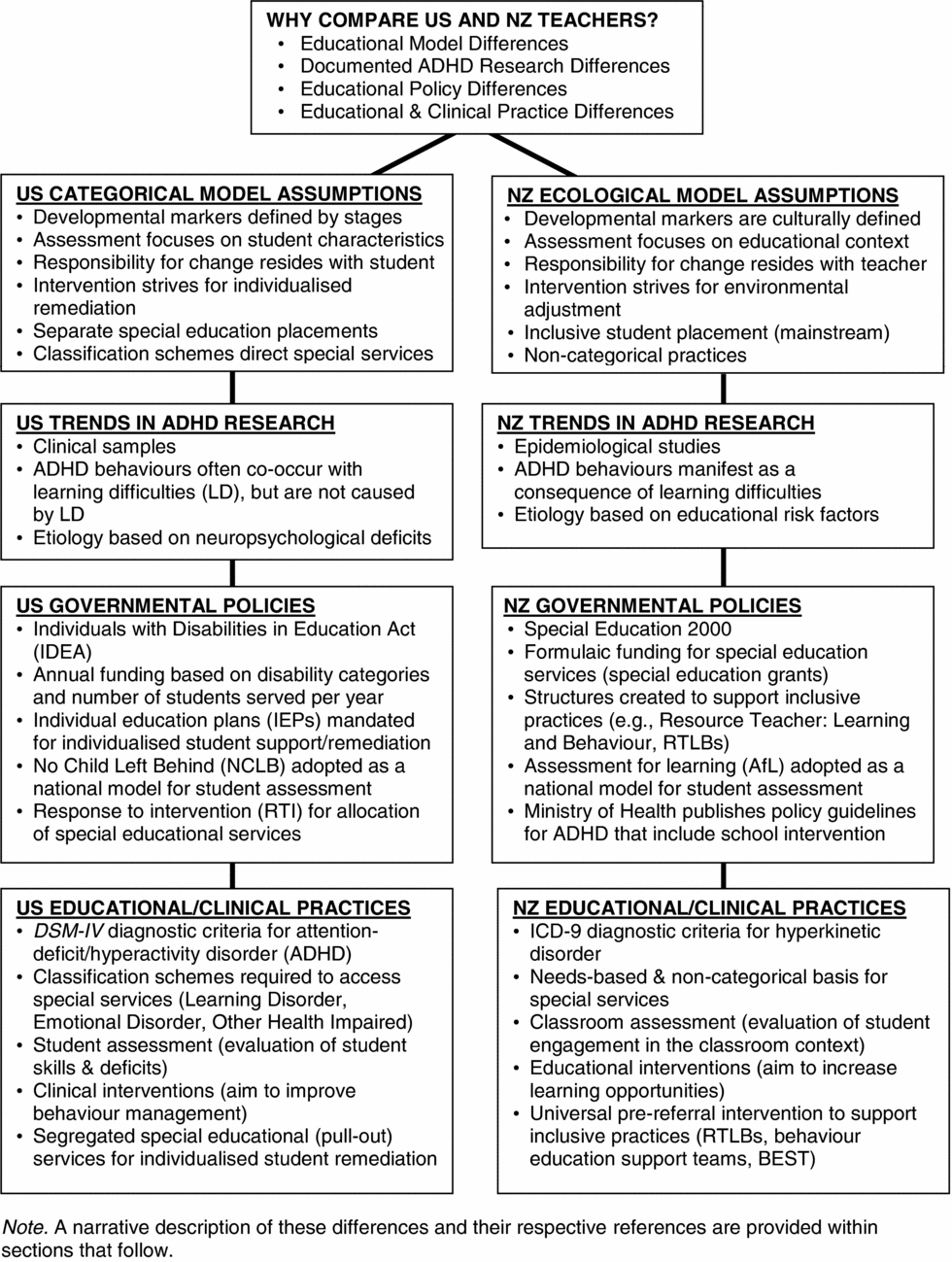
There are known differences between the US and NZ that can be observed across distinct societal and cultural domains including their respective (a) educational model and policy assumptions, (b) governmental policies for special education services, (c) common educational and clinical practices for children with disruptive behaviours, and (d) ADHD research trends (see Figure 1). Differences in the way these learning and behavioural problems are conceptualised across the two countries are extensively documented within the professional literature. Most notably, although researchers in NZ have recognised possible neurodevelopmental origins (McGee, Prior, Williams, Smart, & Sanson, Reference McGee, Prior, Williams, Smart and Sanson2002), they have argued that ADHD-related problems commonly result from academic failure or learning difficulties (e.g., the failure to proficiently acquire literacy skills; McGee & Share, Reference McGee and Share1988; McGee, Williams, & Feehan, Reference McGee, Williams and Feehan1992; Stanton, Feehan, McGee, & Silva, Reference Stanton, Feehan, McGee and Silva1990). This is contrary to commonly held beliefs in the US in which ADHD is considered to be a distinct biologically based condition that frequently co-occurs with learning disabilities (Nigg & Casey, Reference Nigg and Casey2005). The literature suggests that teachers in NZ may focus their intervention(s) on changes in teaching methods or upon improving literacy skills in the classroom, relegating behaviour management to a secondary function (Brown et al., Reference Brown, Harris and Harnett2012; McGee & Share, Reference McGee and Share1988; Stanton et al., Reference Stanton, Feehan, McGee and Silva1990; Thomson, Brown, Jones, & Manins, Reference Thomson, Brown, Jones and Manins2000). Brown and colleagues’ (2012) study, which enlisted a nationally representative sample of NZ teachers, reported teacher beliefs and learning orientations that were consistently in line with the objectives of NZ educational policies. Furthermore, the diagnostic category for ADHD is not specifically recognised within NZ schools, as special services are needs-based and noncategorically determined (Brown et al., Reference Brown, Harris and Harnett2012; Moore et al., Reference Moore, Anderson, Timperley, Glynn, Macfarlane, Brown and Thompson1999; New Zealand Ministry of Education, 2012). On the contrary, it has been argued that diagnoses such as ADHD are highlighted within US classrooms due to a ‘cultural preoccupation’ with the manufacture of systematic remediation efforts for underperforming students (McDermott et al., Reference McDermott, Goldman and Varenne2006). Arguably, the way these behaviours are conceptualised is important because it bears directly on the perceived relevance of the classroom management strategies teachers choose. Examining the moderating effects of societal and cultural influences upon teachers’ perceptions of the acceptability of ADHD interventions may provide information to better guide clinical and educational strategies for addressing children with these challenges.
A Framework for Comparing US and NZ Teachers’ Preferences for ADHD Interventions.

United States and New Zealand Educational Models
A categorical or ‘functional limitations’ model has historically served as the conceptual framework for addressing special education and related services in the US (Danforth, Reference Danforth2001; Individuals with Disabilities Education Improvement Act of 2004 [IDEA], 2003), whereas an ecological educational model emphasising needs-based, noncategorical learning experiences has been formally adopted by the NZ educational system (Ministry of Education, 1996; Moore et al., Reference Moore, Timperley, Macfarlane, Brown, Thomson and Anderson1998). The issue of student classification is likely to be the most notable difference between these two viewpoints. However, in both settings student behaviours are likely to be initially recognised by the general education teacher (DuPaul & Stoner, Reference DuPaul and Stoner2003; Thomson & Rowan, Reference Thomson and Rowan1995).
The US educational system emphasises the use of disability classifications such Learning Disordered (LD), Emotionally Disturbed (ED), or Other Health Impaired (OHI) to determine eligibility for personalised school-based supports (IDEA, 2003). In fact, in 2004 these three categories were expanded to 13 through IDEA reform to include Autism, Deaf-Blindness, Deafness, Developmental Delay, Emotional Disturbance, Hearing Impairment, Intellectual Disability, Multiple Disabilities, Orthopaedic Impairment, Other Health Impairment, Specific Learning Disability, Speech/Language Impairment, Traumatic Brain Injury, and Visual Impairment (U.S. Department of Education, 2010). These ‘categorical methods of classification were created to solely classify deviance’ (DiStefano, Kamphaus, & Mîndrilă, Reference DiStefano, Kamphaus and Mîndrilă2010, p. 152). To qualify for special education services under the OHI category, children are required to present documentation of a formal diagnosis of ADHD as determined by a qualified health professional (IDEA, 2003; Rehabilitation Act of 1973). Supports typically focus on remediation of the child's functional limitations through individualised education programs (IEPs) and 504 Plan accommodations that implement formal behavioural intervention plans (IDEA, 2003; Rehabilitation Act of 1973). Educational funding and regulations emanate from a centralised government department. These funds are then disseminated hierarchically across state and regional communities, based upon the number of students classified as receiving special education services the year prior (IDEA, 2003). Although more inclusive practices have been encouraged through educational reform of IDEA and the No Child Left Behind (NCLB) Act of 2001, federal and state monies continue to be allocated based upon a categorical model of service delivery (NCLB, 2001). Response to intervention (RTI) is an educational policy recently launched in the US (following the 2004 reauthorisation of IDEA) to expedite special education services, making them more accessible and less restrictive to children presenting with special needs (Fletcher, Coulter, Reschly, & Vaughn, Reference Fletcher, Coulter, Reschly and Vaughn2004; Reschly, Reference Reschly2005). However, the RTI design was based upon a categorical model in which individual student deficits are identified and subsequently remediated through a three-tier hierarchy of educational services (Fletcher et al., Reference Fletcher, Coulter, Reschly and Vaughn2004). Consequently, RTI policy development may inadvertently incentivise the use of diagnostic categorisation (including ADHD) in US schools to justify annual funding for special education services.
Since an individualised remediation approach has dominated the US educational framework, inattentive, hyperactive, and impulsive classroom behaviours may readily be associated with categorical depictions of ADHD. Thus, teachers in the US may often consider these behaviours to be student-specific, neurologically oriented, independent from classroom process, and requiring individualised intervention/remediation (Barkley, Reference Barkley1997; Nigg & Casey, Reference Nigg and Casey2005). Noted advantages of this include (a) the ability to operationalise specific behavioural targets for developing IEPs, (b) the use of classification schemes to guide allocation of government funds, (c) classification to guide evidence-based classroom interventions, and (d) categorisation to guide communication and collaboration among educators, family members, clinicians and other stakeholders who advocate for the child (Reschly, Reference Reschly2005).
By comparison, the NZ Ministry of Education declared a national mission in the 1970s to move away from segregated special education services and to promote an ecological orientation to educational policies and practices (Thomson et al., Reference Thomson, Brown, Jones and Manins2000). Consequently, a program called Special Education 2000 was later developed with the aim to achieve a world-class inclusive education system that provides learning opportunities of equal quality for all students (New Zealand Ministry of Education, 1996, p. 5). Testing and diagnostic procedures were deemed insufficient grounds for provision of special education services, and the allocation of funds and services for special education was dramatically changed (Thomson et al., Reference Thomson, Brown, Jones and Manins2000). More recent reforms implemented within the past three decades emphasise the use of teacher- and school-level structures (rather than individualised student programming) to promote enhanced learning and student welfare (Anderson, Thomas, Moore, & Kool, Reference Anderson, Thomas, Moore and Kool2008). Funding and decision-making for schools were decentralised in NZ, and schools now call upon itinerant teacher consultants (i.e., Resource Teacher: Learning and Behaviour; RTLBs), localised special education grants (SEG), and behavioural education support teams (BEST teams) as the primary support services for inclusive educational practices (Moore et al., Reference Moore, Timperley, Macfarlane, Brown, Thomson and Anderson1998; Thomson et al., Reference Thomson, Brown, Jones, Walker, Moore, Anderson and Glynn2003). Although NZ has successfully implemented a national curriculum, local and regional educators have been formally granted decision-making powers for resource allocation and educational program implementation (Moore et al., Reference Moore, Anderson, Timperley, Glynn, Macfarlane, Brown and Thompson1999). In recent years, the NZ Ministry of Education has formally adopted Assessment for Learning (AfL), which emphasises improving instruction and student achievement, as its dominant evaluation policy rather than ascribing to a narrow testing regime (Brown et al., Reference Brown, Harris and Harnett2012). The New Zealand Ministry of Education (2014) has also formally recognised ADHD as a valid clinical condition, recently publishing a set of guidelines for ‘setting up for success’ students with ADHD. However, these guidelines merely present the symptoms typically associated with ADHD, similar to acknowledging any paediatric health concern, and then highlight the need to make changes to the learning environment to provide instructional adaptations, rather than suggesting the implementation of any student-specific behavioural or academic remediation planning. Consistent with NZ's ecological model and noncategorical approach, individual categorisation and behaviour management are not discussed in these guidelines.
Consequently, behaviours related to ADHD may present altogether different classroom challenges from a NZ educator's point of view. Though ADHD has been formally recognised as a valid clinical condition, the ‘category’ of ADHD (or any other socioemotional or behavioural category) is not actually used within the NZ classroom. Inclusive practices are prioritised and educational services are not typically administered individually to students. This is consistent with an ecological conceptualisation depicting these problems as resulting from the demands of the school environment (McGee & Share, Reference McGee and Share1988; McGee et al., Reference McGee, Williams and Feehan1992; Millar & Morton, Reference Millar and Morton2007; Mitchell, Reference Mitchell, Fraser, Moltzen and Ryba2000). Instead, behaviours typically associated with ADHD would be addressed by changing instructional practices in the classroom rather than singling a child out for an individualised behaviour intervention plan (Thomson et al., Reference Thomson, Brown, Jones, Walker, Moore, Anderson and Glynn2003). An example of this might include a teacher's request for consultation from an RTLB to collaboratively identify ways of improving whole-class instruction to circumvent or minimise students’ loss of learning opportunities due to off-task behaviours. Advantages inherent to this approach include (a) an emphasis on instruction over behaviour management, focusing on the goal to promote learning opportunities rather than minimising disruptions; (b) acceptance of needs for ‘learning differences’ instead of ‘learning disabilities’ (Graham & Bailey, Reference Graham and Bailey2007); (c) teacher-focused interventions for improving learning opportunities, rather than student-remediation focused; and (d) a greater focus on learning contexts and classroom climate (Moore et al., Reference Moore, Anderson, Timperley, Glynn, Macfarlane, Brown and Thompson1999; Thomson et al., Reference Thomson, Brown, Jones, Walker, Moore, Anderson and Glynn2003).
Although within-culture teaching practices vary widely in both the US and NZ, teacher training, educational policies and institutional supports, which may affect teacher beliefs, are certainly influenced by the overarching educational model espoused. MacFarlane and Woolfson (Reference MacFarlane and Woolfson2013) recently illustrated the importance of a school's leadership and the ethos it established in predicting teacher behaviours. Additionally, the overarching educational framework within which the school resided may have also influenced both the school's leadership and the instructional processes that played out within the classroom (Brown & Harris, Reference Brown and Harris2009).
The purpose of this study was to compare US and NZ teacher classroom management preferences for inattentive and disruptive behaviours typically associated with ADHD. Specifically, this study aimed to examine the role of teacher beliefs in determining their classroom management preferences across the two samples. Although the direct influence of societal and cultural variables is not directly tested, differences in teacher ratings will offer compelling support in considering how teachers’ and their students’ experiences in the classroom may vary across the two settings. Preliminary data for this study revealed differences in teachers’ intervention preferences based upon nationality alone. Teachers in the US perceived both pharmacological and behavioural interventions to be more acceptable, effective, and timely when compared to teachers in the NZ sample (Curtis, Pisecco, Hamilton, & Moore, Reference Curtis, Pisecco, Hamilton and Moore2006). An interaction between student gender and teacher nationality was also evident, with US teachers more likely than NZ teachers to consider the daily report card more readily for girls than for boys (Curtis et al., Reference Curtis, Pisecco, Hamilton and Moore2006; Pisecco et al., Reference Pisecco, Huzinec and Curtis2001). These data identified differences in teachers’ intervention preferences, but examination of teacher beliefs is warranted to determine how their philosophy and approach to classroom management may influence their selection and use of classroom strategies. This investigation examines the relationship between teacher beliefs and their treatment choices.
There were two overarching research questions investigated in this study:
(1) Do teacher beliefs about pupil control and their efficacy as a teacher influence their decisions about classroom management practices?
(2) How do teacher beliefs about students presenting ADHD-related challenges differ across US and NZ educational contexts? More specifically, do teachers rely more upon their sense of teaching competence and control ideology when choosing classroom management strategies or do they select intervention methods based upon individual student characteristics?
Method
Participants
Teachers were recruited for this study from two metropolitan centres within the US and NZ. The US sample consisted of 159 regular and special education teachers from 12 elementary (K–8) schools within a single state in the southwest region of the country. These teachers were recruited to participate in this study prior to their attending required inservice training on ADHD. Teachers in the US were predominantly female (n = 147, 92%), ranged in ages from 25 to 65, and represented an average of 11.9 years teaching experience. Though study participation was voluntary, teachers were required to attend the inservice training so they were not self-selected based on their interest in ADHD. Eight percent (n = 12) of the total number invited (n = 171) declined to participate in the study or returned questionnaires with incomplete data. Although the overwhelming majority of participants (n = 151, 95%) considered ADHD to be a legitimate educational problem, over half (n = 83, 52%) had not received any prior training related to ADHD. The large majority (n = 134, 84%) reported teaching at least one child in the past 2 years who was diagnosed with ADHD. Of those teachers, 120 (90%) taught a child who was prescribed medication for ADHD and 96 (72%) had implemented behavioural programs for these children.
The NZ sample consisted of 261 regular and special education teachers from 17 elementary schools in urban and suburban settings within the north island region. School principals were contacted in order to recruit their teachers’ participation in the study. Principals were offered the opportunity for their school to receive a teacher inservice session, including a presentation of the study's findings and discussion of potential classroom implications of these data. Of the 18 schools approached, 17 principals agreed to participate in the study. Out of 291 eligible participants, 10% (n = 30) declined to complete the surveys or returned questionnaires with incomplete data. Similar to the US sample, NZ participants were predominantly female (n = 218, 84%), ranged in ages from 20 to 70, and averaged 12.5 years of teaching experience. Ninety-six percent of the NZ teachers considered ADHD to be a legitimate educational problem; however, only 167 (64%) claimed to have taught at least one child with ADHD in the past 2 years. Of those 167, nearly half (n = 79, 47%) said that their students were prescribed medication and 70 (42%) of those teachers were involved in implementing a behaviour plan. The majority of NZ participants (n = 172, 66%) had not received prior training for ADHD.
Instruments
Teachers were asked to complete a packet of questionnaires requiring approximately 45 minutes. The packet consisted of measures of teacher characteristics and student vignettes for assessing teachers’ acceptability for four classroom interventions. The packet contained the following measures:
The Background Information Questionnaire (BIQ)
The BIQ enquires about participants’ demographic information such as years and types of teacher training, years of experience, educational settings, classification (e.g., regular or special education), age, gender, ethnicity, training in ADHD, experience teaching children with ADHD, and experience with children who required behavioural or psychopharmacological interventions.
Behavioural Intervention Rating Scale (BIRS)
The BIRS consists of 24 items and uses a 6-point summated rating scale format, where lower scores indicate greater acceptability (Elliott & Von Brock Treuting, Reference Elliott and Treuting1991). Perceived intervention acceptability, effectiveness, and timeliness of effect are the three distinct factors that comprise the BIRS, accounting for 76.3% of the total variance. The BIRS has demonstrated convergent validity by correlating significantly with other measures of treatment acceptability. High internal consistency reliability has been established, with estimates of .97 (acceptability), .92 (effectiveness), and .87 (timeliness; Elliott & Von Brock Treuting, Reference Elliott and Treuting1991). As the BIRS was developed and tested with only US participants, the reliability of this scale was also determined for NZ teachers in this sample. The internal consistency of the BIRS for the NZ sample was .90 for acceptability, .88 for effectiveness, and .59 for timeliness of effect. Although the timeliness variable appeared to be less reliable for the NZ sample, this subscale comprised only two items. It can therefore be considered to be a valid and reliable instrument for use with this sample.
Teacher Efficacy Scale (TES; Gibson & Dembo, Reference Gibson and Dembo1984)
The TES consists of 30 items that use a summated rating scale format, with higher scores indicating greater perceived self-efficacy. The TES measures two primary factors. The construct of Personal Teaching Efficacy reflects the individual’s sense of responsibility and the belief that he or she personally has the skills and capabilities to bring about positive student outcomes. General Teaching Efficacy represents the belief that teachers are figures in children's lives who can bring about change, but that changes may be limited by external factors such as home environment and other influences (Gibson & Dembo, Reference Gibson and Dembo1984). The measure has demonstrated good internal consistency (.75 to .79) and convergent validity (Agne, Greenwood, & Miller, Reference Agne, Greenwood and Miller1994). Internal consistency for the TES in this study was .74 for the NZ teacher sample and .71 for the US teacher sample.
Pupil Control Ideology Form (PCI; Willower & Jones, Reference Willower and Jones1963)
The PCI measures beliefs about the teacher–student relationship, specifically regarding classroom management. The PCI measures teachers’ beliefs on a continuum across humanistic and custodial orientations. Humanistic orientations emphasise the need for classroom interactions and experiential learning activities. Custodial orientations connote beliefs that emphasise students’ needs for classroom structure, order and disciplinary control (Gordon et al., Reference Gordon, Dembo and Hocevar2007; Hoy, Reference Hoy2001). The PCI Form consists of 20 items and employs a 5-point summated scale format with scores ranging from 1 (strongly disagree) to 5 (strongly agree). Higher scores indicate custodial orientations, whereas lower scores suggest humanistic orientations. The PCI has evidenced excellent split-half reliability (.91) and the ability to discriminate between custodial and humanistic teachers based on administrative judgments (Agne et al., Reference Agne, Greenwood and Miller1994). Internal consistency determined for the NZ teachers in this sample was .73. Similarly, the US sample demonstrated an internal consistency of the PCI Form of .75.
Procedure
Questionnaires were administered to each sample of teachers as a group prior to their attending a mandatory faculty event. Teachers in NZ participated prior to commencing a weekly staff meeting; teachers in the US took part prior to a required school inservice. Teachers were given the choice whether or not to participate and were assured that responses would be kept anonymous. Each teacher was given a packet that included the aforementioned instruments, along with a description of four typical classroom management strategies, and one of six different vignettes with a description of a child displaying inattentive, hyperactive, and impulsive behaviours. The vignettes were based directly upon Diagnostic and Statistical Manual of Mental Disorders (4th ed., text rev.; DSM-IV-TR; American Psychiatric Association, 2000) criteria for ADHD, but no actual label or use of the term ADHD was provided within the vignettes. Narratives varied by the student's gender (Jane or Jonathan) as well as the symptom type (i.e., predominantly inattentive type, hyperactive-impulsive type, or combined type). The vignettes were randomly distributed in equal proportions to participants. After reading his or her assigned vignette, each teacher read the following descriptions of four classroom management strategies and completed 24 subsequent items on the BIRS:
Daily Report Card. The use of a daily report card is a possible intervention that involves the parents and teachers working together to identify approximately three to five problem behaviours. A report card is then developed with daily goals being set in a positive manner for the child. The child then takes the report card home to his or her parents and the child earns rewards for meeting specific daily goals.
Response Cost Technique. The use of the response cost technique is a possible intervention where the child would earn points for exhibiting specific positive behaviours (e.g., completing tasks) and would lose points for exhibiting negative behaviours (interrupting the teacher). At a predetermined time the child could redeem points for rewards.
Stimulant Medication (e.g., Ritalin). Ritalin is a possible intervention and is usually taken once or twice a day. Ritalin is a medication that is intended to reduce the child's behavioural problems.
Classroom Lottery. A classroom lottery is a possible treatment strategy that is a group intervention in which the children can earn classroom rewards based upon their behaviour. The teacher establishes a brief list of class rules and posts them. The children are told that they will earn class jobs (e.g., line monitor, office messenger, etc.) according to their ability to follow class rules. At unannounced times the teacher checks to see who is following the rules. The names of all children who are following the rules are written down. At the end of the day the children who were following the rules at a predetermined criterion level (e.g., four out of five scans) put their names on a piece of paper which is then put into a lottery bin. As the names are drawn, the children choose the classroom job that they want for the next day.
The decision to include these four interventions was based upon two factors. First, all interventions have been shown to be effective for ADHD, either independently or as a class of interventions (DuPaul & Power, Reference DuPaul and Power2008; DuPaul & Stoner, Reference DuPaul and Stoner2003). Second, stimulant medication and classroom-based behavioural interventions are classes of interventions with which teachers are familiar as they are commonly used or recommended for the treatment of ADHD. Of the various contingency management strategies, the daily report card was selected because it is an individualised intervention. Both response cost and classroom lottery were included because they are group-monitored interventions that require different levels of structure and implementation support.
Upon reading the vignette and each intervention description, teachers completed the BIRS, rating the acceptability of each of the four interventions. After completing these forms, a debriefing was provided and teachers were offered the opportunity to attend a follow-up meeting to obtain the results of the investigation and participate in a discussion related to evidence-based classroom management methods.
Analysis
General linear modelling techniques were used to analyse data using multivariate analysis of covariance (MANCOVA) models. These methods provided the opportunity to observe linear relations between variables, cross-cultural differences in main effects, as well as any potential confounding influences attributable to teacher beliefs (Tabachnick & Fidell, Reference Tabachnick and Fidell2001).
Prior to analyses, the data were confirmed to conform to the assumptions required for these techniques (i.e., sample size, independence, normality, outliers and multivariate normality, linearity, multicollinearity/singularity, and homogeneity of variance; Tabachnick & Fidell, Reference Tabachnick and Fidell2001). Additionally, the internal consistency of each instrument was assessed and observed as reliable for teachers in NZ before carrying out further analyses.
The primary analysis consisted of a fixed-effects MANCOVA model, where teacher nationality (i.e., US or NZ) served as the between-subjects factor. The three dependent variables were participants’ general ratings of intervention acceptability, effectiveness, and rate of change. To account for multiple comparisons across three dependent variables, a Bonferroni correction (0.05/3) was used and the Cronbach's alpha was conservatively set at .0167 for the primary analyses (Jaccard & Guilamo-Ramos, Reference Jaccard and Guilamo-Ramos2002). Teacher beliefs were treated as covariates. These consisted of ratings of PCI, personal teaching efficacy and general teaching efficacy. The primary analyses examined potential two- and three-way interactions (i.e., Intervention x Nationality and Intervention x Nationality x Teacher Beliefs). This nested models approach allowed for the most comprehensive model to emerge that would best represent intervention effects (Maxwell & Delaney, Reference Maxwell and Delaney1990). Following the primary analysis, post hoc analyses were conducted to identify specific differences across samples (by nationality) based upon the intervention types examined.
After evaluating the comprehensive model, secondary post hoc analyses examined the four different intervention types: daily report card, response cost technique, medication, and the classroom lottery. When significant interactions were identified within the primary analyses, secondary analyses were conducted to identify intervention-specific results. The four interventions served as univariate components for the multivariate dependent variables of intervention acceptability, effectiveness, and rate of change. Since there were four intervention types examined in the secondary analyses, another Bonferroni correction was made (0.05/4) to establish a conservative alpha coefficient of .0125 to reduce the likelihood of a Type I error (Jaccard & Guilamo-Ramos, Reference Jaccard and Guilamo-Ramos2002). Thus, potential differences between each type of intervention were evaluated.
Results
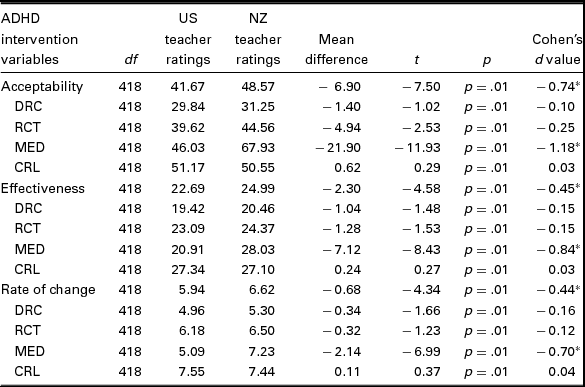
Prior to conducting the primary analyses, teacher ratings of intervention acceptability, effectiveness, and rate of change were examined based upon nationality alone. A series of independent-samples t-tests were performed and statistically significant differences were found across US and NZ teacher ratings for all three constructs. Medication was notably less favoured by teachers in the NZ sample. It should be noted that for these mean comparisons, lower scores on the BIRS reflect greater acceptability, effectiveness, and rate of change. Teachers in both samples displayed a similar rank order of intervention preferences. However, despite similar ranking, NZ teachers consistently endorsed lower ratings of acceptability, effectiveness, and timeliness for all interventions, except the classroom lottery (US: pooled M = 86.06, NZ: pooled M = 85.09). Medication was rated by US teachers as their third favourite and by NZ teachers as their fourth favourite out of the four intervention choices. Though medication was less preferred to other interventions by US teachers, their ratings of medication acceptability, effectiveness, and timeliness (pooled M = 72.03) were still much greater than NZ teachers’ ratings for response cost (pooled M = 75.43), classroom lottery (pooled M = 85.09), and medication (pooled M = 103.19). Descriptive data also indicated that NZ teachers were also less likely than their US counterparts within the past 2 years to (a) have a child in class diagnosed with ADHD (NZ = 64% vs. US = 84%), (b) have a student prescribed medication for ADHD (NZ = 30% vs. US = 75%), or (c) formally participate in an individualised behaviour plan (NZ = 27% vs. US = 60%).
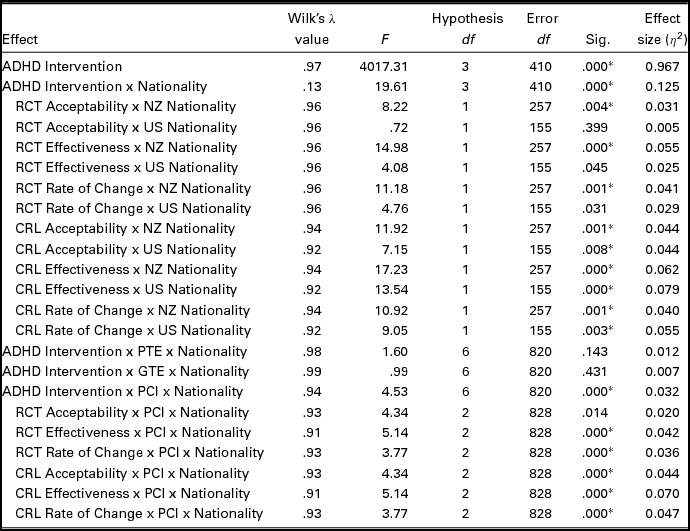
The primary analysis consisted of a MANCOVA that incorporated teacher belief variables as covariates and explored how the presence of particular beliefs may have been associated with teacher intervention preferences across the two samples. Specifically investigated were PCI, personal teaching efficacy, and general teaching efficacy. Results indicated a significant three-way interaction for ADHD Interventions x Teacher Nationality x Teacher Beliefs. Of the three covariates, PCI was the only variable that independently yielded significant differences across cultures with respect to intervention acceptability, effectiveness and rate of change. Specifically, the relationships between teachers’ nationality and intervention acceptability, effectiveness, and rate of change were moderated by teachers’ control ideology, F(6, 820) = 4.53, p = .000; Wilks’ lambda = .94; partial eta squared = .03. No interactions were significant for personal or general teaching efficacy and these constructs did not demonstrate any moderating effects upon teachers’ intervention choices (see Table 2). In sum, teachers’ control ideology displayed a significant main effect, where their preferences for classroom strategies increased (overall) in association with greater ratings of custodial beliefs.
Differences in US and NZ Teacher Perceptions of ADHD Interventionsa
Note. DRC = daily report card; RCT = response cost technique; MED = medication; CRL = classroom lottery.
aLower scores on the BIRS indicate greater teacher ratings of intervention acceptability, effectiveness, and rate of change.
*Significant differences at p < .01.
Multivariate General Linear Modelling Results
Note. RCT = response cost technique; CRL = classroom lottery; PTE = personal teaching efficacy; GTE = general teaching efficacy; PCI = pupil control ideology.
*Significant differences at p < .0125.
Results of secondary analyses indicated that the interaction between ADHD Intervention x PCI x Nationality was most notable for response cost and the classroom lottery (see Table 2). In general, teacher preferences for both response cost and classroom lottery were associated with beliefs that were more custodial in nature. However, relative to their control ideology, NZ teachers demonstrated a greater change in their acceptability and effectiveness ratings for response cost based upon increasing ratings of custodial teaching beliefs. The opposite was observed for their ratings for the classroom lottery as well as the perceived timeliness of both the classroom lottery and response cost technique. For these variables, US teachers evidenced a greater magnitude of change corresponding to increases in custodial teaching beliefs. The most pronounced interaction effects were observed for classroom lottery. This strategy increased in its favourability overall as custodial beliefs increased; however, significant differences between US and NZ teacher preferences were observed at both humanistic and custodial ends of the PCI continuum.
Teachers in both samples, by a large majority, displayed humanistic orientations (US = 82%, NZ = 83%). Thus, no significant differences were observed between the two sample means for the continuous variable PCI, M = −.46, SE = 1.03, t(366) = 0.459, p > .05. However, when humanistic orientations were considered, NZ teachers rated the classroom lottery as more favourable and response cost less favourable compared to US teachers. Consistent with the interaction effects, the opposite was true for custodial orientations. NZ teachers rated the classroom lottery as less favourable and response cost more favourable compared to their US counterparts. It is important to note that overall teachers in the US sample generally rated daily report cards, medication, and response cost to be more acceptable, effective, and timely compared to NZ teachers. Classroom lottery was the only intervention that received more favourable ratings by NZ teachers. Differences observed between custodial beliefs in US and NZ teachers for classroom lottery were consistent with these overall ratings, where US teachers rated greater preferences for all of the other interventions offered. The only time NZ teachers preferred an intervention (i.e., classroom lottery) more than their US counterparts was when they also rated themselves as having a humanistic control ideology.
Discussion
This investigation compared US and NZ teachers’ preferences for classroom management strategies for students with hyperactive, impulsive, and inattentive behaviours typically associated with ADHD. In response to the first research question, teacher beliefs did not differ significantly across the two samples. Indeed, ratings of personal teaching efficacy, general teaching efficacy, and PCI were almost identical for US and NZ teachers. However, the influence of these beliefs upon teachers’ reported practice was different across the two samples, thus answering the second research question. Differences in US and NZ teachers’ ratings of intervention acceptability, effectiveness, and timeliness proved to be moderated by their PCI. Specifically, teachers’ ratings of the response cost technique and the classroom lottery were most affected by this three-way interaction. Teachers’ beliefs (US and NZ) about their individual influence as a teacher (i.e., personal teaching efficacy) as well as their general influence within the teacher role (i.e., general teaching efficacy) did not affect their intervention ratings.
Response cost was preferred more by teachers in the US than NZ, whereas the classroom lottery was preferred more by NZ teachers. Though teachers were not distinctively categorised as either custodial or humanistic in their beliefs, ratings across both samples clearly indicated dominant preferences for humanistic beliefs (US = 82%, NZ = 83%), suggesting a preference across settings for more classroom interaction, experiential learning, and facilitation of positive relationships (Gordon et al., Reference Gordon, Dembo and Hocevar2007). However, a key distinction was the direction of the relation between teachers’ control ideology and intervention preferences, which suggested custodial beliefs were more positively associated with greater favourability for the response cost and classroom lottery for teachers in both samples.
The biggest difference observed across these two samples was teachers’ views of medication. Despite having similar pupil control orientations, US teachers were more favourable toward medication compared to the NZ teachers. This difference was so great, based upon nationality alone, that teacher beliefs had no significant bearing upon their choices surrounding medication. Greater differences in intervention preferences (i.e., medication) could thus be attributed to nationality alone, whereas smaller differences (i.e., response cost, classroom lottery) were moderated by both nationality and teachers’ beliefs.
US and NZ teacher ratings of classroom management preferences clearly demonstrated distinct group effects. These differences may not be directly attributable to teachers’ respective educational systems, but clear differences in teacher experiences were likely due to their respective societal and cultural milieu. For instance, proportionally more US teachers reported exposure to children with ADHD (84% vs. 64%) within the past 2 years, encountering a child who was prescribed medication (75% vs. 30%), and participating in a formal behavioural intervention plan (60% vs. 27%). Though these differences are pronounced, they merely present a dichotomous experience (i.e., answering yes or no about having the experience within the past 2 years) rather than indicating the frequency of these experiences. Therefore, it is not known if teachers’ endorsements for these items represented encounters with these student experiences a single time or multiple times within the past 2 years. These limited descriptive data do suggest, however, that there were many more classroom concerns identified as ADHD-related for US teachers. Differences in teachers’ ratings of intervention acceptability, effectiveness, and timeliness may thus have resulted from teachers’ familiarity with ADHD-related concerns.
Diagnostic categories are likely to be used more frequently in US schools because they are required in order to be eligible for educational accommodations (Fletcher et al., Reference Fletcher, Coulter, Reschly and Vaughn2004; U.S. Department of Education, 2010), whereas NZ's ecological model disavows the use of such classification schemes (Brown et al., Reference Brown, Harris and Harnett2012). An anecdote from implementing this study illustrates this point. When inviting one of the principals to have his school participate in the study, he replied ‘I’d love to. It sounds very interesting. The only problem is that we don't have any children with ADHD at our school’. After agreeing to participate nonetheless, many teachers from this school were observed making statements like ‘oh, this is Malcolm to a tee’ or ‘huh, this sounds like everyday in my class with Devin’. Statements like these were enlightening as they suggested that these teachers often encountered the same classroom behaviours associated with ADHD in the US, but did not conceptualise them as a disability. This likely affected their exposure to children prescribed medication for ADHD, which was also more frequently noted by US teachers.
The US and NZ are the only two developed countries in the world that allow direct-to-consumer advertising for prescription medications (Frosch, Krueger, Hornik, Cronholm, & Barg, Reference Frosch, Krueger, Hornik, Cronholm and Barg2007). However, the content of television and magazine advertising of ADHD medications in NZ must first be approved by the Ministry of Health — resulting in much more restricted mass media marketing of medications and information about ADHD symptoms (New Zealand Ministry of Health, 2001). Furthermore, NZ healthcare is provided via socialised medicine. This means that ADHD-related care in NZ is government funded and not driven by the types of profit margins often sought by privatised healthcare in the US, where primary healthcare is predominantly delivered through independent insurance agencies. Consequently, national prescription formularies (i.e., lists of prescription drugs covered by a health insurance plan) in NZ are decided upon by government regulators. These formularies limit the types of medications available, resulting in fewer ADHD medication options for pharmaceutical companies to advertise to consumers. Thus, NZ teachers’ familiarity with ADHD medication and their repeated exposure to advertised symptoms and treatments for ADHD was likely to be much less than their US counterparts. Since behaviour intervention plans are formally delivered in US schools within a mandated IEP, it is not surprising that US teachers’ intervention preferences were based more upon student characteristics than teacher beliefs. Based on findings from prior studies (e.g., Brown et al., Reference Brown, Harris and Harnett2012; Hamre et al., Reference Hamre, Pianta, Burchinal, Field, LoCasale-Crouch, Downer and Scott-Little2012; Tschannen-Moran & Woolfolk Hoy, Reference Tschannen-Moran and Woolfolk Hoy2007), it was predicted that teachers’ beliefs and larger contextual influences would determine their ratings of ADHD intervention acceptability, effectiveness, and timeliness. An alternative perspective to consider after reviewing these data is a possible ‘grassroots’ notion that teachers’ exposure/familiarity with ADHD-related classroom concerns influence their beliefs rather than the ‘top down’ influence of the educational model and policy objectives. Frequent encounters with children who have received ADHD diagnoses, medication for ADHD, and children whose ADHD impairments require formal behavioural intervention plans may influence teachers’ beliefs about classroom management for such concerns. Brown and his colleagues (2011) indicate that these experiences are embedded within greater social and cultural mores such that the frequency of teachers’ ADHD-related classroom experiences and their larger educational contexts are ultimately more likely to be integrated and have reciprocal effects on teachers’ beliefs.
With regard to the types of interventions preferences observed, PCI influenced NZ teacher decisions regarding their prospective use of response cost and the classroom lottery. This highlighted how NZ teacher beliefs moderated their preferences for strategies delivered at the whole class level, but not for individualised interventions such as the daily report card or medication. Teacher beliefs did not significantly influence US teacher preferences for any classroom management strategies. Instead, their preferences were for individualised ADHD interventions, based upon individual student characteristics (i.e., student gender and ADHD symptom subtype; Pisecco et al., Reference Pisecco, Huzinec and Curtis2001). Consequently, teachers’ control ideology might be an indicator of sample differences regarding preferences for individualised versus whole class administered classroom management strategies. Medication and daily report cards are more individualised interventions, for which NZ teachers gave their most extreme ratings. They greatly preferred the daily report card over all other interventions and gave their lowest ratings to medication (regardless of control orientations).
Limitations of this study need to be acknowledged. The study samples comprised teachers from US and NZ; however, neither can be regarded as nationally representative. Convenient samples were selected from a cross-section of teachers within a single city in each country. Teachers from the two samples were invited to participate under differing conditions (US: prior to an ADHD inservice vs. NZ: prior to a school staff meeting). However, both inservice and staff meetings were required for these teachers and study participation took place prior to receiving any inservice materials in both settings. Another possible limitation may have been teachers’ lack of familiarity with the behavioural interventions used (Murik et al., Reference Murik, Shaddock, Spinks, Zilber and Curry2005). Future studies may also consider including interventions focused solely on teachers’ instructional methods in addition to child-focused behavioural strategies. Finally, this investigation used vignettes instead of actual observations. Though studies have shown consistency between acceptability ratings when using vignettes compared to actual classroom observations (e.g., Eckert & Hintze, Reference Eckert and Hintze2000), naturalistic observation of teachers’ intervention preferences across cultures may clarify practical differences between typical classroom experiences in each of the two samples.
Despite these limitations, the results of this research have several practical implications that highlight the notion that context matters. First, teacher training should promote greater teaching self-efficacy by emphasising the use of more humanistic-oriented classroom practices. One of the similarities across the two samples in this study was that the dominant beliefs teachers espoused about their role and their classroom management styles were very much alike. Regardless of sociocultural norms, developing greater teacher efficacy and humanistic orientations appear to be important for teachers’ classroom management success within any educational context. Something that was consistent across samples was a clear preference for using the daily report card above all other intervention choices. One inference about this preference could be that the daily report card is more consistent with a humanistic approach. It certainly clarifies and prompts desired behaviours, but does not restrict or identify the student in any way during daily classroom interactions. It is individualised to the student, but not in a public manner, allowing for priming at the beginning of the school day, reinforcement at the end of the school day, and clear communication of performance to caregivers at home for continuity of behavioural goals. Teaching more effective ways of using ‘acceptable’ classroom management strategies such as this one should be considered to help teachers to better exercise their own teaching strengths throughout their classroom careers. Efron and colleagues (Reference Efron, Sciberras and Hassell2008) recently asserted that parents often perceive teachers as unprepared and/or insufficiently supported to address their children's ADHD-related classroom needs. Learning to effectively implement strategies like the daily report card for students with disruptive behaviours may also allow teachers to enlist caregivers in supporting their child's classroom goals.
Second, this study shows that the same teacher beliefs hold different meanings depending upon their sociocultural context. Regardless of why these differences exist, teachers in NZ reported different acceptability, effectiveness, and timeliness for classroom management strategies often employed within US teachers’ classrooms. Rather than expounding upon the virtues or failings of either educational model or set of national policies, these data certainly support the notion of working more effectively within the strengths of one's respective system. Doing so would promote better use of support resources for teachers and their students versus a desire to seek and implement methods not supported by one's current educational infrastructure. What this means for NZ classrooms might include an emphasis on seeking RTLB consultation earlier when classroom management concerns arise. Gaining early RTLB support might empower more teacher-focused classroom management methods to be considered. Delaying may ultimately require more individualised student behavioural interventions that would be inconsistent with NZ teachers’ general preferences. For US schools, this might suggest that teachers could benefit from becoming more knowledgeable and competent for tailoring evidence-based behavioural strategies for ADHD to formalised behaviour intervention plans within IEPs (Lewis, Reference Lewis2000). Teachers in the US sample frequently reported teaching children with ADHD (84%) and a strong desire to gain more ADHD-related teacher training (96%). Increasing teachers’ familiarity with behavioural methods for better controlling classroom antecedents to behaviour problems will also enable teachers to employ methods more consistent with the RTI program currently underway in US schools (Berninger, Reference Berninger2006).
Finally, the results of this study provide an opportunity for educators to reflect on what teachers perceive to be best for their classrooms and differences in these perceptions based upon contexts. Understanding how teachers in NZ may perceive their role and prefer certain classroom management strategies can offer US teachers the chance to further examine their own practices while learning about other ways of achieving the same kinds of high educational standards for their students. Likewise, NZ teachers may examine US teacher data to consider other ways of addressing students’ classroom behaviours when more regionally consistent practices have been exhausted. For educational researchers, the differences presented in this study may prompt further exploration of educational model and policy influences upon teachers’ beliefs and classroom practices. If educational models and policy objectives are truly a reflection of societal and cultural norms, then it would be beneficial to find ways to more clearly illustrate the systemic links within educational systems and the teacher practices that reside within them.