The first challenge facing formal accounts of adjective position in English versus French lies in adequately accounting for the word-order patterns exemplified in (1)–(3). Adjectives uniformly precede the noun in English, whereas their French equivalents appear either predominantly in one position—postnominally (post-N), as in (1), or prenominally (pre-N), as in (2)—or in both positions, as in (3a)–(3b).1
For these examples, the traditional symbols * for ungrammatical and ? for marginal are presented in parentheses to indicate that such judgments are made in the absence of contextual information. As does Waugh (1977), however, I assume that it is not the case that certain word-order combinations are strictly ungrammatical but, rather, that the meaning given by a certain combination is semantically inappropriate in context. In later examples, I use the symbol % to indicate an infelicitous interpretation within a given context.

Furthermore, ordering restrictions on two or more adjectives in pre-N position in English (under normal intonation contours) find a reflex in pre-N versus post-N position in French, as in (4), which suggests that adjectival modification in the two languages is of a similar nature even if the surface position of the noun differs between the two languages.

A second challenge lies in adequately accounting for the correlation between position and interpretation in French: why, for instance, cher should correspond to the English gloss expensive in post-N position but to the English gloss cherished in pre-N position, as in (3a). Note the even greater difficulty of capturing the interpretive difference for the adjective lourde “heavy” in (3b), which has no distinctive English glosses.
A final challenge, and the most relevant to our concerns, lies in adequately explaining how the instantiation of these position-interpretation correlates is guaranteed in the case of native language (L1) acquisition based primarily, or perhaps exclusively, on positive evidence. The same question can, of course, be asked in the context of classroom-based SLA, and this question becomes all the more interesting when one considers the various forms of evidence that are potentially available to the native-English-speaking classroom learner, including (a) prior knowledge, consisting of L1 knowledge, existing second language (L2) knowledge, language universals, and knowledge of other languages (Gass, 1997, p. 24), and (b) classroom-specific input, including the relative frequency of pre-N versus post-N positions, which might differ in quantity or quality from the input to which native speakers are normally exposed.
The present study is not the first to examine adjective ordering in SLA (see, e.g., Bruhn de Garavito & White, 2002; Gess & Herschensohn, 2001; Granfeldt, 2000; Hawkins, 1998, reported in Hawkins, 2001; Parodi, Schwartz, & Clahsen, 1997). It is the first, however, to empirically do so with respect to the interpretive correlates of such ordering within context.2
Coppieters (1987) utilized the interpretive correlates of adjective position as one of a number of structures on which native and nonnative speakers were asked to verbalize their intuition of grammaticality, but in the absence of contextual information. Given the conceptual and empirical problems of this study, noted in Birdsong (1992), I omit discussion of Coppieters's results here.
In response to the challenges of accounting for adjective position and its interpretational correlates, a syntactic-semantic account of the data in (1)–(4) will be adopted. This analysis—based on initial works by Bernstein (1993), Cinque (1994), and Valois (1991), among others, and later defended and expanded upon in Anderson (2002)—involves particular adjunction sites for adjectives within the determiner phrase (DP). I will argue that eventual attainment of the L2 system requires knowledge of just such a representational format, in line with the notion of domain-specificity of language as pursued in generative (or so-called Universal Grammar [UG]-access) accounts of SLA (see White, 2003, for an overview). Results from a contextualized acceptability judgment task administered to monolingual English-speaker controls, four groups of university-level learners, and native-French-speaker controls (N = 157) will show that adjective position-interpretation pairings are fully acquirable, although grammatical development is characterized by a high degree of between-learner variability, which will be attributed to a number of group- and learner-specific variables that mediate depth of processing (following Gass, 1997).
ADJECTIVE POSITION AND REPRESENTATIONAL FORMATS
Although there are many nongenerative syntactic accounts of French adjective position offered in the literature (Delbecque, 1990; Forsgren, 1978; Larsson, 1993; Martin, 1986; Nølke, 1996, 1997; Reiner, 1968; Waugh, 1977; Weinrich, 1966; Wilmet, 1981; see also Delmonier, 1980, for an overview of less recent literature on the topic), the present article will take as its starting point the standard generative account of adjective position in Germanic versus Romance languages (Anderson, 2002; Bernstein, 1993; Cinque, 1994; Valois, 1991). This account is shared by the SLA studies involving DP word order previously cited and the only one to date that meets the criteria of descriptive and explanatory adequacy in the crosslinguistic sense, thereby meeting the challenges of adequately accounting for French adjective position and its interpretational correlates.
The basic proposal of generative accounts of adjective position is that the surface position of the noun with respect to other DP elements (articles, adjectives, genitives) crosslinguistically is not the result of distinct structural representations underlyingly, but, rather, the result of overt versus covert noun movement. This parametric difference is conceptualized in terms of the strength (strong or weak) value of an abstract grammatical feature—perhaps number (NUM), as proposed in the earliest accounts, or gender, in later accounts (e.g., Carstens, 1991, 2000; Ritter, 1991, 1993), or some composite of the two that is associated with the head of a functional projection between the noun phrase (NP) and DP, which I will refer to, following the literature, as number phrase (NumP). A strong value for this feature in French forces overt movement of the noun across an attributive adjective adjoined to NP. This analysis accounts for both uniformly pre-N adjectives in English (as the noun does not overtly move) and the possibility of post-N order in French, as seen in (1).
To account for the fact that French, like English, allows for pre-N order of attributive adjectives as well as post-N order, as illustrated in (2), adjunction to the higher functional projection NumP rather than NP is posited, such that the adjective appears prenominally in surface word order even after overt movement of the noun. Thus, for une petite voiture rouge “a little red car,” both languages are claimed to share a common representational format in which petite and little are adjoined to NumP, whereas rouge and red are adjoined to NP; both adjectives appear before the noun in English (and in the order little > red), whereas noun movement separates the two in French, with petite preceding the noun and rouge following it.
Still lacking, however, is an account of how position correlates with interpretation (i.e., how interpretation is “read off” the syntax) with respect to French adjective use, such as in (1)–(4). In what follows, I will briefly summarize the explanation provided in Anderson (2002), based in part on Heim and Kratzer (1998).
Consider the order of elements in—and the interpretation of—a DP such as le deuxième ballon rayé “the second striped ball,” which is posited to have the representational format in (5):

We understand those lexical elements underlyingly within NP—ballon “ball” and rayé “striped”—as referring to some object that is both a ball and striped. Thus, its meaning is derivable from simple composition (the conjunction of the two properties being a ball and being striped). Yet, we understand the DP le deuxième ballon rayé “the second striped ball” to uniquely refer to the second of the striped balls in some contextually defined array, not to the ball that happens to be second in an array and striped. Although logically possible, the meaning of the DPs in (5), in contrast to the NPs, appears to be derivable not from simple composition in natural language grammars but, rather, through some kind of functional application: Deuxième “second” has scope over (applies to) particular NP descriptions within a context, and the definite article le applies to particular NumP descriptions within a context. A universal computational procedure must operate over just those structural representations, (5a) and (5b), not simply structure-independent linear representations, such that the same interpretation obtains in both languages (and other logically possible interpretations are blocked) irrespective of the difference in linear word orders that results from a language-specific parameter setting p.
Let us now return to (1)–(3). Note first that the adjectives red and small (and their French equivalents) differ in entailment patterns: Knowing that cars are vehicles, the utterance This is a red car entails that This is a red vehicle. However, knowing that elephants are animals, the utterance This is a small elephant does not entail that This is a small animal. Such a distinction in entailment patterns has been informally analyzed as a distinction between those adjectives that have an objective meaning (derived independently of noun meaning and context) versus a subjective or scalar meaning (and thus dependent on noun meaning and context).
Anderson (2002) followed Heim and Kratzer (1998) in formally capturing the more informal objective versus subjective account by positing that red is of type 〈e,t〉, a simple predicate (or function that maps individuals [〈e〉] to truth values [〈t〉]) and small is of type 〈〈e,t〉〈e,t〉〉, a complex predicate that places restrictions on the mapping of individuals meeting particular NP descriptions. The meaning of the expression red car, therefore, is the result of simple composition (x is red and x is a car), whereby two expressions of type 〈e,t〉 (the adjective and the noun) are conjoined, as we saw in the case of ballon rayé “striped ball.” The meaning of small elephant is the result of a functional application (x is an elephant and the size of x is below the average size of the contextually defined set of elephants), whereby the adjective, as an expression of type 〈〈e,t〉〈e,t〉〉, is applied to the noun, as an expression of type 〈e,t〉, returning an expression of type 〈e,t〉, as would be the case of deuxième ballon “second ball.”3
A third logical type might need to be posited for so-called intensional adjectives like former (see Heim & Kratzer, 1998). Its translation equivalent ancien must appear in pre-N position; when in post-N or predicate position, its translation equivalent is ancient. Thus, pre-N position is associated with a nonintersective interpretation, a cover term for what might underlyingly represent two different logical types, both of which are distinct from simple predicates of type 〈〈e,t〉〉.
That the denotation of an adjective is determined by the point at which it is introduced into the derivation of the utterance gives rise to what will be termed here an intersective interpretation versus a nonintersective interpretation. The former interpretation is that which can only obtain in post-N position in French, as it is only at the lexical (NP) level in the DP structure that simple composition can take place. The latter interpretation is that which can only obtain in pre-N position, as it is only at the functional (NumP) level that functional application can take place. Thus, in the case of (3a), un bijou cher “an expensive jewel” versus un cher bijou “a cherished jewel,” cher can be viewed as having a basic lexical meaning of “greater than average in value,” with semantically related variants that follow from adjunction level. It means “expensive” in post-N position because that is the meaning derived from simple composition at the NP level, requiring that the property it denotes be determined noncontextually (x is a jewel and x is valuable in some objective sense; in this case, a monetary sense). In pre-N position, it means “cherished” because that is the meaning derived from functional application at the NumP level, requiring that the property it denotes be determined contextually (x is a jewel and x is valuable in some subjective, contextually defined sense).
The account developed thus far also extends to the case of lourde “heavy” in (3b), whose difference in interpretation—first noted in Martin's (1986) nongenerative account—cannot be captured through the use of distinct English glosses. Here, conjunction of the properties valise “suitcase” and lourde “heavy” at the NP level (i.e., the configuration that surfaces as valise lourde) picks out a referent that is both a suitcase and heavy; use of the definite determiner picks out the unique referent that is both a suitcase and heavy, although there might be objects in the context that are heavy but not suitcases or suitcases but not heavy. On the contrary, functional application of the property lourde “heavy” to valise “suitcase,” this time at the NumP level (i.e., the configuration that surfaces as lourde valise), picks out just those suitcases within context and specifies that they are heavy; use of the definite article presupposes the uniqueness of such a suitcase in context, allowing for no others. Thus, although an adjective such as lourde “heavy” does not have two readily identifiable interpretations via English glosses, an interpretive distinction is present nonetheless.
Use of the term “change of meaning adjectives” for cher in (3a), as is often the case in pedagogical treatments, is thus a misnomer, in that any adjective can, in principle, be of either denotation type. The typical or virtually exclusive position of adjectives such as rouge “red” and petite “little” in (1) and (2) versus cher “expensive∼cherished” and lourde “heavy” in (3) follows, under this compositional account and in line with Waugh (1977), not from the ungrammaticality of the opposite word order per se but rather from contextual information that necessitates one or the other adjective denotation.
A conceptualization of grammatical development and eventual attainment in terms of parameterization would claim that a priori knowledge of a UG-derived representational format such as in the syntactic structures in (5), in conjunction with positive evidence of adjectives in post-N position (perhaps in addition to other morphosyntactic properties of the DP), would lead the French L1 child or L2 learner to deduce a positive value for the binary parameter p governing noun movement but would lead the English L1 child or L2 learner to deduce a negative value.4
Following the comments of an anonymous SSLA reviewer, deduction via parameterization is neither the only way nor (necessarily) the best way to conceptualize grammatical development and eventual attainment, even within generative accounts of SLA. Carroll (2001), for instance, offered a pointed criticism of parameterization as a deductive learning algorithm. Her autonomous induction theory nonetheless retains the notion of domain-specific representational formats (and would presumably concur that the representation in [5] is of the right type). Nonetheless, I will continue to cast my discussion in terms of parameterization and provide some evidence for a deductive switch from an Englishlike to a Frenchlike grammar.
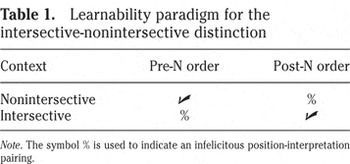
I use the term disfavored rather than preempted here because the latter term implies that we would find absolute acceptance and rejection of the position-interpretation pairs in Table 1 at near-ceiling rates among native speakers. Studies involving interpretive judgments within context (e.g., Dekydtspotter, 2001; Dekydtspotter & Sprouse, 2001; Dekydtspotter, Sprouse, & Anderson, 1997, 1998; Dekydspotter, Sprouse, & Thyre, 1999/2000) as compared to studies on word order alone rarely demonstrate such absolute behavior because one is not dealing with grammaticality per se but, more typically, the degree to which a given (grammatical) word order is acceptable given particular and rather subtle contextual information, which might be disregarded, forgotten, or misunderstood by task-takers in their evaluation of sentence tokens. Additionally, task-takers might reject test sentences that we would have expected them to accept because they are odd on pragmatic or stylistic grounds despite the fact that the propositional content of such sentences yields true values in terms of truth-conditional semantics. The present study is no exception: Statistically significant relative rates of acceptance (favored) and rejection (disfavored) are found rather than absolute rates for word orders based on interpretive differences.
The principal research question guiding the current study is whether L1 English learners of French arrive at the same position-interpretation correlates shown in Table 1 in some stage of interlanguage grammatical development and, if so, at what point during grammatical development they do so. What separates the child L1 acquirer from the adult L2 learner under this developmental scenario is the existence of other forms of evidence for the interpretive distinction schematized in Table 1.
Learnability paradigm for the intersective-nonintersective distinction

ADJECTIVE POSITION AND AVAILABLE EVIDENCE
Gass (1997) defined prior knowledge as consisting of L1 knowledge, existing L2 knowledge, language universals, and knowledge of other languages. Of these four types of knowledge, only the first two will be addressed here, as language universals have already been discussed in terms of domain-specific representational formats, and knowledge of other languages does not apply to the experimental population of the current study. Although Gass provided a useful characterization of prior knowledge, her use of the term “knowledge” is (perhaps intentionally) left vague as to the implicit-explicit dichotomy. For the purpose of this study, existing L2 knowledge is operationalized as both explicit knowledge of pedagogical rules to which learners are exposed in the classroom and implicit knowledge gleaned from L2 input. L1 knowledge is conceptualized as solely implicit knowledge—a (parameterized) grammar constituting the initial set of structural hypotheses about the L2 (following Schwartz & Sprouse, 1994, 1996).
Explicit Rules
English-speaking classroom learners in the United States are provided with three rules of French adjective placement, which take the form of a general rule with two exceptions: Most adjectives in French are post-N, although a few are pre-N, and a few more are said to change meaning based on their position. First- and second-year textbooks are strikingly similar in the statement of such rules and in their order of presentation, although they differ to some degree on which adjectives are to be included in the classes that constitute (putative) exceptions to the general post-N rule (see Anderson, 2007b).
In the textbook used by the second-year university-level students who participated in the present study, readers are told that “a number of adjectives change meaning depending on whether they're placed after or before a noun. In general, an adjective placed after the noun retains its basic, concrete meaning. The same adjective placed before the noun is used in an abstract or figurative manner” (Bragger & Rice, 1996, p. 34). The seven adjectives that apparently fall into this class are listed in (6). The first gloss captures the meaning derived from pre-N position; the second gloss captures the meaning derived from post-N position.

This approach to instruction on adjective position is advantageous in its simplicity, providing easily remembered rules of thumb that learners can apply during comprehension and production tasks. Learners might therefore be expected to accept as grammatical an adjective in post-N position and concomitantly consider ungrammatical an adjective in pre-N position unless it belongs to the two classes of exceptions that textbooks treat as being lexicalized: one requiring pre-N position and the other requiring this position only under a particular English gloss-based meaning meant to capture the “abstract or figurative manner” in which it is used (Bragger & Rice, 1996, p. 34).
It is noteworthy that in most pedagogical treatments, no explicit rules are given relating to the possibility of both pre-N and post-N adjective positions for adjectives other than those that have particular English gloss-based meaning differences. Such is the case, for example, with an adjective like lourde “heavy” in (3b). This is arguably an important gap in the pedagogical treatment of adjective position in French, as Anderson (2002, 2007b) found that roughly 60% of the 205 most frequently used adjectives across a number of text genres in French are regularly attested in both positions.6
A. Valdman (personal communication, December 10, 1999) pointed out that frequency counts alone are potentially inaccurate representations of the extent to which adjectives vary in position because the corpora on which they are based (e.g., Wilmet, 1980) provide no indication of the range of nouns with which they appear. Thus, although an adjective like plein “full” might appear 79 times in pre-N position out of 155 tokens, it might only do so in a number of fixed expressions such as la pleine lune “the full moon.” Therefore, in selecting adjectives for use in the test sentences, I consulted the ARTFL database, which allows a concordance to be performed on French literary texts. Only adjectives that appeared both prenominally and postnominally with a range of nouns were selected for inclusion in the test sentences.
Classroom Input Frequency
Anderson (2002, 2007b) observed L2 French classes at different levels in the university setting to determine the quantity and quality of input on adjective position. These classroom observations demonstrated that throughout the undergraduate curriculum the explicit rules just summarized are rarely contradicted by examples of unexpected pre-N or post-N position—despite the fact that adjectives occurred in classroom input from 42 times per 50-min class period in a first-year introductory course to 156 times per class in a fourth-year civilization course for French majors. Students therefore heard an adjective used one to three times per minute on average.
Post-N and predicate positions, both of which derive an intersective interpretation, constituted fully 75% of the ratio. Pre-N position, deriving a nonintersective interpretation, never surpassed 27% for any one course level. Considering the number of distinct lexemes (types) that make up those percentages, only 15 adjectives appeared in pre-N position in the introductory course. This number gradually increased with course level but only reached a total of 41 lexemes in the fourth-year course. Post-N position, on the other hand, admitted a much larger variety of adjectives in classroom input, from 71 in the introductory course to 323 in the fourth-year course. Students therefore received relatively little input on pre-N position, made up of a relatively small number of adjectives used over and over again in this position. Most of these adjectives already figure into the list of so-called exceptionally pre-N adjectives typically provided in textbooks.
Finally, Anderson (2002, 2007b) demonstrated that very few adjectives showed variation in position. None was attested in 10 h of observation in the introductory course, and only four to seven adjectives varied in position in the second- and third-year courses. At the fourth-year level, learners received somewhat more targetlike input, in which 20 adjectives varied in position. Of those adjectives appearing in both positions in the input, most (but not all) already figure into the list in (6).
L1 Knowledge
In a model of grammatical development in which the L1 (parameterized) grammar constitutes the initial state of SLA (e.g., Schwartz & Sprouse, 1994, 1996), native English speakers would initially assume that their grammar—in particular, a structural representation of DP that lacks overt noun movement—is sufficient to accommodate French input containing adnominal adjectives. Subsequent states of grammatical development, in this model, are failure-driven in the sense that the inability to accommodate L2 input deductively triggers a structural representation that will accommodate such data. (Note that this does not necessarily entail that interim or even end-state representations necessarily match those of the target; they are simply representations that successfully accommodate input.)
Although post-N adjective position in French input might, at first glance, appear to constitute an unambiguous and, therefore, immediate trigger for a targetlike structural representation of DPs, there is some reason to believe it does not: The existence of DPs containing pre-N adjectives in the L2 input in conjunction with the existence of at least four surface word-order patterns in which an adjective appears postnominally in English means that the L1 and L2 grammars do not produce mutually exclusive word-order strings. Instances of post-N position in English include the types of uses exemplified in (7)–(10):

Whereas (7) might be dismissed as a peripheral (i.e., marked) construction, (8) dismissed as involving solely pronouns, and (10b)–(10d) considered structurally distinct from the unmarked case of adjectival modification, Bouldin (1990) argued on the basis of several tests of constituency that (9) and (10a) represent true NP constituents and that both are interpreted intersectively. Although one might additionally dismiss (9) as irrelevant (following Ernst, 2002, one can consider weight-related movement as a postsyntactic operation at phonological form), the ability of deverbal nouns to appear postnominally in English, as in (10a)—constituting true NP constituents and receiving an intersective interpretation—allows for the possibility that a much larger class of adjectives in French (also appearing postnominally and interpreted intersectively) would not serve as an unambiguous and, therefore, immediate trigger, as such input can (arguably) be accommodated within the L1-based grammar.
Summary
On a conceptualization of grammatical development and eventual attainment in terms of parameterization, a priori knowledge of a UG-derived representational format (such as in the syntactic trees in [5]) in conjunction with positive evidence of adjectives in post-N position (perhaps in addition to other morphosyntactic properties of the DP) would lead both the L1 French speaker and the L2 French learner to favor an intersective interpretation in post-N position for a given adjective and the nonintersective interpretation in pre-N position, as in Table 1. The other potential interpretation for each adjective position would necessarily be disfavored, given only two adjunction site possibilities and overt movement to a functional head between these two sites.
In the present section, forms of evidence available solely to the adult classroom L2 learner have been considered. In general, this evidence would appear to work against the learner in quickly arriving at the relevant target representation of DPs capable of distinguishing between the position-interpretation pairings in Table 1. First, available classroom input reinforces rather than contradicts the notion of a fixed word order for adjectives: The only exceptions to the general post-N rule are lexicalized classes to be memorized; those that do appear in pre-N position in classroom input are, in most cases, ones that learners expect to appear in that position; the few adjectives that appear in both positions are, again, in most cases, ones that learners expect to do so. Second, the overlap in word-order strings produced by French and English grammars might potentially make the flood of input featuring DPs containing post-N adjectives a less immediate and less unambiguous trigger for grammatical change.
RESEARCH QUESTIONS AND METHODOLOGY
Research Questions
The foregoing discussion has raised the question of whether classroom L2 French learners, like native French speakers, come to demonstrate knowledge of the position-interpretation correlates of French adjective position and, if so, at what point during the course of grammatical development they do so. Additionally, the availability of explicit rules for some such correlates raises the question of whether learners demonstrate knowledge of these correlates earlier in the course of development than they do for adjectives that demonstrate the same intersective-nonintersective correlation but are not the subject of explicit rules.
Study Populations
There were 157 participants in this study, divided into six groups. A monolingual English-speaker control group consisted of 30 freshmen students enrolled in a course on English composition, none of whom had previously studied or were currently studying French.7
Nearly all participants in the native-English-speaker control group had some exposure to a foreign language during high school; therefore, they were not monolingual speakers of English in the strictest sense. Those having studied a typologically similar foreign language (Spanish or Italian) were retained in the study population, whereas data from those who reported having studied French in particular were excluded from analysis, as it was felt that they would be the most likely to accept Frenchlike (but otherwise ungrammatical) English word orders. Those who reported growing up in a bilingual household or one in which English was not the sole language were similarly excluded from data analysis (in the learner groups as well).
The learner groups consisted of 100 English-speaking students of French at a Midwestern American university at the second-year (n = 29), third-year (n = 24), and fourth-year levels (n = 27) of undergraduate study.8
Learners in the second-year class were in their third semester of the core foreign language and culture curriculum that is required of all university students. The third- and fourth-year classes consisted mostly of students majoring or minoring in French. Participants at the third-year level came from courses in conversation and advanced grammar/composition. Participants at the fourth-year level came from courses in French civilization and advanced conversation. The inclusion of students at levels earlier than the second year was impossible because instruction on so-called variable adjective position (ancien, pauvre, cher, etc.) takes place during the first few weeks of the second-year level.
Finally, the French-speaker control group consisted of 27 students at the University of Lille in their second year of study toward a general diploma (DEUG) in English. The inclusion of data from these participants served two purposes: (a) to demonstrate that the testing instrument devised for the study was sensitive enough to capture interpretive distinctions already noted in the theoretical literature and (b) to examine how isomorphic the response patterns of the most advanced group of learners are with those of native speakers (i.e., to investigate the issue of eventual attainment).
Task Design and Tokens
A two-part acceptability judgment task was administered via computer in a controlled setting (a university computer lab) on two different days spaced a week apart. Study participants were asked to complete a Web-based form that requested biographical information and previous experience with French and other foreign languages. Participants then read a page of instructions, in which they were asked to provide a judgment of each test sentence by clicking on buttons marked fine, odd, or cannot decide in response to the prompt This particular sentence sounds ____ in this context. They were asked to do so in a timely fashion and not to compare answers with other students or with previously answered task tokens. Context-sentence pairs involving the position of only in English were used as an example (e.g., Only Tom likes spinach vs. Tom only likes spinach). Each 30–50-min testing session was supervised by the experimenter, in order to ensure that all directions were being followed properly.
The total number of context-sentence pair tokens was 104, randomly divided between two tasks of 52 context-sentence tokens each. Three versions of each task, representing different randomizations, were constructed in order to avoid a task effect. (An analysis of the responses provided on each version of the task showed no disproportionate scores for any one version.)
To ensure that the learner groups fully understood the subtleties of the contexts within which the French task sentences were to be evaluated and that each of the two tasks could be completed in a reasonable amount of time without undue fatigue, the contexts were written in English. So as not to introduce language-of-context as a potential confound, English was also used on the tasks for the native-French-speaker control group (requiring French speakers with a good reading knowledge of English) and, obviously, for the monolingual English-speaker control group. Language transfer from context to sentence represents its own potential confound, but one that was felt to be less serious in nature, given previous studies that successfully utilized the same format (beginning with Dekydtspotter, Sprouse, & Anderson, 1997). Within each context, a few French translations were provided in parentheses for those words in the (French) test sentences that were most likely unknown to the lower-level learners.
Eight sentences with pre-N adjective position and eight sentences with post-N adjective position were presented once in a context favoring a general intersective interpretation and again in a context favoring a general nonintersective interpretation, for a total of 32 tokens randomized across the two tasks. The remaining 72 tokens were either distracters (n = 16) or were included to test knowledge of other interpretive properties of French (n = 56) (see Anderson, 2002, 2007a).
The eight adjectives chosen for inclusion in the test sentences were equally divided between those that regularly receive instruction in the form of lexicalized meanings based on English glosses, listed in (11), and those that do not, listed in (12). The two percentages in brackets next to each adjective indicate the extent to which that adjective appears in pre-N versus post-N position, respectively, in written French texts across a number of genres (based on corpora compiled by Forsgren, 1978; Larsson, 1993; Wilmet, 1980). They are provided here only to demonstrate that such adjectives do indeed vary in their position, although adjectives within the instruction set in (11) are, distributionally speaking, much more skewed toward pre-N position than those in (12).

An example of the contexts and test sentences used on the task is provided in Appendix A, using the interpretive correlates related to cher in (11a). Because the goal of the contexts was to strongly favor one interpretation and concomitantly disfavor the other, care was taken to ensure, for example, that the “beloved” piece of jewelry in the context was not “expensive” and that the “expensive” piece of jewelry was not “beloved.”
Among the monolingual English-speaking controls, we should find clear-cut acceptance rates owing to the (un)grammaticality of adjective order, with sentences featuring pre-N adjective position accepted well above chance rates and sentences featuring post-N position rejected well below chance rates. Among the native-French-speaker controls, for whom adjective order is a matter of acceptability within context, we should find a significant statistical difference between the relative acceptance rates of the sentences with pre-N and post-N adjectives based on the interpretation motivated by the context.
Scoring
Participants' responses were recorded automatically by a Web-based testing service. Fine and odd answers for each of the four conditions (two syntactic configurations crossed with two interpretations) were converted into percentages, such that if a participant answered fine on seven of the eight tokens within condition X (e.g., post-N position in an intersective context), this was converted to 87.5%; the one token marked odd was converted to 12.5%, thereby totaling 100%.9
Responses of cannot decide did not alter the calculation of the percentages; they were simply discarded from analysis. A lack of response on a particular token did, however, alter the calculation of the percentages: If only five out of the eight tokens were judged, three fine responses of those five constituted a rate of 60%; the two odd responses constituted a rate of 40%.
RESULTS
Native-French-Speaker Control Group
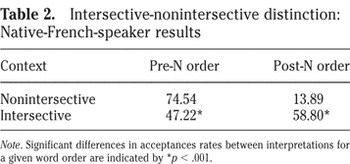
The results from the native French speakers, presented in Table 2, demonstrate that the task was moderately sensitive to the interpretive distinctions schematized in Table 1. Pre-N position is associated with a nonintersective interpretation, preferred 75–47% over an intersective interpretation (p < .001), and post-N position is associated with an intersective interpretation, preferred 59–14% over a nonintersective interpretation (p < .001).
Intersective-nonintersective distinction: Native-French-speaker results

Although the task as designed was sufficiently powerful to capture the interpretive distinctions noted in the theoretical literature, we find that the data related to the nonintersective interpretation is much more robust: clearly favored in pre-N position, at 75%, and clearly disfavored in post-N position, at 14%. The data related to the intersective interpretation is less robust, with rates in both positions hovering around chance level.
One could argue that the intersective contexts—taking the one provided for the adjective cher “expensive∼beloved” as an example (see Appendix A)—do a better job of motivating one particular interpretation (expensive) than they do of concomitantly excluding the other interpretation (beloved). In other words, a piece of jewelry worth $100,000 might still be beloved not because of its sentimental value, which the intersective context tried to mitigate against, but because of the wealth it bestows on its owner, a possibility that the context failed to mitigate against. The higher-than-expected acceptance rate of 47% in pre-N position for the intersective contexts in general might, therefore, be attributed to the ability of native speakers to defeat the intent of contexts, as written, in this respect. This, however, would not explain why, in post-N position, we find a lower-than-expected rate of 59% for the intersective interpretation. (A $100,000 piece of jewelry is, after all, expensive.) I would attribute this fact to the distributional bias we saw earlier in reference to the adjectives in the instruction set in (11) and the noninstruction set in (12), most of which appear much more frequently in pre-N position than in post-N position. The reason behind this distributional bias, moreover, might be attributable to the existence of separate lexemes that unambiguously capture the intersective interpretation: Whereas cher “expensive” and nouveau “new” can have such an interpretation in post-N position, the adjectives coûteux “costly” and neuf “(brand) new,” respectively, do so more transparently. The native-French-speaker response rates for post-N position under an intersective interpretation, at 59%, might, therefore, be attributed to a stylistic preference based on this distributional bias coupled with the existence of alternative lexemes.
Despite less robust findings for the intersective interpretation among native French speakers, it is the case that the more felicitous interpretation-position test sentences were significantly preferred over the less felicitous ones in both cases, as predicted by a French parameterized grammar. The task as devised was therefore sufficiently sensitive for probing the intuitions of the learner groups with respect to the position-interpretation pairs in Table 1.
Native-English-Speaker Control Group
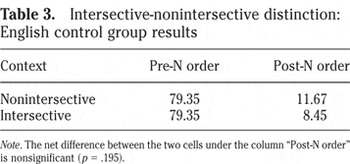
Table 3 illustrates that, for the native-English-speaker controls who evaluated word-for-word translations of the French test sentences, adjectives are accepted in pre-N position at equal rates of 79% and rejected in post-N position at rates of 12% for an intersective interpretation and 8% for a nonintersective interpretation, a nonsignificant difference (p = .195). Such rates provide a clear picture of the acceptability (= grammaticality) of pre-N position and concomitant rejection (= ungrammaticality) of post-N position, as predicted by a parameterized grammar distinct from French.
Intersective-nonintersective distinction: English control group results

Learner Groups
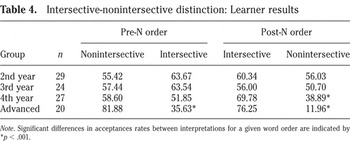
The results presented in Table 4, involving all eight adjective tokens in (11) and (12), show that there is no statistically significant difference in means in either position on the part of second- and third-year learners. Acceptance rates are at chance level or somewhat skewed in favor of acceptance (ranging from 51% to 64%). By the fourth-year level, a significant and nativelike difference appears only in post-N position (70% for intersective interpretations and 39% for nonintersective interpretations, p < .001). It is only at the advanced level that a significant Frenchlike distinction is made in both pre-N position (82% nonintersective and 36% intersective, p < .001) and post-N position (76% intersective and 12% nonintersective, p < .001).
Intersective-nonintersective distinction: Learner results

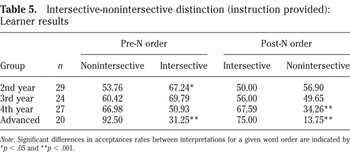
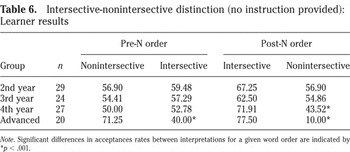
When the results in Table 4 are divided between those adjectives for which the learner groups can rely on the glosses they have learned (the instruction set), illustrated in Table 5, and those for which they cannot (the noninstruction set), illustrated in Table 6, virtually no difference is found. What is (non)significant when all eight adjectives are considered together in Table 4 is also (non)significant when they are considered separately.10
Results from the native-speaker control groups were not computed and are not included in Tables 5 and 6 because the distinction between adjectives receiving pedagogical treatment and receiving no such treatment is unique to the experimental groups (the L2 learners of French).
Intersective-nonintersective distinction (instruction provided): Learner results

Intersective-nonintersective distinction (no instruction provided): Learner results

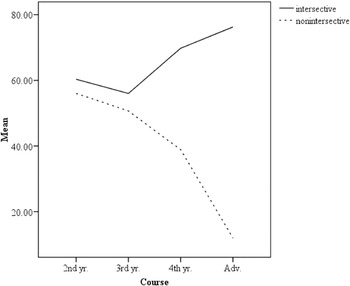
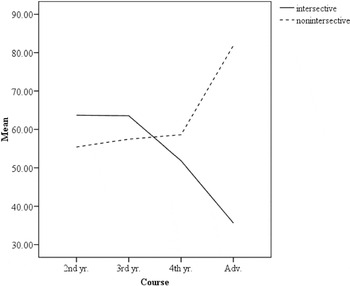
The acceptance rates for all eight adjectives in Table 4 are plotted on the graphs in Figures 1 and 2, which range from the second-year level to the advanced level and from which we can extrapolate the course of grammatical development. Acceptance rates for post-N position are plotted in Figure 1. Unlike the native-English-speaker controls, learners generally accept adjectives in post-N position at rates of roughly 60% on either interpretation.

Development of more nativelike intuitions concerning the felicity of postnominal position under an intersective interpretation (solid line) and infelicity under a nonintersective interpretation (dotted line).

Development of more nativelike intuitions concerning the felicity of prenominal adjective position under a nonintersective interpretation (dotted line) and infelicity under an intersective interpretation (solid line).
The lack of an interpretive distinction is maintained (statistically) in the second- and third-year groups, although the results from these two groups are interesting in a developmental sense: A slightly higher raw percentage acceptance rate is found for the intersective interpretation (the solid line) than for the nonintersective interpretation (the dotted line), a difference in the target French direction that becomes increasingly more pronounced—and reaches statistical significance—by the fourth-year level and even more so at the advanced level. When compared to the results from the French-speaking controls, one finds that the advanced-level learners outperformed the native speakers, so to speak, in that their relative rates of acceptance for post-N position (76% vs. 12%) are more robustly skewed in the theoretically predicted direction than those of the native speakers (59% vs. 14%). This might be attributed to a greater reliance on UG-driven properties of syntax-semantic correspondence that is less hampered by idiosyncratic distributional biases and alternative lexemes.
Figure 2 presents the acceptance rates for pre-N position (nonintersective interpretation). The high rate of acceptance on the part of the native-English-speaker controls (and lack of an interpretive distinction) is not maintained at the second-year level, given a decrease in acceptance rates and a significant distinction in interpretation in the direction opposite to the native-French system. As mentioned previously, an intersective interpretation (the solid line) is actually preferred over a nonintersective interpretation (the dotted line) in pre-N position by these learners. This nontargetlike distinction is lost at the third-year level, given the lack of a statistically significant difference based on interpretation. By the fourth-year level, the raw percentages of acceptance rates have switched to the Frenchlike direction, though not yet in a statistically significant way. At the advanced level, a preference for a nonintersective over an intersective interpretation is firmly in place. Unlike the case of post-N position in Figure 1, relative rates of acceptance for pre-N position among these advanced-level learners (82% vs. 36%) are more isomorphic with those of the native-French-speaker controls (75% vs. 47%).
The net difference in mean acceptance rates between the two interpretations in both adjective positions—the area between the solid and dotted lines in Figures 1 and 2—was submitted to a one-way ANOVA that showed that the course-based learner groups did differ significantly from one another for both post-N position, F(3, 96) = 19.49, p < .001, and pre-N position, F(3, 96) = 18.477, p < .001. Post hoc least significant difference (LSD) tests for post-N position showed that the second- and third-year learner groups were not significantly different from one another, whereas the fourth-year learners were significantly different from all other groups, as were the advanced learners. Post hoc LSD tests for pre-N position showed that the second-year level learners were not significantly different from the third-year learners, who, in turn, were not significantly different from the fourth-year learners. The advanced learners were, again, significantly different from all other groups.
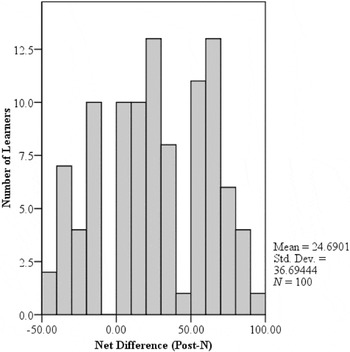
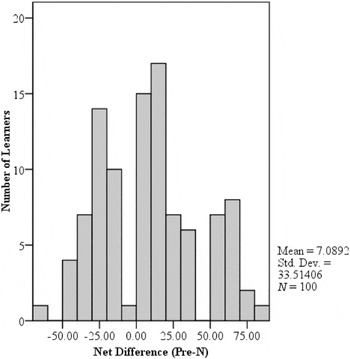
The net difference in mean acceptance rates for individual learners (N = 100) was then plotted on the histograms in Figures 3 and 4.11
The histograms in Figures 3 and 4, involving individual learner results, are meant to correspond with the aggregate-learner-group results in Figures 1 and 2; therefore, results from the native-speaker control groups were not plotted in these figures.

Distribution of individual learner results based on the net difference between acceptance of post-N adjective position under an intersective versus nonintersective interpretation.

Distribution of individual learner results based on the net difference between acceptance of pre-N adjective position under an intersective versus nonintersective interpretation.
With respect to pre-N position (Figure 4), a wide and unregimented distribution is in evidence, ranging from 37 learners who show a negative difference, 14 who show no difference, and 49 with a positive difference. Those learners who show a negative or zero difference are distributed across all levels except advanced; those learners who show a positive difference are distributed across all levels, as was the case for post-N position.
Finally, note that some learners at each course level show a targetlike difference in interpretation for both adjective positions simultaneously. Of those learners for whom a positive distinction is in evidence in the histograms in Figures 3 and 4, 10 are at the second-year level (n = 29), 14 are at the third-year level (n = 24), 22 are at the fourth-year level (n = 27), and all 20 learners at the advanced level fall into this category. A subset of the learners at each course level shows a positive distinction at rates that are equal to or greater than the native-French-speaker average: These include 2 learners at the second-year level, 5 at the third-year level, 9 at the fourth-year level, and 19 at the advanced level.
DISCUSSION AND IMPLICATIONS
In response to our research questions, the results of the present study show the following:
- Second language French learners, like native French speakers, acquire the position-interpretation correlates schematized in Table 1.
- On the basis of aggregate group data, such correlates would appear to be a gradual and late-acquired property, given that statistically significant distinctions based on interpretation in both adjective positions do not arise in the data until the postgraduate level. However, on the basis of individual results, targetlike position-interpretation correlates appear in the interlanguage grammars of even a few second-year learners at rates equal to or exceeding those of native French speakers.
- Position-interpretation correlates for the adjectives in the instruction set do not appear to be acquired any earlier than the adjectives in the noninstruction set, which evince the same interpretive correlation but are not the subject of explicit rules. Task tokens utilizing each class of adjectives show, instead, a striking similarity in response patterns.
The results summarized in point 1 support the claim that domain-specific representational (hierarchical) formats, as illustrated in the syntactic trees in (5), are a necessary component in accounting for L1 and L2 implicit knowledge of syntactico-semantic composition—as opposed to linear word orders—and that these formats continue to be accessible in the case of SLA (contra Meisel, 1997).
A particularly important finding in this respect is the fact that grammatical development is not static from the second-year level onward, but, rather, moves in the target direction. For this to occur, the infelicitous position-interpretation pairs (intersective for pre-N order and nonintersective for post-N order) must come to be disfavored (or preempted). This development is found in the current data: Acceptance of the infelicitous intersective interpretation in pre-N position drops from 64% at the second-year level to 36% by the advanced level, and acceptance of the infelicitous nonintersective interpretation in post-N position drops from 56% at the second-year level to 12% by the advanced level. Yet, there is nothing, in the absence of a priori constraints on syntactico-semantic composition, to guarantee that just this sort of developmental path should occur. In an unconstrained theory of induction, in which intuitions are based on recurrent and nonrecurrent patterns, a change in the quality and quantity of positive evidence in the L2 input would need to occur past the second-year level in order to drive the preemption of infelicitous position-interpretation pairs that we find. As Anderson (2002, 2007b) showed, however, this is not the case for the classroom learners in the present study. Moreover, although the switch from an Englishlike grammar (as represented by the response rates of the native-English-speaker control group) to a Frenchlike grammar appears to be a gradual one—potentially supporting a gradual, domain-general inductive account—this is only true when results are cast in terms of aggregate group rates. As mentioned earlier, there are already 10 learners at the second-year level who show a targetlike difference in interpretation for both adjective positions simultaneously, 2 of whom do so at rates that are equal to or greater than the native-French-speaker average.
The claim of a priori constraints on grammatical development and, in particular, the conceptualization of such development in terms of deduction via parameterization is nonetheless met with the challenge of accounting for the finding that learners exposed to the same quantity and quality of classroom L2 input appear to make the relevant switch at different points in the course of development (point 2). There are, for example, five learners as late as the fourth-year level who fail to make a targetlike difference in interpretation for both adjective positions simultaneously.
The analysis of adjective position and available evidence adopted for this study has already gone some way in accounting for a general acquisitional delay, given forms of evidence that are available solely to the adult classroom L2 learner and that can be considered to work against the immediate triggering of the relevant noun-movement analysis of DPs. In particular, prior knowledge in the form of an L1-based initial state might have a particularly strong effect. It could be argued, however, that English post-N adjective constructions (e.g., The River Wild, someone charming) would only delay or prevent adoption of a noun-movement analysis of French DPs if one assumes that native English speakers do not fully know the structural properties that distinguish these particular conditions from the unmarked French cases (in [1]–[4]). This assumption seems problematic.
Of particular relevance in responding to this argument and to the issue of delayed acquisition more generally is Gass's (1997) distinction between the apperception, comprehension, and integration of input, each of which constitutes independently necessary steps within the acquisition process. To summarize her account, a learner may or may not apperceive (recognize, notice) in the input that there is “something to be learned … that there is a gap between what [he or she] already knows and what there is to know” (Gass, p. 4). If apperceived, such input may or may not be comprehended (analyzed) at a deep enough level to “gain an understanding of the syntactic or phonological pattern represented” (Gass, p. 5). If apperceived and comprehended, such input may or may not be integrated (instantiated as part of implicit knowledge). How quickly, if ever, learners pass through these stages is, on Gass's account, mediated by a number of factors, including time pressure, frequency, affect, prior knowledge, salience of form, or attention level, among others. Thus, I would argue that similar word-order strings, even if superficially similar ones, constitute one mediating factor in how quickly learners from the same L1 group pass through each stage, with other psychosocial factors described by Gass mediating how quickly individual learners from the same L1 group do so.
If a L1-based initial state, as part of the learner's prior knowledge, appears to have a particularly strong effect on the course of grammatical development, the effect of existing L2 knowledge in the form of explicit rules, as summarized in point 3, is less clear. Explicit rules of the type currently provided in the classroom, involving English gloss-based differences in meaning, appear not to have been accessed by (many of) the undergraduate learners in their evaluation of the acceptability of the sentences with cher “beloved∼expensive,” ancien “former∼ancient,” grand “great∼tall,” and pauvre “pitiful∼peniless.” Nor does it appear that such rules were extended to interpretation-position pairs for which instruction is not provided but that, nonetheless, evince the same interpretive correlates (nouveau “new,” nombreux “numerous,” simple “simple,” and différent “different”).
Of the main research findings, however, the discussion of this latter finding is the most tentative. Norris and Ortega's (2000) meta-analysis of research on the effectiveness of pedagogical intervention convincingly showed a stronger and more durable effect for explicit evidence (focus-on-form[s], rule presentation, correction, feedback, etc.) in combination with input than for input alone, as provided during implicit, meaning-oriented interventions. Explicit evidence apparently has such an effect, according to Norris and Ortega, by manipulating learners' focal attention when processing the L2 “so as to increase the likelihood that certain linguistic features are noticed … and eventually acquired” (p. 419)—or apperceived and eventually integrated, in Gass's (1997) terminology. Norris and Ortega's explanation, however, conspicuously leaves out the intermediary stage of comprehension in Gass's model, wherein input must be analyzed at a certain depth for true integration to occur. It remains an empirical question whether explicit instruction plays a role at this stage and not simply in apperception. In a solely bottom-up input processing account of language, of the type advocated by Fodor (1983) and applied to the case of SLA by Schwartz (1986, 1993, 1999), explicit instruction could only play a role at the apperception stage. In an account in which input processing can be both bottom-up and top-down, of the type advocated by Jackendoff (1997) and applied to the case of SLA by Carroll (2001), explicit instruction—including focus-on-form(s), correction, and feedback—constitutes conceptual knowledge that can, if translated into a domain-specific format, play a role at both the apperception and comprehension stages.
One might wish to argue, then, that the explicit rules provided to learners in the present study at least cued them to the fact that variation in French adjective position is to be associated with variation in interpretation. Whether some other form(s) of explicit evidence, including pedagogical intervention of a type other than English gloss-based distinctions, would be used more readily in the participants' evaluations (their performance) or indeed incorporated into their implicit knowledge of French DP structure (their competence) is an open question. Further research on the acquisition of adjective position in L2 French involving differential pedagogical treatments would be valuable in this respect.
APPENDIX A: SAMPLE CONTEXTS AND TEST SENTENCES
NONINTERSECTIVE CONTEXT
Madame Blin is getting quite old. Before she dies, she'd like her grandchildren to have some of her favorite possessions. There is a painting of her when she was young, a rug she bought on a vacation to North Africa, and an imitation diamond—worth only about 100F (= $15)—that she wore in the many community theater productions she took part in. She gives the painting and rug to her grandchildren, but the piece of jewelry (= bijou) has so much sentimental value that she decides to keep (= garder) it until her death.

INTERSECTIVE CONTEXT
Madame Blin is divorcing her husband, and the two of them are now working out who will keep (= garder) which items. One piece of jewelry (= bijou) she received from her husband was now valued at close to $100,000—a large sum of money for such a small item! She is not a sentimental person, so she considered giving it back to her husband (she really didn't want to keep anything that man had given her!). However, on second thought, she decides that it's better to keep the piece of jewelry after the divorce. In the future it will be worth even more money.

Note. The English glosses of the test sentences are those that the monolingual English control group evaluated. The symbol % is used to indicate an infelicitous interpretation within the particular context.
APPENDIX B: NATIVE-FRENCH-SPEAKER RESULTS BY TASK TOKEN