INTRODUCTION
Limited prospects for increasing overall land area under crop production, along with declining yield of major food crops in many parts of the world, raise concerns about the capacity to feed a world population expected to exceed 7·5 billion by 2020 (Mosier & Kroeze Reference Mosier and Kroeze2000). Furthermore, widespread decline of soil fertility also raises questions about the sustainability of current agricultural production levels, maintenance of animal health through soil-mediated supply of good herbage and the wider range of ecosystem goods and services that soils must provide. The soil resource base is the critical component of agro-ecosystems, and must be managed sustainably to safeguard food security. Future strategies for increasing agricultural productivity must focus on more efficient use of soil resources. Integrated soil management (ISM) encompasses many of the principles required to achieve this.
Definitions
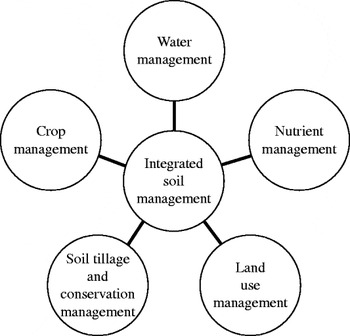
ISM involves a combined strategy of effective nutrient, crop, water, soil and land management (Fig. 1) for sustainable agricultural production and other forms of land use. Sustainable agriculture requires conservation of land and water, as well as plant and animal genetic resources, it does not degrade the environment, and is economically viable and socially acceptable (Sakai Reference Sakai2009). It can be tailored to the characteristics of site and soil and, importantly, to environmental, economic and social constraints faced by farmers.
ISM and its components.

CURRENT DEVELOPMENTS IN ISM
Global perspective
The doubling of global food demand projected for the next 50 years (Beddington Reference Beddington2009) poses a challenge for sustainability of food production and the environment.
The greatest requirement for soil management technologies to best use soil and water resources is in the arid and semi-arid developing world, including sub-Saharan Africa as well as large parts of India, Central Asia and north-eastern Brazil (Lal Reference Lal2000). Such technologies should enhance soil structure, improve nutrient use efficiency, conserve valuable soil and water resources, improve water use efficiency and, where possible, increase cropping intensity (Lal Reference Lal2000). Although ISM, incorporating these aims, offers a way ahead, a real shift towards this is critically dependent on policy conditions, as well as educational and cultural changes to translate policy into action (Kauffman et al. Reference Kauffman, Koning and Heerink2000). This will apply to most developing areas.
Minimization/avoidance of soil degradation and environmental pollution
Soil and fertility loss worldwide are caused by salinization, desertification and soil mismanagement. Continued loss of productive land along with vital, stabilizing, soil organic matter in developing countries such as Pakistan is linked to the separation of fertility management and rainwater conservation practices (Shaheen et al. Reference Shaheen, Naeem, Jilani and Shafiq2009). A more effective future direction is offered by ISM, where these issues are dealt with in a combined strategy. Lal (Reference Lal2000) identified soil-specific technologies for such a combined strategy including structural enhancement, integrated nutrient management/recycling, residue management/incorporation/mulching, conservation/minimum tillage and improved water capture/recycling/irrigation. Success of conservation/minimum tillage in increasing soil organic matter, with consequent improvement in fertility and erosion control, has been reported for Brazilian agriculture (Machado & Silva Reference Machado and Silva2001). Other established technologies such as contour ploughing/physical barriers across slopes and cover cropping are also useful in stabilizing soil vulnerable to erosion, particularly in arid and semi-arid areas.
A range of agroforestry (silvopastoral and silvoarable) approaches protect against erosion and conservation of the soil resource, through mechanisms such as more effective rooting patterns to stabilize soil and access water, riparian zones, residue incorporation and green manuring with legume residues. Agroforestry-mediated soil and water conservation with associated erosion control has proved successful in Himalayan India using leguminous (Leucaena) and non-leguminous (Eucalyptus) trees (Narain et al. Reference Narain, Singh, Sindhwal and Joshie1998).
Some technologies for protection against soil erosion are also effective in reducing environmental pollution (gaseous and waterborne) resulting from agriculture and reflect multiple gains from ISM. This applies to riparian strips, effective management of residues with varying carbon:nitrogen (C:N) ratios, cover cropping and minimum tillage (Dinnes et al. Reference Dinnes, Karlen, Jaynes, Kaspar, Hatfield, Colvin and Cambardella2002). It also applies to agroforestry through nutrient interception at different rooting depths of arable crops and trees, as well as through mulching of tree litter.
Manipulation of the soil biota for sustainable production
Chemical control of soil biota has long been practised using pesticides. More interestingly, rates of key below-ground processes have been partially managed with selective inhibitors. Examples include inhibitors to control urea hydrolysis and nitrification (Zaman et al. Reference Zaman, Saggar, Blennerhassett and Singh2009), while slow release fertilizers such as sulphur or polyolefin-coated ureas retard microbiological activity, better marrying nutrient supply to crop demand.
Biofertilization
Although legume inoculation for enhancing nitrogen (N2)fixation has been successful (mainly in tropical latitudes) and inoculation programmes with mycorrrhizal fungi and phosphate-solubilizing micro-organisms have encountered limited success (Siddiqui et al. Reference Siddiqui, Akhtar and Futai2008), widespread biofertilization with microbial inocula is yet to be realized. For consistently successful microbial inoculation, favourable edaphic conditions (resulting from ISM) are required at inoculum delivery and establishment.
Biocontrol
Whether exploiting indigenous populations or introduced inocula, biocontrol suffers from inconsistent field performance but has consistently succeeded in the protected and controlled confines of glasshouses. However, biocontrol forms a critical part of a ‘systems approach’ to integrated, sustainable soil pest management, to combat insecticide-resistant pests and minimize pesticide use (Bale et al. Reference Bale, Van Lenteren and Bigler2008). Successful, consistent biocontrol beyond the glasshouse requires research to understand the biology/ecology of pest/control agent/soil interaction so that soil management underpins this interaction.
Integrated weed control and control under soil conservation tillage
Sustainable agriculture requires control of pests and weeds with minimum input of chemical pesticides, which sometimes have unfortunate and environmentally damaging, non-target effects. Researching for viable alternatives to chemical control is also driven by issues of food safety and quality.
Integrated weed management, like ISM, involves alternative control measures. These include cultural, genetic, mechanical, biological and chemical means of weed control, none of which alone provide acceptable levels of control, but if implemented in some systematic strategy, adequate control is achieved (Swanton et al. Reference Swanton, Mahoney, Chandler and Gulden2008).
Integrated weed management for conservation tillage systems, well documented in Australian agriculture (Swanton et al. Reference Swanton, Mahoney, Chandler and Gulden2008), for example, aims to minimize environmental impacts of crop production, while maintaining effective weed control and profitability, but poses the greatest weed control challenge. Reduced herbicide application, rotary hoeing, inter-row cultivation and more advanced weeding techniques (e.g. intra-row hoeing) form components of alternative weed control and strongly complement/parallel ISM. Traditional techniques for weed and other pest control, such as soil solarization, are also being revisited with a view to sustainable, ISM.
Soil use as determined by land capability for agriculture
Managing soil for land-use capability is pivotal for ISM. Soil surveys have been carried out in many parts of the world to classify soil for land-use (particularly agricultural) capability, but this is frequently ignored or over-ridden in land-use decision-making by other criteria.
There are several different approaches for assessing land-use capability, each one having been developed for a particular part of the world. Many European systems are derived from approaches pioneered in North America. Assessment of land capability for agriculture is therefore well proven, and assessment is based on relationships between cropping and physical factors of soil, topography and climate.
Soil fertility enhancement and maintenance
ISM aims to combine organic and inorganic nutrients optimally for the enhancement/maintenance of soil fertility. This is not a new concept and there are obvious advantages to it, particularly in tropical latitudes where not only are nutrients supplied through mineralization from organic amendments, but there are also benefits from the activation of microbial biomass by an organic energy source. Organic amendments also supply a precursor to soil organic matter, reducing soil phosphorus (P) sorption (but increasing cationic nutrient retention) and enhancing fertility. With the expense of inorganic fertilizers, especially in developing countries, there is an economic and soil fertility argument to combined use of inorganic and organic fertilizers. Organic sources, providing bound nitrogen (N), P and sulphur (S), as well as some potassium (K), include composted and non-composted animal and crop residues, as well as sewage sludge (assuming acceptable metal concentrations). For both animal and human wastes, pathogens must be appropriately managed. However, regular organic amendments should translate to long-term improvements in crop yields as soil organic matter levels increase and soil becomes more fertile and structurally stable. Lal (Reference Lal2004) highlighted the important link between restoring diminished organic matter of degraded soils, and estimated that an increase of 1 tonne (t) of soil carbon in degraded cropland may increase yield by 20–40 kg/ha for wheat, 10–20 kg/ha for maize and 0·5–1 kg/ha for cowpea.
Adopting integrated soil fertility management (ISFM) requires policy and cultural changes in much of the developing world especially holders of small farms on marginal land, who rarely practise soil fertility management. ISFM involves judicious use of farmyard manures, crop residues, animal dung, green manures and oil cakes combined with inorganic fertilization, but this type of farming is not widespread.
Although ISM may offer sustainability through long-term soil fertility, there are many development-perpetuated myths about the adverse effects of inorganic fertilizers and beneficial effects of organic amendments requiring correction so that effective strategies are taken forward, particularly in sub-Saharan Africa (Vanlauwe & Giller Reference Vanlauwe and Giller2006).
Precision farming
Precision farming offers much of the enabling science needed to deliver ISM with the optimal use of soil, water and nutrient resources for efficient production and minimal environmental pollution. Precision farming with global positioning satellites (GPS) comprises remote sensing to locate ground position and geographic information systems (GIS) to store ground information for farming (Sylvester-Bradley et al. Reference Sylvester-Bradley, Lord, Sparkes, Scott, Wiltshire and Orson1999). It prescribes spatially, at appropriate scale, practices such as fertilization (the main practice under precision farming) cultivation/tillage, sowing and weeding using spatially variable soil/crop data.
Despite benefits of precision farming, there are obvious economic and social constraints to its adoption in developing countries, restricting it to large-scale, commercial farms. It may be, however, that some models of precision farming, particularly community-based models with associated learning groups of farmers and companies (Shibusawa Reference Shibusawa2004), can be applied to smaller-scale farms.
Soil in relation to land reclamation
Because ISM combines improvement of the supply of available soil water, restoring and improving soil fertility with organic and inorganic nutrient management and soil conservation techniques, it offers great potential for reclamation of structurally and chemically degraded soils, particularly in arid and semi-arid zones (Kauffman et al. Reference Kauffman, Koning and Heerink2000).
Crop productivity loss due to soil degradation (from erosion) is estimated at 18 million tonnes of food staples per year at 1990 yield levels for sub-Saharan Africa and 272 million tonnes worldwide at 1996 production levels (Lal Reference Lal2000). This may represent a yield loss at the landscape level or even total crop failure at the farm level. Much soil structural integrity comes from organic matter, including the living fraction (soil microbial biomass). The mining of soil organic matter through agriculture is common and threatens structural integrity, particularly in tropical soils (Lal Reference Lal2004), as organic matter mediates short term and more persistent binding. Loss of soil structure can also occur through slaking and dispersion, often linked to intensive cultivation (Lal Reference Lal2008), causing compaction and vital loss of the pore size distribution needed to maintain soil fertility. Because of these different processes, mechanisms of soil structural collapse and degradation vary climatically and from one soil type to another.
Technologies that enhance soil structure (residue incorporation and mulching, soil conditioning, manuring and some forms of agroforestry) and conserve soil (cover cropping, contour ploughing, riparian zones, minimum tillage and efficient/appropriate irrigation) have to be selected on a soil-/site-specific basis but offer ISM tools of soil restoration from physical degradation worldwide.
Remediation of contaminated soil
Although estimates of chemically contaminated (organic contaminants and/or metals) land vary with definition and methods of analysis, and a global figure is unknown, the extent is vast. Estimates of chemically contaminated land in England and Wales alone range from 50 000 to 200 000 ha (EA 2000). While the heaviest chemical contamination is associated with long histories of industrial development, the problem is worldwide, with contamination from persistent pesticides and from diffuse atmospheric pollutants being ubiquitous.
Remediation of contaminated land, along with food production, requires ISM where the emphasis is on sustainability rather than short-term gains. Bioremediation refers to the application of biodegradative processes to remove/detoxify contaminants found in water, soil or sediments. It can offer a cost-effective alternative to more traditional ‘dig and dump’ approaches and frequently offers sustainable solutions to the restoration of contaminated land, reducing land-filling and harnessing the inherent capacity of soil for degrading and immobilizing many contaminants, and restoring ecosystem function/health. Bioremediation also offers the prospects of soil reuse, assuming that regulatory end-points are reached. Both in situ and ex situ bioremediation require integrated management of soil and water (this may be groundwater, surface and soil water depending on site and type of bioremediation) resource, with issues of nutrient status/supply and oxygenation being critical for optimal remediation (Piotrowski et al. Reference Piotrowski, Doyle and Carraway2006).
Indicators for monitoring soil
Sustainable soil use requires robust indicators to monitor changes in soil quality/health. Recent research to identify which indicators are most suitable points to biological properties, as they best diagnose soil health and complement existing and well understood physicochemical properties.
A suite of indicators identified by Ritz et al. (Reference Ritz, Black, Campbell, Harris and Wood2009) comprises molecular fingerprinting techniques as well as more traditional enzymatic- and organism-based approaches, addressing the major biological trophic levels that mediate soil function. Measurement of these indicators requires standard operating procedures and assessment of their sensitivity, capacity to discriminate between soil and land-use combinations, as well as ecological/agroecological relevance.
FUTURE POTENTIAL OF ISM
While focusing on current aspects, it is useful to consider how ISM may develop in future both with policy/advisory support and with technological advances.
Uptake of ISM
Current policy approaches in many developing countries may prevent the transition to ISM (Koning et al. Reference Koning, Heerink and Kauffman2001). The time lags involved in adopting new technologies, in applying them to local conditions, and in harvesting the benefits of soil fertility investments ideally call for dual support of agricultural incomes and educational/extension/advisory programmes through policy change. The changes required for realizing the benefits of ISM have been hampered in West Africa, for example, by socioeconomic factors. These include insecure land-use rights, political instability, bureaucratic culture, disproportionate investment in research/extension towards export crops rather than staples, expense of infrastructural improvements and established farming attitudes based on long fallow and nomadic pastoral agriculture. These are not conducive to agricultural intensification (Koning et al. Reference Koning, Heerink and Kauffman2001) or to the development of effective decision support tools.
Progress in ISM in developing countries and the challenges facing further adoption in sub-Saharan Africa, India, Central Asian countries, north-eastern Brazil and other semi-arid regions of the developing world are reviewed by Lal (Reference Lal2000).
Global movement towards ISM is likely to be driven by the food and environmental policies of developed and developing countries, as well as associated socio-economic (including educational) programmes introduced to facilitate such policies.
New technologies for soil improvement
There is considerable scope for manipulation of the soil–plant–microbe system for agricultural production, with new knowledge meeting the challenges of nutrient deficiencies, pests and diseases, and the need for increasing global food production in an environmentally sustainable manner (Lambers et al. Reference Lambers, Mougel, Jaillard and Hinsinger2009).
Soil biotechnological advances
Control of soil processes and pests by chemical means is reasonably well established, although the number of process targets and consistency of control are limited. There is increasing scope to engineer the crop root–soil interface for this type of control, either through inoculation or changing the nature of the crop. Rhizosphere engineering may involve genetic modification or other biotechnological approaches. The latter can be achieved, for example, by exploiting the mycorrhizal symbiosis between plants and certain root colonizing fungi. The arbuscular mycorrhizal (AM) symbiosis, involving most crop plants, inhibits certain disease causing pathogens, although mechanisms are poorly understood (Harrier & Watson Reference Harrier and Watson2004). Unfortunately, routine inoculum production/delivery is far from achievable due to cultural demands of AM fungi.
Genetic manipulation may involve modifying microbial inocula or crop modification. For the latter, manipulation of rhizosphere C flow offers control of plant disease (Jones et al. Reference Jones, Nguyen and Finlay2009) by inhibition of pathogens or by stimulation of antagonists (mainly bacteria). Genetic modification of microbial inocula may target enhancing mechanisms of antagonizing crop pathogens, or may be aimed at increasing inoculum establishment potential.
Consistent control of some plant diseases may best be realized through engineering of the plant itself. Pardo-Lopez et al. (Reference Pardo-Lopez, Munoz-Garay, Porta, Rodrıguez-Almazan, Soberon and Bravo2009) review strategies to improve the activity of insecticidal toxins from Bacillus thuringiensis by using this bacterium and the plant as delivery vehicles as well as preventing the development of resistance.
Many microbial functions linked to soil fertility are controlled by signals from plants and other microbes. Although a rapidly emerging area of science with research still needed, it presents a promising approach for manipulating below ground processes, either through plant engineering to produce signals (or mimics) or engineering of microbial inocula. Some plants, including economically important legumes, produce halogenated furanones, mimics of microbial signals and which appear to regulate important microbial processes in the rhizosphere (Bauer & Robinson Reference Bauer and Robinson2002).
Biotechnological advances will drive forward (bio)-remediation. Again, this may involve genetic engineering, but will often involve better exploitation of natural systems. For example, the ‘mycorrhizosphere’ around fungal–root associations formed by most plants offers great potential. Ectomycorrhizal associations involving trees are particularly promising as this zone represents a bioreactor for breakdown of organic pollutants (Joner & Leyval Reference Joner and Leyval2003), as well as metal immobilization/uptake. The extent of ectomycorrhizal root systems may enable slow, but sustainable, in situ bioremediation to considerable depths.
Although this review focuses on soil, great biotechnological advances are likely to come from plant breeding, which should be encouraged to continue introducing increasingly nutrient- (and water-) efficient crops to facilitate the greatest yields from nutrient inputs to soils, and species better adapted to extreme conditions.
Composting/manuring/fermentation technologies
Incorporation of organic residues and manures is the key to many ISM strategies. These inputs are often composted to ensure highest compatibility with growing crops. Composting, manuring and fermentation technologies have advanced considerably in the last few decades and now offer controllable preparation of many types of organic materials for soil incorporation. A great advantage of composting for ISM is operation at a wide range of scales and processing of diverse mixtures of ligno-cellulosic plant waste with material of lower C:N ratio such as animal wastes or green manures (e.g. legume residues) (Insam et al. Reference Insam, Riddech and Klammer2002).
As composting technologies continue to be adopted, simple, cheap indicators of compost maturity/stability are becoming commercially available (Wu et al. Reference Wu, Ma and Martinez2000).
Advances in precision farming
Currently, precision farming is mainly restricted to large-scale, high-budget farming, as well as to the use of sensor-assisted systems in horticulture. However, it can potentially assist in the efficient application of ISM at a greater range of scales, in forestry and horticulture as well as agriculture, if the access barriers of cost and ease of use are progressively reduced. Furthermore, precision farming focuses on site-specific application of fertilizers, with the resulting cost and associated advantages being relatively modest. The control of weeds, insect pests and soil-borne plant diseases has received less attention. Precision farming will increase considerably in importance when these aspects are integrated, along with reduced environmental pollution (Auernhammer Reference Auernhammer2001).
Soil degradation prediction and control
As soil erosion continues to cause widespread loss of soil/soil fertility across the world, and affect water quality through inputs of transported sediments, nutrients and pesticides/pesticide residues, areas prone to erosion need to be identified so that appropriate conservation measures are introduced.
Conventional prediction of soil erosion based on field soil surveys to generate erosion maps is expensive or unrealistic for many developing countries. Soil and environmental data are fed into the Universal Soil Loss equation (USLE), but data are sparse and/or uncertain. Limited variable, fuzzy logic models offer a promising way forward at a fraction of the cost of traditional, field-based approaches. These models are reasonably good predictors, and partly based on satellite measurable parameters such as slope angle and land use.
Where structural integrity is being lost through the reduction in soil organic matter associated with intensive cultivation, a greater understanding of critical thresholds for this is needed, along with the most effective ISM strategies for maintenance and restoration of soil organic pools (particularly those responsible for structural stability).
To ensure effective application of ISM, simple tests of soil structure have been developed so that farmers can monitor soil structure in the field with minimal expertise/equipment (Low Reference Low1954).
ISM for addressing climate change
Soil management is the key to carbon (C)-sequestration (Liu et al. Reference Liu, Herbert, Hashemi, Zhang and Ding2006), with soils containing twice as much C as the atmosphere, and the sink capacity of the world's agricultural and degraded soil being 0·50–0·66 of the historic C loss through cultivation and disturbance. The latter figure has been estimated at 40–90 gigatonne (Gt) C, with current rates of loss of 1·6±0·8 Gt C/year, mainly in the tropics (Smith Reference Smith, Braimoh and Vlek2008).
Agriculture contributes a major part of greenhouse gas (GHG) emissions. For example, arable lands provide c. 0·20 of the global N2O output of 13–16 megatonne (Mt)/year (Bouwman Reference Bouwman1996), through denitrification and nitrification. Therefore, as agricultural systems represent an organic matter reservoir and provide sources and sinks of the GHGs carbon dioxide (CO2), methane (CH4), and nitrous oxide (N2O), there is considerable scope for the application of ISM (including composting technologies) in controlling C-sequestration/loss and GHG fluxes from land.
Controls of C-sequestration and GHG emission are reasonably well established, and ISM strategies to achieve sequestration and acceptable balance of GHG emission may involve practices, such as minimum tillage, optimal fertilizer/manuring regimes, water and residual nutrient management, residue incorporation and cover cropping. It may also involve changing cropping practices (even shifting from arable to forest crops) to systems favouring C-sequestration, although economic incentives may be required.
Despite knowledge of controls of soil C-sequestration and GHG emission, ISM for minimizing environmental change is complex. Management to lower fluxes of one GHG may well increase those of another. Sequestering more C will also impact on GHG emissions and vice versa. Achieving the best compromise by weighting the strength of GHG against fluxes, while achieving reasonable C-sequestration, will require knowledge of which soils are conducive to different management, use of land-use and climate change models for achieving a globally effective strategy (Smith Reference Smith, Braimoh and Vlek2008) and long-term monitoring of soil organic matter status.
Any soil strategy to increase C-sequestration and control GHG emission must not only include agricultural and forest soils, where capacity for additional C-sequestration is limited, but also semi-natural and natural systems, including many peatland systems where much global C is stored (Freibauer et al. Reference Freibauer, Rounsevell, Smith and Verhagen2004).
Where ISM aims to minimize the environmental impact of agriculture, including climate change, policy shifts (and adoption of associated educational/advisory programmes) will be needed to change farming rewards across the world towards more sustainable land use.
Globally accepted and appropriate soil indicators
As possible indicators are identified for soil monitoring to ensure sustainable management (Ritz et al. Reference Ritz, Black, Campbell, Harris and Wood2009); their validity in providing robust agro-ecologically relevant data for policy-makers must be assessed. Although some indicators should be specific to national/regional monitoring, a number should be internationally robust and provide a global perspective. Furthermore, advanced spatial methods of monitoring will be required to assess changes in soil health/quality with changing land use. This is particularly true for countries such as China with the challenge of a considerable land area under management (Sun et al. Reference Sun, Zhou and Zhao2003).
ISM and the challenge of scale-up
Research into technologies underpinning ISM should be given high priority, but research should also address scale-up so that technologies are appropriate across the range of scales required. Satellite data and fuzzy logic models to predict areas of soil erosion facilitate this, as soil survey maps derived from other data sets do, such as Digital Terrain Models and geological data (Mayr & Palmer Reference Mayr, Palmer, Lagacherie, McBratney and Voltz2006). In reality, many potential benefits associated with ISM cannot be realized without addressing scale-up, with the need for associated links to industry (to deliver commercially available technology/infrastructure) and policy-makers (Noordin et al. Reference Noordin, Mukalama, Rotich, Wabwile, Lynam, Bationo, Waswa, Kihara and Kimetu2007), as well as to education/extension.
CONCLUDING REMARKS
This review has introduced the main concepts behind ISM and the ways in which it currently operates, and has suggested scope for future technological development. It has also highlighted the potential of ISM to address the challenge of meeting the increasing demands of the worlds’ burgeoning population, while maintaining sustainable agro-ecosystems from long-term soil fertility, environmental and socio-economic perspectives. This will only be realized with changes to policy, governance and funding worldwide to conserve and manage the soil resource, including restoration of already degraded systems, and prioritizing research to ensure continued delivery of new soil technologies. Such changes must engage all land-use stakeholders, involve educational and training/extension programmes as well as embrace the multidisciplinarity required for effective soil conservation and management.