INTRODUCTION
After decades of isolation from world politics, Africa is returning to international attention with its rising strategic and economic status in the restructuring global balance of power. Emerging powers such as China, India and Brazil have recently developed multi-billion dollar projects in some energy-rich African countries. Turkey, too, as the main heir to the Ottoman State, which was for centuries the dominant power in North Africa, has recently begun to show closer economic and political interest in the continent. Less than a decade ago, it was unthinkable that at one of the major conferences where all Turkish ambassadors and representatives from all over the world were present, the Turkish foreign minister would ‘attach particular importance to Africa within the context of … new perspective policies’; however, now Turkey is opening fifteen new embassies in Africa (Babacan Reference Babacan2008a). What has changed in the last decade, to lead Turkey to open more new embassies in Africa than it previously had in the whole continent? Is this a sign of deep policy change towards Africa in Turkish foreign policy? Is it the growing economic potential of Africa that has attracted Turkey? Or is it Turkey's disappointment with its long-term aim to integrate with the European Union (EU) that has led the Turkish leadership to look for new markets in the world? Our argument is that all of these have a share in Turkey's growing relations with Africa. Turkey's Africa policy is also an arena in which, probably for the first time, the interests of civil society organisations, business sectors and the state have largely converged. This is the key element in understanding Turkey's opening to Africa. This article will outline and try to analyse the underlying motivations behind Turkey's opening to Africa within the changing Turkish foreign policy context, and address the possible implications of this new initiative.
DEFINING TURKEY'S MULTIDIMENSIONAL FOREIGN POLICY
In the last two decades, Turkish society and politics have gone through tremendous transformations, under the impact of both domestic and outside forces. The country's foreign policy has also shifted its course from a monolithic Western orientation during the Cold War years to multi-regional connections since the 1990s. Thus, although Turkey is a member of almost every international organisation in Europe (such as NATO, OSCE, OECD, Council of Europe, and currently negotiating with EU), it has developed political, economic and strategic ties with neighbouring countries in the Balkans, Caucasia and the Middle East since the end of the Cold War. In the 2000s, Turkey further extended its interests to long-neglected organisations and regions in its foreign policy, such as the Arab League, the Non-Aligned Movement, the Gulf Cooperation Organisation and African-based organisations. Deploying its unique geopolitics, cultural identity and growing economy, Turkey is currently redefining its international identity from being a passive pro-Western state to an active and constructive global actor, as the recently launched ‘Alliance of Civilisations’ project as well as its creative diplomatic initiatives in Syria–Israel relations, the Russia–Georgia conflict, and the nuclear crisis between Iran and the USA well illustrate (Gözen Reference Gözen2009; Kirisci Reference Kirisci2009; Kose Reference Kose2009).
The main tenets of traditional Turkish foreign policy have been defined in the context of Turkey's birth as a nation-state. Turkey was established after World War I on the political legacy of the defunct Ottoman State by a reformist elite led by Mustafa Kemal Atatürk. The main objective of the founding fathers was to create a nation-state based on the Western model, with a focus on independence and sovereignty (Lewis Reference Lewis2002). Atatürk's famous dictum, ‘peace at home, peace in the world’, came to summarise modern Turkey's attitude toward international politics. Turkey's relative isolation from the world ended at the dawn of the emerging bipolar world after World War II. Turkey made a hard choice to fully integrate with the West, in the light of the growing threat of neighbouring Soviet invasion. Turkey's Western orientation was also consistent with the vision of Atatürk, since he always advocated that Turkey must be a part of the contemporary civilised world defined as ‘the West’. Successive Turkish governments thus closely followed Western interests during the Cold War, and showed no serious interest in Middle Eastern or African affairs.
The collapse of the Soviet bloc created a new international environment around Turkey, providing new opportunities as well as uncertainties and threats that prompted a new round of debate on Turkey's international role (Sozen Reference Sozen2006: 22–5). This systemic level change coincided with the diversification of the societal and political sources that affect the Turkish foreign policy making process. If one reason for Turkey's diversifying foreign relations was changing geopolitical conditions and systemic level determinants in the 1990s, as may be emphasised by the ‘realist’ school of international theory, the second decisive factor has been domestic sources of Turkish politics, as may be pointed out by adherents of the ‘constructivist’ school (Aras Reference Aras2004). Turkish foreign policy has long been shaped by Westernised political elites, who were impervious to changes in domestic politics and acted on their own perception of national interest. In the 1990s, however, Turkish politics has witnessed the rise of religious and nationalistic groups with differing preferences on Turkish foreign policy priorities. Moreover, civil wars and ethnic conflicts from the Balkans to the Middle East in the post-Cold War era, and theories such as Huntington's (Reference Huntington1993) ‘clash of civilisations’, contributed to the emergence of identity-based awareness among these peripheral groups who constantly pressured governments for action more independent from Western institutions. As a result, today powerful conservative business organisations and dynamic civil society groups are much more interested in developing societal ties with countries in the Middle East, Eurasia, the Balkans and Africa. Thus public opinion at large has come to play an unusually important role in shaping Turkey's foreign policy behaviour. The EU process especially has widened the political space through the push for democratisation and civil participation which, in turn, has made Turkish foreign policy makers more responsive to public opinion and civil society activities (Keyman & Icduygu Reference Keyman and Icduygu2003; Kubicek Reference Kubicek2005). Undoubtedly, various powerful business groups and NGOs in Turkey pursue different political agendas; but their investments, and their humanitarian and educational activities abroad, have been critical in shaping Turkey's new foreign policy vision, as well as strengthening its soft power instruments in various regions of the world.
A defining epoch for Turkey's multi-dimensional foreign policy was the coming to power of the Justice and Development Party (Adalet ve Kalkınma Partisi – AKP) in 2002. The AKP was perhaps the most conservative party in Turkish politics and represented a new type of political elite. Although many party leaders and cabinet members can be considered as pious Muslims, Erdoğan's government has taken tremendous steps to restructure Turkey's political and economic landscape in the past eight years. This was mainly to meet EU criteria, but the AKP also tried hard to improve Turkey's image in the world by taking courageous initiatives in the Middle East and elsewhere (Robins Reference Robins2007). Although the influence of Erdoğan's predecessors, such as late Turgut Özal and İsmail Cem, should not be underestimated in diversifying Turkish foreign policy, it was in the AKP era that for the first time Turkish foreign policy has come to be truly multidimensional. Moreover, Turkey's new foreign policy has gained a well-defined conceptual framework, known as the Strategic Depth Doctrine, developed by the AKP's chief foreign policy advisor (2002–9) and now foreign minister Ahmet Davutoğlu (see Davutoğlu Reference Davutoğlu2001).
Davutoğlu (Reference Davutoğlu2008) argues that Turkey may be defined as a central country with multiple regional identities that cannot be reduced to one unified character. Thus its foreign policy and security interests can only be maximised by following a multi-faceted foreign policy. To this end, he lays down five pillars for a successful Turkish foreign policy. First it should be based on a fine balance between democracy and security at home, and promote democracy abroad as Turkey's most important soft power tool. Second, Turkey should follow a ‘zero problem policy with its neighbours’ for maintaining security and stability in its surroundings. Third, it should develop closer relations with the neighbouring regions and beyond by undertaking a more proactive foreign policy stance on global affairs. The fourth principle is adherence to a multi-dimensional foreign policy: ‘Turkey's relations with other global actors aim to be complementary, not in competition’ (Davutoğlu Reference Davutoğlu2008: 82). Finally, to maintain its envisioned multifaceted foreign policy, Turkey must conduct a ‘rhythmic diplomacy’ at the bilateral and multilateral level. In the light of Turkey's outlined new vision, the Turkish government now pursues a relatively more active foreign policy than ever before, and its engagements from Africa to Central Asia, and from EU to OIC, aim to make Turkey a respected global power in the upcoming years (ibid.: 78, 96). Davutoğlu (Reference Davutoğlu2001: 206) notes that Africa has been the most ignored region in Turkish foreign policy for decades, and thus needs urgent attention to build up diplomatic and economic relations.
In addition to the Davutoğlu factor, there has been an increasing civil society influence on foreign policy making in Turkey. This power does not originate from formal cooperation or established mechanisms between government and civil society organisations, but during the AKP period the government for the first time utilised and took advantage of discourses created by NGOs, especially on Africa.
In the literature, a number of authors have discussed how civil society can best influence policy making. Although all recognise that a variety of different factors can undermine or enable civil society impact on policy making, some of them give more prominence to the political context (e.g. political culture, legal environment etc.), while others give more importance to factors such as civil society's expertise, networks and mobilisation capacity. For example, Grugel (Reference Grugel1999) argues that the policy impact of civil society is heavily dependent on the political context within which it operates. The main reason is that the political context may lead to different types of engagement/disengagement between civil society and political actors (Edwards Reference Edwards2004). Yet others have focused attention on issues such as capacity building, competence, know-how and mobilisation capacity as key factors affecting civil society influence on policy processes. According to Najam (Reference Najam and Lewis1999), for example, the policy influence of civil society is based on the specific activities undertaken by civil society organisations and their niche expertise. The influence of civil society on Turkey's Africa policy has been a result both of the political context and of civil society's expertise and guidance. In terms of political context, the democratisation process and economic development in Turkey have brought civil society to the fore. Its influence has been more constructive and guiding, especially on issues where it has expertise, as will be shown below by the examples of the IHH and TUSKON.
In general, the AKP government agrees that if Turkey is to be a global player, it can no longer overlook a rising Africa, but has to develop closer ties with a continent which ‘lies at the centre of global attention and interest’ (Babacan Reference Babacan2008b). Thus, Turkey's opening to Africa cannot be merely seen as a temporary foray to obtain the support of fifty-three African states in its bid to get elected to non-permanent membership of the UN Security Council, nor as a deviation from its Western orientation; rather it is a manifestation of evolving consensus in the country's ruling political elite, as well as growing business and civil society groups, on the requirement that Turkey's economic and foreign policy interests may best be served by developing multiple ties and active engagement with both close and distant neighbours.
TURKEY–AFRICA RELATIONS: A SHORT HISTORY
Students of Turkish foreign policy frequently argue that Turkey is at the crossroads of three continents: Asia, Europe and Africa. But although Eurasia is often well examined in Turkish foreign policy context, hardly any attention has been paid to Africa (e.g. Uchehara Reference Uchehara2008), and there are few books that deal with Africa and Turkey–Africa relations (e.g. Hazar Reference Hazar2003; Kavas Reference Kavas2006a; Uçar Reference Uçar2000). Turkey's growing interest in Africa, its timing and underlying reasons, thus need an explanation.
Turkey's relations with Africa may be divided into three periods. The first covers the Ottoman State's relations with Africa until the establishment of Turkey in 1923, during which the Ottomans had considerable ties with Africa (Kavas Reference Kavas2005: 7–18). The years from 1923 to 1998 represent the second period, when Turkey–Africa relations were at the lowest level. Since 1998, with the acceptance of the Africa Action Plan, there has been a gradual revival in Turkey's interest in Africa, reaching a peak after 2005.
Historically, the Turks' relations with Africa go back centuries. Some African countries were totally or partially parts of the Ottoman State, such as Egypt, Libya, Algeria, Tunisia, the Sudan, Eritrea, Ethiopia, Djibouti, Somalia, and even Niger and Chad. During the wave of colonialism, the Ottoman State competed with the Portuguese in eastern Africa and with Spain in North Africa for power and influence. In northern sub-Saharan Africa, the Ottomans were part of the balance of power system, having friendship and alliance with the Kanem Burnu Empire that prevailed in today's northern Nigeria, Niger and Chad. The Kanem Burnu Empire even signed a defence pact in 1575 with the Ottoman State during the time of Sultan Murad III, upon which the sultan sent military equipment and trainers to the region (Hazar Reference Hazar2000: 109–10). With regard to southern Africa, the Ottoman State had honorary consuls in Cape Town from 1860 onwards, and at the request of the Muslim community and the efforts of the first consul, De Roubaix, the Ottomans sent imams to the Muslims of the Cape of Good Hope in 1863 (Orakci Reference Orakci2008; Wheeler Reference Wheeler2005: 3–4). With the arrival of Imam Abu Bakr Effendi, a strong bridge was built between the Muslims of the region and the Ottomans due to his contribution to South Africa. As a sign of this, the Muslims of South Africa raised funds and actively participated in the Hijaz railway construction campaigns (Koloğlu Reference Koloğlu, İhsanoğlu and Kacar1995: 220–2). Later some members of the Effendi family were involved in politics and played an active role in South African society (Argun Reference Argun2005: 12). The Effendi surname is still well known and highly respected among South African Muslims (Argun Reference Argun2008: 29–31).
In 1894, after the first mosque was built in Lagos, the Ottoman State sent a special emissary to Nigeria conferring the staff of office, the decoration of the Order of Medjidie as well as the title of Bey, a high civilian rank in the Ottoman State, on the leader of the Muslim Community, Mohammed Shitta Bey. The Shitta Bey family is a large one and still has several members playing important roles in Nigerian social and political life (Hazar Reference Hazar2000: 110).
In the republican era, however, Turkey–Africa relations were downgraded to the lowest level. This derives from several reasons, such as domestic considerations on both sides and colonialism. Turkey slowly started to attach importance to Africa during the Cold War years. When the decolonisation process in Africa started in the late 1950s, Turkey recognised all newly independent countries and established diplomatic relations (Karaca Reference Karaca2000: 116). Turkey opened her first official mission, the Turkish Consulate General in Lagos, in 1956 (ibid.). Similarly, when Ghana gained independence in 1957, Turkey recognised the new state and later opened a resident embassy. It tried its best to establish and develop economic, cultural and political ties, in particular, with black African countries. In that sense several strides were made in the late sixties and seventies. Turkey played a relatively minor role in the independence of Namibia and Zimbabwe. However, this was not based on any long-term relationship, and Turkey was not really seriously involved in African affairs.
It can be argued that at decolonisation, Turkey missed the opportunity to develop permanent political, economic and commercial relations with Africa, even though it had designed an initial plan in the 1970s as part of an attempt to diversify its foreign policy when it had difficult times with its Western allies due to the Cyprus issue. This may be seen partly as the result of other issues in Turkish policy at the time, but the main reason was certainly the lack of Turkey's interest, knowledge and strategy about how or what to do about Africa. The Turkish opening to Africa consequently came only in the late 1990s (Hazar Reference Hazar2008: 24–5).
TURKEY'S OPENING TO AFRICA
It is generally argued, as does the official Turkish Foreign Ministry (TFM 2008) website, that ‘Turkey has traditionally good relations with the African continent’. However, this has in fact been far from reality, and is only true if no relations are interpreted as a sign of good relations. Until recently, modern Turkey paid little attention to African affairs, and Africa is known in Turkey only from TV images of hunger, poverty, AIDS and other negative elements. Partly because of this, there is hardly any credible information about Africa, either in academia or in government circles. As an academic subject Africa has long been taught only within the larger context of world political history, and it has been almost impossible to find an expert on the continent or a basic textbook (except Ataöv Reference Ataöv1975).
In 1998, the Turkish government adopted a document entitled ‘Opening up to Africa policy’. This was part of Turkey's newly emerging multidimensional foreign policy vision, initiated by then foreign minister İsmail Cem, partly in response to the EU's failure to recognise Turkey as a candidate state for EU membership at its 1997 summit. In this document, Turkey sought to develop its future political, economic and cultural ties with African countries; it outlined some policy recommendations which became guidelines in the years to come.
The Action Plan for opening up to Africa was prepared in 1998 with the participation of delegates from various ministries, agencies and the private sector. Turkish ambassadors in Africa and honorary consuls of African countries in Turkey were also present when relations with Africa were discussed at length. The debates helped to determine outstanding issues and various measures were suggested in order to expand Turkey–Africa relations (see Hazar Reference Hazar2000: 111–13). The Action Plan urged improving political, economic and cultural cooperation with Africa. In the diplomatic arena, it was suggested that the level of diplomatic representation in Africa be upgraded. For that purpose, initially it was decided to open new embassies in Accra (Ghana), Abidjan (Côte d'Ivoire) and Harare (Zimbabwe), in addition to the twelve existing embassies. This was an important step, as three embassies had previously been closed for economic reasons (Ghana, Somalia and Tanzania). Another measure was the accreditation of ambassadors directly from Ankara to some African countries where opening of a resident embassy was not possible for financial reasons. According to the Plan, Turkish diplomats from Ankara would occasionally be sent to African capitals as special envoys in order to develop bilateral relations.
In the political sphere, the Action Plan proposed to develop Turkey's relations with African countries through high-level visits to and from African countries, and intensification of contacts with Africa within international organisations. Reciprocal inter-parliamentary visits and contributions to various UN technical and humanitarian assistance programmes in Africa were also proposed. Economic measures proposed by the Action Plan were designed to create a framework between Turkey and Africa, with several agreements including trade and protection of investments, and the creation of a special technical assistance fund to be allocated for Africa, listed as priorities. Moreover, Turkey's membership in both the African Development Bank and the African Export and Import Bank, along with the creation of a Joint Business Council, were to be encouraged.
The Action Plan also proposed several measures to improve cultural cooperation and interaction in the field of education such as conclusion of cultural agreements, contacts between universities, and grant of scholarships. The invitation of African scholars to various international seminars and conferences was suggested, as was the establishment of an Institute of African Studies, in order to enlighten the Turkish public on the one hand, and to better understand Africa and its problems on the other (Hazar Reference Hazar2000: 113). Other ideas included cooperation for military training, a Turkish contribution to UN peacekeeping activities, and inviting Africans to military exercises in Turkey. In a sense, the Action Plan was a road map for developing relations with Africa. However, logistical problems and domestic political turmoil (three-party coalition government, accompanied by the severe economic crisis in Turkey in 2000–1) prevented Turkey from fully implementing the plan.
When the AKP came to power in November 2002 with a strong parliamentary majority, it took concrete steps to expand the horizons of Turkish foreign policy. In earlier years, it was difficult to pursue a coherent and long-term foreign policy especially to Africa, as this could be criticised by opposition parties as a waste of Turkey's diplomatic energy in a low-priority area. When the AKP took office, it faced hard foreign policy issues, such as the Iraq war, the Cyprus issue, and Turkey–EU relations. As these required urgent attention, Turkey's opening to Africa came into existence only in 2005, when Turkey announced ‘the year of Africa’; in March 2005, Turkish Prime Minister Recep Tayyip Erdoğan visited Ethiopia and South Africa – the first official visit by a Turkish prime minister to a country south of the equator.
THE YEAR 2005: A TURNING POINT IN TURKEY–AFRICA RELATIONS
The prime minister's visit to Ethiopia and South Africa demonstrated Turkey's political commitment to Africa. Along with developing relations with individual countries, Turkey also pushed for institutional cooperation with Africa. As part of these efforts, Turkey obtained ‘observer status’ to the African Union (AU) in 2005, and accredited her embassy in Addis Ababa to the AU. At the invitation of AU President Konaré, Erdoğan attended the opening session of the AU Summit in January 2007, and made an important speech on Turkey–Africa relations. Furthermore, the AU declared Turkey a ‘strategic partner’ at its 2008 summit.
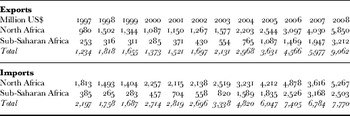
The economic results of the developing relations are shown in Table 1. Turkey's trade volume with African countries was only US$5.4 billion in 2003, and increased more than three-fold exceeding $16 billion in 2008. Yet, considering that Turkey's total trade volume with the world amounts to almost $300 billion, the volume with African countries remains relatively low. Turkey's target is to reach a trade volume of US$30 billion with Africa by the end of 2010 (Babacan Reference Babacan2008b).
Turkey's trade with Africa (1997–2008)

Source: Turkish PM, the Undersecretary of Foreign Trade website, http://www.dtm.gov.tr (20.6.2009); totals may not add up, due to rounding.
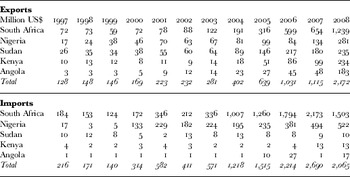
Turkey's Africa policy does not seem to give priority to any region or a group of states. As Turkey is interested in developing economic and political relations with Africa at this stage, all countries seem to be targeted. However, the nature of economic relations appears to have been determined by the existing economic potential between Turkey and the country in question. For example, Table 2 shows that economic relations increased most with key African countries, such as South Africa and Nigeria, with which Turkey has larger trade potential. It also indicates that Turkish exports have been key to developing relations with countries which have relatively smaller economies.
Turkey's trade with selected sub-Saharan African countries (1997–2008)

Source: Turkish PM, the Undersecretary of Customs website, http://www.gumruk.gov.tr (14.12.2009); totals may not add up, due to rounding.
With government encouragement, Turkish companies are also actively exploring investment opportunities in Africa. Turkish contractors, for example, had by the end of 2007 completed over 3,000 projects in seventy countries across the globe, amounting to a total value of US$105 billion. The share of African countries was 22% overall. This share increased rapidly in 2007 reaching 29%, with a total of nearly $5.8 billion worth of projects (Babacan Reference Babacan2008b). Turkey's investments in African countries in different fields exceed $500 million (ibid.), with 355 Turkish firms currently operating in various African countries. Turkish Airlines currently flies to thirteen points in Africa, including Addis Ababa, Khartoum, Lagos, Dakar and Johannesburg, and is planning to operate more direct flights to destinations in Africa. New means of transport, particularly in the maritime field, are also under consideration. Turkey also became the twenty-fifth non-regional member of the African Development Bank in May 2008. This membership is expected to open new areas of cooperation. It could also enable Turkish contracting companies to undertake larger infrastructure projects in the continent. Turkey's push to open the door to Africa was crowned with the First Turkey–Africa Cooperation Summit, held with the theme of ‘Solidarity and partnership for a common future’ in Istanbul in August 2008 under the auspices of Turkish President Abdullah Gül, with high-level participation from fifty countries.
Turkey under the AKP administration brought a new vision to the country's Africa initiative (Safak Reference Safak2008), and certainly aims to fill the gap which emerged after nearly a century of negligence. To make up for the losses in time and foster relations between Turkey and Africa, the summit provided the venue to increase bilateral contacts and search for new ways of developing relations. The Turkish president in a press meeting said that he ‘had bilateral talks with heads of delegations of 42 countries within the scope of the summit’ (‘Turkey–Africa’ 2008). Similarly, the bilateral meetings of the PM Erdoğan would give an impetus to developing relations with Africa. These bilateral meetings were the first between a Turkish president and prime minister and delegations from several African countries. Given that neither Turkey nor many African countries know much about one another, these meetings and the summit itself may help to overcome difficulties such as visa requirements for Turkish businessmen visiting African countries.
Along with developing economic relations, Turkey also had short and long-term political expectations from the summit. In the short run, Turkey sought the support of African countries for the non-permanent seat at the UN Security Council that took place in October 2008. Apparently, Turkey secured the support of African countries, as it was elected to the Council with a vote of 151 (Akgün Reference Akgün2009). In the longer term, Turkey hopes to cooperate with African countries in international forums such as the UN, and exchange views on regional and global issues. To lay the ground for long-term cooperation, it was decided to hold Turkey–Africa summits every five years, with an African country hosting the second summit in 2013 (‘Turkey–Africa’ 2008). It was also decided that the Turkish Union of Chambers and Commodity Exchanges (TOBB) and the Union of African Chambers of Commerce, Industry, Agriculture and Professions (UACCIAP) would cooperate to establish the Turkish–African Chamber for strengthening commercial ties (Zaman 21.8.2008: 11). President Abdullah Gül visited Kenya and Tanzania in February 2009, and Congo and Cameron in March 2010, underlining Turkey's commitment to Africa (The Economist 25.3.2010; Zaman 22.2.2009:1).
STATE AGENCIES IN AFRICA: TIKA AND DIYANET
Besides the exchange of visits and Turkey–Africa Summit, several state agencies play active roles in Africa. The Turkish International Cooperation and Development Agency (TIKA) and the Directorate for Religious Affairs of Turkey (Diyanet) deserve special attention, not only for their activities but as showing the depth of Turkish involvement in Africa.
One of the defining aspects of the new Turkish foreign policy has been increased humanitarian and development assistance programmes, evidenced by an expanding international aid budget over recent years. Although Turkey is still listed as an aid recipient country, it started its own aid activities as early as 1985. These were more coordinated once TIKA came into existence in 1992 (Fidan & Nurdun Reference Fidan and Nurdun2008: 99). TIKA is the Turkish government's official Development Cooperation Agency and has coordination offices in twenty countries in Africa, Asia and Europe for delivering development assistance through technical projects and humanitarian activities.
TIKA was initially established to help transition of the states in Central Asia, Caucasus and the Balkans. However, from 2003 it was transformed into a more global aid agency and expanded its area of operation in parallel to Turkey's diversifying foreign policy engagements. For example, in 1992–2002 TIKA conducted 2,346 projects and activities in total, and its annual average number of projects and activities was only 256. However, TIKA's total projects and activities expanded to 2,780 in 2003–6 (Sahin Reference Sahin and Kose2007: 27), notably in Africa, Middle East and North Africa (Fidan & Nurdun Reference Fidan and Nurdun2008: 100). TIKA-sponsored projects towards Middle East and Africa rose from 45 in 2005 to 150 in 2006 (Sahin Reference Sahin and Kose2007: 27). The first TIKA Programme Coordinator Office in Africa was opened in Addis Ababa in 2005, with Khartoum and Dakar following in 2006 and 2007, respectively. TIKA offices support development projects in their respective regions, and from these three offices it operates in thirty-seven countries in Africa.Footnote 1 With the opening of new embassies all over the continent, the number of TIKA offices in Africa is likely to increase as well.
TIKA's projects and activities in Africa are designed to serve long-term purposes such as the development of social infrastructure, cultural cooperation and communication, the production sectors, economic infrastructure, and to a lesser extent provide support in urgent humanitarian crises (ibid.). As part of this long-term policy orientation, in August 2008 TIKA initiated an African Agricultural Development Programme to be implemented in thirteen African countries, namely Burkina Faso, Djibouti, Ethiopia, Guinea, Guinea Bissau, Mali, Senegal, Comoros, Madagascar, Tanzania, Kenya, Rwanda and Uganda.Footnote 2
Turkish official development assistance reached US$714 million at the end of 2006, and when private donations are added this figure reaches $1.7 billion, placing Turkey among leading donors in the world. Turkey has also donated $7.5 million to various African countries via international organisations such as the World Health Organisation, World Food Programme (WFP) and the Red Crescent to assist them to cope with the effects of drought and other natural disasters. The most recent donation amounts to $3.5 million as humanitarian aid through the WFP (‘Turkey donates’ 2008). In 2007, as a sign of its interest and support for the underdeveloped world, Turkey for the first time hosted a summit of the Least Developed Countries in Istanbul, where it committed $20 million development aid for them and promised a further $3 million to be allocated for combating the AIDS epidemic in three years.
Turkey's opening to Africa goes beyond the political and economic fields. Diyanet for the first time invited religious leaders from African countries for consultation and cooperation. The Religious Leaders Meeting of African Continent Muslim Countries and Societies was held in Istanbul in November 2006 with the participation of representatives from twenty-one countries (Deniz & Orakci Reference Deniz and Orakci2006). Until recently Turkey, which is constitutionally a strict secular state, has deliberately refrained from involvement in any Islamic/religious meeting, let alone organising an official one in Turkey. However, this started to change after the AKP assumed power in 2002. For example, Turkey actively participated in the activities of the Organisation for Islamic Conference, and a Turkish citizen, Ekmeleddin İhsanoğlu, was elected as its secretary-general in 2004 (Özkan Reference Özkan2007). Turkey's hosting of African religious leaders in Istanbul is directly related to the two paradigmatic shifts in Turkish foreign policy. First, Turkey softened its approach to religious-based organisations and meetings, and saw these as opportunities to further Turkish national interests through soft power instruments. Secondly, Turkey understood that opening up policy to Africa would not be complete or sustained without religious connections which are also directly linked to the Ottoman past in Africa. Confirming this was that almost all religious leaders at the meeting emphasised the Ottoman legacy in their countries positively, and wished to restore it (Final Communiqué 2006). In addition to the establishment of a permanent secretariat in Istanbul, participants requested Ottoman/Turkish-style mosques to be built in African countries, and long-term educational cooperation in Islamic studies be established by creating an international theology school (Kavas Reference Kavas2006b: 9). Subsequently, as the first step to building religious ties with African Muslim nations, Diyanet has developed a plan to provide scholarships to educate imams of interested countries in Turkey. Within this programme, Turkey invited 300 Muslim students from such countries as Mozambique, Togo, Mauritania, Sudan, Uganda and Côte d'Ivoire through Turkish embassies in the continent for 2009 (Gönültaş Reference Gönültaş2008). The Turkish conception of Islamic understanding is compatible with Western democratic values, and provides an alternative to that fostered in Africa by a number of other Muslim states.
THE ROLE OF CIVIL SOCIETY IN TURKEY–AFRICA RELATIONS
Generally speaking, the role of civil society in Turkish foreign policy has been quite limited, and it has usually played a complementary role to state policy. However, in the 2000s, probably for the first time in the republican era, civil society organisations have not only contributed to Turkish foreign policy but, most importantly, have actively promoted a policy backed by the state. This is more true of Turkey–Africa relations than of any other field in Turkish foreign policy. Conservative business associations which are ideologically and politically close to the ruling AKP, such as the Confederation of Businessmen and Industrialists of Turkey (TUSKON), and international aid organisations like the Foundation for Human Rights and Freedoms and Humanitarian Relief (IHH), have paved the way for the acceleration of Turkey–Africa relations, exemplifying the converging interests between state and civil society.
In Turkey, the accession negotiations with the EU since 2005 have led to many changes in laws and regulations, which have opened channels of influence for civil society organisations in the foreign policy process. Moreover, these organisations have raised awareness of Africa, both for its economic opportunities, and for political and humanitarian engagement. Their activities have contributed to a new public discourse in the Turkish media about Africa. The traditional Turkish image of Africa (one of hunger and poverty) has been reformulated and articulated by civil society organisations to present Africa, along with its problems, as a place for economic and political cooperation. Although there are a number of business and humanitarian-based groups with an interest in developing relations with Africa, below we overview two pioneering organisations which provide a sense of deepening community ties between Turkey and Africa.
TUSKON and foreign trade opportunities
TUSKON is a non-governmental organisation founded by regional business federations in Istanbul in 2005, and gradually expanded countrywide. Today, it represents 11,500 businessmen throughout Turkey, involved in 150 local business organisations.Footnote 3 Although it is quite a new association, TUSKON has been very active in developing Turkey's ties with the world in the economic field since its inception. It has organised five international trade summits to boast Turkey's economic relations – three with African countries, one with Eurasia and one with the Asia-Pacific region. These summits not only brought Africa to the attention of Turkey but, most importantly, created a venue for both sides to get to know each other and explore possible forms of cooperation. These meetings were encouraged by the Turkish government and created new opportunities for Turkish entrepreneurs to open up to Africa. The first meeting was organised in May 2006 in Istanbul, with the participation of 500 businessmen and 20 ministers from 31 African countries and 1,500 businessmen from the Turkish side.Footnote 4 Participation in the second Turkey–Africa Foreign Trade Bridge in May 2007 was higher than the previous one, with bureaucrats and businessmen present from thirty-nine African countries including twenty-six ministers. The last one was organised ahead of the Turkey–Africa Cooperation Summit in May 2008 in Istanbul, and attended by then Turkish foreign minister Ali Babacan, with some 2,600 businessmen from Turkey and forty-five other countries. All the meetings were opened by the state minister for foreign trade, as evidence of Turkish government support for such visionary initiatives of the Turkish business sector.
TUSKON's meetings can be seen at best as an active promotion of an initiative launched in 2003 by the Turkish undersecretary of foreign trade in order to develop Turkey's commercial relations with Africa. TUSKON encourages medium-sized Turkish enterprises to engage in international trade; after the end of the summit, it organised business trips for foreign participants to flourishing Anatolian cities, to explore business opportunities and to get to know Turkish entrepreneurs and their potential. At the last summit, some US$3 million new business contracts have been signed by the members.
TUSKON's pioneering role as an association in developing Turkey–Africa relations will probably continue, as currently 134 TUSKON members have significant investments in Africa (Today's Zaman 21.8.2008). TUSKON members also actively support the opening of Turkish schools, which now total up to sixty in thirty different African countries, by the Gülen movement, a conservative social fraternity group (The Economist 25.3.2010). Turkey's flourishing new business class also provides funds for humanitarian work and relief efforts undertaken by Turkish NGOs in the region.
IHH in Africa: solidarity, self-development and brotherhood
Among many other humanitarian NGO groups, the IHH stands out in Turkey for its leading role and long-time commitment to Africa. The origin of the IHH goes back to the onset of the war between Bosnians and Serbs from 1992 onwards, when a group of concerned people gathered and began working individually to help the war victims. As they were working to alleviate sufferings from the war, conflict broke out in Chechnya, and the volunteers came together in 1995 and founded the IHH, with the main objective of delivering humanitarian aid to all people who are victimised by war, disaster, famine, or violations against their basic rights and liberties.Footnote 5
Currently, the IHH is one of the biggest aid organisations in Turkey in terms of projects, activities and reach. It has implemented projects and aid activities in 112 countries around the world, and still continues to operate in most of these countries. The IHH has been one of the first Turkish humanitarian organisations to start aid activities and services in Africa. What makes the IHH unique especially in Africa is that, in the words of its vice-president, the IHH ‘met with people who nobody had gone to, nobody had greeted for centuries’ from Turkey (Oruc Reference Oruc and Kose2007: 28). Therefore, the IHH has in many respects become a pioneer charity NGO in Turkish society, both opening up to Africa and creating awareness of human suffering there among larger Turkish society.
The IHH launched its first initiative in Africa in 1996, when it went to Somalia to deliver humanitarian aid. It subsequently expanded its projects to other countries in Africa and gradually increased its presence (Aydin 2008 int.). The IHH selected especially the Ramadan (fasting) and Qurbani (sacrifice) periods (Oruc Reference Oruc and Kose2007: 29), so that it could not only gather information and see the ground at first hand but also share this happiness with local people. This strategy was also well received by Turkish people, and donations increased many-fold to show their solidarity with fellow Muslims in Africa.
The IHH intensified its activities in the region in the 1999–2000 period during the great distress experienced in Ethiopia. Humanitarian aid to Ethiopia was not enough to alleviate the suffering, so the IHH generated its first lasting projects in that country. The most important difficulty faced in the region was the lack of available clean water. Thus, the IHH has started to open wells in the region as a long-term solution to the water shortage problem. Between 2000 and 2008, more than 1,000 wells were opened in Africa (Aydin 2008 int.).
Great sorrow and misery in Niger led the IHH to devise another strategy in 2005. The IHH believed that solutions to problems could only be found if Africa occupied a central place in people's agenda. Therefore, the IHH started an African campaign in March 2006, to popularise Africa as a centre for development, investment and humanitarian aid projects. The IHH still runs an Africa aid campaign with Istanbul as centre. The IHH's most striking campaign slogan, ‘700,000 people are dying’, caught the attention of people from all layers of society to increase support for the campaign. However, the most important outcome of this campaign was to encourage many other institutions, foundations and associations to start activities in Africa. They wanted to know Africa, and the IHH took them to many countries in the continent, sharing its experience with fellow relief and aid organisations as well as Turkish media outlets.Footnote 6
One of the most important problems in Africa is certainly AIDS. The IHH does not deal with AIDS issues directly, though it helps its victims in different ways (Yilmaz Reference Yilmaz2007: 62). Instead, it has chosen an area in health in Africa which is neglected by many NGOs: blindness due to cataract. In Africa, more than 10 million people do not see or are visually impaired; half of them are cataract patients who could be treated by simple surgery. The IHH realised the first cataract project in Somalia in 2005, and just in a week 700 people were successfully operated to regain their eyesight (Oruc Reference Oruc and Kose2007: 31). After this experience, the IHH again put forward a project for Africa and started a campaign with slogans such as ‘Turkish people will open the eyes of 100,000 Africans’, and ‘100,000 Africans will see with Turkey’. The IHH raised considerable funds for the project, enough to cover the costs of 35,000 more cataract operations in the first month of the campaign in June 2007, with a target to operate on 100,000 people by 2010 (Aydin 2008 int.). By June 2008, the IHH reached forty-one countries in Africa through various projects such as clinics, wells, schools or computer laboratories, to mention a few.Footnote 7 The IHH African campaigns broke new ground in Turkey–Africa relations, and facilitated the activities of many organisations in the region. They have created social awareness and brought Africa to Turkey's attention. The IHH projects have been included in the agenda of meetings between Turkish and African leaders, thus becoming a foreign policy subject themselves (ibid.).
* * *
Every diplomatic achievement since the 1990s boosted Ankara's self-esteem, leading Turkey to adopt a multidimensional foreign policy approach. Turkey's opening to Africa in recent years is thus not a pure coincidence, but rather an outcome of changing perceptions of Turkey towards its environment. A globally oriented Turkey could not have stayed out of Africa, while other emerging countries like India and Brazil were making significant efforts. Moreover, Turkey's vigorous business sector and flourishing civil society groups also pushed successive Turkish governments to establish better relations with Africa, whether for trade benefits or humanitarian concerns. Despite the fact that the ruling AKP government and its intellectual advisor Davutoğlu must be credited for recent high-level visits from Turkey to Africa and the 2008 summit in Istanbul, Turkey's new Africa policy is based on consensus and civil society-backed initiative, which is critical for Turkey's long-term involvement in the continent. Perhaps most importantly, the conceptualisation of Africa in Turkey has changed dramatically compared with earlier years, with an effective contribution from civil society organisations. Turkey's current African openness is first and foremost a result of its redefinition of its own international role in the post-Cold War era. After establishing closer ties with neighbouring Balkan, Caucasian and Middle Eastern regions in the 1990s, Turkey developed a strategic interest in its relatively distant neighbours in Africa in the 2000s. For Turkey, developing strong economic and political ties with Africa is critical for expanding export markets and diversifying energy resources, as well as consolidating its image as an emerging global power with a human-centred and conciliatory approach.
While Africa is now returning to world politics, and the balance of power seems to be transforming to multipolarity, African nations may find Turkey a reliable partner and a more benign state to be collaborated with in their efforts to create a just, peaceful and more equal international environment for their economic development. Turkey seems to have well recognised African countries' expectations for getting their voice heard on international platforms. Thus, in the recently held high-level meetings such as the World Summit on Food Security (Rome, November 2009) and G-20 meetings in London and Pittsburgh, Turkey, in consultation with African nations, put priority on addressing many of the issues promoted by African leaders. In his visit to Cameroon in March 2010, President Gül declared that the world has moral and political responsibility to African nations, and Turkey will be the voice of Africa in international institutions (NTV 2010).
Some Africans have found Turkey's African opening unconvincing in terms of its benefits to Africa. Turkey's over-emphasis on trade relations with Africa is perplexing, but African response has been a mixed one. On the one hand, the benefits to Africa from this partnership are open to question at least in the minds of some African leaders.Footnote 8 On the other hand, some African experts have recognised that Turkey's ‘political and commercial interests in Africa can contribute to the successful development of the region’. Similarly, ‘continuing poverty, … outward migration, … organised crime and drug trafficking’, as potential threats, require Turkish–African cooperation (Wheeler Reference Wheeler2008).
Economically, both sides benefit from increasing trade between Turkey and Africa, which creates employment and investment. Moreover, Turkish international aid and development projects in Africa have steadily increased over recent years through TIKA and other international organisations. Politically, Africa could expect Turkey's support at international platforms. For example, Turkey promised that as a non-permanent member of the UN Security Council for 2009–10, it would pay special attention to African issues. The other international organisations like the OIC where Turkey is influential could also be employed to raise African concerns.Footnote 9 Nevertheless, Turkey still needs to persuasively explain and find new ways to a win-win situation to get serious and influential African players to be involved in the process. While the steady increase in economic relations between Turkey and key African players (Table 2) may be taken as a sign of serious interest from African partners, the potential for cooperation has not been exhausted.
Two main obstacles could hinder the future of Turkey–Africa relations. First, an urgent strategy of overcoming lack of knowledge on both sides is required. Turkey opened an Institute for African Studies in Ankara in 2008, though collaborative and mutual efforts such as academic and student exchange programmes might be more effective. Second, serious economic or political crises originating from Turkey's own fragile domestic politics may also affect the speed of Turkey's opening to Africa, as domestic political conditions could distract attention elsewhere. Otherwise, Turkey's rapprochement with African countries will surely stay on course as Turkey emerges as a global power in world politics.