


The development of an international system that is based on the rule of law requires not only durable legal rules but also that interpretation and rule application be delegated to third parties (e.g., Goldstein et al. Reference Goldstein, Kahler, Keohane and Slaughter2001). For this purpose, states have created about two dozen permanent international judicial bodies with formally independent judges that issue legally binding judgments and many more quasi-judicial or nonpermanent dispute settlement mechanisms (Terris, Romano, and Swigart Reference Terris, Romano and Swigart2007).Footnote 1 Scholars of various theoretical persuasions agree that impartiality should be a defining quality of such bodies. As a principle of justice, impartiality implies that all actors are treated as equals, meaning that they are evaluated on the extent to which they observe their obligations rather than on factors unrelated to their rights and obligations (e.g., Dworkin Reference Dworkin1977). To constructivists, impartiality differentiates intralegal from extralegal politics and helps legitimize international courts (e.g., Reus-Smit Reference Reus-Smit and Reus-Smith2004). Rational institutionalists stress that impartial information about compliance allows states to pursue cooperative strategies and helps states make credible commitments (e.g., Keohane, Moracvsik, and Slaughter Reference Keohane2000; Majone Reference Majone2001).
Despite the consensus that impartiality is the cornerstone of effective international adjudication, there is no agreement on whether or under what circumstances international judges can indeed be relied upon to impartially resolve disputes. Some scholars argue that governments exert a great deal of influence over the choices of even formally independent international judges (e.g., Carrubba 2005; Carrubba, Gabel, and Hankla N.d.; Garrett and Weingast Reference Garrett, Weingast, Goldstein and Keohane1993; Garrett, Kelemen, and Schultz Reference Garrett, Kelemen and Schulz1998; Stephan Reference Stephan2002). Others, however, counter that the ability of governments to monitor and sanction judges is generally weak and ineffective at swaying judges (e.g., Alter Reference Alter, Hawkins, Neilson, Tierney and Lake2006, Reference Alter2008; Alter and Meunier-Aitsahalia Reference Alter and Meunier-Aitsahalia1994; Majone Reference Majone2001). Sometimes such starkly different conclusions are based on the same court decisions.Footnote 2 A shared limitation of these studies is that they treat courts as unitary actors rather than as committees of individual judges. The underlying assumption is that all judges share a concern for the institutional capacities of their courts and a desire to see their decisions implemented. Thus, they are sensitive to the same threats of noncompliance, legislative override, or withdrawal of institutional support. Yet many theoretical threats to impartiality vary across judges and cases. A Bulgarian judge may perceive incentives to favor Bulgaria when it is a party to a dispute. Perhaps, he or she also feels pressure to favor economic or political allies of Bulgaria or may have a bias toward similar legal cultures. Yet there is no a priori reason to presume that the pressures and incentives facing a Bulgarian judge on a given case will be the same as, for example, those facing a Belgian judge.
The practice of interpreting court decisions to make inferences about what motivates judges stems largely from data limitations. Either dissenting opinions, the primary data source in studies of judicial behavior, are not publicly available, or courts have too few judgments to allow for viable statistical inquiries that can discriminate between motivations. For example, Posner and De Figueiredo conclude in a systematic study of bias among judges on the International Court of Justice (ICJ) that “We [..] have not shown that judges—consciously or unconsciously—vote in a manner that promotes the strategic interests of their homestates; it is possible that the judges vote in a manner that reflects their own psychological or philosophical biases. [..] We do not have enough data to reject this possibility” (2005, 625).
I examine international judicial behavior in a uniquely data-rich context: the European Court of Human Rights (ECtHR). The ECtHR has by far the highest caseload of any international court, having rendered its 10,000th judgment on September 18, 2008. Judges can and do regularly write public minority opinions. The ECtHR includes judges from 47 Council of Europe member states, including Russia, Turkey, and all European Union member states.Footnote 3 It has issued politically controversial opinions on the right of gays to serve in the military, voting rights for prisoners, extradition of terrorism suspects to countries where they might be tortured, privacy rights of celebrities, the independence and efficiency of trials in member states, property rights, abortion rights, and many other issues. Shapiro and Stone Sweet (Reference Shapiro and Sweet2002, 155) conclude that the ECtHR “[..] has rendered enough judgments that have caused enough changes in state practices so that it can be counted to a rather high degree as a constitutional review court.”
I use a new dataset of public minority opinions to discriminate between three theoretically plausible sources of bias in international judicial behavior. Each of these threats presents its own set of challenges to the impartiality of international courts. First, judges may systematically assign different meanings to the same legal rules because they have internalized modes of legal reasoning specific to their domestic legal cultures. If such cultural bias were prevalent, this would threaten the aspiration of international courts to transcend national blinders and might lead to charges of bias from minority legal cultures. Second, although ECtHR judges are not formally representatives of their governments,Footnote 4 they do have incentives to behave as such (e.g., six-year renewable terms). Judges who feel threatened in their career prospects may be tempted to rule based on the national interests of their home governments. Such behavior would challenge the very nature of the legalization movement, which is based on the notion that adjudication in legal institutions yields results that are different from conflict resolution through geopolitical means. Third, ECtHR judges may have personal policy preferences that influence how they evaluate cases, in a way similar to that in which political scientists generally presume that U.S. Supreme Court justices are motivated by policy. If such motivations were prevalent, the model of a judge as an impartial “umpire” would be untenable in the same way many scholars deem it untenable in the context of domestic review courts.
I derive hypotheses from these general theoretical frameworks for two types of observable behavior. First, judges are frequently asked to evaluate violations committed by their home governments. The frameworks yield different expectations about the conditions under which judges are more and less likely to display national bias. Second, I evaluate whether ECtHR judges are more benevolent toward respondent governments that share political or economic relationships with their national governments.
The findings are generally optimistic for the possibility of impartial review at the international level. There is no evidence that legal culture and geopolitics are important sources of bias among ECtHR judges. There is, however, evidence that ECtHR judges are political actors in the sense that they have policy preferences that shape their choices. This suggests that the sources of judicial behavior on the ECtHR are not so different from those on domestic review courts, such as the U.S. Supreme Court. One qualification to this finding is that national bias does matter and appears to be greater on politically sensitive issues.
THE EUROPEAN COURT OF HUMAN RIGHTS AND ITS POLITICAL CONTEXT
The ECtHR evaluates complaints by individuals that their government has violated one or more provisions of the 1950 European Convention for the Protection of Human Rights and Fundamental Freedoms (hereafter Convention) or its protocols).Footnote 5 The Convention is based on the Universal Declaration of Human Rights and protects such basic and abstract rights as the freedom of speech and assembly, the right to a fair trial by an independent and impartial court, the right to privacy, and the right not to be tortured. Originally, states could ratify the Convention without opting into the provisions that gave the court compulsory jurisdiction and that allowed individuals direct access. The adoption of Protocol 11 in 1998 made both provisions mandatory components of the Convention regime and created the full-time court. Since then, all citizens of Council of Europe member states can appeal directly to the ECtHR after they exhaust domestic legal remedies. As a result of this and the expanding membership of the Council of Europe, the number of applications has skyrocketed. In 2007, the Court received 41,700 individual applications (up from 14,200 in 1997) and reached 1,503 judgments on the merits.
About one-third of all applications are dismissed for procedural reasons by the registry. Another 60% of applications are declared inadmissible by unanimous decision of a committee of three judges, most frequently because the applicant had not exhausted domestic judicial remedies. Admissibility decisions are based on the recommendation of a rapporteur, which is usually the national judge of the respondent government, granting that judge considerable leverage over national cases. The remaining 7% of cases are evaluated by a Chamber of seven judges, including the national judge. Appeals can then be heard by a Grand Chamber of 17 judges.Footnote 6 The ECtHR can demand administrative or legislative remedies to the problems it identifies and it can demand that governments pay monetary compensation to victims. The execution of judgments is facilitated by the fact that all member states either have adopted the Convention into national law (e.g., the 1998 U.K. Human Rights Act) or are monist systems where treaty obligations take precedence over national legislation.
ECtHR decisions often invite public scrutiny and are sometimes openly criticized by elected officials. For example, Russian President Vladimir Putin called the Ilaşcu decision, in which the ECtHR holds Russia partially responsible for the treatment of political detainees in the Moldovan breakaway republic of Transnistria, “[..]a purely political decision, an undermining of trust in the judicial international system.”Footnote 7 British home secretary John Reid complained that the judges responsible for the Chahal judgment, which prohibits states from extraditing prisoners to countries in which they might be tortured, “just don't get” the nature of the security threat posed by Islamic terrorism.Footnote 8 The public, too, can exert pressure. In 2000 and again in 2005, around ten thousand Kurdish protestors came to Strasbourg while the ECtHR was holding hearings in the case filed by former Kurdish rebel leader Abdullah Öcalan. The ECtHR eventually ordered a retrial and the Turkish government abided amid severe domestic protests.
This scrutiny is sometimes targeted at individual judges. For example, the popular British tabloid The Sun individually singled out the “Euro clowns” it held responsible for the decision to stay the extradition of radical Muslim cleric Abu Hamza to the United States.Footnote 9 (Hamza claimed he faced the prospect of torture in a U.S. prison.) More generally, it is common for politicians and the media to identify how the national judge voted on major cases or to attach special significance to minority opinions. For example, the Latvian foreign minister Maris Rieksins argued that the minimum majority vote in the Kosonovs case showed that the conclusion was “ambiguous” and explicitly identified that the Swedish and Icelandic judges voted with the Latvian judge in opposition to the finding of a violation.Footnote 10 There is also some evidence of direct attempts at tampering with the decisions of judges. The Swiss former President of the Court, Luzius Wildhaber, claims that Russia's Council of Europe ambassador threatened to publicly blame the Moscow theatre hostage crisis on the ECtHR unless the Court revised its earlier decision that 13 Chechen separatists held by Georgia need not be extradited.Footnote 11 He also alleged that he was poisoned during a subsequent trip to Russia.
Although such blunt attempts at influencing judges are rare and probably ineffective, judges cannot be but aware of the political context in which they make their decisions. Some are quite explicit about their political roles. For example, the Turkish judge Türmen, a career diplomat, stated in an interview that “I see my role [..] not merely as a judge deciding cases, but also as an intermediary between the Court's standards and the aspirations of Turkey to join the European Union” (quoted in Bruinsma Reference Bruinsma, Hoek, Hol, Jansen, Rijpkema and Widdershoven2006, p. 12). Others lament the role of politics and the deference judges show to states. As the Belgian judge Tulkens puts it, “The raison d'état is more present here than I would have thought possible” (quoted in Bruinsma Reference Bruinsma, Hoek, Hol, Jansen, Rijpkema and Widdershoven2006). It is sometimes suggested that the Court occasionally gives in to political pressure, as in the Behrami case, where it ruled that responsibility for the actions of NATO-led peacekeepers in Kosovo belonged entirely to the United Nations, which is not a party to the European Convention, thus making the case inadmissible.Footnote 12 What is unclear is if, how, and when judges are systematically influenced by factors other than the law. The next section lays out a set of hypotheses.
THEORETICAL THREATS TO IMPARTIALITY
Legal Culture
One of the most widely recognized challenges for international courts is to meld the main legal traditions of the world (e.g., Terris, Romano, and Swigart Reference Terris, Romano and Swigart2007). There is a fierce debate in the comparative law literature on the continued relevance of the traditional taxonomy that identifies countries as having either a civil law or a common law legal culture. On the one hand, there are those who argue that legal systems are converging due to regional integration and the prominence of international legal rules (e.g., Husa Reference Husa2004, Reimann Reference Reimann2002). Other scholars maintain that differences among legal systems have deep historical roots that are not easily altered (e.g., Balas et al. Reference Balas, Porta, Shleifer and Lopez-de-Silanes2008) and that have enduring effects on the performance of legal, economic, and political institutions (e.g., la Porta et al. Reference La Porta, Lopez-de-Silanes, Shleifer and Vishny1998, Reference La Porta, deSilanes, Florencio, Pop-Eleches, Shleifer and Andrei2004). Legrand (Reference Legrand1996) argues that divergence persists primarily due to the fundamentally different legal mentalités that practitioners in different legal cultures have internalized. Even when some of the legal rules are converging, these rules continue to have a different meaning in common law countries due to cultural and historical differences in the nature of legal reasoning.
The idea that internalized political or legal culture can influence judicial behavior has firm roots in the study of comparative judicial behavior (e.g., Schubert Reference Schubert1977; Schubert and Danelski Reference Schubert and Danelski1969; Shapiro Reference Shapiro1981; Wenner, Wenner, and Flango Reference Wenner, Wenner and Flango1978). The ECtHR is an excellent testing ground for evaluating whether judges from different legal cultures systematically assign different meanings to the same rules (Arold Reference Arold2007). From the perspective of impartiality, especially worrying is if judges are more sympathetic toward arguments advanced by respondent states with similar legal systems. What may appear to a judge socialized in civil law as an entirely appropriate state action may seem inappropriate to a judge socialized and educated into a common law system, or vice versa. Although there is little support for the hypothesis that judges are more lenient toward respondent governments with similar legal cultures in the existing empirical literature (Arold Reference Arold2007, Renteln Reference Renteln1998, but see Prott Reference Prott1979), it does receive institutional recognition in the ECtHR and many other international courts. For example, the composition of the ECtHR's sections explicitly “[..] takes account of the different legal systems of the Contracting States.”Footnote 13
Cultural factors could also be responsible for the apparent national bias of international judges. For example, Hensley (Reference Hensley1968) attributes national bias on the ICJ to “the more subtle influence of culturally inculcated values” (p. 568), although he does not specify a precise mechanism through which culture has such an effect. One plausible mechanism is that judges who are accustomed to political interference domestically are more likely to defer to the position of their government when serving on an international court. The difference between common law and civil law systems may again be relevant here. It is widely asserted that judges in civil law legal systems play a subordinate role to legislatures whereas judges in common law legal systems are regularly asked to engage in broader interpretations of legal principles (e.g., la Porta et al. Reference La Porta, deSilanes, Florencio, Pop-Eleches, Shleifer and Andrei2004). By extension, judges who are socialized to defer to legislative bodies may be more prone to display national bias than are judges from legal cultures where they are more insulated from political pressures. Legal origin may not be the most appropriate measure for judicial independence. Constitutional judges in civil law countries, including France, have been willing and able to play more creative roles (Stone Sweet Reference Stone Sweet2000). Therefore, I also test this hypothesis with a measure of de facto judicial independence.
Finally, if judges can become socialized into domestic legal cultures, it may also be that the collegial norms of the international court on which they serve exert an influence (see Arold Reference Arold2007). Judges who spend a long time away from their home country in the relative isolation of Strasbourg may well internalize the norms of the court, including impartiality, which is a strong norm in most international judicial contexts (Meron Reference Meron2005). As the Greek judge Rozakis puts it: “The Court has proved to be very independent, without any liability to the states. This is partly due to the fact that judges almost live in a vacuum and work in abstracto, far from their home countries in a detached environment” (cited in Bruinsma Reference Bruinsma, Hoek, Hol, Jansen, Rijpkema and Widdershoven2006, 6). This suggests the hypothesis that the longer a judge has served on the ECtHR, the more that judge becomes divorced from affinity toward the homeland. Such detachment may contribute to perceptions that international judges lack accountability.
Career Incentives and Geopolitics
Judges may exercise caution in making decisions that go against the perceived interests of their national governments out of fear that such choices will harm their careers. That career motivations may be an important determinant of judicial behavior is widely recognized in the domestic (U.S.) literature (e.g., Posner Reference Posner1993). For example, studies of American courts have shown that retention prospects may influence the decisions of judges on when to retire (Hall Reference Hall and Melinda2001) and how severely to sentence a defendant (Huber and Gordon Reference Huber and Gordon2004). The potential influence of retention on judicial decisions is particularly troubling in the international court context, given the large role reserved for governments in selecting judges. ECtHR judges are appointed for six-year renewable terms.Footnote 14 Governments submit lists of three judges, from each of which the Council of Europe's Parliamentary Assembly elects one.Footnote 15 Moreover, governments can advance judges for other prestigious national or international positions. For example, in 2006 four of the 25 ECJ judges had previously served on the ECtHRFootnote 16 and two former ECtHR judges were advanced by their governments as candidates for judgeships on the first International Criminal Court (ICC).Footnote 17 Thus, there are strong incentives for judges to seek to be viewed favorably by national governments.
Anecdotal evidence suggests that it is at least plausible that post hoc removal has had a deterrent effect on judicial behavior. There are some examples of judges who were not renewed and where this decision was publicly linked to the judge's decisions. According to some observers, the Bulgarian authorities “settled scores” with judge Dimitar Gotchev after his vote in the Loukanov case (Flauss Reference Flauss1998, 70). The Moldovan judge Tudor Pantiru was ousted by the newly elected Communist government, which vowed to only “send real patriots” to Moldova's diplomatic missions after Pantiru's failure to dissent in Metropolitan Church of Bessarabia and Others.Footnote 18 The Slovakian judge Viera Stráznická, who had voted against her country on several occasions, was not selected as a candidate for reelection in 2004, a decision she appealed.Footnote 19 It should be noted that there were multiple motivations at play in these removals. For example, it could be that these judges simply became the victims of domestic political turnover. Nevertheless, the possibility of removal combined with the dependence on national governments for other prestigious positions might well encourage prudent behavior among judges. These concerns are reflected in the proposed Protocol 14, which, if adopted, would create nonrenewable nine-year terms for ECtHR judges.Footnote 20
Several hypotheses with regard to national bias follow from the career perspective. First, ECtHR judgeships are lucrative. The 2004 annual salary of ECtHR judges was 189,349 Euros, free from income tax.Footnote 21 This salary is high in comparison to what legal practitioners earn in many European countries. For example, the estimated annual salaries of constitutional court justices varied from 2600 Euros in Moldova to 256,390 Euros in the United Kingdom.Footnote 22 McKaskle (Reference McKaskle2005, p. 16) suggests, based on interviews with close observers of the ECtHR, that “Economic concerns may affect the desire of sitting judges from such countries to get renominated to the Court where the salary and benefits are far higher than for lawyers or judges in his or her member state.” This hypothesis can be tested directly with the data at hand. If true, it would suggest a bias against the wealthier states.
Second, since the adoption of Protocol XI in 1998, judges face a mandatory retirement age of 70 (Article 23.6). If judges vote for their home governments because they fear that doing otherwise would threaten their reappointment chances, then judges nearing compulsory retirement should be less likely to show national bias than should other judges. There is considerable evidence for such shirking behavior in political bodies (e.g., Rothenberg and Sanders Reference Rothenberg and Sanders2000), as well as evidence that judges strategically time their retirement based on electoral prospects (e.g., Hall Reference Hall and Melinda2001). As far as I am aware, this hypothesis has not been addressed in the international arena, which has the methodological advantage of a fixed retirement age.
Third, if governments successfully select and reselect loyal judges, the sample of judges who have served multiple terms should be biased toward those who reliably represent the government's interests. Thus, contrary to the socialization hypothesis, the career perspective suggests that judges who have served on the court longer are more likely to display national bias.
Fourth, not all ECtHR judgments are equally important to the national interests of a respondent government. If judges care about how decisions affect their careers, they may be especially likely to display national bias on politically sensitive cases. Political sensitivity is context-dependent, and thus notoriously difficult to measure. Realists have long worried about international interference with human rights issues that directly interfere with how a regime controls its subjects (e.g., Hoffmann Reference Hoffmann1977, 8). Within the ECtHR, this most notably concerns alleged violations of Article 3, the prohibition on torture and inhumane treatment.Footnote 23 As noted before, Article 3 violations are commonly filed against governments with generally good human rights records, mostly in relation to the extradition of asylum seekers or terrorism suspects to countries where torture is relatively common. Because these issues are generally sensitive ones for those who hold executive power, I hypothesize that Article 3 votes are more likely to invite dissents by national judges than are judgments on other articles.
The most serious potential consequence of careerism from a normative perspective is that international judges may favor important allies of their national governments. If this were so, then it would make international courts much more similar to purely political international institutions than posited by the ideas behind the legalization movement. Posner and De Figuerido (2005) find evidence for such geopolitical biases among ICJ judges. It should be noted that the ICJ primarily resolves interstate disputes over fairly high-stakes issues. In such interstate disputes, geopolitics is more likely to enter the equation than in disputes between an individual and a government. Nevertheless, judges may feel pressure to take geopolitics into account. For example, a major Albanian opposition party was “embarrassed” by the vote of the Albanian judge Ledi Bianku on the preliminary ruling in the aforementioned Hamza case, stressing that “Albanian representatives [..] should contribute to the efforts to build the image of Albania, [..] and to strengthen the friendship with countries, such as the United States, that have supported Albania for centuries.”Footnote 24 Such statements related to a preliminary ruling could pressure a judge to take geopolitics into account on a final ruling. I therefore examine the hypothesis that judges show more leniency toward respondent governments that are important economically or politically to their home country. Moreover, I examine whether this effect is more pronounced for politically sensitive Article 3 issues.
Policy Preferences
The consensus in the political science literature on the United States Supreme Court is that justices are policy-seekers (e.g., Baum Reference Baum1994). This claim is often associated with the attitudinal model of judicial decision-making, which holds that judges decide cases in light of their ideological values and the legal facts presented by the case (e.g., Schubert Reference Schubert1965; Segal and Spaeth Reference Segal and Spaeth1993). The assumption that justices seek to move policy toward their preferred direction also underlies most strategic approaches to judicial decision-making (e.g., Epstein and Knight Reference Epstein and Knight1997). This does not necessarily imply that the law is unimportant (e.g., Bailey and Maltzman Reference Bailey and Maltzman2008). Rather, disputes over how to interpret abstract individual rights in concrete instances cannot always be resolved by mere reference to statutes or treaties. Thus, it is inevitable that judges sometimes use their personal preferences to find their preferred solutions within the broad constraints defined by the law (e.g., Kelsen Reference Kelsen1928; Shapiro Reference Shapiro1994; Stone Sweet Reference Stone Sweet2007). This presents a fundamental challenge to impartiality as a standard for judicial behavior. Judges cannot be thought of as “umpires” who could potentially resolve conflicts by simply applying the rules, although they must always justify their decisions as if these followed logically from those rules.
In theory, international judges have a wider margin of maneuver than most domestic judges, as the law is less settled and there is no strict principle of stare decisis that constrains the leeway of judges, although precedent is not unimportant (e.g., Terris, Romano, and Swigart Reference Terris, Romano and Swigart2007). A challenge in extending this research from the U.S. Supreme Court is that little is known about what type of policy preferences matter in other courts (Helmke and Sanders Reference Helmke and Sanders2006). I focus on two plausible sources of policy preferences: broad ideological debates about the desired reach of the ECtHR and beliefs on how ECtHR decisions might impact specific injustices experienced or valued by the judges.
First, ideological conflict in the U.S. Supreme Court is dominated by the liberal-conservative dimension (e.g., Martin and Quinn Reference Martin and Quinn2002). This provides an important link with the U.S. political arena, in which liberal-conservative conflict also plays a major role. Recent research shows that the equivalent dimension in the ECtHR revolves around the desired degree of judicial activism or restraint of the court (Voeten Reference Voeten2007). Whereas some judges grant states a wide margin of appreciation when deciding whether a violation of the Convention has occurred, others (“activists”) allow much less room for governments to hide behind national customs or interests (e.g., Yourow Reference Yourow1995). These latter judges strive for a more universal implementation of human rights across Council of Europe member states. Scholars have found that the ECtHR has become increasingly activist over time (e.g., Mowbray Reference Mowbray2005), an observation that is lamented by some of its judges (e.g., Matscher Reference Matscher, McDonald, Matscher and Petzold1993) and member states that argue that they are now subject to a much more intrusive international legal regime than they anticipated when they ratified the Convention.Footnote 25
The above-cited analysis was limited to votes on cases where judges evaluated states other than their home states. If judges are indeed motivated by policy, judges who are predisposed toward activism when they evaluate other nations should display these tendencies also in cases involving their home governments. If broader concerns about the reach of the court matter even in such strategically important votes, then this would provide strong evidence for the relevance of policy motivations. Moreover, it would suggest that there are real costs for governments that appoint activist international judges.
One issue is that governments may not be able to predict ex ante who will be an activist judge. Several studies have found that the professional background of international judges can be quite informative (Bruinsma Reference Bruinsma, Hoek, Hol, Jansen, Rijpkema and Widdershoven2006; Voeten Reference Voeten2007). Most notably, judges who have spent their careers as diplomats or in some other government function can be expected to be much more likely to defer to stated national interests than judges who have made their careers as human rights activists. For example, the Austrian judge Matscher spent 17 years in the Austrian diplomatic service before joining the Court in 1977 and has openly accused the court of engaging in “legal policy-making” (1993,70). By contrast, the Maltese judge Giovanni Bonello defended 170 human rights lawsuits as a private practitioner before ascending to the Court. His collection of 53 dissenting opinions was published in an attempt to inspire other human rights activists.Footnote 26 Diplomats may not just exercise more self-restraint across the board but also be especially sensitive to national cases. As such, I hypothesize that former diplomats display more national bias than other national judges.
Second, judges may care not only about the authority of the international court on which they serve but also about how international court rulings affect a domestic situation. In this regard, the judges from the former socialist states adopt a special position. Many of the judges elected on behalf of former socialist states explicitly stated on their CVs that they had suffered in some form from Communist rule (see also Flauss Reference Flauss1998). For example, both the Czech judge Karel Jungwiert and the Slovak judge Bohumil Repik added paragraphs of text to their CVs to stress that they lost their formal positions in 1970 in relation to their activities in protesting the 1968 occupation of Czechoslovakia. Arold (Reference Arold2007, 311) quotes several Western ECtHR judges and clerks who express surprise at how independent from their home countries Eastern European judges are relative to other judges. Thus, I hypothesize that judges from former socialist states are less likely to display national bias. More generally, these judges may be especially aware of and sensitive to the way the remnants of socialist rule affect human rights. For example, one Western ECtHR judge notes that judges from socialist countries specifically reject state-governed economic regulation and suggested that “[..] behind this behavior is their urge to change and develop away from the communist past.”Footnote 27 If such policy concerns are prevalent, judges from former socialist states should be more likely to vote in favor of a finding of a violation when the respondent government is also a former socialist state.
DATA
Independent Variables
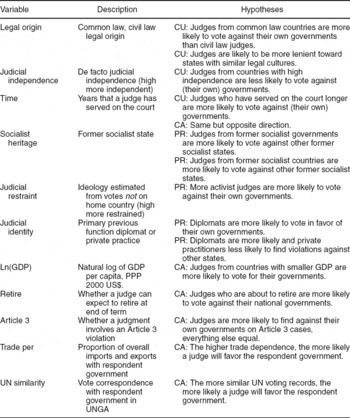
Table 1 summarizes the hypotheses and the measures for the theoretical concepts introduced in the previous section. Legal Origin is taken from la Porta et al. (Reference La Porta, Shleifer, Lopez-de-Silanes and Vishny1999). There are two approaches to measuring Judicial Independence. First, one can construct an index of de jure judicial independence based on institutional characteristics of tenure and the judicial appointment process (La Porta et al. Reference La Porta, deSilanes, Florencio, Pop-Eleches, Shleifer and Andrei2004).Footnote 28 Legal origin accounts for 66% of the variation in this measure. However, as noted in the theory section, legal origin and formal protections against political interference are not always informative about the actual independence enjoyed by judges. Feld and Voigt (Reference Feld and Voigt2003) have created a widely used index of de facto independence as assessed by a survey of 75 country experts (mostly law professors). The experts are asked a variety of questions about the frequency with which judges are removed from office, whether the budget of the courts and the salaries of judges have been adjusted, and how common it is for government agencies to remain inactive when they should take actions for court decisions to become effective. The bivariate correlation between the two measures is .15. Legal Origin accounts for 28% of the variation in de facto Judicial Independence, suggesting that it indeed measures something different from the formal approaches. The de facto measure has a high degree of external validity (Feld and Voigt Reference Feld and Voigt2003). Unfortunately, the measure is only available for 24 countries in the sample (the de facto measure is only available for 19 countries). I will therefore test its effects in a separate equation.
Overview of Variables and Hypotheses by Theoretical Origins

Note: PR, preferences; CU, cultural; CA, career.
Judicial Restraint is a measure of judges’ ideal points, estimated from votes not on cases involving the judges’ home countries. This measure is estimated using the same model that is generally fitted on Supreme Court justices to estimate their relative degree of liberalism (Martin and Quinn Reference Martin and Quinn2002; Voeten Reference Voeten2007). This measure captures the general inclination of individual judges to favor the raison d'état, regardless of whether the respondent government is their national government. High scores indicate high levels of self-restraint (μ = 0, σ = 1). Obviously, this measure will only be used to explain votes on home state violations. Data on professional identities before ascending to the court were taken from Bruinsma (Reference Bruinsma, Hoek, Hol, Jansen, Rijpkema and Widdershoven2006) and supplemented with new codings based on standard curricula vitae submitted to the Council of Europe's Parliamentary Assembly (Cafter 1998) and the ECtHR's Annual Survey of Activities (before 1998). Obviously, many judges fit in multiple categories. Consistent with Bruinsma, I assigned judges to a single category based on the date and prominence of the former position. The former function of a judge explains 35% of the variation in Judicial Restraint in an ANOVA analysis. The Judicial Identity measure is available for all regularly appointed judges, whereas the Judicial Restraint measure is available only for those 97 judges who voted on at least 15 controversial votes.
To measure the opportunity costs of losing one's position, I include the natural log of GDP per capita in constant 2000 international dollars, adjusted for purchasing power parity (World Bank 2006). I also gathered data on the gross annual salary of a judge on the highest appellate court in a country gathered by the European Commission for the Efficiency of Justice (CEPEJ).Footnote 29 These data are only available for the year 2004 and not for all Council of Europe countries. Because of limited coverage, because GDP may more broadly indicate the attractiveness of alternative private sector career opportunities, and because of the difficulty of comparing gross salaries of judges on a variety of national courts, I use GDP as the primary measure. The natural log of judicial salaries and the GDP variable are highly correlated (Pearson R = .72).
Retire indicates whether a judge could realistically expect to be subject to re-election at the end of her term. In the post-Protocol XI court, judges knew that they would not be re-elected if they reached the age of 70. It is reasonable to presume, however, that judges who would be a few years short of the mandatory retirement age at the end of their current terms would not have a realistic chance at re-election. I assume that a judge would have to be able to serve at least half a term at the end of her current term in order to be subject to re-election pressures.
Trade Dependence measures the proportion of total imports and exports of the judge's home state with the respondent state. Data are from Gleditsch (Reference Gleditsch2002). UN Similarity reflects the similarity in the UN voting records between the judge's national state and the respondent government.Footnote 30 This measure is frequently used as a proxy for similar geopolitical interests (e.g., Gartzke Reference Gartzke1998).
Data on ECtHR Panel Compositions and Dissents
I collected data from all 7,319 published judgments between 1960 and 2006 as reported in the Court's electronic catalog, Hudoc.Footnote 31 The Court divides cases into three levels of importance. The vast majority of judgments (5,042 or 69%) are classified as having little legal significance because they are straightforward applications of existing case law or friendly settlements. Judgments of importance level 2 (1,114) are not straightforward applications of case law but are also not considered to make new contributions to case law. Judgments of importance level 1 are deemed to make a significant contribution to the development of case law. It is not surprising that judges focus their separate opinions on the last judgments. Whereas only 6% of judgments of importance level 3 invite a concurring or dissenting separate opinion, 26% of judgments of importance level 2 and 53% of judgments of level 1 had at least one minority opinion. Moreover, many of the dissents on judgments of lower importance were repetitive and can thus cannot be treated as independent observations. For instance, Judge Ferrari-Bravo issued 133 identical dissenting opinions on alleged Italian Article 6–1 violations, all in one day (February 28 2002).
I collected data on panel composition and dissents for both split and unanimous judgments at importance level 1. Regular panels are composed of seven judges but almost half (49%) of the judgments came from the Court's Grand Chamber, which consists of 17 judges. There were 61 issues that were decided by only one vote. For additional analyses, I also collected data on divided level 2 judgments. Judgments were only included if an unambiguous determination could be made that the issue was decided for or against a respondent state. This primarily excludes friendly settlements. I also excluded all judgments and dissents that exclusively dealt with just satisfaction (compensation) determinations, as these were often ambiguous.Footnote 32 Rulings included findings of violations as well as (in)admissibility, such as rejections of government petitions that the court lacked jurisdiction. In many judgments, separate decisions were made on the merit of violations of individual articles of the Convention. There were some judgments where some judges argued that no violation had occurred whereas others believed that violations of multiple articles had occurred, even though a majority could only be found on the occurrence of a subset of these violations. Given that such differences are substantively interesting, these issues are treated as separate entries in the dataset. The sensitivity of all results to this decision is checked by running robustness checks on samples including only one randomly selected issue per judgment.
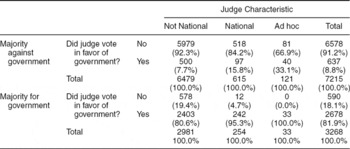
Table 2 presents the dissenting behavior of judges on 1,024 level 1 judgments by the direction of the majority ruling and whether the respondent government was the judge's home country. Of these cases, 42% included a dissent. For this table, if a judgment included dissents on more than one legal issue, only one randomly sampled legal issue is included. Nationality clearly mattered. When a ruling favored the respondentgovernment, 100% of ad hoc judges and 95% of regular judges from the respondent's country voted with the majority. This compared to 81% of other judges. When the ruling went against the respondent state, 33% of ad hoc judges and 16% of regular national judges dissented, compared to only 8% of other judges. These differences are statistically significant in a χ2 test at p = .001. Thus, we should reject the null hypothesis that judges are fully impartial when they evaluate their national governments. This finding confirms earlier studies with smaller samples (Bruinsma and DeBlois Reference Bruinsma and de Blois1997; Jackson Reference Jackson1997; Kuijer Reference Kuijer1997). Yet the table also makes it clear that regular national judges do not always vote in favor of their home governments. The rate at which national judges vote against their national governments is much higher than in the ICJ, where this occurs in only about 10% of all cases (Posner and De Figueirido Reference Posner and de Figueiredo2005). In the ECtHR, in the vast majority of cases national judges vote with the non-national judges, suggesting a good amount of independence.
Vote Choices by National and Non-national Judges by Direction of Majority Vote

There were 32 instances in which the national judge was in a position to cast the pivotal vote to prevent a finding of a violation. On 24 of these cases, the national judge voted in favor of the government. If we assume that these were 50–50 votes, our best guess would be that governments escaped a judgment of a violation in about eight cases due to national bias. When viewed against the whole body of work by the ECtHR, the number of cases decided by a national judge seems minor, although we should keep in mind that national judges also play a pivotal gatekeeper role in the largely unobservable admissibility process, so the presence of national bias may have broader implications. Moreover, the primary objective of this article is not to estimate the overall effect of national bias but to examine whether there are systematic differences in the voting choices of judges that are revealing about potential underlying biases in their decisions. The next sections turn to this task.
WHAT MOTIVATES NATIONAL BIAS?
Are there systematic factors that make some judges on some cases more likely to vote with their national governments? If so, do these factors provide evidence for biases that originate in variation in legal cultures, career motivations, or policy motivations? This section tests the hypotheses identified in Table 1 that speak to these questions.
An important complication in evaluating these hypotheses is that not all legal issues are alike. Even within the group of importance level 1 judgments, there is a great deal of variation in the clarity of ECtHR precedent and government violations under consideration. There is no good proxy for legal clarity, which is problematic if one wishes to estimate the effect of law on judicial behavior (see Bailey and Maltzman Reference Bailey and Maltzman2008). The purpose here is to examine why some judges make different choices than their colleagues. All models therefore include the proportion of non-national judges on a panel that voted for the government on a given issue. This defines a baseline expectation for each judge's choice. Thus, the coefficients on the other variables should be interpreted as estimates of how judges deviated from this baseline.
Most judges voted on multiple issues. Thus, it is unrealistic to assume that errors are independent and identically distributed. I address this issue by estimating a GEE population-averaged model with a probit link (see Zorn Reference Zorn2001).Footnote 33 This modeling choice allows a more appropriate correction to the correlated data structure given the variety in the number of votes per judge. Unlike the case with, for instance, logit clustered on judges,Footnote 34 the estimated coefficients present average effects across the population of judges of a unit change in an independent variable on the probability of a vote in favor of the government. This is the appropriate quantity of interest for the problem at hand.
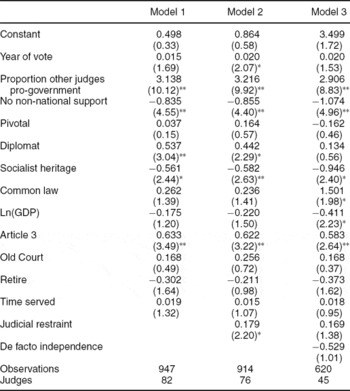
Table 3 presents the results from four models estimated on regular (not ad hoc) national judges on all unanimous and split judgments of importance level 1. The first model includes only the measures that are available for all judges. The models include a linear time counter to control for possible trends as well as a dummy that identifies whether the case was in the pre- or post-Protocol XI court. In the sample, 57% of the vote choices went against the government (i.e. in favor of a finding of a violation). Although assessing model fit is complex in GEE models, a simple evaluation shows that the models fit the data quite well: model (1) correctly classifies 87% of vote choices, which is about 70% of the observed variation.Footnote 35 All results are robust to the inclusion of measures for human rights observance in a judge's country (Amnesty International physical integrity rights, Gibney Reference Gibney2003), which had no significant effect on any specification and did not alter the substantive results.
GEE Model on Whether a Judge Favored Home Country

Note: Robust z statistics in parentheses.* Significant at 5%; ** Significant at 1% (two-tailed tests).
As expected, the vote choices of non-nationals had a strong and significant effect on the likelihood that judges favor their governments. As the proportion of judges on the panel who find in favor of the government increases, the likelihood of the national judge finding in favor of a violation also increases. There is an interesting additional effect. If no non-national judge favored the respondent government in a case, then the national judge was 38% less likely to find in favor of her government, holding all other variables at their means and modes.Footnote 36 This suggests a desire not to be perceived as the lone dissenter in favor of the home government, which perhaps violates collegial norms while not helping out the government. Judges are not, however, significantly more likely to favor the government when their vote is pivotal, although the coefficient is in the expected direction and the test is somewhat imprecise given the small number of pivotal cases.
What then, do the results in Table 3 imply for the three theoretical threats to impartiality? First, there is no evidence that variation in legal culture is at the root of national bias. Common law judges are not more likely to demonstrate their independence from the government. The sign of the coefficient is in the direction opposite to that expected but not significantly different from zero. This result also holds if the model is run with a more refined distinction between German, French, and Scandinavian civil law systems. There is also no evidence that judges who have experienced greater legal independence domestically are more inclined to defect from their governments' positions. This conclusion also holds for the alternative measures of judicial independence discussed in the data section (results available from author). Finally, the hypothesis that judges who served on the court for a long time internalized norms against national bias is rejected by the data. In fact, the coefficient is positive, although not significant at conventional levels.
There is modest support for some of the hypotheses derived from the career incentives perspective. First, judges from countries with less attractive alternative career opportunities are not significantly more likely to favor their governments, although the coefficient is consistently in the expected direction. In a one-tailed test, the coefficient is significant at the 5% level but the effect is not robust to different model specifications. The coefficient is consistently significant if we restrict attention to the post-1998 Court, which had more variation in the economic conditions of the judges’ home nations due to the increased membership (results available from author). Second, there is some evidence that judges about to retire are more likely to favor their own government. The coefficient is, as expected, negative and significantly different from zero at the 5% level (one-tailed test) in the first model but not in the second model. The effect is sizeable: in model 1, a judge who faces retirement is 12% more likely to vote against the government than a judge from the new court who faces the prospect of re-election. But again, the effect is not robust to alternative model specifications.
Finally, and most strongly, judges were about 25% more likely to vote in favor of their national governments when the alleged violation was one of the 127 Article 3 violations in the data. This is not a consequence of Article 3 cases being more controversial per se, given that the model controls for the proportion of other judges who favor the government.Footnote 37 The sample of Article 3 respondent countries is not significantly poorer, or less legally independent and does not have lower Freedom House scores than the sample of countries facing other challenges (results available from author). Moreover, this effect is extremely robust to alternative model specifications. Thus, the results support the notion that judges are subject to increased pressure on controversial cases that directly deal with the security of a country.
Overall, the hypotheses that specified a relationship between the policy preferences of judges and their inclinations to support their national governments fared best. First, judges who were diplomats in their previous careers were about 20%Footnote 38 more likely to favor their national governments than were judges who came from different career tracks. This implies that governments could potentially stack the deck by advancing diplomats as their candidates. However, only 24% of all ECtHR judges in the period under investigation were career diplomats.Footnote 39 Second, judges with activist inclinations, when they evaluate other countries, are also less likely to favor their own governments. This effect is substantial: a one-standard-deviation shift in the level of judicial activism corresponds with an expected 8% increase in the probability of a vote against the national government, holding all other factors constant. Thus, the overall ideological convictions of judges matter even when they evaluate the government that could potentially fire them. This is a strong indication that judges are motivated by the policy consequences of their decisions.
Third, judges from former socialist countries were about 20% more likely to vote against their own governments than were other judges.Footnote 40 This corroborates the anecdotal evidence that these judges were particularly keen on demonstrating their independence from the government and rectifying deficiencies in their domestic human rights situations. This effect is highly robust to alternative model specifications (available from author) that include indicators of democracy (Polity scores and Freedom House scores), suggesting that it truly reflects the different motivations of judges from former socialist countries.
In summary, even after controlling for the vote choices of non-nationals, there are still several significant and substantively important ways in which judges systematically vary in the extent to which they favor their home nations. The largest effects are consistent with the view that the policy preferences of judges matter even when voting on alleged human rights violations by their home governments. Holding other variables at their means and modes, judges from former socialist countries and judges who are not career diplomats were each about 20% less likely to favor their national governments than judges in the respective reference categories. The other strong and significant effect, that judges were 25% more likely to favor their home governments on sensitive Article 3 cases, is consistent with the argument that national bias derives from career incentives. There is no evidence that variation in legal cultures can account for the observed variation in national bias.
VOTING BEHAVIOR ON NON-NATIONAL CASES
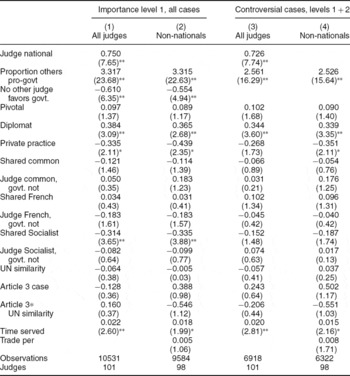
To assess whether the results from the previous section generalize to non-national cases and whether judges have biases in favor of political or economic allies of their national governments, I now turn to an analysis of how judges evaluate cases against respondent governments other than their own. Table 4 presents four models that address this question. Models (1) and (2) are run on the full dataset of all votes at importance level 1. Models (3) and (4) are run on all votes of importance levels 1 and 2 on which at least one non-national judge dissented. This latter sample could be labeled a sample of “controversial” votes. The main results are robust to an equation that estimates random effects for cases rather than to the GEE equation. The models include an orthogonal quadratic time trend in order to control for underlying trends in increased activism. The orthogonal transformation, using Hermite polynomials (Arfken Reference Arfken1985, 416), is to avoid the generally strong correlations between linear and quadratic time trend variables.
GEE Model on Whether a Judge Favored Respondent State

Note: Robust z statistics in parentheses. Quadratic time trends + constant omitted for space reasons. *Significant at 5%. ** Significant at 1% (two-tailed tests).
All models control for the proportion of other judges on a panel that voted in favor of the respondent government. Not surprisingly, this variable has a strong effect and represents a base-line expectation for how a judge is expected to vote. As such, there is no value to adding characteristics of respondent governments or cases to the model.Footnote 41 Consistent with the results in the previous section, judges also have a strong and significant preference for not being lone dissenters. Being in a pivotal position does not affect the overall likelihood that a judge defers to the government. Models (1) and (3) include both national and non-national judges. Consistent with the earlier findings, judges are much more likely to favor their home governments, even after controlling for how other judges vote and characteristics of judges. In model 3, a national judge is 27% more likely to favor her government than a non-national judge, holding other variables at their means and modes (this estimate is 24% in model (1)). This provides further corroboration for the presence of national bias, although the effect is not so strong as to suggest that ECtHR judges behave like diplomats who support their home governments unconditionally. Other factors enter into the decision-making process as well.
The evidence with respect to the three theoretical sources of bias is consistent with the results from vote choices on national cases. First, there is no consistent evidence that shared legal culture made a judge more lenient. Judges from French civil law countries tend to evaluate other French civil law countries more favorably than non-French civil law countries, but the difference is not consistently statistically significant.Footnote 42 Moreover, judges who served longer on the court were more, not less, likely to favor the respondent governments. Thus, there is no evidence that judges were socialized into a more activist orientation. This is plausibly due to a selection effect, where more restrained judges may have survived longer on the court.
Second, there is no sustained evidence that judges were systematically beholden to their national governments on votes where their national governments were not the respondent governments. Judges were not more likely to vote for countries on which their national governments depend for trade or with which they frequently vote in the United Nations. Neither of the coefficients on the geopolitics variables, trade dependence and UN voting similarity, approached conventional levels of statistical significance, although the coefficients generally had the expected signs.Footnote 43 I examined this further by evaluating whether geopolitics matters more on Article 3 votes, which more directly concern security issues. However, the interaction effect between Article 3 votes and the UN voting variable was not significant, although the coefficient is in the expected direction. As suggested earlier, the ECtHR is an unlikely context for geopolitics to matter in, incomparison to courts that directly settle interstate disputes, such as the ICJ and the WTO's Dispute Settlement Understanding.Footnote 44 Nonetheless, the absence of systematic geopolitical bias is extremely good news for the impartiality of the ECtHR.
Third, there is consistent evidence that judges are motivated by policy considerations. The proxies for judicial preferences have strong and significant effects on observed vote choices.Footnote 45 Judges who were private practitioners were about 14% (16% in model (4)) more likely than non–private practitioners and nondiplomats (the reference category) to find a violation, holding other variables at their means and modes.Footnote 46 Former diplomats and bureaucrats were about 13% (16% in model (4)) more likely to favor the respondent governments, holding other variables at their means and modes. This is important because it implies that the presence of diplomats on the court not only favors the governments that appointed them but also makes the court as a whole more conservative in finding violations. As could be expected, though, the tendency of former diplomats to favor their own governments was about twice as strong as their inclination to find in favor of the raison d'état more generally.
Moreover, judges from former socialist countries were harsher on other socialist countries than they were on countries without a socialist heritage. This difference is consistently significant and substantively strong: a judge from a former socialist country was about 8% more likely to find in favor of a violation when the respondent government was also a former socialist state than against other respondent governments. Note that because we control for how other judges voted on an issue, this cannot be attributed to potentially more severe human rights violations by former socialist countries. I tested this further by evaluating whether judges from other legal traditions were also more likely to find a violation when a former socialist government was the respondent state, but I found no evidence for such an effect.
In all, these results reveal no systematic biases based on legal culture or geopolitical affinities between the judge's home governments and the government under review. This evidence is very good news indeed for the possibility of impartial review of government behavior by judges on an international court. Nevertheless, the results also do not support the “umpire” baseline. The results that the professional backgrounds of judges matter and that judges from former socialist governments evaluate other former socialist states differently indicate that the personal preferences of international judges do shape their decisions in significant ways.
CONCLUSIONS
To conclude, I offer some thoughts on what these results mean for the impartiality of the ECtHR and international courts more generally. First, there is no evidence that the heterogeneity in legal cultures is a prominent source of concern. On the surface, cultural accounts carry normative appeal in that they leave open the possibility that judges are individuals of “high moral character”Footnote 47 who behave in manners that override their self-interest. Yet, on closer inspection, cultural effects are highly problematic for international courts. Governments from legal cultures that are less well represented on the court might perceive that the court is biased against them and in favor of majority traditions (in this case, French civil law). Moreover, threats to impartiality that result from instrumental motives have obvious institutional solutions: the better international judges are insulated, the more impartial they should become. The downside is, of course, that if governments have no desire to properly insulate judges, then we should not count on impartiality. If domestic legal culture were as deeply rooted and had as strong an effect on legal reasoning as some scholars suggest, the possibility of a truly international judiciary that transcended domestic legal cultures and interpreted international law in a universal manner would seem grim.
This study provides no grounds for such pessimism. It may be that the problem is more severe on other international courts. The most notable legal tradition that is not represented on the ECtHR is the Islamic one. Future studies of global courts should evaluate whether judges coming from that legal culture differentiate themselves sharply from both civil and common law traditions. Moreover, it could be that the difference between legal traditions is more pronounced in international criminal tribunals, given the stark differences in the roles of judges in common and civil law criminal trials.
Second, although there is strong evidence that ECtHR judges displayed more national bias on politically sensitive Article 3 cases, the overall effect of career motivations on the behavior of ECtHR judges appears modest. Support for hypotheses that alternative career opportunities and retirement affect national bias was inconsistent. This may reflect the fact that ECtHR judges already receive a fairly high degree of institutional protection (e.g., Abbott et al. Reference Abbott, Keohane, Moravcsik, Slaughter and Snidal2000, 404), although their insulation could be improved upon through the adoption of Protocol XIV, which would create nonrenewable nine-year terms.
From a normative perspective, perhaps the most important result is that there is no evidence that ECtHR judges are systematically motivated by geopolitics. These results suggest that ECtHR decisions differ fundamentally from those taken by more explicitly political international institutions. There are two qualifications to this result. First, this nonfinding does not preclude that judges occasionally consider geopolitical factors, for example on those cases where there national governments express a clear position on the case. Such behavior is suggested by Carrubba, Gabel, and Hankla's finding that the ECJ is more likely to favor the outcome for which more national governments file amicus briefs, although they do not have data on the choices of individual judges (Carrubba, Gabel, and Hankla N.d.). Although third-party governments have a smaller role in ECtHR proceedings, future studies should investigate whether such involvement influences the behavior of the judges from the third-party government. Second, the lack of impact of geopolitical concerns may not transfer to judicial institutions that deal with interstate disputes, such as the ICJ and the WTO's DSU. For example, Posner and de Figueiredo (Reference Posner and de Figueiredo2005) find that ICJ judges are biased in favor of economic and political allies of their national governments. Yet the results in this article demonstrate that the impact of geopolitics is not a necessity in international adjudication.
Third, there is considerable evidence for the claim that judges are policy seekers. Judges from former socialist countries appear motivated by rectifying a particular set of injustices. As a result, they are more likely to find violations against their own governments and against other former socialist governments. More generally, ECtHR judges are a heterogeneous lot, who have varying preferences for expanding the reach of their court. Judges who are expansive in the way they apply Convention rights when they evaluate other countries also tend to be more likely to find violations against their home nations. These tendencies are to some extent foreseeable by the governments that appoint these judges. Judges who were career diplomats before ascending to the bench were much more likely to be activist across the board and more likely to favor the national government when it was a party to a dispute.
This finding has interesting theoretical and normative implications. Most theories about the behavior of international courts assume that states are primarily motivated by limiting the sovereignty costs that these courts impose upon them, whereas judges are motivated by extending the reach of their courts. Scholars differ on who generally prevails in this struggle, but they rarely challenge this basic setup.Footnote 48 The findings in this article indicate that judges vary in their activist inclinations and that many governments willingly put activists on the bench (see also Voeten Reference Voeten2007). This suggests that we need to develop a better understanding of the heterogeneous motives that governments may have in their interactions with international courts. Moreover, the limited evidence that ex post sanctions have a deterrent effect on judicial behavior, combined with the relevance of policy preferences, suggest that the selection of judges may be a more important tool for government influence over courts than hitherto realized. The results also suggest an avenue for studying selection on courts that lack public dissents, namely that the easily observable professional background of judges is indicative of their policy preferences. Finally, these findings suggest that methods and theories developed for the study of domestic judicial behavior may be profitably employed to study international judicial behavior.
Normatively, the finding that personal policy preferences influence international judicial behavior is troubling if one adheres strongly to the “umpire” ideal of judges, which has a long history in judicial ethics (e.g., Frankel Reference Frankel1975).Footnote 49 Other theorists, however, counter that given the relatively underdeveloped state of international law, international judges have little choice but to engage their personal principles and that this is not as threatening as alternatives, such as making judges less independent or relying more on alternatives to judicial adjudication (e.g., Dworkin Reference Dworkin2003). Moreover, it suggests the possibility that governments could respond to activist international court decisions by appointing judges more inclined toward self-restraint. This may well be desirable from a perspective of accountability, as it may help counter often-heard criticisms that international courts remain unchecked and engage in wayward activism. Such responsiveness is limited, of course, by the reality that each government is at best responsible for the appointment of a single judge, so one would need the support of other governments to change the direction of a court.
It is unclear how well these results carry over to international courts other than the ECtHR. Courts vary in how well they insulate judges, what is at stake in cases, whether dissents are observable, their membership, and other relevant factors that may well lead to a different dynamics in judicial behavior. On the other hand, several of the ECtHR's judges have served on the ECJ, the ICJ, the ICC, and other courts. So the sample of judges under investigation may not be all that unrepresentative. To further advance the study of international judicial behavior, it would be interesting to examine how these judges behaved under a different set of constraints and incentives. Anecdotal evidence suggests that the preferences of judges carry over well between courts. For example, the most restrained judge in the ECtHR's history according to the measure used in this study was Sir Gerald Fitzmaurice, who was also one of the most noted judicial conservatives in the ICJ's history (Merills Reference Merills1998).
ECtHR judges at times considered factors other than the law when evaluating cases. Most clearly, judges evaluated their own countries differently from other countries. Aside from the issue of national bias, however, the decision-making process on the ECtHR appears not all that different from that on national review courts such as the U.S. Supreme Court. ECtHR judges are politically motivated actors in the sense that they have policy preferences on how to best apply abstract human rights in concrete cases, not in the sense that they are using their judicial power to settle geopolitical scores.



Comments
No Comments have been published for this article.