I. INTRODUCTION
Solid solution strengthened Ni-base superalloy Inconel 617 (UNS N06617) contains the high solid solution element (Mo, Cr, and Co) concentration. The superalloy has been widely used in the high temperature applications, such as the gas turbine boiler tubes, the combustion chambers, and very high temperature reactor, due to the excellent oxidation resistance, the superior mechanical properties and the high temperature phase stability above 980 °C. Reference Wang, Dong, Zhang and Xie1,Reference Mankins, Hosier and Bassford2 Liquation cracking in heat affected zone (HAZ) is a serious problem in the welding of Inconel 617. Reference Fink and Zinke3 Liquation cracking is caused by the combination of the liquid film on the grain boundary (GB) and the large thermal stress. The intergranular liquid film has a great influence on HAZ liquation cracking. The liquid film is eliminated before the existence of enough tensile stress, and then liquation cracking is prevented.
Liquid film migration (LFM) occurs when the metastable liquid film is produced by the liquation of the second phase in HAZ. LFM is one of a diffusion-induced GB migration in the presence of an intergranular liquid film. In 1979, Yoon and Huppmann Reference Yoon and Huppman4 have firstly discovered that the LFM occurs during the liquid phase interspersing of tungsten with the liquid nickel. The liquid film which initially separated the tungsten grains migrates into the dissolving grain, and the expanding grain grows by the formation of the W–Ni solid solution. This phenomenon was called LFM.
Some studies on LFM in HAZ during the welding process have been reported by several researchers. Idowu et al. Reference Idowu, Ojo and Chaturvedi5 and Osoba and Ojo Reference Osoba and Ojo6 have briefly reported that the liquation cracking is reduced by LFM in laser welding of Inconel 718plus and Haynes 282. Ojo et al. Reference Ojo, Richards and Chaturvedi7 have revealed that the liquid film caused by the constitutional liquation of the γ′ particles is observed to migrate in HAZ of cast Inconel 738LC superalloy, however, liquation cracking is not prevented effectively by LFM. Acoff and Thompson Reference Acoff and Thompson8 have studied LFM in HAZ of Inconel 718 performed in the Geeble. The liquid film is produced by the constitutional liquation of the Nb-rich carbides. The concentration of the element Nb behind the migrated liquid film is shown to be slightly greater than the Nb concentration in the matrix. The Nb concentration in the area swept out by LFM decreases as the peak temperature increases. Nakkalil et al. Reference Nakkalil, Richards and Chaturvedi9 have shown that the solute supersaturation of the liquid film is relieved by LFM during the electron beam welding of Incoloy 903.
The details on the LFM in the welded Inconel 617 have been rarely reported. Hence, the objective of the study is to investigate the LFM in HAZ of laser welded Inconel 617. The possible driving forces for LFM, the effect of heat input and the initial particles on LFM in HAZ, and the effect of LFM on liquation cracking are discussed.
II. EXPERIMENTAL PROCEDURE
The chemical composition of the superalloy Inconel 617 is summarized in Table I. The plates (35 mm × 15 mm × 5 mm) were butt welded by a fiber laser welding machine (IPG 10000). The maximum output power of the fiber laser machine is 10 kW and the focal point diameter is 0.72 mm. The back shielding gas (Ar) with the flow rate of 4 L/min was used to prevent back weld oxidation in the laser welding. Laser welding parameters are listed in Table II. In the laser welding process, the test specimens were maintained constraint-free. One of the samples with heat input of 142.9 J/mm was given a solution treatment (ST) at 1100 °C for 1 h followed by water quenching before the laser welding. Other samples are in as-received (AR) condition.
The chemical composition of the AR Inconel 617 (wt%).

Fiber laser welding parameters.

The welded specimens were sectioned transverse to the welding direction by an electric discharge machine and were subsequently prepared by the standard metallographic procedures for microstructural examination. The specimens were etched with a solution of 10 g FeCl3 + 100 mL HCl. Metallographic examination was investigated by using an optical microscope model of Carl ZEISS and field emission scanning electron microscope of Quanta FEI 250 (Houston, TX) with energy dispersive x-ray spectrometer (EDS). The LFM distance in 3 samples, and the GB-resolidified phase length and the total cracking length in 8 samples were measured by the Image Pro-plus 6.0 in the study. Transmission electron microscope (TEM) samples were prepared by the electrochemical polishing at −20 °C in a mixture of 7% perchloric acid + 93% ethanol. A TEM (JEOL JEM-2100) operated at 200 kV was used to examine the thin foils.
III. RESULTS AND DISCUSSION
A. Microstructure of base material
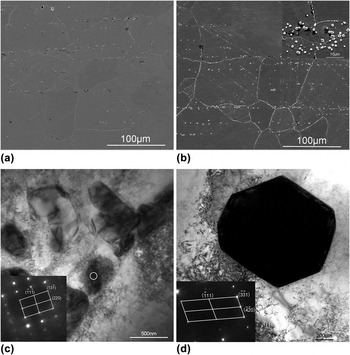
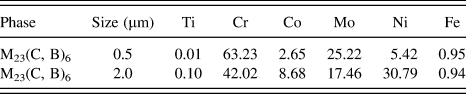
Figure 1 shows the SEM micrographs of Inconel 617 with the AR and the ST condition which all contain an equiaxed crystal austenitic γ matrix. The precipitates M23(C, B)6 (M = Cr, Mo) distribute on grain boundaries and inside the grains in the base material with the AR condition. Reference Shah Hosseini, Shamanian and Kermanpur10,Reference Darius, Pyuck-Pa, Jutta, Aleksander, Gerhard and Dierka11 The two sizes of the particles observed in the base material with ST condition are about 0.5 and 2.0 μm, as shown in the inset of Fig. 1(b). The TEM analysis of the particles with the two sizes is shown in Figs. 1(c) and 1(d). The selected area diffraction patterns of the particles in Figs. 1(c) and 1(d) and Table III show that the particles with the two sizes are M23(C, B)6 (M = Cr, Mo). The precipitates on grain boundaries of the base material with the ST condition [Fig. 1(b)] are more than that in the AR condition [Fig. 1(a)].
Microstructure analysis of the base material with (a) the AR condition; (b) the ST condition at 1100 °C/1 h; (c) TEM and the SADP in [-112] axis of the fine particles in ST; (d) TEM and the SADP in [-123] axis of the large particles in ST.

The EDS results taken from the phases in Inconel 617 (wt%) with ST condition.

B. LFM in HAZ of fiber welded joint of Inconel 617
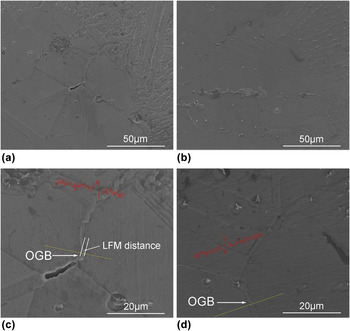
The features that confirmed LFM are the form of the new solid solution and the reversal of curvature of the liquid film. Reference Acoff and Thompson8 The form of the new solid solution is the migrated region, which is the area swept by the moving liquid film. There is a composition change between the region and the adjacent matrix. The reversal of curvature of the liquid film is caused by the relaxation stress. The local bowing of GB shows the reversal of curvature of the liquid film. Under the heat input of 142.9 J/mm, LFM in HAZ of Inconel 617 with the AR condition and the ST condition (1100 °C/1 h) is depicted in Fig. 2. It is obvious that from Figs. 2(a) and 2(b) the GB with the local bowing occurs in HAZ, and it shows the typical migrated GB. The migrated GB has a thickened region which is the form of the new solid solution, as shown in Figs. 2(c) and 2(d). The original grain boundary (OGB) is marked in Figs. 2(c) and 2(d). The OGB separates the adjacent matrix from the migrated liquid film. The scanning electronic microscopy (SEM)/line scanning across the thickened region is also observed in Figs. 2(c) and 2(d). The element of Mo in the thickened region is slightly richer than that in the adjacent matrix. It is confirmed that LFM occurs on GB in HAZ of fiber laser welded Inconel 617 with the AR condition and the ST condition.
SEM and line scanning of LFM in HAZ of Inconel 617 with (a) and (c) the AR condition; (b) and (d) the ST condition under heat input of 142.9 J/mm.

C. Mechanism of LFM in laser welded Inconel 617
The two primary driving forces for LFM are the diffusional coherency strain and the asymmetry of surface energy. When the liquid film occurs, it leads to the chemical composition gradient between the liquid film and the adjacent matrix. The solute atoms in the liquid film diffuse into the adjacent matrix. The significant difference in size between the solute in liquid film and the matrix atoms creates the lattice mismatch. Reference McPhee, Schaffer and Drennan12,Reference Baik and Yoon13 The coherency strain is generally produced by the lattice mismatch. Therefore, the coherency strain becomes the driving force for the LFM.
Several works Reference Kirkaldy14,Reference Rabkin, Weygand, Straumal, Semenov, Gust and Brechet15 have studied that the weak anisotropy of the surface tension in solid–liquid interface is the essential cause of the asymmetry of surface energy. LFM arises from the broken symmetry which is produced by an unbalanced anisotropy of surface tension. The GB curvature with the differential surface energy gives rise to the variation of equilibrium solute concentrations in the solid–liquid interface. A substantial concentration gradient between the liquid and the matrix benefits the solute diffusive flux during LFM. Thus, the asymmetry in the surface energy of two solid–liquid interface leads to LFM in one preferred direction.
In the study, Inconel 617 with the AR condition and the ST condition contains the straight GB, as shown in Fig. 1. It is suggested that the driving force for LFM is the coherency strain. The elements in liquid film influence the coherency strain in the liquid–solid interface. The coherency strain in the frontal diffusion zone drives LFM can be expressed as Reference Shin, Kim, Yoon and Song16
 $$\delta = {\eta _i}\Delta {C_i} = {\eta _i}\left( {C_i^{\,0} - C_i^{\rm{l}}} \right)\quad ,$$
where δ is the coherency strain,
 $C_i^0$
is the solute contents in the initial grain,
 $C_i^{\rm{l}}$
is the solute contents in the thickened region, ΔC
i
is the chemical concentration change of element i between the thickened region and the matrix, and η
i
is the lattice misfit parameter for solute in Ni matrix given by
 $${\eta _i} = {{{a_i} - {a_{{\rm{Ni}}}}} \over {{a_{{\rm{Ni}}}}}}\quad ,$$
where a i is the atom size of element i and a Ni is the atom size of Ni.
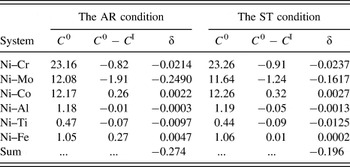
According to Eq. (1), the coherency strain δ is affected by the change of the concentration and the lattice misfit parameter. The values of the lattice misfit η i are listed Table IV. From Table IV, it is seen that the lattice misfit parameters of Ni–Mo and Ni–Ti are 0.1301 and 0.139, respectively, which are larger than that of other systems. It is indicated that the substantial lattice mismatch is caused by the considerable difference in size between the elements of Mo and Ti atoms and the γ matrix atoms.
The lattice misfit parameters ηi of the system.

The concentration changes ΔC i and the calculated coherency strain δ i are shown in Table V. The chemical composition of 10 points in the thickened region is measured by using the SEM–EDS. As shown in Table V, the concentration changes of the element Mo are −1.91 and −1.24 wt% in the AR condition and the ST condition, respectively. The concentration changes of other elements Cr, Co, Fe, Ti, and Al are lower than that of the element Mo. From Table V, it is seen that the δ values of Cr, Mo, Ti, and Al are negative. The δ values of the element Mo are −0.249 and −0.1617, which are much lower than that of the elements Ti and Cr. The coherency strain δ values are the minimum required to drive LFM. It is confirmed that the negative coherency strain caused by the elements is −0.274 and −0.196, which are sufficient to drive LFM in HAZ of laser welded Inconel 617 with the AR and the ST condition. In addition, the diffusional coherency strain due to the lattice mismatch between the element of Mo and the matrix atom is the dominant factor contributing to the occurrence of LFM in HAZ of laser welded Inconel 617.
The measured concentration changes C 0 − C I, calculated δ for the solute atoms in Ni in HAZ with the AR condition and the ST condition under heat input of 142.9 J/mm.

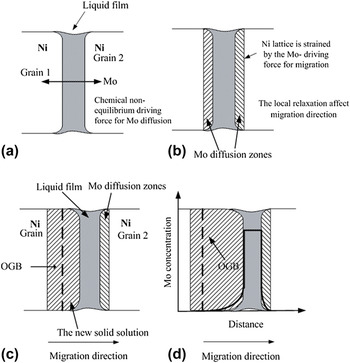
The constitution liquation of M23(C, B)6 in base material with the AR and ST condition leads to the enrichment of element Mo in the migrated region of the liquid film. The lattice misfit in the adjacent matrix is developed by a large number of Mo atoms. The free energy is large in liquid–solid interface where the coherency strain is great. The liquid film occurs to migrate to reduce the free energy of liquid–solid interface. In addition, the coherency stress produced by the coherency strain can relax by plastic deformation in matrix. Reference Acoff and Thompson8 The LFM occurs in the liquid–solid interface with the stress relaxation. It leads to the local bowing of GB in HAZ. The liquid film migrates into the matrix and is replaced by the solid phase behind the liquid film. The LFM process in HAZ of welded Inconel 617 is shown schematically in Fig. 3.
A schematic diagram of liquid film migration in HAZ of laser welded Inconel 617 (a-c) and the resulting Mo concentration profile (d).

D. The effect of heat input on LFM in HAZ
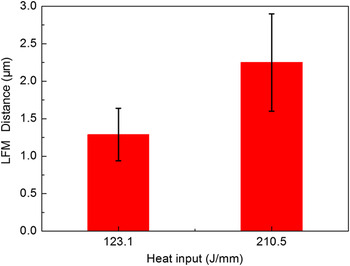
The LFM distance is illustrated in Fig. 2(c). The LFM distance in HAZ with different heat inputs is shown in Fig. 4. The large LFM distance of 2.25 ± 0.65 μm is observed in HAZ with the high heat input of 210.5 J/mm, and the small LFM distance of 1.29 ± 0.35 μm is obtained in HAZ with the low heat input of 123.1 J/mm.
The LFM distance in HAZ with the different heat inputs.

The initial migration velocity v 0 of the liquid film is given by Reference Barker and Purdy17 :
 $${v_0} = {{{D_{\rm{L}}}{{\left( {\Delta C} \right)}_0}} \mathord{\left/ {\vphantom {{{D_{\rm{L}}}{{\left( {\Delta C} \right)}_0}} {\left( {{C_{{\rm{L}},{\rm{T}}}} - {C_{{\rm{S}},{\rm{T}}}}} \right)\delta \left( 0 \right)}}} \right. \kern-\nulldelimiterspace} {\left( {{C_{{\rm{L}},{\rm{T}}}} - {C_{{\rm{S}},{\rm{T}}}}} \right)\delta \left( 0 \right)}}\quad ,$$
where D L is the solute atoms diffusivity in the liquid phase, ΔC 0 is the concentration difference across the liquid film, δ(0) is the initial liquid film thickness, and CL,T and CS,T are the equilibrium solute concentrations of the liquid and solid phases in the interface, respectively. From the Eq. (3), it is seen that the initial migration velocity v 0 reduces with increasing the initial liquid film thickness. The sufficient diffusion of the solute atoms released from M23(C, B)6 is caused by the slow heating rate in the high heat input, and a thin initial liquid film δ(0) is produced in the high heat input of 210.5 J/mm. The initial migration velocity in high heat input is faster than that in low heat input. In HAZ with the high heat input, the large LFM distance is obtained due to the slow cooling rate and the thin initial liquid film. It is indicated that LFM is promoted by the thin initial liquid film and the slow cooling rate.
E. The effect of the initial particles on LFM in HAZ
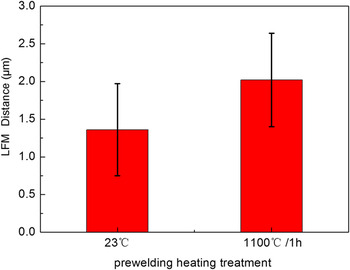
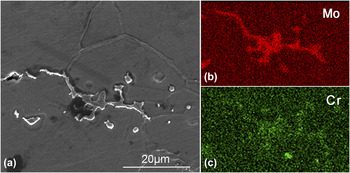
The sample of Inconel 617 was heated at 1100 °C for 1 h before the laser welding to further investigate the effect of the initial particles in base material on LFM. The extensive LFM occurs on some grain boundaries, as shown in Fig. 2(b). Figure 5 shows that the LFM distance in the AR condition and the ST condition under heat input of 142.9 J/mm. The LFM distance in the AR condition and the ST condition is 1.36 ± 0.61 μm and 2.02 ± 0.62 μm, respectively. The GB-resolidified phases occurs on grain boundaries in HAZ, as shown in Fig. 6(a). The x-ray maps of the GB-resolidified phase show that the GB-resolidified phase is enriched with the elements of Mo and Cr, as shown in Figs. 6(b) and 6(c). There is two sizes of the particles M23(C, B)6 in the base material, which are 0.5 and 2.0 μm, respectively. The constitutional liquation of M23(C, B)6 in Inconel 617 has been discussed in author's previous study. Assuming the rapid heating process to be the local equilibrium, and the dissolution kinetics of the spherical precipitates under the isothermal condition is descripted by the Eq. (4) (Ref. Reference Mousavizade, Malek Ghaini, Torkamany, Sabbaghzadeh and Abdollah-zadeh18):
 $${r^{\,2}} = r_0^{\,2} - 2k{D_{\rm{m}}}t\quad ,$$
where r is the particle radius, r 0 is the initial particle radius, t is the long holding time, and D m is the solute atoms diffusivity. The time required for a complete isothermal dissolution of the particles is obtained from Eq. (5) by setting r = 0,
 $${t_{\rm{f}}} = {{r_0^{\,2}} \mathord{\left/ {\vphantom {{r_0^2} {k{D_{\rm{m}}}}}} \right. \kern-\nulldelimiterspace} {k{D_{\rm{m}}}}}\quad .$$
The LFM distance in HAZ (142.9 J/mm) with the AR and ST condition.

The analysis of the GB-resolidified phase in HAZ (a) SEM image of the GB-resolidified phase; (b) x-ray map of Mo, and (c) x-ray map of Cr.

The two sizes of the particles are substituted into the Eq. (5), so the ratio of the time to be required for a complete isothermal dissolution of the large particles (2.0 μm) to that of the fine particles (0.5 μm) is about 16. It indicates that the fine particles tend to dissolve into the matrix before reaching the eutectic composition. The liquid film caused by the liquation of the fine particles tends to migrate due to the thin liquid film thickness and the fast initial migration velocity of the liquid film compared with those of the large particles. The liquid film on the GB has two solidification modes, i.e., by LFM and by normal solidification accompanied by GB-resolidified phase. Reference Nakkalil, Richards and Chaturvedi9,Reference Richards, Nakkalil and Chaturvedi19 The solute microsegregation ahead of the solid/liquid interface in the thin liquid film is relieved of its excess solute concentration through LFM. The continuous GB-resolidified phase is formed. Thus, the GB with the fine particles tends to have LFM, and the GB-resolidified particles are formed in the GB with the large particles.
F. The effect of LFM on liquation cracking in HAZ
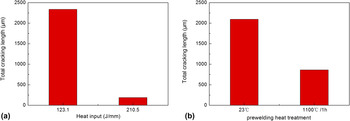
The total cracking length in the high heat input of 123.1 J/mm is larger than those in the high heat input of 210.5 J/mm, as shown Fig. 7(a). It can be seen in Figs. 4 and 7(a) that the total cracking length reduces with increasing the LFM distance. Figure 7(b) shows that the total cracking length in AR condition is much more than those in ST condition under heat input of 142.9 J/mm.
The variation of the total cracking length (a) in different heat inputs; (b) in the AR and ST condition under heat input of 142.9 J/mm.

The liquid film thickness δ(t) which is obtained by LFM is assumed to be given by Reference Richards, Nakkalil and Chaturvedi19 :
 $$\delta \left( t \right) = \delta \left( 0 \right) - 2k{v_0}t\quad ,$$
where k is the solute distributed coefficient, and t is the time of LFM. According to the analysis of the initial liquid film thickness δ(0) and the initial migration velocity v 0, the smaller δ(t) is obtained by LFM in the heat input of 210.5 J/mm and in the ST condition, while the larger δ(t) is obtained by LFM in the heat input of 123.1 J/mm and in AR condition. It is shown that the liquid film thickness is reduced by LFM in high heat input and the ST condition. The critical tensile stress σ overcoming the surface γL tension at the solid/liquid interface on liquated grain boundaries containing liquid film thickness δ(t) is given by the equation Reference Hong, Kim, Choi, Yoo and Jo20 :
 $$\sigma = {{2{\gamma _{\rm{L}}}} \mathord{\left/ {\vphantom {{2{\gamma _{\rm{L}}}} {\delta \left( t \right)}}} \right. \kern-\nulldelimiterspace} {\delta \left( t \right)}}\quad .$$
According to the Eq. (7), the stress/strain required to cause decohesion in a solid–liquid interface increases with decreasing the intergranular liquid film thickness. The tensile stress overcoming the surface tension is increased by the reduced thickness of liquid film. The extent of HAZ liquation cracking is reduced by LFM in large heat input and the ST condition.
IV. CONCLUSIONS
The intergranular liquid film produced mainly by the constitutional liquation of M23(C, B)6 particles was observed to migrate in HAZ of laser welded Inconel 617. The negative coherency strain caused by the lattice misfit between the element Mo and the matrix was sufficient to drive LFM in HAZ. LFM tended to occur in HAZ with the high heat input due to the thin initial liquid film. LFM tended to occur on the GB with the fine particles, and the GB-resolidified particles were formed on the GB with the large particles. Liquation cracking was reduced in the weld with the high heat input and the ST condition because the thin liquid film was obtained by LFM.
ACKNOWLEDGMENT
The authors appreciate the financial support from the science and technology research program of Shanghai science and technology committee (Project No. 13DZ1101502).